Herodotus, Histories 2.124-128: Cheops and Chephren, the builders of the pyramids
Introduction
In the second book of his Histories (written c. 430 BCE) Herodotus reports what the priests of Hephaestus at Memphis told him of the kings of Egypt, from Min (Menes), who first ruled and founded Memphis, through 330 kings named from a papyrus roll, to Sesostris, Proteus, Rhampsinitus, the pyramid builders Cheops, Chephren and Mycerinus, and Sethos, priest-king in the time of Sennacherib. He ends with their chronology: 341 generations, 11,340 years, during which no god had reigned in human form and the sun had four times risen out of its usual place.
The manuscript is Florence, Biblioteca Medicea Laurenziana, Plut. 70.3, written in the 10th century, the oldest surviving manuscript of Herodotus (codex A of the editors). Chapters 2.99-146 run from fol. 78v to fol. 92v. Each section is one chapter (Godley's subdivisions of the Rhampsinitus story, 121a-f, are kept apart) and points at the page(s) that carry it; the page breaks were read on the images and are recorded in each note.
This entry covers 2.124 to 2.128, on fol. 86v to 88r.
How was this verified? (Provenance)
Where on the image
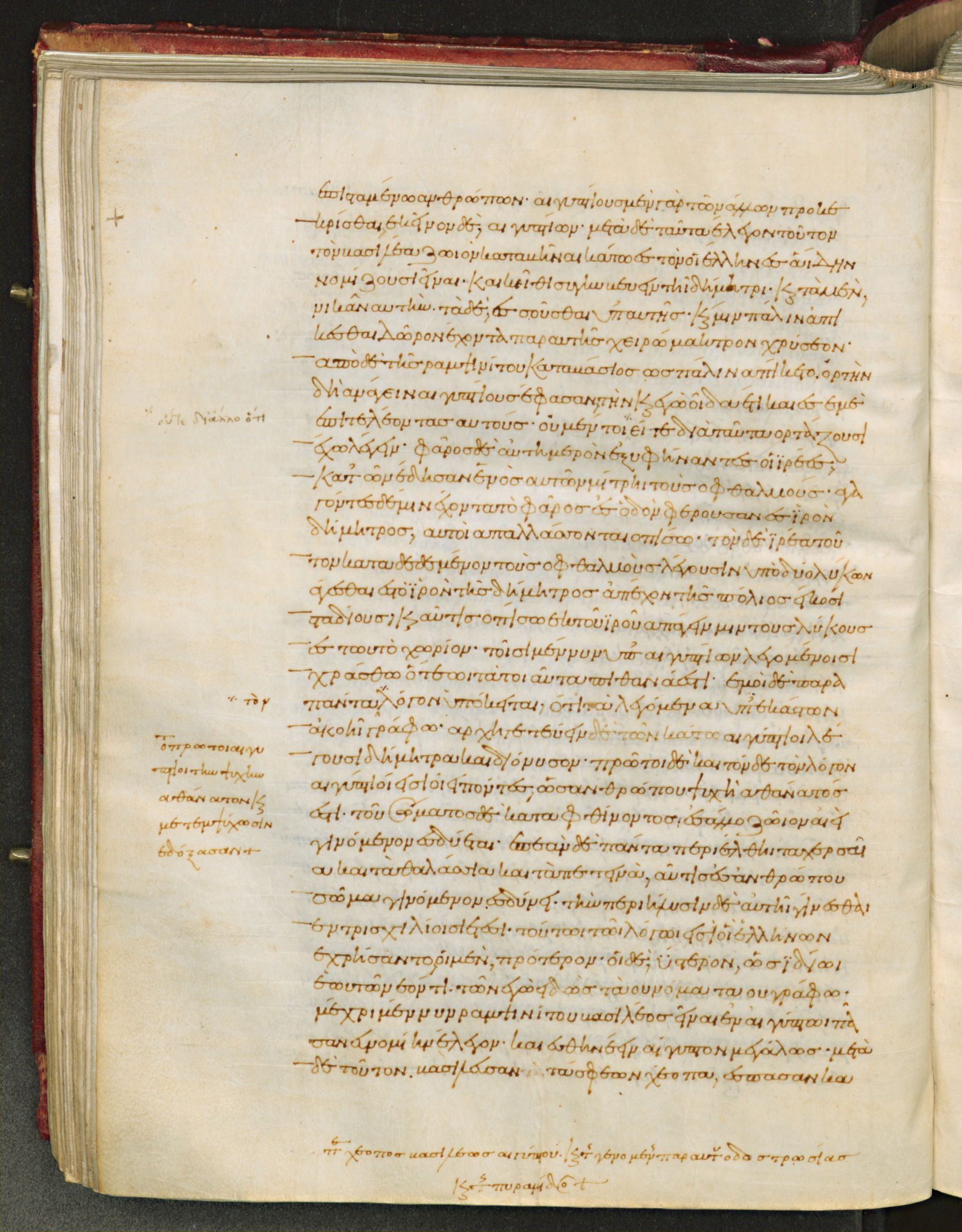
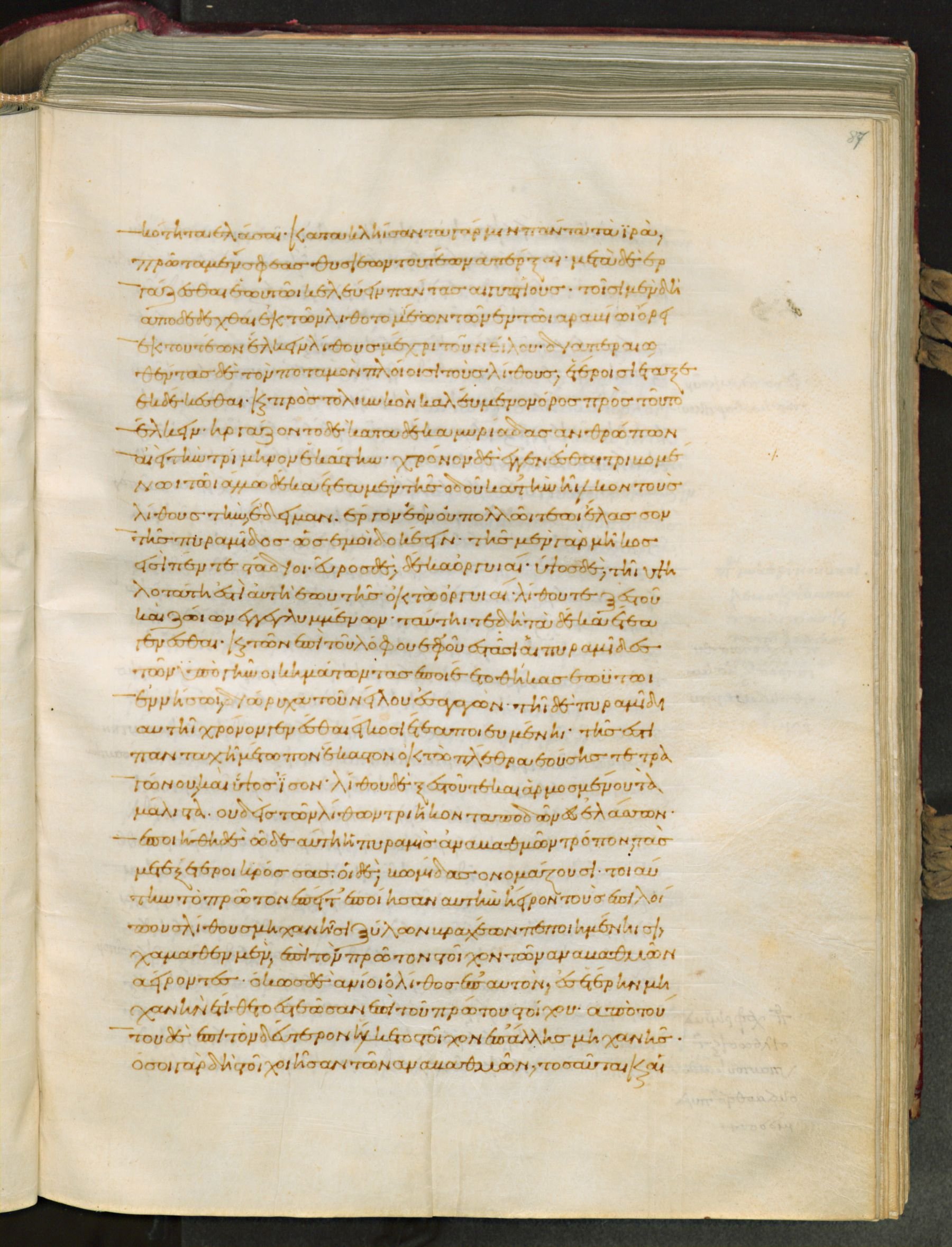
2.124 runs from fol. 86v to fol. 87r. Page breaks read on the images: fol. 86v begins 'ἐπισταμένῳ ἀνθρώπων' (2.121f.2) and ends '...βασιλεύσαντά σφεων Χέοπα ἐς πᾶσαν κα-' (2.124.1; a reader's note on Cheops stands in the lower margin); fol. 87r begins '-κότητα ἐλάσαι· κατακληίσαντα γάρ μιν πάντα τὰ ἱρά' (2.124.1) and ends '...τοσαῦται καί' (2.125.4). Checked on the image. Viewer: https://tecabml.contentdm.oclc.org/digital/collection/plutei/id/1358114
2.124μέχρι μέν νυν Ῥαμψινίτου βασιλέος εἶναι ἐν Αἰγύπτῳ πᾶσαν εὐνομίην ἔλεγον καὶ εὐθηνέειν Αἴγυπτον μεγάλως, μετὰ δὲ τοῦτον βασιλεύσαντα σφέων Χέοπα ἐς πᾶσαν κακότητα ἐλάσαι. κατακληίσαντα γάρ μιν πάντα τὰ ἱρὰ πρῶτα μὲν σφέας θυσιέων τουτέων ἀπέρξαι, μετὰ δὲ ἐργάζεσθαι ἑωυτῷ κελεύειν πάντας Αἰγυπτίους.
τοῖσι μὲν δὴ ἀποδεδέχθαι ἐκ τῶν λιθοτομιέων τῶν ἐν τῷ Ἀραβίῳ ὄρεϊ, ἐκ τουτέων ἕλκειν λίθους μέχρι τοῦ Νείλου· διαπεραιωθέντας δὲ τὸν ποταμὸν πλοίοισι τοὺς λίθους ἑτέροισι ἐπέταξε ἐκδέκεσθαι καὶ πρὸς τὸ Λιβυκὸν καλεύμενον ὄρος, πρὸς τοῦτο ἕλκειν.
ἐργάζοντο δὲ κατὰ δέκα μυριάδας ἀνθρώπων αἰεὶ τὴν τρίμηνον ἑκάστην. χρόνον δὲ ἐγγενέσθαι τριβομένῳ τῷ λεῷ δέκα ἔτεα μὲν τῆς ὁδοῦ κατʼ ἣν εἷλκον τοὺς λίθους, τὴν ἔδειμαν ἔργον ἐὸν οὐ πολλῷ τεῳ ἔλασσον τῆς πυραμίδος. ὡς ἐμοὶ δοκέειν·
τῆς μὲν γὰρ μῆκος εἰσὶ πέντε στάδιοι, εὖρος δὲ δέκα ὀργυιαί, ὕψος δέ, τῇ ὑψηλοτάτη ἐστὶ αὐτὴ ἑωυτῆς, ὀκτὼ ὀργυιαί, λίθου δὲ ξεστοῦ καὶ ζῴων ἐγγεγλυμμένων· ταύτης τε δὴ τὰ δέκα ἔτεα γενέσθαι καὶ τῶν ἐπὶ τοῦ λόφου ἐπʼ οὗ ἑστᾶσι αἱ πυραμίδες, τῶν ὑπὸ γῆν οἰκημάτων, τὰς ἐποιέετο θήκας ἑωυτῷ ἐν νήσῳ, διώρυχα τοῦ Νείλου ἐσαγαγών.
τῇ δὲ πυραμίδι αὐτῇ χρόνον γενέσθαι εἴκοσι ἔτεα ποιευμένῃ· τῆς ἐστὶ πανταχῇ μέτωπον ἕκαστον ὀκτὼ, πλέθρα ἐούσης τετραγώνου καὶ ὕψος ἴσον, λίθου δὲ ξεστοῦ τε καὶ ἁρμοσμένου τὰ μάλιστα· οὐδεὶς τῶν λίθων τριήκοντα ποδῶν ἐλάσσων.
2.124Till the time of Rhampsinitus Egypt (so the priests told me) was in all ways well governed and greatly prospered, but Cheops, who was the next king, brought the people to utter misery. For first he shut up all the temples, so that none could sacrifice there; and next, he compelled all the Egyptians to work for him, appointing to some to drag stones from the quarries in the Arabian mountains to the Nile: and the stones being carried across the river in boats, others were charged to receive and drag them to the mountains called Libyan. They worked in gangs of a hundred thousand men, each gang for three months. For ten years the people were afflicted in making the road whereon the stones were dragged, the making of which road was to my thinking a task but a little lighter than the building of the pyramid, for the road is five furlongs long and ten fathoms broad, and raised at its highest to a height of eight fathoms, and it is all of stone polished and carven with figures. The ten years aforesaid went to the making of this road and of the underground chambers on the hill whereon the pyramids stand; these the king meant to be burial-places for himself, and encompassed them with water, bringing in a channel from the Nile. The pyramid itself was twenty years in the making. Its base is square, each side eight hundred feet long, and its height is the same; the whole is of stone polished and most exactly fitted; there is no block of less than thirty feet in length.
Where on the image
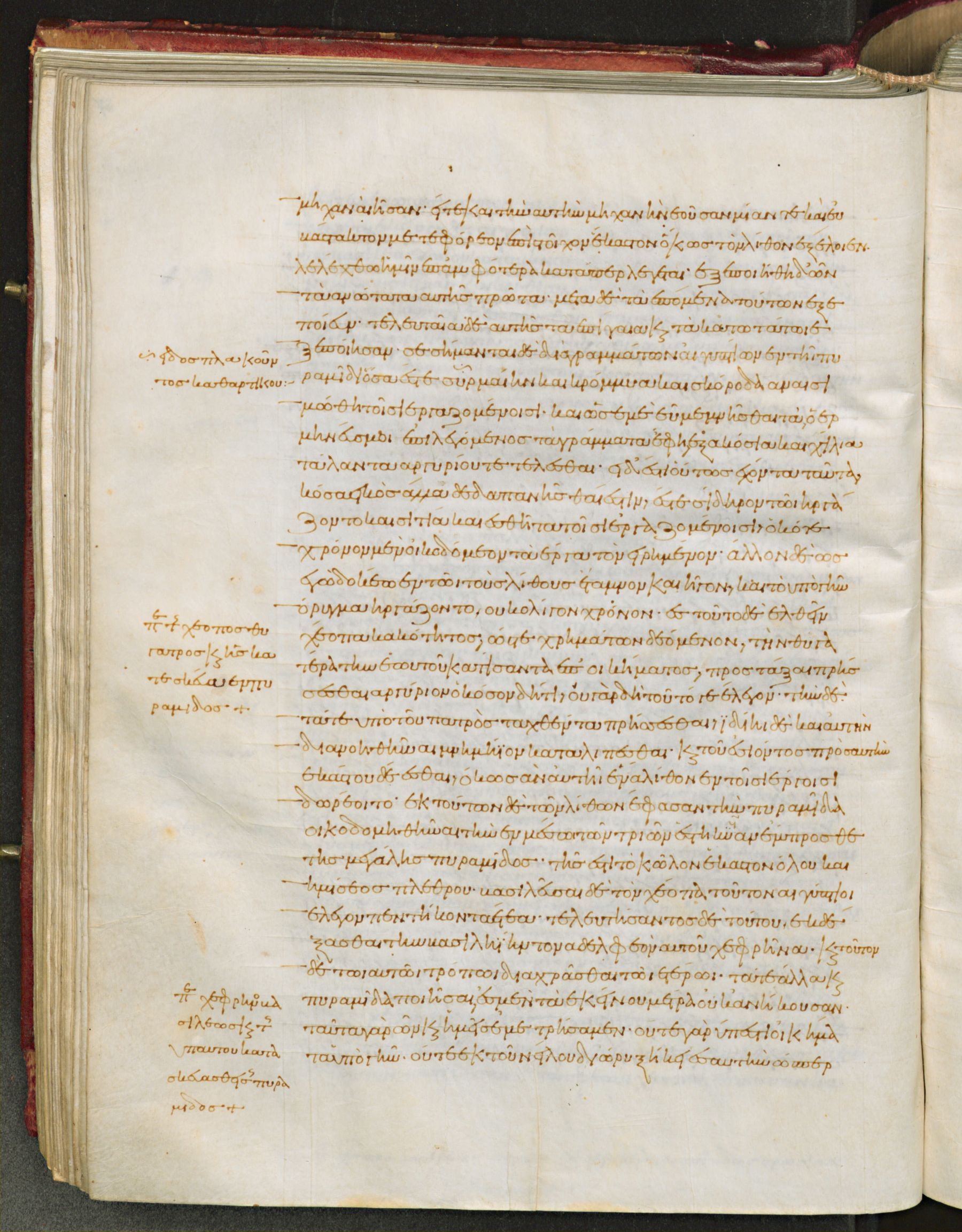
2.125 runs from fol. 87r to fol. 87v. Page breaks read on the images: fol. 87r begins '-κότητα ἐλάσαι· κατακληίσαντα γάρ μιν πάντα τὰ ἱρά' (2.124.1) and ends '...τοσαῦται καί' (2.125.4); fol. 87v begins 'μηχαναὶ ἦσαν' (2.125.4), margin 'περὶ Χεφρῆνος', and ends '...οὔτε ἐκ τοῦ Νείλου διῶρυξ ἥκει ἐς αὐτὴν ὥσπερ' (2.127.2). Checked on the image. Viewer: https://tecabml.contentdm.oclc.org/digital/collection/plutei/id/1358114
2.125ἐποιήθη δὲ ὧδε αὕτη ἡ πυραμίς· ἀναβαθμῶν τρόπον, τὰς μετεξέτεροι κρόσσας οἳ δὲ βωμίδας ὀνομάζουσι,
τοιαύτην τὸ πρῶτον ἐπείτε ἐποίησαν αὐτήν, ἤειρον τοὺς ἐπιλοίπους λίθους μηχανῇσι ξύλων βραχέων πεποιημένῃσι, χαμᾶθεν μὲν ἐπὶ τὸν πρῶτον στοῖχον τῶν ἀναβαθμῶν ἀείροντες·
ὅκως δὲ ἀνίοι ὁ λίθος ἐπʼ αὐτόν, ἐς ἑτέρην μηχανὴν ἐτίθετο ἑστεῶσαν ἐπὶ τοῦ πρώτου στοίχου, ἀπὸ τούτου δὲ ἐπὶ τὸν δεύτερον εἵλκετο στοῖχον ἐπʼ ἄλλης μηχανῆς·
ὅσοι γὰρ δὴ στοῖχοι ἦσαν τῶν ἀναβαθμῶν, τοσαῦται καὶ μηχαναὶ ἦσαν, εἴτε καὶ τὴν αὐτὴν μηχανὴν ἐοῦσαν μίαν τε καὶ εὐβάστακτον μετεφόρεον ἐπὶ στοῖχον ἕκαστον, ὅκως τὸν λίθον ἐξέλοιεν· λελέχθω γὰρ ἡμῖν ἐπʼ ἀμφότερα, κατά περ λέγεται.
ἐξεποιήθη δʼ ὦν τὰ ἀνώτατα αὐτῆς πρῶτα, μετὰ δὲ τὰ ἐχόμενα τούτων ἐξεποίευν, τελευταῖα δὲ αὐτῆς τὰ ἐπίγαια καὶ τὰ κατωτάτω ἐξεποίησαν.
σεσήμανται δὲ διὰ γραμμάτων Αἰγυπτίων ἐν τῇ πυραμίδι ὅσα ἔς τε συρμαίην καὶ κρόμμυα καὶ σκόροδα ἀναισιμώθη τοῖσι ἐργαζομένοισι· καὶ ὡς ἐμὲ εὖ μεμνῆσθαι τὰ ὁ ἑρμηνεύς μοι ἐπιλεγόμενος τὰ γράμματα ἔφη, ἑξακόσια καὶ χίλια τάλαντα ἀργυρίου τετελέσθαι.
εἰ δʼ ἔστι οὕτω ἔχοντα ταῦτα, κόσα οἰκὸς ἄλλα δεδαπανῆσθαι ἐστὶ ἔς τε σίδηρον τῷ ἐργάζοντο καὶ σιτία καὶ ἐσθῆτα τοῖσι ἐργαζομένοισι, ὁκότε χρόνον μὲν οἰκοδόμεον τὰ ἔργα τὸν εἰρημένον, ἄλλον δέ, ὡς ἐγὼ δοκέω, ἐν τῷ τοὺς λίθους ἔταμνον καὶ ἦγον καὶ τὸ ὑπὸ γῆν ὄρυγμα ἐργάζοντο, οὐκ ὀλίγον χρόνον.
2.125This pyramid was made like a stairway with tiers, or steps. When this, its first form, was completed, the workmen used levers made of short wooden logs to raise the rest of the stones; they heaved up the blocks from the ground on to the first tier of steps; when the stone had been so raised it was set on another lever that stood on the first tier, and a lever again drew it up from this tier to the next. It may be that there was a new lever on each tier of the steps, or perhaps there was but one lever, and that easily lifted, which they carried up to each tier in turn, when they had taken out the stone; I leave this uncertain, both ways being told me. But this is certain, that the upper part of the pyramid was the first finished off, then the next below it, and last of all the base and the lowest part. There are writings on the pyramid in Egyptian characters showing how much was spent on purges and onions and garlic for the workmen; and so far as I well remember, the interpreter when he read me the writing said that sixteen hundred talents of silver had been paid. Now if that is so, how much must needs have been expended on the iron with which they worked, and the workmen’s food and clothing? seeing that the time aforesaid was spent in building, and the hewing and carrying of the stone and the digging out of the underground parts was, as I suppose, a business of long duration.
Where on the image
2.126 is on fol. 87v. Page breaks read on the images: fol. 87v begins 'μηχαναὶ ἦσαν' (2.125.4), margin 'περὶ Χεφρῆνος', and ends '...οὔτε ἐκ τοῦ Νείλου διῶρυξ ἥκει ἐς αὐτὴν ὥσπερ' (2.127.2). Checked on the image. Viewer: https://tecabml.contentdm.oclc.org/digital/collection/plutei/id/1358114
2.126ἐς τοῦτο δὲ ἐλθεῖν Χέοπα κακότητος ὥστε χρημάτων δεόμενον τὴν θυγατέρα τὴν ἑωυτοῦ κατίσαντα ἐπʼ οἰκήματος προστάξαι πρήσσεσθαι ἀργύριον ὁκόσον δή τι· οὐ γὰρ δὴ τοῦτό γε ἔλεγον. τὴν δὲ τά τε ὑπὸ τοῦ πατρὸς ταχθέντα πρήσσεσθαι, ἰδίῃ δὲ καὶ αὐτὴν διανοηθῆναι μνημήιον καταλιπέσθαι, καὶ τοῦ ἐσιόντος πρὸς αὐτὴν ἑκάστου δέεσθαι ὅκως ἂν αὐτῇ ἕνα λίθον ἐν τοῖσι ἔργοισι δωρέοιτο.
ἐκ τούτων δὲ τῶν λίθων ἔφασαν τὴν πυραμίδα οἰκοδομηθῆναι τὴν ἐν μέσῳ τῶν τριῶν ἑστηκυῖαν, ἔμπροσθε τῆς μεγάλης πυραμίδος, τῆς ἐστὶ τὸ κῶλον ἕκαστον ὅλου καὶ ἡμίσεος πλέθρου.
2.126And so evil a man was Cheops that for lack of money he made his own daughter to sit in a chamber and exact payment (how much, I know not; for they did not tell me this). She, they say, doing her father’s bidding, was minded to leave some memorial of her own, and demanded of everyone who sought intercourse with her that he should give one stone to set in her work; and of these stones was built the pyramid that stands midmost of the three, over against the great pyramid; each side of it measures one hundred and fifty feet.
Where on the image
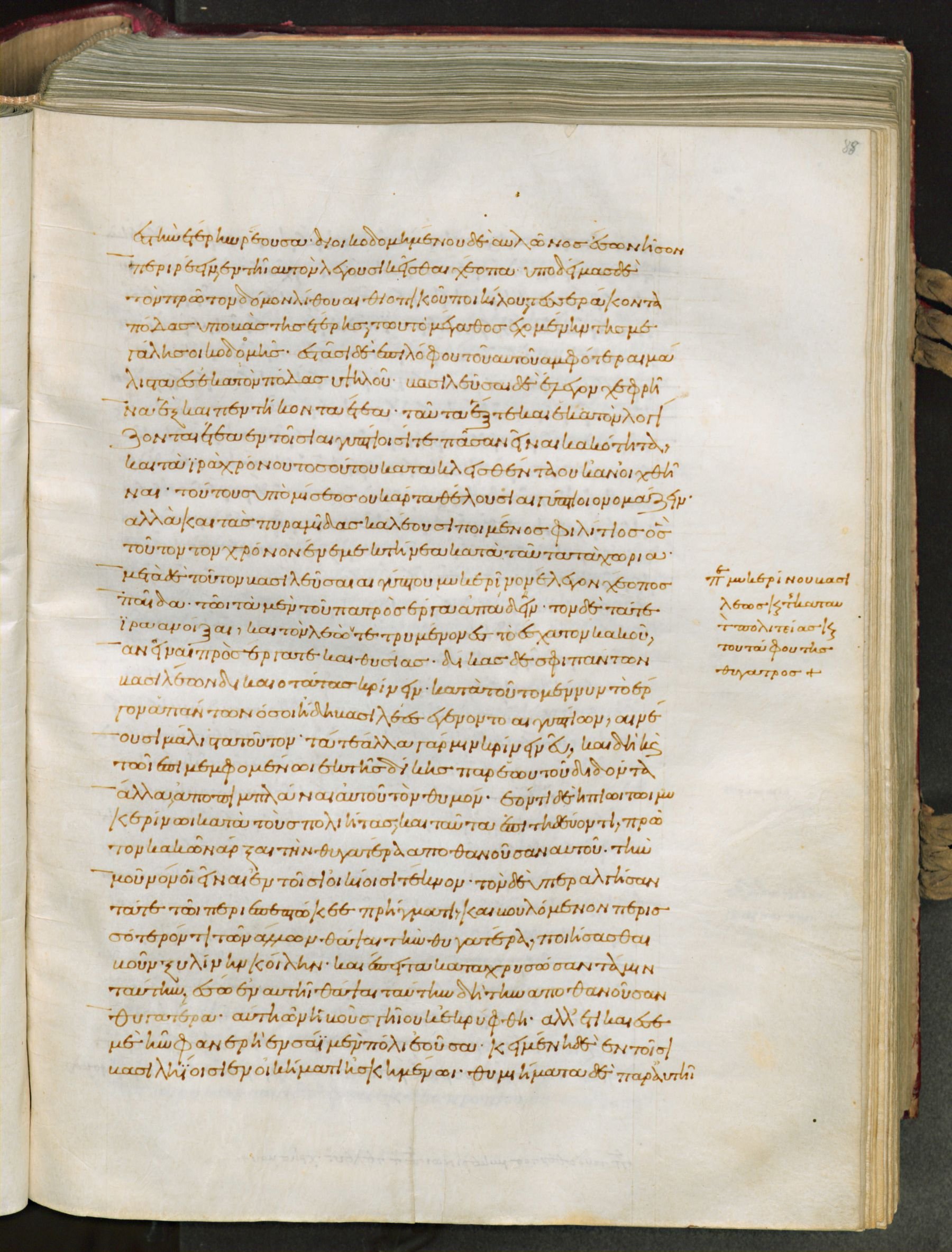
2.127 runs from fol. 87v to fol. 88r. Page breaks read on the images: fol. 87v begins 'μηχαναὶ ἦσαν' (2.125.4), margin 'περὶ Χεφρῆνος', and ends '...οὔτε ἐκ τοῦ Νείλου διῶρυξ ἥκει ἐς αὐτὴν ὥσπερ' (2.127.2); fol. 88r begins 'ἐς τὴν ἑτέρην ῥέουσα' (2.127.2) and ends '...θυμιήματα δὲ παρ’ αὐτῇ' (2.130.1). Checked on the image. Viewer: https://tecabml.contentdm.oclc.org/digital/collection/plutei/id/1358114
2.127βασιλεῦσαι δὲ τὸν Χέοπα τοῦτον Αἰγύπτιοι ἔλεγον πεντήκοντα ἔτεα, τελευτήσαντος δὲ τούτου ἐκδέξασθαι τὴν βασιληίην τὸν ἀδελφεὸν αὐτοῦ Χεφρῆνα· καὶ τοῦτον δὲ τῷ αὐτῷ τρόπῳ διαχρᾶσθαι τῷ ἑτέρῳ τά τε ἄλλα καὶ πυραμίδα ποιῆσαι, ἐς μὲν τὰ ἐκείνου μέτρα οὐκ ἀνήκουσαν·
ταῦτα γὰρ ὦν καὶ ἡμεῖς ἐμετρήσαμεν· (οὔτε γὰρ ὕπεστι οἰκήματα ὑπὸ γῆν, οὔτε ἐκ τοῦ Νείλου διῶρυξ ἥκει ἐς αὐτὴν ὥσπερ ἐς τὴν ἑτέρην ῥέουσα· διʼ οἰκοδομημένου δὲ αὐλῶνος ἔσω νῆσον περιρρέει, ἐν τῇ αὐτὸν λέγουσι κεῖσθαι Χέοπα)·
ὑποδείμας δὲ τὸν πρῶτον δόμον λίθου Αἰθιοπικοῦ ποικίλου, τεσσεράκοντα πόδας ὑποβὰς τῆς ἑτέρης τὠυτὸ μέγαθος, ἐχομένην τῆς μεγάλης οἰκοδόμησε. ἑστᾶσι δὲ ἐπὶ λόφου τοῦ αὐτοῦ ἀμφότεραι, μάλιστα ἐς ἑκατὸν πόδας ὑψηλοῦ. βασιλεῦσαι δὲ ἔλεγον Χεφρῆνα ἓξ καὶ πεντήκοντα ἔτεα.
2.127Cheops reigned (so the Egyptians said) for fifty years; at his death he was succeeded by his brother Chephren, who bore himself in all respects like Cheops. Chephren also built a pyramid, of a less size than his. brother’s. I have myself measured it. It has no underground chambers, nor is it entered like the other by a canal from the Nile, but the river comes in through a built passage and encircles an island, in which, they say, Cheops himself lies. This pyramid was built of the same bigness as the other, save that it falls forty feet short of it in height; it stands near to the great pyramid; the lowest layer of it is of variegated Ethiopian stone. Both of them stand on the same ridge, which is about an hundred feet high. Chephren, they said, reigned for fifty-six years.
Where on the image
2.128 is on fol. 88r. Page breaks read on the images: fol. 88r begins 'ἐς τὴν ἑτέρην ῥέουσα' (2.127.2) and ends '...θυμιήματα δὲ παρ’ αὐτῇ' (2.130.1). Checked on the image. Viewer: https://tecabml.contentdm.oclc.org/digital/collection/plutei/id/1358114
2.128ταῦτα ἕξ τε καὶ ἑκατὸν λογίζονται ἔτεα, ἐν τοῖσι Αἰγυπτίοισί τε πᾶσαν εἶναι κακότητα καὶ τὰ ἱρὰ χρόνου τοσούτου κατακληισθέντα οὐκ ἀνοιχθῆναι. τούτους ὑπὸ μίσεος οὐ κάρτα θέλουσι Αἰγύπτιοι ὀνομάζειν, ἀλλὰ καὶ τὰς πυραμίδας καλέουσι ποιμένος Φιλίτιος, ὃς τοῦτον τὸν χρόνον ἔνεμε κτήνεα κατὰ ταῦτα τὰ χωρία.
2.128Thus they reckon that for a hundred and six years Egypt was in great misery and the temples so long shut were never opened. So much do the people hate the memory of these two kings that they do not greatly wish to name them, and call the pyramids after the shepherd Philitis, who then pastured his flocks in this place.
Notes
- Greek: the text printed in A. D. Godley's Loeb edition (1920), from Perseus. Square brackets mark words the editor considers later additions. The manuscript's wording differs from the edition in places; the Greek is the edition, not a transcription of the page.
- English: A. D. Godley's translation as printed in 1920 (Loeb Classical Library, Herodotus vol. 1), not the modernized version on Perseus. Godley's footnotes are omitted.
- Chapter 121 is divided into 121 and 121a-121f as in Godley's edition; the English is divided at the corresponding sentences.
Cite
Sources
- Source: Florence, Laur. Plut. 70.3 (10th c.) via BML Teca Digitale + Greek of Godley's Loeb (Perseus) + English of A. D. Godley (1920, Wikisource, checked against the printing) (holding institution)
- Critical edition: Greek of A. D. Godley's Loeb edition (1920), via Perseus
← previous · → next · v cycle view · l back to library