Herodotus, Histories 2.121-123: Rhampsinitus, the treasure-thief, and the descent to the underworld
Introduction
In the second book of his Histories (written c. 430 BCE) Herodotus reports what the priests of Hephaestus at Memphis told him of the kings of Egypt, from Min (Menes), who first ruled and founded Memphis, through 330 kings named from a papyrus roll, to Sesostris, Proteus, Rhampsinitus, the pyramid builders Cheops, Chephren and Mycerinus, and Sethos, priest-king in the time of Sennacherib. He ends with their chronology: 341 generations, 11,340 years, during which no god had reigned in human form and the sun had four times risen out of its usual place.
The manuscript is Florence, Biblioteca Medicea Laurenziana, Plut. 70.3, written in the 10th century, the oldest surviving manuscript of Herodotus (codex A of the editors). Chapters 2.99-146 run from fol. 78v to fol. 92v. Each section is one chapter (Godley's subdivisions of the Rhampsinitus story, 121a-f, are kept apart) and points at the page(s) that carry it; the page breaks were read on the images and are recorded in each note.
This entry covers 2.121 to 2.123, on fol. 84v to 86v.
How was this verified? (Provenance)
Where on the image
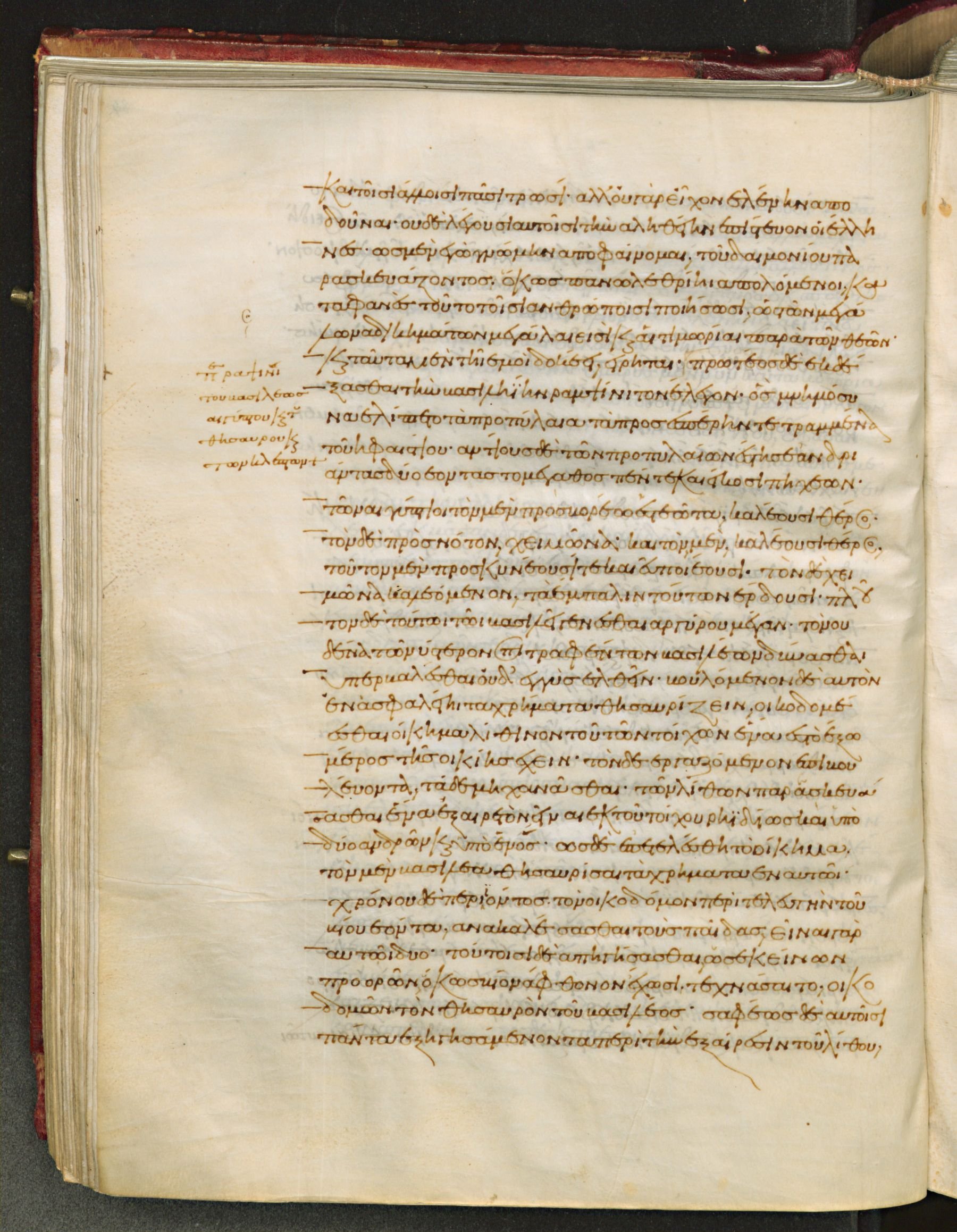
2.121 is on fol. 84v. Page breaks read on the images: fol. 84v begins 'καὶ τοῖσι ἄλλοισι πᾶσι Τρωσί' (2.120.4) and ends '...τὰ περὶ τὴν ἐξαίρεσιν τοῦ λίθου' (2.121a.2). Checked on the image. Viewer: https://tecabml.contentdm.oclc.org/digital/collection/plutei/id/1358114
2.121Πρωτέος δὲ ἐκδέξασθαι τὴν βασιληίην Ῥαμψίνιτον ἔλεγον, ὃς μνημόσυνα ἐλίπετο τὰ προπύλαια τὰ πρὸς ἑσπέρην τετραμμένα τοῦ Ἡφαιστείου, ἀντίους δὲ τῶν προπυλαίων ἔστησε ἀνδριάντας δύο, ἐόντας τὸ μέγαθος πέντε καὶ εἴκοσι πηχέων, τῶν Αἰγύπτιοι τὸν μὲν πρὸς βορέω ἑστεῶτα καλέουσι θέρος, τὸν δὲ πρὸς νότον χειμῶνα· καὶ τὸν μὲν καλέουσι θέρος, τοῦτον μὲν προσκυνέουσί τε καὶ εὖ ποιέουσι, τὸν δὲ χειμῶνα καλεόμενον τὰ ἔμπαλιν τούτων ἔρδουσι
2.121The next to reign after Proteus (they said) was Rhampsinitus. The memorial of his name left by him was the western forecourt of the temple of Hephaestus; before this he set two statues of twenty-five cubits’ height; the northernmost of these is called by the Egyptians Summer, and the southernmost Winter; that one which they call Summer they worship and entreat well, but do contrariwise to the statue called Winter.
Where on the image
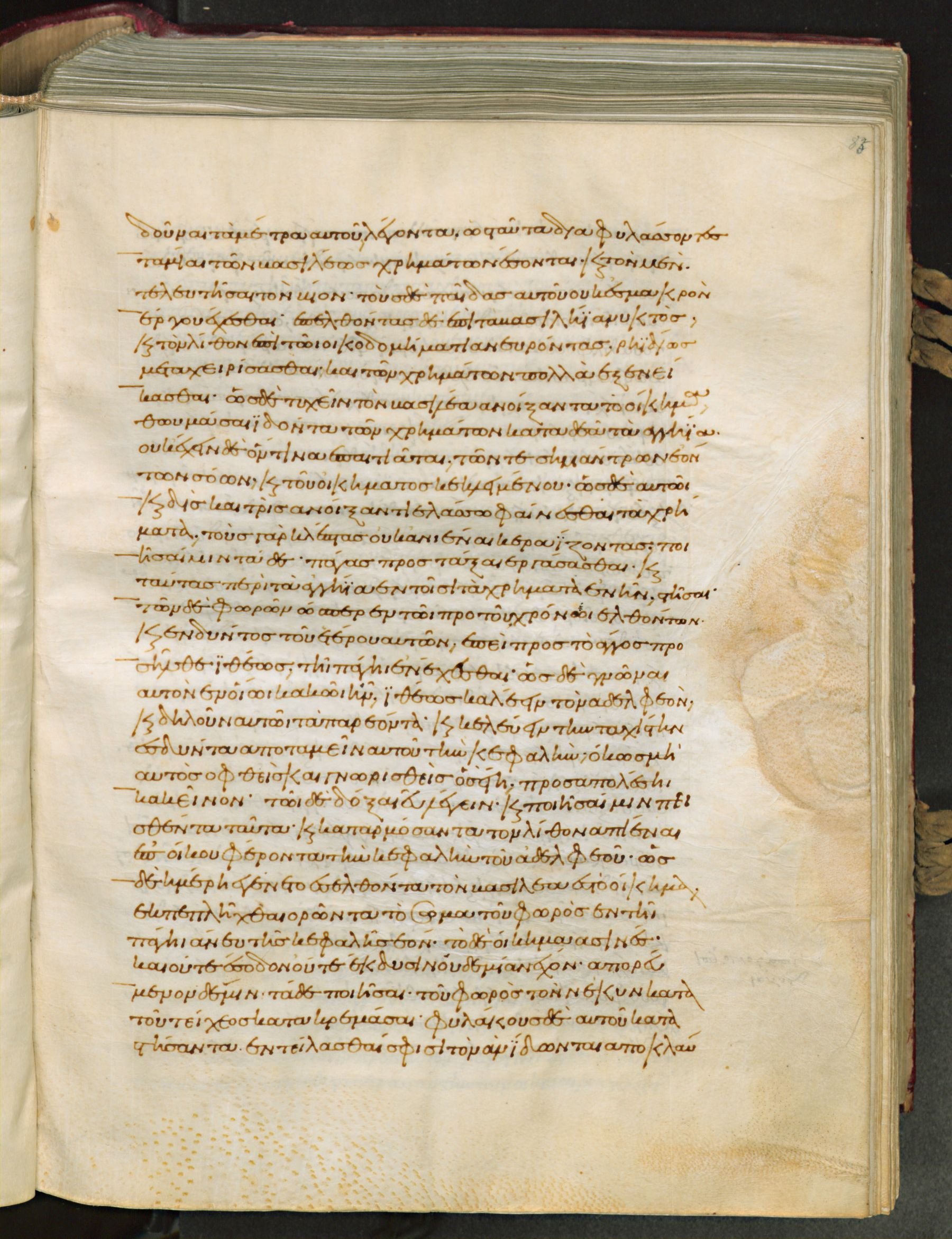
2.121a runs from fol. 84v to fol. 85r. Page breaks read on the images: fol. 84v begins 'καὶ τοῖσι ἄλλοισι πᾶσι Τρωσί' (2.120.4) and ends '...τὰ περὶ τὴν ἐξαίρεσιν τοῦ λίθου' (2.121a.2); fol. 85r begins 'δοῦναι τὰ μέτρα αὐτοῦ' (2.121a.2) and ends '...τὸν ἂν ἴδωνται ἀποκλαύ-' (2.121c.1). Checked on the image. Viewer: https://tecabml.contentdm.oclc.org/digital/collection/plutei/id/1358114
2.121aπλοῦτον δὲ τούτῳ τῷ βασιλέι γενέσθαι ἀργύρου μέγαν, τὸν οὐδένα τῶν ὕστερον ἐπιτραφέντων βασιλέων δύνασθαι ὑπερβαλέσθαι οὐδʼ ἐγγὺς ἐλθεῖν. βουλόμενον δὲ αὐτὸν ἐν ἀσφαλείῃ τὰ χρήματα θησαυρίζειν οἰκοδομέεσθαι οἴκημα λίθινον, τοῦ τῶν τοίχων ἕνα ἐς τὸ ἔξω μέρος τῆς οἰκίης ἔχειν. τὸν δὲ ἐργαζόμενον ἐπιβουλεύοντα τάδε μηχανᾶσθαι· τῶν λίθων παρασκευάσασθαι ἕνα ἐξαιρετὸν εἶναι ἐκ τοῦ τοίχου ῥηιδίως καὶ ὑπὸ δύο ἀνδρῶν καὶ ὑπὸ ἑνός.
ὡς δὲ ἐπετελέσθη τὸ οἴκημα, τὸν μὲν βασιλέα θησαυρίσαι τὰ χρήματα ἐν αὐτῷ· χρόνου δὲ περιιόντος τὸν οἰκοδόμον περὶ τελευτὴν τοῦ βίου ἐόντα ἀνακαλέσασθαι τοὺς παῖδας (εἶναι γὰρ αὐτῷ δύο), τούτοισι δὲ ἀπηγήσασθαι ὡς ἐκείνων προορῶν, ὅκως βίον ἄφθονον ἔχωσι, τεχνάσαιτο οἰκοδομέων τὸν θησαυρὸν τοῦ βασιλέος· σαφέως δὲ αὐτοῖσι πάντα ἐξηγησάμενον τὰ περὶ τὴν ἐξαίρεσιν τοῦ λίθου δοῦναι τὰ μέτρα αὐτοῦ, λέγοντα ὡς ταῦτα διαφυλάσσοντες ταμίαι τῶν βασιλέος χρημάτων ἔσονται.
καὶ τὸν μὲν τελευτῆσαι τὸν βίον, τοὺς δὲ παῖδας οὐκ ἐς μακρὴν ἔργου ἔχεσθαι, ἐπελθόντας δὲ ἐπὶ τὰ βασιλήια νυκτὸς καὶ τὸν λίθον ἐπὶ τῷ οἰκοδομήματι ἀνευρόντας ῥηιδίως μεταχειρίσασθαι καὶ τῶν χρημάτων πολλὰ ἐξενείκασθαι.
2.121aThis king (they told me) had great wealth of silver, so great that none of the later-born kings could surpass or nearly match it. That he might store his treasure safely, he made to be built a stone chamber, one of its walls abutting on the outer side of his palace. But the builder of it craftily contrived that one stone should be so placed as to be easily removed by two men or even by one. So when the chamber was finished, the king stored his treasure in it. But as time went on, the builder, being now near his end, called to him his two sons and told them how he had provided an ample livelihood for them by the art with which he had built the king’s treasure-house; he made them clearly to understand concerning the removal of the stone, and gave the measurements which would find it; saying that if they kept these in mind they would be stewards of the king’s riches. So when he was dead, his sons set to work with no long delay: coming to the palace by night, they easily found and handled the stone in the building, and took away much of the treasure.
Where on the image
2.121b is on fol. 85r. Page breaks read on the images: fol. 85r begins 'δοῦναι τὰ μέτρα αὐτοῦ' (2.121a.2) and ends '...τὸν ἂν ἴδωνται ἀποκλαύ-' (2.121c.1). Checked on the image. Viewer: https://tecabml.contentdm.oclc.org/digital/collection/plutei/id/1358114
2.121bὡς δὲ τυχεῖν τὸν βασιλέα ἀνοίξαντα τὸ οἴκημα, θωμάσαι ἰδόντα τῶν χρημάτων καταδεᾶ τὰ ἀγγήια, οὐκ ἔχειν δὲ ὅντινα ἐπαιτιᾶται, τῶν τε σημάντρων ἐόντων σόων καὶ τοῦ οἰκήματος κεκληιμένου. ὡς δὲ αὐτῷ καὶ δὶς καὶ τρὶς ἀνοίξαντι αἰεὶ ἐλάσσω φαίνεσθαι τὰ χρήματα (τοὺς γὰρ κλέπτας οὐκ ἀνιέναι κεραΐζοντας), ποιῆσαί μιν τάδε· πάγας προστάξαι ἐργάσασθαι καὶ ταύτας περὶ τὰ ἀγγήια ἐν τοῖσι τὰ χρήματα ἐνῆν στῆσαι.
τῶν δὲ φωρῶν ὥσπερ ἐν τῷ πρὸ τοῦ χρόνῳ ἐλθόντων καὶ ἐσδύντος τοῦ ἑτέρου αὐτῶν, ἐπεὶ πρὸς τὸ ἄγγος προσῆλθε, ἰθέως τῇ πάγῃ ἐνέχεσθαι. ὡς δὲ γνῶναι αὐτὸν ἐν οἵῳ κακῷ ἦν, ἰθέως καλέειν τὸν ἀδελφεὸν καὶ δηλοῦν αὐτῷ τὰ παρεόντα, καὶ κελεύειν τὴν ταχίστην ἐσδύντα ἀποταμεῖν αὐτοῦ τὴν κεφαλήν, ὅκως μὴ αὐτὸς ὀφθεὶς καὶ γνωρισθεὶς ὃς εἴη προσαπολέσῃ κἀκεῖνον. τῷ δὲ δόξαι εὖ λέγειν, καὶ ποιῆσαί μιν πεισθέντα ταῦτα, καὶ καταρμόσαντα τὸν λίθον ἀπιέναι ἐπʼ οἴκου, φέροντα τὴν κεφαλὴν τοῦ ἀδελφεοῦ.
2.121bWhen the king opened the building, he was amazed to see the vessels lacking their full tale of treasure; yet he knew not whom to accuse, seeing that the seals were unbroken and the chamber fast shut. But when at the second and third opening of the chamber he saw the treasure grown ever less (for the thieves ceased not from plundering), he bid traps to be made and set about the vessels in which his riches lay. The thieves came as they had done before, and one of them crept in; when he came near the vessel, at once he was caught and held in the trap. Seeing his evil plight, he straightway called to his brother, and, showing him how matters stood, “Creep in quickly,” said he, “and cut off my head, lest I be seen and recognised and so bring you too to ruin.” The brother consented and did this, thinking the counsel good. Then he set the stone in place again, and went away home, carrying his brother’s head.
Where on the image
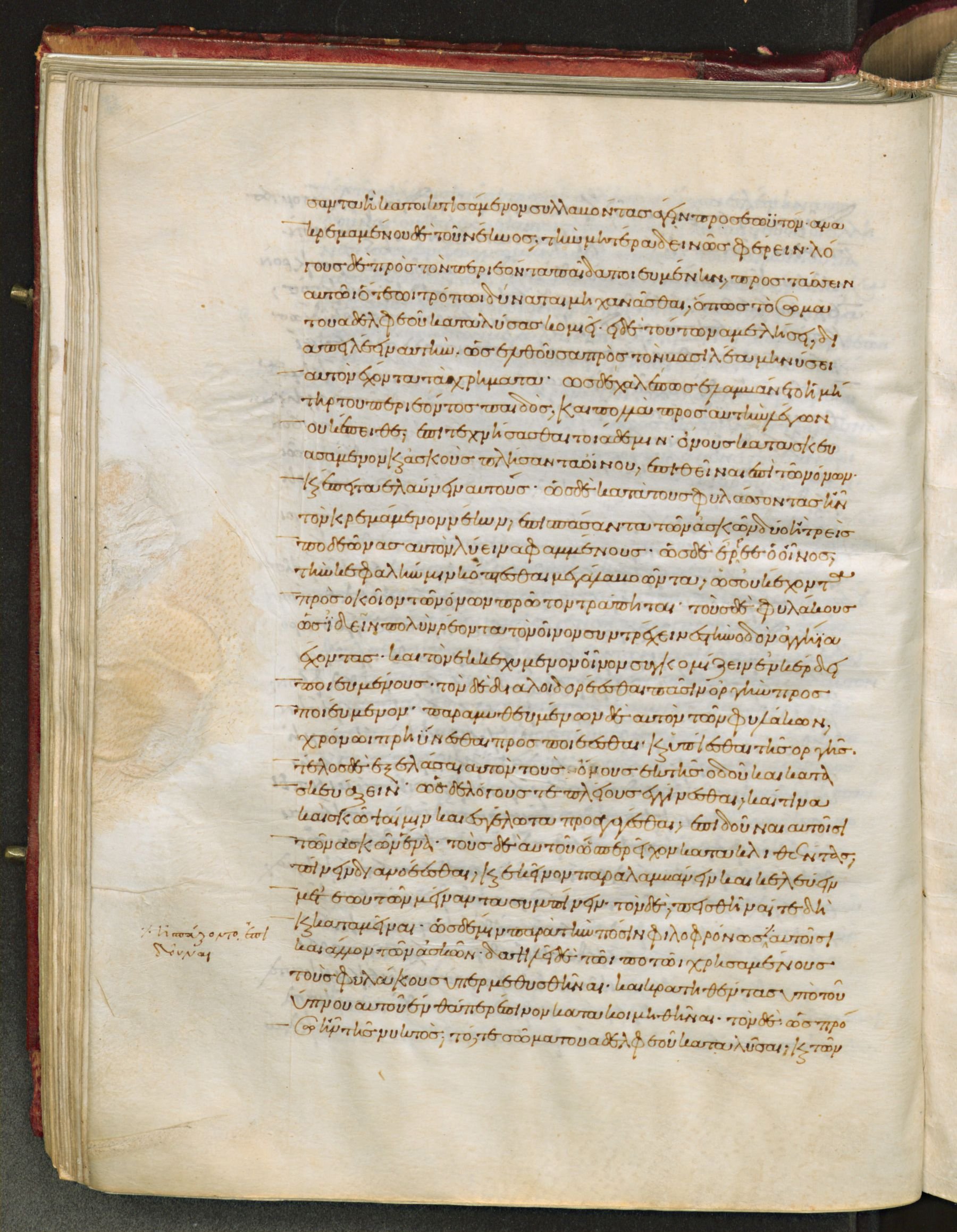
2.121c runs from fol. 85r to fol. 85v. Page breaks read on the images: fol. 85r begins 'δοῦναι τὰ μέτρα αὐτοῦ' (2.121a.2) and ends '...τὸν ἂν ἴδωνται ἀποκλαύ-' (2.121c.1); fol. 85v begins '-σαντα ἢ κατοικτισάμενον, συλλαβόντας ἄγειν' (2.121c.1) and ends '...τό τε σῶμα τοῦ ἀδελφεοῦ καταλῦσαι καὶ τῶν' (2.121d.6). Checked on the image. Viewer: https://tecabml.contentdm.oclc.org/digital/collection/plutei/id/1358114
2.121cὡς δὲ ἡμέρη ἐγένετο, ἐσελθόντα τὸν βασιλέα ἐς τὸ οἴκημα ἐκπεπλῆχθαι ὁρῶντα τὸ σῶμα τοῦ φωρὸς ἐν τῇ πάγῃ ἄνευ τῆς κεφαλῆς ἐόν, τὸ δὲ οἴκημα ἀσινὲς καὶ οὔτε ἔσοδον οὔτε ἔκδυσιν οὐδεμίαν ἔχον. ἀπορεύμενον δέ μιν τάδε ποιῆσαι· τοῦ φωρὸς τὸν νέκυν κατὰ τοῦ τείχεος κατακρεμάσαι, φυλάκους δὲ αὐτοῦ καταστήσαντα ἐντείλασθαί σφι, τὸν ἂν ἴδωνται ἀποκλαύσαντα ἢ κατοικτισάμενον, συλλαβόντας ἄγειν πρὸς ἑωυτόν.
ἀνακρεμαμένου δὲ τοῦ νέκυος τὴν μητέρα δεινῶς φέρειν, λόγους δὲ πρὸς τὸν περιεόντα παῖδα ποιευμένην προστάσσειν αὐτῷ ὅτεῳ τρόπῳ δύναται μηχανᾶσθαι ὅκως τὸ σῶμα τοῦ ἀδελφεοῦ καταλύσας κομιεῖ· εἰ δὲ τούτων ἀμελήσει, διαπειλέειν αὐτὴν ὡς ἐλθοῦσα πρὸς τὸν βασιλέα μηνύσει αὐτὸν ἔχοντα τὰ χρήματα.
2.121cWhen it was morning the king came to the chamber, and was amazed to see the thief’s headless body in the trap, yet the chamber unbroken, with no way of passing in or out; and he knew not what to do. But presently he hung the thief’s dead body on the outer wall, and set guards over it, charging them to seize and bring before him whomsoever they should see weeping or making lamentation.
But the thief’s mother, when the body had been so hung, was greatly moved: she talked with her surviving son, and bade him contrive by whatever means to loose and bring her his brother’s body, threatening that if he would not obey her she would go to the king and lay an information that he had the treasure.
Where on the image
2.121d runs from fol. 85v to fol. 86r. Page breaks read on the images: fol. 85v begins '-σαντα ἢ κατοικτισάμενον, συλλαβόντας ἄγειν' (2.121c.1) and ends '...τό τε σῶμα τοῦ ἀδελφεοῦ καταλῦσαι καὶ τῶν' (2.121d.6); fol. 86r begins 'φυλάκων ἐπὶ λύμῃ πάντων ξυρῆσαι τὰς δεξιὰς παρηίδας' (2.121d.6) and ends '...συνοικίσαι ὡς πλεῖστα' (2.121f.2). Checked on the image. Viewer: https://tecabml.contentdm.oclc.org/digital/collection/plutei/id/1358114
2.121dὡς δὲ χαλεπῶς ἐλαμβάνετο ἡ μήτηρ τοῦ περιεόντος παιδὸς καὶ πολλὰ πρὸς αὐτὴν λέγων οὐκ ἔπειθε, ἐπιτεχνήσασθαι τοιάδε μιν· ὄνους κατασκευασάμενον καὶ ἀσκοὺς πλήσαντα οἴνου ἐπιθεῖναι ἐπὶ τῶν ὄνων καὶ ἔπειτα ἐλαύνειν αὐτούς· ὡς δὲ κατὰ τοὺς φυλάσσοντας ἦν τὸν κρεμάμενον νέκυν, ἐπισπάσαντα τῶν ἀσκῶν δύο ἢ τρεῖς ποδεῶνας αὐτὸν λύειν ἀπαμμένους·
ὡς δὲ ἔρρεε ὁ οἶνος, τὴν κεφαλήν μιν κόπτεσθαι μεγάλα βοῶντα ὡς οὐκ ἔχοντα πρὸς ὁκοῖον τῶν ὄνων πρῶτον τράπηται. τοὺς δὲ φυλάκους ὡς ἰδεῖν πολλὸν ῥέοντα τὸν οἶνον, συντρέχειν ἐς τὴν ὁδὸν ἀγγήια ἔχοντας, καὶ τὸν ἐκκεχυμένον οἶνον συγκομίζειν ἐν κέρδεϊ ποιευμένους·
τὸν δὲ διαλοιδορέεσθαι πᾶσι ὀργὴν προσποιεύμενον, παραμυθευμένων δὲ αὐτὸν τῶν φυλάκων χρόνῳ πρηΰνεσθαι προσποιέεσθαι καὶ ὑπίεσθαι τῆς ὀργῆς, τέλος δὲ ἐξελάσαι αὐτὸν τοὺς ὄνους ἐκ τῆς ὁδοῦ καὶ κατασκευάζειν.
ὡς δὲ λόγους τε πλέους ἐγγίνεσθαι καί τινα καὶ σκῶψαι μιν καὶ ἐς γέλωτα προαγαγέσθαι, ἐπιδοῦναι αὐτοῖσι τῶν ἀσκῶν ἕνα· τοὺς δὲ αὐτοῦ ὥσπερ εἶχον κατακλιθέντας πίνειν διανοέεσθαι, καὶ ἐκεῖνον παραλαμβάνειν καὶ κελεύειν μετʼ ἑωυτῶν μείναντα συμπίνειν· τὸν δὲ πεισθῆναί τε δὴ καὶ καταμεῖναι.
ὡς δέ μιν παρὰ τὴν πόσιν φιλοφρόνως ἠσπάζοντο, ἐπιδοῦναι αὐτοῖσι καὶ ἄλλον τῶν ἀσκῶν· δαψιλέι δὲ τῷ ποτῷ χρησαμένους τοὺς φυλάκους ὑπερμεθυσθῆναι καὶ κρατηθέντας ὑπὸ τοῦ ὕπνου αὐτοῦ ἔνθα περ ἔπινον κατακοιμηθῆναι.
τὸν δέ, ὡς πρόσω ἦν τῆς νυκτός, τό τε σῶμα τοῦ ἀδελφεοῦ καταλῦσαι καὶ τῶν φυλάκων ἐπὶ λύμῃ πάντων ξυρῆσαι τὰς δεξιὰς παρηίδας, ἐπιθέντα δὲ τὸν νέκυν ἐπὶ τοὺς ὄνους ἀπελαύνειν ἐπʼ οἴκου, ἐπιτελέσαντα τῇ μητρὶ τὰ προσταχθέντα.
2.121dSo when she bitterly reproached him and for all he said he could not overpersuade her, the brother devised a plot: he got his asses and loaded them with skins full of wine and then drove them before him till he came near those who guarded the hanging body; then he pulled at the feet of two or three of the skins and loosed their fastenings; and the wine so running out, he cried aloud and beat his head like one that knew not which of his asses he should deal with first. The guards, seeing the wine running freely, all took vessels and ran into the highway, where they caught the spilt wine, and thought themselves lucky; the man pretended to be angry and reviled each and all of them; but the guards speaking peaceably to him, he presently made as if he were comforted and appeased, till at last he drove his asses aside from the highway and put his gear in order. So the guards and he fell into talk, and one of them jesting with him, so that there was laughter, he gave them one of the skins: whereupon without more ado they sat down and began to drink, making him one of their company and bidding him stay and drink with them; and he consented and stayed. They drank to him merrily, and he gave them yet another of the skins, till the guards grew very drunk with the abundance of liquor, and at last being overmastered by sleep lay down in the place where they had been drinking. When the night was far spent, the thief cut down his brother’s body and then (first shaving all the guard’s right cheeks by way of insult) laid it on his asses and drove them home, having so fulfilled his mother’s commands for her.
Where on the image
2.121e is on fol. 86r. Page breaks read on the images: fol. 86r begins 'φυλάκων ἐπὶ λύμῃ πάντων ξυρῆσαι τὰς δεξιὰς παρηίδας' (2.121d.6) and ends '...συνοικίσαι ὡς πλεῖστα' (2.121f.2). Checked on the image. Viewer: https://tecabml.contentdm.oclc.org/digital/collection/plutei/id/1358114
2.121eτὸν δὲ βασιλέα, ὡς αὐτῷ ἀπηγγέλθη τοῦ φωρὸς ὁ νέκυς ἐκκεκλεμμένος, δεινὰ ποιέειν· πάντως δὲ βουλόμενον εὑρεθῆναι ὅστις κοτὲ εἴη ὁ ταῦτα μηχανώμενος, ποιῆσαί μιν τάδε, ἐμοὶ μὲν οὐ πιστά·
τὴν θυγατέρα τὴν ἑωυτοῦ κατίσαι ἐπʼ οἰκήματος, ἐντειλάμενον πάντας τε ὁμοίως προσδέκεσθαι, καὶ πρὶν συγγενέσθαι, ἀναγκάζειν λέγειν αὐτῇ ὅ τι δὴ ἐν τῷ βίῳ ἔργασται αὐτῷ σοφώτατον καὶ ἀνοσιώτατον· ὃς δʼ ἂν ἀπηγήσηται τὰ περὶ τὸν φῶρα γεγενημένα, τοῦτον συλλαμβάνειν καὶ μὴ ἀπιέναι ἔξω.
ὡς δὲ τὴν παῖδα ποιέειν τὰ ἐκ τοῦ πατρὸς προσταχθέντα, τὸν φῶρα πυθόμενον τῶν εἵνεκα ταῦτα ἐπρήσσετο, βουληθέντα πολυτροπίῃ τοῦ βασιλέος περιγενέσθαι ποιέειν τάδε·
νεκροῦ προσφάτου ἀποταμόντα ἐν τῷ ὤμῳ τὴν χεῖρα ἰέναι αὐτὸν ἔχοντα αὐτὴν ὑπὸ τῷ ἱματίῳ. ἐσελθόντα δὲ ὡς τοῦ βασιλέος τὴν θυγατέρα καὶ εἰρωτώμενον τά περ καὶ οἱ ἄλλοι, ἀπηγήσασθαι ὡς ἀνοσιώτατον μὲν εἴη ἐργασμένος ὅτι τοῦ ἀδελφεοῦ ἐν τῷ θησαυρῷ τοῦ βασιλέος ὑπὸ πάγης ἁλόντος ἀποτάμοι τὴν κεφαλήν, σοφώτατον δὲ ὅτι τοὺς φυλάκους καταμεθύσας καταλύσειε τοῦ ἀδελφεοῦ κρεμάμενον τὸν νέκυν.
τὴν δὲ ὡς ἤκουσε ἅπτεσθαι αὐτοῦ. τὸν δὲ φῶρα ἐν τῷ σκότεϊ προτεῖναι αὐτῇ τοῦ νεκροῦ τὴν χεῖρα· τὴν δὲ ἐπιλαβομένην ἔχειν, νομίζουσαν αὐτοῦ ἐκείνου τῆς χειρὸς ἀντέχεσθαι· τὸν δὲ φῶρα προέμενον αὐτῇ οἴχεσθαι διὰ θυρέων φεύγοντα.
2.121eWhen the king was told of the stealing away of the dead thief’s body he was very angry, and resolved by all means to find who it was that had plotted the deed. So he bade his daughter (such is the story, but I myself do not believe it) to sit in a certain room and receive alike all who came; before she had intercourse with any, she should compel him to tell her what was the cleverest trick and the greatest crime of his life; then if any told her the story of the thief she must seize him and not suffer him to pass out. The girl did as her father bade her. The thief, learning the purpose of the king’s act, was minded to get the better of him by ready cunning. He therefore cut off the arm of a man newly dead at the shoulder, and went to the king’s daughter, carrying it under his cloak, and when asked the same question as the rest, he told her that his greatest crime was the cutting off of his brother’s head when the brother was caught in a trap in the king’s treasury, and his cleverest trick the release of his brother’s hanging body by making the guards drunk. Hearing this, the princess would have laid hands on him, but the thief in the darkness giving her the dead man’s arm, she seized that, thinking that she was grasping the arm of the thief, who, having given it to her, made his escape by way of the door.
Where on the image
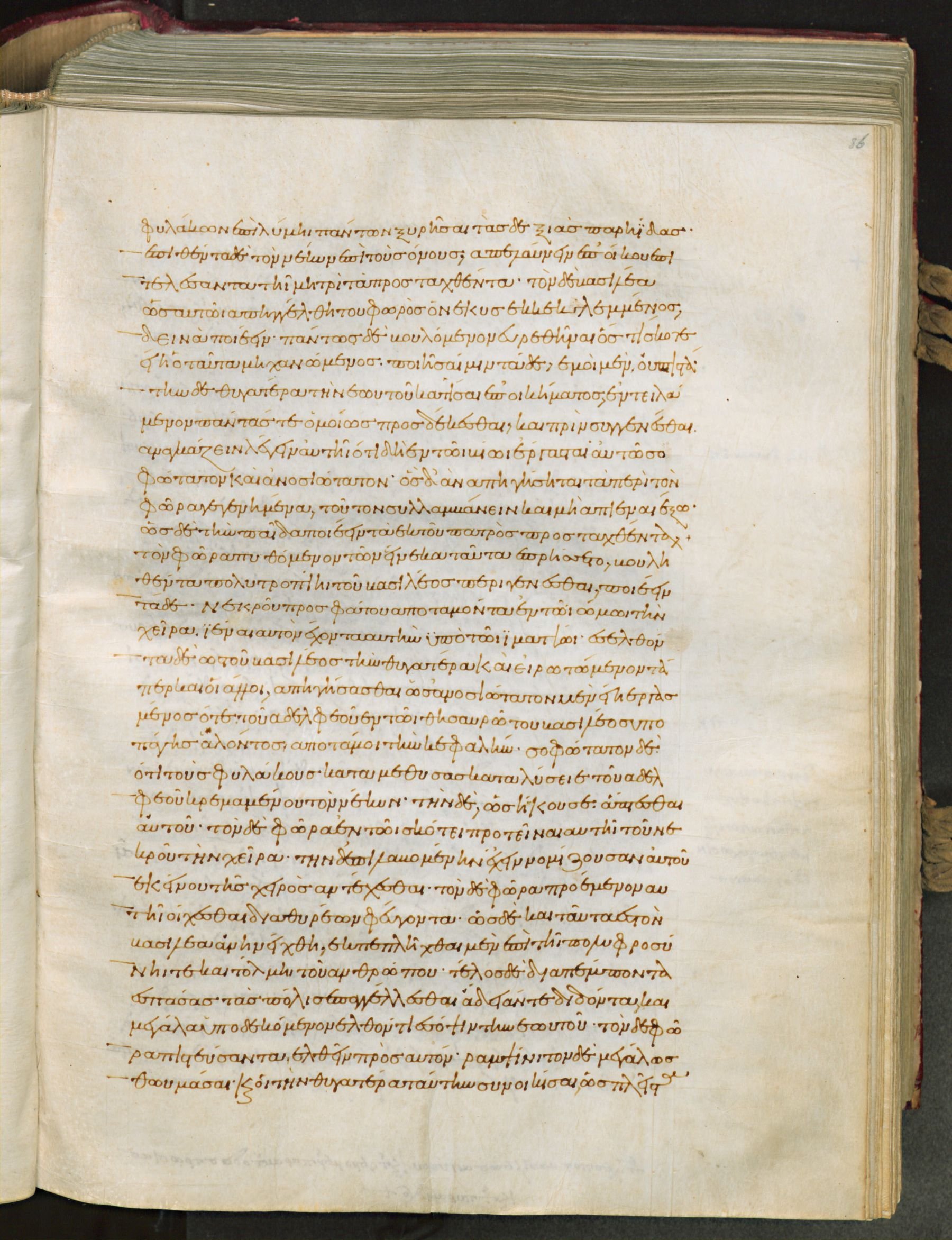
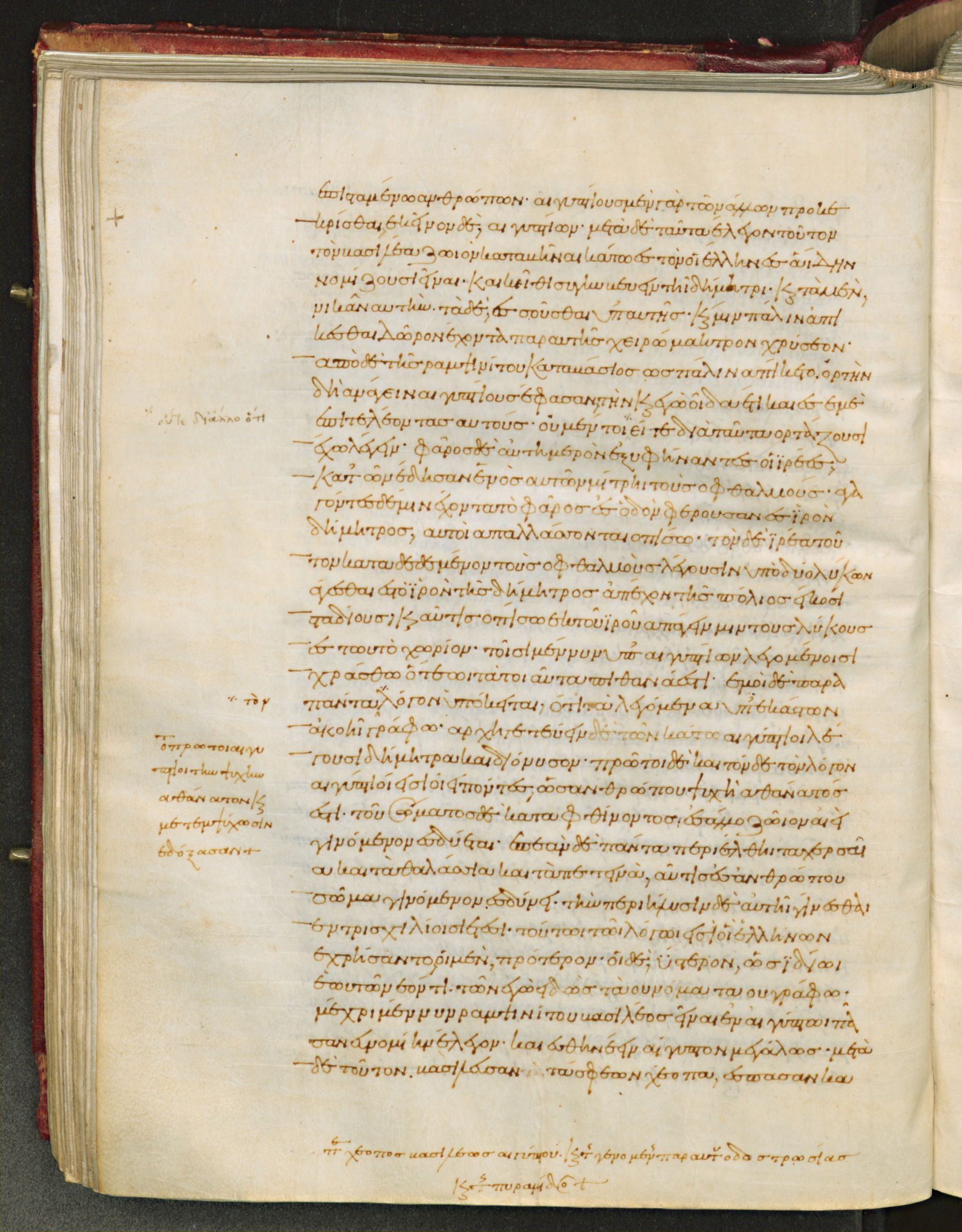
2.121f runs from fol. 86r to fol. 86v. Page breaks read on the images: fol. 86r begins 'φυλάκων ἐπὶ λύμῃ πάντων ξυρῆσαι τὰς δεξιὰς παρηίδας' (2.121d.6) and ends '...συνοικίσαι ὡς πλεῖστα' (2.121f.2); fol. 86v begins 'ἐπισταμένῳ ἀνθρώπων' (2.121f.2) and ends '...βασιλεύσαντά σφεων Χέοπα ἐς πᾶσαν κα-' (2.124.1; a reader's note on Cheops stands in the lower margin). Checked on the image. Viewer: https://tecabml.contentdm.oclc.org/digital/collection/plutei/id/1358114
2.121fὡς δὲ καὶ ταῦτα ἐς τὸν βασιλέα ἀνηνείχθη, ἐκπεπλῆχθαι μὲν ἐπὶ τῇ πολυφροσύνῃ τε καὶ τόλμῃ τοῦ ἀνθρώπου, τέλος δὲ διανέμοντα ἐς πάσας τὰς πόλις ἐπαγγέλλεσθαι ἀδείην τε διδόντα καὶ μεγάλα ὑποδεκόμενον ἐλθόντι ἐς ὄψιν τὴν ἑωυτοῦ.
τὸν δὲ φῶρα πιστεύσαντα ἐλθεῖν πρὸς αὐτόν, Ῥαμψίνιτον δὲ μεγάλως θωμάσαι, καί οἱ τὴν θυγατέρα ταύτην συνοικίσαι ὡς πλεῖστα ἐπισταμένῳ ἀνθρώπων. Αἰγυπτίους μὲν γὰρ τῶν ἄλλων προκεκρίσθαι, ἐκεῖνον δὲ Αἰγυπτίων.
2.121fWhen this also came to the king’s ears, he was astonished at the man’s ingenuity and daring, and in the end, he sent a proclamation to every town, promising the thief impunity and a great reward if he would come into the king’s presence. The thief trusted the king and came before him; Rhampsinitus admired him greatly and gave him his daughter to wife for his surpassing cleverness, for as the Egyptians (said he) excelled all others in craft, so did he excel the Egyptians.
Where on the image
2.122 is on fol. 86v. Page breaks read on the images: fol. 86v begins 'ἐπισταμένῳ ἀνθρώπων' (2.121f.2) and ends '...βασιλεύσαντά σφεων Χέοπα ἐς πᾶσαν κα-' (2.124.1; a reader's note on Cheops stands in the lower margin). Checked on the image. Viewer: https://tecabml.contentdm.oclc.org/digital/collection/plutei/id/1358114
2.122μετὰ δὲ ταῦτα ἔλεγον τοῦτον τὸν βασιλέα ζωὸν καταβῆναι κάτω ἐς τὸν οἱ Ἕλληνες Ἅιδην νομίζουσι εἶναι, καὶ κεῖθι συγκυβεύειν τῇ Δήμητρι, καὶ τὰ μὲν νικᾶν αὐτὴν τὰ δὲ ἑσσοῦσθαι ὑπʼ αὐτῆς, καί μιν πάλιν ἀπικέσθαι δῶρον ἔχοντα παρʼ αὐτῆς χειρόμακτρον χρύσεον.
ἀπὸ δὲ τῆς Ῥαμψινίτου καταβάσιος, ὡς πάλιν ἀπίκετο, ὁρτὴν δὴ ἀνάγειν Αἰγυπτίους ἔφασαν· τὴν καὶ ἐγὼ οἶδα ἔτι καὶ ἐς ἐμὲ ἐπιτελέοντας αὐτούς, οὐ μέντοι εἴ γε διὰ ταῦτα ὁρτάζουσι ἔχω λέγειν.
φᾶρος δὲ αὐτημερὸν ἐξυφήναντες οἱ ἱρέες κατʼ ὦν ἔδησαν ἑνὸς ἑωυτῶν μίτρῃ τοὺς ὀφθαλμούς, ἀγαγόντες δέ μιν ἔχοντα τὸ φᾶρος ἐς ὁδὸν φέρουσαν ἐς ἱρὸν Δήμητρος αὐτοὶ ἀπαλλάσσονται ὀπίσω· τὸν δὲ ἱρέα τοῦτον καταδεδεμένον τοὺς ὀφθαλμοὺς λέγουσι ὑπὸ δύο λύκων ἄγεσθαι ἐς τὸ ἱρὸν τῆς Δήμητρος ἀπέχον τῆς πόλιος εἴκοσι σταδίους, καὶ αὖτις ὀπίσω ἐκ τοῦ ἱροῦ ἀπάγειν μιν τοὺς λύκους ἐς τὠυτὸ χωρίον.
2.122After this (said the priests) this king went down alive to the place which the Greeks call Hades; there he played dice with Demeter, and after both winning and losing he returned back with a gift from her of a golden napkin. From this descent of Rhampsinitus the Egyptians were said by the priests to have kept a festival after his return, which to my own knowledge they celebrate to this day, but whether it be for that cause I cannot say. On the day of this festival the priests weave a cloth and bind it for a headgear on the eyes of one among themselves, whom they then lead, wearing the cloth, into a road that goes to the temple of Demeter; they themselves return back, but this priest with his eyes bandaged is guided (say they) by two wolves to Demeter’s temple, a distance of twenty furlongs from the city, and led back again from the temple by the wolves to the same place.
Where on the image
2.123 is on fol. 86v. Page breaks read on the images: fol. 86v begins 'ἐπισταμένῳ ἀνθρώπων' (2.121f.2) and ends '...βασιλεύσαντά σφεων Χέοπα ἐς πᾶσαν κα-' (2.124.1; a reader's note on Cheops stands in the lower margin). Checked on the image. Viewer: https://tecabml.contentdm.oclc.org/digital/collection/plutei/id/1358114
2.123τοῖσι μέν νυν ὑπʼ Αἰγυπτίων λεγομένοισι χράσθω ὅτεῳ τὰ τοιαῦτα πιθανά ἐστι· ἐμοὶ δὲ παρὰ πάντα τὸν λόγον ὑπόκειται ὅτι τὰ λεγόμενα ὑπʼ ἑκάστων ἀκοῇ γράφω. ἀρχηγετέειν δὲ τῶν κάτω Αἰγύπτιοι λέγουσι Δήμητρα καὶ Διόνυσον.
πρῶτοι δὲ καὶ τόνδε τὸν λόγον Αἰγύπτιοι εἰσὶ οἱ εἰπόντες, ὡς ἀνθρώπου ψυχὴ ἀθάνατος ἐστί, τοῦ σώματος δὲ καταφθίνοντος ἐς ἄλλο ζῷον αἰεὶ γινόμενον ἐσδύεται, ἐπεὰν δὲ πάντα περιέλθῃ τὰ χερσαῖα καὶ τὰ θαλάσσια καὶ τὰ πετεινά, αὖτις ἐς ἀνθρώπου σῶμα γινόμενον ἐσδύνει· τὴν περιήλυσιν δὲ αὐτῇ γίνεσθαι ἐν τρισχιλίοισι ἔτεσι.
τούτῳ τῷ λόγῳ εἰσὶ οἳ Ἑλλήνων ἐχρήσαντο, οἳ μὲν πρότερον οἳ δὲ ὕστερον, ὡς ἰδίῳ ἑωυτῶν ἐόντι· τῶν ἐγὼ εἰδὼς τὰ οὐνόματα οὐ γράφω.
2.123These Egyptian stories are for the use of whosoever believes such tales: for myself, it is my rule throughout this history that I record whatever is told me as I have heard it.
It is believed in Egypt that the rulers of the lower world are Demeter and Dionysus. Moreover, the Egyptians were the first to teach that the human soul is immortal, and at the death of the body enters into some other living thing then coming to birth; and after passing through all creatures of land, sea, and air (which cycle it completes in three thousand years) it enters once more into a human body at birth. Some of the Greeks, early and late, have used this doctrine as if it were their own; I know their names, but do not here record them.
Notes
- Greek: the text printed in A. D. Godley's Loeb edition (1920), from Perseus. Square brackets mark words the editor considers later additions. The manuscript's wording differs from the edition in places; the Greek is the edition, not a transcription of the page.
- English: A. D. Godley's translation as printed in 1920 (Loeb Classical Library, Herodotus vol. 1), not the modernized version on Perseus. Godley's footnotes are omitted.
- Chapter 121 is divided into 121 and 121a-121f as in Godley's edition; the English is divided at the corresponding sentences.
Cite
Sources
- Source: Florence, Laur. Plut. 70.3 (10th c.) via BML Teca Digitale + Greek of Godley's Loeb (Perseus) + English of A. D. Godley (1920, Wikisource, checked against the printing) (holding institution)
- Critical edition: Greek of A. D. Godley's Loeb edition (1920), via Perseus
← previous · → next · v cycle view · l back to library