Herodotus, Histories 2.111: Pheros, the blind king
Introduction
In the second book of his Histories (written c. 430 BCE) Herodotus reports what the priests of Hephaestus at Memphis told him of the kings of Egypt, from Min (Menes), who first ruled and founded Memphis, through 330 kings named from a papyrus roll, to Sesostris, Proteus, Rhampsinitus, the pyramid builders Cheops, Chephren and Mycerinus, and Sethos, priest-king in the time of Sennacherib. He ends with their chronology: 341 generations, 11,340 years, during which no god had reigned in human form and the sun had four times risen out of its usual place.
The manuscript is Florence, Biblioteca Medicea Laurenziana, Plut. 70.3, written in the 10th century, the oldest surviving manuscript of Herodotus (codex A of the editors). Chapters 2.99-146 run from fol. 78v to fol. 92v. Each section is one chapter (Godley's subdivisions of the Rhampsinitus story, 121a-f, are kept apart) and points at the page(s) that carry it; the page breaks were read on the images and are recorded in each note.
This entry covers 2.111, on fol. 81v to 82r.
How was this verified? (Provenance)
Where on the image
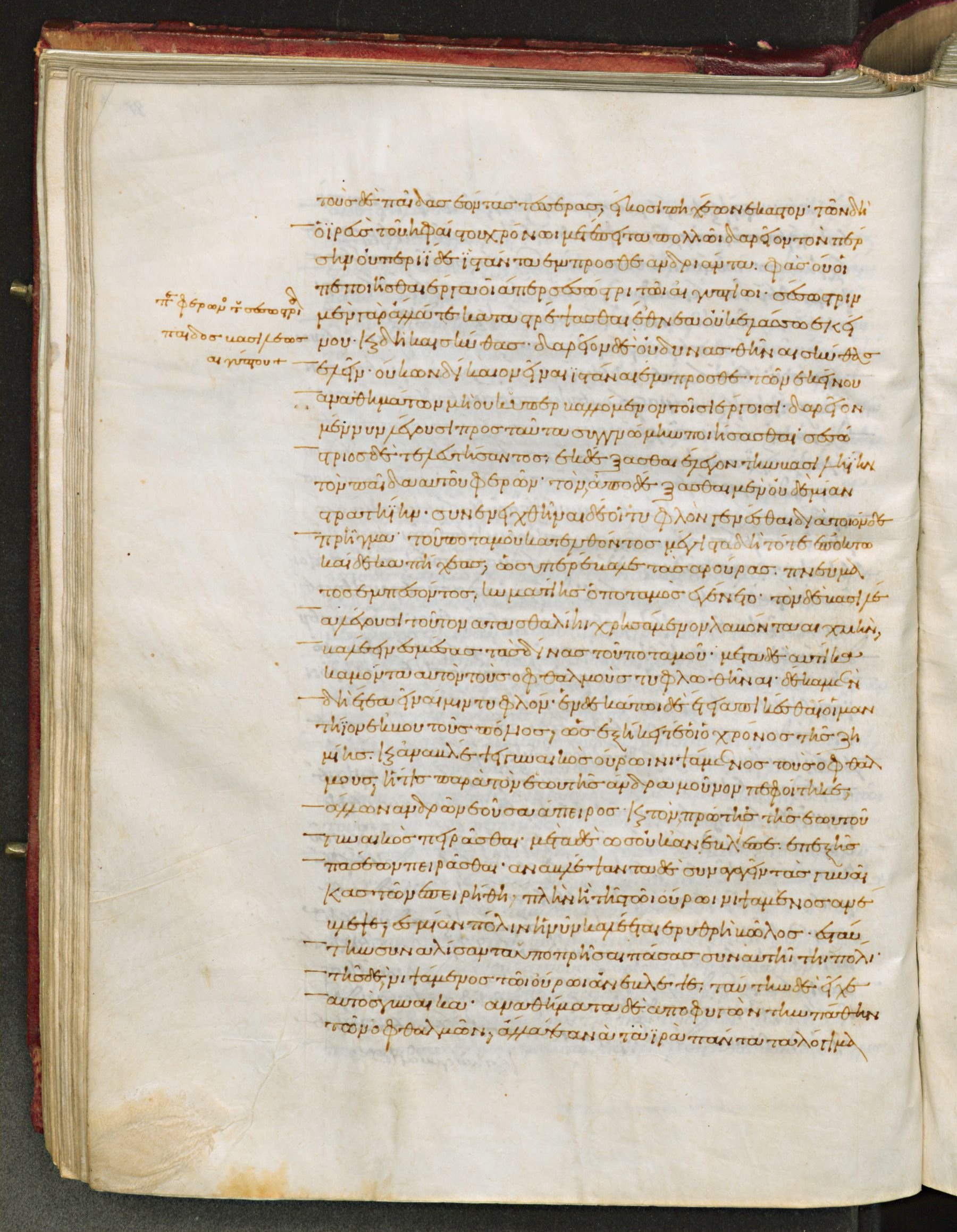
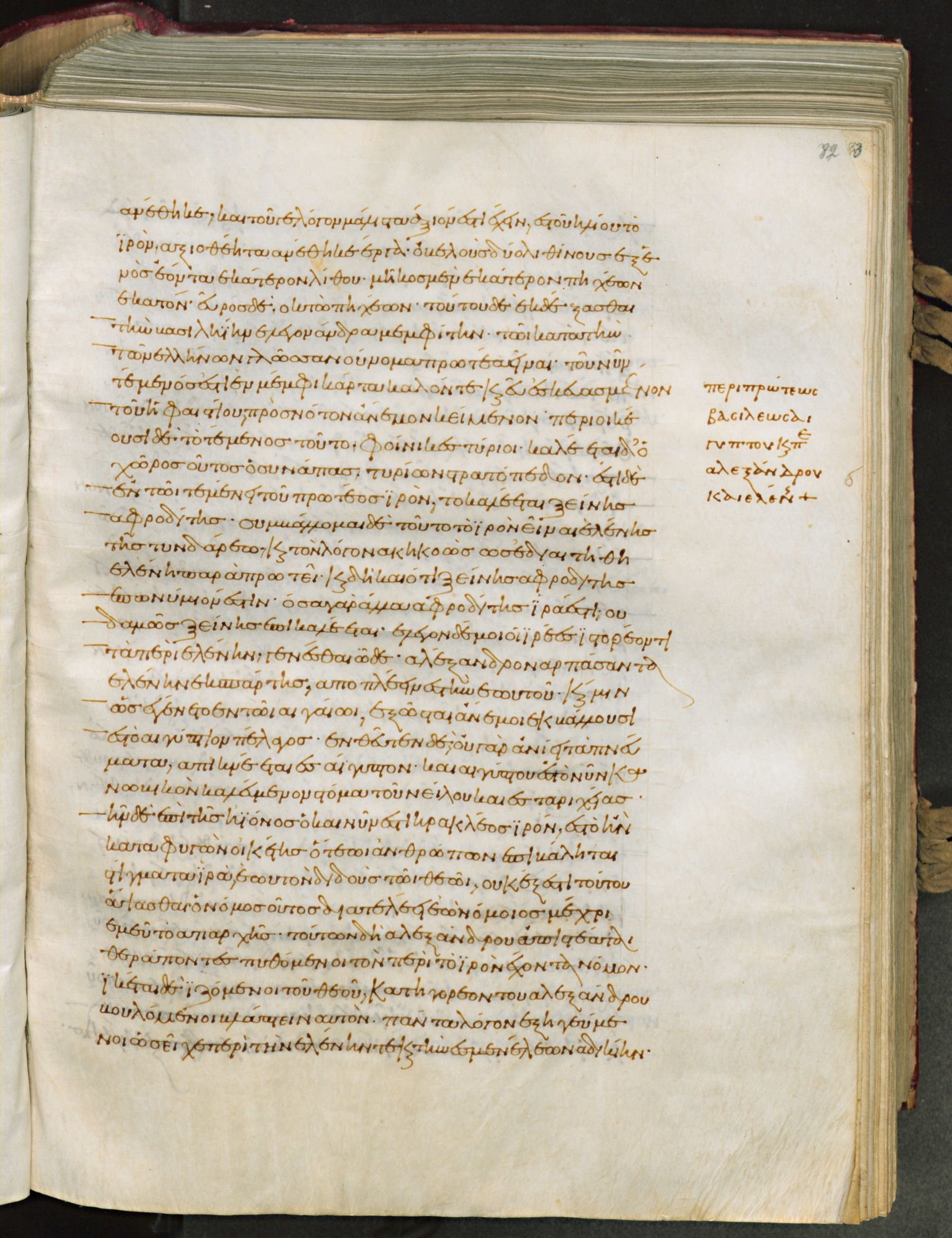
2.111 runs from fol. 81v to fol. 82r. Page breaks read on the images: fol. 81v begins 'τοὺς δὲ παῖδας ἐόντας τέσσερας' (2.110.1) and ends '...ἄλλα τε ἀνὰ τὰ ἱρὰ πάντα τὰ λόγιμα' (2.111.4); fol. 82r begins 'ἀνέθηκε καὶ τοῦ γε λόγον μάλιστα ἄξιόν ἐστι ἔχειν' (2.111.4) and ends '...τὴν Ἑλένην τε καὶ τὴν ἐς Μενέλεων ἀδικίην' (2.113.2). Checked on the image. Viewer: https://tecabml.contentdm.oclc.org/digital/collection/plutei/id/1358114
2.111Σεσώστριος δὲ τελευτήσαντος ἐκδέξασθαι ἔλεγον τὴν βασιληίην τὸν παῖδα αὐτοῦ Φερῶν, τὸν ἀποδέξασθαι μὲν οὐδεμίαν στρατηίην, συνενειχθῆναι δέ οἱ τυφλὸν γενέσθαι διὰ τοιόνδε πρῆγμα. τοῦ ποταμοῦ κατελθόντος μέγιστα δὴ τότε ἐπʼ ὀκτωκαίδεκα πήχεας, ὡς ὑπερέβαλε τὰς ἀρούρας, πνεύματος ἐμπεσόντος κυματίης ὁ ποταμὸς ἐγένετο·
τὸν δὲ βασιλέα λέγουσι τοῦτον ἀτασθαλίῃ χρησάμενον, λαβόντα αἰχμὴν βαλεῖν ἐς μέσας τὰς δίνας τοῦ ποταμοῦ, μετὰ δὲ αὐτίκα καμόντα αὐτὸν τοὺς ὀφθαλμοὺς τυφλωθῆναι. δέκα μὲν δὴ ἔτεα εἶναί μιν τυφλόν, ἑνδεκάτῳ δὲ ἔτεϊ ἀπικέσθαι οἱ μαντήιον ἐκ Βουτοῦς πόλιος ὡς ἐξήκει τέ οἱ ὁ χρόνος τῆς ζημίης καὶ ἀναβλέψει γυναικὸς οὔρῳ νιψάμενος τοὺς ὀφθαλμούς, ἥτις παρὰ τὸν ἑωυτῆς ἄνδρα μοῦνον πεφοίτηκε, ἄλλων ἀνδρῶν ἐοῦσα ἄπειρος.
καὶ τὸν πρώτης τῆς ἑωυτοῦ γυναικὸς πειρᾶσθαι, μετὰ δέ, ὡς οὐκ ἀνέβλεπε, ἐπεξῆς πασέων πειρᾶσθαι· ἀναβλέψαντα δὲ συναγαγεῖν τὰς γυναῖκας τῶν ἐπειρήθη, πλὴν ἢ τῆς τῷ οὔρῳ νιψάμενος ἀνέβλεψε, ἐς μίαν πόλιν, ἣ νῦν καλέεται Ἐρυθρὴ βῶλος· ἐς ταύτην συναλίσαντα ὑποπρῆσαι πάσας σὺν αὐτῇ τῇ πόλι·
τῆς δὲ νιψάμενος τῷ οὔρῳ ἀνέβλεψε, ταύτην δὲ ἔσχε αὐτὸς γυναῖκα. ἀναθήματα δὲ ἀποφυγὼν τὴν πάθην τῶν ὀφθαλμῶν ἄλλα τε ἀνὰ τὰ ἱρὰ πάντα τὰ λόγιμα ἀνέθηκε καὶ τοῦ γε λόγον μάλιστα ἄξιον ἐστὶ ἔχειν, ἐς τοῦ Ἡλίου τὸ ἱρὸν ἀξιοθέητα ἀνέθηκε ἔργα, ὀβελοὺς δύο λιθίνους, ἐξ ἑνὸς ἐόντα ἑκάτερον λίθου, μῆκος μὲν ἑκάτερον πηχέων ἑκατόν, εὖρος δὲ ὀκτὼ πηχέων.
2.111When Sesostris died, he was succeeded in the kingship (so said the priests) by his son Pheros. This king made no wars; and it happened that he became blind, for the following reason: the Nile came down in a flood such as never was before, rising to a height of eighteen cubits, and the water which overflowed the fields was roughened by a strong wind; then, it is said, the king was so infatuated that he took a spear and hurled it into the midst of the river eddies. Straightway after this he suffered from a disease of the eyes, and became blind. When he had been blind for ten years, an oracle from the city of Buto declared to him that the time of his punishment was drawing to an end, and that he should regain his sight by washing his eyes with the issue of a woman who had never had intercourse with any man but her own husband. Pheros made trial with his own wife first, and as he still remained blind, with all women, one after another. When he at last recovered sight, he took all the women of whom he had made trial, save only her who had made him to see again, and gathered them into one town, that which is now called “Red Clay”; where having collected them together he burnt them and the town; but the woman by whose means he had recovered sight he took to wife. Among the many offerings which he dedicated in all the noteworthy temples for his deliverance from blindness, most worthy of mention are the two marvellous stone obelisks which he set up in the temple of the Sun. Each of these is made of a single block, and is an hundred cubits high and eight cubits thick.
Notes
- Greek: the text printed in A. D. Godley's Loeb edition (1920), from Perseus. Square brackets mark words the editor considers later additions. The manuscript's wording differs from the edition in places; the Greek is the edition, not a transcription of the page.
- English: A. D. Godley's translation as printed in 1920 (Loeb Classical Library, Herodotus vol. 1), not the modernized version on Perseus. Godley's footnotes are omitted.
- Chapter 121 is divided into 121 and 121a-121f as in Godley's edition; the English is divided at the corresponding sentences.
Cite
Sources
- Source: Florence, Laur. Plut. 70.3 (10th c.) via BML Teca Digitale + Greek of Godley's Loeb (Perseus) + English of A. D. Godley (1920, Wikisource, checked against the printing) (holding institution)
- Critical edition: Greek of A. D. Godley's Loeb edition (1920), via Perseus
← previous · → next · v cycle view · l back to library