Herodotus, Histories 2.112-120: Proteus, and Helen in Egypt
Introduction
In the second book of his Histories (written c. 430 BCE) Herodotus reports what the priests of Hephaestus at Memphis told him of the kings of Egypt, from Min (Menes), who first ruled and founded Memphis, through 330 kings named from a papyrus roll, to Sesostris, Proteus, Rhampsinitus, the pyramid builders Cheops, Chephren and Mycerinus, and Sethos, priest-king in the time of Sennacherib. He ends with their chronology: 341 generations, 11,340 years, during which no god had reigned in human form and the sun had four times risen out of its usual place.
The manuscript is Florence, Biblioteca Medicea Laurenziana, Plut. 70.3, written in the 10th century, the oldest surviving manuscript of Herodotus (codex A of the editors). Chapters 2.99-146 run from fol. 78v to fol. 92v. Each section is one chapter (Godley's subdivisions of the Rhampsinitus story, 121a-f, are kept apart) and points at the page(s) that carry it; the page breaks were read on the images and are recorded in each note.
This entry covers 2.112 to 2.120, on fol. 82r to 84v.
How was this verified? (Provenance)
Where on the image
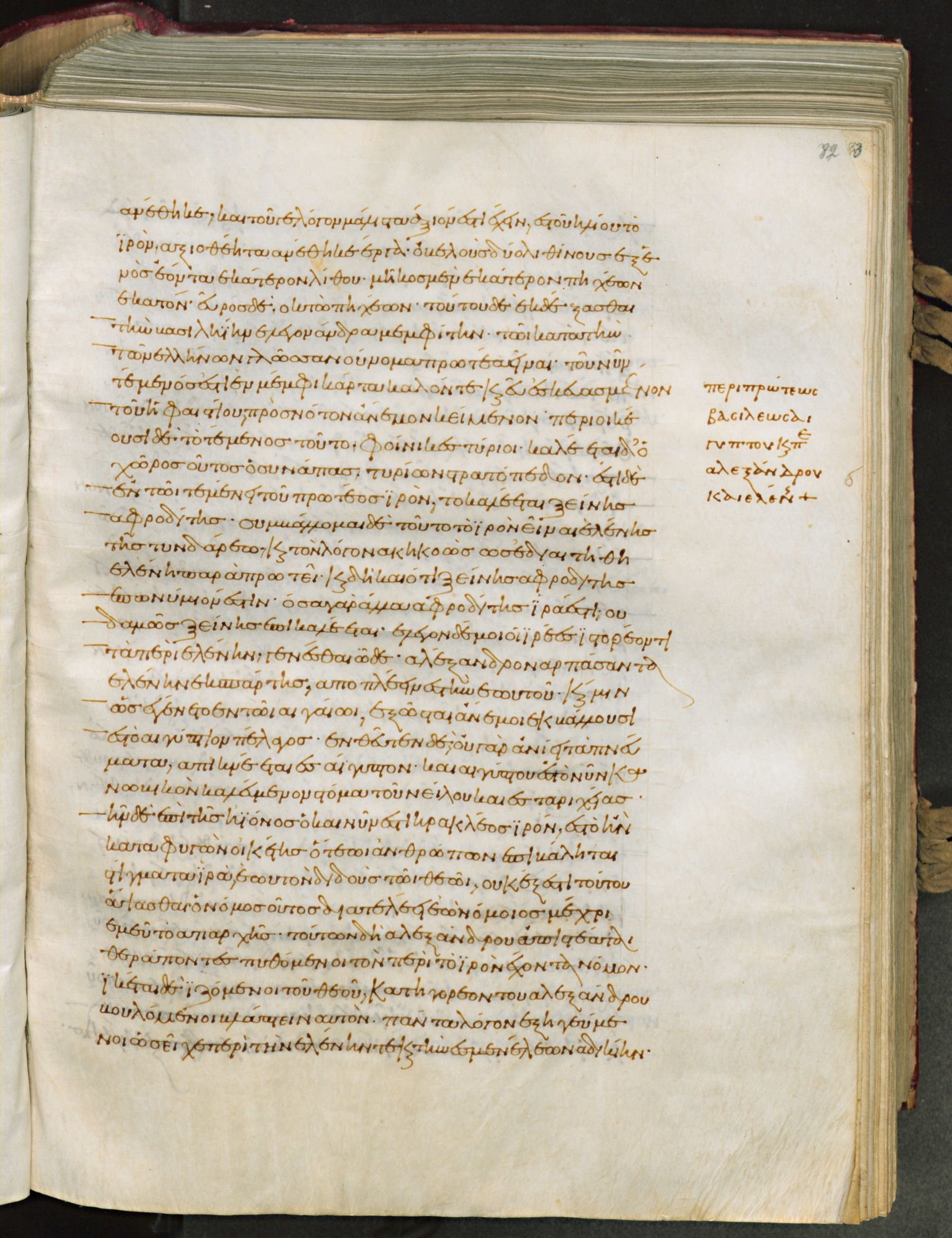
2.112 is on fol. 82r. Page breaks read on the images: fol. 82r begins 'ἀνέθηκε καὶ τοῦ γε λόγον μάλιστα ἄξιόν ἐστι ἔχειν' (2.111.4) and ends '...τὴν Ἑλένην τε καὶ τὴν ἐς Μενέλεων ἀδικίην' (2.113.2). Checked on the image. Viewer: https://tecabml.contentdm.oclc.org/digital/collection/plutei/id/1358114
2.112τούτου δὲ ἐκδέξασθαι τὴν βασιληίην ἔλεγον ἄνδρα Μεμφίτην, τῷ κατὰ τὴν Ἑλλήνων γλῶσσαν οὔνομα Πρωτέα εἶναι· τοῦ νῦν τέμενος ἐστὶ ἐν Μέμφι κάρτα καλόν τε καὶ εὖ ἐσκευασμένον, τοῦ Ἡφαιστείου πρὸς νότον ἄνεμον κείμενον.
περιοικέουσι δὲ τὸ τέμενος τοῦτο Φοίνικες Τύριοι, καλέεται δὲ ὁ χῶρος οὗτος ὁ συνάπας Τυρίων στρατόπεδον. ἔστι δὲ ἐν τῷ τεμένεϊ τοῦ Πρωτέος ἱρὸν τὸ καλέεται ξείνης Ἀφροδίτης· συμβάλλομαι δὲ τοῦτο τὸ ἱρὸν εἶναι Ἑλένης τῆς Τυνδάρεω, καὶ τὸν λόγον ἀκηκοὼς ὡς διαιτήθη Ἑλένη παρὰ Πρωτέι, καὶ δὴ καὶ ὅτι ξείνης Ἀφροδίτης ἐπώνυμον ἐστί· ὅσα γὰρ ἄλλα Ἀφροδίτης ἱρά ἐστι, οὐδαμῶς ξείνης ἐπικαλέεται.
2.112Pheros was succeeded (they said) by a man of Memphis, whose name in the Greek language was Proteus. This Proteus has a fair and well-adorned temple precinct at Memphis, lying to the south of the temple of Hephaestus. Round the precinct dwell Phoenicians of Tyre, and the whole place is called the Camp of the Tyrians. There is in the precinct of Proteus a temple entitled the temple of the Stranger Aphrodite; this I guess to be a temple of Helen, daughter of Tyndareus, partly because I have heard the story of Helen’s abiding with Proteus, and partly because it bears the name of the Stranger Aphrodite; for no other of Aphrodite’s temples is called by that name.
Where on the image
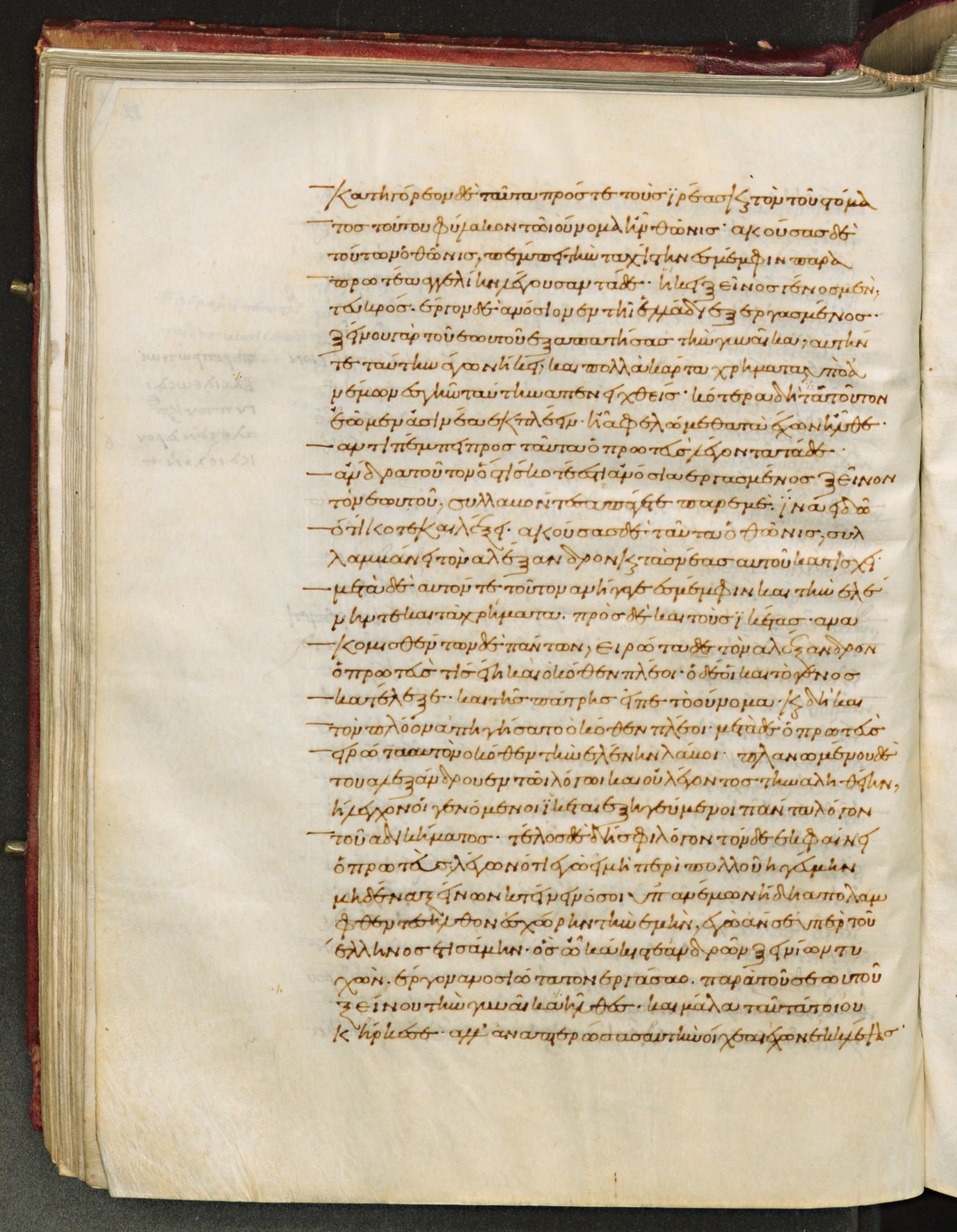
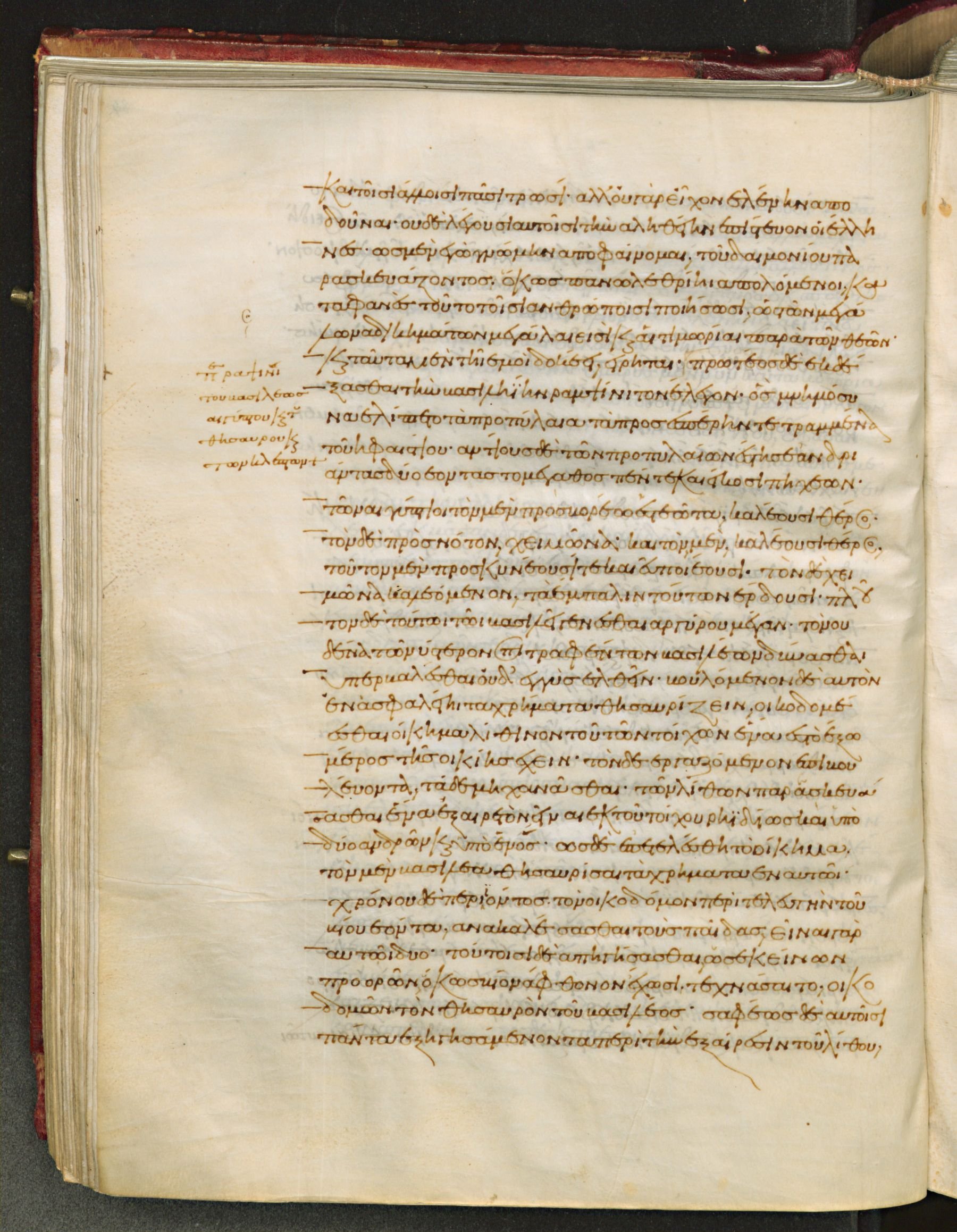
2.113 runs from fol. 82r to fol. 82v. Page breaks read on the images: fol. 82r begins 'ἀνέθηκε καὶ τοῦ γε λόγον μάλιστα ἄξιόν ἐστι ἔχειν' (2.111.4) and ends '...τὴν Ἑλένην τε καὶ τὴν ἐς Μενέλεων ἀδικίην' (2.113.2); fol. 82v begins 'κατηγόρεον δὲ ταῦτα πρός τε τοὺς ἱρέας' (2.113.3) and ends '...ἀλλ’ ἀναπτερώσας αὐτὴν οἴχεαι ἔχων ἐκκλέψας' (2.115.4). Checked on the image. Viewer: https://tecabml.contentdm.oclc.org/digital/collection/plutei/id/1358114
2.113ἔλεγον δέ μοι οἱ ἱρέες ἱστορέοντι τὰ περὶ Ἑλένην γενέσθαι ὧδε. Ἀλέξανδρον ἁρπάσαντα Ἑλένην ἐκ Σπάρτης ἀποπλέειν ἐς τὴν ἑωυτοῦ· καί μιν, ὡς ἐγένετο ἐν τῷ Αἰγαίῳ, ἐξῶσται ἄνεμοι ἐκβάλλουσι ἐς τὸ Αἰγύπτιον πέλαγος, ἐνθεῦτεν δέ, οὐ γὰρ ἀνιεῖ τὰ πνεύματα, ἀπικνέεται ἐς Αἴγυπτον καὶ Αἰγύπτου ἐς τὸ νῦν Κανωβικὸν καλεύμενον στόμα τοῦ Νείλου καὶ ἐς Ταριχείας.
ἦν δὲ ἐπὶ τῆς ἠιόνος τὸ καὶ νῦν ἐστι Ἡρακλέος ἱρόν, ἐς τὸ ἢν καταφυγὼν οἰκέτης ὅτευ ὦν ἀνθρώπων ἐπιβάληται στίγματα ἱρά, ἑωυτὸν διδοὺς τῷ θεῷ, οὐκ ἔξεστι τούτου ἅψασθαι.
ὁ νόμος οὗτος διατελέει ἐὼν ὅμοιος μέχρι ἐμεῦ τῷ ἀπʼ ἀρχῆς· τοῦ ὦν δὴ Ἀλεξάνδρου ἀπιστέαται θεράποντες πυθόμενοι τὸν περὶ τὸ ἱρὸν ἔχοντα νόμον, ἱκέται δὲ ἱζόμενοι τοῦ θεοῦ κατηγόρεον τοῦ Ἀλεξάνδρου, βουλόμενοι βλάπτειν αὐτόν, πάντα λόγον ἐξηγεύμενοι ὡς εἶχε περὶ τὴν Ἑλένην τε καὶ τὴν ἐς Μενέλεων ἀδικίην· κατηγόρεον δὲ ταῦτα πρός τε τοὺς ἱρέας καὶ τὸν στόματος τούτου φύλακον, τῷ οὔνομα ἦν Θῶνις.
2.113When I enquired of the priests, they told me that this was the story of Helen:—After carrying off Helen from Sparta, Alexandrus sailed away for his own country; violent winds caught him in the Aegean, and drove him into the Egyptian sea; whence (the wind not abating) he came to Egypt, to the mouth of the Nile called the Canopic mouth, and to the Salting-places. Now there was on the coast (and still is) a temple of Heracles; where if a servant of any man take refuge and be branded with certain sacred marks in token that he delivers himself to the god, such an one may not be touched. This law continues to-day the same as it has ever been from the first. Hearing of the temple law, certain of Alexandrus’ servants separated themselves from him, threw themselves on the mercy of the god, and brought an accusation against Alexandrus with intent to harm him, telling all the story of Helen and the wrong done to Menelaus. They laid this accusation before the priests and the warden of the Nile mouth, whose name was Thonis.
Where on the image
2.114 is on fol. 82v. Page breaks read on the images: fol. 82v begins 'κατηγόρεον δὲ ταῦτα πρός τε τοὺς ἱρέας' (2.113.3) and ends '...ἀλλ’ ἀναπτερώσας αὐτὴν οἴχεαι ἔχων ἐκκλέψας' (2.115.4). Checked on the image. Viewer: https://tecabml.contentdm.oclc.org/digital/collection/plutei/id/1358114
2.114ἀκούσας δὲ τούτων ὁ Θῶνις πέμπει τὴν ταχίστην ἐς Μέμφιν παρὰ Πρωτέα ἀγγελίην λέγουσαν τάδε.
ἥκει ξεῖνος γένος μὲν Τευκρός, ἔργον δὲ ἀνόσιον ἐν τῇ Ἑλλάδι ἐξεργασμένος· ξείνου γὰρ τοῦ ἑωυτοῦ ἐξαπατήσας τὴν γυναῖκα αὐτήν τε ταύτην ἄγων ἥκει καὶ πολλὰ κάρτα χρήματα, ὑπὸ ἀνέμων ἐς γῆν ταύτην ἀπενειχθείς. κότερα δῆτα τοῦτον ἐῶμεν ἀσινέα ἐκπλέειν ἢ ἀπελώμεθα τὰ ἔχων ἦλθε;
ἀντιπέμπει πρὸς ταῦτα ὁ Πρωτεὺς λέγοντα τάδε. ἄνδρα τοῦτον, ὅστις κοτὲ ἐστὶ ἀνόσια ἐργασμένος ξεῖνον τὸν ἑωυτοῦ, συλλαβόντες ἀπάγετε παρʼ ἐμέ, ἵνα εἰδέω ὅ τι κοτὲ καὶ λέξει.
2.114When Thonis heard it, he sent this message with all speed to Proteus at Memphis: “There has come hither a Teucrian stranger who has done great wrong in Hellas. He has deceived his host and robbed him of his wife, and brought her hither driven to your country by the wind, with very great store of wealth besides. Shall we suffer him to sail away unharmed, or take away from him that which he has brought?” Proteus sent back this message: “Whoever be this man who has done a wrong to his own host, seize him and bring him to me, that I may know what he will say.”
Where on the image
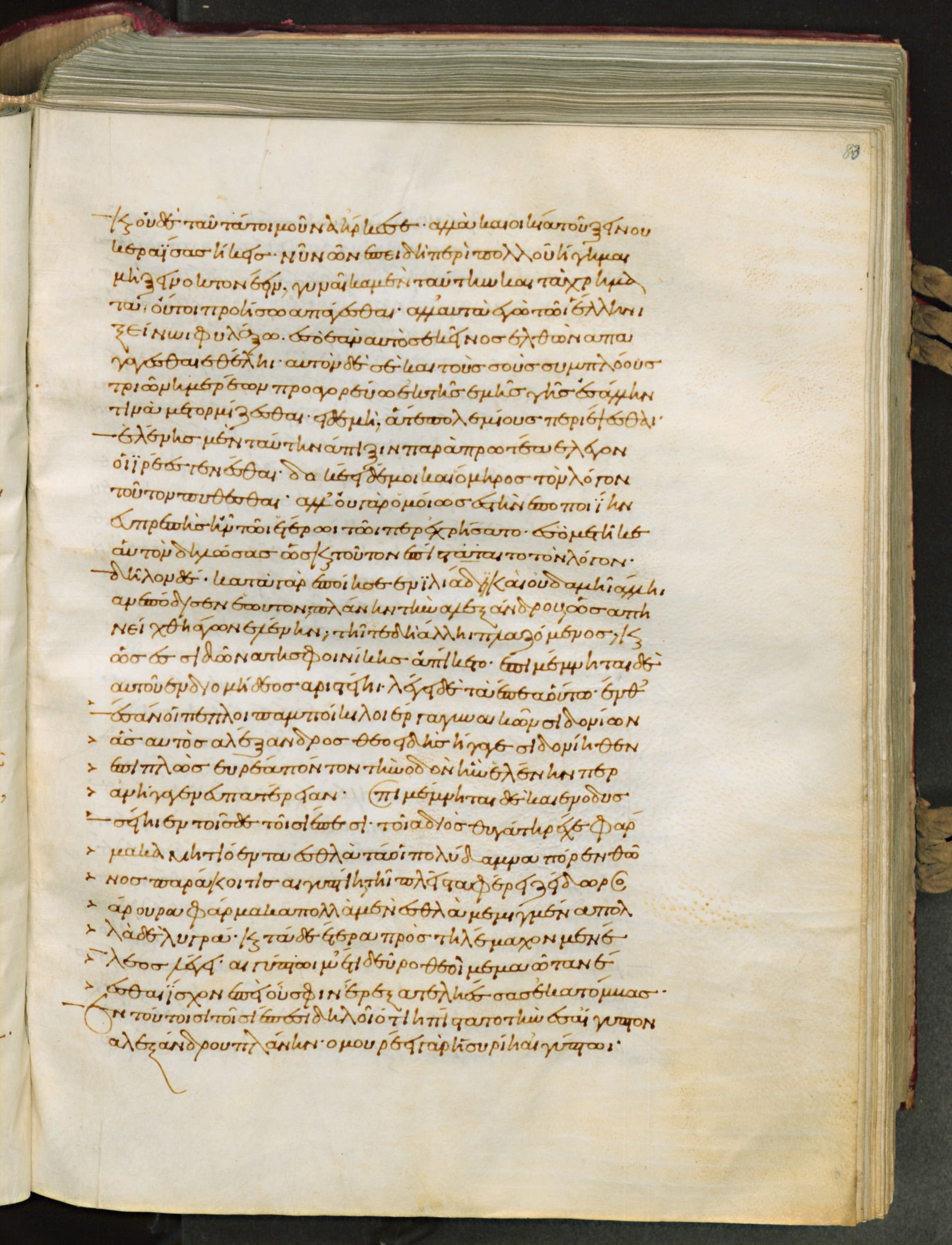
2.115 runs from fol. 82v to fol. 83r. Page breaks read on the images: fol. 82v begins 'κατηγόρεον δὲ ταῦτα πρός τε τοὺς ἱρέας' (2.113.3) and ends '...ἀλλ’ ἀναπτερώσας αὐτὴν οἴχεαι ἔχων ἐκκλέψας' (2.115.4); fol. 83r begins 'καὶ οὐδὲ ταῦτά τοι μοῦνα' (2.115.5) and ends '...ὁμουρέει γὰρ ἡ Συρίη Αἰγύπτῳ' (2.116.6). Checked on the image. Viewer: https://tecabml.contentdm.oclc.org/digital/collection/plutei/id/1358114
2.115ἀκούσας δὲ ταῦτα ὁ Θῶνις συλλαμβάνει τὸν Ἀλέξανδρον καὶ τὰς νέας αὐτοῦ κατίσχει, μετὰ δὲ αὐτόν τε τοῦτον ἀνήγαγε ἐς Μέμφιν καὶ τὴν Ἑλένην τε καὶ τὰ χρήματα, πρὸς δὲ καὶ τοὺς ἱκέτας.
ἀνακομισθέντων δὲ πάντων, εἰρώτα τὸν Ἀλέξανδρον ὁ Πρωτεὺς τίς εἴη καὶ ὁκόθεν πλέοι. ὁ δέ οἱ καὶ τὸ γένος κατέλεξε καὶ τῆς πάτρης εἶπε τὸ οὔνομα, καὶ δὴ καὶ τὸν πλόον ἀπηγήσατο ὁκόθεν πλέοι.
μετὰ δὲ ὁ Πρωτεὺς εἰρώτα αὐτὸν ὁκόθεν τὴν Ἑλένην λάβοι· πλανωμένου δὲ τοῦ Ἀλεξάνδρου ἐν τῷ λόγῳ καὶ οὐ λέγοντος τὴν ἀληθείην, ἤλεγχον οἱ γενόμενοι ἱκέται, ἐξηγεύμενοι πάντα λόγον τοῦ ἀδικήματος.
τέλος δὲ δή σφι λόγον τόνδε ἐκφαίνει ὁ Πρωτεύς, λέγων ὅτι ἐγὼ εἰ μὴ περὶ πολλοῦ ἡγεύμην μηδένα ξείνων κτείνειν, ὅσοι ὑπʼ ἀνέμων ἤδη ἀπολαμφθέντες ἦλθον ἐς χώρην τὴν ἐμήν, ἐγὼ ἄν σε ὑπὲρ τοῦ Ἕλληνος ἐτισάμην, ὅς, ὦ κάκιστε ἀνδρῶν, ξεινίων τυχὼν ἔργον ἀνοσιώτατον ἐργάσαο· παρὰ τοῦ σεωυτοῦ ξείνου τὴν γυναῖκα ἦλθες. καὶ μάλα ταῦτά τοι οὐκ ἤρκεσε, ἀλλʼ ἀναπτερώσας αὐτὴν οἴχεαι ἔχων ἐκκλέψας.
καὶ οὐδὲ ταῦτά τοι μοῦνα ἤρκεσε, ἀλλὰ καὶ οἰκία τοῦ ξείνου κεραΐσας ἥκεις.
νῦν ὦν ἐπειδὴ περὶ πολλοῦ ἥγημαι μὴ ξεινοκτονέειν, γυναῖκα μὲν ταύτην καὶ τὰ χρήματα οὔ τοι προήσω ἀπάγεσθαι, ἀλλʼ αὐτὰ ἐγὼ τῷ Ἕλληνι ξείνῳ φυλάξω, ἐς ὃ ἂν αὐτὸς ἐλθὼν ἐκεῖνος ἀπαγαγέσθαι ἐθέλῃ· αὐτὸν δέ σε καὶ τοὺς σοὺς συμπλόους τριῶν ἡμερέων προαγορεύω ἐκ τῆς ἐμῆς γῆς ἐς ἄλλην τινὰ μετορμίζεσθαι, εἰ δὲ μή, ἅτε πολεμίους περιέψεσθαι.
2.115Hearing this, Thonis seized Alexandrus and held his ships there, and presently brought him with Helen and all the wealth, and the suppliants therewith, to Memphis. All having come thither, Proteus asked Alexandrus who he was and whence he sailed; Alexandrus told him of his lineage and the name of his country, and of his voyage, whence he sailed. Then Proteus asked him whence he had taken Helen; Alexandrus made no straightforward or truthful answer; but the men who had taken refuge with the temple disproved his tale, and related the whole story of the wrongful act. When all was said, Proteus thus gave sentence:—“Were I not careful to slay no stranger who has ever been caught by the wind and driven to my coasts, I would have avenged that Greek upon you; seeing that, O basest of men! you have done foul wrong to him who hospitably entreated you, and have entered in to the wife of your own host. Nay, and this did not suffice you; you made her to fly with you and stole her away. Nor was even this enough, but you have come hither with the plunder of your host’s house. Now, therefore, since I am careful to slay no stranger, I will not suffer you to take away this woman and these possessions; I will keep them for the Greek stranger, till such time as he shall himself come to take them away; but as for you and the companions of your voyage, I warn you to depart from my country elsewhither within three days, else I will deal with you as with enemies.”
Where on the image
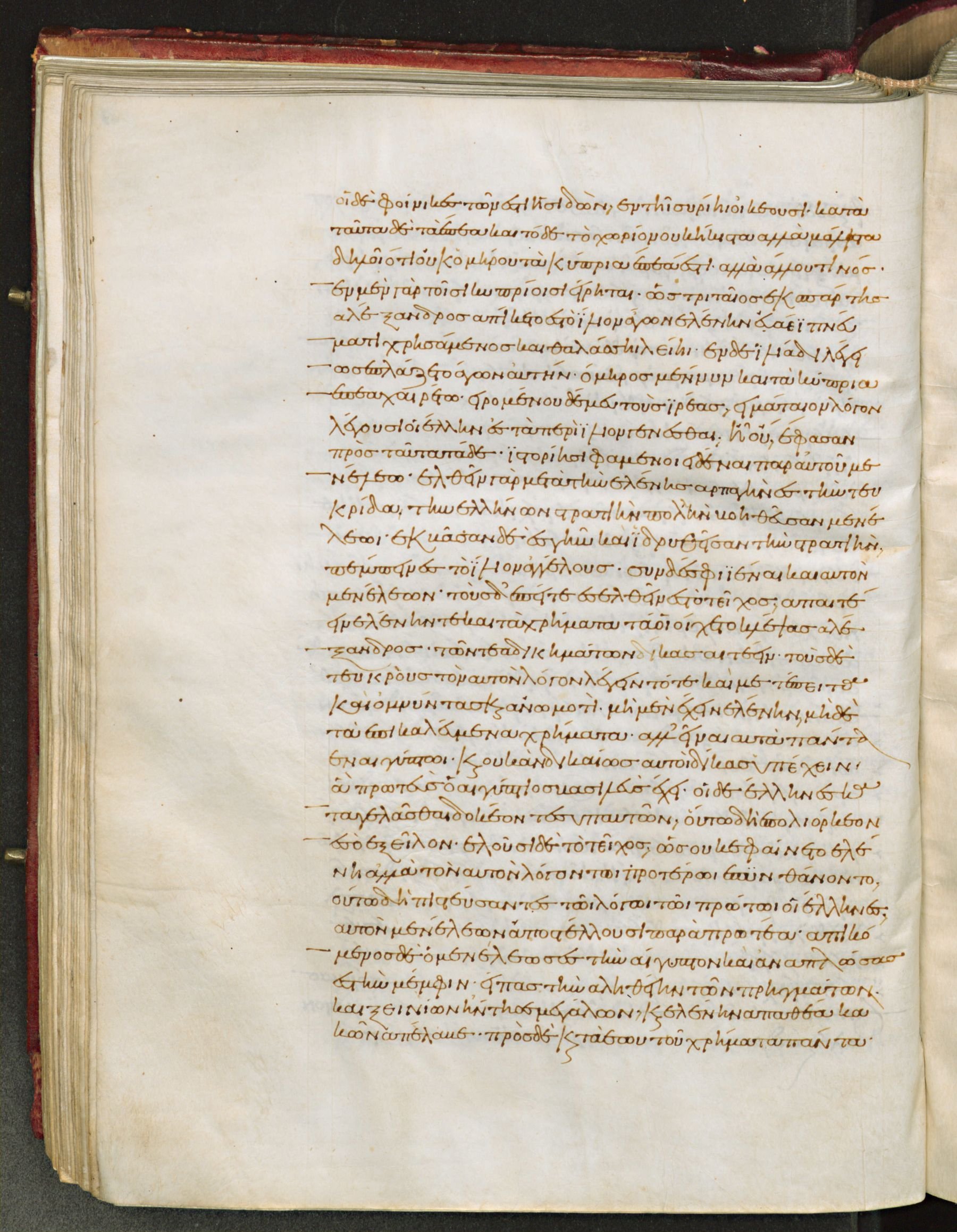
2.116 runs from fol. 83r to fol. 83v. Page breaks read on the images: fol. 83r begins 'καὶ οὐδὲ ταῦτά τοι μοῦνα' (2.115.5) and ends '...ὁμουρέει γὰρ ἡ Συρίη Αἰγύπτῳ' (2.116.6); fol. 83v begins 'οἱ δὲ Φοίνικες, τῶν ἡ Σιδών, ἐν τῇ Συρίῃ οἰκέουσι' (2.116.6) and ends '...πρὸς δὲ καὶ τὰ ἑωυτοῦ χρήματα πάντα' (2.119.1). Checked on the image. Viewer: https://tecabml.contentdm.oclc.org/digital/collection/plutei/id/1358114
2.116Ἑλένης μὲν ταύτην ἄπιξιν παρὰ Πρωτέα ἔλεγον οἱ ἱρέες γενέσθαι· δοκέει δέ μοι καὶ Ὅμηρος τὸν λόγον τοῦτον πυθέσθαι· ἀλλʼ οὐ γὰρ ὁμοίως ἐς τὴν ἐποποιίην εὐπρεπὴς ἦν τῷ ἑτέρῳ τῷ περ ἐχρήσατο, ἑκὼν μετῆκε αὐτόν, δηλώσας ὡς καὶ τοῦτον ἐπίσταιτο τὸν λόγον·
δῆλον δὲ κατὰ [γὰρ] ἐποίησε ἐν Ἰλιάδι (καὶ οὐδαμῇ ἄλλῃ ἀνεπόδισε ἑωυτόν) πλάνην τὴν Ἀλεξάνδρου, ὡς ἀπηνείχθη ἄγων Ἑλένην τῇ τε δὴ ἄλλῃ πλαζόμενος καὶ ὡς ἐς Σιδῶνα τῆς Φοινίκης ἀπίκετο.
ἐπιμέμνηται δὲ αὐτοῦ ἐν Διομήδεος ἀριστείῃ· λέγει δὲ τὰ ἔπεα ὧδε.
ἔνθʼ ἔσαν οἱ πέπλοι παμποίκιλοι, ἔργα γυναικῶν
Σιδονίων, τὰς αὐτὸς Ἀλέξανδρος θεοειδής
ἤγαγε Σιδονίηθεν, ἐπιπλὼς εὐρέα πόντον,
τὴν ὁδὸν ἣν Ἑλένην περ ἀνήγαγεν εὐπατέρειαν.
ἐπιμέμνηται δὲ καὶ ἐν Ὀδυσσείῃ ἐν τοῖσιδε τοῖσι ἔπεσι.
τοῖα Διὸς θυγάτηρ ἔχε φάρμακα μητιόεντα,
ἐσθλά, τά οἱ Πολύδαμνα πόρεν Θῶνος παράκοιτις
Αἰγυπτίη, τῇ πλεῖστα φέρει ζείδωρος ἄρουρα
φάρμακα, πολλὰ μὲν ἐσθλὰ μεμιγμένα, πολλὰ δὲ λυγρά.
καὶ τάδε ἕτερα πρὸς Τηλέμαχον Μενέλεως λέγει.
Αἰγύπτῳ μʼ ἔτι δεῦρο θεοὶ μεμαῶτα νέεσθαι
ἔσχον, ἐπεὶ οὔ σφιν ἔρεξα τεληέσσας ἑκατόμβας.
ἐν τούτοισι τοῖσι ἔπεσι δηλοῖ ὅτι ἠπίστατο τὴν ἐς Αἴγυπτον Ἀλεξάνδρου πλάνην· ὁμουρέει γὰρ ἡ Συρίη Αἰγύπτῳ, οἱ δὲ Φοίνικες, τῶν ἐστὶ ἡ Σιδών, ἐν τῇ Συρίῃ οἰκέουσι.
2.116This, by what the priests told me, was the manner of Helen’s coming to Proteus. And, to my thinking, Homer too knew this story; but seeing that it suited not so well with epic poetry as the tale of which he made use, he rejected it of set purpose, showing withal that he knew it. This is plain, from the passage in the Iliad (and nowhere else does he return to the story) where he relates the wanderings of Alexandrus, and shows how he with Helen was carried out of his course, among other places, to Sidon in Phoenice. This is in the story of the Feats of Diomedes, where the verses run as follows:
There were the robes in his house, inwrought with manifold colours, Work of the women of Sidon, whom godlike Paris aforetime Brought from their eastern town, o’er wide seas voyaging thither, E’en when he won from her home fair Helen, the daughter of princes.
He makes mention of it in the Odyssey also:
Suchlike drugs of grace, for a healing cunningly mingled, Once in the land of Nile had the wife of Thon, Polydamna, Giv’n to the daughter of Zeus; for there of the country’s abundance, Potent to heal or to harm, are herbs full many engendered:
and again Menelaus says to Telemachus:
Eager was I to return, but the gods fast held me in Egypt, Wroth that I honoured them not nor offered a sacrifice duly.
In these verses the poet shows that he knew of Alexandrus’ wanderings to Egypt; for Syria borders on Egypt, and the Phoenicians, to whom Sidon belongs, dwell in Syria.
Where on the image
2.117 is on fol. 83v. Page breaks read on the images: fol. 83v begins 'οἱ δὲ Φοίνικες, τῶν ἡ Σιδών, ἐν τῇ Συρίῃ οἰκέουσι' (2.116.6) and ends '...πρὸς δὲ καὶ τὰ ἑωυτοῦ χρήματα πάντα' (2.119.1). Checked on the image. Viewer: https://tecabml.contentdm.oclc.org/digital/collection/plutei/id/1358114
2.117κατὰ ταῦτα δὲ τὰ ἔπεα καὶ τόδε τὸ χωρίον οὐκ ἥκιστα ἀλλὰ μάλιστα δηλοῖ ὅτι οὐκ Ὁμήρου τὰ Κύπρια ἔπεα ἐστὶ ἀλλʼ ἄλλου τινός. ἐν μὲν γὰρ τοῖσι Κυπρίοισι εἴρηται ὡς τριταῖος ἐκ Σπάρτης Ἀλέξανδρος ἀπίκετο ἐς τὸ Ἴλιον ἄγων Ἑλένην, εὐαέι τε πνεύματι χρησάμενος καὶ θαλάσσῃ λείῃ· ἐν δὲ Ἰλιάδι λέγει ὡς ἐπλάζετο ἄγων αὐτήν.
2.117These verses and this passage prove most clearly that the Cyprian poems are by the hand not of Homer but of another. For the Cyprian poems relate that Alexandrus reached Ilion with Helen in three days from Sparta, having a fair wind and a smooth sea; but according to the Iliad he wandered from his course in bringing her.
Where on the image
2.118 is on fol. 83v. Page breaks read on the images: fol. 83v begins 'οἱ δὲ Φοίνικες, τῶν ἡ Σιδών, ἐν τῇ Συρίῃ οἰκέουσι' (2.116.6) and ends '...πρὸς δὲ καὶ τὰ ἑωυτοῦ χρήματα πάντα' (2.119.1). Checked on the image. Viewer: https://tecabml.contentdm.oclc.org/digital/collection/plutei/id/1358114
2.118Ὅμηρος μέν νυν καὶ τὰ Κύπρια ἔπεα χαιρέτω. εἰρομένου δέ μευ τοὺς ἱρέας εἰ μάταιον λόγον λέγουσι οἱ Ἕλληνες τὰ περὶ Ἴλιον γενέσθαι ἢ οὔ, ἔφασαν πρὸς ταῦτα τάδε, ἱστορίῃσι φάμενοι εἰδέναι παρʼ αὐτοῦ Μενέλεω.
ἐλθεῖν μὲν γὰρ μετὰ τὴν Ἑλένης ἁρπαγὴν ἐς τὴν Τευκρίδα γῆν Ἑλλήνων στρατιὴν πολλὴν βοηθεῦσαν Μενέλεῳ, ἐκβᾶσαν δὲ ἐς γῆν καὶ ἱδρυθεῖσαν τὴν στρατιὴν πέμπειν ἐς τὸ Ἴλιον ἀγγέλους, σὺν δέ σφι ἰέναι καὶ αὐτὸν Μενέλεων·
τοὺς δʼ ἐπείτε ἐσελθεῖν ἐς τὸ τεῖχος, ἀπαιτέειν Ἑλένην τε καὶ τὰ χρήματα τά οἱ οἴχετο κλέψας Ἀλέξανδρος, τῶν τε ἀδικημάτων δίκας αἰτέειν· τοὺς δὲ Τευκροὺς τὸν αὐτὸν λόγον λέγειν τότε καὶ μετέπειτα, καὶ ὀμνύντας καὶ ἀνωμοτί, μὴ μὲν ἔχειν Ἑλένην μηδὲ τὰ ἐπικαλεύμενα χρήματα, ἀλλʼ εἶναι αὐτὰ πάντα ἐν Αἰγύπτῳ, καὶ οὐκ ἂν δικαίως αὐτοὶ δίκας ὑπέχειν τῶν Πρωτεὺς ὁ Αἰγύπτιος βασιλεὺς ἔχει.
οἱ δὲ Ἕλληνες καταγελᾶσθαι δοκέοντες ὑπʼ αὐτῶν οὕτω δὴ ἐπολιόρκεον, ἐς ὃ ἐξεῖλον· ἑλοῦσι δὲ τὸ τεῖχος ὡς οὐκ ἐφαίνετο ἡ Ἑλένη, ἀλλὰ τὸν αὐτὸν λόγον τῷ προτέρῳ ἐπυνθάνοντο, οὕτω δὴ πιστεύσαντες τῷ λόγῳ τῷ πρώτῳ οἱ Ἕλληνες αὐτὸν Μενέλεων ἀποστέλλουσι παρὰ Πρωτέα.
2.118Enough, then, of Homer and the Cyprian poems. But when I asked the priests whether the Greek account of the Trojan business were vain or true, they gave me the following answer, saying that they had inquired and knew what Menelaus himself had said:—After the rape of Helen, a great host of Greeks came to the Teucrian land on Menelaus’ behalf. Having there disembarked and encamped, they sent to Ilion messengers, of whom Menelaus himself was one. These, on coming within the city walls, demanded restitution of Helen and the possessions which Alexandrus had stolen from Menelaus and carried off, and reparation besides for the wrong done; but the Teucrians then and ever afterwards declared, with oaths and without, that neither Helen nor the goods claimed were with them, she and they being in Egypt; nor could they (so they said) justly make reparation for what was in the hands of the Egyptian king Proteus. But the Greeks thought that the Trojans mocked them, and therewith besieged the city, till they took it; and it was not till they took the fortress and found no Helen there, and heard the same declaration as before, that they gave credence to the Trojans’ first word and so sent Menelaus himself to Proteus.
Where on the image
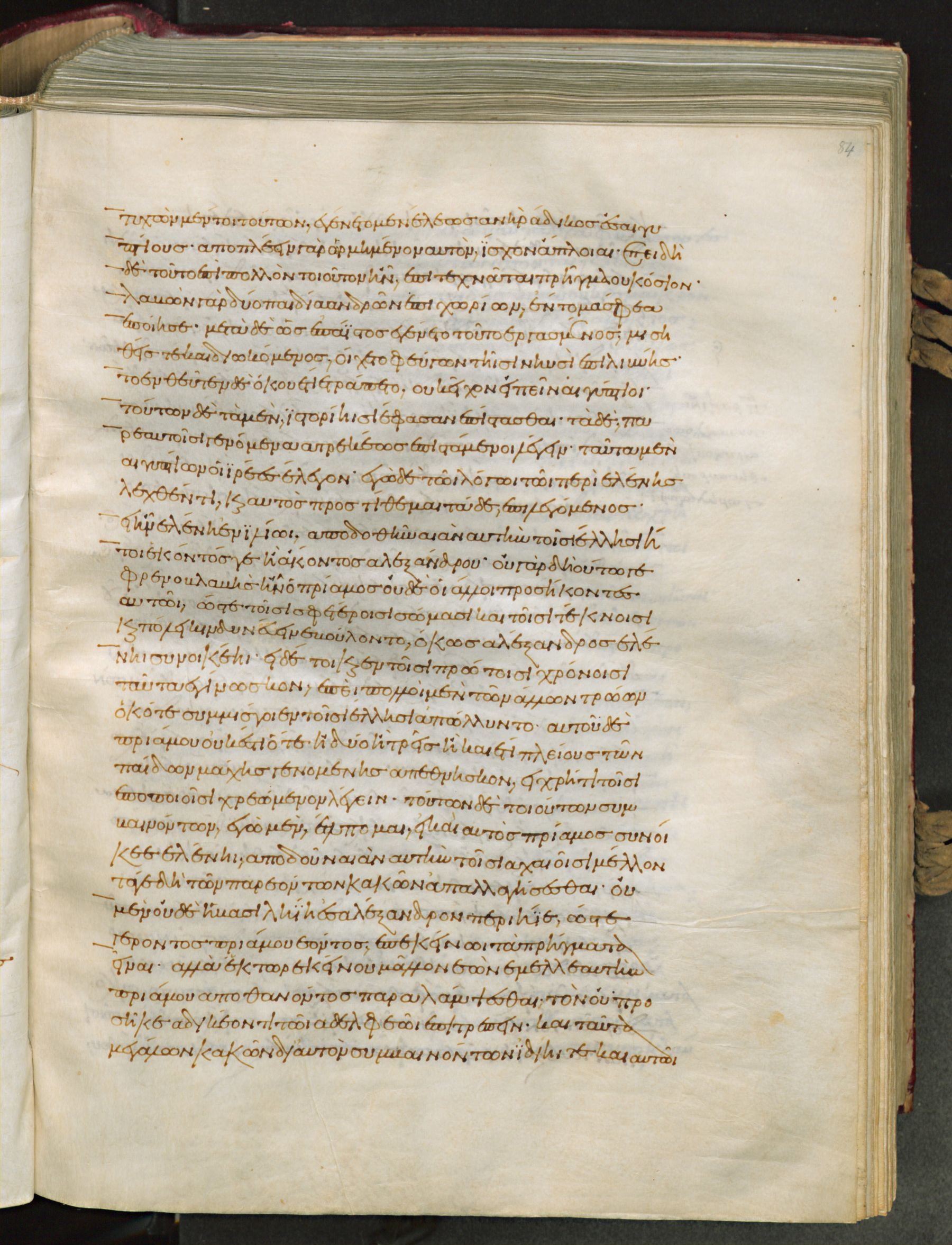
2.119 runs from fol. 83v to fol. 84r. Page breaks read on the images: fol. 83v begins 'οἱ δὲ Φοίνικες, τῶν ἡ Σιδών, ἐν τῇ Συρίῃ οἰκέουσι' (2.116.6) and ends '...πρὸς δὲ καὶ τὰ ἑωυτοῦ χρήματα πάντα' (2.119.1); fol. 84r begins 'τυχὼν μέντοι τούτων ἐγένετο Μενέλεως ἀνὴρ ἄδικος' (2.119.2) and ends '...συμβαινόντων ἰδίῃ τε αὐτῷ' (2.120.4). Checked on the image. Viewer: https://tecabml.contentdm.oclc.org/digital/collection/plutei/id/1358114
2.119ἀπικόμενος δὲ ὁ Μενέλεως ἐς τὴν Αἴγυπτον καὶ ἀναπλώσας ἐς τὴν Μέμφιν, εἴπας τὴν ἀληθείην τῶν πρηγμάτων, καὶ ξεινίων ἤντησε μεγάλων καὶ Ἑλένην ἀπαθέα κακῶν ἀπέλαβε, πρὸς δὲ καὶ τὰ ἑωυτοῦ χρήματα πάντα.
τυχὼν μέντοι τούτων ἐγένετο Μενέλεως ἀνὴρ ἄδικος ἐς Αἰγυπτίους. ἀποπλέειν γὰρ ὁρμημένον αὐτὸν ἶσχον ἄπλοιαι· ἐπειδὴ δὲ τοῦτο ἐπὶ πολλὸν τοιοῦτον ἦν, ἐπιτεχνᾶται πρῆγμα οὐκ ὅσιον·
λαβὼν γὰρ δύο παιδία ἀνδρῶν ἐπιχωρίων ἔντομα σφέα ἐποίησε. μετὰ δὲ ὡς ἐπάιστος ἐγένετο τοῦτο ἐργασμένος, μισηθείς τε καὶ διωκόμενος οἴχετο φεύγων τῇσι νηυσὶ ἐπὶ Λιβύης· τὸ ἐνθεῦτεν δὲ ὅκου ἔτι ἐτράπετο οὐκ εἶχον εἰπεῖν Αἰγύπτιοι. τούτων δὲ τὰ μὲν ἱστορίῃσι ἔφασαν ἐπίστασθαι, τὰ δὲ παρʼ ἑωυτοῖσι γενόμενα ἀτρεκέως ἐπιστάμενοι λέγειν.
2.119Menelaus then came to Egypt and went up the river to Memphis; there, telling the whole truth of what had happened, he was very hospitably entertained and received back Helen unharmed and all his possessions withal. Yet, albeit so well entreated, Menelaus did the Egyptians a wrong. For when he would have sailed away he was stayed by stress of weather; and this hindrance continuing for long, he devised and did a forbidden deed, taking two children of the land and sacrificing them. When it was known that he had so done, the people hated and pursued him, and he fled away with his ships to Libya; and whither he thence betook himself the Egyptians could not say. The priests told me that they had learnt some of this tale by inquiry, but that they spoke with exact knowledge of what had happened in their own country.
Where on the image
2.120 runs from fol. 84r to fol. 84v. Page breaks read on the images: fol. 84r begins 'τυχὼν μέντοι τούτων ἐγένετο Μενέλεως ἀνὴρ ἄδικος' (2.119.2) and ends '...συμβαινόντων ἰδίῃ τε αὐτῷ' (2.120.4); fol. 84v begins 'καὶ τοῖσι ἄλλοισι πᾶσι Τρωσί' (2.120.4) and ends '...τὰ περὶ τὴν ἐξαίρεσιν τοῦ λίθου' (2.121a.2). Checked on the image. Viewer: https://tecabml.contentdm.oclc.org/digital/collection/plutei/id/1358114
2.120ταῦτα μὲν Αἰγυπτίων οἱ ἱρέες ἔλεγον· ἐγὼ δὲ τῷ λόγῳ τῷ περὶ Ἑλένης λεχθέντι καὶ αὐτὸς προστίθεμαι, τάδε ἐπιλεγόμενος, εἰ ἦν Ἑλένη ἐν Ἰλίῳ, ἀποδοθῆναι ἂν αὐτὴν τοῖσι Ἕλλησι ἤτοι ἑκόντος γε ἢ ἀέκοντος Ἀλεξάνδρου.
οὐ γὰρ δὴ οὕτω γε φρενοβλαβὴς ἦν ὁ Πρίαμος οὐδὲ οἱ ἄλλοι οἱ προσήκοντες αὐτῷ, ὥστε τοῖσι σφετέροισι σώμασι καὶ τοῖσι τέκνοισι καὶ τῇ πόλι κινδυνεύειν ἐβούλοντο, ὅκως Ἀλέξανδρος Ἑλένῃ συνοικέῃ.
εἰ δέ τοι καὶ ἐν τοῖσι πρώτοισι χρόνοισι ταῦτα ἐγίνωσκον, ἐπεὶ πολλοὶ μὲν τῶν ἄλλων Τρώων, ὁκότε συμμίσγοιεν τοῖσι Ἕλλησι, ἀπώλλυντο, αὐτοῦ δὲ Πριάμου οὐκ ἔστι ὅτε οὐ δύο ἢ τρεῖς ἢ καὶ ἔτι πλέους τῶν παίδων μάχης γινομένης ἀπέθνησκον, εἰ χρή τι τοῖσι ἐποποιοῖσι χρεώμενον λέγειν, τούτων δὲ τοιούτων συμβαινόντων ἐγὼ μὲν ἔλπομαι, εἰ καὶ αὐτὸς Πρίαμος συνοίκεε Ἑλένῃ, ἀποδοῦναι ἂν αὐτὴν τοῖσι Ἀχαιοῖσι, μέλλοντά γε δὴ τῶν παρεόντων κακῶν ἀπαλλαγήσεσθαι.
οὐ μὲν οὐδὲ ἡ βασιληίη ἐς Ἀλέξανδρον περιήιε, ὥστε γέροντος Πριάμου ἐόντος ἐπʼ ἐκείνῳ τὰ πρήγματα εἶναι, ἀλλὰ Ἕκτωρ καὶ πρεσβύτερος καὶ ἀνὴρ ἐκείνου μᾶλλον ἐὼν ἔμελλε αὐτὴν Πριάμου ἀποθανόντος παραλάμψεσθαι, τὸν οὐ προσῆκε ἀδικέοντι τῷ ἀδελφεῷ ἐπιτρέπειν, καὶ ταῦτα μεγάλων κακῶν διʼ αὐτὸν συμβαινόντων ἰδίῃ τε αὐτῷ καὶ τοῖσι ἄλλοισι πᾶσι Τρωσί.
ἀλλʼ οὐ γὰρ εἶχον Ἑλένην ἀποδοῦναι, οὐδὲ λέγουσι αὐτοῖσι τὴν ἀληθείην ἐπίστευον οἱ Ἕλληνες, ὡς μὲν ἐγὼ γνώμην ἀποφαίνομαι, τοῦ δαιμονίου παρασκευάζοντος, ὅκως πανωλεθρίῃ ἀπολόμενοι καταφανὲς τοῦτο τοῖσι ἀνθρώποισι ποιήσωσι, ὡς τῶν μεγάλων ἀδικημάτων μεγάλαι εἰσὶ καὶ αἱ τιμωρίαι παρὰ τῶν θεῶν. καὶ ταῦτα μὲν τῇ ἐμοὶ δοκέει εἴρηται.
2.120So much was told me by the Egyptian priests. For myself, I believe their story about Helen: for I reason thus—that had Helen been in Ilion, then with or without the will of Alexandrus she would have been given back to the Greeks. For surely neither was Priam so mad, nor those nearest to him, as to consent to risk their own persons and their children and their city, that Alexandrus might have Helen to wife. Even be it granted that they were so minded in the first days, yet when not only many of the Trojans were slain in fighting against the Greeks, but Priam himself lost by death two or three or even more of his sons in every battle (if the poets are to be trusted), in this turn of affairs, had Helen been Priam’s own wife, I cannot but think (for myself) that he would have restored her to the Greeks, if by so doing he could escape from the present evil plight. Nay, nor was Alexandrus next heir to the kingship, whereby he might have been the real ruler, Priam being old; it was Hector, an older and a more valiant man than Alexandrus, who was like to receive the royal power at Priam’s death; and it was none of Hector’s business to consent to his brother’s wrongdoing, least of all when that brother was the cause of great calamity to Hector himself and the whole of Troy beside. But matters fell out as they did because the Trojans had not Helen there to give back, yet though they spoke the truth the Greeks would not believe them; for, as I am convinced and declare, the powers above ordained that the utter destruction of Troy should prove in the sight of all men that the gods do greatly punish great wrongdoing. This is my own belief and thus I declare it.
Notes
- Greek: the text printed in A. D. Godley's Loeb edition (1920), from Perseus. Square brackets mark words the editor considers later additions. The manuscript's wording differs from the edition in places; the Greek is the edition, not a transcription of the page.
- English: A. D. Godley's translation as printed in 1920 (Loeb Classical Library, Herodotus vol. 1), not the modernized version on Perseus. Godley's footnotes are omitted.
- Chapter 121 is divided into 121 and 121a-121f as in Godley's edition; the English is divided at the corresponding sentences.
Cite
Sources
- Source: Florence, Laur. Plut. 70.3 (10th c.) via BML Teca Digitale + Greek of Godley's Loeb (Perseus) + English of A. D. Godley (1920, Wikisource, checked against the printing) (holding institution)
- Critical edition: Greek of A. D. Godley's Loeb edition (1920), via Perseus
← previous · → next · v cycle view · l back to library