Hesiod, Theogony 507-616: Prometheus and Pandora
Introduction
Hesiod's Theogony (c. 700 BCE) is the oldest Greek account of the origin of the world and the gods, from Chaos and Earth through the reign of Cronos to the victory of Zeus. This part: Prometheus and Pandora (lines 507-616, 110 lines). The sons of Iapetus; the trick at Mecone, the theft of fire, and the making of the first woman.
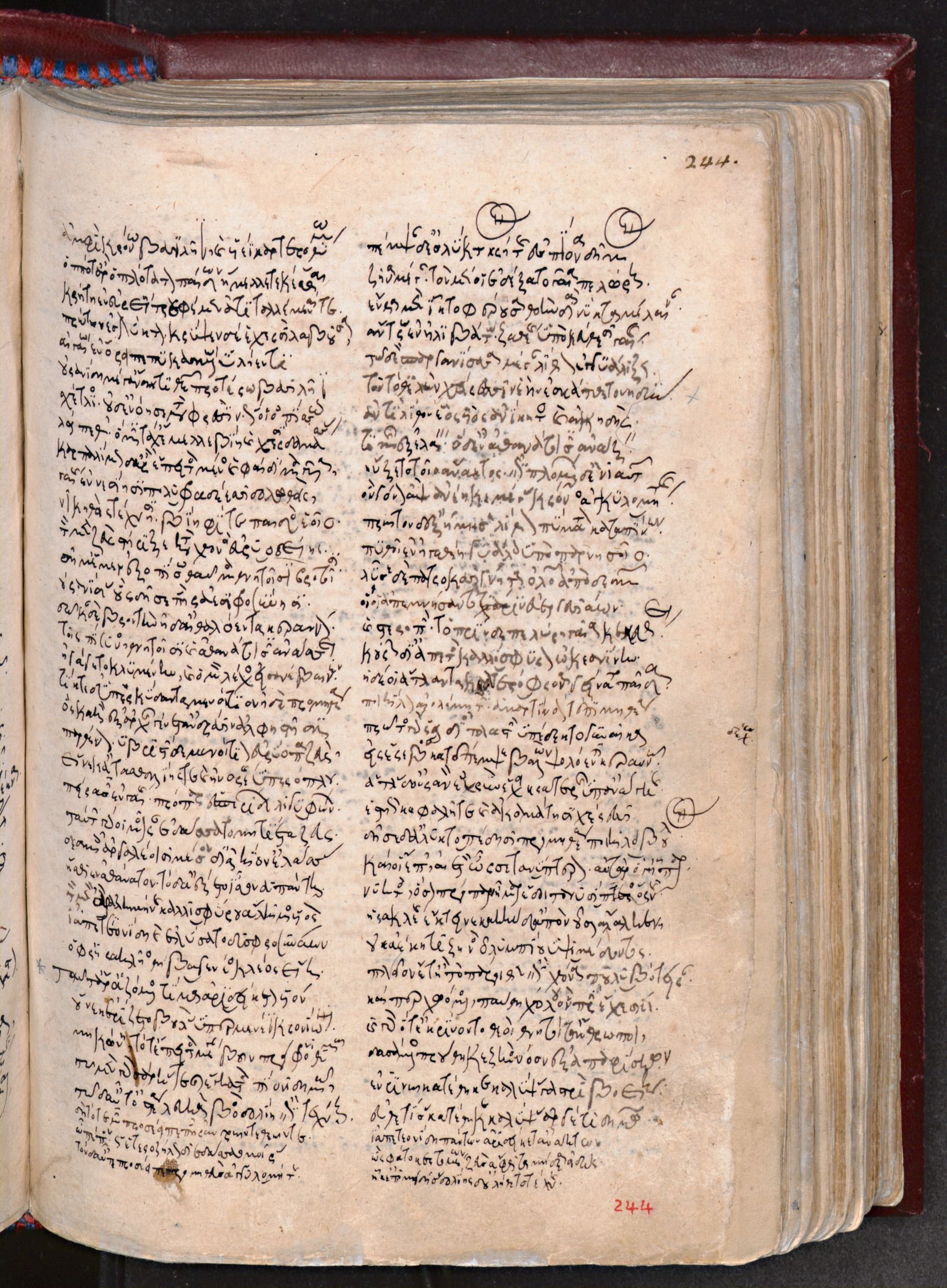
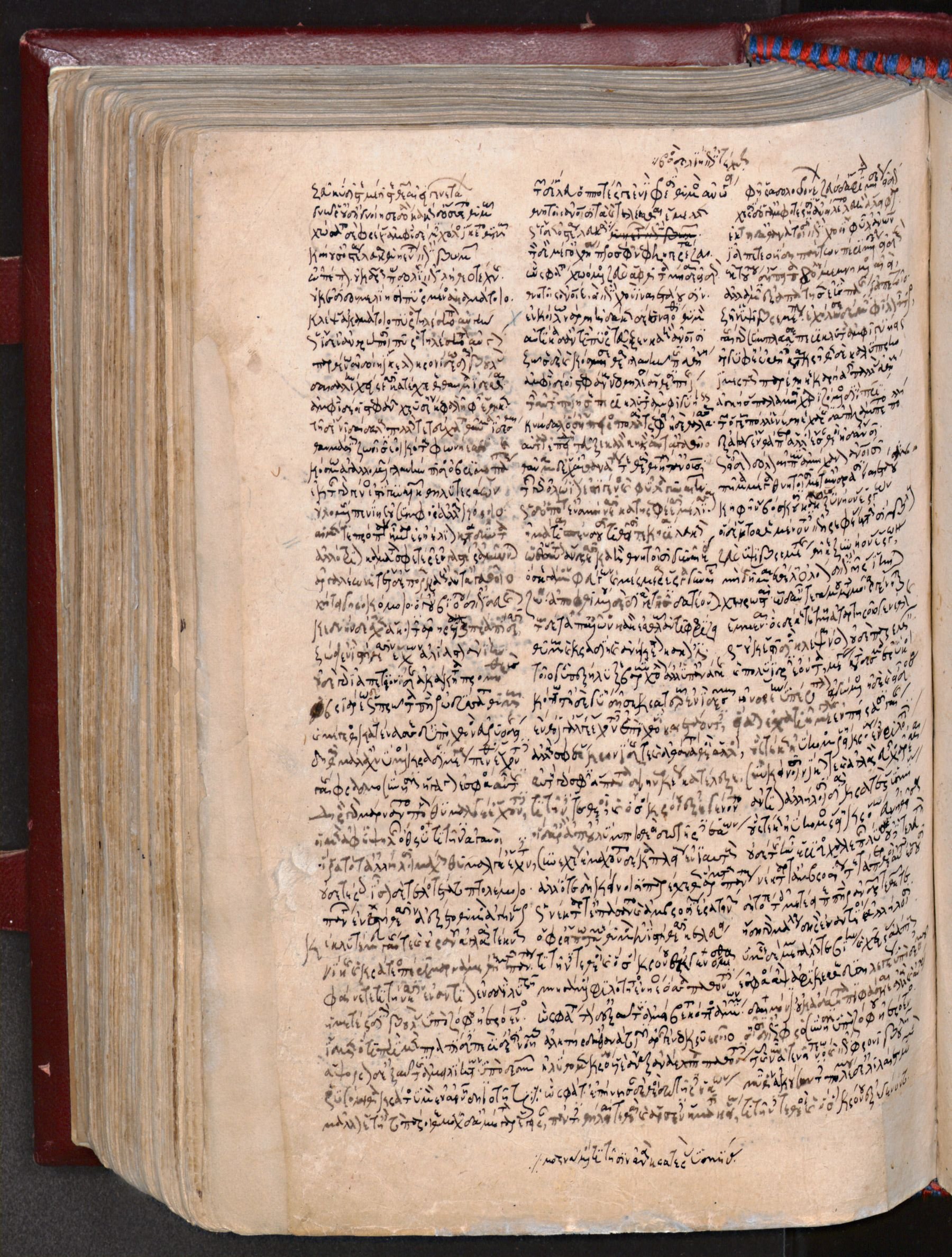
The page photographs are from Florence, Biblioteca Medicea Laurenziana, Plut. 32.16 (paper, late 13th century; a large collection of Greek poetry that also holds letters of Maximus Planudes), Theogony on fols. 240r-247v, the oldest complete manuscript of the poem with published images, in the Biblioteca Medicea Laurenziana's Teca Digitale. This part is on fol. 244r, 244v. The scribe writes two verses to a row, one in each column, so a page is read across the columns, row by row. Each section below is one page; its note gives the page's first and last verse as read on the photograph.
The Greek is Evelyn-White's Loeb text (1914) via Perseus, not a transcription of this manuscript, whose wording differs here and there. Verses the editor brackets as later additions are shown in square brackets. The English is Evelyn-White's prose translation (1914); it is cut at the end of his sentences, so where a sentence runs across a page break it is given whole to one page; each section's note gives the exact lines its English covers.
How was this verified? (Provenance)
Where on the image
Laur. Plut. 32.16, fol. 244r: lines 476-547, begins ‹ἀμφὶ Κρόνῳ βασιλῆι καὶ›, ends ‹δʼ οὐ λήθετο τέχνης·›. Checked on the image: first and last rows read and matched to the Greek (re-read on the image 2026-11-12: first row ‹476 | 477: ἀμφὶ κρόνῳ βασιλῆι ... | πέμψαν δ' ἐς λύκτον ...›, last row ‹546 | 547: τὸν δ' αὖτε προσέειπε προμηθεὺς ... | ... δολίης δ' οὐ λήθετο τέχνης›); the page before ends at line 475 and the page after begins at line 548. This section shows lines 507-547 of that page; the rest of the page belongs to the previous part of the poem. The last three rows (542-547) are written smaller, squeezed in at the foot of the page. English here: lines 507-547, cut at the end of Evelyn-White's sentences. At the break with the next page the English ends with line 547, the same line as the Greek.
507κούρην δʼ Ἰαπετὸς καλλίσφυρον Ὠκεανίνην
508ἠγάγετο Κλυμένην καὶ ὁμὸν λέχος εἰσανέβαινεν.
509ἣ δέ οἱ Ἄτλαντα κρατερόφρονα γείνατο παῖδα·
510τίκτε δʼ ὑπερκύδαντα Μενοίτιον ἠδὲ Προμηθέα
511ποικίλον αἰολόμητιν, ἁμαρτίνοόν τʼ Ἐπιμηθέα
512ὃς κακὸν ἐξ ἀρχῆς γένετʼ ἀνδράσιν ἀλφηστῇσιν·
513πρῶτος γάρ ῥα Διὸς πλαστὴν ὑπέδεκτο γυναῖκα
514παρθένον. ὑβριστὴν δὲ Μενοίτιον εὐρύοπα Ζεὺς
515εἰς Ἔρεβος κατέπεμψε βαλὼν ψολόεντι κεραυνῷ
516εἵνεκʼ ἀτασθαλίης τε καὶ ἠνορέης ὑπερόπλου.
517Ἄτλας δʼ οὐρανὸν εὐρὺν ἔχει κρατερῆς ὑπʼ ἀνάγκης
518πείρασιν ἐν γαίης, πρόπαρ Εσπερίδων λιγυφώνων,
519ἑστηὼς κεφαλῇ τε καὶ ἀκαμάτῃσι χέρεσσιν·
520ταύτην γάρ οἱ μοῖραν ἐδάσσατο μητίετα Ζεύς.
521δῆσε δʼ ἀλυκτοπέδῃσι Προμηθέα ποικιλόβουλον
522δεσμοῖς ἀργαλέοισι μέσον διὰ κίονʼ ἐλάσσας·
523καί οἱ ἐπʼ αἰετὸν ὦρσε τανύπτερον· αὐτὰρ ὅ γʼ ἧπαρ
524ἤσθιεν ἀθάνατον, τὸ δʼ ἀέξετο ἶσον ἁπάντη
525νυκτός ὅσον πρόπαν ἦμαρ ἔδοι τανυσίπτερος ὄρνις.
526τὸν μὲν ἄρʼ Ἀλκμήνης καλλισφύρου ἄλκιμος υἱὸς
527Ἡρακλέης ἔκτεινε, κακὴν δʼ ἀπὸ νοῦσον ἄλαλκεν
528Ἰαπετιονίδῃ καὶ ἐλύσατο δυσφροσυνάων
529οὐκ ἀέκητι Ζηνὸς Ὀλυμπίου ὑψιμέδοντος,
530ὄφρʼ Ἡρακλῆος Θηβαγενέος κλέος εἴη
531πλεῖον ἔτʼ ἢ τὸ πάροιθεν ἐπὶ χθόνα πουλυβότειραν.
532ταῦτʼ ἄρα ἁζόμενος τίμα ἀριδείκετον υἱόν·
533καί περ χωόμενος παύθη χόλου, ὃν πρὶν ἔχεσκεν,
534οὕνεκʼ ἐρίζετο βουλὰς ὑπερμενέι Κρονίωνι.
535καὶ γὰρ ὅτʼ ἐκρίνοντο θεοὶ θνητοί τʼ ἄνθρωποι
536Μηκώνῃ, τότʼ ἔπειτα μέγαν βοῦν πρόφρονι θυμῷ
537δασσάμενος προέθηκε, Διὸς νόον ἐξαπαφίσκων.
538τοῖς μὲν γὰρ σάρκας τε καὶ ἔγκατα πίονα δημῷ
539ἐν ῥινῷ κατέθηκε καλύψας γαστρὶ βοείῃ,
540τῷ δʼ αὖτʼ ὀστέα λευκὰ βοὸς δολίῃ ἐπὶ τέχνῃ
541εὐθετίσας κατέθηκε καλύψας ἀργέτι δημῷ.
542δὴ τότε μιν προσέειπε πατὴρ ἀνδρῶν τε θεῶν τε·
543Ἰαπετιονίδη, πάντων ἀριδείκετʼ ἀνάκτων,
544ὦ πέπον, ὡς ἑτεροζήλως διεδάσσαο μοίρας.
545ὣς φάτο κερτομέων Ζεὺς ἄφθιτα μήδεα εἰδώς.
546τὸν δʼ αὖτε προσέειπε Προμηθεὺς ἀγκυλομήτης
547ἦκʼ ἐπιμειδήσας, δολίης δʼ οὐ λήθετο τέχνης·
507Now Iapetus took to wife the neat-ankled maid Clymene, daughter of Ocean, and went up with her into one bed. And she bore him a stout-hearted son, Atlas: 510also she bore very glorious Menoetius and clever Prometheus, full of various wiles, and scatter-brained Epimetheus who from the first was a mischief to men who eat bread; for it was he who first took of Zeus the woman, the maiden whom he had formed. But Menoetius was outrageous, and farseeing Zeus 515struck him with a lurid thunderbolt and sent him down to Erebus because of his mad presumption and exceeding pride. And Atlas through hard constraint upholds the wide heaven with unwearying head and arms, standing at the borders of the earth before the clear-voiced Hesperides; 520for this lot wise Zeus assigned to him. And ready-witted Prometheus he bound with inextricable bonds, cruel chains, and drove a shaft through his middle, and set on him a long-winged eagle, which used to eat his immortal liver; but by night the liver grew 525as much again everyway as the long-winged bird devoured in the whole day. That bird Heracles, the valiant son of shapely-ankled Alcmene, slew; and delivered the son of Iapetus from the cruel plague, and released him from his affliction—not without the will of Olympian Zeus who reigns on high, 530that the glory of Heracles the Theban-born might be yet greater than it was before over the plenteous earth. This, then, he regarded, and honored his famous son; though he was angry, he ceased from the wrath which he had before because Prometheus matched himself in wit with the almighty son of Cronos. 535For when the gods and mortal men had a dispute at Mecone, even then Prometheus was forward to cut up a great ox and set portions before them, trying to deceive the mind of Zeus. Before the rest he set flesh and inner parts thick with fat upon the hide, covering them with an ox paunch; 540but for Zeus he put the white bones dressed up with cunning art and covered with shining fat. Then the father of men and of gods said to him: “Son of Iapetus, most glorious of all lords, good sir, how unfairly you have divided the portions!” 545So said Zeus whose wisdom is everlasting, rebuking him. But wily Prometheus answered him, smiling softly and not forgetting his cunning trick:
Where on the image
Laur. Plut. 32.16, fol. 244v: lines 548-668, begins ‹ζεῦ κύδιστε μέγιστε θεῶν›, ends ‹καὶ ὅσοι Κρόνου ἐξεγένοντο,›. Checked on the image: first and last rows read and matched to the Greek (re-read on the image 2026-11-12: first row ‹548 | 549 | 550: ζεῦ κύδιστε μέγιστε ... | τῶν δ' ἕλε' ὁπποτέρην ... | φῆ ῥα δολοφρονέων ...›, last row ‹666-668 across the full width: μᾶλλον ἔτ' ἢ τὸ πάροιθε ... καὶ ὅσοι κρόνου ἐξεγένοντο›); the page before ends at line 547 and the page after begins at line 669. This section shows lines 548-616 of that page; the rest of the page belongs to the next part of the poem. Dense page written in three columns, three verses to a row (548 left, 549 middle, 550 right, and so on); the last five rows run across the full width (653-655, 656-658, 659-661, 662 with 664-665, 666-668). Verse 663 (μαρνάμενοι τιτῆσιν ἀνὰ καρτερὰς ὑσμίνας) is left out of its row and written in the lower margin under a reference mark that also follows 662; the Greek shows it in its place. A short note in the top margin is not part of the text. English here: lines 548-616, cut at the end of Evelyn-White's sentences. At the break with the page before, his sentence for line 548 (‹“Zeus, most glorious and greatest ...›) begins with the Greek of this page.
548ζεῦ κύδιστε μέγιστε θεῶν αἰειγενετάων,
549τῶν δʼ ἕλεʼ, ὁπποτέρην σε ἐνὶ φρεσὶ θυμὸς ἀνώγει.
550Φῆ ῥα δολοφρονέων· Ζεὺς δʼ ἄφθιτα μήδεα εἰδὼς
551γνῶ ῥʼ οὐδʼ ἠγνοίησε δόλον· κακὰ δʼ ὄσσετο θυμῷ
552θνητοῖς ἀνθρώποισι, τὰ καὶ τελέεσθαι ἔμελλεν.
553χερσὶ δʼ ὅ γʼ ἀμφοτέρῃσιν ἀνείλετο λευκὸν ἄλειφαρ.
554χώσατο δὲ φρένας ἀμφί, χόλος δέ μιν ἵκετο θυμόν,
555ὡς ἴδεν ὀστέα λευκὰ βοὸς δολίῃ ἐπὶ τέχνῃ.
556ἐκ τοῦ δʼ ἀθανάτοισιν ἐπὶ χθονὶ φῦλʼ ἀνθρώπων
557καίουσʼ ὀστέα λευκὰ θυηέντων ἐπὶ βωμῶν.
558τὸν δὲ μέγʼ ὀχθήσας προσέφη νεφεληγερέτα Ζεύς·
559Ἰαπετιονίδη, πάντων πέρι μήδεα εἰδώς,
560ὦ πέπον, οὐκ ἄρα πω δολίης ἐπιλήθεο τέχνης.
561ὣς φάτο χωόμενος Ζεὺς ἄφθιτα μήδεα εἰδώς·
562ἐκ τούτου δὴ ἔπειτα δόλου μεμνημένος αἰεὶ
563οὐκ ἐδίδου Μελίῃσι πυρὸς μένος ἀκαμάτοιο
564θνητοῖς ἀνθρώποις, οἳ ἐπὶ χθονὶ ναιετάουσιν.
565ἀλλά μιν ἐξαπάτησεν ἐὺς πάις Ἰαπετοῖο
566κλέψας ἀκαμάτοιο πυρὸς τηλέσκοπον. αὐγὴν
567ἐν κοΐλῳ νάρθηκι· δάκεν δέ ἑ νειόθι θυμόν,
568Ζῆνʼ ὑψιβρεμέτην, ἐχόλωσε δέ μιν φίλον ἦτορ,
569ὡς ἴδʼ ἐν ἀνθρώποισι πυρὸς τηλέσκοπον αὐγήν.
570αὐτίκα δʼ ἀντὶ πυρὸς τεῦξεν κακὸν ἀνθρώποισιν·
571γαίης γὰρ σύμπλασσε περικλυτὸς Ἀμφιγυήεις
572παρθένῳ αἰδοίῃ ἴκελον Κρονίδεω διὰ βουλάς.
573ζῶσε δὲ καὶ κόσμησε θεὰ γλαυκῶπις Ἀθήνη
574ἀργυφέη ἐσθῆτι· κατὰ κρῆθεν δὲ καλύπτρην
575δαιδαλέην χείρεσσι κατέσχεθε, θαῦμα ἰδέσθαι·
576[ἀμφὶ δέ οἱ στεφάνους, νεοθηλέος ἄνθεα ποίης,]
577[ἱμερτοὺς περίθηκε καρήατι Παλλὰς Ἀθήνη.]
578ἀμφὶ δέ οἱ στεφάνην χρυσέην κεφαλῆφιν ἔθηκε,
579τὴν αὐτὸς ποίησε περικλυτὸς Ἀμφιγυήεις
580ἀσκήσας παλάμῃσι, χαριζόμενος Διὶ πατρί.
581τῇ δʼ ἐνὶ δαίδαλα πολλὰ τετεύχατο, θαῦμα ἰδέσθαι,
582κνώδαλʼ, ὅσʼ ἤπειρος πολλὰ τρέφει ἠδὲ θάλασσα,
583τῶν ὅ γε πόλλʼ ἐνέθηκε,—χάρις δʼ ἀπελάμπετο πολλή,—
584θαυμάσια, ζῴοισιν ἐοικότα φωνήεσσιν.
585αὐτὰρ ἐπεὶ δὴ τεῦξε καλὸν κακὸν ἀντʼ ἀγαθοῖο.
586ἐξάγαγʼ, ἔνθα περ ἄλλοι ἔσαν θεοὶ ἠδʼ ἄνθρωποι,
587κόσμῳ ἀγαλλομένην γλαυκώπιδος ὀβριμοπάτρης.
588θαῦμα δʼ ἔχʼ ἀθανάτους τε θεοὺς θνητούς τʼ ἀνθρώπους,
589ὡς εἶδον δόλον αἰπύν, ἀμήχανον ἀνθρώποισιν.
590ἐκ τῆς γὰρ γένος ἐστὶ γυναικῶν θηλυτεράων,
591[τῆς γὰρ ὀλώιόν ἐστι γένος καὶ φῦλα γυναικῶν,]
592πῆμα μέγʼ αἳ θνητοῖσι μετʼ ἀνδράσι ναιετάουσιν
593οὐλομένης πενίης οὐ σύμφοροι, ἀλλὰ κόροιο.
594ὡς δʼ ὁπότʼ ἐν σμήνεσσι κατηρεφέεσσι μέλισσαι
595κηφῆνας βόσκωσι, κακῶν ξυνήονας ἔργων—
596αἳ μέν τε πρόπαν ἦμαρ ἐς ἠέλιον καταδύντα
597ἠμάτιαι σπεύδουσι τιθεῖσί τε κηρία λευκά,
598οἳ δʼ ἔντοσθε μένοντες ἐπηρεφέας κατὰ σίμβλους
599ἀλλότριον κάματον σφετέρην ἐς γαστέρʼ ἀμῶνται—
600ὣς δʼ αὔτως ἄνδρεσσι κακὸν θνητοῖσι γυναῖκας
601Ζεὺς ὑψιβρεμέτης θῆκεν, ξυνήονας ἔργων
602ἀργαλέων· ἕτερον δὲ πόρεν κακὸν ἀντʼ ἀγαθοῖο·
603ὅς κε γάμον φεύγων καὶ μέρμερα ἔργα γυναικῶν
604μὴ γῆμαι ἐθέλῃ, ὀλοὸν δʼ ἐπὶ γῆρας ἵκοιτο
605χήτεϊ γηροκόμοιο· ὅ γʼ οὐ βιότου ἐπιδευὴς
606ζώει, ἀποφθιμένου δὲ διὰ κτῆσιν δατέονται
607χηρωσταί· ᾧ δʼ αὖτε γάμου μετὰ μοῖρα γένηται,
608κεδνὴν δʼ ἔσχεν ἄκοιτιν ἀρηρυῖαν πραπίδεσσι,
609τῷ δέ τʼ ἀπʼ αἰῶνος κακὸν ἐσθλῷ ἀντιφερίζει
610ἐμμενές· ὃς δέ κε τέτμῃ ἀταρτηροῖο γενέθλης,
611ζώει ἐνὶ στήθεσσιν ἔχων ἀλίαστον ἀνίην
612θυμῷ καὶ κραδίῃ, καὶ ἀνήκεστον κακόν ἐστιν.
613ὣς οὐκ ἔστι Διὸς κλέψαι νόον οὐδὲ παρελθεῖν.
614οὐδὲ γὰρ Ἰαπετιονίδης ἀκάκητα Προμηθεὺς
615τοῖό γʼ ὑπεξήλυξε βαρὺν χόλον, ἀλλʼ ὑπʼ ἀνάγκης
616καὶ πολύιδριν ἐόντα μέγας κατὰ δεσμὸς ἐρύκει.
548“Zeus, most glorious and greatest of the eternal gods, take which ever of these portions your heart within you bids.” 550So he said, thinking trickery. But Zeus, whose wisdom is everlasting, saw and failed not to perceive the trick, and in his heart he thought mischief against mortal men which also was to be fulfilled. With both hands he took up the white fat and was angry at heart, and wrath came to his spirit 555when he saw the white ox-bones craftily tricked out: and because of this the tribes of men upon earth burn white bones to the deathless gods upon fragrant altars. But Zeus who drives the clouds was greatly vexed and said to him: “Son of Iapetus, clever above all! 560So, sir, you have not yet forgotten your cunning arts!” So spake Zeus in anger, whose wisdom is everlasting; and from that time he was always mindful of the trick, and would not give the power of unwearying fire to the Melian race of mortal men who live on the earth. 565But the noble son of Iapetus outwitted him and stole the far-seen gleam of unwearying fire in a hollow fennel stalk. And Zeus who thunders on high was stung in spirit, and his dear heart was angered when he saw amongst men the far-seen ray of fire. 570Forthwith he made an evil thing for men as the price of fire; for the very famous Limping God formed of earth the likeness of a shy maiden as the son of Cronos willed. And the goddess bright-eyed Athena girded and clothed her with silvery raiment, and down from her head 575she spread with her hands an embroidered veil, a wonder to see; and she, Pallas Athena, put about her head lovely garlands, flowers of new-grown herbs. Also she put upon her head a crown of gold which the very famous Limping God made himself 580and worked with his own hands as a favor to Zeus his father. On it was much curious work, wonderful to see; for of the many creatures which the land and sea rear up, he put most upon it, wonderful things, like living beings with voices: and great beauty shone out from it. 585But when he had made the beautiful evil to be the price for the blessing, he brought her out, delighting in the finery which the bright-eyed daughter of a mighty father had given her, to the place where the other gods and men were. And wonder took hold of the deathless gods and mortal men when they saw that which was sheer guile, not to be withstood by men. 590For from her is the race of women and female kind: of her is the deadly race and tribe of women who live amongst mortal men to their great trouble, no helpmeets in hateful poverty, but only in wealth. And as in thatched hives bees 595feed the drones whose nature is to do mischief—by day and throughout the day until the sun goes down the bees are busy and lay the white combs, while the drones stay at home in the covered hives and reap the toil of others into their own bellies— 600even so Zeus who thunders on high made women to be an evil to mortal men, with a nature to do evil. And he gave them a second evil to be the price for the good they had: whoever avoids marriage and the sorrows that women cause, and will not wed, reaches deadly old age 605without anyone to tend his years, and though he at least has no lack of livelihood while he lives, yet, when he is dead, his kinsfolk divide his possessions amongst them. And as for the man who chooses the lot of marriage and takes a good wife suited to his mind, evil continually contends with good; 610for whoever happens to have mischievous children, lives always with unceasing grief in his spirit and heart within him; and this evil cannot be healed. So it is not possible to deceive or go beyond the will of Zeus: for not even the son of Iapetus, kindly Prometheus, 615escaped his heavy anger, but of necessity strong bands confined him, although he knew many a wile.
Notes
- Greek: H. G. Evelyn-White, Hesiod, the Homeric Hymns and Homerica (Loeb Classical Library, 1914), via Perseus. Square brackets mark verses the editor regards as interpolated.
- English: H. G. Evelyn-White's translation in the same volume; his footnotes are omitted.
- Lines 929a-929t of the Loeb text (a passage on the birth of Athena quoted by Galen from Chrysippus) are not in the medieval manuscripts and are not included.
Cite
Sources
- Source: Laur. Plut. 32.16 (BML Teca Digitale IIIF) + Evelyn-White Greek (Loeb 1914, Perseus) + Evelyn-White English (1914, Perseus) (holding institution)
- Critical edition: Evelyn-White, Loeb 1914, via Perseus
← previous · → next · v cycle view · l back to library