Hesiod, Theogony 617-728: The war of the gods and Titans (Titanomachy)
Introduction
Hesiod's Theogony (c. 700 BCE) is the oldest Greek account of the origin of the world and the gods, from Chaos and Earth through the reign of Cronos to the victory of Zeus. This part: The war of the gods and Titans (Titanomachy) (lines 617-728, 112 lines). Zeus frees the Hundred-Handers, the ten-year war with the Titans, and the Titans cast down into Tartarus.
The page photographs are from Florence, Biblioteca Medicea Laurenziana, Plut. 32.16 (paper, late 13th century; a large collection of Greek poetry that also holds letters of Maximus Planudes), Theogony on fols. 240r-247v, the oldest complete manuscript of the poem with published images, in the Biblioteca Medicea Laurenziana's Teca Digitale. This part is on fol. 244v, 245r. The scribe writes two verses to a row, one in each column, so a page is read across the columns, row by row. Each section below is one page; its note gives the page's first and last verse as read on the photograph.
The Greek is Evelyn-White's Loeb text (1914) via Perseus, not a transcription of this manuscript, whose wording differs here and there. Verses the editor brackets as later additions are shown in square brackets. The English is Evelyn-White's prose translation (1914); it is cut at the end of his sentences, so where a sentence runs across a page break it is given whole to one page; each section's note gives the exact lines its English covers.
How was this verified? (Provenance)
Where on the image
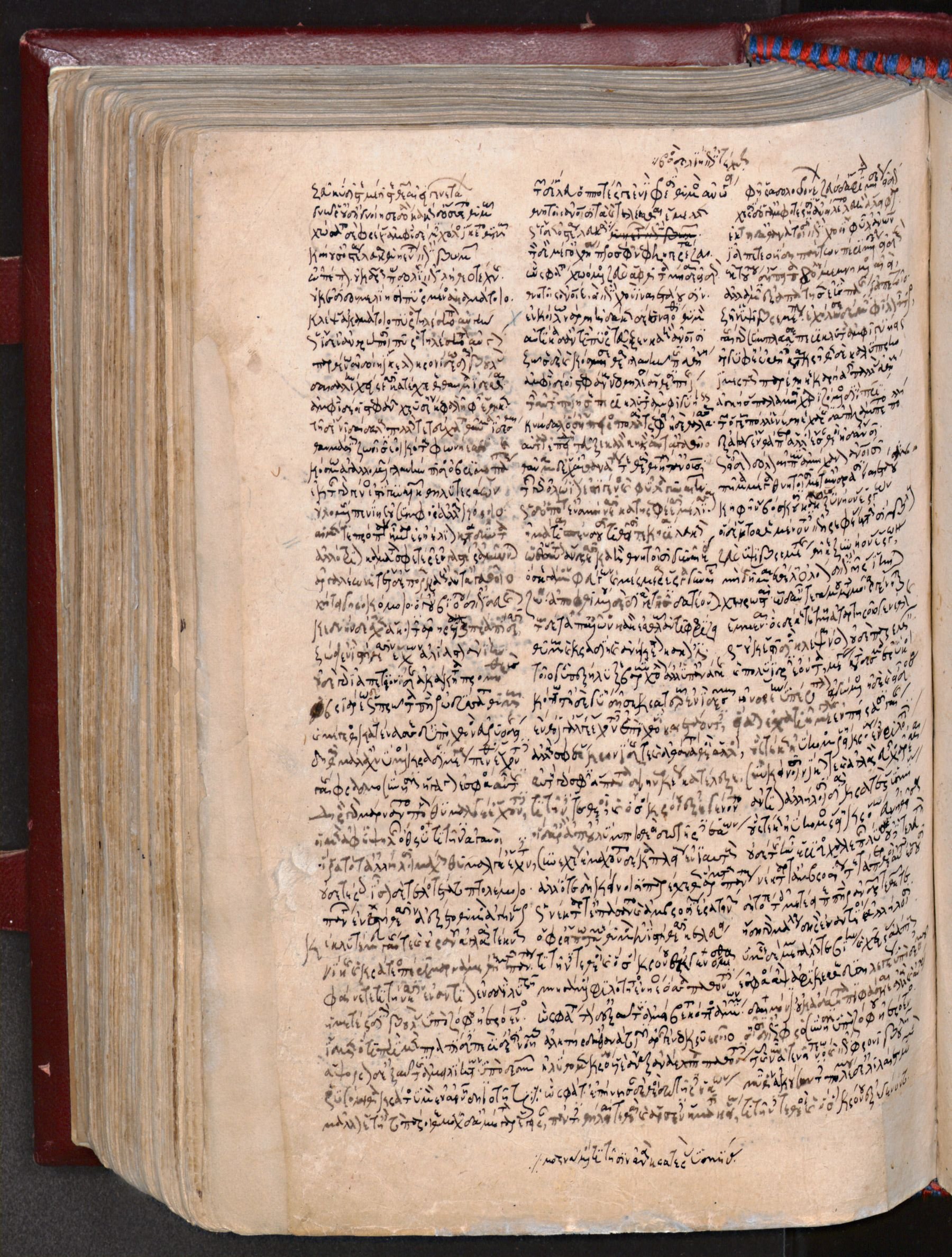
Laur. Plut. 32.16, fol. 244v: lines 548-668, begins ‹ζεῦ κύδιστε μέγιστε θεῶν›, ends ‹καὶ ὅσοι Κρόνου ἐξεγένοντο,›. Checked on the image: first and last rows read and matched to the Greek (re-read on the image 2026-11-12: first row ‹548 | 549 | 550: ζεῦ κύδιστε μέγιστε ... | τῶν δ' ἕλε' ὁπποτέρην ... | φῆ ῥα δολοφρονέων ...›, last row ‹666-668 across the full width: μᾶλλον ἔτ' ἢ τὸ πάροιθε ... καὶ ὅσοι κρόνου ἐξεγένοντο›); the page before ends at line 547 and the page after begins at line 669. This section shows lines 617-668 of that page; the rest of the page belongs to the previous part of the poem. Dense page written in three columns, three verses to a row (548 left, 549 middle, 550 right, and so on); the last five rows run across the full width (653-655, 656-658, 659-661, 662 with 664-665, 666-668). Verse 663 (μαρνάμενοι τιτῆσιν ἀνὰ καρτερὰς ὑσμίνας) is left out of its row and written in the lower margin under a reference mark that also follows 662; the Greek shows it in its place. A short note in the top margin is not part of the text. English here: lines 617-670, cut at the end of Evelyn-White's sentences. His sentence that runs across the break with the next page is given whole here, so the English ends with line 670 (‹... from Erebus beneath the earth.›).
617Βριάρεῳ δʼ ὡς πρῶτα πατὴρ ὠδύσσατο θυμῷ
618Κόττῳ τʼ ἠδὲ Γύῃ, δῆσεν κρατερῷ ἐνὶ δεσμῷ
619ἠνορέην ὑπέροπλον ἀγώμενος ἠδὲ καὶ εἶδος
620καὶ μέγεθος· κατένασσε δʼ ὑπὸ χθονὸς εὐρυοδείης.
621ἔνθʼ οἵ γʼ ἄλγεʼ ἔχοντες ὑπὸ χθονὶ ναιετάοντες
622εἵατʼ ἐπʼ ἐσχατιῇ, μεγάλης ἐν πείρασι γαίης,
623δηθὰ μάλʼ ἀχνύμενοι, κραδίῃ μέγα πένθος ἔχοντες.
624ἀλλά σφεας Κρονίδης τε καὶ ἀθάνατοι θεοὶ ἄλλοι,
625οὓς τέκεν ἠύκομος Ῥείη Κρόνου ἐν φιλότητι,
626Γαίης φραδμοσύνῃσιν ἀνήγαγον ἐς φάος αὖτις·
627αὐτὴ γάρ σφιν ἅπαντα διηνεκέως κατέλεξε
628σὺν κείνοις νίκην τε καὶ ἀγλαὸν εὖχος ἀρέσθαι.
629δηρὸν γὰρ μάρναντο πόνον θυμαλγέʼ ἔχοντες
630Τιτῆνές τε θεοὶ καὶ ὅσοι Κρόνου ἐξεγένοντο,
631ἀντίον ἀλλήλοισι διὰ κρατερὰς ὑσμίνας,
632οἳ μὲν ἀφʼ ὑψηλῆς Ὄθρυος Τιτῆνες ἀγαυοί,
633οἳ δʼ ἄρʼ ἀπʼ Οὐλύμποιο θεοί, δωτῆρες ἐάων,
634οὓς τέκεν ἠύκομος Ῥείη Κρόνῳ εὐνηθεῖσα.
635οἵ ῥα τότʼ ἀλλήλοισι χόλον θυμαλγέʼ ἔχοντες
636συνεχέως ἐμάχοντο δέκα πλείους ἐνιαυτούς·
637οὐδέ τις ἦν ἔριδος χαλεπῆς λύσις οὐδὲ τελευτὴ
638οὐδετέροις, ἶσον δὲ τέλος τέτατο πτολέμοιο.
639ἀλλʼ ὅτε δὴ κείνοισι παρέσχεθεν ἄρμενα πάντα,
640νέκταρ τʼ ἀμβροσίην τε, τά περ θεοὶ αὐτοὶ ἔδουσι,
641πάντων ἐν στήθεσσιν ἀέξετο θυμὸς ἀγήνωρ.
642ὡς νέκταρ τʼ ἐπάσαντο καὶ ἀμβροσίην ἐρατεινήν,
643δὴ τότε τοῖς μετέειπε πατὴρ ἀνδρῶν τε θεῶν τε·
644κέκλυτε μευ, Γαίης τε καὶ Οὐρανοῦ ἀγλαὰ τέκνα,
645ὄφρʼ εἴπω, τά με θυμὸς ἐνὶ στήθεσσι κελεύει.
646ἤδη γὰρ μάλα δηρὸν ἐναντίοι ἀλλήλοισι
647νίκης καὶ κράτεος πέρι μαρνάμεθʼ ἤματα πάντα
648Τιτῆνές τε θεοὶ καὶ ὅσοι Κρόνου ἐκγενόμεσθα.
649ὑμεῖς δὲ μεγάλην τε βίην καὶ χεῖρας ἀάπτους
650φαίνετε Τιτήνεσσιν ἐναντίοι ἐν δαῒ λυγρῇ
651μνησάμενοι φιλότητος ἐνηέος, ὅσσα παθόντες
652ἐς φάος ἂψ ἀφίκεσθε δυσηλεγέος ὑπὸ δεσμοῦ
653ἡμετέρας διὰ βουλὰς ὑπὸ ζόφου ἠερόεντος.
654ὣς φάτο· τὸν δʼ ἐξαῦτις ἀμείβετο Κόττος ἀμύμων·
655Δαιμόνιʼ, οὐκ ἀδάητα πιφαύσκεαι· ἀλλὰ καὶ αὐτοὶ
656ἴδμεν, ὅ τοι περὶ μὲν πραπίδες, περὶ δʼ ἐστὶ νόημα,
657ἀλκτὴρ δʼ ἀθανάτοισιν ἀρῆς γένεο κρυεροῖο.
658σῇσι δʼ ἐπιφροσύνῃσιν ὑπὸ ζόφου ἠερόεντος
659ἄψορρον δʼ† ἐξαῦτις ἀμειλίκτων ὑπὸ δεσμῶν
660ἠλύθομεν, Κρόνου υἱὲ ἄναξ, ἀνάελπτα παθόντες.
661τῷ καὶ νῦν ἀτενεῖ τε νόῳ καὶ ἐπίφρονι βουλῇ
662ῥυσόμεθα κράτος ὑμὸν ἐν αἰνῇ δηϊοτῆτι
663μαρνάμενοι Τιτῆσιν ἀνὰ κρατερὰς ὑσμίνας.
664ὣς φάτʼ· ἐπῄνεσσαν δὲ θεοί, δωτῆρες ἐάων,
665μῦθον ἀκούσαντες· πολέμου δʼ ἐλιλαίετο θυμὸς
666μᾶλλον ἔτʼ ἢ τὸ πάροιθε· μάχην δʼ ἀμέγαρτον ἔγειραν
667πάντες, θήλειαι τε καὶ ἄρσενες, ἤματι κείνῳ,
668Τιτῆνές τε θεοὶ καὶ ὅσοι Κρόνου ἐξεγένοντο,
617But when first their father was vexed in his heart with Obriareus and Cottus and Gyes, he bound them in cruel bonds, because he was jealous of their exceeding manhood and comeliness 620and great size: and he made them live beneath the wide-pathed earth, where they were afflicted, being set to dwell under the ground, at the end of the earth, at its great borders, in bitter anguish for a long time and with great grief at heart. But the son of Cronos and the other deathless gods 625whom rich-haired Rhea bore from union with Cronos, brought them up again to the light at Earth's advising. For she herself recounted all things to the gods fully, how with these they might gain victory and a glorious cause to vaunt themselves. 630For the Titan gods and as many as sprang from Cronos had long been fighting together in stubborn war with heart-grieving toil, the lordly Titans from high Othrys, but the gods, givers of good, whom rich-haired Rhea bore in union with Cronos, from Olympus. 635So they, with bitter wrath, were fighting continually with one another at that time for ten full years, and the hard strife had no close or end for either side, and the issue of the war hung evenly balanced. But when he had provided those three with all things fitting, 640nectar and ambrosia which the gods themselves eat, and when their proud spirit revived within them all after they had fed on nectar and delicious ambrosia, then it was that the father of men and gods spoke amongst them: “Hear me, bright children of Earth and Heaven, 645that I may say what my heart within me bids. A long while now have we, who are sprung from Cronos and the Titan gods, fought with each other every day to get victory and to prevail. But show your great might and unconquerable strength, and 650face the Titans in bitter strife; for remember our friendly kindness, and from what sufferings you are come back to the light from your cruel bondage under misty gloom through our counsels.” 654So he said. And blameless Cottus answered him again: “ 655Divine one, you speak that which we know well: no, even of ourselves we know that your wisdom and understanding is exceeding, and that you became a defender of the deathless ones from chill doom. And through your devising we have come back again from the murky gloom and from our merciless bonds, 660enjoying what we looked not for, O lord, son of Cronos. And so now with fixed purpose and deliberate counsel we will aid your power in dreadful strife and will fight against the Titans in hard battle.” So he said: and the gods, givers of good things, applauded when 665they heard his word, and their spirit longed for war even more than before, and they all, both male and female, stirred up hated battle that day, the Titan gods, and all that were born of Cronos together with those dread, mighty ones of overwhelming strength 670whom Zeus brought up to the light from Erebus beneath the earth.
Where on the image
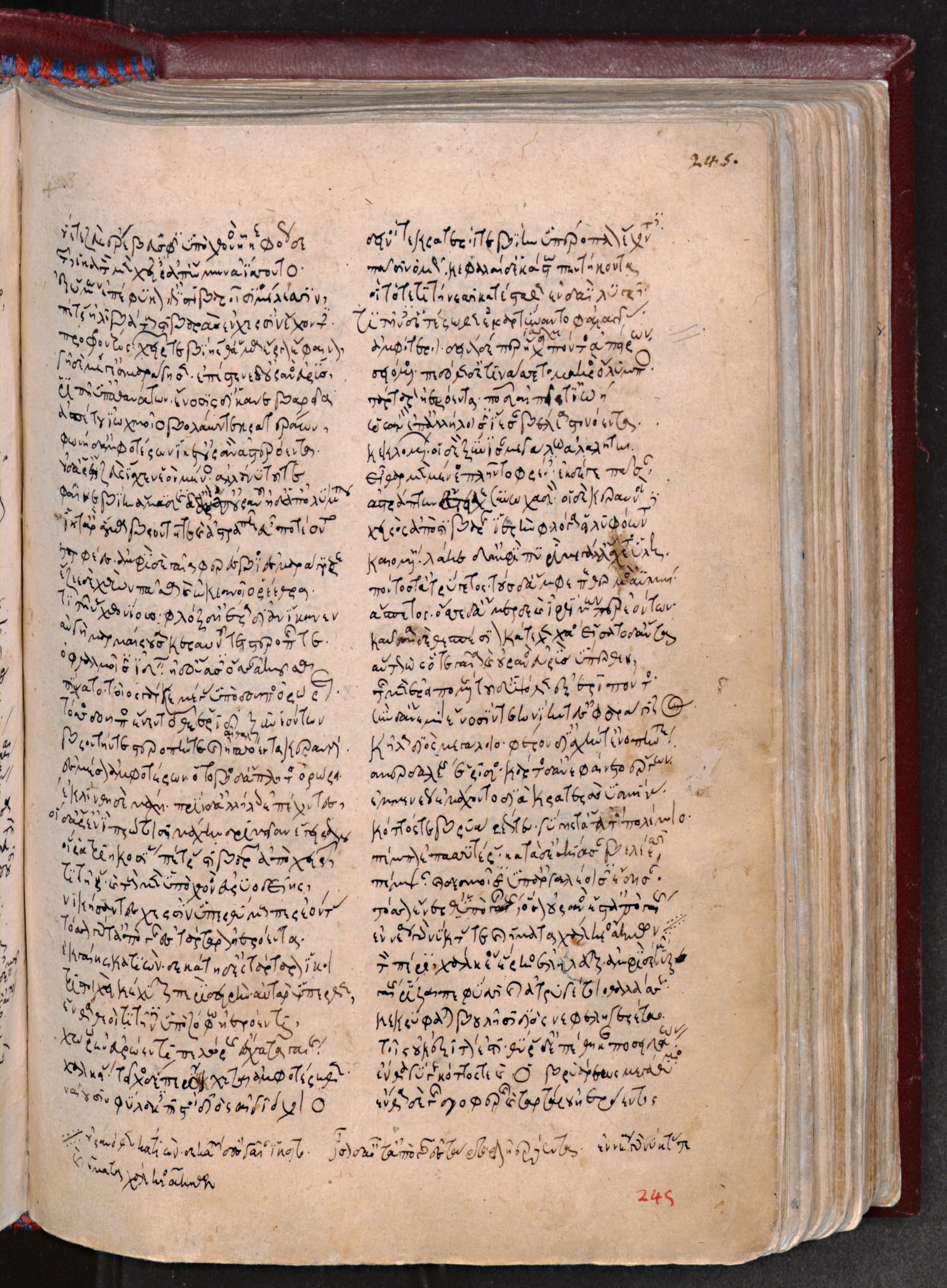
Laur. Plut. 32.16, fol. 245r: lines 669-736, begins ‹οὕς τε Ζεὺς Ἐρέβευσφιν›, ends ‹δνοφερῆς καὶ Ταρτάρου ἠερόεντος›. Checked on the image: first and last rows read and matched to the Greek (re-read on the image 2026-11-12: first row ‹669 | 670: οὕς τε ζεὺς ἐρέβευσφιν ... | δεινοί τε κρατεροί τε ...›, last row ‹735 | 736: ναίουσιν φύλακες πιστοὶ ... | ἔνθα δὲ γῆς δνοφερῆς ...›); the page before ends at line 668 and the page after begins at line 737. This section shows lines 669-728 of that page; the rest of the page belongs to the next part of the poem. In the falling-anvil passage the scribe's eye slipped from ἄκμων (722) to ἄκμων (724): the column reads 721 | 722, with a mark after 722, then 725 | 726. Under the same mark in the lower margin stand 723 (οὐρανόθεν κατιὼν ...), then a verse that is not in Evelyn-White's text (read as ἶσον δ' αὖτ' ἀπὸ [γῆς] ἐς τάρταρον ἠερόεντα, the middle abbreviated, so not certain; a verse of this kind is found in part of the manuscript tradition), then 724 written over two lines. The Greek shows 723-724 in their places and does not include the extra verse. English here: lines 671-728, cut at the end of Evelyn-White's sentences. The sentence that runs across the page break (to line 670) is given whole with the page before; the English here begins with ‹A hundred arms sprang from the shoulders ...› (line 671).
669οὕς τε Ζεὺς Ἐρέβευσφιν ὑπὸ χθονὸς ἧκε φόωσδε
670δεινοί τε κρατεροί τε, βίην ὑπέροπλον ἔχοντες.
671τῶν ἑκατὸν μὲν χεῖρες ἀπʼ ὤμων ἀίσσοντο
672πᾶσιν ὁμῶς, κεφαλαὶ δὲ ἑκάστῳ πεντήκοντα
673ἐξ ὤμων ἐπέφυκον ἐπὶ στιβαροῖσι μέλεσσιν.
674οἳ τότε Τιτήνεσσι κατέσταθεν ἐν δαῒ λυγρῇ
675πέτρας ἠλιβάτους στιβαρῇς ἐν χερσὶν ἔχοντες.
676Τιτῆνες δʼ ἑτέρωθεν ἐκαρτύναντο φάλαγγας
677προφρονέως, χειρῶν τε βίης θʼ ἅμα ἔργον ἔφαινον
678ἀμφότεροι· δεινὸν δὲ περίαχε πόντος ἀπείρων,
679γῆ δὲ μέγʼ ἐσμαράγησεν, ἐπέστενε δʼ οὐρανὸς εὐρὺς
680σειόμενος, πεδόθεν δὲ τινάσσετο μακρὸς Ὄλυμπος
681ῥιπῇ ὕπʼ ἀθανάτων, ἔνοσις δʼ ἵκανε βαρεῖα
682Τάρταρον ἠερόεντα, ποδῶν τʼ αἰπεῖα ἰωὴ
683ἀσπέτου ἰωχμοῖο βολάων τε κρατεράων·
684ὣς ἄρʼ ἐπʼ ἀλλήλοις ἵεσαν βέλεα στονόεντα.
685φωνὴ δʼ ἀμφοτέρων ἵκετʼ οὐρανὸν ἀστερόεντα
686κεκλομένων· οἳ δὲ ξύνισαν μεγάλῳ ἀλαλητῷ.
687οὐδʼ ἄρʼ ἔτι Ζεὺς ἴσχεν ἑὸν μένος, ἀλλά νυ τοῦ γε
688εἶθαρ μὲν μένεος πλῆντο φρένες, ἐκ δέ τε πᾶσαν
689φαῖνε βίην· ἄμυδις δʼ ἄρʼ ἀπʼ οὐρανοῦ ἠδʼ ἀπʼ Ὀλύμπου
690ἀστράπτων ἔστειχε συνωχαδόν· οἱ δὲ κεραυνοὶ
691ἴκταρ ἅμα βροντῇ τε καὶ ἀστεροπῇ ποτέοντο
692χειρὸς ἄπο στιβαρῆς, ἱερὴν φλόγα εἰλυφόωντες
693ταρφέες· ἀμφὶ δὲ γαῖα φερέσβιος ἐσμαράγιζε
694καιομένη, λάκε δʼ ἀμφὶ πυρὶ μεγάλʼ ἄσπετος ὕλη.
695ἔζεε δὲ χθὼν πᾶσα καὶ Ὠκεανοῖο ῥέεθρα
696πόντος τʼ ἀτρύγετος· τοὺς δʼ ἄμφεπε θερμὸς ἀυτμὴ
697Τιτῆνας χθονίους, φλὸξ δʼ αἰθέρα δῖαν ἵκανεν
698ἄσπετος, ὄσσε δʼ ἄμερδε καὶ ἰφθίμων περ ἐόντων
699αὐγὴ μαρμαίρουσα κεραυνοῦ τε στεροπῆς τε.
700καῦμα δὲ θεσπέσιον κάτεχεν Χάος· εἴσατο δʼ ἄντα
701ὀφθαλμοῖσιν ἰδεῖν ἠδʼ οὔασι ὄσσαν ἀκοῦσαι
702αὔτως, ὡς εἰ Γαῖα καὶ Οὐρανὸς εὐρὺς ὕπερθε
703πίλνατο· τοῖος γάρ κε μέγας ὑπὸ δοῦπος ὀρώρει
704τῆς μὲν ἐρειπομένης, τοῦ δʼ ὑψόθεν ἐξεριπόντος·
705τόσσος δοῦπος ἔγεντο θεῶν ἔριδι ξυνιόντων.
706σὺν δʼ ἄνεμοι ἔνοσίν τε κονίην τʼ ἐσφαράγιζον
707βροντήν τε στεροπήν τε καὶ αἰθαλόεντα κεραυνόν,
708κῆλα Διὸς μεγάλοιο, φέρον δʼ ἰαχήν τʼ ἐνοπήν τε
709ἐς μέσον ἀμφοτέρων· ὄτοβος δʼ ἄπλητος ὀρώρει
710σμερδαλέης ἔριδος, κάρτος δʼ ἀνεφαίνετο ἔργων.
711ἐκλίνθη δὲ μάχη· πρὶν δʼ ἀλλήλοις ἐπέχοντες
712ἐμμενέως ἐμάχοντο διὰ κρατερὰς ὑσμίνας.
713οἳ δʼ ἄρʼ ἐνὶ πρώτοισι μάχην δριμεῖαν ἔγειραν
714Κόττος τε Βριάρεώς τε Γύης τʼ ἄατος πολέμοιο,
715οἵ ῥα τριηκοσίας πέτρας στιβαρῶν ἀπὸ χειρῶν
716πέμπον ἐπασσυτέρας, κατὰ δʼ ἐσκίασαν βελέεσσι
717Τιτῆνας, καὶ τοὺς μὲν ὑπὸ χθονὸς εὐρυοδείης
718πέμψαν καὶ δεσμοῖσιν ἐν ἀργαλέοισιν ἔδησαν
719χερσὶν νικήσαντες ὑπερθύμους περ ἐόντας,
720τόσσον ἔνερθʼ ὑπὸ γῆς, ὅσον οὐρανός ἐστʼ ἀπὸ γαίης·
721τόσσον γάρ τʼ ἀπὸ γῆς ἐς Τάρταρον ἠερόεντα.
722ἐννέα γὰρ νύκτας τε καὶ ἤματα χάλκεος ἄκμων
723οὐρανόθεν κατιὼν δεκάτῃ κʼ ἐς γαῖαν ἵκοιτο·
724ἐννέα δʼ αὖ νύκτας τε καὶ ἤματα χάλκεος ἄκμων
725ἐκ γαίης κατιὼν δεκάτῃ κʼ ἐς Τάρταρον ἵκοι.
726τὸν πέρι χάλκεον ἕρκος ἐλήλαται· ἀμφὶ δέ μιν νὺξ
727τριστοιχεὶ κέχυται περὶ δειρήν· αὐτὰρ ὕπερθεν
728γῆς ῥίζαι πεφύασι καὶ ἀτρυγέτοιο θαλάσσης.
671A hundred arms sprang from the shoulders of all alike, and each had fifty heads growing from his shoulders upon stout limbs. These, then, stood against the Titans in grim strife, 675holding huge rocks in their strong hands. And on the other part the Titans eagerly strengthened their ranks, and both sides at one time showed the work of their hands and their might. The boundless sea rang terribly around, and the earth crashed loudly: wide Heaven was shaken and 680groaned, and high Olympus reeled from its foundation under the charge of the undying gods, and a heavy quaking reached dim Tartarus and the deep sound of their feet in the fearful onset and of their hard missiles. So, then, they launched their grievous shafts upon one another, 685and the cry of both armies as they shouted reached to starry heaven; and they met together with a great battle-cry. 687Then Zeus no longer held back his might; but straight his heart was filled with fury and he showed forth all his strength. From Heaven and from Olympus 690he came immediately, hurling his lightning: the bolts flew thick and fast from his strong hand together with thunder and lightning, whirling an awesome flame. The life-giving earth crashed around in burning, and the vast wood crackled loud with fire all about. 695All the land seethed, and Ocean's streams and the unfruitful sea. The hot vapor lapped round the earthborn Titans: flame unspeakable rose to the bright upper air: the flashing glare of the thunderstone and lightning blinded their eyes for all that they were strong. 700Astounding heat seized Chaos: and to see with eyes and to hear the sound with ears it seemed even as if Earth and wide Heaven above came together; for such a mighty crash would have arisen if Earth were being hurled to ruin, and Heaven from on high were hurling her down; 705so great a crash was there while the gods were meeting together in strife. Also the winds brought rumbling earthquake and duststorm, thunder and lightning and the lurid thunderbolt, which are the shafts of great Zeus, and carried the clangor and the warcry into the midst of the two hosts. A horrible uproar 710of terrible strife arose: mighty deeds were shown and the battle inclined. But until then, they kept at one another and fought continually in cruel war. And amongst the foremost Cottus and Briareos and Gyes insatiate for war 715raised fierce fighting: three hundred rocks, one upon another, they launched from their strong hands and overshadowed the Titans with their missiles, and hurled them beneath the wide-pathed earth, and bound them in bitter chains when they had conquered them by their strength for all their great spirit, 720as far beneath the earth as heaven is above earth; for so far is it from earth to Tartarus. For a brazen anvil falling down from heaven nine nights and days would reach the earth upon the tenth: and again, a brazen anvil falling from earth nine nights and days 725would reach Tartarus upon the tenth. Round it runs a fence of bronze, and night spreads in triple line all about it like a neck-circlet, while above grow the roots of the earth and unfruitful sea.
Notes
- Greek: H. G. Evelyn-White, Hesiod, the Homeric Hymns and Homerica (Loeb Classical Library, 1914), via Perseus. Square brackets mark verses the editor regards as interpolated.
- English: H. G. Evelyn-White's translation in the same volume; his footnotes are omitted.
- Lines 929a-929t of the Loeb text (a passage on the birth of Athena quoted by Galen from Chrysippus) are not in the medieval manuscripts and are not included.
Cite
Sources
- Source: Laur. Plut. 32.16 (BML Teca Digitale IIIF) + Evelyn-White Greek (Loeb 1914, Perseus) + Evelyn-White English (1914, Perseus) (holding institution)
- Critical edition: Evelyn-White, Loeb 1914, via Perseus
← previous · → next · v cycle view · l back to library