Hesiod, Theogony 729-819: Tartarus, Night, Sleep, Death and the Styx
Introduction
Hesiod's Theogony (c. 700 BCE) is the oldest Greek account of the origin of the world and the gods, from Chaos and Earth through the reign of Cronos to the victory of Zeus. This part: Tartarus, Night, Sleep, Death and the Styx (lines 729-819, 91 lines). The geography of the underworld: the prison of the Titans, the houses of Night and Day, Hades' hound and the oath of the Styx.
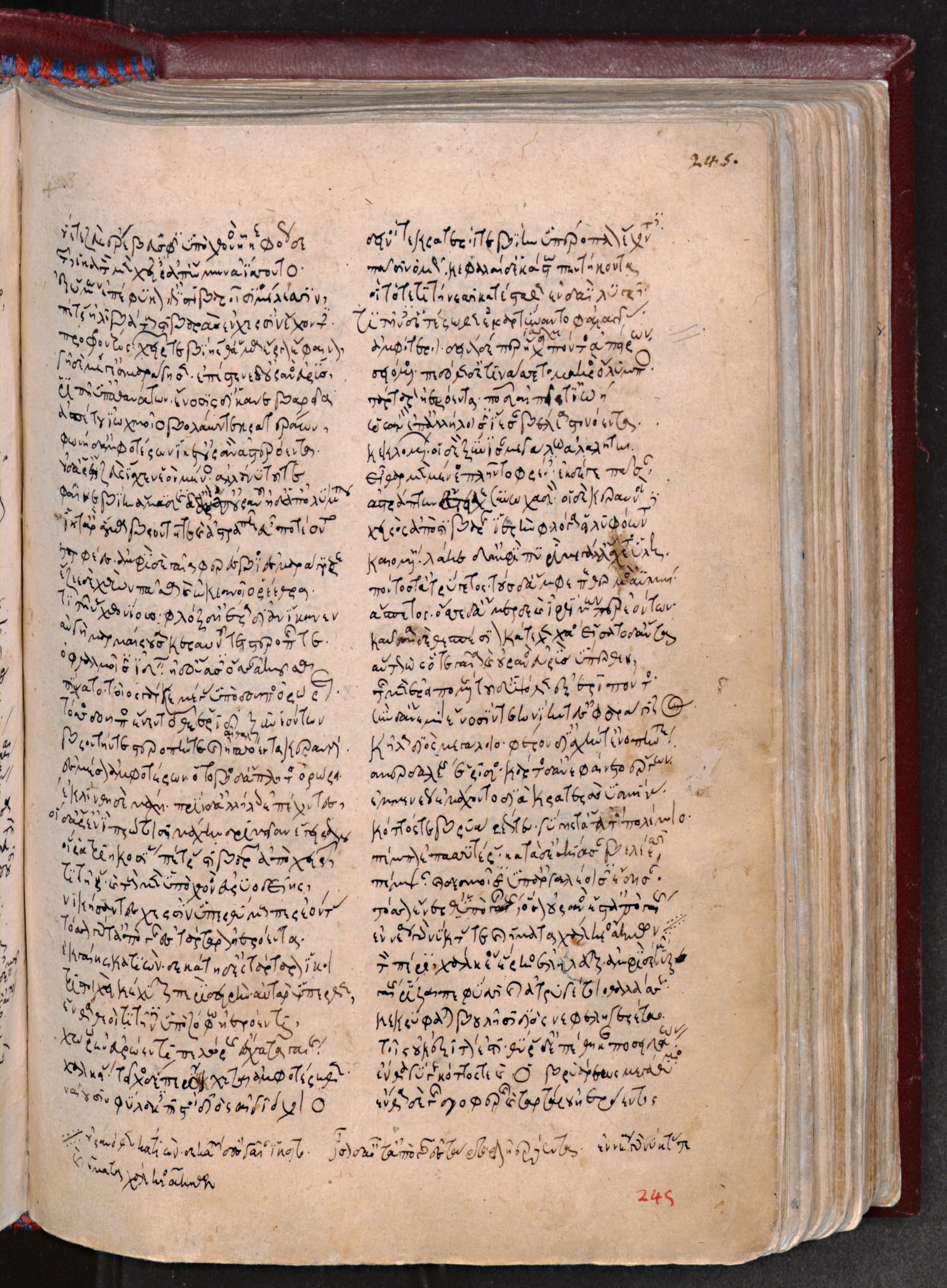
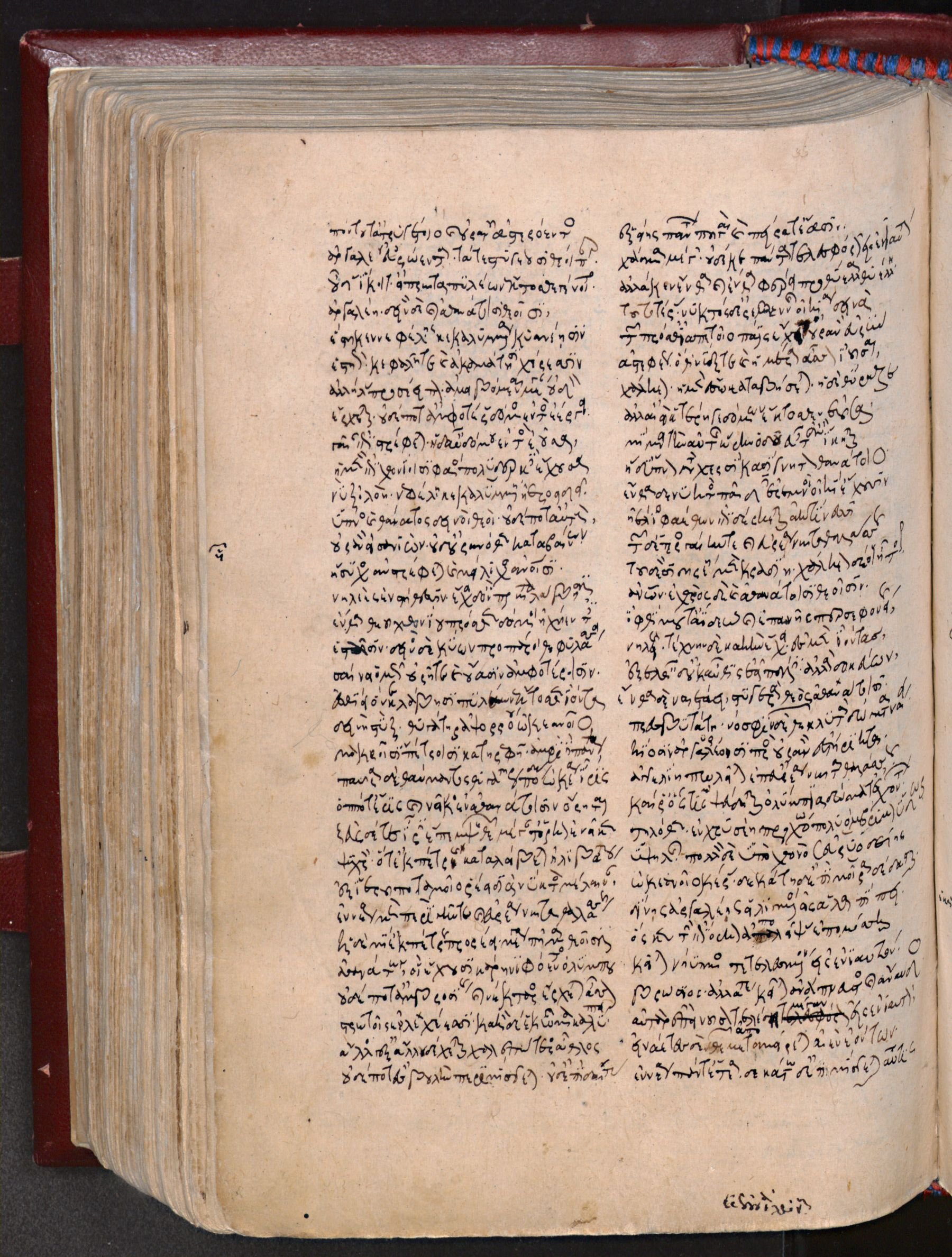
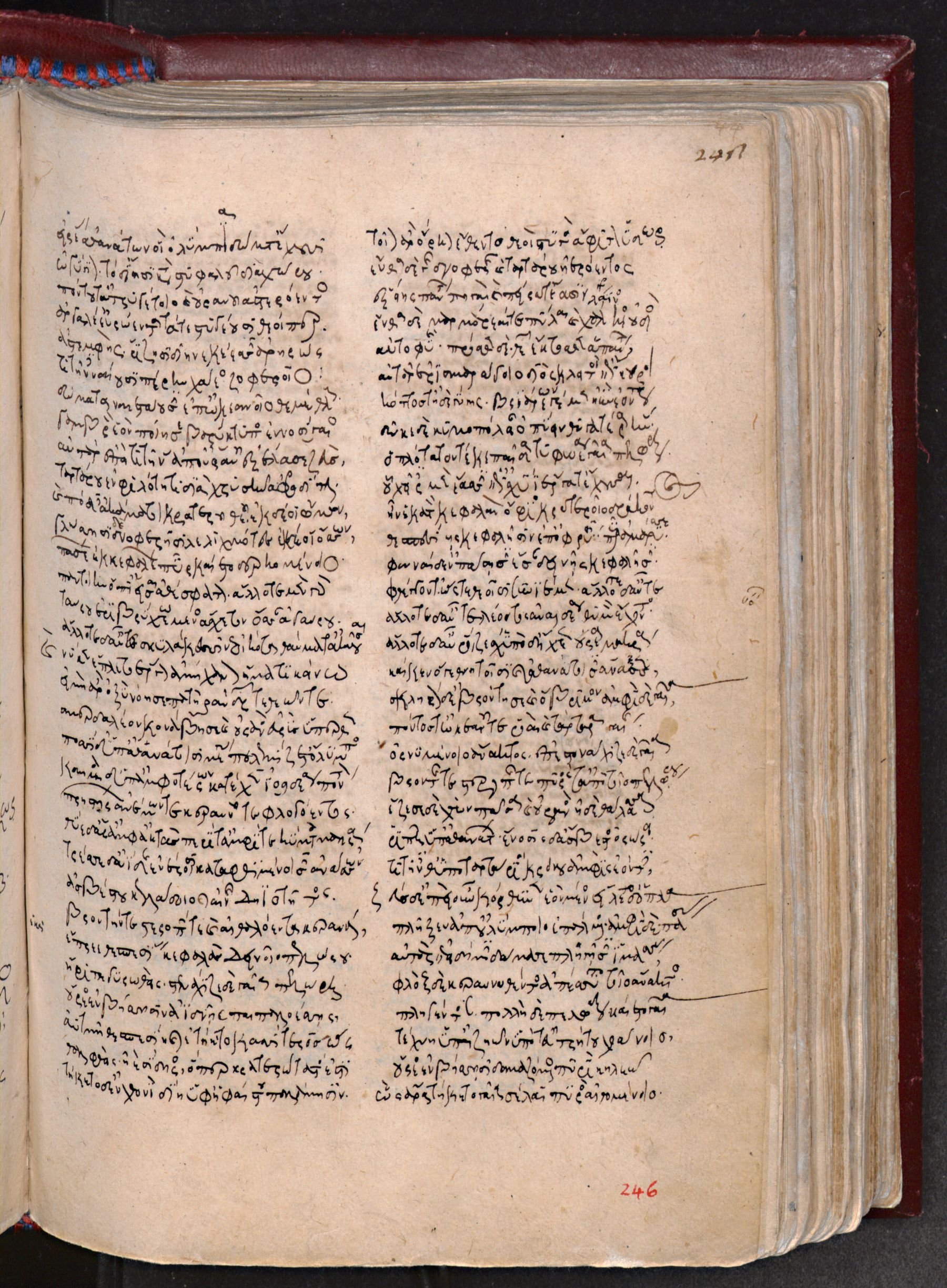
The page photographs are from Florence, Biblioteca Medicea Laurenziana, Plut. 32.16 (paper, late 13th century; a large collection of Greek poetry that also holds letters of Maximus Planudes), Theogony on fols. 240r-247v, the oldest complete manuscript of the poem with published images, in the Biblioteca Medicea Laurenziana's Teca Digitale. This part is on fol. 245r, 245v, 246r. The scribe writes two verses to a row, one in each column, so a page is read across the columns, row by row. Each section below is one page; its note gives the page's first and last verse as read on the photograph.
The Greek is Evelyn-White's Loeb text (1914) via Perseus, not a transcription of this manuscript, whose wording differs here and there. Verses the editor brackets as later additions are shown in square brackets. The English is Evelyn-White's prose translation (1914); it is cut at the end of his sentences, so where a sentence runs across a page break it is given whole to one page; each section's note gives the exact lines its English covers.
How was this verified? (Provenance)
Where on the image
Laur. Plut. 32.16, fol. 245r: lines 669-736, begins ‹οὕς τε Ζεὺς Ἐρέβευσφιν›, ends ‹δνοφερῆς καὶ Ταρτάρου ἠερόεντος›. Checked on the image: first and last rows read and matched to the Greek (re-read on the image 2026-11-12: first row ‹669 | 670: οὕς τε ζεὺς ἐρέβευσφιν ... | δεινοί τε κρατεροί τε ...›, last row ‹735 | 736: ναίουσιν φύλακες πιστοὶ ... | ἔνθα δὲ γῆς δνοφερῆς ...›); the page before ends at line 668 and the page after begins at line 737. This section shows lines 729-736 of that page; the rest of the page belongs to the previous part of the poem. In the falling-anvil passage the scribe's eye slipped from ἄκμων (722) to ἄκμων (724): the column reads 721 | 722, with a mark after 722, then 725 | 726. Under the same mark in the lower margin stand 723 (οὐρανόθεν κατιὼν ...), then a verse that is not in Evelyn-White's text (read as ἶσον δ' αὖτ' ἀπὸ [γῆς] ἐς τάρταρον ἠερόεντα, the middle abbreviated, so not certain; a verse of this kind is found in part of the manuscript tradition), then 724 written over two lines. The Greek shows 723-724 in their places and does not include the extra verse. English here: lines 729-735, cut at the end of Evelyn-White's sentences. His sentence ‹And there, all in their order, are the sources and ends of gloomy ...› begins in line 736, before the page break, and is given whole with the next page, so the English here ends with line 735.
729ἔνθα θεοὶ Τιτῆνες ὑπὸ ζόφῳ ἠερόεντι
730κεκρύφαται βουλῇσι Διὸς νεφεληγερέταο
731χώρῳ ἐν εὐρώεντι, πελώρης ἔσχατα γαίης.
732τοῖς οὐκ ἐξιτόν ἐστι. θύρας δʼ ἐπέθηκε Ποσειδέων
733χαλκείας, τεῖχος δὲ περοίχεται ἀμφοτέρωθεν.
734ἔνθα Γύης Κόττος τε καὶ Ὀβριάρεως μεγάθυμος
735ναίουσιν, φύλακες πιστοὶ Διὸς αἰγιόχοιο.
736ἔνθα δὲ γῆς δνοφερῆς καὶ Ταρτάρου ἠερόεντος
729There by the counsel of Zeus who drives the clouds the Titan gods 730are hidden under misty gloom, in a dank place where are the ends of the huge earth. And they may not go out; for Poseidon fixed gates of bronze upon it, and a wall runs all round it on every side. There Gyes and Cottus and great-souled Obriareus 735live, trusty warders of Zeus who holds the aegis.
Where on the image
Laur. Plut. 32.16, fol. 245v: lines 737-803, begins ‹πόντου τʼ ἀτρυγέτοιο καὶ›, ends ‹δεκάτῳ δʼ ἐπιμίσγεται αὖτις›. Checked on the image: first and last rows read and matched to the Greek (re-read on the image 2026-11-12: first row ‹737 | 738: πόντου τ' ἀτρυγέτοιο ... | ἑξείης πάντων πηγαὶ ...›, last row ‹802 | 803: οὐδέ ποτ' ἐς βουλὴν ... | ἐννέα πάντα ἔτεα ... αὖτις›); the page before ends at line 736 and the page after begins at line 804. A short note in the lower margin is not part of the poem. English here: lines 736-803, cut at the end of Evelyn-White's sentences. His sentence ‹And there, all in their order, are the sources and ends of gloomy ...› begins in line 736, before the page break, and is given whole with this page. His sentence ‹But in the tenth year he comes again ...› begins in line 803, before the page break, and is given whole with the next page, so the English here ends with line 803 (the sentence break falls inside that line).
737πόντου τʼ ἀτρυγέτοιο καὶ οὐρανοῦ ἀστερόεντος
738ἑξείης πάντων πηγαὶ καὶ πείρατʼ ἔασιν
739ἀργαλέʼ εὐρώεντα, τά τε στυγέουσι θεοί περ,
740χάσμα μέγʼ, οὐδέ κε πάντα τελεσφόρον εἰς ἐνιαυτὸν
741οὖδας ἵκοιτʼ, εἰ πρῶτα πυλέων ἔντοσθε γένοιτο,
742ἀλλά κεν ἔνθα καὶ ἔνθα φέροι πρὸ θύελλα θυέλλῃ
743ἀργαλέη· δεινὸν δὲ καὶ ἀθανάτοισι θεοῖσι
744τοῦτο τέρας. Νυκτὸς δʼ ἐρεβεννῆς οἰκία δεινὰ
745ἕστηκεν νεφέλῃς κεκαλυμμένα κυανέῃσιν.
746τῶν πρόσθʼ Ἰαπετοῖο πάις ἔχει οὐρανὸν εὐρὺν
747ἑστηὼς κεφαλῇ τε καὶ ἀκαμάτῃσι χέρεσσιν
748ἀστεμφέως, ὅθι Νύξ τε καὶ Ἡμέρη ἆσσον ἰοῦσαι
749ἀλλήλας προσέειπον, ἀμειβόμεναι μέγαν οὐδὸν
750χάλκεον· ἣ μὲν ἔσω καταβήσεται, ἣ δὲ θύραζε
751ἔρχεται, οὐδέ ποτʼ ἀμφοτέρας δόμος ἐντὸς ἐέργει,
752ἀλλʼ αἰεὶ ἑτέρη γε δόμων ἔκτοσθεν ἐοῦσα
753γαῖαν ἐπιστρέφεται, ἣ δʼ αὖ δόμου ἐντὸς ἐοῦσα
754μίμνει τὴν αὐτῆς ὥρην ὁδοῦ, ἔστʼ ἂν ἵκηται,
755ἣ μὲν ἐπιχθονίοισι φάος πολυδερκὲς ἔχουσα,
756ἣ δʼ Ὕπνον μετὰ χερσί, κασίγνητον Θανάτοιο.
757Νὺξ ὀλοή, νεφέλῃ κεκαλυμμένη ἠεροειδεῖ.
758ἔνθα δὲ Νυκτὸς παῖδες ἐρεμνῆς οἰκίʼ ἔχουσιν,
759Ὕπνος καὶ Θάνατος, δεινοὶ θεοί· οὐδέ ποτʼ αὐτοὺς
760Ἠέλιος φαέθων ἐπιδέρκεται ἀκτίνεσσιν
761οὐρανὸν εἲς ἀνιὼν οὐδʼ οὐρανόθεν καταβαίνων.
762τῶν δʼ ἕτερος γαῖάν τε καὶ εὐρέα νῶτα θαλάσσης
763ἥσυχος ἀνστρέφεται καὶ μείλιχος ἀνθρώποισι,
764τοῦ δὲ σιδηρέη μὲν κραδίη, χάλκεον δέ οἱ ἦτορ
765νηλεὲς ἐν στήθεσσιν· ἔχει δʼ ὃν πρῶτα λάβῃσιν
766ἀνθρώπων· ἐχθρὸς δὲ καὶ ἀθανάτοισι θεοῖσιν.
767ἔνθα θεοῦ χθονίου πρόσθεν δόμοι ἠχήεντες
768ἰφθίμου τʼ Ἀίδεω καὶ ἐπαινῆς Περσεφονείης
769ἑστᾶσιν, δεινὸς δὲ κύων προπάροιθε φυλάσσει
770νηλειής, τέχνην δὲ κακὴν ἔχει· ἐς μὲν ἰόντας
771σαίνει ὁμῶς οὐρῇ τε καὶ οὔασιν ἀμφοτέροισιν,
772ἐξελθεῖν δʼ οὐκ αὖτις ἐᾷ πάλιν, ἀλλὰ δοκεύων
773ἐσθίει, ὅν κε λάβῃσι πυλέων ἔκτοσθεν ἰόντα.
774[ἰφθίμου τʼ Ἀίδεω καὶ ἐπαινῆς Περσεφονείης.]
775ἔνθα δὲ ναιετάει στυγερὴ θεὸς ἀθανάτοισι,
776δεινὴ Στύξ, θυγάτηρ ἀψορρόου Ὠκεανοῖο
777πρεσβυτάτη· νόσφιν δὲ θεῶν κλυτὰ δώματα ναίει
778μακρῇσιν πέτρῃσι κατηρεφέʼ· ἀμφὶ δὲ πάντη
779κίοσιν ἀργυρέοισι πρὸς οὐρανὸν ἐστήρικται.
780παῦρα δὲ Θαύμαντος θυγάτηρ πόδας ὠκέα Ἶρις
781ἀγγελίην πωλεῖται ἐπʼ εὐρέα νῶτα θαλάσσης.
782ὁππότʼ ἔρις καὶ νεῖκος ἐν ἀθανάτοισιν ὄρηται
783καί ῥʼ ὅστις ψεύδηται Ὀλύμπια δώματʼ ἐχόντων,
784Ζεὺς δέ τε Ἶριν ἔπεμψε θεῶν μέγαν ὅρκον ἐνεῖκαι
785τηλόθεν ἐν χρυσέῃ προχόῳ πολυώνυμον ὕδωρ
786ψυχρόν, ὅτʼ ἐκ πέτρης καταλείβεται ἠλιβάτοιο
787ὑψηλῆς· πολλὸν δὲ ὑπὸ χθονὸς εὐρυοδείης
788ἐξ ἱεροῦ ποταμοῖο ῥέει διὰ νύκτα μέλαιναν
789Ὠκεανοῖο κέρας· δεκάτη δʼ ἐπὶ μοῖρα δέδασται·
790ἐννέα μὲν περὶ γῆν τε καὶ εὐρέα νῶτα θαλάσσης
791δίνῃς ἀργυρέῃς εἱλιγμένος εἰς ἅλα πίπτει,
792ἣ δὲ μίʼ ἐκ πέτρης προρέει μέγα πῆμα θεοῖσιν.
793ὅς κεν τὴν ἐπίορκον ἀπολλείψας ἐπομόσσῃ
794ἀθανάτων, οἳ ἔχουσι κάρη νιφόεντος Ὀλύμπου,
795κεῖται νήυτμος τετελεσμένον εἰς ἐνιαυτόν·
796οὐδέ ποτʼ ἀμβροσίης καὶ νέκταρος ἔρχεται ἆσσον
797βρώσιος, ἀλλά τε κεῖται ἀνάπνευστος καὶ ἄναυδος
798στρωτοῖς ἐν λεχέεσσι, κακὸν δέ ἑ κῶμα καλύπτει.
799αὐτὰρ ἐπεὶ νοῦσον τελέσῃ μέγαν εἰς ἐνιαυτόν,
800ἄλλος γʼ ἐξ ἄλλου δέχεται χαλεπώτερος ἄεθλος.
801εἰνάετες δὲ θεῶν ἀπαμείρεται αἰὲν ἐόντων,
802οὐδέ ποτʼ ἐς βουλὴν ἐπιμίσγεται οὐδʼ ἐπὶ δαῖτας
803ἐννέα πάντα ἔτεα· δεκάτῳ δʼ ἐπιμίσγεται αὖτις
736And there, all in their order, are the sources and ends of gloomy earth and misty Tartarus and the unfruitful sea and starry heaven, loathsome and dank, which even the gods abhor. 740It is a great gulf, and if once a man were within the gates, he would not reach the floor until a whole year had reached its end, but cruel blast upon blast would carry him this way and that. And this marvel is awful even to the deathless gods. There stands the awful home of murky Night 745wrapped in dark clouds. In front of it the son of Iapetus stands immovably upholding the wide heaven upon his head and unwearying hands, where Night and Day draw near and greet one another as they pass the great threshold 750of bronze: and while the one is about to go down into the house, the other comes out at the door. And the house never holds them both within; but always one is without the house passing over the earth, while the other stays at home and waits until the time for her journeying comes; 755and the one holds all-seeing light for them on earth, but the other holds in her arms Sleep the brother of Death, even evil Night, wrapped in a vaporous cloud. And there the children of dark Night have their dwellings, Sleep and Death, awful gods. 760The glowing Sun never looks upon them with his beams, neither as he goes up into heaven, nor as he comes down from heaven. And the former of them roams peacefully over the earth and the sea's broad back and is kindly to men; but the other has a heart of iron, and his spirit within him 765is pitiless as bronze: whomever of men he has once seized he holds fast: and he is hateful even to the deathless gods. 767There, in front, stand the echoing halls of the god of the lower-world, strong Hades, and of awful Persephone. A fearful hound guards the house in front, 770pitiless, and he has a cruel trick. On those who go in he fawns with his tail and both his ears, but suffers them not to go out back again, but keeps watch and devours whomever he catches going out of the gates of strong Hades and awful Persephone. 775And there dwells the goddess loathed by the deathless gods, terrible Styx, eldest daughter of backflowing Ocean. She lives apart from the gods in her glorious house vaulted over with great rocks and propped up to heaven all round with silver pillars. 780Rarely does the daughter of Thaumas, swift-footed Iris, come to her with a message over the sea's wide back. But when strife and quarrel arise among the deathless gods, and when any one of them who live in the house of Olympus lies, then Zeus sends Iris to bring in a golden jug the great oath of the gods 785from far away, the famous cold water which trickles down from a high and beetling rock. Far under the wide-pathed earth a branch of Oceanus flows through the dark night out of the holy stream, and a tenth part of his water is allotted to her. 790With nine silver-swirling streams he winds about the earth and the sea's wide back, and then falls into the main; but the tenth flows out from a rock, a sore trouble to the gods. For whoever of the deathless gods that hold the peaks of snowy Olympus pours a libation of her water and is forsworn, 795must lie breathless until a full year is completed, and never come near to taste ambrosia and nectar, but lie spiritless and voiceless on a strewn bed: and a heavy trance overshadows him. But when he has spent a long year in his sickness, 800another penance more hard follows after the first. For nine years he is cut off from the eternal gods and never joins their councils or their feasts, nine full years.
Where on the image
Laur. Plut. 32.16, fol. 246r: lines 804-867, begins ‹εἴρας ἐς ἀθανάτων, οἳ›, ends ‹γαῖα σέλαι πυρὸς αἰθομένοιο.›. Checked on the image: first and last rows read and matched to the Greek (re-read on the image 2026-11-12: first row ‹804 | 805: εἴρας ἐς ἀθανάτων ... | τοῖον ἄρ' ὅρκον ἔθεντο ...›, last row ‹866 | 867: τήκεται ἐν χθονὶ δίῃ ... | ὣς ἄρα τήκετο γαῖα ...›); the page before ends at line 803 and the page after begins at line 868. This section shows lines 804-819 of that page; the rest of the page belongs to the next part of the poem. English here: lines 803-819, cut at the end of Evelyn-White's sentences. His sentence ‹But in the tenth year he comes again ...› begins in line 803, before the page break, and is given whole with this page (line 803 holds the end of one sentence and the start of the next).
804εἴρας ἐς ἀθανάτων, οἳ Ὀλύμπια δώματʼ ἔχουσιν.
805τοῖον ἄρʼ ὅρκον ἔθεντο θεοὶ Στυγὸς ἄφθιτον ὕδωρ
806ὠγύγιον, τὸ δʼ ἵησι καταστυφέλου διὰ χώρου.
807ἔνθα δὲ γῆς δνοφερῆς καὶ Ταρτάρου ἠερόεντος
808πόντου τʼ ἀτρυγέτοιο καὶ οὐρανοῦ ἀστερόεντος
809ἑξείης πάντων πηγαὶ καὶ πείρατʼ ἔασιν
810ἀργαλέʼ εὐρώεντα, τά τε στυγέουσι θεοί περ.
811ἔνθα δὲ μαρμάρεαί τε πύλαι καὶ χάλκεος οὐδὸς
812ἀστεμφής, ῥίζῃσι διηνεκέεσσιν ἀρηρώς,
813αὐτοφυής· πρόσθεν δὲ θεῶν ἔκτοσθεν ἁπάντων
814Τιτῆνες ναίουσι, πέρην Χάεος ζοφεροῖο.
815αὐτὰρ ἐρισμαράγοιο Διὸς κλειτοὶ ἐπίκουροι
816δώματα ναιετάουσιν ἐπʼ Ὠκεανοῖο θεμέθλοις,
817Κόττος τʼ ἠδὲ Γύης· Βριάρεών γε μὲν ἠὺν ἐόντα
818γαμβρὸν ἑὸν ποίησε βαρύκτυπος Ἐννοσίγαιος,
819δῶκε δὲ Κυμοπόλειαν ὀπυίειν, θυγατέρα ἥν.
803But in the tenth year he comes again to join the assemblies of the deathless gods who live in the house of Olympus. 805Such an oath, then, did the gods appoint the eternal and primeval water of Styx to be: and it spouts through a rugged place. 807And there, all in their order, are the sources and ends of the dark earth and misty Tartarus and the unfruitful sea and starry heaven, 810loathsome and dank, which even the gods abhor. And there are shining gates and an immovable threshold of bronze having unending roots, and it is grown of itself. And beyond, away from all the gods, live the Titans, beyond gloomy Chaos. 815But the glorious allies of loud-crashing Zeus have their dwelling upon Ocean's foundations, even Cottus and Gyes; but Briareos, being goodly, the deep-roaring Earth-Shaker made his son-in-law, giving him Cymopolea his daughter to wed.
Notes
- Greek: H. G. Evelyn-White, Hesiod, the Homeric Hymns and Homerica (Loeb Classical Library, 1914), via Perseus. Square brackets mark verses the editor regards as interpolated.
- English: H. G. Evelyn-White's translation in the same volume; his footnotes are omitted.
- Lines 929a-929t of the Loeb text (a passage on the birth of Athena quoted by Galen from Chrysippus) are not in the medieval manuscripts and are not included.
Cite
Sources
- Source: Laur. Plut. 32.16 (BML Teca Digitale IIIF) + Evelyn-White Greek (Loeb 1914, Perseus) + Evelyn-White English (1914, Perseus) (holding institution)
- Critical edition: Evelyn-White, Loeb 1914, via Perseus
← previous · → next · v cycle view · l back to library