Hesiod, Theogony 820-885: Typhoeus; Zeus becomes king
Introduction
Hesiod's Theogony (c. 700 BCE) is the oldest Greek account of the origin of the world and the gods, from Chaos and Earth through the reign of Cronos to the victory of Zeus. This part: Typhoeus; Zeus becomes king (lines 820-885, 66 lines). Earth bears Typhoeus, whom Zeus defeats; the gods ask Zeus to reign.
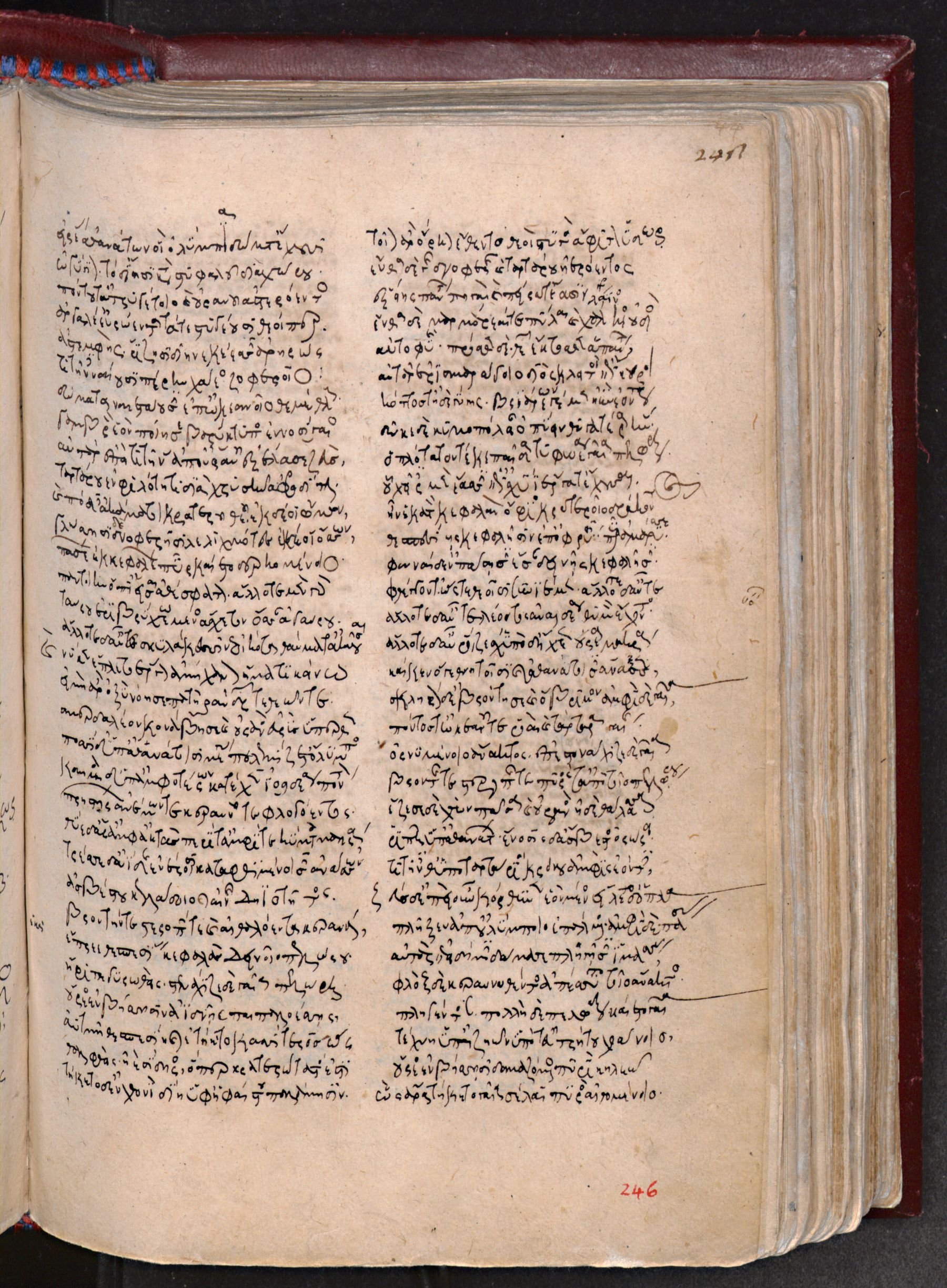
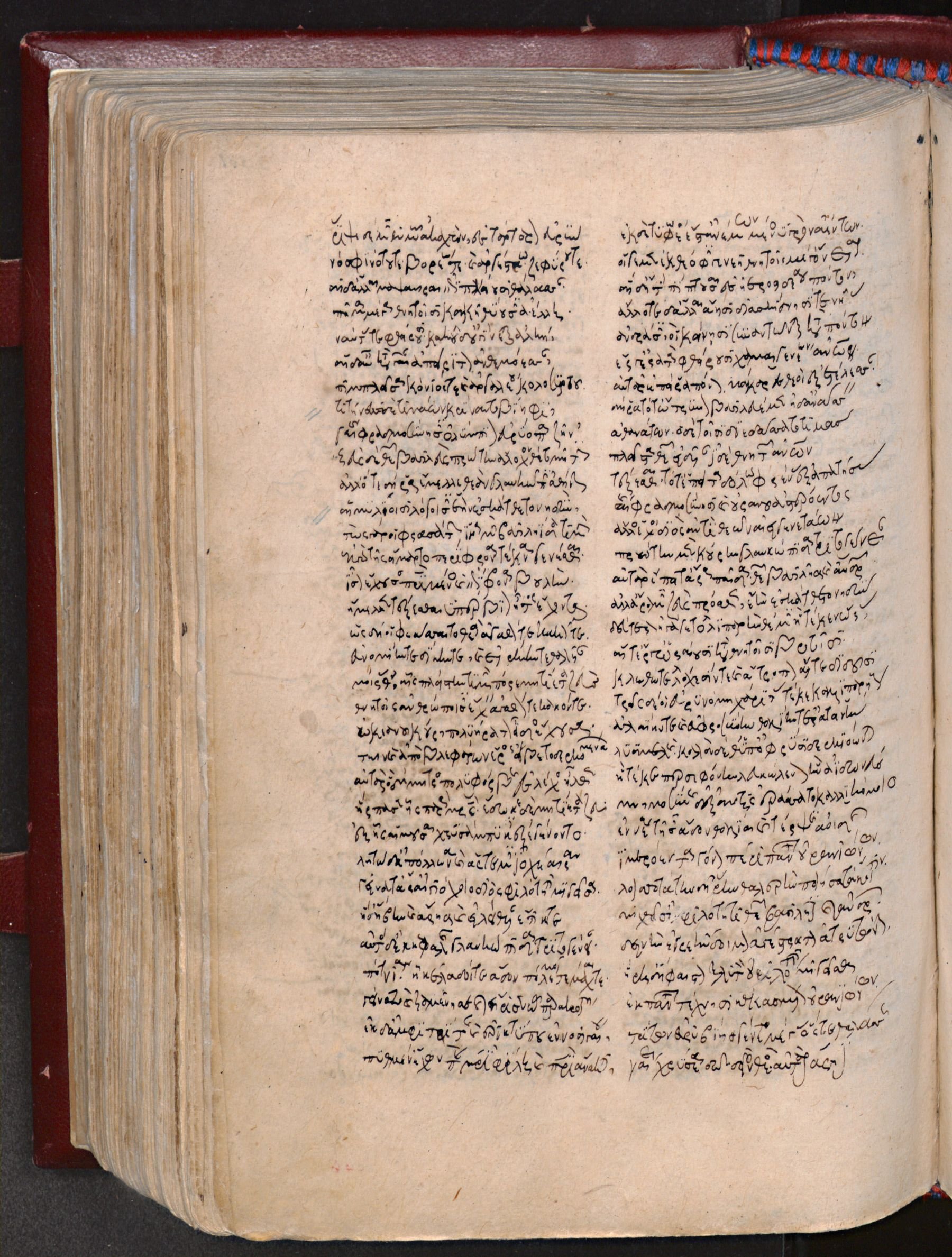
The page photographs are from Florence, Biblioteca Medicea Laurenziana, Plut. 32.16 (paper, late 13th century; a large collection of Greek poetry that also holds letters of Maximus Planudes), Theogony on fols. 240r-247v, the oldest complete manuscript of the poem with published images, in the Biblioteca Medicea Laurenziana's Teca Digitale. This part is on fol. 246r, 246v. The scribe writes two verses to a row, one in each column, so a page is read across the columns, row by row. Each section below is one page; its note gives the page's first and last verse as read on the photograph.
The Greek is Evelyn-White's Loeb text (1914) via Perseus, not a transcription of this manuscript, whose wording differs here and there. Verses the editor brackets as later additions are shown in square brackets. The English is Evelyn-White's prose translation (1914); it is cut at the end of his sentences, so where a sentence runs across a page break it is given whole to one page; each section's note gives the exact lines its English covers.
How was this verified? (Provenance)
Where on the image
Laur. Plut. 32.16, fol. 246r: lines 804-867, begins ‹εἴρας ἐς ἀθανάτων, οἳ›, ends ‹γαῖα σέλαι πυρὸς αἰθομένοιο.›. Checked on the image: first and last rows read and matched to the Greek (re-read on the image 2026-11-12: first row ‹804 | 805: εἴρας ἐς ἀθανάτων ... | τοῖον ἄρ' ὅρκον ἔθεντο ...›, last row ‹866 | 867: τήκεται ἐν χθονὶ δίῃ ... | ὣς ἄρα τήκετο γαῖα ...›); the page before ends at line 803 and the page after begins at line 868. This section shows lines 820-867 of that page; the rest of the page belongs to the previous part of the poem. English here: lines 820-867, cut at the end of Evelyn-White's sentences. At the break with the next page the English ends with line 867, the same line as the Greek.
820αὐτὰρ ἐπεὶ Τιτῆνας ἀπʼ οὐρανοῦ ἐξέλασεν Ζεύς,
821ὁπλότατον τέκε παῖδα Τυφωέα Γαῖα πελώρη
822Ταρτάρου ἐν φιλότητι διὰ χρυσέην Ἀφροδίτην·
823οὗ χεῖρες μὲν ἔασιν ἐπʼ ἰσχύι, ἔργματʼ ἔχουσαι,
824καὶ πόδες ἀκάματοι κρατεροῦ θεοῦ· ἐκ δέ οἱ ὤμων
825ἣν ἑκατὸν κεφαλαὶ ὄφιος, δεινοῖο δράκοντος,
826γλώσσῃσιν δνοφερῇσι λελιχμότες, ἐκ δέ οἱ ὄσσων
827θεσπεσίῃς κεφαλῇσιν ὑπʼ ὀφρύσι πῦρ ἀμάρυσσεν·
828πασέων δʼ ἐκ κεφαλέων πῦρ καίετο δερκομένοιο·
829φωναὶ δʼ ἐν πάσῃσιν ἔσαν δεινῇς κεφαλῇσι
830παντοίην ὄπʼ ἰεῖσαι ἀθέσφατον· ἄλλοτε μὲν γὰρ
831φθέγγονθʼ ὥστε θεοῖσι συνιέμεν, ἄλλοτε δʼ αὖτε
832ταύρου ἐριβρύχεω, μένος ἀσχέτου, ὄσσαν ἀγαύρου,
833ἄλλοτε δʼ αὖτε λέοντος ἀναιδέα θυμὸν ἔχοντος,
834ἄλλοτε δʼ αὖ σκυλάκεσσιν ἐοικότα, θαύματʼ ἀκοῦσαι,
835ἄλλοτε δʼ αὖ ῥοίζεσχʼ, ὑπὸ δʼ ἤχεεν οὔρεα μακρά.
836καί νύ κεν ἔπλετο ἔργον ἀμήχανον ἤματι κείνῳ
837καί κεν ὅ γε θνητοῖσι καὶ ἀθανάτοισιν ἄναξεν,
838εἰ μὴ ἄρʼ ὀξὺ νόησε πατὴρ ἀνδρῶν τε θεῶν τε.
839σκληρὸν δʼ ἐβρόντησε καὶ ὄβριμον, ἀμφὶ δὲ γαῖα
840σμερδαλέον κονάβησε καὶ οὐρανὸς εὐρὺς ὕπερθε
841πόντος τʼ Ὠκεανοῦ τε ῥοαὶ καὶ Τάρταρα γαίης.
842ποσσὶ δʼ ὕπʼ ἀθανάτοισι μέγας πελεμίζετʼ Ὄλυμπος
843ὀρνυμένοιο ἄνακτος· ἐπεστενάχιζε δὲ γαῖα.
844καῦμα δʼ ὑπʼ ἀμφοτέρων κάτεχεν ἰοειδέα πόντον
845βροντῆς τε στεροπῆς τε, πυρός τʼ ἀπὸ τοῖο πελώρου,
846πρηστήρων ἀνέμων τε κεραυνοῦ τε φλεγέθοντος.
847ἔζεε δὲ χθὼν πᾶσα καὶ οὐρανὸς ἠδὲ θάλασσα·
848θυῖε δʼ ἄρʼ ἀμφʼ ἀκτὰς περί τʼ ἀμφί τε κύματα μακρὰ
849ῥιπῇ ὕπʼ ἀθανάτων, ἔνοσις δʼ ἄσβεστος ὀρώρει·
850τρέε δʼ Ἀίδης, ἐνέροισι καταφθιμένοισιν ἀνάσσων,
851Τιτῆνές θʼ ὑποταρτάριοι, Κρόνον ἀμφὶς ἐόντες,
852ἀσβέστου κελάδοιο καὶ αἰνῆς δηιοτῆτος.
853Ζεὺς δʼ ἐπεὶ οὖν κόρθυνεν ἑὸν μένος, εἵλετο δʼ ὅπλα,
854βροντήν τε στεροπήν τε καὶ αἰθαλόεντα κεραυνόν,
855πλῆξεν ἀπʼ Οὐλύμποιο ἐπάλμενος· ἀμφὶ δὲ πάσας
856ἔπρεσε θεσπεσίας κεφαλὰς δεινοῖο πελώρου.
857αὐτὰρ ἐπεὶ δή μιν δάμασεν πληγῇσιν ἱμάσσας,
858ἤριπε γυιωθείς, στενάχιζε δὲ γαῖα πελώρη.
859φλὸξ δὲ κεραυνωθέντος ἀπέσσυτο τοῖο ἄνακτος
860οὔρεος ἐν βήσσῃσιν ἀιδνῇς παιπαλοέσσῃς,
861πληγέντος. πολλὴ δὲ πελώρη καίετο γαῖα
862ἀτμῇ θεσπεσίῃ καὶ ἐτήκετο κασσίτερος ὣς
863τέχνῃ ὕπʼ αἰζηῶν ἐν ἐυτρήτοις χοάνοισι
864θαλφθείς, ἠὲ σίδηρος, ὅ περ κρατερώτατός ἐστιν.
865οὔρεος ἐν βήσσῃσι δαμαζόμενος πυρὶ κηλέῳ
866τήκεται ἐν χθονὶ δίῃ ὑφʼ Ἡφαιστου παλάμῃσιν.
867ὣς ἄρα τήκετο γαῖα σέλαι πυρὸς αἰθομένοιο.
820But when Zeus had driven the Titans from heaven, huge Earth bore her youngest child Typhoeus of the love of Tartarus, by the aid of golden Aphrodite. Strength was with his hands in all that he did and the feet of the strong god were untiring. From his shoulders 825grew a hundred heads of a snake, a fearful dragon, with dark, flickering tongues, and from under the brows of his eyes in his marvellous heads flashed fire, and fire burned from his heads as he glared. And there were voices in all his dreadful heads 830which uttered every kind of sound unspeakable; for at one time they made sounds such that the gods understood, but at another, the noise of a bull bellowing aloud in proud ungovernable fury; and at another, the sound of a lion, relentless of heart; and at another, sounds like whelps, wonderful to hear; 835and again, at another, he would hiss, so that the high mountains re-echoed. And truly a thing past help would have happened on that day, and he would have come to reign over mortals and immortals, had not the father of men and gods been quick to perceive it. But he thundered hard and mightily: and the earth around 840resounded terribly and the wide heaven above, and the sea and Ocean's streams and the nether parts of the earth. Great Olympus reeled beneath the divine feet of the king as he arose and earth groaned thereat. And through the two of them heat took hold on the dark-blue sea, 845through the thunder and lightning, and through the fire from the monster, and the scorching winds and blazing thunderbolt. The whole earth seethed, and sky and sea: and the long waves raged along the beaches round and about at the rush of the deathless gods: and there arose an endless shaking. 850Hades trembled where he rules over the dead below, and the Titans under Tartarus who live with Cronos, because of the unending clamor and the fearful strife. 853So when Zeus had raised up his might and seized his arms, thunder and lightning and lurid thunderbolt, 855he leaped from Olympus and struck him, and burned all the marvellous heads of the monster about him. But when Zeus had conquered him and lashed him with strokes, Typhoeus was hurled down, a maimed wreck, so that the huge earth groaned. And flame shot forth from the thunderstricken lord 860in the dim rugged glens of the mount, when he was smitten. A great part of huge earth was scorched by the terrible vapor and melted as tin melts when heated by men's art in channelled crucibles; or as iron, which is hardest of all things, is shortened 865by glowing fire in mountain glens and melts in the divine earth through the strength of Hephaestus. Even so, then, the earth melted in the glow of the blazing fire.
Where on the image
Laur. Plut. 32.16, fol. 246v: lines 868-933, begins ‹ῥῖψε δέ μιν θυμῷ›, ends ‹δεινὸς θεός. αὐτὰρ Ἄρηι›. Checked on the image: first and last rows read and matched to the Greek (re-read on the image 2026-11-12: first row ‹868 | 869: ῥῖψε δέ μιν θυμῷ ... | ἐκ δὲ τυφωέος ...›, last row ‹932 | 933: πυθμέν' ἔχων παρὰ μητρὶ ... | ναίει χρύσεα δῶ ... αὐτὰρ ἄρηϊ›); the page before ends at line 867 and the page after begins at line 934. This section shows lines 868-885 of that page; the rest of the page belongs to the next part of the poem. Lines 929a-929t of the Loeb edition (a passage quoted by Galen) are not in this or any medieval manuscript and are left out here: the row 928 | 929 is followed directly by 930 | 931. English here: lines 868-885, cut at the end of Evelyn-White's sentences. At the break with the page before, his sentence for line 868 (‹And in the bitterness of his anger ...›) begins with the Greek of this page.
868ῥῖψε δέ μιν θυμῷ ἀκαχὼν ἐς Τάρταρον εὐρύν.
869ἐκ δὲ Τυφωέος ἔστʼ ἀνέμων μένος ὑγρὸν ἀέντων,
870νόσφι Νότου Βορέω τε καὶ ἀργέστεω Ζεφύροιο·
871οἵ γε μὲν ἐκ θεόφιν γενεή, θνητοῖς μέγʼ ὄνειαρ·
872οἱ δʼ ἄλλοι μαψαῦραι ἐπιπνείουσι θάλασσαν·
873αἳ δή τοι πίπτουσαι ἐς ἠεροειδέα πόντον,
874πῆμα μέγα θνητοῖσι, κακῇ θυίουσιν ἀέλλῃ·
875ἄλλοτε δʼ ἄλλαι ἄεισι διασκιδνᾶσί τε νῆας
876ναύτας τε φθείρουσι· κακοῦ δʼ οὐ γίγνεται ἀλκὴ
877ἀνδράσιν, οἳ κείνῃσι συνάντωνται κατὰ πόντον·
878αἳ δʼ αὖ καὶ κατὰ γαῖαν ἀπείριτον ἀνθεμόεσσαν
879ἔργʼ ἐρατὰ φθείρουσι χαμαιγενέων ἀνθρώπων
880πιμπλεῖσαι κόνιός τε καὶ ἀργαλέου κολοσυρτοῦ.
881αὐτὰρ ἐπεί ῥα πόνον μάκαρες θεοὶ ἐξετέλεσσαν,
882Τιτήνεσσι δὲ τιμάων κρίναντο βίηφι,
883δή ῥα τότʼ ὤτρυνον βασιλευέμεν ἠδὲ ἀνάσσειν
884Γαίης φραδμοσύνῃσιν Ὀλύμπιον εὐρύοπα Ζῆν
885ἀθανάτων· ὃ δὲ τοῖσιν ἑὰς διεδάσσατο τιμάς.
868And in the bitterness of his anger Zeus cast him into wide Tartarus. And from Typhoeus come boisterous winds which blow damply, 870except Notus and Boreas and clear Zephyr. These are a god-sent kind, and a great blessing to men; but the others blow fitfully upon the sea. Some rush upon the misty sea and work great havoc among men with their evil, raging blasts; 875for varying with the season they blow, scattering ships and destroying sailors. And men who meet these upon the sea have no help against the mischief. Others again over the boundless, flowering earth spoil the fair fields of men who dwell below, 880filling them with dust and cruel uproar. But when the blessed gods had finished their toil, and settled by force their struggle for honors with the Titans, they pressed far-seeing Olympian Zeus to reign and to rule over them, by Earth's prompting. So he divided their dignities amongst them.
Notes
- Greek: H. G. Evelyn-White, Hesiod, the Homeric Hymns and Homerica (Loeb Classical Library, 1914), via Perseus. Square brackets mark verses the editor regards as interpolated.
- English: H. G. Evelyn-White's translation in the same volume; his footnotes are omitted.
- Lines 929a-929t of the Loeb text (a passage on the birth of Athena quoted by Galen from Chrysippus) are not in the medieval manuscripts and are not included.
Cite
Sources
- Source: Laur. Plut. 32.16 (BML Teca Digitale IIIF) + Evelyn-White Greek (Loeb 1914, Perseus) + Evelyn-White English (1914, Perseus) (holding institution)
- Critical edition: Evelyn-White, Loeb 1914, via Perseus
← previous · → next · v cycle view · l back to library