Hesiod, Theogony 886-962: The wives and children of Zeus
Introduction
Hesiod's Theogony (c. 700 BCE) is the oldest Greek account of the origin of the world and the gods, from Chaos and Earth through the reign of Cronos to the victory of Zeus. This part: The wives and children of Zeus (lines 886-962, 77 lines). Zeus swallows Metis, then marries Themis, Eurynome, Demeter, Mnemosyne, Leto and Hera; the birth of Athena and the other Olympians.
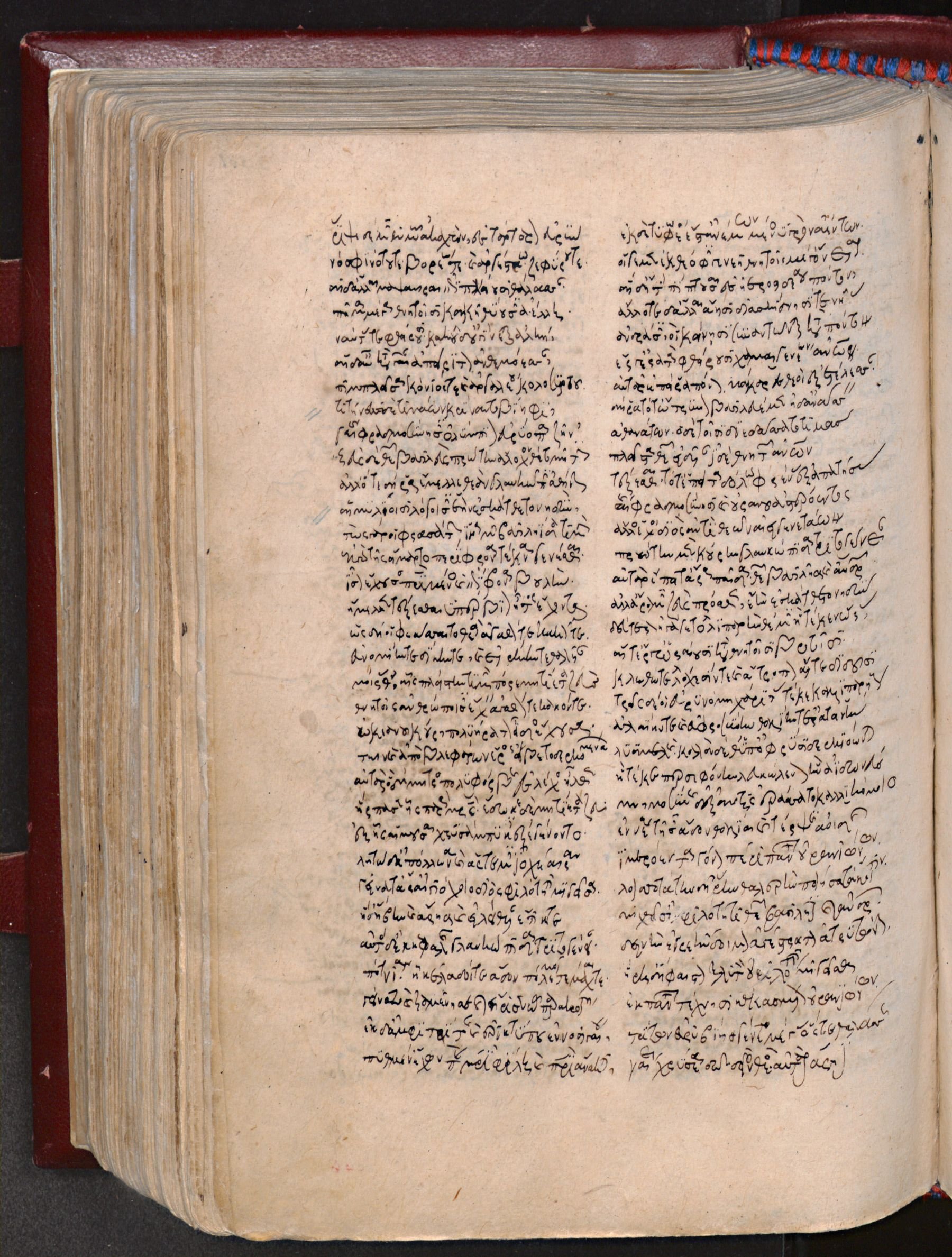
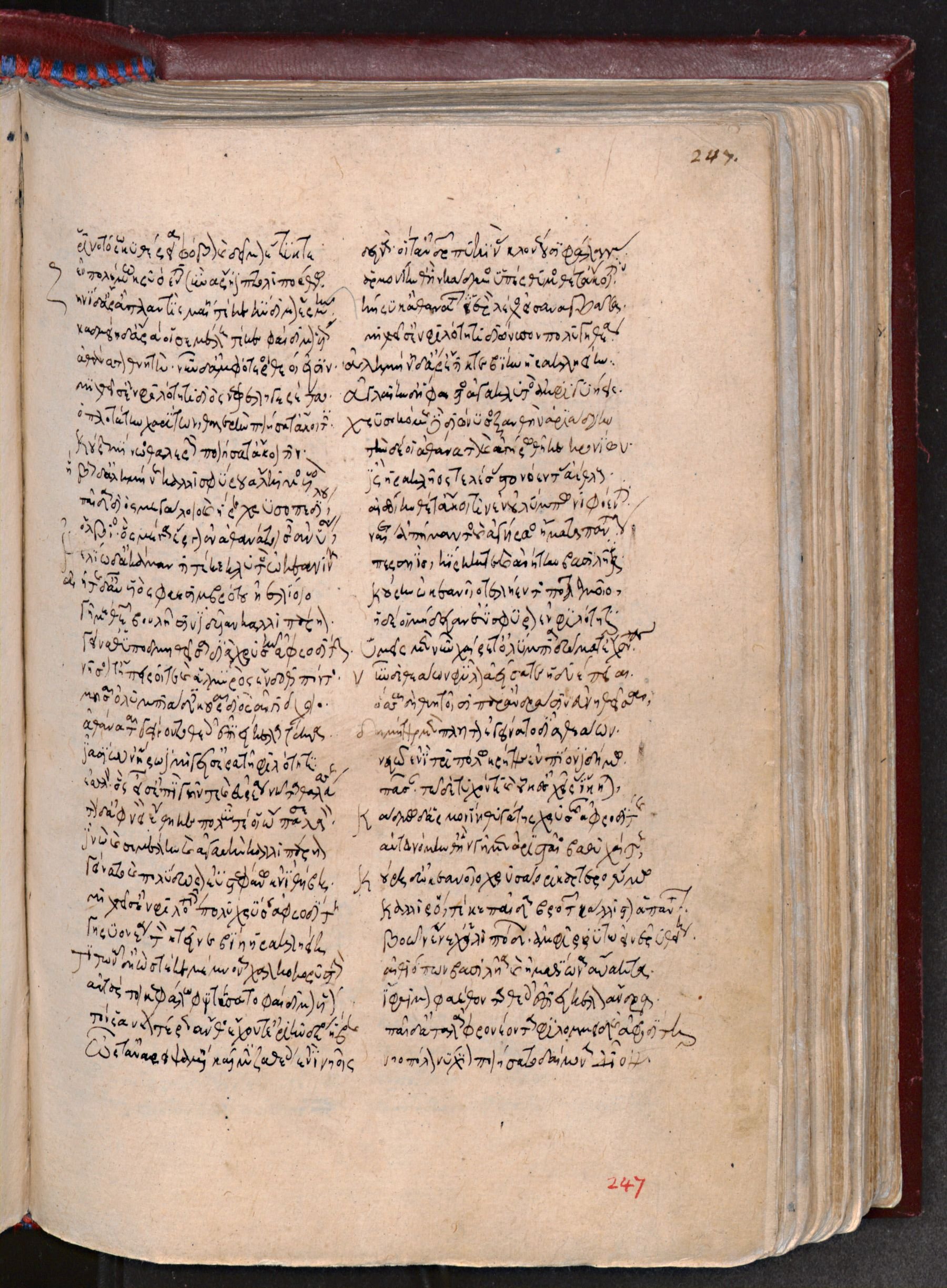
The page photographs are from Florence, Biblioteca Medicea Laurenziana, Plut. 32.16 (paper, late 13th century; a large collection of Greek poetry that also holds letters of Maximus Planudes), Theogony on fols. 240r-247v, the oldest complete manuscript of the poem with published images, in the Biblioteca Medicea Laurenziana's Teca Digitale. This part is on fol. 246v, 247r. The scribe writes two verses to a row, one in each column, so a page is read across the columns, row by row. Each section below is one page; its note gives the page's first and last verse as read on the photograph.
The Greek is Evelyn-White's Loeb text (1914) via Perseus, not a transcription of this manuscript, whose wording differs here and there. Verses the editor brackets as later additions are shown in square brackets. The English is Evelyn-White's prose translation (1914); it is cut at the end of his sentences, so where a sentence runs across a page break it is given whole to one page; each section's note gives the exact lines its English covers.
How was this verified? (Provenance)
Where on the image
Laur. Plut. 32.16, fol. 246v: lines 868-933, begins ‹ῥῖψε δέ μιν θυμῷ›, ends ‹δεινὸς θεός. αὐτὰρ Ἄρηι›. Checked on the image: first and last rows read and matched to the Greek (re-read on the image 2026-11-12: first row ‹868 | 869: ῥῖψε δέ μιν θυμῷ ... | ἐκ δὲ τυφωέος ...›, last row ‹932 | 933: πυθμέν' ἔχων παρὰ μητρὶ ... | ναίει χρύσεα δῶ ... αὐτὰρ ἄρηϊ›); the page before ends at line 867 and the page after begins at line 934. This section shows lines 886-933 of that page; the rest of the page belongs to the previous part of the poem. Lines 929a-929t of the Loeb edition (a passage quoted by Galen) are not in this or any medieval manuscript and are left out here: the row 928 | 929 is followed directly by 930 | 931. English here: lines 886-933, cut at the end of Evelyn-White's sentences. His sentence ‹Also Cytherea bore to Ares ...› begins in line 933, before the page break, and is given whole with the next page, so the English here ends with line 933 (the sentence break falls inside that line).
886Ζεὺς δὲ θεῶν βασιλεὺς πρώτην ἄλοχον θέτο Μῆτιν
887πλεῖστα θεῶν εἰδυῖαν ἰδὲ θνητῶν ἀνθρώπων.
888ἀλλʼ ὅτε δὴ ἄρʼ ἔμελλε θεὰν γλαυκῶπιν Ἀθήνην
889τέξεσθαι, τότʼ ἔπειτα δόλῳ φρένας ἐξαπατήσας
890αἱμυλίοισι λόγοισιν ἑὴν ἐσκάτθετο νηδὺν
891Γαίης φραδμοσύνῃσι καὶ Οὐρανοῦ ἀστερόεντος.
892τὼς γάρ οἱ φρασάτην, ἵνα μὴ βασιληίδα τιμὴν
893ἄλλος ἔχοι Διὸς ἀντὶ θεῶν αἰειγενετάων.
894ἐκ γὰρ τῆς εἵμαρτο περίφρονα τέκνα γενέσθαι·
895πρώτην μὲν κούρην γλαυκώπιδα Τριτογένειαν
896ἶσον ἔχουσαν πατρὶ μένος καὶ ἐπίφρονα βουλήν.
897αὐτὰρ ἔπειτʼ ἄρα παῖδα θεῶν βασιλῆα καὶ ἀνδρῶν
898ἤμελλεν τέξεσθαι, ὑπέρβιον ἦτορ ἔχοντα·
899ἀλλʼ ἄρα μιν Ζεὺς πρόσθεν ἑὴν ἐσκάτθετο νηδύν,
900ὡς δή οἱ φράσσαιτο θεὰ ἀγαθόν τε κακόν τε.
901δεύτερον ἠγάγετο λιπαρὴν Θέμιν, ἣ τέκεν Ὥρας,
902Εὐνομίην τε Δίκην τε καὶ Εἰρήνην τεθαλυῖαν,
903αἳ ἔργʼ ὠρεύουσι καταθνητοῖσι βροτοῖσι,
904Μοίρας θʼ, ᾗ πλείστην τιμὴν πόρε μητίετα Ζεύς,
905Κλωθώ τε Λάχεσίν τε καὶ Ἄτροπον, αἵτε διδοῦσι
906θνητοῖς ἀνθρώποισιν ἔχειν ἀγαθόν τε κακόν τε.
907τρεῖς δέ οἱ Εὐρυνομη Χάριτας τέκε καλλιπαρῄους,
908Ὠκεανοῦ κούρη, πολυήρατον εἶδος ἔχουσα,
909Ἀγλαΐην τε καὶ Εὐφροσύνην Θαλίην τʼ ἐρατεινήν·
910τῶν καὶ ἀπὸ βλεφάρων ἔρος εἴβετο δερκομενάων
911λυσιμελής· καλὸν δέ θʼ ὑπʼ ὀφρύσι δερκιόωνται.
912αὐτὰρ ὁ Δήμητρος πολυφόρβης ἐς λέχος ἦλθεν,
913ἣ τέκε Περσεφόνην λευκώλενον, ἣν Ἀιδωνεὺς
914ἥρπασε ἧς παρὰ μητρός· ἔδωκε δὲ μητίετα Ζεύς.
915Μνημοσύνης δʼ ἐξαῦτις ἐράσσατο καλλικόμοιο,
916ἐξ ἧς οἱ Μοῦσαι χρυσάμπυκες ἐξεγένοντο
917ἐννέα, τῇσιν ἅδον θαλίαι καὶ τέρψις ἀοιδῆς.
918Λητὼ δʼ Ἀπόλλωνα καὶ Ἄρτεμιν ἰοχέαιραν,
919ἱμερόεντα γόνον περὶ πάντων Οὐρανιώνων,
920γείνατʼ ἄρʼ αἰγιόχοιο Διὸς φιλότητι μιγεῖσα.
921λοισθοτάτην δʼ Ἥρην θαλερὴν ποιήσατʼ ἄκοιτιν·
922ἣ δʼ Ἥβην καὶ Ἄρηα καὶ Εἰλείθυιαν ἔτικτε
923μιχθεῖσʼ ἐν φιλότητι θεῶν βασιλῆι καὶ ἀνδρῶν.
924αὐτὸς δʼ ἐκ κεφαλῆς γλαυκώπιδα Τριτογένειαν
925δεινὴν ἐγρεκύδοιμον ἀγέστρατον Ἀτρυτώνην
926πότνιαν, ᾗ κέλαδοί τε ἅδον πόλεμοί τε μάχαι τε,
927Ἥρη δʼ Ἥφαιστον κλυτὸν οὐ φιλότητι μιγεῖσα
928γείνατο, καὶ ζαμένησε καὶ ἤρισε ᾧ παρακοίτῃ,
929ἐκ πάντων τέχνῃσι κεκασμένον Οὐρανιώνων.
930Ἐκ δʼ Ἀμφιτρίτης καὶ ἐρικτύπου Ἐννοσιγαίου
931Τρίτων εὐρυβίης γένετο μέγας, ὅστε θαλάσσης
932πυθμένʼ ἔχων παρὰ μητρὶ φίλῃ καὶ πατρὶ ἄνακτι
933ναίει χρύσεα δῶ, δεινὸς θεός. αὐτὰρ Ἄρηι
886Now Zeus, king of the gods, made Metis his wife first, and she was wisest among gods and mortal men. But when she was about to bring forth the goddess bright-eyed Athena, Zeus craftily deceived her 890with cunning words and put her in his own belly, as Earth and starry Heaven advised. For they advised him so, to the end that no other should hold royal sway over the eternal gods in place of Zeus; for very wise children were destined to be born of her, 895first the maiden bright-eyed Tritogeneia, equal to her father in strength and in wise understanding; but afterwards she was to bear a son of overbearing spirit king of gods and men. But Zeus put her into his own belly first, 900that the goddess might devise for him both good and evil. 901Next he married bright Themis who bore the Horae (Hours), and Eunomia (Order), Dikë (Justice), and blooming Eirene (Peace), who mind the works of mortal men, and the Moerae (Fates) to whom wise Zeus gave the greatest honor, 905Clotho, and Lachesis, and Atropos who give mortal men evil and good to have. And Eurynome, the daughter of Ocean, beautiful in form, bore him three fair-cheeked Charites (Graces), Aglaea, and Euphrosyne, and lovely Thaleia, 910from whose eyes as they glanced flowed love that unnerves the limbs: and beautiful is their glance beneath their brows. Also he came to the bed of all-nourishing Demeter, and she bore white-armed Persephone whom Aidoneus carried off from her mother; but wise Zeus gave her to him. 915And again, he loved Mnemosyne with the beautiful hair: and of her the nine gold-crowned Muses were born who delight in feasts and the pleasures of song. And Leto was joined in love with Zeus who holds the aegis, 920and bore Apollo and Artemis delighting in arrows, children lovely above all the sons of Heaven. Lastly, he made Hera his blooming wife: and she was joined in love with the king of gods and men, and brought forth Hebe and Ares and Eileithyia. But Zeus himself gave birth from his own head to bright-eyed Tritogeneia, 925the awful, the strife-stirring, the host-leader, the unwearying, the queen, who delights in tumults and wars and battles. But Hera without union with Zeus—for she was very angry and quarrelled with her mate—bare famous Hephaestus, who is skilled in crafts more than all the sons of Heaven. 930And of Amphitrite and the loud-roaring Earth-Shaker was born great, wide-ruling Triton, and he owns the depths of the sea, living with his dear mother and the lord his father in their golden house, an awful god.
Where on the image
Laur. Plut. 32.16, fol. 247r: lines 934-991, begins ‹ῥινοτόρῳ Κυθέρεια Φόβον καὶ›, ends ‹νύχιον ποιήσατο, δαίμονα δῖον.›. Checked on the image: first and last rows read and matched to the Greek (re-read on the image 2026-11-12: first row ‹934 | 935: ῥινοτόρῳ κυθέρεια φόβον ... | δεινούς οἵ τ' ἀνδρῶν πυκινὰς ...›, last row ‹990 | 991: ὦρτ' ἀναρεψαμένη ... | ... ποιήσατο δαίμονα δῖον›); the page before ends at line 933 and the page after begins at line 992. This section shows lines 934-962 of that page; the rest of the page belongs to the next part of the poem. Rows 1-3 hold 934-939; 940 (Καδμείη δ' ἄρα οἱ) opens row 4. (Corrected 2026-11-12: the page map had put 934-939 on fol. 246v.) English here: lines 933-962, cut at the end of Evelyn-White's sentences. His sentence ‹Also Cytherea bore to Ares ...› begins in line 933, before the page break, and is given whole with this page (line 933 holds the end of one sentence and the start of the next).
934ῥινοτόρῳ Κυθέρεια Φόβον καὶ Δεῖμον ἔτικτε
935δεινούς, οἵτʼ ἀνδρῶν πυκινὰς κλονέουσι φάλαγγας
936ἐν πολέμῳ κρυόεντι σὺν Ἄρηι πτολιπόρθῳ,
937Ἁρμονίην θʼ, ἣν Κάδμος ὑπέρθυμος θέτʼ ἄκοιτιν.
938Ζηνὶ δʼ ἄρʼ Ἀτλαντὶς Μαίη τέκε κύδιμον Ἑρμῆν,
939κήρυκʼ ἀθανάτων, ἱερὸν λέχος εἰσαναβᾶσα.
940Καδμείη δʼ ἄρα οἱ Σεμέλη τέκε φαίδιμον υἱὸν
941μιχθεῖσʼ ἐν φιλότητι, Διώνυσον πολυγηθέα,
942ἀθάνατον θνητή· νῦν δʼ ἀμφότεροι θεοί εἰσιν.
943Ἀλκμήνη δʼ ἄρʼ ἔτικτε βίην Ἡρακληείην
944μιχθεῖσʼ ἐν φιλότητι Διὸς νεφεληγερέταο.
945ἀγλαΐην δʼ Ἥφαιστος, ἀγακλυτὸς ἀμφιγυήεις,
946ὁπλοτάτην Χαρίτων θαλερὴν ποιήσατʼ ἄκοιτιν.
947χρυσοκόμης δὲ Διώνυσος ξανθὴν Ἀριάδνην,
948κούρην Μίνωος, θαλερὴν ποιήσατʼ ἄκοιτιν.
949τὴν δέ οἱ ἀθάνατον καὶ ἀγήρω θῆκε Κρονίων.
950ἥβην δʼ Ἀλκμήνης καλλισφύρου ἄλκιμος υἱός,
951ἲς Ἡρακλῆος, τελέσας στονόεντας ἀέθλους,
952παῖδα Διὸς μεγάλοιο καὶ Ἥρης χρυσοπεδίλου,
953αἰδοίην θέτʼ ἄκοιτιν ἐν Οὐλύμπῳ νιφόεντι,
954ὄλβιος, ὃς μέγα ἔργον ἐν ἀθανάτοισιν ἀνύσσας
955ναίει ἀπήμαντος καὶ ἀγήραος ἤματα πάντα.
956ἠελίῳ δʼ ἀκάμαντι τέκεν κλυτὸς Ὠκεανίνη
957Περσηὶς Κίρκην τε καὶ Αἰήτην βασιλῆα.
958Αἰήτης δʼ υἱὸς φαεσιμβρότου Ἠελίοιο
959κούρην Ὠκεανοῖο τελήεντος ποταμοῖο
960γῆμε θεῶν βουλῇσιν Ἰδυῖαν καλλιπάρῃον.
961ἣ δέ οἱ Μήδειαν ἐύσφυρον ἐν φιλότητι
962γείναθʼ ὑποδμηθεῖσα διὰ χρυσέην Ἀφροδίτην.
933Also Cytherea bore to Ares the shield-piercer Panic and Fear, 935terrible gods who drive in disorder the close ranks of men in numbing war, with the help of Ares, sacker of towns; and Harmonia whom high-spirited Cadmus made his wife. 938And Maia, the daughter of Atlas, bore to Zeus glorious Hermes, the herald of the deathless gods, for she went up into his holy bed. 940And Semele, daughter of Cadmus was joined with him in love and bore him a splendid son, joyous Dionysus,—a mortal woman an immortal son. And now they both are gods. And Alcmena was joined in love with Zeus who drives the clouds and bore mighty Heracles. 945And Hephaestus, the famous Lame One, made Aglaea, youngest of the Graces, his buxom wife. And golden-haired Dionysus made brown-haired Ariadne, the daughter of Minos, his buxom wife: and the son of Cronos made her deathless and unageing for him. 950And mighty Heracles, the valiant son of neat-ankled Alcmena, when he had finished his grievous toils, made Hebe the child of great Zeus and goldshod Hera his shy wife in snowy Olympus. Happy he! For he has finished his great work 955and lives amongst the undying gods, untroubled and unaging all his days. And Perseis, the daughter of Ocean, bore to unwearying Helios Circe and Aeetes the king. And Aeetes, the son of Helios who shows light to men, 960took to wife fair-cheeked Idyia, daughter of Ocean the perfect stream, by the will of the gods: and she was subject to him in love through golden Aphrodite and bore him neat-ankled Medea.
Notes
- Greek: H. G. Evelyn-White, Hesiod, the Homeric Hymns and Homerica (Loeb Classical Library, 1914), via Perseus. Square brackets mark verses the editor regards as interpolated.
- English: H. G. Evelyn-White's translation in the same volume; his footnotes are omitted.
- Lines 929a-929t of the Loeb text (a passage on the birth of Athena quoted by Galen from Chrysippus) are not in the medieval manuscripts and are not included.
Cite
Sources
- Source: Laur. Plut. 32.16 (BML Teca Digitale IIIF) + Evelyn-White Greek (Loeb 1914, Perseus) + Evelyn-White English (1914, Perseus) (holding institution)
- Critical edition: Evelyn-White, Loeb 1914, via Perseus
← previous · → next · v cycle view · l back to library