Hesiod, Works and Days 109-201: The Five Ages of mankind
Introduction
Hesiod's Works and Days (c. 700 BCE) is a poem of advice to his brother Perses on justice, work and the farmer's year. It contains the myth of Prometheus and Pandora and the Five Ages of mankind, from the golden race to the race of iron. This part: The Five Ages of mankind (lines 109-201, 93 lines). The golden, silver, bronze and heroic races, and the present race of iron, with its prophecy of decline.
The page photographs are from Florence, Biblioteca Medicea Laurenziana, Plut. 32.16 (paper, late 13th century; a large collection of Greek poetry that also holds letters of Maximus Planudes), Works and Days on fols. 233r-239v, in the Biblioteca Medicea Laurenziana's Teca Digitale. Older manuscripts of the poem exist (Paris gr. 2771, 10th/11th century; Florence, Laur. Plut. 31.39, 12th century), but this copy is legible on every page and holds Hesiod's three poems together. This part is on fol. 233v, 234r, 234v. The scribe writes two verses to a row, one in each column, so a page is read across the columns, row by row; the margins are filled with scholia (ancient and Byzantine notes). Each section below is one page; its note gives the page's first and last verse as read on the photograph.
The Greek is Evelyn-White's Loeb text (1914) via Perseus, not a transcription of this manuscript, whose wording differs here and there. Verses the editor brackets as later additions are shown in square brackets. The English is Evelyn-White's prose translation (1914); it is cut at the end of his sentences, so where a sentence runs across a page break it is given whole to one page; each section's note gives the exact lines its English covers.
How was this verified? (Provenance)
Where on the image
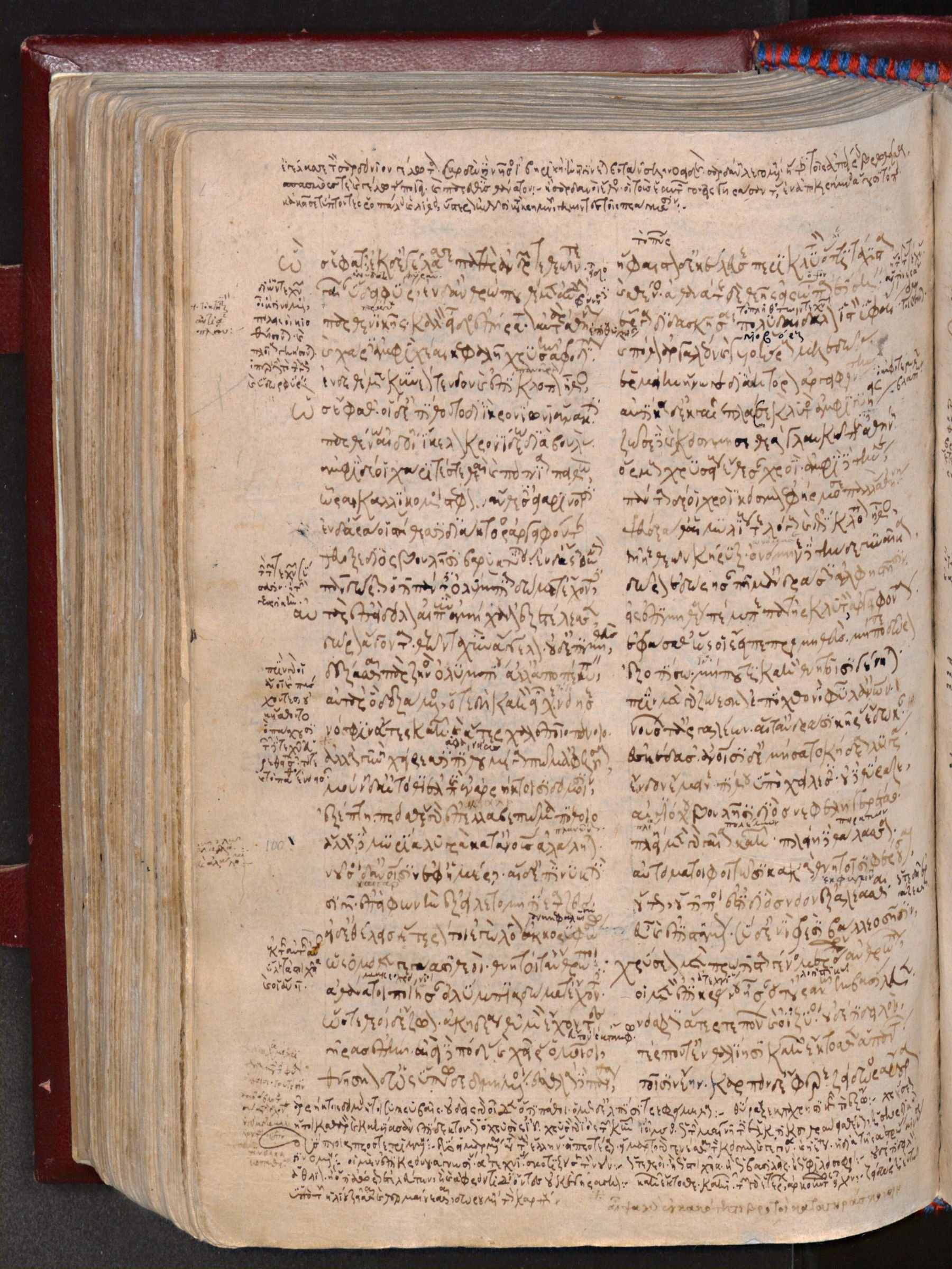
Laur. Plut. 32.16, fol. 233v: lines 59-117, begins ‹ὣς ἔφατʼ· ἐκ δʼ›, ends ‹δʼ ἔφερε ζείδωρος ἄρουρα›. Checked on the image: first and last verse rows read and matched to the Greek (re-read on the image 2026-11-12: first row ‹59 | 60: ὣς ἔφατ' ἐκ δ' ἐγέλασσε ... | ἥφαιστον δ' ἐκέλευσε ...›, last row ‹116 | 117: θνῇσκον δ' ὥσθ' ὕπνῳ ... | ... ζείδωρος ἄρουρα›); the page before ends at line 58 and the page after begins at line 118. This section shows lines 109-117 of that page; the rest of the page belongs to the previous part of the poem. Verse 93 (αἶψα γὰρ ἐν κακότητι βροτοὶ καταγηράσκουσιν) is not in the column (the row after 91 | 92 is 94 | 95); it is written in pale ink at the foot of the page, keyed by a + sign in the left margin. The Greek shows it in its place. English here: lines 109-118, cut at the end of Evelyn-White's sentences. His sentence that runs across the break with the next page is given whole here, so the English ends with line 118 (‹... fruit abundantly and without stint.›).
109χρύσεον μὲν πρώτιστα γένος μερόπων ἀνθρώπων
110ἀθάνατοι ποίησαν Ὀλύμπια δώματʼ ἔχοντες.
111οἳ μὲν ἐπὶ Κρόνου ἦσαν, ὅτʼ οὐρανῷ ἐμβασίλευεν·
112ὥστε θεοὶ δʼ ἔζωον ἀκηδέα θυμὸν ἔχοντες
113νόσφιν ἄτερ τε πόνων καὶ ὀιζύος· οὐδέ τι δειλὸν
114γῆρας ἐπῆν, αἰεὶ δὲ πόδας καὶ χεῖρας ὁμοῖοι
115τέρποντʼ ἐν θαλίῃσι κακῶν ἔκτοσθεν ἁπάντων·
116θνῇσκον δʼ ὥσθʼ ὕπνῳ δεδμημένοι· ἐσθλὰ δὲ πάντα
117τοῖσιν ἔην· καρπὸν δʼ ἔφερε ζείδωρος ἄρουρα
109First of all 110the deathless gods who dwell on Olympus made a golden race of mortal men who lived in the time of Cronos when he was reigning in heaven. And they lived like gods 115without sorrow of heart, remote and free from toil and grief: miserable age rested not on them; but with legs and arms never failing they made merry with feasting beyond the reach of all evils. When they died, it was as though they were overcome with sleep, and they had all good things; for the fruitful earth unforced bare them fruit abundantly and without stint.
Where on the image
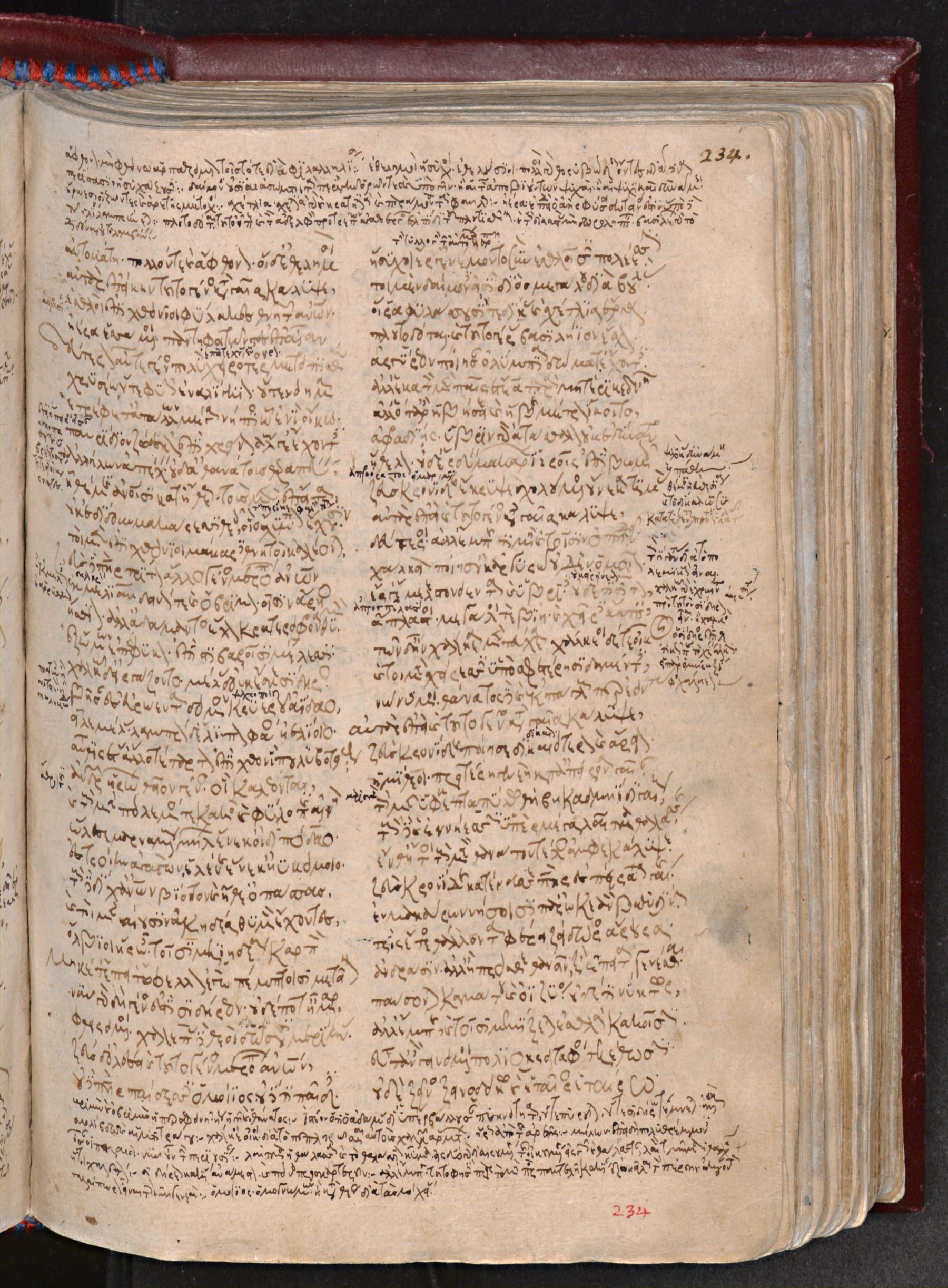
Laur. Plut. 32.16, fol. 234r: lines 118-183, begins ‹αὐτομάτη πολλόν τε καὶ›, ends ‹ξεινοδόκῳ καὶ ἑταῖρος ἑταίρῳ,›. Checked on the image: first and last verse rows read and matched to the Greek (re-read on the image 2026-11-12: first row ‹118 | 119: αὐτομάτη πολλόν τε ... | ἥσυχοι ἔργ' ἐνέμοντο ...›, last row ‹182 | 183: οὐδὲ πατὴρ παίδεσσιν ... | ... καὶ ἑταῖρος ἑταίρῳ›); the page before ends at line 117 and the page after begins at line 184. Line 120 (ἀφνειοὶ μήλοισι, φίλοι μακάρεσσι θεοῖσιν) is not on the page: the first row has 118-119 and the second begins with 121 (the small writing above row 1 and the marginal word at row 3 are glosses). The verse is known from an ancient quotation and is missing from most medieval manuscripts. Line 169 (τηλοῦ ἀπ' ἀθανάτων· τοῖσιν Κρόνος ἐμβασιλεύει) is not on the page either: the rows run 167 | 168, 170 | 171, 172 | 173, 174 | 175, without it in its traditional place or after 173, where Evelyn-White prints it. Neither line is shown in the Greek; the English of both is Evelyn-White's. English here: lines 118-184, cut at the end of Evelyn-White's sentences. The sentence that runs across the page break (to line 118) is given whole with the page before; the English here begins with ‹They dwelt in ease and peace ...› (line 118). His sentence that runs across the break with the next page is given whole here, so the English ends with line 184 (‹... dear to brother as aforetime.›).
118αὐτομάτη πολλόν τε καὶ ἄφθονον· οἳ δʼ ἐθελημοὶ
119ἥσυχοι ἔργʼ ἐνέμοντο σὺν ἐσθλοῖσιν πολέεσσιν.
121αὐτὰρ ἐπεὶ δὴ τοῦτο γένος κατὰ γαῖʼ ἐκάλυψε,—
122τοὶ μὲν δαίμονες ἁγνοὶ ἐπιχθόνιοι καλέονται
123ἐσθλοί, ἀλεξίκακοι, φύλακες θνητῶν ἀνθρώπων,
124[οἵ ῥα φυλάσσουσίν τε δίκας καὶ σχέτλια ἔργα]
125[ἠέρα ἑσσάμενοι πάντη φοιτῶντες ἐπʼ αἶαν,]
126πλουτοδόται· καὶ τοῦτο γέρας βασιλήιον ἔσχον—,
127δεύτερον αὖτε γένος πολὺ χειρότερον μετόπισθεν
128ἀργύρεον ποίησαν Ὀλύμπια δώματʼ ἔχοντες,
129χρυσέῳ οὔτε φυὴν ἐναλίγκιον οὔτε νόημα.
130ἀλλʼ ἑκατὸν μὲν παῖς ἔτεα παρὰ μητέρι κεδνῇ
131ἐτρέφετʼ ἀτάλλων, μέγα νήπιος, ᾧ ἐνὶ οἴκῳ.
132ἀλλʼ ὅτʼ ἄρʼ ἡβήσαι τε καὶ ἥβης μέτρον ἵκοιτο,
133παυρίδιον ζώεσκον ἐπὶ χρόνον, ἄλγεʼ ἔχοντες
134ἀφραδίῃς· ὕβριν γὰρ ἀτάσθαλον οὐκ ἐδύναντο
135ἀλλήλων ἀπέχειν, οὐδʼ ἀθανάτους θεραπεύειν
136ἤθελον οὐδʼ ἔρδειν μακάρων ἱεροῖς ἐπὶ βωμοῖς,
137ἣ θέμις ἀνθρώποις κατὰ ἤθεα. τοὺς μὲν ἔπειτα
138Ζεὺς Κρονίδης ἔκρυψε χολούμενος, οὕνεκα τιμὰς
139οὐκ ἔδιδον μακάρεσσι θεοῖς, οἳ Ὄλυμπον ἔχουσιν.
140αὐτὰρ ἐπεὶ καὶ τοῦτο γένος κατὰ γαῖʼ ἐκάλυψε,—
141τοὶ μὲν ὑποχθόνιοι μάκαρες θνητοῖς καλέονται,
142δεύτεροι, ἀλλʼ ἔμπης τιμὴ καὶ τοῖσιν ὀπηδεῖ—,
143Ζεὺς δὲ πατὴρ τρίτον ἄλλο γένος μερόπων ἀνθρώπων
144χάλκειον ποίησʼ, οὐκ ἀργυρέῳ οὐδὲν ὁμοῖον,
145ἐκ μελιᾶν, δεινόν τε καὶ ὄβριμον· οἷσιν Ἄρηος
146ἔργʼ ἔμελεν στονόεντα καὶ ὕβριες· οὐδέ τι σῖτον
147ἤσθιον, ἀλλʼ ἀδάμαντος ἔχον κρατερόφρονα θυμόν,
148ἄπλαστοι· μεγάλη δὲ βίη καὶ χεῖρες ἄαπτοι
149ἐξ ὤμων ἐπέφυκον ἐπὶ στιβαροῖσι μέλεσσιν.
150τῶν δʼ ἦν χάλκεα μὲν τεύχεα, χάλκεοι δέ τε οἶκοι
151χαλκῷ δʼ εἰργάζοντο· μέλας δʼ οὐκ ἔσκε σίδηρος.
152καὶ τοὶ μὲν χείρεσσιν ὕπο σφετέρῃσι δαμέντες
153βῆσαν ἐς εὐρώεντα δόμον κρυεροῦ Ἀίδαο
154νώνυμνοι· θάνατος δὲ καὶ ἐκπάγλους περ ἐόντας
155εἷλε μέλας, λαμπρὸν δʼ ἔλιπον φάος ἠελίοιο.
156αὐτὰρ ἐπεὶ καὶ τοῦτο γένος κατὰ γαῖʼ ἐκάλυψεν,
157αὖτις ἔτʼ ἄλλο τέταρτον ἐπὶ χθονὶ πουλυβοτείρῃ
158Ζεὺς Κρονίδης ποίησε, δικαιότερον καὶ ἄρειον,
159ἀνδρῶν ἡρώων θεῖον γένος, οἳ καλέονται
160ἡμίθεοι, προτέρη γενεὴ κατʼ ἀπείρονα γαῖαν.
161καὶ τοὺς μὲν πόλεμός τε κακὸς καὶ φύλοπις αἰνή,
162τοὺς μὲν ὑφʼ ἑπταπύλῳ Θήβῃ, Καδμηίδι γαίῃ,
163ὤλεσε μαρναμένους μήλων ἕνεκʼ Οἰδιπόδαο,
164τοὺς δὲ καὶ ἐν νήεσσιν ὑπὲρ μέγα λαῖτμα θαλάσσης
165ἐς Τροίην ἀγαγὼν Ἑλένης ἕνεκʼ ἠυκόμοιο.
166ἔνθʼ ἤτοι τοὺς μὲν θανάτου τέλος ἀμφεκάλυψε,
167τοῖς δὲ δίχʼ ἀνθρώπων βίοτον καὶ ἤθεʼ ὀπάσσας
168Ζεὺς Κρονίδης κατένασσε πατὴρ ἐς πείρατα γαίης.
170καὶ τοὶ μὲν ναίουσιν ἀκηδέα θυμὸν ἔχοντες
171ἐν μακάρων νήσοισι παρʼ Ὠκεανὸν βαθυδίνην,
172ὄλβιοι ἥρωες, τοῖσιν μελιηδέα καρπὸν
173τρὶς ἔτεος θάλλοντα φέρει ζείδωρος ἄρουρα.
174μηκέτʼ ἔπειτʼ ὤφελλον ἐγὼ πέμπτοισι μετεῖναι
175ἀνδράσιν, ἀλλʼ ἢ πρόσθε θανεῖν ἢ ἔπειτα γενέσθαι.
176νῦν γὰρ δὴ γένος ἐστὶ σιδήρεον· οὐδέ ποτʼ ἦμαρ
177παύονται καμάτου καὶ ὀιζύος, οὐδέ τι νύκτωρ
178φθειρόμενοι. χαλεπὰς δὲ θεοὶ δώσουσι μερίμνας·
179ἀλλʼ ἔμπης καὶ τοῖσι μεμείξεται ἐσθλὰ κακοῖσιν.
180Ζεὺς δʼ ὀλέσει καὶ τοῦτο γένος μερόπων ἀνθρώπων,
181εὖτʼ ἂν γεινόμενοι πολιοκρόταφοι τελέθωσιν.
182οὐδὲ πατὴρ παίδεσσιν ὁμοίιος οὐδέ τι παῖδες,
183οὐδὲ ξεῖνος ξεινοδόκῳ καὶ ἑταῖρος ἑταίρῳ,
118They dwelt in ease and peace upon their lands with many good things, 120rich in flocks and loved by the blessed gods. But after the earth had covered this generation—they are called pure spirits dwelling on the earth, and are kindly, delivering from harm, and guardians of mortal men; 125for they roam everywhere over the earth, clothed in mist and keep watch on judgements and cruel deeds, givers of wealth; for this royal right also they received;—then they who dwell on Olympus made a second generation which was of silver and less noble by far. It was like the golden race neither in body nor in spirit. 130A child was brought up at his good mother's side a hundred years, an utter simpleton, playing childishly in his own home. But when they were full grown and were come to the full measure of their prime, they lived only a little time and that in sorrow because of their foolishness, for they could not keep from sinning and 135from wronging one another, nor would they serve the immortals, nor sacrifice on the holy altars of the blessed ones as it is right for men to do wherever they dwell. Then Zeus the son of Cronos was angry and put them away, because they would not give honor to the blessed gods who live on Olympus. 140But when earth had covered this generation also—they are called blessed spirits of the underworld by men, and, though they are of second order, yet honor attends them also—Zeus the Father made a third generation of mortal men, a brazen race, sprung from ash-trees ; and it was in no way equal to the silver age, 145but was terrible and strong. They loved the lamentable works of Ares and deeds of violence; they ate no bread, but were hard of heart like adamant, fearful men. Great was their strength and unconquerable the arms which grew from their shoulders on their strong limbs. 150Their armor was of bronze, and their houses of bronze, and of bronze were their implements: there was no black iron. These were destroyed by their own hands and passed to the dank house of chill Hades, and left no name: terrible though they were, 155black Death seized them, and they left the bright light of the sun. But when earth had covered this generation also, Zeus the son of Cronos made yet another, the fourth, upon the fruitful earth, which was nobler and more righteous, a god-like race of hero-men who are called 160demi-gods, the race before our own, throughout the boundless earth. Grim war and dread battle destroyed a part of them, some in the land of Cadmus at seven-gated Thebes when they fought for the flocks of Oedipus, and some, when it had brought them in ships over the great sea gulf 165to Troy for rich-haired Helen's sake: there death's end enshrouded a part of them. But to the others father Zeus the son of Cronos gave a living and an abode apart from men, and made them dwell at the ends of earth. 170And they live untouched by sorrow in the islands of the blessed along the shore of deep-swirling Ocean, happy heroes for whom 173the grain-giving earth bears honey-sweet fruit flourishing thrice a year, 169far from the deathless gods, and Cronos rules over them; 174Thereafter, would that I were not among the men of the fifth generation, 175but either had died before or been born afterwards. For now truly is a race of iron, and men never rest from labor and sorrow by day, and from perishing by night; and the gods shall lay sore trouble upon them. But, notwithstanding, even these shall have some good mingled with their evils. 180And Zeus will destroy this race of mortal men also when they come to have grey hair on the temples at their birth. The father will not agree with his children, nor the children with their father, nor guest with his host, nor comrade with comrade; nor will brother be dear to brother as aforetime.
Where on the image
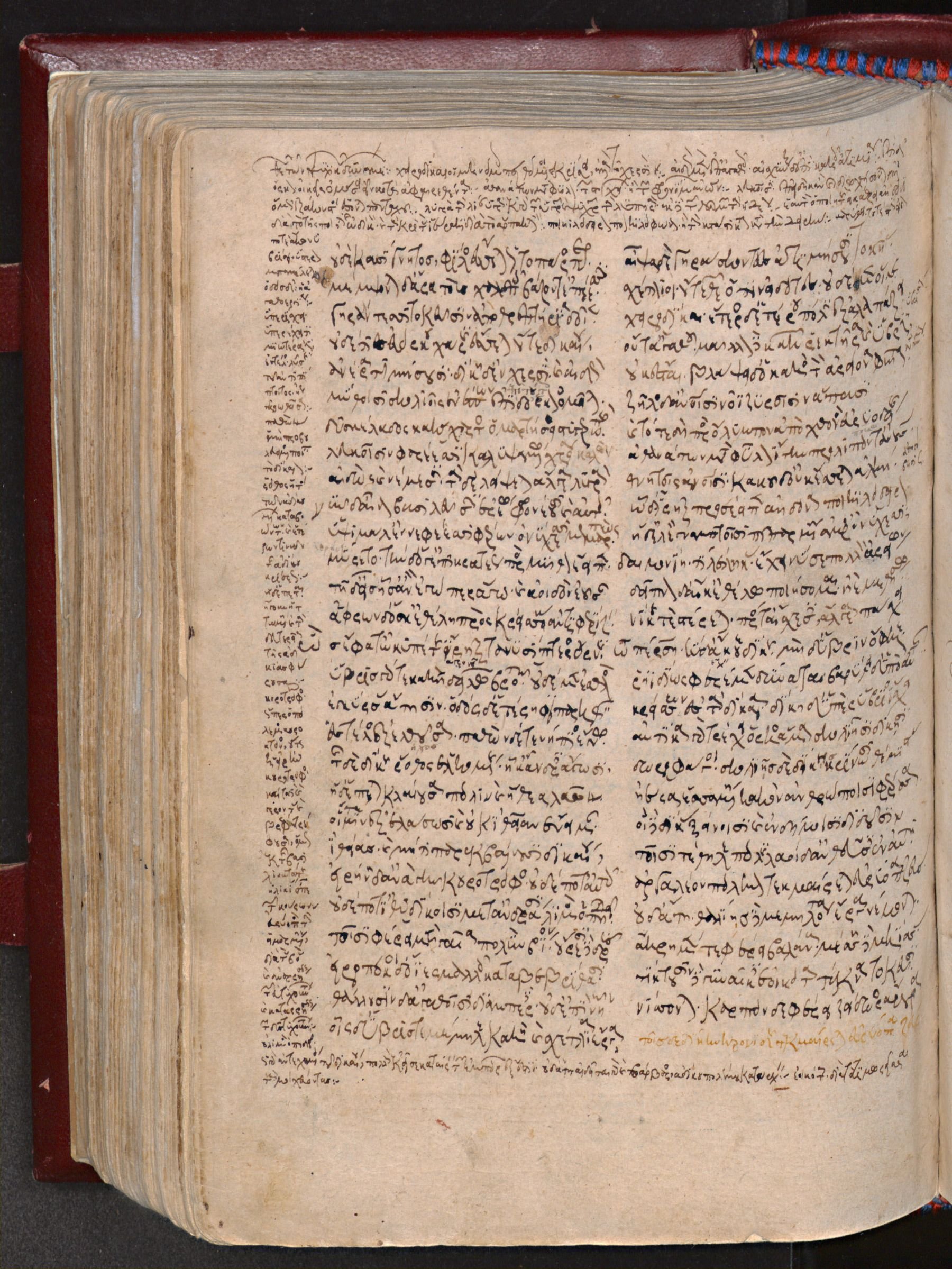
Laur. Plut. 32.16, fol. 234v: lines 184-239, begins ‹οὐδὲ κασίγνητος φίλος ἔσσεται,›, ends ‹Κρονίδης τεκμαίρεται εὐρύοπα Ζεύς.›. Checked on the image: first and last verse rows read and matched to the Greek (re-read on the image 2026-11-12: first row ‹184 | 185: οὐδὲ κασίγνητος φίλος ... | αἶψα δὲ γηράσκοντας ...›, last row ‹238 | 239: οἷς δ' ὕβρις τε μέμηλε ... | τοῖς δὲ δίκην κρονίδης ... εὐρύοπα ζεύς›); the page before ends at line 183 and the page after begins at line 240. This section shows lines 184-201 of that page; the rest of the page belongs to the next part of the poem. Line 239, the last on the page, is written in a pale orange-brown ink, unlike the dark brown of the text; it may have been added later. English here: lines 185-201, cut at the end of Evelyn-White's sentences. The sentence that runs across the page break (to line 184) is given whole with the page before; the English here begins with ‹Men will dishonor their parents ...› (line 185).
184οὐδὲ κασίγνητος φίλος ἔσσεται, ὡς τὸ πάρος περ.
185αἶψα δὲ γηράσκοντας ἀτιμήσουσι τοκῆας·
186μέμψονται δʼ ἄρα τοὺς χαλεποῖς βάζοντες ἔπεσσι
187σχέτλιοι οὐδὲ θεῶν ὄπιν εἰδότες· οὐδέ κεν οἵ γε
188γηράντεσσι τοκεῦσιν ἀπὸ θρεπτήρια δοῖεν
189χειροδίκαι· ἕτερος δʼ ἑτέρου πόλιν ἐξαλαπάξει.
190οὐδέ τις εὐόρκου χάρις ἔσσεται οὔτε δικαίου
191οὔτʼ ἀγαθοῦ, μᾶλλον δὲ κακῶν ῥεκτῆρα καὶ ὕβριν
192ἀνέρες αἰνήσουσι· δίκη δʼ ἐν χερσί, καὶ αἰδὼς
193οὐκ ἔσται· βλάψει δʼ ὁ κακὸς τὸν ἀρείονα φῶτα
194μύθοισιν σκολιοῖς ἐνέπων, ἐπὶ δʼ ὅρκον ὀμεῖται.
195ζῆλος δʼ ἀνθρώποισιν ὀιζυροῖσιν ἅπασι
196δυσκέλαδος κακόχαρτος ὁμαρτήσει, στυγερώπης.
197καὶ τότε δὴ πρὸς Ὄλυμπον ἀπὸ χθονὸς εὐρυοδείης
198λευκοῖσιν φάρεσσι καλυψαμένα χρόα καλὸν
199ἀθανάτων μετὰ φῦλον ἴτον προλιπόντʼ ἀνθρώπους
200Αἰδὼς καὶ Νέμεσις· τὰ δὲ λείψεται ἄλγεα λυγρὰ
201θνητοῖς ἀνθρώποισι· κακοῦ δʼ οὐκ ἔσσεται ἀλκή.
185Men will dishonor their parents as they grow quickly old, and will carp at them, chiding them with bitter words, hard-hearted they, not knowing the fear of the gods. They will not repay their aged parents the cost of their nurture, for might shall be their right: and one man will sack another's city. 190There will be no favor for the man who keeps his oath or for the just or for the good; but rather men will praise the evil-doer and his violent dealing. Strength will be right, and reverence will cease to be; and the wicked will hurt the worthy man, speaking false words against him, and will swear an oath upon them. 195Envy, foul-mouthed, delighting in evil, with scowling face, will go along with wretched men one and all. 200And then Aidos and Nemesis, with their sweet forms wrapped in white robes, will go from the wide-pathed earth and forsake mankind to join the company of the deathless gods: and bitter sorrows will be left for mortal men, and there will be no help against evil.
Notes
- Greek: H. G. Evelyn-White, Hesiod, the Homeric Hymns and Homerica (Loeb Classical Library, 1914), via Perseus. Square brackets mark verses the editor regards as interpolated.
- English: H. G. Evelyn-White's translation in the same volume; his footnotes are omitted.
- Lines 169a-169d of the Loeb text (fragments from a papyrus on Cronos and the fifth race) are not in the medieval manuscripts and are not included.
Cite
Sources
- Source: Laur. Plut. 32.16 (BML Teca Digitale IIIF) + Evelyn-White Greek (Loeb 1914, Perseus) + Evelyn-White English (1914, Perseus) (holding institution)
- Critical edition: Evelyn-White, Loeb 1914, via Perseus
← previous · → next · v cycle view · l back to library