Hesiod, Works and Days 202-319: The hawk and the nightingale; Justice
Introduction
Hesiod's Works and Days (c. 700 BCE) is a poem of advice to his brother Perses on justice, work and the farmer's year. It contains the myth of Prometheus and Pandora and the Five Ages of mankind, from the golden race to the race of iron. This part: The hawk and the nightingale; Justice (lines 202-319, 118 lines). The fable of the hawk and the nightingale, the blessings of the just city and the curse on the unjust, and the hard road to excellence.
The page photographs are from Florence, Biblioteca Medicea Laurenziana, Plut. 32.16 (paper, late 13th century; a large collection of Greek poetry that also holds letters of Maximus Planudes), Works and Days on fols. 233r-239v, in the Biblioteca Medicea Laurenziana's Teca Digitale. Older manuscripts of the poem exist (Paris gr. 2771, 10th/11th century; Florence, Laur. Plut. 31.39, 12th century), but this copy is legible on every page and holds Hesiod's three poems together. This part is on fol. 234v, 235r, 235v. The scribe writes two verses to a row, one in each column, so a page is read across the columns, row by row; the margins are filled with scholia (ancient and Byzantine notes). Each section below is one page; its note gives the page's first and last verse as read on the photograph.
The Greek is Evelyn-White's Loeb text (1914) via Perseus, not a transcription of this manuscript, whose wording differs here and there. Verses the editor brackets as later additions are shown in square brackets. The English is Evelyn-White's prose translation (1914); it is cut at the end of his sentences, so where a sentence runs across a page break it is given whole to one page; each section's note gives the exact lines its English covers.
How was this verified? (Provenance)
Where on the image
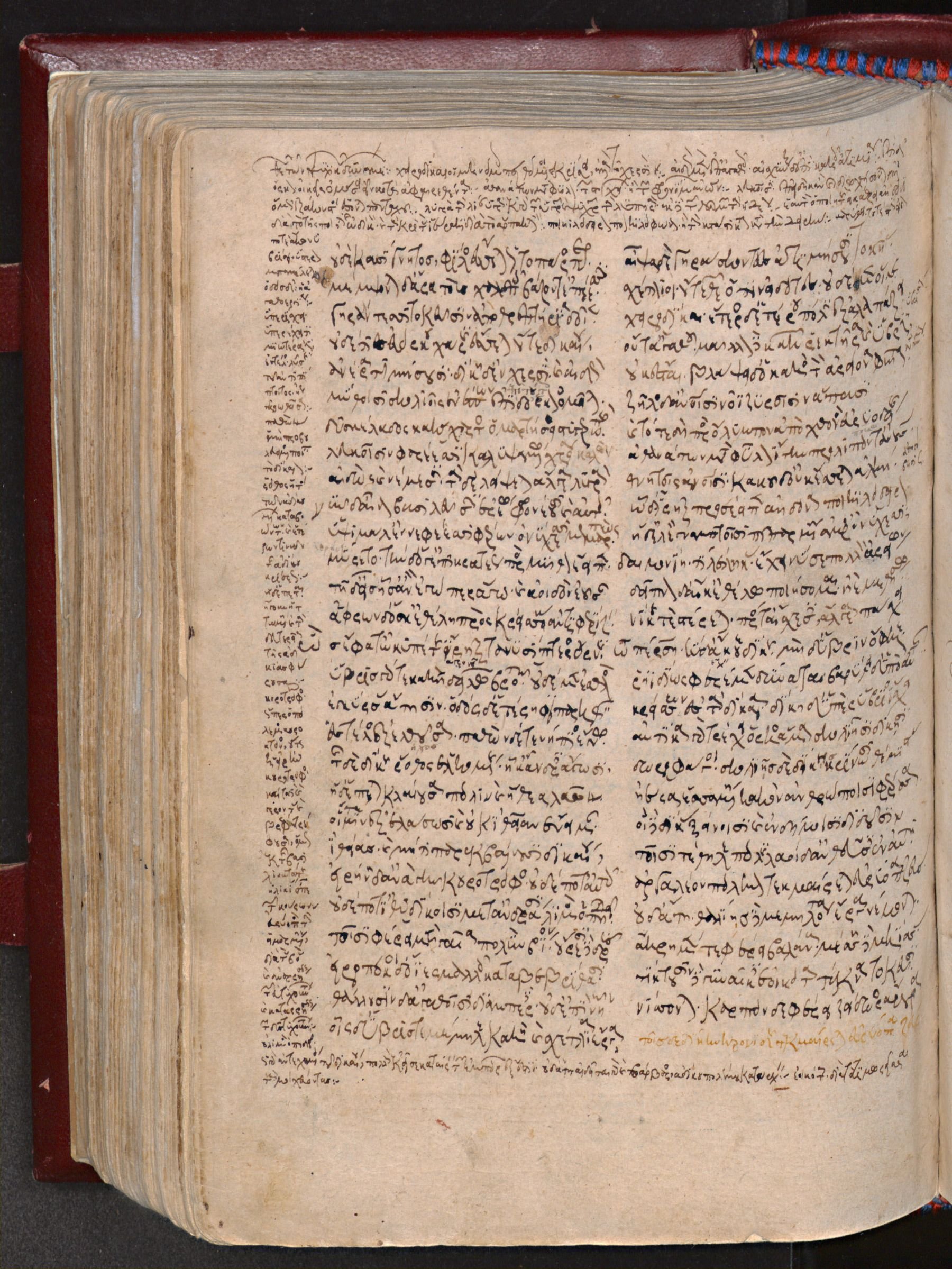
Laur. Plut. 32.16, fol. 234v: lines 184-239, begins ‹οὐδὲ κασίγνητος φίλος ἔσσεται,›, ends ‹Κρονίδης τεκμαίρεται εὐρύοπα Ζεύς.›. Checked on the image: first and last verse rows read and matched to the Greek (re-read on the image 2026-11-12: first row ‹184 | 185: οὐδὲ κασίγνητος φίλος ... | αἶψα δὲ γηράσκοντας ...›, last row ‹238 | 239: οἷς δ' ὕβρις τε μέμηλε ... | τοῖς δὲ δίκην κρονίδης ... εὐρύοπα ζεύς›); the page before ends at line 183 and the page after begins at line 240. This section shows lines 202-239 of that page; the rest of the page belongs to the previous part of the poem. Line 239, the last on the page, is written in a pale orange-brown ink, unlike the dark brown of the text; it may have been added later. English here: lines 202-239, cut at the end of Evelyn-White's sentences. At the break with the next page the English ends with line 239, the same line as the Greek.
202νῦν δʼ αἶνον βασιλεῦσιν ἐρέω φρονέουσι καὶ αὐτοῖς·
203ὧδʼ ἴρηξ προσέειπεν ἀηδόνα ποικιλόδειρον
204ὕψι μάλʼ ἐν νεφέεσσι φέρων ὀνύχεσσι μεμαρπώς·
205ἣ δʼ ἐλεόν, γναμπτοῖσι πεπαρμένη ἀμφʼ ὀνύχεσσι,
206μύρετο· τὴν ὅγʼ ἐπικρατέως πρὸς μῦθον ἔειπεν·
207δαιμονίη, τί λέληκας; ἔχει νύ σε πολλὸν ἀρείων·
208τῇ δʼ εἶς, ᾗ σʼ ἂν ἐγώ περ ἄγω καὶ ἀοιδὸν ἐοῦσαν·
209δεῖπνον δʼ, αἴ κʼ ἐθέλω, ποιήσομαι ἠὲ μεθήσω.
210ἄφρων δʼ, ὅς κʼ ἐθέλῃ πρὸς κρείσσονας ἀντιφερίζειν·
211νίκης τε στέρεται πρός τʼ αἴσχεσιν ἄλγεα πάσχει.
212ὣς ἔφατʼ ὠκυπέτης ἴρηξ, τανυσίπτερος ὄρνις.
213ὦ Πέρση, σὺ δʼ ἄκουε δίκης, μηδʼ ὕβριν ὄφελλε·
214ὕβρις γάρ τε κακὴ δειλῷ βροτῷ· οὐδὲ μὲν ἐσθλὸς
215ῥηιδίως φερέμεν δύναται, βαρύθει δέ θʼ ὑπʼ αὐτῆς
216ἐγκύρσας ἄτῃσιν· ὁδὸς δʼ ἑτέρηφι παρελθεῖν
217κρείσσων ἐς τὰ δίκαια· Δίκη δʼ ὑπὲρ Ὕβριος ἴσχει
218ἐς τέλος ἐξελθοῦσα· παθὼν δέ τε νήπιος ἔγνω.
219αὐτίκα γὰρ τρέχει Ὅρκος ἅμα σκολιῇσι δίκῃσιν.
220τῆς δὲ Δίκης ῥόθος ἑλκομένης, ᾗ κʼ ἄνδρες ἄγωσι
221δωροφάγοι, σκολιῇς δὲ δίκῃς κρίνωσι θέμιστας.
222ἣ δʼ ἕπεται κλαίουσα πόλιν καὶ ἤθεα λαῶν,
223ἠέρα ἑσσαμένη, κακὸν ἀνθρώποισι φέρουσα,
224οἵ τε μιν ἐξελάσωσι καὶ οὐκ ἰθεῖαν ἔνειμαν.
225Οἳ δὲ δίκας ξείνοισι καὶ ἐνδήμοισι διδοῦσιν
226ἰθείας καὶ μή τι παρεκβαίνουσι δικαίου,
227τοῖσι τέθηλε πόλις, λαοὶ δʼ ἀνθεῦσιν ἐν αὐτῇ·
228εἰρήνη δʼ ἀνὰ γῆν κουροτρόφος, οὐδέ ποτʼ αὐτοῖς
229ἀργαλέον πόλεμον τεκμαίρεται εὐρύοπα Ζεύς·
230οὐδέ ποτʼ ἰθυδίκῃσι μετʼ ἀνδράσι λιμὸς ὀπηδεῖ
231οὐδʼ ἄτη, θαλίῃς δὲ μεμηλότα ἔργα νέμονται.
232τοῖσι φέρει μὲν γαῖα πολὺν βίον, οὔρεσι δὲ δρῦς
233ἄκρη μέν τε φέρει βαλάνους, μέσση δὲ μελίσσας·
234εἰροπόκοι δʼ ὄιες μαλλοῖς καταβεβρίθασιν·
235τίκτουσιν δὲ γυναῖκες ἐοικότα τέκνα γονεῦσιν·
236θάλλουσιν δʼ ἀγαθοῖσι διαμπερές· οὐδʼ ἐπὶ νηῶν
237νίσσονται, καρπὸν δὲ φέρει ζείδωρος ἄρουρα.
238οἷς δʼ ὕβρις τε μέμηλε κακὴ καὶ σχέτλια ἔργα,
239τοῖς δὲ δίκην Κρονίδης τεκμαίρεται εὐρύοπα Ζεύς.
202And now I will tell a fable for princes who themselves understand. Thus said the hawk to the nightingale with speckled neck, while he carried her high up among the clouds, gripped fast in his talons, 205and she, pierced by his crooked talons, cried pitifully. To her he spoke disdainfully: “Miserable thing, why do you cry out? One far stronger than you now holds you fast, and you must go wherever I take you, songstress as you are. And if I please, I will make my meal of you, or let you go. 210He is a fool who tries to withstand the stronger, for he does not get the mastery and suffers pain besides his shame.” So said the swiftly flying hawk, the long-winged bird. But you, Perses, listen to right and do not foster violence; for violence is bad for a poor man. 215Even the prosperous cannot easily bear its burden, but is weighed down under it when he has fallen into delusion. The better path is to go by on the other side towards Justice; for Justice beats Outrage when she comes at length to the end of the race. But only when he has suffered does the fool learn this. For Oath keeps pace with wrong judgements. 220There is a noise when Justice is being dragged in the way where those who devour bribes and give sentence with crooked judgements, take her. And she, wrapped in mist, follows to the city and haunts of the people, weeping, and bringing mischief to men, even to such as have driven her forth in that they did not deal straightly with her. 225But they who give straight judgements to strangers and to the men of the land, and go not aside from what is just, their city flourishes, and the people prosper in it: Peace, the nurse of children, is abroad in their land, and all-seeing Zeus never decrees cruel war against them. 230Neither famine nor disaster ever haunt men who do true justice; but light-heartedly they tend the fields which are all their care. The earth bears them victual in plenty, and on the mountains the oak bears acorns upon the top and bees in the midst. Their woolly sheep are laden with fleeces; 235their women bear children like their parents. They flourish continually with good things, and do not travel on ships, for the grain-giving earth bears them fruit. 238But for those who practice violence and cruel deeds far-seeing Zeus, the son of Cronos, ordains a punishment.
Where on the image
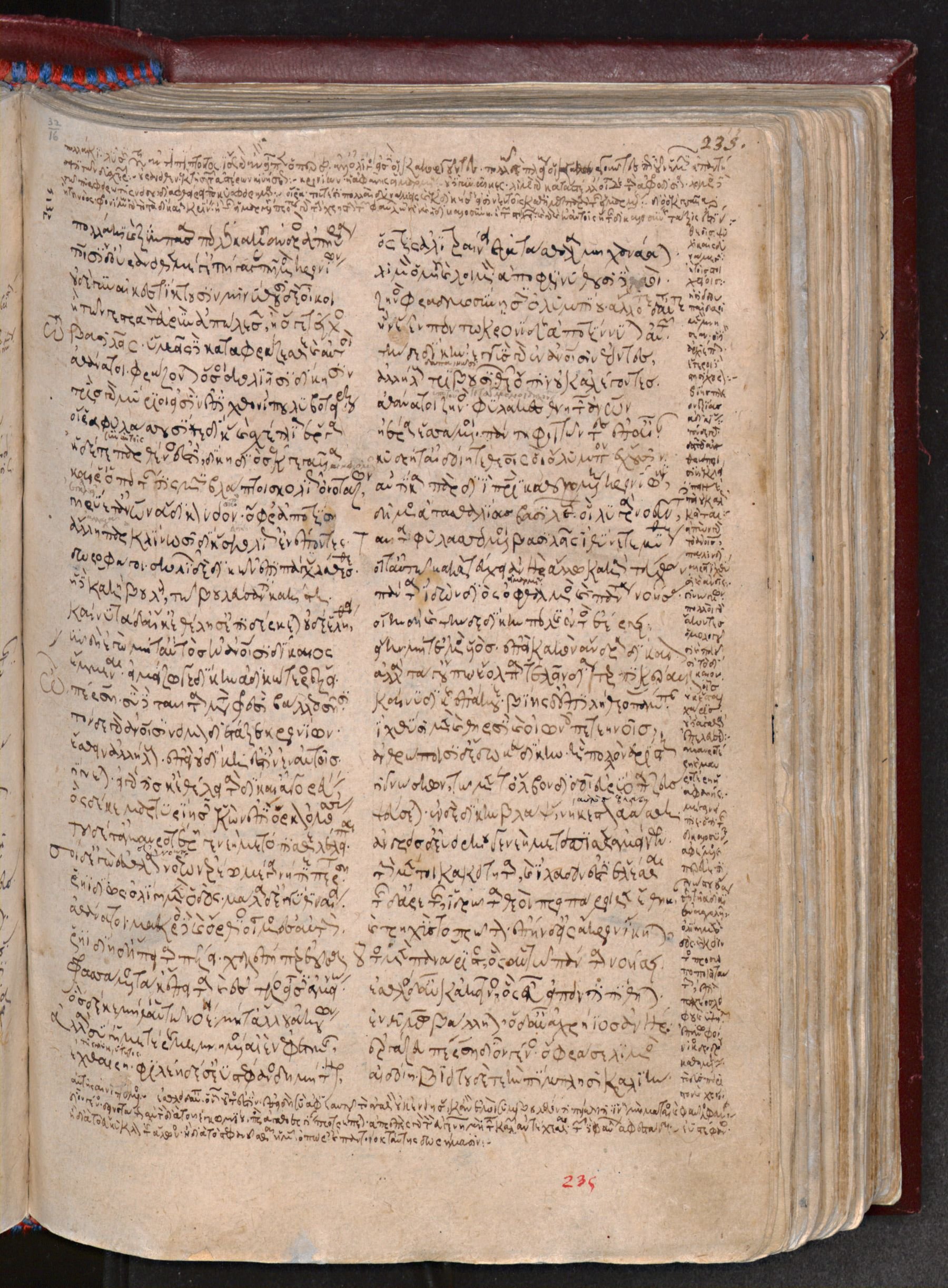
Laur. Plut. 32.16, fol. 235r: lines 240-301, begins ‹πολλάκι καὶ ξύμπασα πόλις›, ends ‹δὲ τεὴν πιμπλῇσι καλιήν·›. Checked on the image: first and last verse rows read and matched to the Greek (re-read on the image 2026-11-12: first row ‹240 | 241: πολλάκι καὶ ξύμπασα ... | ὅς κεν ἀλιτραίνῃ ...›, last row ‹300 | 301: ἐχθαίρῃ φιλέῃ δέ σ' ... | αἰδοίη βιότου δὲ ... καλιήν›); the page before ends at line 239 and the page after begins at line 302. English here: lines 240-302, cut at the end of Evelyn-White's sentences. At the break with the page before, his sentence for line 240 (‹Often even a whole city suffers ...›) begins with the Greek of this page. His sentence that runs across the break with the next page is given whole here, so the English ends with line 302 (‹... meet comrade for the sluggard.›).
240πολλάκι καὶ ξύμπασα πόλις κακοῦ ἀνδρὸς ἀπηύρα,
241ὅς κεν ἀλιτραίνῃ καὶ ἀτάσθαλα μηχανάαται.
242τοῖσιν δʼ οὐρανόθεν μέγʼ ἐπήγαγε πῆμα Κρονίων
243λιμὸν ὁμοῦ καὶ λοιμόν· ἀποφθινύθουσι δὲ λαοί.
244οὐδὲ γυναῖκες τίκτουσιν, μινύθουσι δὲ οἶκοι
245Ζηνὸς φραδμοσύνῃσιν Ὀλυμπίου· ἄλλοτε δʼ αὖτε
246ἢ τῶν γε στρατὸν εὐρὺν ἀπώλεσεν ἢ ὅ γε τεῖχος
247ἢ νέας ἐν πόντῳ Κρονίδης ἀποαίνυται αὐτῶν.
248ὦ βασιλῆς, ὑμεῖς δὲ καταφράζεσθε καὶ αὐτοὶ
249τήνδε δίκην· ἐγγὺς γὰρ ἐν ἀνθρώποισιν ἐόντες
250ἀθάνατοι φράζονται, ὅσοι σκολιῇσι δίκῃσιν
251ἀλλήλους τρίβουσι θεῶν ὄπιν οὐκ ἀλέγοντες.
252τρὶς γὰρ μύριοί εἰσιν ἐπὶ χθονὶ πουλυβοτείρῃ
253ἀθάνατοι Ζηνὸς φύλακες θνητῶν ἀνθρώπων·
254οἵ ῥα φυλάσσουσίν τε δίκας καὶ σχέτλια ἔργα
255ἠέρα ἑσσάμενοι, πάντη φοιτῶντες ἐπʼ αἶαν.
256ἡ δέ τε παρθένος ἐστὶ Δίκη, Διὸς ἐκγεγαυῖα,
257κυδρή τʼ αἰδοίη τε θεῶν, οἳ Ὄλυμπον ἔχουσιν.
258καί ῥʼ ὁπότʼ ἄν τίς μιν βλάπτῃ σκολιῶς ὀνοτάζων,
259αὐτίκα πὰρ Διὶ πατρὶ καθεζομένη Κρονίωνι
260γηρύετʼ ἀνθρώπων ἄδικον νόον, ὄφρʼ ἀποτίσῃ
261δῆμος ἀτασθαλίας βασιλέων, οἳ λυγρὰ νοεῦντες
262ἄλλῃ παρκλίνωσι δίκας σκολιῶς ἐνέποντες.
263ταῦτα φυλασσόμενοι, βασιλῆς, ἰθύνετε †δίκας
264δωροφάγοι, σκολιέων δὲ δικέων ἐπὶ πάγχυ λάθεσθε.
265οἷ γʼ αὐτῷ κακὰ τεύχει ἀνὴρ ἄλλῳ κακὰ τεύχων,
266ἡ δὲ κακὴ βουλὴ τῷ βουλεύσαντι κακίστη.
267πάντα ἰδὼν Διὸς ὀφθαλμὸς καὶ πάντα νοήσας
268καί νυ τάδʼ, αἴ κʼ ἐθέλῃσʼ, ἐπιδέρκεται, οὐδέ ἑ λήθει,
269οἵην δὴ καὶ τήνδε δίκην πόλις ἐντὸς ἐέργει.
270νῦν δὴ ἐγὼ μήτʼ αὐτὸς ἐν ἀνθρώποισι δίκαιος
271εἴην μήτʼ ἐμὸς υἱός· ἐπεὶ κακὸν ἄνδρα δίκαιον
272ἔμμεναι, εἰ μείζω γε δίκην ἀδικώτερος ἕξει·
273ἀλλὰ τά γʼ οὔ πω ἔολπα τελεῖν Δία μητιόεντα.
274ὦ Πέρση, σὺ δὲ ταῦτα μετὰ φρεσὶ βάλλεο σῇσι,
275καί νυ δίκης ἐπάκουε, βίης δʼ ἐπιλήθεο πάμπαν.
276τόνδε γὰρ ἀνθρώποισι νόμον διέταξε Κρονίων
277ἰχθύσι μὲν καὶ θηρσὶ καὶ οἰωνοῖς πετεηνοῖς
278ἐσθέμεν ἀλλήλους, ἐπεὶ οὐ δίκη ἐστὶ μετʼ αὐτοῖς·
279ἀνθρώποισι δʼ ἔδωκε δίκην, ἣ πολλὸν ἀρίστη
280γίγνεται· εἰ γάρ τίς κʼ ἐθέλῃ τὰ δίκαιʼ ἀγορεῦσαι
281γιγνώσκων, τῷ μέν τʼ ὄλβον διδοῖ εὐρύοπα Ζεύς·
282ὃς δέ κε μαρτυρίῃσι ἑκὼν ἐπίορκον ὀμόσσας
283ψεύσεται, ἐν δὲ δίκην βλάψας νήκεστον ἀασθῇ,
284τοῦ δέ τʼ ἀμαυροτέρη γενεὴ μετόπισθε λέλειπται·
285ἀνδρὸς δʼ εὐόρκου γενεὴ μετόπισθεν ἀμείνων.
286σοὶ δʼ ἐγὼ ἐσθλὰ νοέων ἐρέω, μέγα νήπιε Πέρση.
287τὴν μέν τοι κακότητα καὶ ἰλαδὸν ἔστιν ἑλέσθαι
288ῥηιδίως· λείη μὲν ὁδός, μάλα δʼ ἐγγύθι ναίει·
289τῆς δʼ ἀρετῆς ἱδρῶτα θεοὶ προπάροιθεν ἔθηκαν
290ἀθάνατοι· μακρὸς δὲ καὶ ὄρθιος οἶμος ἐς αὐτὴν
291καὶ τρηχὺς τὸ πρῶτον· ἐπὴν δʼ εἰς ἄκρον ἵκηται,
292ῥηιδίη δὴ ἔπειτα πέλει, χαλεπή περ ἐοῦσα.
293οὗτος μὲν πανάριστος, ὃς αὐτὸς πάντα νοήσῃ
294φρασσάμενος, τά κʼ ἔπειτα καὶ ἐς τέλος ᾖσιν ἀμείνω·
295ἐσθλὸς δʼ αὖ κἀκεῖνος, ὃς εὖ εἰπόντι πίθηται·
296ὃς δέ κε μήτʼ αὐτὸς νοέῃ μήτʼ ἄλλου ἀκούων
297ἐν θυμῷ βάλληται, ὃ δʼ αὖτʼ ἀχρήιος ἀνήρ.
298ἀλλὰ σύ γʼ ἡμετέρης μεμνημένος αἰὲν ἐφετμῆς
299ἐργάζευ, Πέρση, δῖον γένος, ὄφρα σε λιμὸς
300ἐχθαίρῃ, φιλέῃ δέ σʼ ἐυστέφανος Δημήτηρ
301αἰδοίη, βιότου δὲ τεὴν πιμπλῇσι καλιήν·
240Often even a whole city suffers for a bad man who sins and devises presumptuous deeds, and the son of Cronos lays great trouble upon the people, famine and plague together, so that the men perish away, and their women do not bear children, and their houses become few, 245through the contriving of Olympian Zeus. And again, at another time, the son of Cronos either destroys their wide army, or their walls, or else makes an end of their ships on the sea. You princes, mark well this punishment, you also, for the deathless gods are near among men; and 250mark all those who oppress their fellows with crooked judgements; and heed not the anger of the gods. For upon the bounteous earth Zeus has thrice ten thousand spirits, watchers of mortal men, and these keep watch on judgements and deeds of wrong 255as they roam, clothed in mist, all over the earth. And there is virgin Justice, the daughter of Zeus, who is honored and reverenced among the gods who dwell on Olympus, and whenever anyone hurts her with lying slander, she sits beside her father, Zeus the son of Cronos, 260and tells him of men's wicked heart, until the people pay for the mad folly of their princes who, evilly minded, pervert judgement and give sentence crookedly. Keep watch against this, you princes, and make straight your judgements, you who devour bribes; put crooked judgements altogether from your thoughts. 265He does mischief to himself who does mischief to another, and evil planned harms the plotter most. The eye of Zeus, seeing all and understanding all, beholds these things too, if so he will, and fails not to mark what sort of justice is this that the city keeps within it. 270Now, therefore, may neither I myself be righteous among men, nor my son—for then it is a bad thing to be righteous—if indeed the unrighteous shall have the greater right. But I think that all-wise Zeus will not yet bring that to pass. 274But you, Perses, lay up these things within your heart and 275listen now to right, ceasing altogether to think of violence. For the son of Cronos has ordained this law for men, that fishes and beasts and winged fowls should devour one another, for right is not in them; but to mankind he gave right which proves 280far the best. For whoever knows the right and is ready to speak it, far-seeing Zeus gives him prosperity; but whoever deliberately lies in his witness and foreswears himself, and so hurts Justice and sins beyond repair, that man's generation is left obscure thereafter. 285But the generation of the man who swears truly is better thenceforward. To you, foolish Perses, I will speak good sense. Badness can be got easily and in shoals; the road to her is smooth, and she lives very near us. But between us and Goodness the gods have placed the sweat of our brows; 290long and steep is the path that leads to her, and it is rough at the first; but when a man has reached the top, then is she easy to reach, though before that she was hard. 295That man is altogether best who considers all things himself and marks what will be better afterwards and at the end; and he, again, is good who listens to a good adviser; but whoever neither thinks for himself nor keeps in mind what another tells him, he is an unprofitable man. But do you at any rate, always remembering my charge, work, high-born Perses, that Hunger 300may hate you, and venerable Demeter richly crowned may love you and fill your barn with food; for Hunger is altogether a meet comrade for the sluggard.
Where on the image
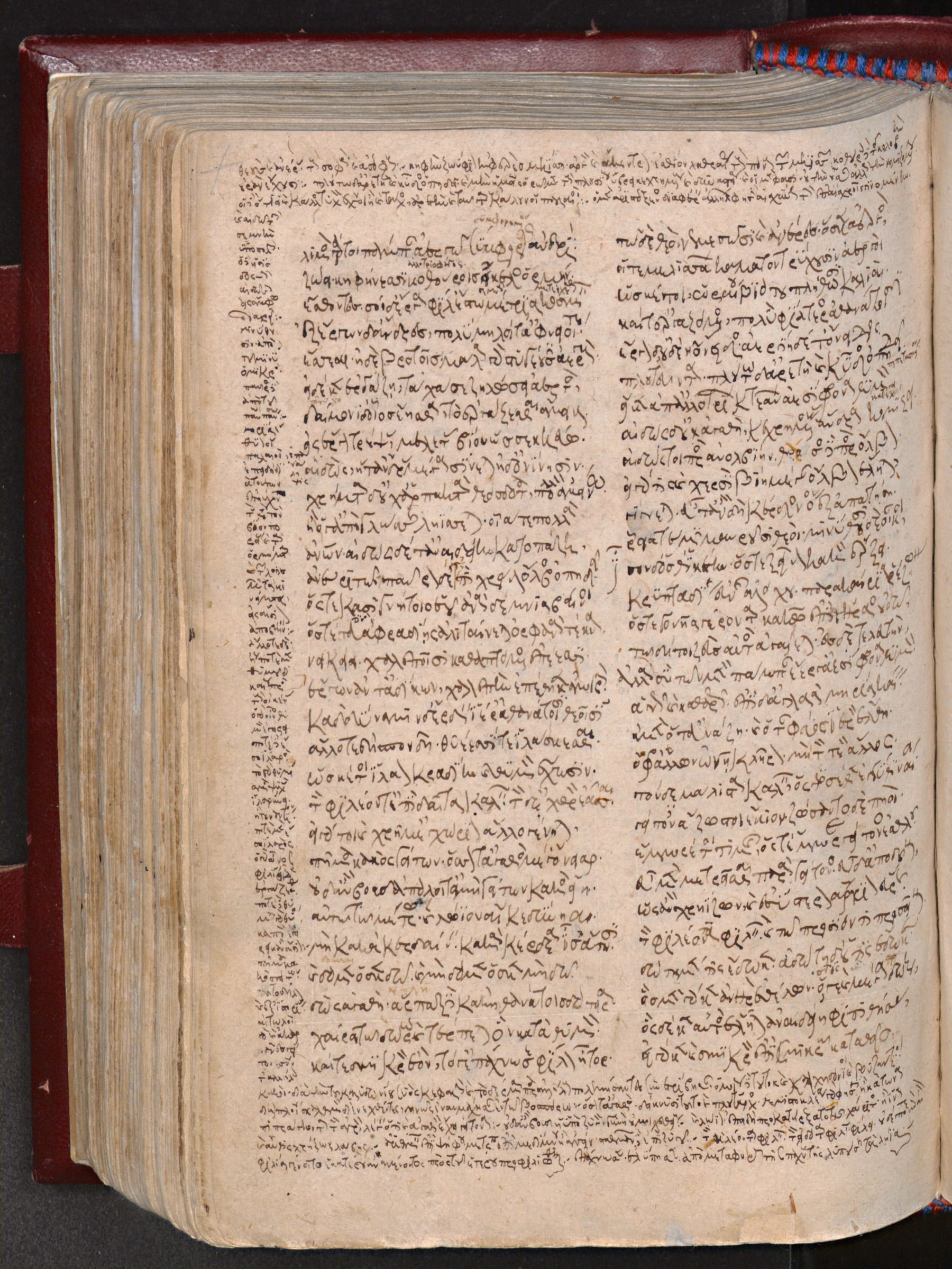
Laur. Plut. 32.16, fol. 235v: lines 302-361, begins ‹λιμὸς γάρ τοι πάμπαν›, ends ‹σμικρὸν ἐπὶ σμικρῷ καταθεῖο›. Checked on the image: first and last verse rows read and matched to the Greek (re-read on the image 2026-11-12: first row ‹302 | 303: λιμὸς γάρ τοι πάμπαν ... | τῷ δὲ θεοὶ νεμεσῶσι ...›, last row ‹360 | 361: καί τε σμικρὸν ἐόν ... φίλον ἦτορ | εἰ γάρ κεν καὶ σμικρὸν ... καταθεῖο›); the page before ends at line 301 and the page after begins at line 362. This section shows lines 302-319 of that page; the rest of the page belongs to the next part of the poem. The page ends with 360 and 361 in the traditional order; the Loeb text moves 363 before 361, so 363 is on the next page. The page also has, in row 5, the verse after 309 that Evelyn-White's text leaves out (line 310); it is not in the Greek or English here. English here: lines 303-319, cut at the end of Evelyn-White's sentences. The sentence that runs across the page break (to line 302) is given whole with the page before; the English here begins with ‹Both gods and men are angry with a man who lives idle ...› (line 303).
302λιμὸς γάρ τοι πάμπαν ἀεργῷ σύμφορος ἀνδρί.
303τῷ δὲ θεοὶ νεμεσῶσι καὶ ἀνέρες, ὅς κεν ἀεργὸς
304ζώῃ, κηφήνεσσι κοθούροις εἴκελος ὀργήν,
305οἵ τε μελισσάων κάματον τρύχουσιν ἀεργοὶ
306ἔσθοντες· σοὶ δʼ ἔργα φίλʼ ἔστω μέτρια κοσμεῖν,
307ὥς κέ τοι ὡραίου βιότου πλήθωσι καλιαί.
308ἐξ ἔργων δʼ ἄνδρες πολύμηλοί τʼ ἀφνειοί τε·
309καὶ ἐργαζόμενοι πολὺ φίλτεροι ἀθανάτοισιν.
311ἔργον δʼ οὐδὲν ὄνειδος, ἀεργίη δέ τʼ ὄνειδος.
312εἰ δέ κε ἐργάζῃ, τάχα σε ζηλώσει ἀεργὸς
313πλουτεῦντα· πλούτῳ δʼ ἀρετὴ καὶ κῦδος ὀπηδεῖ.
314δαίμονι δʼ οἷος ἔησθα, τὸ ἐργάζεσθαι ἄμεινον,
315εἴ κεν ἀπʼ ἀλλοτρίων κτεάνων ἀεσίφρονα θυμὸν
316εἰς ἔργον τρέψας μελετᾷς βίου, ὥς σε κελεύω.
317αἰδὼς δʼ οὐκ ἀγαθὴ κεχρημένον ἄνδρα κομίζει,
318αἰδώς, ἥ τʼ ἄνδρας μέγα σίνεται ἠδʼ ὀνίνησιν.
319αἰδώς τοι πρὸς ἀνολβίῃ, θάρσος δὲ πρὸς ὄλβῳ.
303Both gods and men are angry with a man who lives idle, 305for in nature he is like the stingless drones who waste the labor of the bees, eating without working; but let it be your care to order your work properly, that in the right season your barns may be full of victual. Through work men grow rich in flocks and substance, and 309working they are much better loved by the immortals. 311Work is no disgrace: it is idleness which is a disgrace. But if you work, the idle will soon envy you as you grow rich, for fame and renown attend on wealth. And whatever be your lot, work is best for you, 315if you turn your misguided mind away from other men's property to your work and attend to your livelihood as I bid you. An evil shame is the needy man's companion, shame which both greatly harms and prospers men: shame is with poverty, but confidence with wealth.
Notes
- Greek: H. G. Evelyn-White, Hesiod, the Homeric Hymns and Homerica (Loeb Classical Library, 1914), via Perseus. Square brackets mark verses the editor regards as interpolated.
- English: H. G. Evelyn-White's translation in the same volume; his footnotes are omitted.
- Lines 169a-169d of the Loeb text (fragments from a papyrus on Cronos and the fifth race) are not in the medieval manuscripts and are not included.
Cite
Sources
- Source: Laur. Plut. 32.16 (BML Teca Digitale IIIF) + Evelyn-White Greek (Loeb 1914, Perseus) + Evelyn-White English (1914, Perseus) (holding institution)
- Critical edition: Evelyn-White, Loeb 1914, via Perseus
← previous · → next · v cycle view · l back to library