Hesiod, Works and Days 609-705: Vintage and sailing
Introduction
Hesiod's Works and Days (c. 700 BCE) is a poem of advice to his brother Perses on justice, work and the farmer's year. It contains the myth of Prometheus and Pandora and the Five Ages of mankind, from the golden race to the race of iron. This part: Vintage and sailing (lines 609-705, 97 lines). The grape harvest, the season for sailing, Hesiod's one voyage from Aulis to Euboea, and advice on marriage.
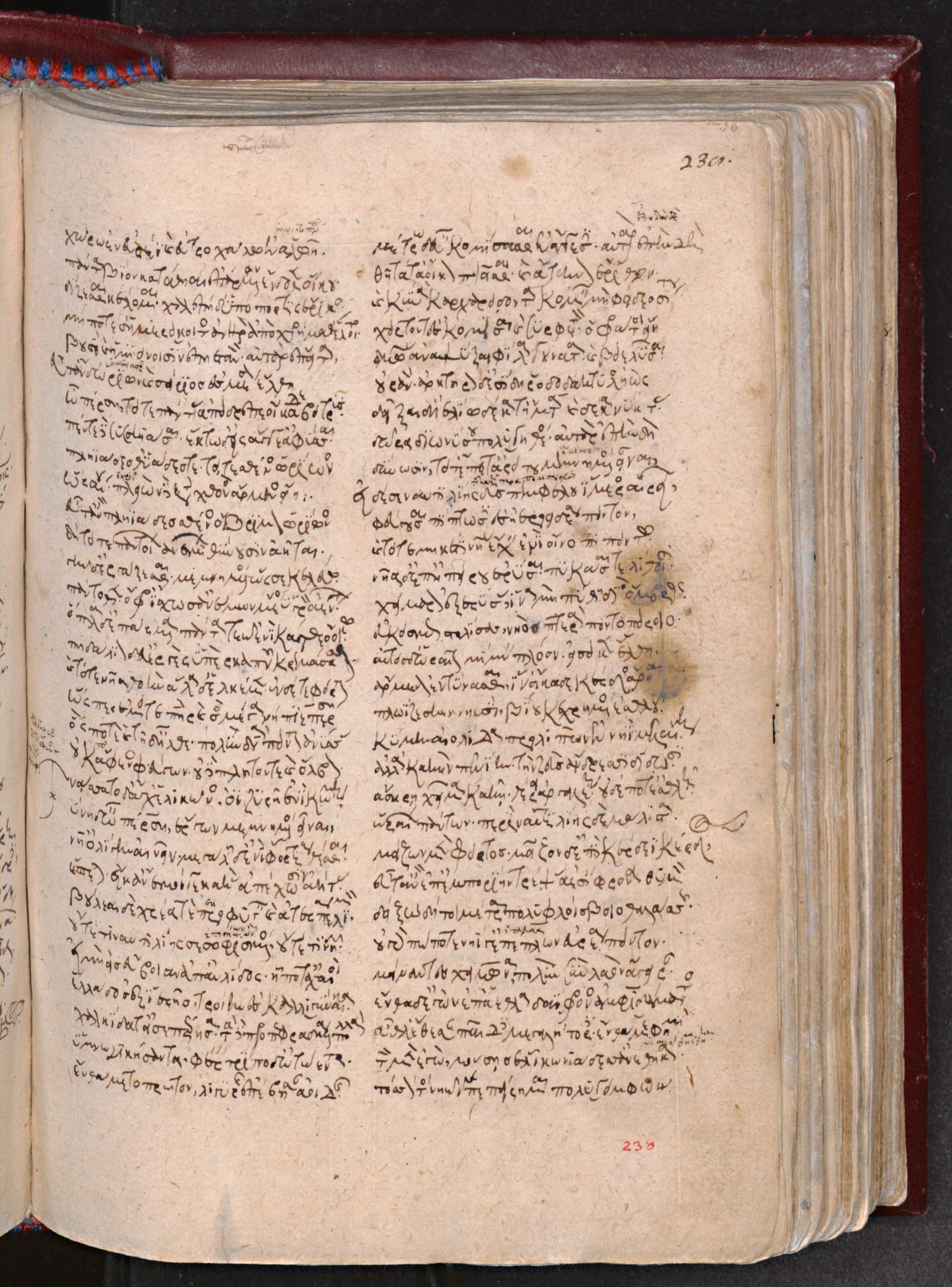
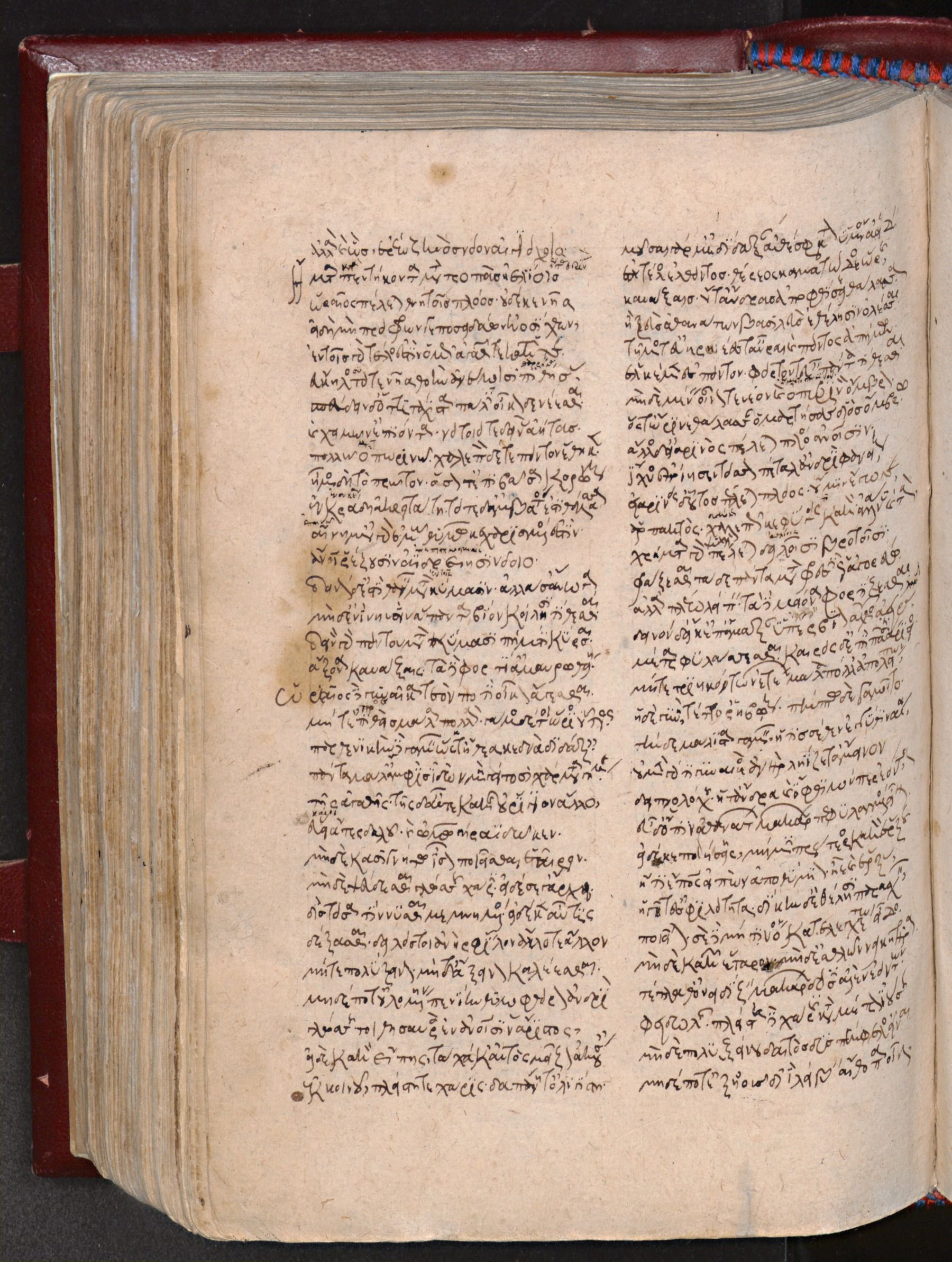
The page photographs are from Florence, Biblioteca Medicea Laurenziana, Plut. 32.16 (paper, late 13th century; a large collection of Greek poetry that also holds letters of Maximus Planudes), Works and Days on fols. 233r-239v, in the Biblioteca Medicea Laurenziana's Teca Digitale. Older manuscripts of the poem exist (Paris gr. 2771, 10th/11th century; Florence, Laur. Plut. 31.39, 12th century), but this copy is legible on every page and holds Hesiod's three poems together. This part is on fol. 238r, 238v. The scribe writes two verses to a row, one in each column, so a page is read across the columns, row by row; the margins are filled with scholia (ancient and Byzantine notes). Each section below is one page; its note gives the page's first and last verse as read on the photograph.
The Greek is Evelyn-White's Loeb text (1914) via Perseus, not a transcription of this manuscript, whose wording differs here and there. Verses the editor brackets as later additions are shown in square brackets. The English is Evelyn-White's prose translation (1914); it is cut at the end of his sentences, so where a sentence runs across a page break it is given whole to one page; each section's note gives the exact lines its English covers.
How was this verified? (Provenance)
Where on the image
Laur. Plut. 32.16, fol. 238r: lines 599-660, begins ‹χώρῳ ἐν εὐαέι καὶ›, ends ‹νηῶν γε πεπείρημαι πολυγόμφων·›. Checked on the image: first and last verse rows read and matched to the Greek (re-read on the image 2026-11-12: first row ‹599 | 600: χώρῳ ἐν εὐαέι ... | μέτρῳ δ' εὖ κομίσασθαι ...›, last row ‹659 | 660: ἔνθα με τὸ πρῶτον ... | τόσσον τοι νηῶν ... πολυγόμφων›); the page before ends at line 598 and the page after begins at line 661. This section shows lines 609-660 of that page; the rest of the page belongs to the previous part of the poem. English here: lines 609-659, cut at the end of Evelyn-White's sentences. His sentence ‹Such is all my experience ...› begins in line 660, before the page break, and is given whole with the next page, so the English here ends with line 659.
609εὖτʼ ἂν δʼ Ὠαρίων καὶ Σείριος ἐς μέσον ἔλθῃ
610οὐρανόν, Ἀρκτοῦρον δʼ ἐσίδῃ ῥοδοδάκτυλος Ἠώς,
611ὦ Πέρση, τότε πάντας ἀποδρέπεν οἴκαδε βότρυς·
612δεῖξαι δʼ ἠελίῳ δέκα τʼ ἤματα καὶ δέκα νύκτας,
613πέντε δὲ συσκιάσαι, ἕκτῳ δʼ εἰς ἄγγεʼ ἀφύσσαι
614δῶρα Διωνύσου πολυγηθέος. αὐτὰρ ἐπὴν δὴ
615Πληιάδες θʼ Ὑάδες τε τό τε σθένος Ὠαρίωνος
616δύνωσιν, τότʼ ἔπειτʼ ἀρότου μεμνημένος εἶναι
617ὡραίου· πλειὼν δὲ κατὰ χθονὸς ἄρμενος εἶσιν.
618εἰ δέ σε ναυτιλίης δυσπεμφέλου ἵμερος αἱρεῖ,
619εὖτʼ ἂν Πληιάδες σθένος ὄβριμον Ὠαρίωνος
620φεύγουσαι πίπτωσιν ἐς ἠεροειδέα πόντον,
621δὴ τότε παντοίων ἀνέμων θυίουσιν ἀῆται·
622καὶ τότε μηκέτι νῆας ἔχειν ἐνὶ οἴνοπι πόντῳ,
623γῆν ἐργάζεσθαι μεμνημένος, ὥς σε κελεύω.
624νῆα δʼ ἐπʼ ἠπείρου ἐρύσαι πυκάσαι τε λίθοισι
625πάντοθεν, ὄφρʼ ἴσχωσʼ ἀνέμων μένος ὑγρὸν ἀέντων,
626χείμαρον ἐξερύσας, ἵνα μὴ πύθῃ Διὸς ὄμβρος.
627ὅπλα δʼ ἐπάρμενα πάντα τεῷ ἐγκάτθεο οἴκῳ
628εὐκόσμως στολίσας νηὸς πτερὰ ποντοπόροιο·
629πηδάλιον δʼ ἐυεργὲς ὑπὲρ καπνοῦ κρεμάσασθαι.
630αὐτὸς δʼ ὡραῖον μίμνειν πλόον, εἰσόκεν ἔλθῃ·
631καὶ τότε νῆα θοὴν ἅλαδʼ ἑλκέμεν, ἐν δέ τε φόρτον
632ἄρμενον ἐντύνασθαι, ἵνʼ οἴκαδε κέρδος ἄρηαι,
633ὥς περ ἐμός τε πατὴρ καὶ σός, μέγα νήπιε Πέρσῃ,
634πλωίζεσκʼ ἐν νηυσί, βίου κεχρημένος ἐσθλοῦ·
635ὅς ποτε καὶ τῇδʼ ἦλθε, πολὺν διὰ πόντον ἀνύσσας,
636Κύμην Αἰολίδα προλιπών, ἐν νηὶ μελαίνῃ·
637οὐκ ἄφενος φεύγων οὐδὲ πλοῦτόν τε καὶ ὄλβον,
638ἀλλὰ κακὴν πενίην, τὴν Ζεὺς ἄνδρεσσι δίδωσιν·
639νάσσατο δʼ ἄγχʼ Ἑλικῶνος ὀιζυρῇ ἐνὶ κώμῃ,
640Ἄσκρῃ, χεῖμα κακῇ, θέρει ἀργαλέῃ, οὐδέ ποτʼ ἐσθλῇ.
641τύνη δʼ, ὦ Πέρση, ἔργων μεμνημένος εἶναι
642ὡραίων πάντων, περὶ ναυτιλίης δὲ μάλιστα.
643νῆʼ ὀλίγην αἰνεῖν, μεγάλῃ δʼ ἐνὶ φορτία θέσθαι.
644μείζων μὲν φόρτος, μεῖζον δʼ ἐπὶ κέρδεϊ κέρδος
645ἔσσεται, εἴ κʼ ἄνεμοί γε κακὰς ἀπέχωσιν ἀήτας.
646εὖτʼ ἂν ἐπʼ ἐμπορίην τρέψας ἀεσίφρονα θυμὸν
647βούληαι χρέα τε προφυγεῖν καὶ λιμὸν ἀτερπέα,
648δείξω δή τοι μέτρα πολυφλοίσβοιο θαλάσσης,
649οὔτε τι ναυτιλίης σεσοφισμένος οὔτε τι νηῶν.
650οὐ γάρ πώ ποτε νηί γʼ ἐπέπλων εὐρέα πόντον,
651εἰ μὴ ἐς Εὔβοιαν ἐξ Αὐλίδος, ᾗ ποτʼ Ἀχαιοὶ
652μείναντες χειμῶνα πολὺν σὺν λαὸν ἄγειραν
653Ἑλλάδος ἐξ ἱερῆς Τροίην ἐς καλλιγύναικα.
654ἔνθα δʼ ἐγὼν ἐπʼ ἄεθλα δαΐφρονος Ἀμφιδάμαντος
655Χαλκίδα τʼ εἲς ἐπέρησα· τὰ δὲ προπεφραδμένα πολλὰ
656ἄεθλʼ ἔθεσαν παῖδες μεγαλήτορος· ἔνθα μέ φημι
657ὕμνῳ νικήσαντα φέρειν τρίποδʼ ὠτώεντα.
658τὸν μὲν ἐγὼ Μούσῃς Ἑλικωνιάδεσσʼ ἀνέθηκα,
659ἔνθα με τὸ πρῶτον λιγυρῆς ἐπέβησαν ἀοιδῆς.
660τόσσον τοι νηῶν γε πεπείρημαι πολυγόμφων·
609But when Orion and Sirius are come into midheaven, 610and rosy-fingered Dawn sees Arcturus, then cut off all the grape-clusters, Perses, and bring them home. Show them to the sun ten days and ten nights: then cover them over for five, and on the sixth day draw off into vessels the gifts of joyful Dionysus. But when 615the Pleiades and Hyades and strong Orion begin to set, then remember to plough in season: and so the completed year will fitly pass beneath the earth. But if desire for uncomfortable sea-faring seize you when the Pleiades plunge into the misty sea 620to escape Orion's rude strength, then truly gales of all kinds rage. Then keep ships no longer on the sparkling sea, but be sure to till the land as I bid you. Haul up your ship upon the land and pack it closely with stones 625all round to keep off the power of the winds which blow damply, and draw out the bilge-plug so that the rain of heaven may not rot it. Put away all the tackle and fittings in your house, and stow the wings of the sea-going ship neatly, and hang up the well-shaped rudder over the smoke. 630You yourself wait until the season for sailing is come, and then haul your swift ship down to the sea and stow a convenient cargo in it, so that you may bring home profit, even as your father and mine, foolish Perses, used to sail on shipboard because he lacked sufficient livelihood. And one day he came to this very place, crossing over a great stretch of sea; 635he left Aeolian Cyme and fled, not from riches and substance, but from wretched poverty which Zeus lays upon men, and he settled near Helicon in a miserable hamlet, 640Ascra, which is bad in winter, sultry in summer, and good at no time. 641But you, Perses, remember all works in their season but sailing especially. Admire a small ship, but put your freight in a large one; for the greater the lading, the greater will be your piled gain, 645if only the winds will keep back their harmful gales. If ever you turn your misguided heart to trading and wish to escape from debt and joyless hunger, I will show you the measures of the loud-roaring sea, though I have no skill in sea-faring nor in ships; 650for never yet have I sailed by ship over the wide sea, but only to Euboea from Aulis where the Achaeans once stayed through much storm when they had gathered a great host from divine Hellas for Troy, the land of fair women. 655Then I crossed over to Chalcis, to the games of wise Amphidamas where the sons of the great-hearted hero proclaimed and appointed prizes. And there I boast that I gained the victory with a song and carried off a handled tripod which I dedicated to the Muses of Helicon, in the place where they first set me in the way of clear song.
Where on the image
Laur. Plut. 32.16, fol. 238v: lines 661-724, begins ‹ἀλλὰ καὶ ὣς ἐρέω›, ends ‹Διὶ λειβέμεν αἴθοπα οἶνον›. Checked on the image: first and last verse rows read and matched to the Greek (re-read on the image 2026-11-12: first row ‹661 | 662: ἀλλὰ καὶ ὣς ἐρέω ... | μοῦσαι γάρ μ' ἐδίδαξαν ...›, last row ‹723 | 724: ἐκ κοινοῦ πλείστη δὲ χάρις ... | μηδέ ποτ' ἐξ ἠοῦς διὶ ... οἶνον›); the page before ends at line 660 and the page after begins at line 725. This section shows lines 661-705 of that page; the rest of the page belongs to the next part of the poem. English here: lines 660-705, cut at the end of Evelyn-White's sentences. His sentence ‹Such is all my experience ...› begins in line 660, before the page break, and is given whole with this page.
661ἀλλὰ καὶ ὣς ἐρέω Ζηνὸς νόον αἰγιόχοιο·
662Μοῦσαι γάρ μʼ ἐδίδαξαν ἀθέσφατον ὕμνον ἀείδειν.
663ἤματα πεντήκοντα μετὰ τροπὰς ἠελίοιο,
664ἐς τέλος ἐλθόντος θέρεος καματώδεος ὥρης,
665ὡραῖος πέλεται θνητοῖς πλόος· οὔτε κε νῆα
666καυάξαις οὔτʼ ἄνδρας ἀποφθείσειε θάλασσα,
667εἰ δὴ μὴ πρόφρων γε Ποσειδάων ἐνοσίχθων
668ἢ Ζεὺς ἀθανάτων βασιλεὺς ἐθέλῃσιν ὀλέσσαι·
669ἐν τοῖς γὰρ τέλος ἐστὶν ὁμῶς ἀγαθῶν τε κακῶν τε.
670τῆμος δʼ εὐκρινέες τʼ αὖραι καὶ πόντος ἀπήμων·
671εὔκηλος τότε νῆα θοὴν ἀνέμοισι πιθήσας
672ἑλκέμεν ἐς πόντον φόρτον τʼ ἐς πάντα τίθεσθαι,
673σπεύδειν δʼ ὅττι τάχιστα πάλιν οἶκόνδε νέεσθαι·
674μηδὲ μένειν οἶνόν τε νέον καὶ ὀπωρινὸν ὄμβρον
675καὶ χειμῶνʼ ἐπιόντα Νότοιό τε δεινὰς ἀήτας,
676ὅστʼ ὤρινε θάλασσαν ὁμαρτήσας Διὸς ὄμβρῳ
677πολλῷ ὀπωρινῷ, χαλεπὸν δέ τε πόντον ἔθηκεν.
678ἄλλος δʼ εἰαρινὸς πέλεται πλόος ἀνθρώποισιν·
679ἦμος δὴ τὸ πρῶτον, ὅσον τʼ ἐπιβᾶσα κορώνη
680ἴχνος ἐποίησεν, τόσσον πέταλʼ ἀνδρὶ φανείῃ
681ἐν κράδῃ ἀκροτάτῃ, τότε δʼ ἄμβατός ἐστι θάλασσα·
682εἰαρινὸς δʼ οὗτος πέλεται πλόος. οὔ μιν ἔγωγε
683αἴνημʼ· οὐ γὰρ ἐμῷ θυμῷ κεχαρισμένος ἐστίν·
684ἁρπακτός· χαλεπῶς κε φύγοις κακόν· ἀλλά νυ καὶ τὰ
685ἄνθρωποι ῥέζουσιν ἀιδρείῃσι νόοιο·
686χρήματα γὰρ ψυχὴ πέλεται δειλοῖσι βροτοῖσιν.
687δεινὸν δʼ ἐστὶ θανεῖν μετὰ κύμασιν. ἀλλά σʼ ἄνωγα
688φράζεσθαι τάδε πάντα μετὰ φρεσίν, ὡς ἀγορεύω.
689μηδʼ ἐν νηυσὶν ἅπαντα βίον κοΐλῃσι τίθεσθαι·
690ἀλλὰ πλέω λείπειν, τὰ δὲ μείονα φορτίζεσθαι.
691δεινὸν γὰρ πόντου μετὰ κύμασι πήματι κύρσαι.
692δεινὸν δʼ, εἴ κʼ ἐπʼ ἄμαξαν ὑπέρβιον ἄχθος ἀείρας
693ἄξονα. καυάξαις καὶ φορτία μαυρωθείη.
694μέτρα φυλάσσεσθαι· καιρὸς δʼ ἐπὶ πᾶσιν ἄριστος.
695ὡραῖος δὲ γυναῖκα τεὸν ποτὶ οἶκον ἄγεσθαι,
696μήτε τριηκόντων ἐτέων μάλα πόλλʼ ἀπολείπων
697μήτʼ ἐπιθεὶς μάλα πολλά· γάμος δέ τοι ὥριος οὗτος·
698ἡ δὲ γυνὴ τέτορʼ ἡβώοι, πέμπτῳ δὲ γαμοῖτο.
699παρθενικὴν δὲ γαμεῖν, ὥς κʼ ἤθεα κεδνὰ διδάξῃς.
700τὴν δὲ μάλιστα γαμεῖν, ἥ τις σέθεν ἐγγύθι ναίει,
701πάντα μάλʼ ἀμφιιδών, μὴ γείτοσι χάρματα γήμῃς.
702οὐ μὲν γάρ τι γυναικὸς ἀνὴρ ληίζετʼ ἄμεινον
703τῆς ἀγαθῆς, τῆς δʼ αὖτε κακῆς οὐ ῥίγιον ἄλλο,
704δειπνολόχης· ἥτʼ ἄνδρα καὶ ἴφθιμόν περ ἐόντα
705εὕει ἄτερ δαλοῖο καὶ ὠμῷ γήραϊ δῶκεν.
660Such is all my experience of many-pegged ships; nevertheless I will tell you the will of Zeus who holds the aegis; for the Muses have taught me to sing in marvellous song. Fifty days after the solstice, when the season of wearisome heat is come to an end, 665is the right time for men to go sailing. Then you will not wreck your ship, nor will the sea destroy the sailors, unless Poseidon the Earth-Shaker be set upon it, or Zeus, the king of the deathless gods, wish to slay them; for the issues of good and evil alike are with them. 670At that time the winds are steady, and the sea is harmless. Then trust in the winds without care, and haul your swift ship down to the sea and put all the freight on board; but make all haste you can to return home again and do not wait till the time of the new wine and autumn rain and 675oncoming storms with the fierce gales of Notus who accompanies the heavy autumn rain of Zeus and stirs up the sea and makes the deep dangerous. 678Another time for men to go sailing is in spring when a man first sees leaves on the topmost shoot of a fig-tree as large as the foot-print that a crow makes; 680then the sea is passable, and this is the spring sailing time. For my part I do not praise it, for my heart does not like it. Such a sailing is snatched, and you will hardly avoid mischief. Yet in their ignorance 685men do even this, for wealth means life to poor mortals; but it is fearful to die among the waves. But I bid you consider all these things in your heart as I say. Do not put all your goods in hollow ships; 690leave the greater part behind, and put the lesser part on board; for it is a bad business to meet with disaster among the waves of the sea, as it is bad if you put too great a load on your wagon and break the axle, and your goods are spoiled. Observe due measure: and proportion is best in all things. 695Bring home a wife to your house when you are of the right age, while you are not far short of thirty years nor much above; this is the right age for marriage. Let your wife have been grown up four years, and marry her in the fifth. Marry a maiden, so that you can teach her careful ways, 700and especially marry one who lives near you, but look well about you and see that your marriage will not be a joke to your neighbors. For a man wins nothing better than a good wife, and, again, nothing worse than a bad one, a greedy soul who 705roasts her man without fire, strong though he may be, and brings him to a raw old age.
Notes
- Greek: H. G. Evelyn-White, Hesiod, the Homeric Hymns and Homerica (Loeb Classical Library, 1914), via Perseus. Square brackets mark verses the editor regards as interpolated.
- English: H. G. Evelyn-White's translation in the same volume; his footnotes are omitted.
- Lines 169a-169d of the Loeb text (fragments from a papyrus on Cronos and the fifth race) are not in the medieval manuscripts and are not included.
Cite
Sources
- Source: Laur. Plut. 32.16 (BML Teca Digitale IIIF) + Evelyn-White Greek (Loeb 1914, Perseus) + Evelyn-White English (1914, Perseus) (holding institution)
- Critical edition: Evelyn-White, Loeb 1914, via Perseus
← previous · → next · v cycle view · l back to library