Hesiod, Works and Days 320-404: Wealth, neighbours and the household
Introduction
Hesiod's Works and Days (c. 700 BCE) is a poem of advice to his brother Perses on justice, work and the farmer's year. It contains the myth of Prometheus and Pandora and the Five Ages of mankind, from the golden race to the race of iron. This part: Wealth, neighbours and the household (lines 320-404, 85 lines). Wealth gained by violence does not last; advice on gods, neighbours, gifts, thrift and the household.
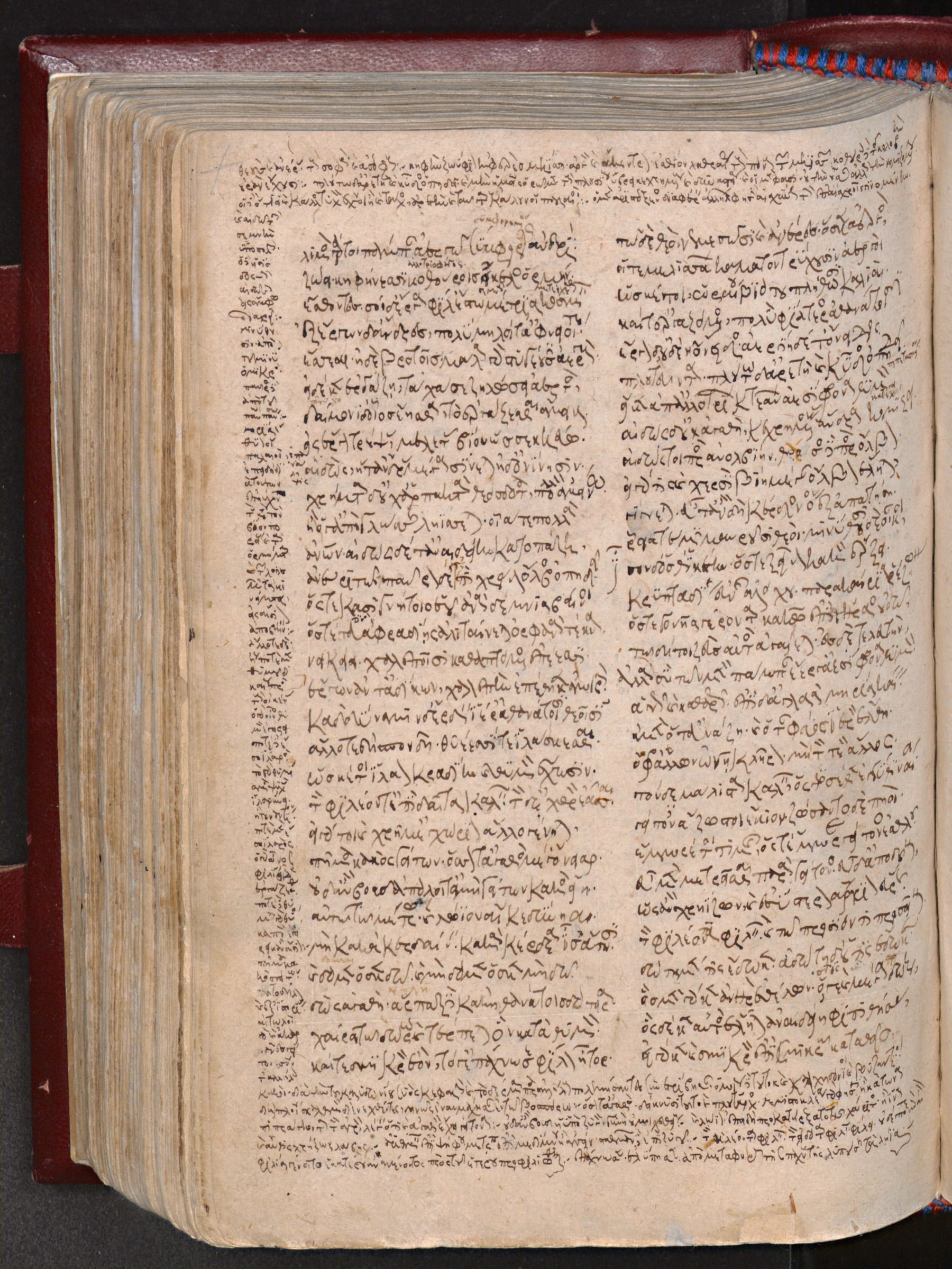
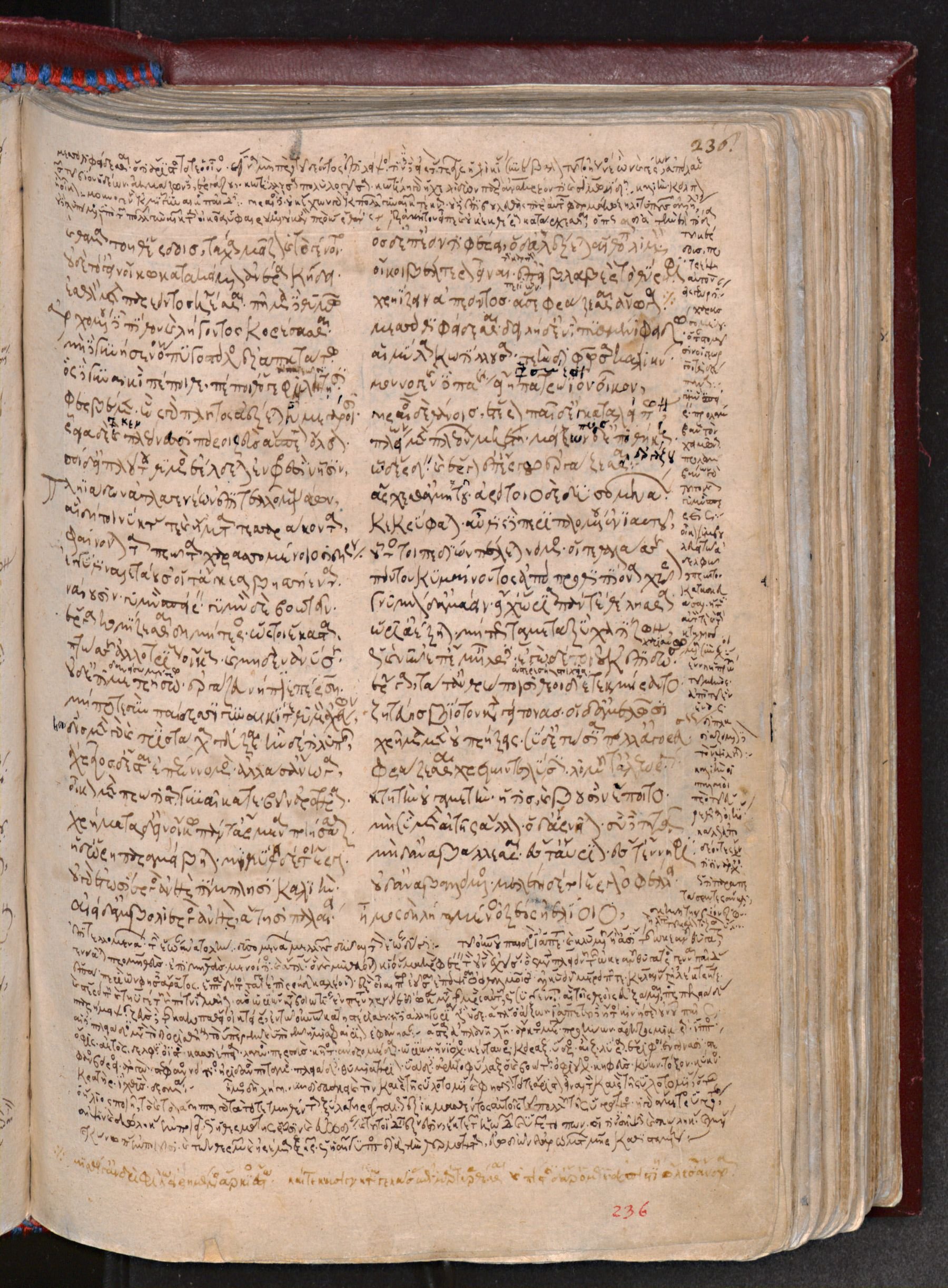
The page photographs are from Florence, Biblioteca Medicea Laurenziana, Plut. 32.16 (paper, late 13th century; a large collection of Greek poetry that also holds letters of Maximus Planudes), Works and Days on fols. 233r-239v, in the Biblioteca Medicea Laurenziana's Teca Digitale. Older manuscripts of the poem exist (Paris gr. 2771, 10th/11th century; Florence, Laur. Plut. 31.39, 12th century), but this copy is legible on every page and holds Hesiod's three poems together. This part is on fol. 235v, 236r. The scribe writes two verses to a row, one in each column, so a page is read across the columns, row by row; the margins are filled with scholia (ancient and Byzantine notes). Each section below is one page; its note gives the page's first and last verse as read on the photograph.
The Greek is Evelyn-White's Loeb text (1914) via Perseus, not a transcription of this manuscript, whose wording differs here and there. Verses the editor brackets as later additions are shown in square brackets. The English is Evelyn-White's prose translation (1914); it is cut at the end of his sentences, so where a sentence runs across a page break it is given whole to one page; each section's note gives the exact lines its English covers.
How was this verified? (Provenance)
Where on the image
Laur. Plut. 32.16, fol. 235v: lines 302-361, begins ‹λιμὸς γάρ τοι πάμπαν›, ends ‹σμικρὸν ἐπὶ σμικρῷ καταθεῖο›. Checked on the image: first and last verse rows read and matched to the Greek (re-read on the image 2026-11-12: first row ‹302 | 303: λιμὸς γάρ τοι πάμπαν ... | τῷ δὲ θεοὶ νεμεσῶσι ...›, last row ‹360 | 361: καί τε σμικρὸν ἐόν ... φίλον ἦτορ | εἰ γάρ κεν καὶ σμικρὸν ... καταθεῖο›); the page before ends at line 301 and the page after begins at line 362. This section shows lines 320-361 of that page; the rest of the page belongs to the previous part of the poem. The page ends with 360 and 361 in the traditional order; the Loeb text moves 363 before 361, so 363 is on the next page. The page also has, in row 5, the verse after 309 that Evelyn-White's text leaves out (line 310); it is not in the Greek or English here. English here: lines 320-360, cut at the end of Evelyn-White's sentences. His sentence ‹He who adds to what he has ...› begins in line 361, before the page break, and is given whole with the next page, so the English here ends with line 360.
320χρήματα δʼ οὐχ ἁρπακτά, θεόσδοτα πολλὸν ἀμείνω.
321εἰ γάρ τις καὶ χερσὶ βίῃ μέγαν ὄλβον ἕληται,
322ἢ ὅ γʼ ἀπὸ γλώσσης ληίσσεται, οἷά τε πολλὰ
323γίγνεται, εὖτʼ ἂν δὴ κέρδος νόον ἐξαπατήσῃ
324ἀνθρώπων, αἰδῶ δέ τʼ ἀναιδείη κατοπάζῃ·
325ῥεῖα δέ μιν μαυροῦσι θεοί, μινύθουσι δὲ οἶκον
326ἀνέρι τῷ, παῦρον δέ τʼ ἐπὶ χρόνον ὄλβος ὀπηδεῖ.
327ἶσον δʼ ὅς θʼ ἱκέτην ὅς τε ξεῖνον κακὸν ἔρξῃ,
328ὅς τε κασιγνήτοιο ἑοῦ ἀνὰ δέμνια βαίνῃ
329κρυπταδίης εὐνῆς ἀλόχου, παρακαίρια ῥέζων,
330ὅς τέ τευ ἀφραδίῃς ἀλιταίνεται ὀρφανὰ τέκνα,
331ὅς τε γονῆα γέροντα κακῷ ἐπὶ γήραος οὐδῷ
332νεικείῃ χαλεποῖσι καθαπτόμενος ἐπέεσσιν·
333τῷ δʼ ἦ τοι Ζεὺς αὐτὸς ἀγαίεται, ἐς δὲ τελευτὴν
334ἔργων ἀντʼ ἀδίκων χαλεπὴν ἐπέθηκεν ἀμοιβήν.
335ἀλλὰ σὺ τῶν μὲν πάμπαν ἔεργʼ ἀεσίφρονα θυμόν.
336κὰδ δύναμιν δʼ ἔρδειν ἱέρʼ ἀθανάτοισι θεοῖσιν
337ἁγνῶς καὶ καθαρῶς, ἐπὶ δʼ ἀγλαὰ μηρία καίειν·
338ἄλλοτε δὲ σπονδῇσι θύεσσί τε ἱλάσκεσθαι,
339ἠμὲν ὅτʼ εὐνάζῃ καὶ ὅτʼ ἂν φάος ἱερὸν ἔλθῃ,
340ὥς κέ τοι ἵλαον κραδίην καὶ θυμὸν ἔχωσιν,
341ὄφρʼ ἄλλων ὠνῇ κλῆρον, μὴ τὸν τεὸν ἄλλος.
342τὸν φιλέοντʼ ἐπὶ δαῖτα καλεῖν, τὸν δʼ ἐχθρὸν ἐᾶσαι·
343τὸν δὲ μάλιστα καλεῖν, ὅς τις σέθεν ἐγγύθι ναίει·
344εἰ γάρ τοι καὶ χρῆμʼ ἐγχώριον ἄλλο γένηται,
345γείτονες ἄζωστοι ἔκιον, ζώσαντο δὲ πηοί.
346πῆμα κακὸς γείτων, ὅσσον τʼ ἀγαθὸς μέγʼ ὄνειαρ.
347ἔμμορέ τοι τιμῆς, ὅς τʼ ἔμμορε γείτονος ἐσθλοῦ.
348οὐδʼ ἂν βοῦς ἀπόλοιτʼ, εἰ μὴ γείτων κακὸς εἴη.
349εὖ μὲν μετρεῖσθαι παρὰ γείτονος, εὖ δʼ ἀποδοῦναι,
350αὐτῷ τῷ μέτρῳ, καὶ λώιον, αἴ κε δύνηαι,
351ὡς ἂν χρηίζων καὶ ἐς ὕστερον ἄρκιον εὕρῃς.
352μὴ κακὰ κερδαίνειν· κακὰ κέρδεα ἶσʼ ἀάτῃσιν.
353τὸν φιλέοντα φιλεῖν, καὶ τῷ προσιόντι προσεῖναι.
354καὶ δόμεν, ὅς κεν δῷ, καὶ μὴ δόμεν, ὅς κεν μὴ δῷ.
355δώτῃ μέν τις ἔδωκεν, ἀδώτῃ δʼ οὔτις ἔδωκεν.
356δὼς ἀγαθή, ἅρπαξ δὲ κακή, θανάτοιο δότειρα.
357ὃς μὲν γάρ κεν ἀνὴρ ἐθέλων, ὅ γε, κεἰ μέγα δοίη,
358χαίρει τῷ δώρῳ καὶ τέρπεται ὃν κατὰ θυμόν·
359ὃς δέ κεν αὐτὸς ἕληται ἀναιδείηφι πιθήσας,
360καί τε σμικρὸν ἐόν, τό γʼ ἐπάχνωσεν φίλον ἦτορ.
361εἰ γάρ κεν καὶ σμικρὸν ἐπὶ σμικρῷ καταθεῖο
320Wealth should not be seized: god-given wealth is much better; for if a man takes great wealth violently and perforce, or if he steals it through his tongue, as often happens when gain deceives men's sense and dishonor tramples down honor, 325the gods soon blot him out and make that man's house low, and wealth attends him only for a little time. Alike with him who does wrong to a suppliant or a guest, or who goes up to his brother's bed and commits unnatural sin in lying with his wife, 330or who infatuately offends against fatherless children, or who abuses his old father at the cheerless threshold of old age and attacks him with harsh words, truly Zeus himself is angry, and at the last lays on him a heavy requital for his evil doing. 335But do you turn your foolish heart altogether away from these things, and, as far as you are able, sacrifice to the deathless gods purely and cleanly, and burn rich meats also, and at other times propitiate them with libations and incense, both when you go to bed and when the holy light has come back, 340that they may be gracious to you in heart and spirit, and so you may buy another's holding and not another yours. Call your friend to a feast; but leave your enemy alone; and especially call him who lives near you: for if any mischief happens in the place, 345neighbors come ungirt, but kinsmen stay to gird themselves. A bad neighbor is as great a plague as a good one is a great blessing; he who enjoys a good neighbor has a precious possession. Not even an ox would die but for a bad neighbor. Take fair measure from your neighbor and pay him back 350fairly with the same measure, or better, if you can; so that if you are in need afterwards, you may find him sure. Do not get base gain: base gain is as bad as ruin. Be friends with the friendly, and visit him who visits you. Give to one who gives, but do not give to one who does not give. 355A man gives to the free-handed, but no one gives to the closefisted. Give is a good girl, but Take is bad and she brings death. For the man who gives willingly, even though he gives a great thing, rejoices in his gift and is glad in heart; but whoever gives way to shamelessness and takes something himself, 360even though it is a small thing, it freezes his heart.
Where on the image
Laur. Plut. 32.16, fol. 236r: lines 362-414, begins ‹καὶ θαμὰ τοῦτʼ ἔρδοις,›, ends ‹λήγει μένος ὀξέος ἠελίοιο›. Checked on the image: first and last verse rows read and matched to the Greek (re-read on the image 2026-11-12: first row ‹362 | 363: καὶ θαμὰ τοῦτ' ἔρδοις ... | ὃς δ' ἐπ' ἐόντι φέρει ...›, last row ‹413 | 414: αἰεὶ δ' ἀμβολιεργὸς ... | ἦμος δὴ λήγει μένος ...›); the page before ends at line 361 and the page after begins at line 415. This section shows lines 362-404 of that page; the rest of the page belongs to the next part of the poem. The verse block ends about two thirds of the way down; the lower part of the page is filled with scholia. Verses 370-372 are left out of the column (row 4 is 368 | 369, row 5 is 373 | 374) and written as one line in orange ink at the very foot of the page, keyed by a sign at the end of row 3; the Greek shows them in their places. Evelyn-White's English follows the Loeb order 360, 363, 361, 362: his sentence He who adds to what he has ... soon that little will become great renders 363, 361 and 362, and is given whole with this page, which holds 362-363. English here: lines 361-404, cut at the end of Evelyn-White's sentences. His sentence ‹He who adds to what he has ...› begins in line 361, before the page break, and is given whole with this page.
362καὶ θαμὰ τοῦτʼ ἔρδοις, τάχα κεν μέγα καὶ τὸ γένοιτο.
363ὃς δʼ ἐπʼ ἐόντι φέρει, ὃ δʼ ἀλέξεται αἴθοπα λιμόν·
364οὐδὲ τό γʼ ἐν οἴκῳ κατακείμενον ἀνέρα κήδει.
365οἴκοι βέλτερον εἶναι, ἐπεὶ βλαβερὸν τὸ θύρηφιν.
366ἐσθλὸν μὲν παρεόντος ἑλέσθαι, πῆμα δὲ θυμῷ
367χρηίζειν ἀπεόντος, ἅ σε φράζεσθαι ἄνωγα.
368ἀρχομένου δὲ πίθου καὶ λήγοντος κορέσασθαι,
369μεσσόθι φείδεσθαι· δειλὴ δʼ ἐνὶ πυθμένι φειδώ.
370μισθὸς δʼ ἀνδρὶ φίλῳ εἰρημένος ἄρκιος ἔστω.
371καί τε κασιγνήτῳ γελάσας ἐπὶ μάρτυρα θέσθαι.
372πίστεις γάρ τοι ὁμῶς καὶ ἀπιστίαι ὤλεσαν ἄνδρας.
373μὴ δὲ γυνή σε νόον πυγοστόλος ἐξαπατάτω
374αἱμύλα κωτίλλουσα, τεὴν διφῶσα καλιήν.
375ὃς δὲ γυναικὶ πέποιθε, πέποιθʼ ὅ γε φηλήτῃσιν.
376μουνογενὴς δὲ πάις εἴη πατρώιον οἶκον
377φερβέμεν ὣς γὰρ πλοῦτος ἀέξεται ἐν μεγάροισιν.
378γηραιὸς δὲ θάνοις ἕτερον παῖδʼ ἐγκαταλείπων.
379ῥεῖα δέ κεν πλεόνεσσι πόροι Ζεὺς ἄσπετον ὄλβον.
380πλείων μὲν πλεόνων μελέτη, μείζων δʼ ἐπιθήκη.
381σοὶ δʼ εἰ πλούτου θυμὸς ἐέλδεται ἐν φρεσὶν ᾗσιν,
382ὧδʼ ἔρδειν, καὶ ἔργον ἐπʼ ἔργῳ ἐργάζεσθαι.
383πληιάδων Ἀτλαγενέων ἐπιτελλομενάων
384ἄρχεσθʼ ἀμήτου, ἀρότοιο δὲ δυσομενάων.
385αἳ δή τοι νύκτας τε καὶ ἤματα τεσσαράκοντα
386κεκρύφαται, αὖτις δὲ περιπλομένου ἐνιαυτοῦ
387φαίνονται τὰ πρῶτα χαρασσομένοιο σιδήρου.
388οὗτός τοι πεδίων πέλεται νόμος, οἵ τε θαλάσσης
389ἐγγύθι ναιετάουσʼ, οἵ τʼ ἄγκεα βησσήεντα,
390πόντου κυμαίνοντος ἀπόπροθι, πίονα χῶρον
391ναίουσιν· γυμνὸν σπείρειν, γυμνὸν δὲ βοωτεῖν,
392γυμνὸν δʼ ἀμάειν, εἴ χʼ ὥρια πάντʼ ἐθέλῃσθα
393ἔργα κομίζεσθαι Δημήτερος· ὥς τοι ἕκαστα
394ὥριʼ ἀέξηται, μή πως τὰ μέταζε χατίζων
395πτώσσῃς ἀλλοτρίους οἴκους καὶ μηδὲν ἀνύσσῃς.
396ὡς καὶ νῦν ἐπʼ ἔμʼ ἦλθες· ἐγὼ δέ τοι οὐκ ἐπιδώσω
397οὐδʼ ἐπιμετρήσω· ἐργάζευ, νήπιε Πέρση,
398ἔργα, τά τʼ ἀνθρώποισι θεοὶ διετεκμήραντο,
399μή ποτε σὺν παίδεσσι γυναικί τε θυμὸν ἀχεύων
400ζητεύῃς βίοτον κατὰ γείτονας, οἳ δʼ ἀμελῶσιν.
401δὶς μὲν γὰρ καὶ τρὶς τάχα τεύξεαι· ἢν δʼ ἔτι λυπῇς,
402χρῆμα μὲν οὐ πρήξεις, σὺ δʼ ἐτώσια πόλλʼ ἀγορεύσεις·
403ἀχρεῖος δʼ ἔσται ἐπέων νομός. ἀλλά σʼ ἄνωγα
404φράζεσθαι χρειῶν τε λύσιν λιμοῦ τʼ ἀλεωρήν.
363He who adds to what he has, will keep off bright-eyed hunger; 361for if you add only a little to a little and do this often, 362soon that little will become great. What a man has by him at home does not trouble him: 365it is better to have your stuff at home, for whatever is abroad may mean loss. It is a good thing to draw on what you have; but it grieves your heart to need something and not to have it, and I bid you mark this. Take your fill when the cask is first opened and when it is nearly spent, but midways be sparing: it is poor saving when you come to the lees. 370Let the wage promised to a friend be fixed; even with your brother smile—and get a witness; for trust and mistrust alike ruin men. Do not let a flaunting woman coax and cozen and deceive you: she is after your barn. The man who trusts womankind trusts deceivers. 375There should be an only son to feed his father's house, for so wealth will increase in the home; but if you leave a second son you should die old. Yet Zeus can easily give great wealth to a greater number. 380More hands mean more work and more increase. If your heart within you desires wealth, do these things and work with work upon work. When the Pleiades, daughters of Atlas, are rising, begin your harvest, and your ploughing when they are going to set. 385Forty nights and days they are hidden and appear again as the year moves round, when first you sharpen your sickle. This is the law of the plains, and of those who live near the sea, 390and who inhabit rich country, the glens and hollows far from the tossing sea,—strip to sow and strip to plough and strip to reap, if you wish to get in all Demeter's fruits in due season, and that each kind may grow in its season. Else, afterwards, you may chance to be in want, 395and go begging to other men's houses, but without avail; as you have already come to me. But I will give you no more nor give you further measure. Foolish Perses! Work the work which the gods ordained for men, lest in bitter anguish of spirit you with your wife and children 400seek your livelihood amongst your neighbors, and they do not heed you. Two or three times, may be, you will succeed, but if you trouble them further, it will not avail you, and all your talk will be in vain, and your word-play unprofitable. Nay, I bid you find a way to pay your debts and avoid hunger.
Notes
- Greek: H. G. Evelyn-White, Hesiod, the Homeric Hymns and Homerica (Loeb Classical Library, 1914), via Perseus. Square brackets mark verses the editor regards as interpolated.
- English: H. G. Evelyn-White's translation in the same volume; his footnotes are omitted.
- Lines 169a-169d of the Loeb text (fragments from a papyrus on Cronos and the fifth race) are not in the medieval manuscripts and are not included.
Cite
Sources
- Source: Laur. Plut. 32.16 (BML Teca Digitale IIIF) + Evelyn-White Greek (Loeb 1914, Perseus) + Evelyn-White English (1914, Perseus) (holding institution)
- Critical edition: Evelyn-White, Loeb 1914, via Perseus
← previous · → next · v cycle view · l back to library