Hesiod, Works and Days 405-503: The farmer's year: the house, the plough and sowing
Introduction
Hesiod's Works and Days (c. 700 BCE) is a poem of advice to his brother Perses on justice, work and the farmer's year. It contains the myth of Prometheus and Pandora and the Five Ages of mankind, from the golden race to the race of iron. This part: The farmer's year: the house, the plough and sowing (lines 405-503, 99 lines). What a farmer needs, how to build a plough, and when to plough and sow at the cry of the crane.
The page photographs are from Florence, Biblioteca Medicea Laurenziana, Plut. 32.16 (paper, late 13th century; a large collection of Greek poetry that also holds letters of Maximus Planudes), Works and Days on fols. 233r-239v, in the Biblioteca Medicea Laurenziana's Teca Digitale. Older manuscripts of the poem exist (Paris gr. 2771, 10th/11th century; Florence, Laur. Plut. 31.39, 12th century), but this copy is legible on every page and holds Hesiod's three poems together. This part is on fol. 236r, 236v, 237r. The scribe writes two verses to a row, one in each column, so a page is read across the columns, row by row; the margins are filled with scholia (ancient and Byzantine notes). Each section below is one page; its note gives the page's first and last verse as read on the photograph.
The Greek is Evelyn-White's Loeb text (1914) via Perseus, not a transcription of this manuscript, whose wording differs here and there. Verses the editor brackets as later additions are shown in square brackets. The English is Evelyn-White's prose translation (1914); it is cut at the end of his sentences, so where a sentence runs across a page break it is given whole to one page; each section's note gives the exact lines its English covers.
How was this verified? (Provenance)
Where on the image
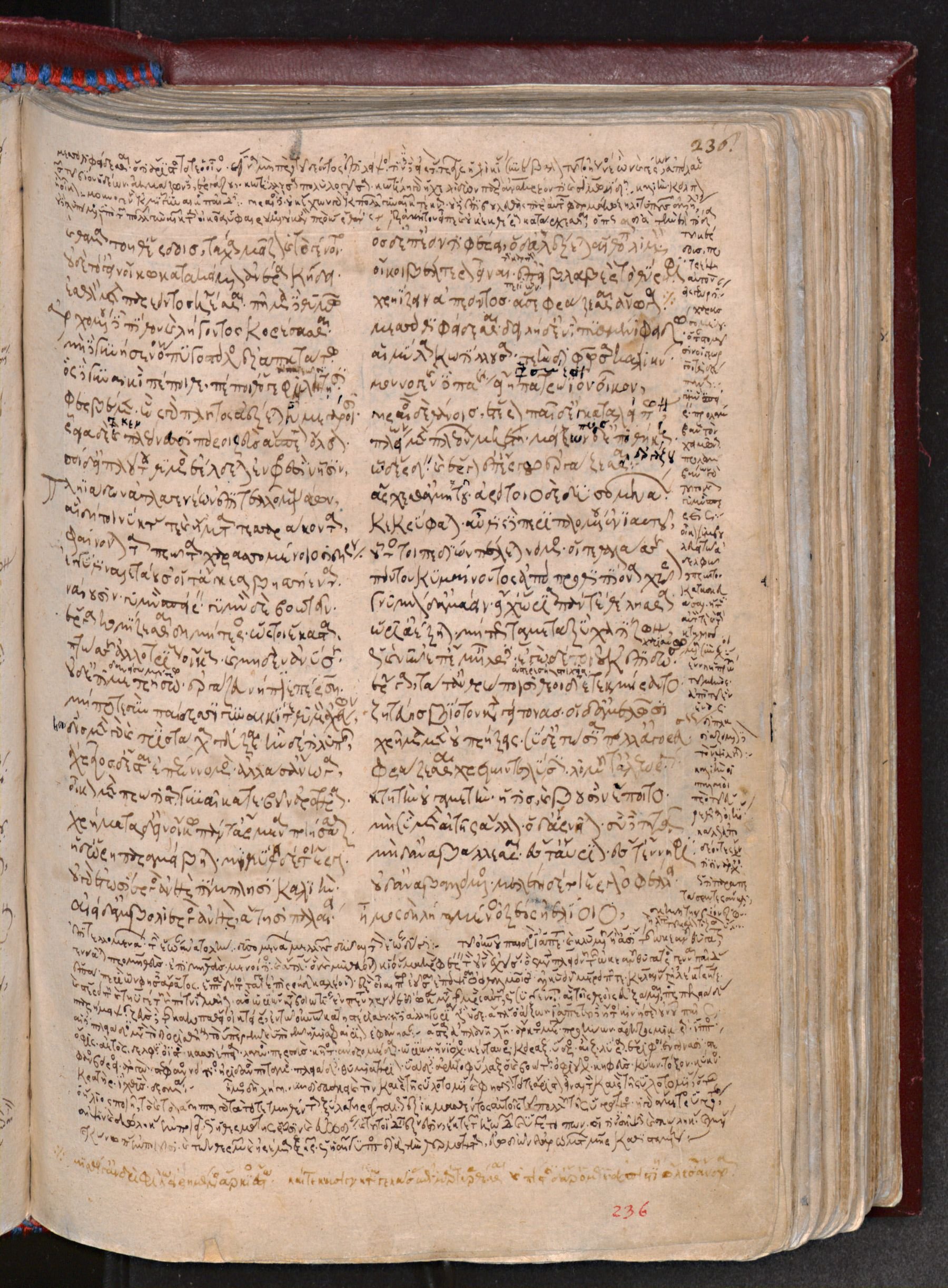
Laur. Plut. 32.16, fol. 236r: lines 362-414, begins ‹καὶ θαμὰ τοῦτʼ ἔρδοις,›, ends ‹λήγει μένος ὀξέος ἠελίοιο›. Checked on the image: first and last verse rows read and matched to the Greek (re-read on the image 2026-11-12: first row ‹362 | 363: καὶ θαμὰ τοῦτ' ἔρδοις ... | ὃς δ' ἐπ' ἐόντι φέρει ...›, last row ‹413 | 414: αἰεὶ δ' ἀμβολιεργὸς ... | ἦμος δὴ λήγει μένος ...›); the page before ends at line 361 and the page after begins at line 415. This section shows lines 405-414 of that page; the rest of the page belongs to the previous part of the poem. The verse block ends about two thirds of the way down; the lower part of the page is filled with scholia. Verses 370-372 are left out of the column (row 4 is 368 | 369, row 5 is 373 | 374) and written as one line in orange ink at the very foot of the page, keyed by a sign at the end of row 3; the Greek shows them in their places. Evelyn-White's English follows the Loeb order 360, 363, 361, 362: his sentence He who adds to what he has ... soon that little will become great renders 363, 361 and 362, and is given whole with this page, which holds 362-363. English here: lines 405-413, cut at the end of Evelyn-White's sentences. His sentence ‹When the piercing power and sultry heat ...› begins in line 414, before the page break, and is given whole with the next page, so the English here ends with line 413.
405οἶκον μὲν πρώτιστα γυναῖκά τε βοῦν τʼ ἀροτῆρα,
406κτητήν, οὐ γαμετήν, ἥτις καὶ βουσὶν ἕποιτο,
407χρήματα δʼ ἐν οἴκῳ πάντʼ ἄρμενα ποιήσασθαι,
408μὴ σὺ μὲν αἰτῇς ἄλλον, ὃ δʼ ἀρνῆται, σὺ δὲ τητᾷ,
409ἡ δʼ ὥρη παραμείβηται, μινύθῃ δὲ τὸ ἔργον.
410μηδʼ ἀναβάλλεσθαι ἔς τʼ αὔριον ἔς τε ἔνηφιν·
411οὐ γὰρ ἐτωσιοεργὸς ἀνὴρ πίμπλησι καλιὴν
412οὐδʼ ἀναβαλλόμενος· μελέτη δὲ τὸ ἔργον ὀφέλλει·
413αἰεὶ δʼ ἀμβολιεργὸς ἀνὴρ ἄτῃσι παλαίει.
414ἦμος δὴ λήγει μένος ὀξέος ἠελίοιο
405First of all, get a house, and a woman and an ox for the plough—a slave woman and not a wife, to follow the oxen as well—and make everything ready at home, so that you may not have to ask of another, and he refuse you, and so, because you are in lack, the season pass by and your work come to nothing. 410Do not put your work off till to-morrow and the day after; for a sluggish worker does not fill his barn, nor one who puts off his work: industry makes work go well, but a man who puts off work is always at hand-grips with ruin.
Where on the image
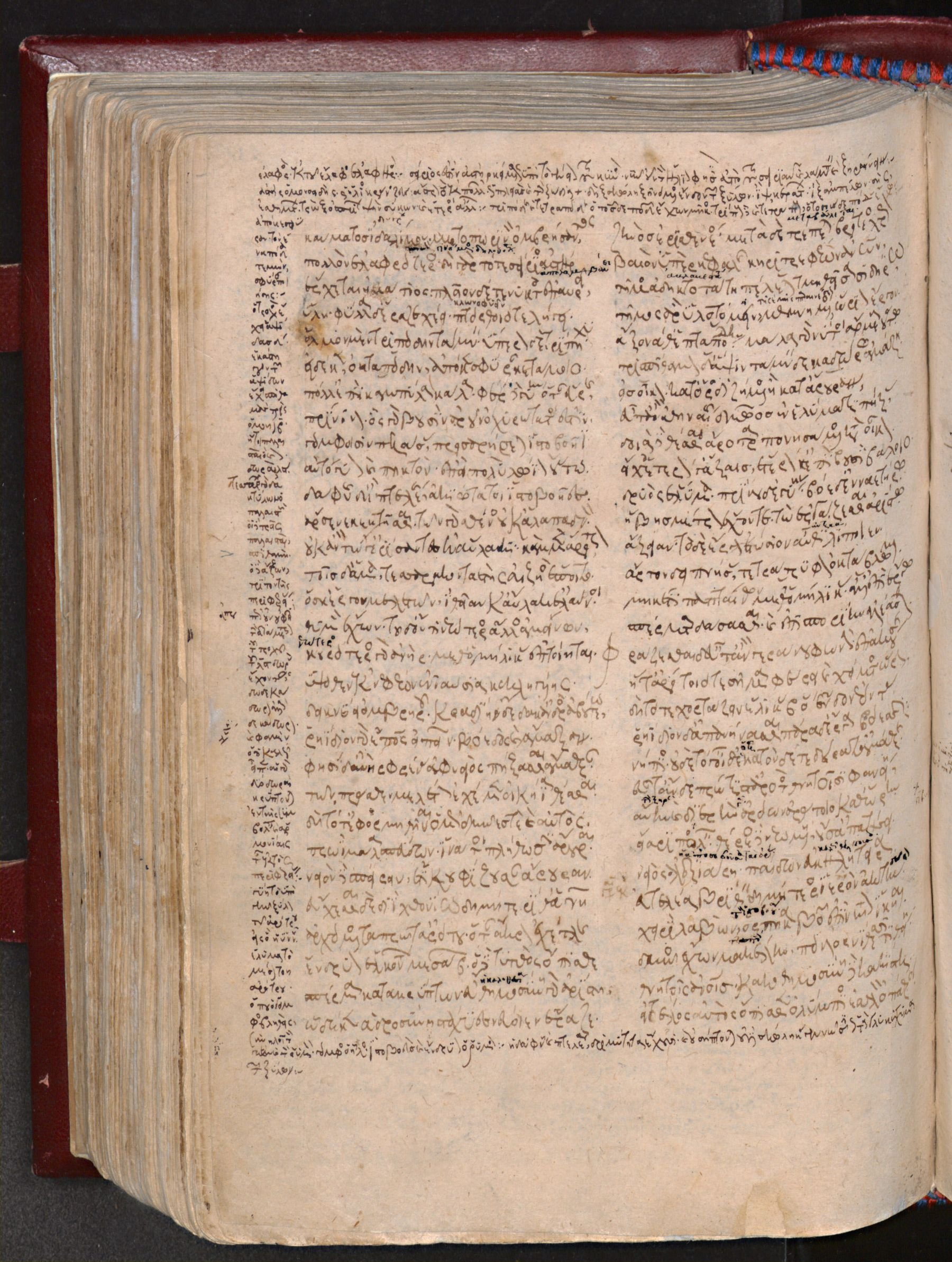
Laur. Plut. 32.16, fol. 236v: lines 415-474, begins ‹καύματος ἰδαλίμου, μετοπωρινὸν ὀμβρήσαντος›, ends ‹ὄπισθεν Ὀλύμπιος ἐσθλὸν ὀπάζοι,›. Checked on the image: first and last verse rows read and matched to the Greek (re-read on the image 2026-11-12: first row ‹415 | 416: καύματος ἰδαλίμου ... | ζηνὸς ἐρισθενέος ...›, last row ‹473 | 474: ὧδέ κεν ἀδροσύνῃ ... | ... ὀλύμπιος ἐσθλὸν ὀπάζοι›); the page before ends at line 414 and the page after begins at line 475. English here: lines 414-476, cut at the end of Evelyn-White's sentences. His sentence ‹When the piercing power and sultry heat ...› begins in line 414, before the page break, and is given whole with this page. His sentence that runs across the break with the next page is given whole here, so the English ends with line 476 (‹... take of your garnered substance.›).
415καύματος ἰδαλίμου, μετοπωρινὸν ὀμβρήσαντος
416Ζηνὸς ἐρισθενέος, μετὰ δὲ τρέπεται βρότεος χρὼς
417πολλὸν ἐλαφρότερος· δὴ γὰρ τότε Σείριος ἀστὴρ
418βαιὸν ὑπὲρ κεφαλῆς κηριτρεφέων ἀνθρώπων
419ἔρχεται ἠμάτιος, πλεῖον δέ τε νυκτὸς ἐπαυρεῖ·
420τῆμος ἀδηκτοτάτη πέλεται τμηθεῖσα σιδήρῳ
421ὕλη, φύλλα δʼ ἔραζε χέει, πτόρθοιό τε λήγει·
422τῆμος ἄρʼ ὑλοτομεῖν μεμνημένος ὥρια ἔργα.
423ὄλμον μὲν τριπόδην τάμνειν, ὕπερον δὲ τρίπηχυν,
424ἄξονα δʼ ἑπταπόδην· μάλα γάρ νύ τοι ἄρμενον οὕτω·
425εἰ δέ κεν ὀκταπόδην, ἀπὸ καὶ σφῦράν κε τάμοιο.
426τρισπίθαμον δʼ ἄψιν τάμνειν δεκαδώρῳ ἀμάξῃ.
427πόλλʼ ἐπικαμπύλα κᾶλα· φέρειν δὲ γύην, ὅτʼ ἂν εὕρῃς,
428ἐς οἶκον, κατʼ ὄρος διζήμενος ἢ κατʼ ἄρουραν,
429πρίνινον· ὃς γὰρ βουσὶν ἀροῦν ὀχυρώτατός ἐστιν,
430εὖτʼ ἂν Ἀθηναίης δμῷος ἐν ἐλύματι πήξας
431γόμφοισιν πελάσας προσαρήρεται ἱστοβοῆι.
432δοιὰ δὲ θέσθαι ἄροτρα, πονησάμενος κατὰ οἶκον,
433αὐτόγυον καὶ πηκτόν, ἐπεὶ πολὺ λώιον οὕτω·
434εἴ χʼ ἕτερον ἄξαις, ἕτερόν κʼ ἐπὶ βουσὶ βάλοιο.
435δάφνης δʼ ἢ πτελέης ἀκιώτατοι ἱστοβοῆες,
436δρυὸς ἔλυμα, γύης πρίνου· βόε δʼ ἐνναετήρω
437ἄρσενε κεκτῆσθαι, τῶν γὰρ σθένος οὐκ ἀλαπαδνόν,
438ἥβης μέτρον ἔχοντε· τὼ ἐργάζεσθαι ἀρίστω.
439οὐκ ἂν τώ γʼ ἐρίσαντε ἐν αὔλακι κὰμ μὲν ἄροτρον
440ἄξειαν, τὸ δὲ ἔργον ἐτώσιον αὖθι λίποιεν.
441τοῖς δʼ ἅμα τεσσαρακονταετὴς αἰζηὸς ἕποιτο
442ἄρτον δειπνήσας τετράτρυφον, ὀκτάβλωμον,
443ὃς ἔργου μελετῶν ἰθεῖάν κʼ αὔλακʼ ἐλαύνοι,
444μηκέτι παπταίνων μεθʼ ὁμήλικας, ἀλλʼ ἐπὶ ἔργῳ
445θυμὸν ἔχων· τοῦ δʼ οὔτι νεώτερος ἄλλος ἀμείνων
446σπέρματα δάσσασθαι καὶ ἐπισπορίην ἀλέασθαι.
447κουρότερος γὰρ ἀνὴρ μεθʼ ὁμήλικας ἐπτοίηται.
448φράζεσθαι δʼ, εὖτʼ ἂν γεράνου φωνὴν ἐπακούσῃς
449ὑψόθεν ἐκ νεφέων ἐνιαύσια κεκληγυίης·
450ἥτʼ ἀρότοιό τε σῆμα φέρει καὶ χείματος ὥρην
451δεικνύει ὀμβρηροῦ· κραδίην δʼ ἔδακʼ ἀνδρὸς ἀβούτεω·
452δὴ τότε χορτάζειν ἕλικας βόας ἔνδον ἐόντας·
453ῥηίδιον γὰρ ἔπος εἰπεῖν· βόε δὸς καὶ ἄμαξαν·
454ῥηίδιον δʼ ἀπανήνασθαι· πάρα ἔργα βόεσσιν.
455φησὶ δʼ ἀνὴρ φρένας ἀφνειὸς πήξασθαι ἄμαξαν,
456νήπιος, οὐδὲ τὸ οἶδʼ· ἑκατὸν δέ τε δούρατʼ ἀμάξης,
457τῶν πρόσθεν μελέτην ἐχέμεν οἰκήια θέσθαι.
458εὖτʼ ἂν δὲ πρώτιστʼ ἄροτος θνητοῖσι φανείῃ,
459δὴ τότʼ ἐφορμηθῆναι ὁμῶς δμῶές τε καὶ αὐτὸς
460αὔην καὶ διερὴν ἀρόων ἀρότοιο καθʼ ὥρην,
461πρωὶ μάλα σπεύδων, ἵνα τοι πλήθωσιν ἄρουραι.
462ἦρι πολεῖν· θέρεος δὲ νεωμένη οὔ σʼ ἀπατήσει.
463νειὸν δὲ σπείρειν ἔτι κουφίζουσαν ἄρουραν·
464νειὸς ἀλεξιάρη παίδων εὐκηλήτειρα.
465εὔχεσθαι δὲ Διὶ χθονίῳ Δημήτερί θʼ ἁγνῇ,
466ἐκτελέα βρίθειν Δημήτερος ἱερὸν ἀκτήν,
467ἀρχόμενος τὰ πρῶτʼ ἀρότου, ὅτʼ ἂν ἄκρον ἐχέτλης
468χειρὶ λαβὼν ὅρπηκα βοῶν ἐπὶ νῶτον ἵκηαι
469ἔνδρυον ἑλκόντων μεσάβων. ὁ δὲ τυτθὸς ὄπισθε
470δμῷος ἔχων μακέλην πόνον ὀρνίθεσσι τιθείη
471σπέρμα κατακρύπτων· ἐυθημοσύνη γὰρ ἀρίστη
472θνητοῖς ἀνθρώποις, κακοθημοσύνη δὲ κακίστη.
473ὧδέ κεν ἀδροσύνῃ στάχυες νεύοιεν ἔραζε,
474εἰ τέλος αὐτὸς ὄπισθεν Ὀλύμπιος ἐσθλὸν ὀπάζοι,
414When the piercing power and sultry heat of the sun abate, 415and almighty Zeus sends the autumn rains, and men's flesh comes to feel far easier,—for then the star Sirius passes over the heads of men, who are born to misery, only a little while by day and takes greater share of night— 420then, when it showers its leaves to the ground and stops sprouting, the wood you cut with your axe is least liable to worm. Then remember to hew your timber: it is the season for that work. Cut a mortar three feet wide and a pestle three cubits long, and an axle of seven feet, for it will do very well so; 425but if you make it eight feet long, you can cut a beetle from it as well. Cut a felloe three spans across for a wagon of ten palms' width. Hew also many bent timbers, and bring home a plough-tree when you have found it, and look out on the mountain or in the field for one of holm-oak; 430for this is the strongest for oxen to plough with when one of Athena's handmen has fixed in the share-beam and fastened it to the pole with dowels. Get two ploughs ready and work on them at home, one all of a piece, and the other jointed. It is far better to do this, for if you should break one of them, you can put the oxen to the other. 435Poles of laurel or elm are most free from worms, and a share-beam of oak and a plough-tree of holm-oak. Get two oxen, bulls of nine years; for their strength is unspent and they are in the prime of their age: they are best for work. They will not fight in the furrow and break the plough 440and then leave the work undone. Let a brisk fellow of forty years follow them, with a loaf of four quarters and eight slices for his dinner, one who will attend to his work and drive a straight furrow and is past the age for gaping after his fellows, 445but will keep his mind on his work. No younger man will be better than he at scattering the seed and avoiding double-sowing; for a man less staid gets disturbed, hankering after his fellows. 448Mark, when you hear the voice of the crane who cries year by year from the clouds above, 450for she gives the signal for ploughing and shows the season of rainy winter; but she vexes the heart of the man who has no oxen. Then is the time to feed up your horned oxen in the byre; for it is easy to say: “Give me a yoke of oxen and a wagon,” and it is easy to refuse: “I have work for my oxen.” 455The man who is rich in fancy thinks his wagon as good as built already—the fool! he does not know that there are a hundred timbers to a wagon. Take care to lay these up beforehand at home. So soon as the time for ploughing is proclaimed to men, then make haste, you and your slaves alike, 460in wet and in dry, to plough in the season for ploughing, and bestir yourself early in the morning so that your fields may be full. Plough in the spring; but fallow broken up in the summer will not belie your hopes. Sow fallow land when the soil is still getting light: fallow land is a defender from harm and a soother of children. 465Pray to Zeus of the Earth and to pure Demeter to make Demeter's holy grain sound and heavy, when first you begin ploughing, when you hold in your hand the end of the plough-tail and bring down your stick on the backs of the oxen as they draw on the pole-bar by the yoke-straps. 470Let a slave follow a little behind with a mattock and make trouble for the birds by hiding the seed; for good management is the best for mortal men as bad management is the worst. In this way your corn-ears will bow to the ground with fullness if the Olympian himself gives a good result at the last, 475and you will sweep the cobwebs from your bins and you will be glad, I think, as you take of your garnered substance.
Where on the image
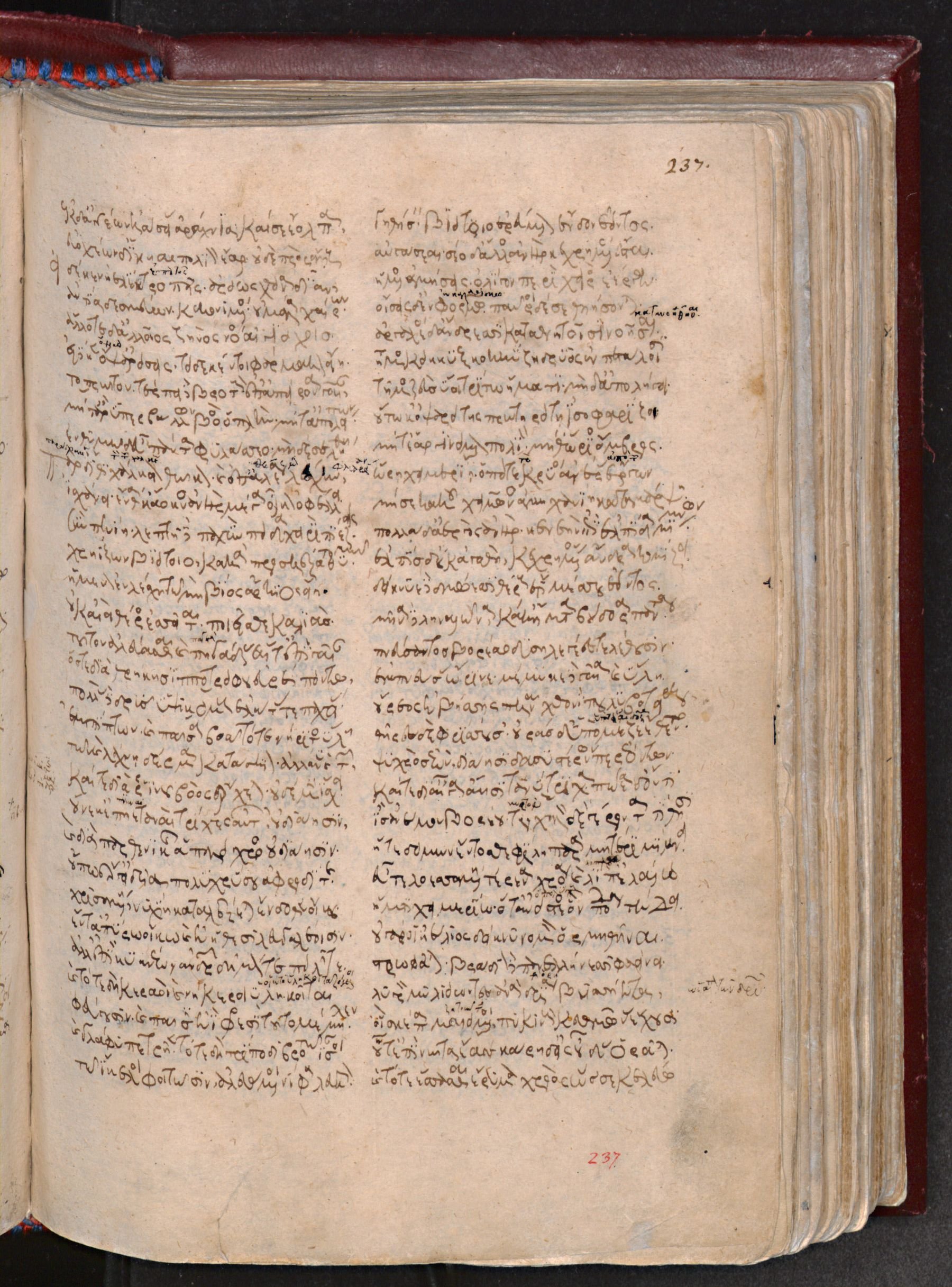
Laur. Plut. 32.16, fol. 237r: lines 475-536, begins ‹ἐκ δʼ ἀγγέων ἐλάσειας›, ends ‹χροός, ὥς σε κελεύω,›. Checked on the image: first and last verse rows read and matched to the Greek (re-read on the image 2026-11-12: first row ‹475 | 476: ἐκ δ' ἀγγέων ἐλάσειας ... | γηθήσειν βιότου ...›, last row ‹535 | 536: τῷ ἴκελοι φοιτῶσιν ... | καὶ τότε ἕσσασθαι ἔρυμα ...›); the page before ends at line 474 and the page after begins at line 537. This section shows lines 475-503 of that page; the rest of the page belongs to the next part of the poem. English here: lines 477-503, cut at the end of Evelyn-White's sentences. The sentence that runs across the page break (to line 476) is given whole with the page before; the English here begins with ‹And so you will have plenty till you come ...› (line 477).
475ἐκ δʼ ἀγγέων ἐλάσειας ἀράχνια· καί σε ἔολπα
476γηθήσειν βιότου αἰρεύμενον ἔνδον ἐόντος.
477εὐοχθέων δʼ ἵξεαι πολιὸν ἔαρ, οὐδὲ πρὸς ἄλλους
478αὐγάσεαι· σέο δʼ ἄλλος ἀνὴρ κεχρημένος ἔσται.
479εἰ δέ κεν ἠελίοιο τροπῇς ἀρόῳς χθόνα δῖαν,
480ἥμενος ἀμήσεις ὀλίγον περὶ χειρὸς ἐέργων,
481ἀντία δεσμεύων κεκονιμένος, οὐ μάλα χαίρων,
482οἴσεις δʼ ἐν φορμῷ· παῦροι δέ σε θηήσονται.
483ἄλλοτε δʼ ἀλλοῖος Ζηνὸς νόος αἰγιόχοιο,
484ἀργαλέος δʼ ἄνδρεσσι καταθνητοῖσι νοῆσαι.
485εἰ δέ κεν ὄψʼ ἀρόσῃς, τόδε κέν τοι φάρμακον εἴη·
486ἦμος κόκκυξ κοκκύζει δρυὸς ἐν πετάλοισι
487τὸ πρῶτον, τέρπει δὲ βροτοὺς ἐπʼ ἀπείρονα γαῖαν,
488τῆμος Ζεὺς ὕοι τρίτῳ ἤματι μηδʼ ἀπολήγοι,
489μήτʼ ἄρʼ ὑπερβάλλων βοὸς ὁπλὴν μήτʼ ἀπολείπων·
490οὕτω κʼ ὀψαρότης πρῳηρότῃ ἰσοφαρίζοι.
491ἐν θυμῷ δʼ εὖ πάντα φυλάσσεο· μηδέ σε λήθοι
492μήτʼ ἔαρ γιγνόμενον πολιὸν μήθʼ ὥριος ὄμβρος.
493πὰρ δʼ ἴθι χάλκειον θῶκον καὶ ἐπαλέα λέσχην
494ὥρῃ χειμερίῃ, ὁπότε κρύος ἀνέρα ἔργων
495ἰσχάνει, ἔνθα κʼ ἄοκνος ἀνὴρ μέγα οἶκον ὀφέλλοι,
496μή σε κακοῦ χειμῶνος ἀμηχανίη καταμάρψῃ
497σὺν πενίῃ, λεπτῇ δὲ παχὺν πόδα χειρὶ πιέζῃς.
498πολλὰ δʼ ἀεργὸς ἀνήρ, κενεὴν ἐπὶ ἐλπίδα μίμνων,
499χρηίζων βιότοιο, κακὰ προσελέξατο θυμῷ.
500ἐλπὶς δʼ οὐκ ἀγαθὴ κεχρημένον ἄνδρα κομίζει,
501ἥμενον ἐν λέσχῃ, τῷ μὴ βίος ἄρκιος εἴη.
502δείκνυε δὲ δμώεσσι θέρευς ἔτι μέσσου ἐόντος·
503οὐκ αἰεὶ θέρος ἐσσεῖται, ποιεῖσθε καλιάς.
477And so you will have plenty till you come to grey springtime, and will not look wistfully to others, but another shall be in need of your help. 479But if you plough the good ground at the solstice, 480you will reap sitting, grasping a thin crop in your hand, binding the sheaves awry, dust-covered, not glad at all; so you will bring all home in a basket and not many will admire you. Yet the will of Zeus who holds the aegis is different at different times; and it is hard for mortal men to tell it; 485for if you should plough late, you may find this remedy—when the cuckoo first calls in the leaves of the oak and makes men glad all over the boundless earth, if Zeus should send rain on the third day and not cease until it rises neither above an ox's hoof nor falls short of it, 490then the late-plougher will vie with the early. Keep all this well in mind, and fail not to mark grey spring as it comes and the season of rain. Pass by the smithy and its crowded lounge in winter time when the cold keeps men from field work,— 495for then an industrious man can greatly prosper his house—lest bitter winter catch you helpless and poor, and you chafe a swollen foot with a shrunk hand. 500The idle man who waits on empty hope, lacking a livelihood, lays to heart mischief-making; it is not a wholesome hope that accompanies a needy man who lolls at ease while he has no sure livelihood. 502While it is yet midsummer command your slaves: “It will not always be summer, build barns.”
Notes
- Greek: H. G. Evelyn-White, Hesiod, the Homeric Hymns and Homerica (Loeb Classical Library, 1914), via Perseus. Square brackets mark verses the editor regards as interpolated.
- English: H. G. Evelyn-White's translation in the same volume; his footnotes are omitted.
- Lines 169a-169d of the Loeb text (fragments from a papyrus on Cronos and the fifth race) are not in the medieval manuscripts and are not included.
Cite
Sources
- Source: Laur. Plut. 32.16 (BML Teca Digitale IIIF) + Evelyn-White Greek (Loeb 1914, Perseus) + Evelyn-White English (1914, Perseus) (holding institution)
- Critical edition: Evelyn-White, Loeb 1914, via Perseus
← previous · → next · v cycle view · l back to library