Hesiod, Works and Days 504-608: Winter, spring and summer; harvest and threshing
Introduction
Hesiod's Works and Days (c. 700 BCE) is a poem of advice to his brother Perses on justice, work and the farmer's year. It contains the myth of Prometheus and Pandora and the Five Ages of mankind, from the golden race to the race of iron. This part: Winter, spring and summer; harvest and threshing (lines 504-608, 105 lines). The month of Lenaeon and the north wind, pruning and digging in spring, summer rest, and threshing.
The page photographs are from Florence, Biblioteca Medicea Laurenziana, Plut. 32.16 (paper, late 13th century; a large collection of Greek poetry that also holds letters of Maximus Planudes), Works and Days on fols. 233r-239v, in the Biblioteca Medicea Laurenziana's Teca Digitale. Older manuscripts of the poem exist (Paris gr. 2771, 10th/11th century; Florence, Laur. Plut. 31.39, 12th century), but this copy is legible on every page and holds Hesiod's three poems together. This part is on fol. 237r, 237v, 238r. The scribe writes two verses to a row, one in each column, so a page is read across the columns, row by row; the margins are filled with scholia (ancient and Byzantine notes). Each section below is one page; its note gives the page's first and last verse as read on the photograph.
The Greek is Evelyn-White's Loeb text (1914) via Perseus, not a transcription of this manuscript, whose wording differs here and there. Verses the editor brackets as later additions are shown in square brackets. The English is Evelyn-White's prose translation (1914); it is cut at the end of his sentences, so where a sentence runs across a page break it is given whole to one page; each section's note gives the exact lines its English covers.
How was this verified? (Provenance)
Where on the image
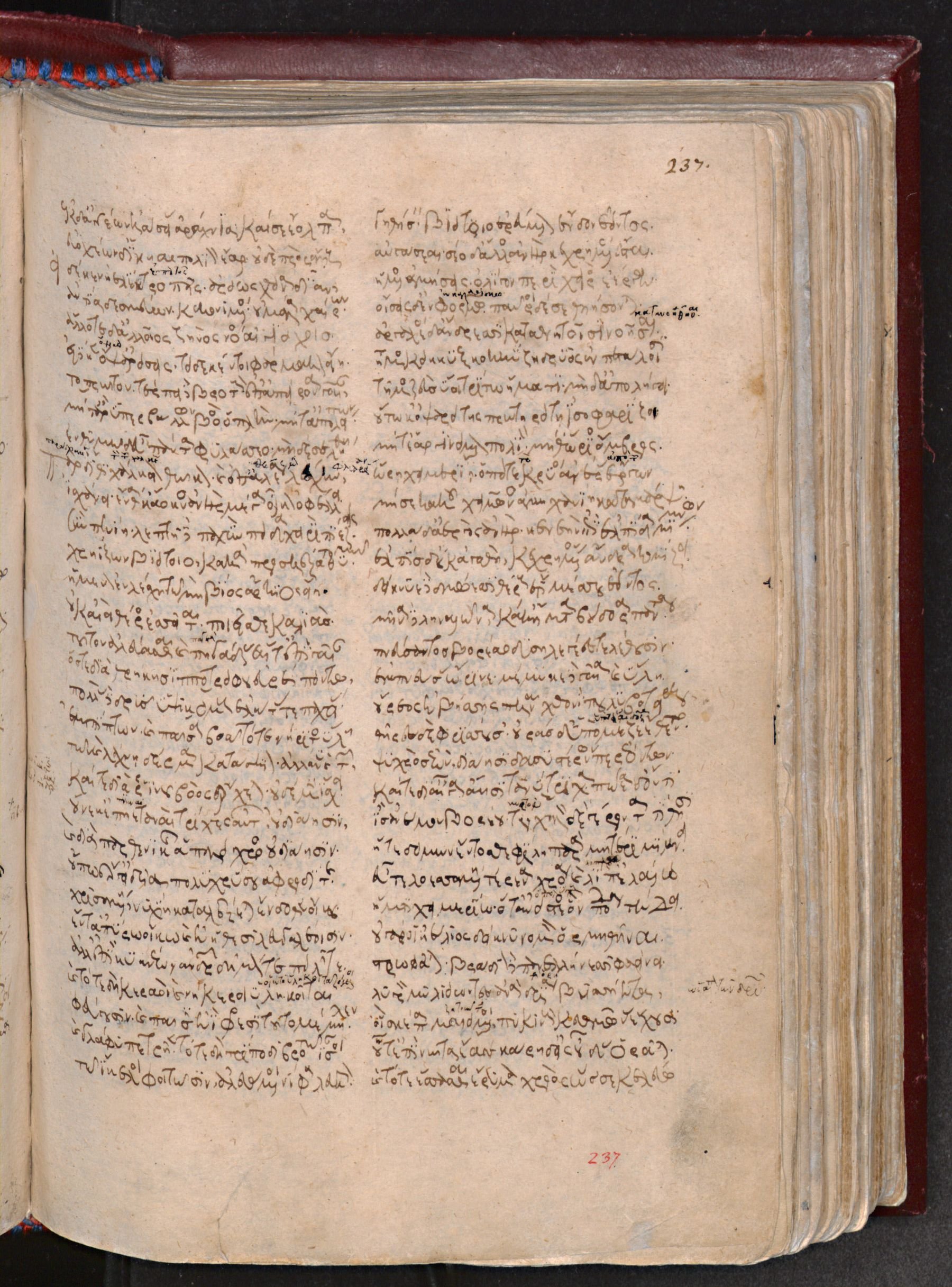
Laur. Plut. 32.16, fol. 237r: lines 475-536, begins ‹ἐκ δʼ ἀγγέων ἐλάσειας›, ends ‹χροός, ὥς σε κελεύω,›. Checked on the image: first and last verse rows read and matched to the Greek (re-read on the image 2026-11-12: first row ‹475 | 476: ἐκ δ' ἀγγέων ἐλάσειας ... | γηθήσειν βιότου ...›, last row ‹535 | 536: τῷ ἴκελοι φοιτῶσιν ... | καὶ τότε ἕσσασθαι ἔρυμα ...›); the page before ends at line 474 and the page after begins at line 537. This section shows lines 504-536 of that page; the rest of the page belongs to the previous part of the poem. English here: lines 504-535, cut at the end of Evelyn-White's sentences. His sentence ‹Then put on, as I bid you ...› begins in line 536, before the page break, and is given whole with the next page, so the English here ends with line 535.
504μῆνα δὲ Ληναιῶνα, κάκʼ ἤματα, βουδόρα πάντα,
505τοῦτον ἀλεύασθαι, καὶ πηγάδας, αἵτʼ ἐπὶ γαῖαν
506πνεύσαντος Βορέαο δυσηλεγέες τελέθουσιν,
507ὅστε διὰ Θρῄκης ἱπποτρόφου εὐρέι πόντῳ
508ἐμπνεύσας ὤρινε· μέμυκε δὲ γαῖα καὶ ὕλη·
509πολλὰς δὲ δρῦς ὑψικόμους ἐλάτας τε παχείας
510οὔρεος ἐν βήσσῃς πιλνᾷ χθονὶ πουλυβοτείρῃ
511ἐμπίπτων, καὶ πᾶσα βοᾷ τότε νήριτος ὕλη.
512θῆρες δὲ φρίσσουσʼ, οὐρὰς δʼ ὑπὸ μέζεʼ ἔθεντο,
513τῶν καὶ λάχνῃ δέρμα κατάσκιον· ἀλλά νυ καὶ τῶν
514ψυχρὸς ἐὼν διάησι δασυστέρνων περ ἐόντων.
515καί τε διὰ ῥινοῦ βοὸς ἔρχεται, οὐδέ μιν ἴσχει·
516καί τε διʼ αἶγα ἄησι τανύτριχα· πώεα δʼ οὔ τι,
517οὕνεκʼ ἐπηεταναὶ τρίχες αὐτῶν, οὐ διάησιν
518ἲς ἀνέμου Βορέου· τροχαλὸν δὲ γέροντα τίθησιν.
519καὶ διὰ παρθενικῆς ἁπαλόχροος οὐ διάησιν,
520ἥτε δόμων ἔντοσθε φίλῃ παρὰ μητέρι μίμνει
521οὔ πω ἔργα ἰδυῖα πολυχρύσου Ἀφροδίτης·
522εὖ τε λοεσσαμένη τέρενα χρόα καὶ λίπʼ ἐλαίῳ
523χρισαμένη μυχίη καταλέξεται ἔνδοθι οἴκου
524ἤματι χειμερίῳ, ὅτʼ ἀνόστεος ὃν πόδα τένδει
525ἔν τʼ ἀπύρῳ οἴκῳ καὶ ἤθεσι λευγαλέοισιν.
526οὐδέ οἱ ἠέλιος δείκνυ νομὸν ὁρμηθῆναι·
527ἀλλʼ ἐπὶ κυανέων ἀνδρῶν δῆμόν τε πόλιν τε
528στρωφᾶται, βράδιον δὲ Πανελλήνεσσι φαείνει.
529καὶ τότε δὴ κεραοὶ καὶ νήκεροι ὑληκοῖται
530λυγρὸν μυλιόωντες ἀνὰ δρία βησσήεντα
531φεύγουσιν· καὶ πᾶσιν ἐνὶ φρεσὶ τοῦτο μέμηλεν,
532ὡς σκέπα μαιόμενοι πυκινοὺς κευθμῶνας ἔχωσι
533καὶ γλάφυ πετρῆεν· τότε δὴ τρίποδι βροτῷ ἶσοι,
534οὗ τʼ ἐπὶ νῶτα ἔαγε, κάρη δʼ εἰς οὖδας ὁρᾶται,
535τῷ ἴκελοι φοιτῶσιν, ἀλευόμενοι νίφα λευκήν.
536καὶ τότε ἕσσασθαι ἔρυμα χροός, ὥς σε κελεύω,
504Avoid the month Lenaeon, wretched days, all of them fit to skin an ox, 505and the frosts which are cruel when Boreas blows over the earth. He blows across horse-breeding Thrace upon the wide sea and stirs it up, while earth and the forest howl. On many a high-leafed oak and thick pine he falls 510and brings them to the bounteous earth in mountain glens: then all the immense wood roars and the beasts shudder and put their tails between their legs, even those whose hide is covered with fur; for with his bitter blast he blows even through them, although they are shaggy-breasted. 515He goes even through an ox's hide; it does not stop him. Also he blows through the goat's fine hair. But through the fleeces of sheep, because their wool is abundant, the keen wind Boreas pierces not at all; but it makes the old man curved as a wheel. And it does not blow through the tender maiden 520who stays indoors with her dear mother, unlearned as yet in the works of golden Aphrodite, and who washes her soft body and anoints herself with oil and lies down in an inner room within the house, on a winter's day when the Boneless One gnaws his foot 525in his fireless house and wretched home; for the sun shows him no pastures to make for, but goes to and fro over the land and city of dusky men, and shines more sluggishly upon the whole race of the Hellenes. Then the horned and unhorned denizens of the wood, 530with teeth chattering pitifully, flee through the copses and glades, and all, as they seek shelter, have this one care, to gain thick coverts or some hollow rock. Then, like the Three-legged One whose back is broken and whose head looks down upon the ground, 535like him, I say, they wander to escape the white snow.
Where on the image
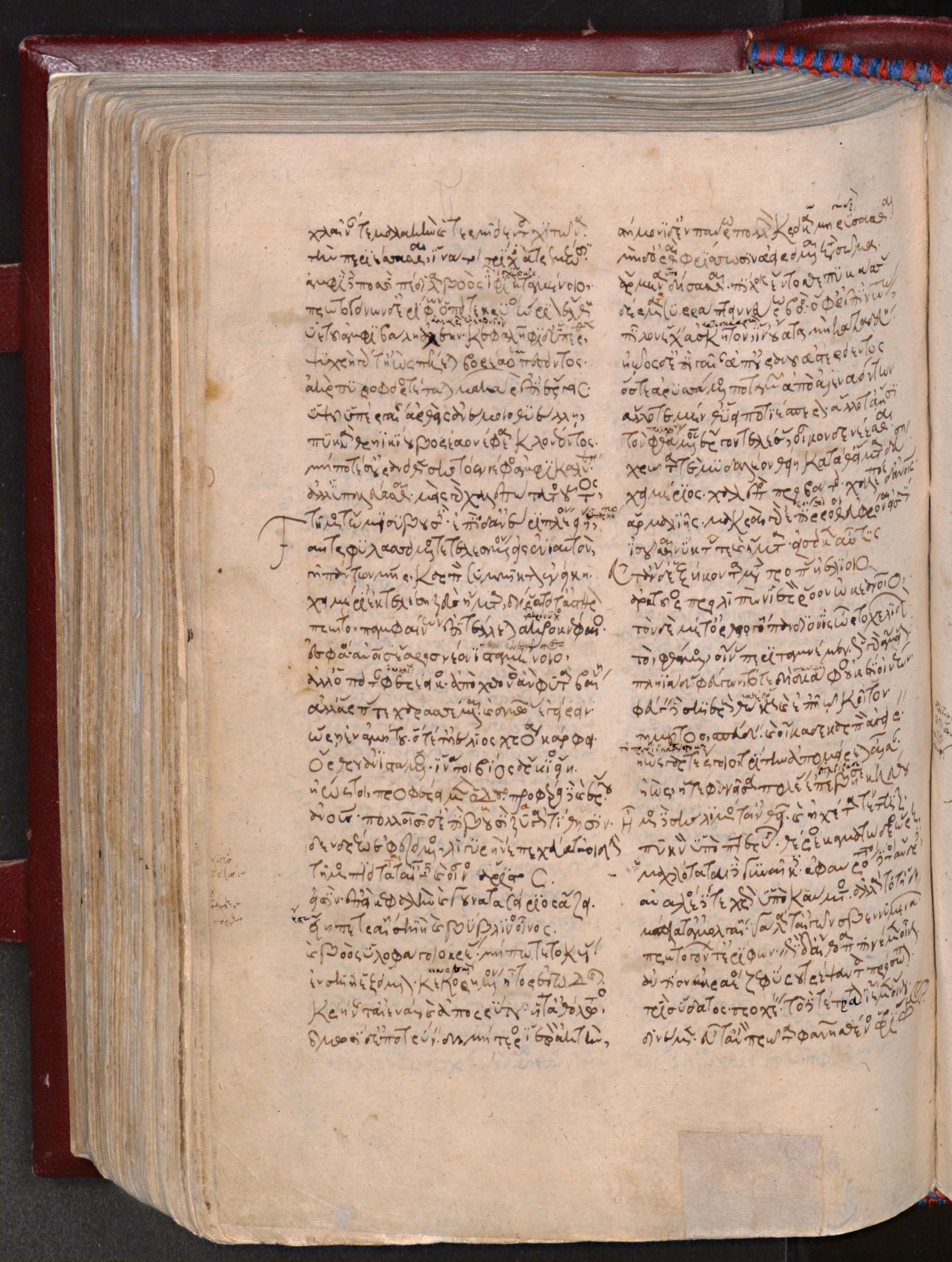
Laur. Plut. 32.16, fol. 237v: lines 537-598, begins ‹χλαῖνάν τε μαλακὴν καὶ›, ends ‹πρῶτα φανῇ σθένος Ὠαρίωνος,›. Checked on the image: first and last verse rows read and matched to the Greek (re-read on the image 2026-11-12: first row ‹537 | 538: χλαῖνάν τε μαλακὴν ... | στήμονι δ' ἐν παύρῳ ...›, last row ‹597 | 598: δμωσὶ δ' ἐποτρύνειν ... | ... σθένος ὠαρίωνος›); the page before ends at line 536 and the page after begins at line 599. English here: lines 536-599, cut at the end of Evelyn-White's sentences. His sentence ‹Then put on, as I bid you ...› begins in line 536, before the page break, and is given whole with this page. His sentence that runs across the break with the next page is given whole here, so the English ends with line 599 (‹... threshing-floor in an airy place.›).
537χλαῖνάν τε μαλακὴν καὶ τερμιόεντα χιτῶνα·
538στήμονι δʼ ἐν παύρῳ πολλὴν κρόκα μηρύσασθαι·
539τὴν περιέσσασθαι, ἵνα τοι τρίχες ἀτρεμέωσι,
540μηδʼ ὀρθαὶ φρίσσωσιν ἀειρόμεναι κατὰ σῶμα.
541ἀμφὶ δὲ ποσσὶ πέδιλα βοὸς ἶφι κταμένοιο
542ἄρμενα δήσασθαι, πίλοις ἔντοσθε πυκάσσας.
543πρωτογόνων δʼ ἐρίφων, ὁπότʼ ἂν κρύος ὥριον ἔλθῃ,
544δέρματα συρράπτειν νεύρῳ βοός, ὄφρʼ ἐπὶ νώτῳ
545ὑετοῦ ἀμφιβάλῃ ἀλέην· κεφαλῆφι δʼ ὕπερθεν
546πῖλον ἔχειν ἀσκητόν, ἵνʼ οὔατα μὴ καταδεύῃ·
547ψυχρὴ γάρ τʼ ἠὼς πέλεται Βορέαο πεσόντος
548ἠώιος δʼ ἐπὶ γαῖαν ἀπʼ οὐρανοῦ ἀστερόεντος
549ἀὴρ πυροφόρος τέταται μακάρων ἐπὶ ἔργοις·
550ὅστε ἀρυσάμενος ποταμῶν ἄπο αἰεναόντων,
551ὑψοῦ ὑπὲρ γαίης ἀρθεὶς ἀνέμοιο θυέλλῃ
552ἄλλοτε μέν θʼ ὕει ποτὶ ἕσπερον, ἄλλοτʼ ἄησι
553πυκνὰ Θρηικίου Βορέου νέφεα κλονέοντος.
554τὸν φθάμενος ἔργον τελέσας οἶκόνδε νέεσθαι,
555μή ποτέ σʼ οὐρανόθεν σκοτόεν νέφος ἀμφικαλύψῃ,
556χρῶτα δὲ μυδαλέον θήῃ κατά θʼ εἵματα δεύσῃ.
557ἀλλʼ ὑπαλεύασθαι· μεὶς γὰρ χαλεπώτατος οὗτος,
558χειμέριος, χαλεπὸς προβάτοις, χαλεπὸς δʼ ἀνθρώποις.
559τῆμος τὤμισυ βουσίν, ἐπʼ ἀνέρι δὲ πλέον εἴη
560ἁρμαλιῆς· μακραὶ γὰρ ἐπίρροθοι εὐφρόναι εἰσίν.
561ταῦτα φυλασσόμενος τετελεσμένον εἰς ἐνιαυτὸν
562ἰσοῦσθαι νύκτας τε καὶ ἤματα, εἰσόκεν αὖτις
563γῆ πάντων μήτηρ καρπὸν σύμμικτον ἐνείκῃ.
564εὖτʼ ἂν δʼ ἑξήκοντα μετὰ τροπὰς ἠελίοιο
565χειμέριʼ ἐκτελέσῃ Ζεὺς ἤματα, δή ῥα τότʼ ἀστὴρ
566Ἀρκτοῦρος προλιπὼν ἱερὸν ῥόον Ὠκεανοῖο
567πρῶτον παμφαίνων ἐπιτέλλεται ἀκροκνέφαιος.
568τὸν δὲ μέτʼ ὀρθογόη Πανδιονὶς ὦρτο χελιδὼν
569ἐς φάος ἀνθρώποις, ἔαρος νέον ἱσταμένοιο.
570τὴν φθάμενος οἴνας περιταμνέμεν· ὣς γὰρ ἄμεινον.
571ἀλλʼ ὁπότʼ ἂν φερέοικος ἀπὸ χθονὸς ἂμ φυτὰ βαίνῃ
572Πληιάδας φεύγων, τότε δὴ σκάφος οὐκέτι οἰνέων·
573ἀλλʼ ἅρπας τε χαρασσέμεναι καὶ δμῶας ἐγείρειν·
574φεύγειν δὲ σκιεροὺς θώκους καὶ ἐπʼ ἠόα κοῖτον
575ὥρῃ ἐν ἀμήτου, ὅτε τʼ ἠέλιος χρόα κάρφει.
576τημοῦτος σπεύδειν καὶ οἴκαδε καρπὸν ἀγινεῖν
577ὄρθρου ἀνιστάμενος, ἵνα τοι βίος ἄρκιος εἴη.
578ἠὼς γὰρ ἔργοιο τρίτην ἀπομείρεται αἶσαν,
579ἠώς τοι προφέρει μὲν ὁδοῦ, προφέρει δὲ καὶ ἔργου,
580ἠώς, ἥτε φανεῖσα πολέας ἐπέβησε κελεύθου
581ἀνθρώπους πολλοῖσί τʼ ἐπὶ ζυγὰ βουσὶ τίθησιν.
582ἦμος δὲ σκόλυμός τʼ ἀνθεῖ καὶ ἠχέτα τέττιξ
583δενδρέῳ ἐφεζόμενος λιγυρὴν καταχεύετʼ ἀοιδὴν
584πυκνὸν ὑπὸ πτερύγων, θέρεος καματώδεος ὥρῃ,
585τῆμος πιόταταί τʼ αἶγες καὶ οἶνος ἄριστος,
586μαχλόταται δὲ γυναῖκες, ἀφαυρότατοι δέ τοι ἄνδρες
587εἰσίν, ἐπεὶ κεφαλὴν καὶ γούνατα Σείριος ἄζει,
588αὐαλέος δέ τε χρὼς ὑπὸ καύματος· ἀλλὰ τότʼ ἤδη
589εἴη πετραίη τε σκιὴ καὶ βίβλινος οἶνος,
590μάζα τʼ ἀμολγαίη γάλα τʼ αἰγῶν σβεννυμενάων,
591καὶ βοὸς ὑλοφάγοιο κρέας μή πω τετοκυίης
592πρωτογόνων τʼ ἐρίφων· ἐπὶ δʼ αἴθοπα πινέμεν οἶνον,
593ἐν σκιῇ ἑζόμενον, κεκορημένον ἦτορ ἐδωδῆς,
594ἀντίον ἀκραέος Ζεφύρου τρέψαντα πρόσωπα,
595κρήνης τʼ αἰενάου καὶ ἀπορρύτου, ἥτʼ ἀθόλωτος,
596τρὶς ὕδατος προχέειν, τὸ δὲ τέτρατον ἱέμεν οἴνου.
597δμωσὶ δʼ ἐποτρύνειν Δημήτερος ἱερὸν ἀκτὴν
598δινέμεν, εὖτʼ ἂν πρῶτα φανῇ σθένος Ὠαρίωνος,
536Then put on, as I bid you, a soft coat and a tunic to the feet to shield your body,—and you should weave thick woof on thin warp. In this clothe yourself so that your hair may keep still 540and not bristle and stand upon end all over your body. Lace on your feet close-fitting boots of the hide of a slaughtered ox, thickly lined with felt inside. And when the season of frost comes on, stitch together skins of firstling kids with ox-sinew, to put over your back 545and to keep off the rain. On your head above wear a shaped cap of felt to keep your ears from getting wet, for the dawn is chill when Boreas has once made his onslaught, and at dawn a fruitful mist is spread over the earth from starry heaven upon the fields of blessed men: 550it is drawn from the ever-flowing rivers and is raised high above the earth by windstorm, and sometimes it turns to rain towards evening, and sometimes to wind when Thracian Boreas huddles the thick clouds. Finish your work and return home ahead of him, 555and do not let the dark cloud from heaven wrap round you and make your body clammy and soak your clothes. Avoid it; for this is the hardest month, wintry, hard for sheep and hard for men. In this season let your oxen have half their usual food, but let your man have more; 560for the helpful nights are long. Observe all this until the year is ended and you have nights and days of equal length, and Earth, the mother of all, bears again her various fruit. When Zeus has finished 565sixty wintry days after the solstice, then the star Arcturus leaves the holy stream of Ocean and first rises brilliant at dusk. After him the shrilly wailing daughter of Pandion, the swallow, appears to men when spring is just beginning. 570Before she comes, prune the vines, for it is best so. 571But when the House-carrier climbs up the plants from the earth to escape the Pleiades, then it is no longer the season for digging vineyards, but to whet your sickles and rouse up your slaves. Avoid shady seats and sleeping until dawn 575in the harvest season, when the sun scorches the body. Then be busy and bring home your fruits, getting up early to make your livelihood sure. For dawn takes away a third part of your work, dawn advances a man on his journey and advances him in his work,— 580dawn which appears and sets many men on their road, and puts yokes on many oxen. But when the artichoke flowers, and the chirping grass-hopper sits in a tree and pours down his shrill song continually from under his wings in the season of wearisome heat, 585then goats are plumpest and wine sweetest; women are most wanton, but men are feeblest, because Sirius parches head and knees and the skin is dry through heat. But at that time let me have a shady rock and wine of Biblis, 590a clot of curds and milk of drained goats with the flesh of a heifer fed in the woods, that has never calved, and of firstling kids; then also let me drink bright wine, sitting in the shade, when my heart is satisfied with food, and so, turning my head to face the fresh Zephyr, 595from the everflowing spring which pours down unfouled, thrice pour an offering of water, but make a fourth libation of wine. Set your slaves to winnow Demeter's holy grain, when strong Orion first appears, on a smooth threshing-floor in an airy place.
Where on the image
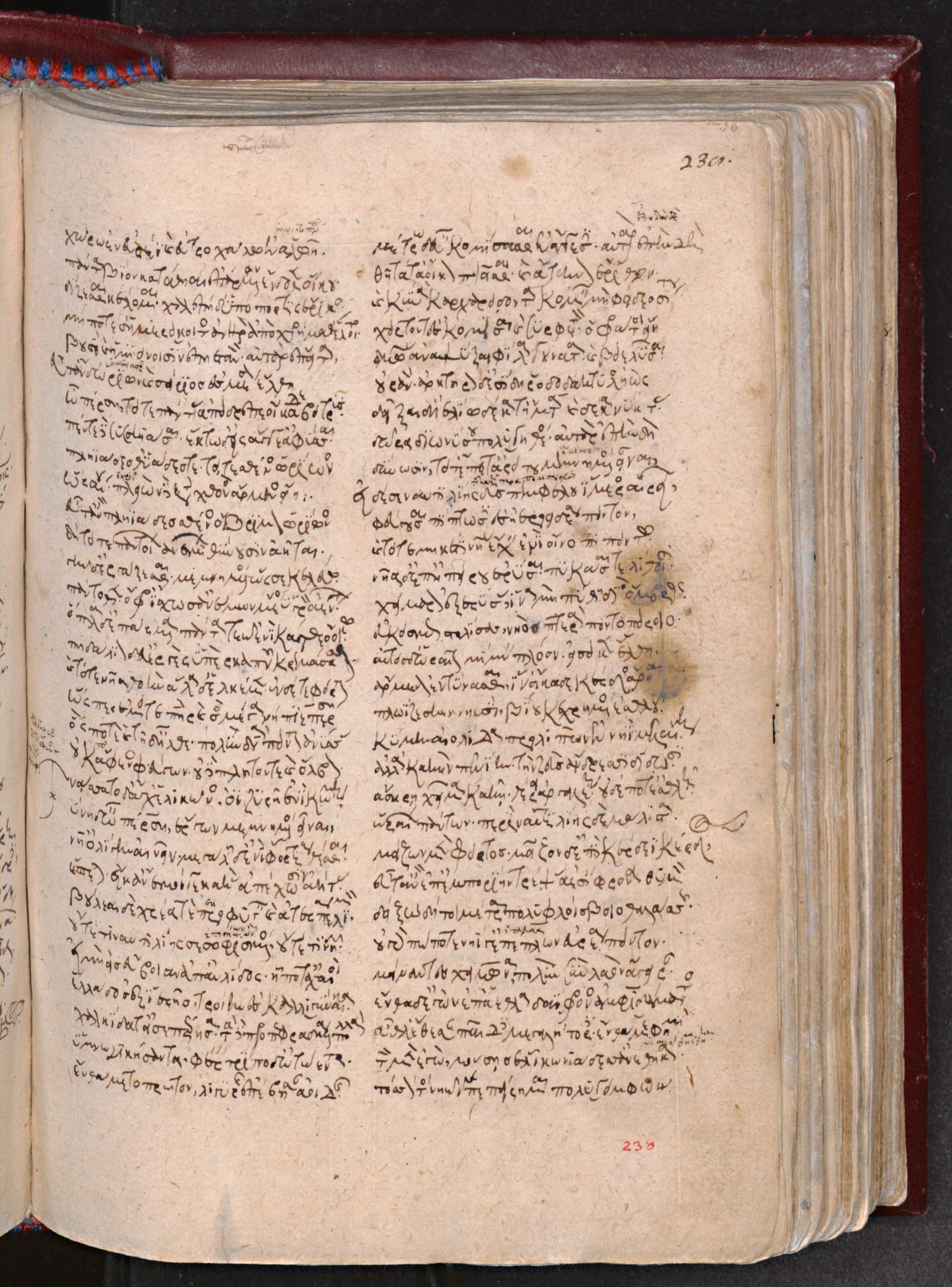
Laur. Plut. 32.16, fol. 238r: lines 599-660, begins ‹χώρῳ ἐν εὐαέι καὶ›, ends ‹νηῶν γε πεπείρημαι πολυγόμφων·›. Checked on the image: first and last verse rows read and matched to the Greek (re-read on the image 2026-11-12: first row ‹599 | 600: χώρῳ ἐν εὐαέι ... | μέτρῳ δ' εὖ κομίσασθαι ...›, last row ‹659 | 660: ἔνθα με τὸ πρῶτον ... | τόσσον τοι νηῶν ... πολυγόμφων›); the page before ends at line 598 and the page after begins at line 661. This section shows lines 599-608 of that page; the rest of the page belongs to the next part of the poem. English here: lines 600-608, cut at the end of Evelyn-White's sentences. The sentence that runs across the page break (to line 599) is given whole with the page before; the English here begins with ‹Then measure it and store it in jars ...› (line 600).
599χώρῳ ἐν εὐαέι καὶ ἐυτροχάλῳ ἐν ἀλωῇ.
600μέτρῳ δʼ εὖ κομίσασθαι ἐν ἄγγεσιν· αὐτὰρ ἐπὴν δὴ
601πάντα βίον κατάθηαι ἐπάρμενον ἔνδοθι οἴκου,
602θῆτά τʼ ἄοικον ποιεῖσθαι καὶ ἄτεκνον ἔριθον
603δίζησθαι κέλομαι· χαλεπὴ δʼ ὑπόπορτις ἔριθος·
604καὶ κύνα καρχαρόδοντα κομεῖν, μὴ φείδεο σίτου,
605μή ποτέ σʼ ἡμερόκοιτος ἀνὴρ ἀπὸ χρήμαθʼ ἕληται.
606χόρτον δʼ ἐσκομίσαι καὶ συρφετόν, ὄφρα τοι εἴη
607βουσὶ καὶ ἡμιόνοισιν ἐπηετανόν. αὐτὰρ ἔπειτα
608δμῶας ἀναψῦξαι φίλα γούνατα καὶ βόε λῦσαι.
600Then measure it and store it in jars. And so soon as you have safely stored all your stuff indoors, I bid you put your bondman out of doors and seek out a servant-girl with no children;—for a servant with a child to nurse is troublesome. And look after the dog with jagged teeth; do not grudge him his food, 605or some time the Day-sleeper may take your stuff. Bring in fodder and litter so as to have enough for your oxen and mules. After that, let your men rest their poor knees and unyoke your pair of oxen.
Notes
- Greek: H. G. Evelyn-White, Hesiod, the Homeric Hymns and Homerica (Loeb Classical Library, 1914), via Perseus. Square brackets mark verses the editor regards as interpolated.
- English: H. G. Evelyn-White's translation in the same volume; his footnotes are omitted.
- Lines 169a-169d of the Loeb text (fragments from a papyrus on Cronos and the fifth race) are not in the medieval manuscripts and are not included.
Cite
Sources
- Source: Laur. Plut. 32.16 (BML Teca Digitale IIIF) + Evelyn-White Greek (Loeb 1914, Perseus) + Evelyn-White English (1914, Perseus) (holding institution)
- Critical edition: Evelyn-White, Loeb 1914, via Perseus
← previous · → next · v cycle view · l back to library