Homeric Hymn 3, To Apollo
Introduction
The Homeric Hymns are 33 hexameter poems to the Greek gods, composed by anonymous poets between about the 7th and the 5th century BCE and handed down under Homer's name. This entry: Homeric Hymn 3, To Apollo. The birth of Apollo on Delos and the founding of his oracle at Delphi, with the slaying of the serpent and the Cretan sailors who become his priests.
This collection has Hymns 1-18 only. The manuscript shown, M, breaks off at Hymn 18, line 4 (fol. 50r; fol. 50v is blank), so the rest of Hymn 18 (lines 5-12) and Hymns 19-33 (to Pan, Hephaestus, Apollo, Poseidon, Zeus, Hestia, the Muses and Apollo, Dionysus, Artemis, Athena, Hestia, Earth, Helios, Selene and the Dioscuri) are not in it and are not given here.
The page photographs are from Leiden, Universiteitsbibliotheek, BPG 33 H (the 'Moscow' manuscript, M; paper, Greece?, first half of the 15th century; found in Moscow in 1777 by C. F. Matthaei), Homeric Hymns on fols. 31r-50r. M is the only manuscript of the Hymn to Demeter. Each section below is one column of a page (a = left, b = right); its note gives the first and last verse as read on the photograph. This entry is on fol. 36r, 36v, 37r, 37v, 38r, 38v, 39r, 39v, 40r, 40v.
Verses of the Loeb text that are not in this manuscript, and so are not shown: Hymn 3: 23-73, 136-138.
The Greek is Evelyn-White's Loeb text (1914) via Perseus, not a transcription of the manuscript; where M is damaged the edition's restorations are shown in square brackets. The English is Evelyn-White's prose translation (1914), in blocks of about five lines, so a block can begin a line or two before or after a column break.
How was this verified? (Provenance)
Where on the image
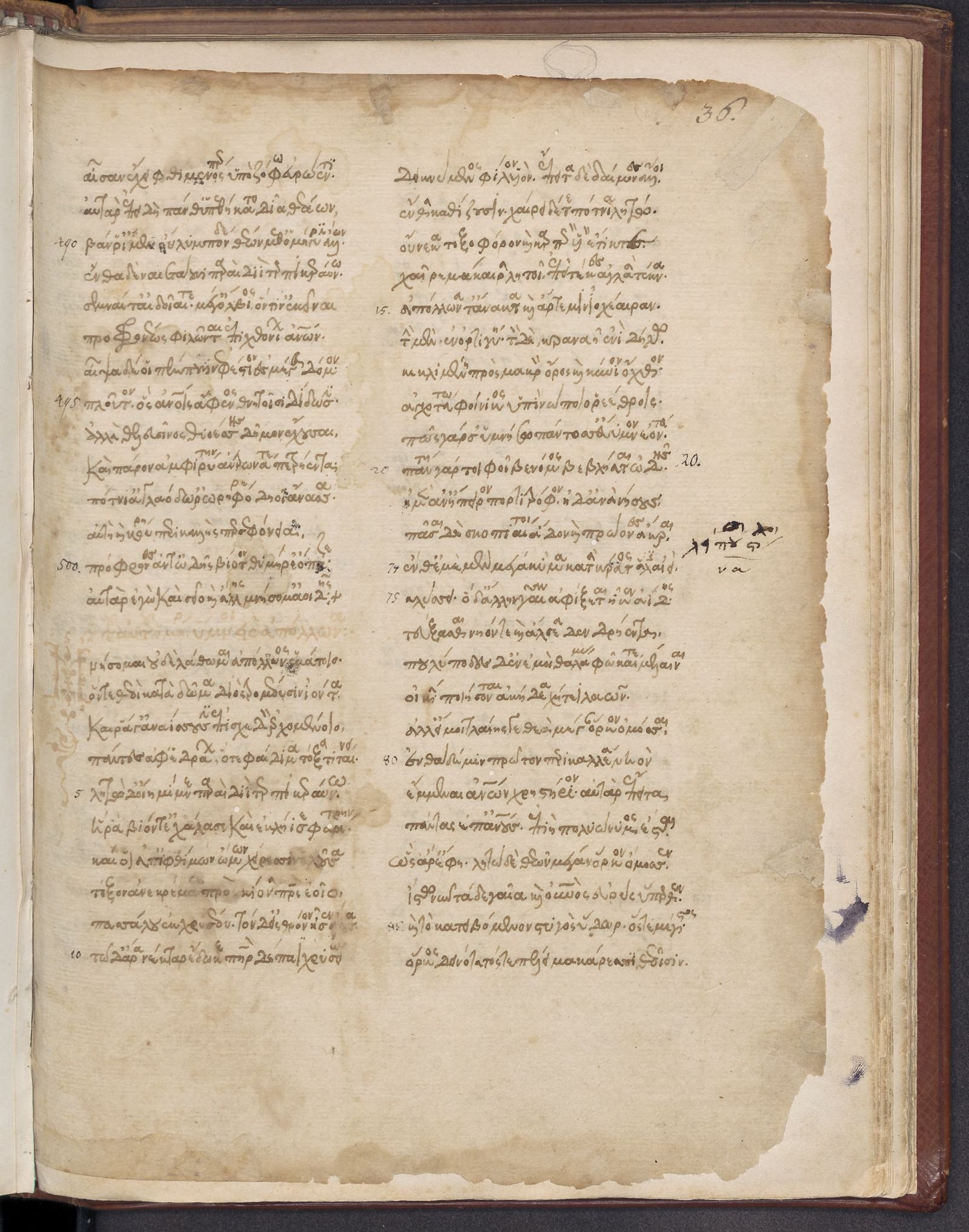
Leiden BPG 33 H, fol. 36r, column a (left): Hymn 2 482-495; Hymn 3 1-10; begins ‹αἶσαν ἔχει φθίμενός περ›, ends ‹ἔδωκε πατὴρ δέπαϊ χρυσείῳ›. Checked on the image: the first and last verses of the column were read and matched to the Greek. The column before ends with Hymn 2 481. The next column begins with Hymn 3 11. The Hymn to Demeter ends with verse 495; a red title (faded) introduces the Hymn to Apollo. English blocks here: 1-4, 5-9.
1μνήσομαι οὐδὲ λάθωμαι Ἀπόλλωνος ἑκάτοιο,
2ὅντε θεοὶ κατὰ δῶμα Διὸς τρομέουσιν ἰόντα·
3καί ῥά τʼ ἀναΐσσουσιν ἐπὶ σχεδὸν ἐρχομένοιο
4πάντες ἀφʼ ἑδράων, ὅτε φαίδιμα τόξα τιταίνει.
5Λητὼ δʼ οἴη μίμνε παραὶ Διὶ τερπικεραύνῳ,
6ἥ ῥα βιόν τʼ ἐχάλασσε καὶ ἐκλήισσε φαρέτρην,
7καί οἱ ἀπʼ ἰφθίμων ὤμων χείρεσσιν ἑλοῦσα
8τόξα κατεκρέμασε πρὸς κίονα πατρὸς ἑοῖο
9πασσάλου ἐκ χρυσέου· τὸν δʼ ἐς θρόνον εἷσεν ἄγουσα.
10τῷ δʼ ἄρα νέκταρ ἔδωκε πατὴρ δέπαϊ χρυσείῳ
1I will remember and not be unmindful of Apollo who shoots afar. As he goes through the house of Zeus, the gods tremble before him and all spring up from their seats when he draws near, as he bends his bright bow. 5But Leto alone stays by the side of Zeus who delights in thunder; and then she unstrings his bow, and closes his quiver, and takes his archery from his strong shoulders in her hands and hangs them on a golden peg against a pillar of his father's house. Then she leads him to a seat and makes him sit:
Where on the image
Leiden BPG 33 H, fol. 36r, column b (right): Hymn 3 11-22; Hymn 3 74-86; begins ‹δεικνύμενος φίλον υἱόν· ἔπειτα›, ends ‹τε πέλει μακάρεσσι θεοῖσιν·›. Checked on the image: the first and last verses of the column were read and matched to the Greek. The column before ends with Hymn 3 10. The next column begins with Hymn 3 87. The manuscript passes from Apollo 22 straight to 74: verses 23-73 are not in M (a note in the right margin marks the place). English blocks here: 10-14, 15-19, 20-24, 70-74, 75-79, 80-84, 85-88. The English block(s) 20-24, 70-74 also cover verses that are not in the manuscript.
11δεικνύμενος φίλον υἱόν· ἔπειτα δὲ δαίμονες ἄλλοι
12ἔνθα καθίζουσιν· χαίρει δέ τε πότνια Λητώ,
13οὕνεκα τοξοφόρον καὶ καρτερὸν υἱὸν ἔτικτε.
14χαῖρε, μάκαιρʼ ὦ Λητοῖ, ἐπεὶ τέκες ἀγλαὰ τέκνα,
15Ἀπόλλωνά τʼ ἄνακτα καὶ Ἄρτεμιν ἰοχέαιραν,
16τὴν μὲν ἐν Ὀρτυγίῃ, τὸν δὲ κραναῇ ἐνὶ Δήλῳ,
17κεκλιμένη πρὸς μακρὸν ὄρος καὶ Κύνθιον ὄχθον,
18ἀγχοτάτω φοίνικος, ἐπʼ Ἰνωποῖο ῥεέθροις.
19πῶς τʼ ἄρ σʼ ὑμνήσω πάντως εὔυμνον ἐόντα;
20πάντη γάρ τοι, Φοῖβε, νόμοι βεβλήατʼ ἀοιδοῖς,
21ἠμὲν ἀνʼ ἤπειρον πορτιτρόφον ἠδʼ ἀνὰ νήσους·
22πᾶσαι δὲ σκοπιαί τοι ἅδον καὶ πρώονες ἄκροι
74ἔνθʼ ἐμὲ μὲν μέγα κῦμα κατὰ κρατὸς ἅλις αἰεὶ
75κλύσσει· ὃ δʼ ἄλλην γαῖαν ἀφίξεται, ἥ κεν ἅδῃ οἱ,
76τεύξασθαι νηόν τε καὶ ἄλσεα δενδρήεντα·
77πουλύποδες δʼ ἐν ἐμοὶ θαλάμας φῶκαί τε μέλαιναι
78οἰκία ποιήσονται ἀκηδέα, χήτεϊ λαῶν.
79ἀλλʼ εἴ μοι τλαίης γε, θεά, μέγαν ὅρκον ὀμόσσαι,
80ἐνθάδε μιν πρῶτον τεύξειν περικαλλέα νηὸν
81ἔμμεναι ἀνθρώπων χρηστήριον, αὐτὰρ ἔπειτα
82πάντας ἐπʼ ἀνθρώπους, ἐπεὶ ἦ πολυώνυμος ἔσται.
83ὣς ἄρ ἔφη· Λητὼ δὲ θεῶν μέγαν ὅρκον ὄμοσσε·
84ἴστω νῦν τάδε Γαῖα καὶ Οὐρανὸς εὐρὺς ὕπερθεν
85καὶ τὸ κατειβόμενον Στυγὸς ὕδωρ, ὅστε μέγιστος
86ὅρκος δεινότατός τε πέλει μακάρεσσι θεοῖσιν·
10and the Father gives him nectar in a golden cup welcoming his dear son, while the other gods make him sit down there, and queenly Leto rejoices because she bare a mighty son and an archer. Rejoice, blessed Leto, for you bare glorious children, 15the lord Apollo and Artemis who delights in arrows; her in Ortygia, and him in rocky Delos, as you rested against the great mass of the Cynthian hill hard by a palm-tree by the streams of Inopus. How, then, shall I sing of you who in all ways are a worthy theme of song? 20For everywhere, O Phoebus, the whole range of song is fallen to you, both over the mainland that rears heifers and over the isles. All mountain-peaks and high headlands of lofty hills and rivers flowing out to the deep and beaches sloping seawards and havens of the sea are your delight. 70Therefore, I greatly fear in heart and spirit that as soon as he sees the light of the sun, he will scorn this island —for truly I have but a hard, rocky soil —and overturn me and thrust me down with his feet in the depths of the sea; then will the great ocean wash deep above my head for ever, 75and he will go to another land such as will please him, there to make his temple and wooded groves. So many-footed creatures of the sea will make their lairs in me and black seals their dwellings undisturbed, because I lack people. Yet if you will but dare to swear a great oath, goddess, 80that here first he will build a glorious temple to be an oracle for men, then let him afterwards 85and dropping water of Styx (this is the strongest and most awful oath for the blessed gods), surely Phoebus shall have here his fragrant altar and precinct, and you he shall honor above all.”
Where on the image
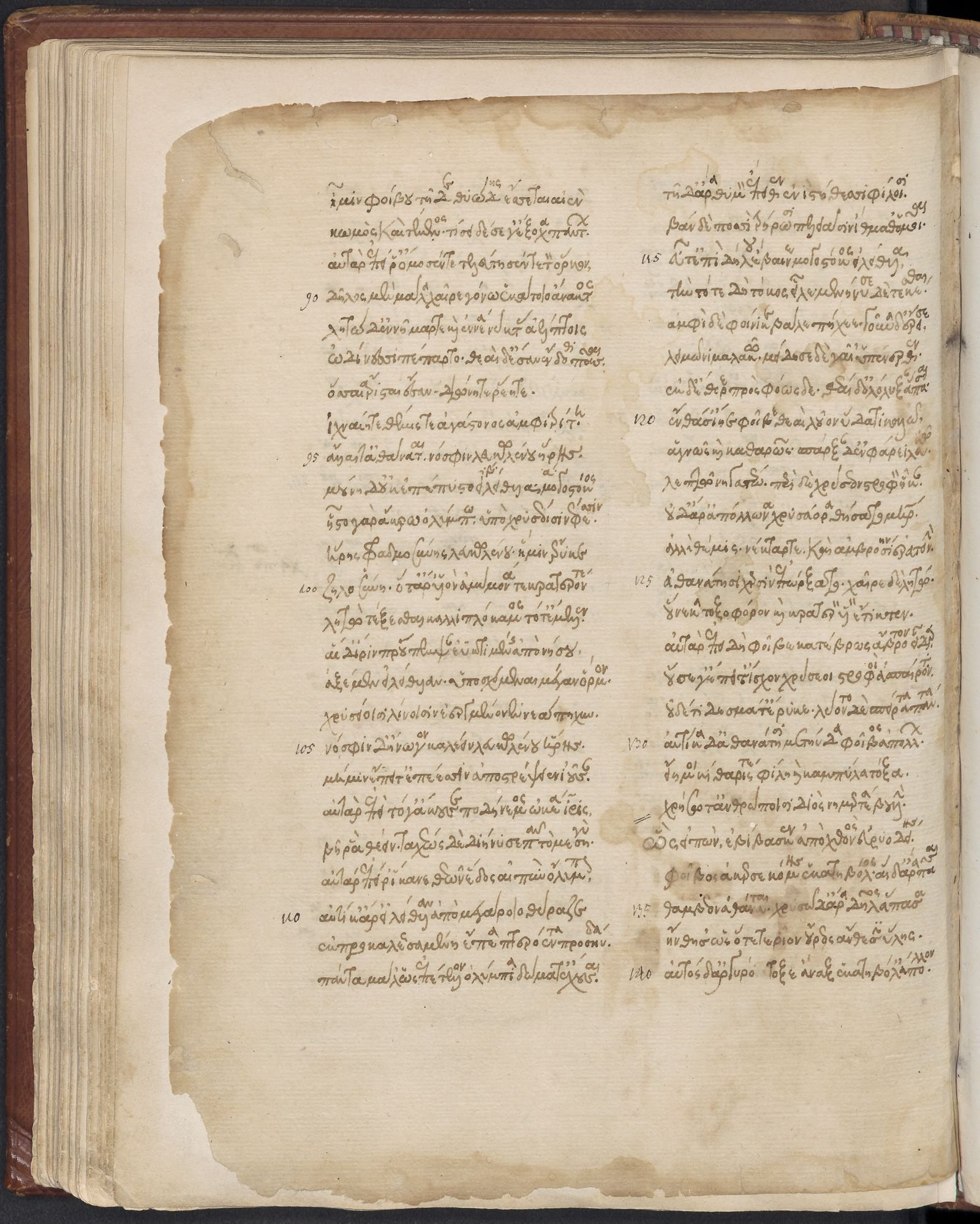
Leiden BPG 33 H, fol. 36v, column a (left): Hymn 3 87-112; begins ‹ἦ μὴν Φοίβου τῇδε›, ends ‹ἐπέτελλον Ὀλύμπια δώματʼ ἔχουσαι.›. Checked on the image: the first and last verses of the column were read and matched to the Greek. The column before ends with Hymn 3 86. The next column begins with Hymn 3 113. English blocks here: 89-89, 90-94, 95-99, 100-104, 105-109, 110-114.
87ἦ μὴν Φοίβου τῇδε θυώδης ἔσσεται αἰεὶ
88βωμὸς καὶ τέμενος, τίσει δέ σέ γʼ ἔξοχα πάντων.
89αὐτὰρ ἐπεί ῥʼ ὄμοσέν τε τελεύτησέν τε τὸν ὅρκον,
90Δῆλος μὲν μάλα χαῖρε γονῇ ἑκάτοιο ἄνακτος·
91Λητὼ δʼ ἐννῆμάρ τε καὶ ἐννέα νύκτας ἀέλπτοις
92ὠδίνεσσι πέπαρτο. θεαὶ δʼ ἔσαν ἔνδοθι πᾶσαι,
93ὅσσαι ἄρισται ἔασι, Διώνη τε Ῥείη τε
94Ἰχναίη τε Θέμις καὶ ἀγάστονος Ἀμφιτρίτη
95ἄλλαι τʼ ἀθάναται νόσφιν λευκωλένου Ἥρης·
96ἧστο γὰρ ἐν μεγάροισι Διὸς νεφεληγερέταο·
97μούνη δʼ οὐκ ἐπέπυστο μογοστόκος Εἰλείθυια·
98ἧστο γὰρ ἄκρῳ Ὀλύμπῳ ὑπὸ χρυσέοισι νέφεσσιν,
99Ἥρης φραδμοσύνης λευκωλένου, ἥ μιν ἔρυκε
100ζηλοσύνῃ, ὅτʼ ἄρʼ υἱὸν ἀμύμονά τε κρατερόν τε
101Λητὼ τέξεσθαι καλλιπλόκαμος τότʼ ἔμελλεν.
102αἳ δʼ Ἶριν προὔπεμψαν ἐυκτιμένης ἀπὸ νήσου,
103ἀξέμεν Εἰλείθυιαν, ὑποσχόμεναι μέγαν ὅρμον,
104χρυσείοισι λίνοισιν ἐερμένον, ἐννεάπηχυν·
105νόσφιν δʼ ἤνωγον καλέειν λευκωλένου Ἥρης,
106μή μιν ἔπειτʼ ἐπέεσσιν ἀποστρέψειεν ἰοῦσαν.
107αὐτὰρ ἐπεὶ τό γʼ ἄκουσε ποδήνεμος ὠκέα Ἶρις,
108βῆ ῥα θέειν, ταχέως δὲ διήνυσε πᾶν τὸ μεσηγύ.
109αὐτὰρ ἐπεί ῥʼ ἵκανε θεῶν ἕδος, αἰπὺν Ὄλυμπον,
110αὐτίκʼ ἄρʼ Εἰλείθυιαν ἀπὲκ μεγάροιο θύραζε
111ἐκπροκαλεσσαμένη ἔπεα πτερόεντα προσηύδα,
112πάντα μάλʼ, ὡς ἐπέτελλον Ὀλύμπια δώματʼ ἔχουσαι.
89Now when Leto had sworn and ended her oath, 90Delos was very glad at the birth of the far-shooting lord. But Leto was racked nine days and nine nights with pangs beyond wont. 95And there were with her all the chiefest of the goddesses, Dione and Rhea and Ichnaea and Themis and loud-moaning Amphitrite and the other deathless goddesses save white-armed Hera, who sat in the halls of cloud-gathering Zeus. Only Eilithyia, goddess of sore travail, had not heard of Leto's trouble, for she sat on the top of Olympus beneath golden clouds by white-armed Hera's 100contriving, who kept her close through envy, because Leto with the lovely tresses was soon to bear a son faultless and strong. But the goddesses sent out Iris from the well-set isle to bring Eilithyia, promising her a great necklace strung with golden threads, nine cubits long. 105And they bade Iris call her aside from white-armed Hera, lest she might afterwards turn her from coming with her words. When swift Iris, fleet of foot as the wind, had heard all this, she set to run; and quickly finishing all the distance she came to the home of the gods, sheer Olympus, 110and forthwith called Eilithyia out from the hall to the door and spoke winged words to her, telling her all as the goddesses who dwell on Olympus had bidden her. So she moved the heart of Eilithyia in her dear breast; and they went their way, like shy wild-doves in their going.
Where on the image
Leiden BPG 33 H, fol. 36v, column b (right): Hymn 3 113-140; begins ‹τῇ δʼ ἄρα θυμὸν›, ends ‹ἀργυρότοξε, ἄναξ ἑκατηβόλʼ Ἄπολλον,›. Checked on the image: the first and last verses of the column were read and matched to the Greek. The column before ends with Hymn 3 112. The next column begins with Hymn 3 141. Verses 136-138, bracketed by the editor as an alternative version of 139, are not in this manuscript; the column runs from 135 to 139. English blocks here: 115-119, 120-124, 125-129, 130-130, 131-134, 135-139. The English block(s) 135-139 also cover verses that are not in the manuscript.
113τῇ δʼ ἄρα θυμὸν ἔπειθεν ἐνὶ στήθεσσι φίλοισι·
114βὰν δὲ ποσὶ τρήρωσι πελειάσιν ἴθμαθʼ ὁμοῖαι.
115εὖτʼ ἐπὶ Δήλου ἔβαινε μογοστόκος Εἰλείθυια,
116δὴ τότε τὴν τόκος εἷλε, μενοίνησεν δὲ τεκέσθαι.
117ἀμφὶ δὲ φοίνικι βάλε πήχεε, γοῦνα δʼ ἔρεισε
118λειμῶνι μαλακῷ· μείδησε δὲ γαῖʼ ὑπένερθεν·
119ἐκ δʼ ἔθορε πρὸ φόωσδε· θεαὶ δʼ ὀλόλυξαν ἅπασαι.
120ἔνθα σέ, ἤιε Φοῖβε, θεαὶ λόον ὕδατι καλῷ
121ἁγνῶς καὶ καθαρῶς, σπάρξαν δʼ ἐν φάρεϊ λευκῷ,
122λεπτῷ, νηγατέῳ· περὶ δὲ χρύσεον στρόφον ἧκαν.
123οὐδʼ ἄρʼ Ἀπόλλωνα χρυσάορα θήσατο μήτηρ,
124ἀλλὰ Θέμις νέκταρ τε καὶ ἀμβροσίην ἐρατεινὴν
125ἀθανάτῃσιν χερσὶν ἐπήρξατο· χαῖρε δὲ Λητώ,
126οὕνεκα τοξοφόρον καὶ καρτερὸν υἱὸν ἔτικτεν.
127αὐτὰρ ἐπεὶ δή, Φοῖβε, κατέβρως ἄμβροτον εἶδαρ,
128οὔ σέ γʼ ἔπειτʼ ἴσχον χρύσεοι στρόφοι ἀσπαίροντα,
129οὐδʼ ἔτι δέσματʼ ἔρυκε, λύοντο δὲ πείρατα πάντα.
130αὐτίκα δʼ ἀθανάτῃσι μετηύδα Φοῖβος Ἀπόλλων·
131εἴη μοι κίθαρίς τε φίλη καὶ καμπύλα τόξα,
132χρήσω δʼ ἀνθρώποισι Διὸς νημερτέα βουλήν.
133ὣς εἰπὼν ἐβίβασκεν ἐπὶ χθονὸς εὐρυοδείης
134Φοῖβος ἀκερσεκόμης, ἑκατηβόλος· αἳ δʼ ἄρα πᾶσαι
135θάμβεον ἀθάναται· χρυσῷ δʼ ἄρα Δῆλος ἅπασα
139ἤνθησʼ, ὡς ὅτε τε ῥίον οὔρεος ἄνθεσιν ὕλης.
140αὐτὸς δʼ, ἀργυρότοξε, ἄναξ ἑκατηβόλʼ Ἄπολλον,
115And as soon as Eilithyia the goddess of sore travail set foot on Delos, the pains of birth seized Leto, and she longed to bring forth; so she cast her arms about a palm tree and kneeled on the soft meadow while the earth laughed for joy beneath. Then the child leaped forth to the light, and all the goddesses raised a cry. 120Straightway, great Phoebus, the goddesses washed you purely and cleanly with sweet water, and swathed you in a white garment of fine texture, new-woven, and fastened a golden band about you. Now Leto did not give Apollo, bearer of the golden blade, her breast; but Themis duly poured nectar and ambrosia 125with her divine hands: and Leto was glad because she had borne a strong son and an archer. But as soon as you had tasted that divine heavenly food, O Phoebus, you could no longer then be held by golden cords nor confined with bands, but all their ends were undone. 130Forth-with Phoebus Apollo spoke out among the deathless goddesses: 131“The lyre and the curved bow shall ever be dear to me, and I will declare to men the unfailing will of Zeus.” So said Phoebus, the long-haired god who shoots afar and began to walk upon the wide-pathed earth; 135and all the goddesses were amazed at him. Then with gold all Delos [was laden, beholding the child of Zeus and Leto, for joy because the god chose her above the islands and shore to make his dwelling in her: and she loved him yet more in her heart.] blossomed as does a mountain-top with woodland flowers.
Where on the image
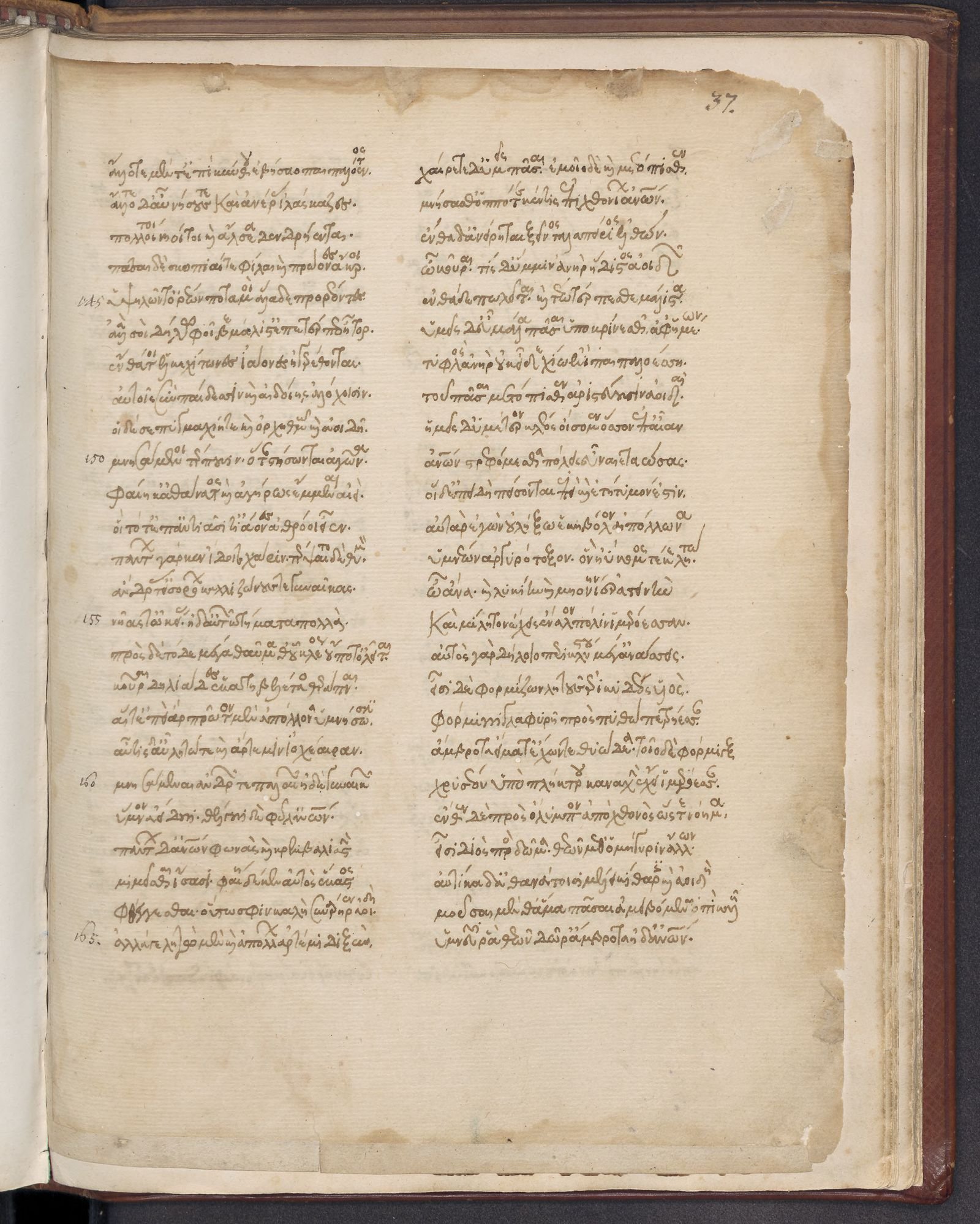
Leiden BPG 33 H, fol. 37r, column a (left): Hymn 3 141-165; begins ‹ἄλλοτε μέν τʼ ἐπὶ›, ends ‹μὲν Ἀπόλλων Ἀρτέμιδι ξύν,›. Checked on the image: the first and last verses of the column were read and matched to the Greek. The column before ends with Hymn 3 140. The next column begins with Hymn 3 166. English blocks here: 140-144, 145-149, 150-154, 155-159, 160-164.
141ἄλλοτε μέν τʼ ἐπὶ Κύνθου ἐβήσαο παιπαλόεντος,
142ἄλλοτε δʼ ἂν νήσους τε καὶ ἀνέρας ἠλάσκαζες.
143πολλοί τοι νηοί τε καὶ ἄλσεα δενδρήεντα·
144πᾶσαι δὲ σκοπιαί τε φίλαι καὶ πρώονες ἄκροι
145ὑψηλῶν ὀρέων ποταμοί θʼ ἅλαδε προρέοντες·
146ἀλλὰ σὺ Δήλῳ, Φοῖβε, μάλιστʼ ἐπιτέρπεαι ἦτορ,
147ἔνθα τοι ἑλκεχίτωνες Ἰάονες ἠγερέθονται
148αὐτοῖς σὺν παίδεσσι καὶ αἰδοίῃς ἀλόχοισιν.
149οἱ δέ σε πυγμαχίῃ τε καὶ ὀρχηθμῷ καὶ ἀοιδῇ
150μνησάμενοι τέρπουσιν, ὅτʼ ἂν στήσωνται ἀγῶνα.
151φαίη κʼ ἀθανάτους καὶ ἀγήρως ἔμμεναι αἰεί,
152ὃς τόθʼ ὑπαντιάσειʼ, ὅτʼ Ἰάονες ἀθρόοι εἶεν·
153πάντων γάρ κεν ἴδοιτο χάριν, τέρψαιτο δὲ θυμὸν
154ἄνδρας τʼ εἰσορόων καλλιζώνους τε γυναῖκας
155νῆάς τʼ ὠκείας ἠδʼ αὐτῶν κτήματα πολλά.
156πρὸς δὲ τόδε μέγα θαῦμα, ὅου κλέος οὔποτʼ ὀλεῖται,
157κοῦραι Δηλιάδες, ἑκατηβελέταο θεράπναι·
158αἵ τʼ ἐπεὶ ἂρ πρῶτον μὲν Ἀπόλλωνʼ ὑμνήσωσιν,
159αὖτις δʼ αὖ Λητώ τε καὶ Ἄρτεμιν ἰοχέαιραν,
160μνησάμεναι ἀνδρῶν τε παλαιῶν ἠδὲ γυναικῶν
161ὕμνον ἀείδουσιν, θέλγουσι δὲ φῦλʼ ἀνθρώπων.
162πάντων δʼ ἀνθρώπων φωνὰς καὶ βαμβαλιαστὺν
163μιμεῖσθʼ ἴσασιν· φαίη δέ κεν αὐτὸς ἕκαστος
164φθέγγεσθʼ· οὕτω σφιν καλὴ συνάρηρεν ἀοιδή.
165ἀλλʼ ἄγεθʼ ἱλήκοι μὲν Ἀπόλλων Ἀρτέμιδι ξύν,
140And you, O lord Apollo, god of the silver bow, shooting afar, now walked on craggy Cynthus, and now kept wandering about the islands and the people in them. Many are your temples and wooded groves, and all peaks and towering bluffs 145of lofty mountains and rivers flowing to the sea are dear to you, Phoebus, yet in Delos do you most delight your heart; for there the long robed Ionians gather in your honor with their children and shy wives: with boxing and dancing and song, 150mindful, they delight you so often as they hold their gathering. A man would say that they were deathless and unageing if he should then come upon the Ionians so met together. For he would see the graces of them all, and would be pleased in heart gazing at the men and well-girded women 155with their swift ships and great wealth. And there is this great wonder besides —and its renown shall never perish —, the girls of Delos, hand-maidens of the Far-shooter; for when they have praised Apollo first, and also Leto and Artemis who delights in arrows, 160they sing a strain telling of men and women of past days, and charm the tribes of men. Also they can imitate the tongues of all men and their clattering speech: each would say that he himself were singing, so close to truth is their sweet song.
Where on the image
Leiden BPG 33 H, fol. 37r, column b (right): Hymn 3 166-190; begins ‹χαίρετε δʼ ὑμεῖς πᾶσαι·›, ends ‹δῶρʼ ἄμβροτα ἠδʼ ἀνθρώπων›. Checked on the image: the first and last verses of the column were read and matched to the Greek. The column before ends with Hymn 3 165. The next column begins with Hymn 3 191. English blocks here: 165-169, 170-174, 175-178, 179-179, 180-184, 185-189.
166χαίρετε δʼ ὑμεῖς πᾶσαι· ἐμεῖο δὲ καὶ μετόπισθεν
167μνήσασθʼ, ὁππότε κέν τις ἐπιχθονίων ἀνθρώπων
168ἐνθάδ’ ἀνείρηται ξεῖνος ταλαπείριος ἐλθών·
169ὦ κοῦραι, τίς δʼ ὔμμιν ἀνὴρ ἥδιστος ἀοιδῶν
170ἐνθάδε πωλεῖται, καὶ τέῳ τέρπεσθε μάλιστα;
171ὑμεῖς δʼ εὖ μάλα πᾶσαι ὑποκρίνασθαι ἀφήμως·
172τυφλὸς ἀνήρ, οἰκεῖ δὲ Χίῳ ἔνι παιπαλοέσσῃ
173τοῦ πᾶσαι μετόπισθεν ἀριστεύσουσιν ἀοιδαί.
174ἡμεῖς δʼ ὑμέτερον κλέος οἴσομεν, ὅσσον ἐπʼ αἶαν
175ἀνθρώπων στρεφόμεσθα πόλεις εὖ ναιεταώσας·
176οἳ δʼ ἐπὶ δὴ πείσονται, ἐπεὶ καὶ ἐτήτυμόν ἐστιν.
177αὐτὰρ ἐγὼν οὐ λήξω ἑκηβόλον Ἀπόλλωνα
178ὑμνέων ἀργυρότοξον, ὃν ἠύκομος τέκε Λητώ.
179ὦ ἄνα, καὶ Λυκίην καὶ Μῃονίην ἐρατεινὴν
180καὶ Μίλητον ἔχεις, ἔναλον πόλιν ἱμερόεσσαν,
181αὐτὸς δʼ αὖ Δήλοιο περικλύστοιο μέγʼ ἀνάσσεις.
182εἶσι δὲ φορμίζων Λητοῦς ἐρικυδέος υἱὸς
183φόρμιγγι γλαφυρῇ πρὸς Πυθὼ πετρήεσσαν,
184ἄμβροτα εἵματʼ ἔχων τεθυωμένα· τοῖο δὲ φόρμιγξ
185χρυσέου ὑπὸ πλήκτρου καναχὴν ἔχει ἱμερόεσσαν.
186ἔνθεν δὲ πρὸς Ὄλυμπον ἀπὸ χθονός, ὥστε νόημα,
187εἶσι Διὸς πρὸς δῶμα θεῶν μεθʼ ὁμήγυριν ἄλλων.
188αὐτίκα δʼ ἀθανάτοισι μέλει κίθαρις καὶ ἀοιδή·
189Μοῦσαι μέν θʼ ἅμα πᾶσαι ἀμειβόμεναι ὀπὶ καλῇ
190ὑμνεῦσίν ῥα θεῶν δῶρʼ ἄμβροτα ἠδʼ ἀνθρώπων
165And now may Apollo be favorable and Artemis; and farewell all you maidens. Remember me in after time whenever any one of men on earth, a stranger who has seen and suffered much, comes here and asks of you: “Whom think ye, girls, is the sweetest singer that comes here, and in whom do you most delight?” 170Then answer, each and all, with one voice: “He is a blind man, and dwells in rocky Chios: his lays are evermore supreme.” As for me, I will carry your renown as far as I roam over the earth 175to the well-placed cities of man, and they will believe also; for indeed this thing is true. And I will never cease to praise far-shooting Apollo, god of the silver bow, whom rich-haired Leto bare. 179O Lord, Lycia is yours and lovely Maeonia 180and Miletus, charming city by the sea, but over wave-girt Delos you greatly reign your own self. Leto's all-glorious son goes to rocky Pytho, playing upon his hollow lyre, clad in divine, perfumed garments; and his lyre, 185at the touch of the golden key, sings sweet. Thence, swift as thought, he speeds from earth to Olympus, to the house of Zeus, to join the gathering of the other gods: then straightway the undying gods think only of the lyre and song, and all the Muses together, voice sweetly answering voice,
Where on the image
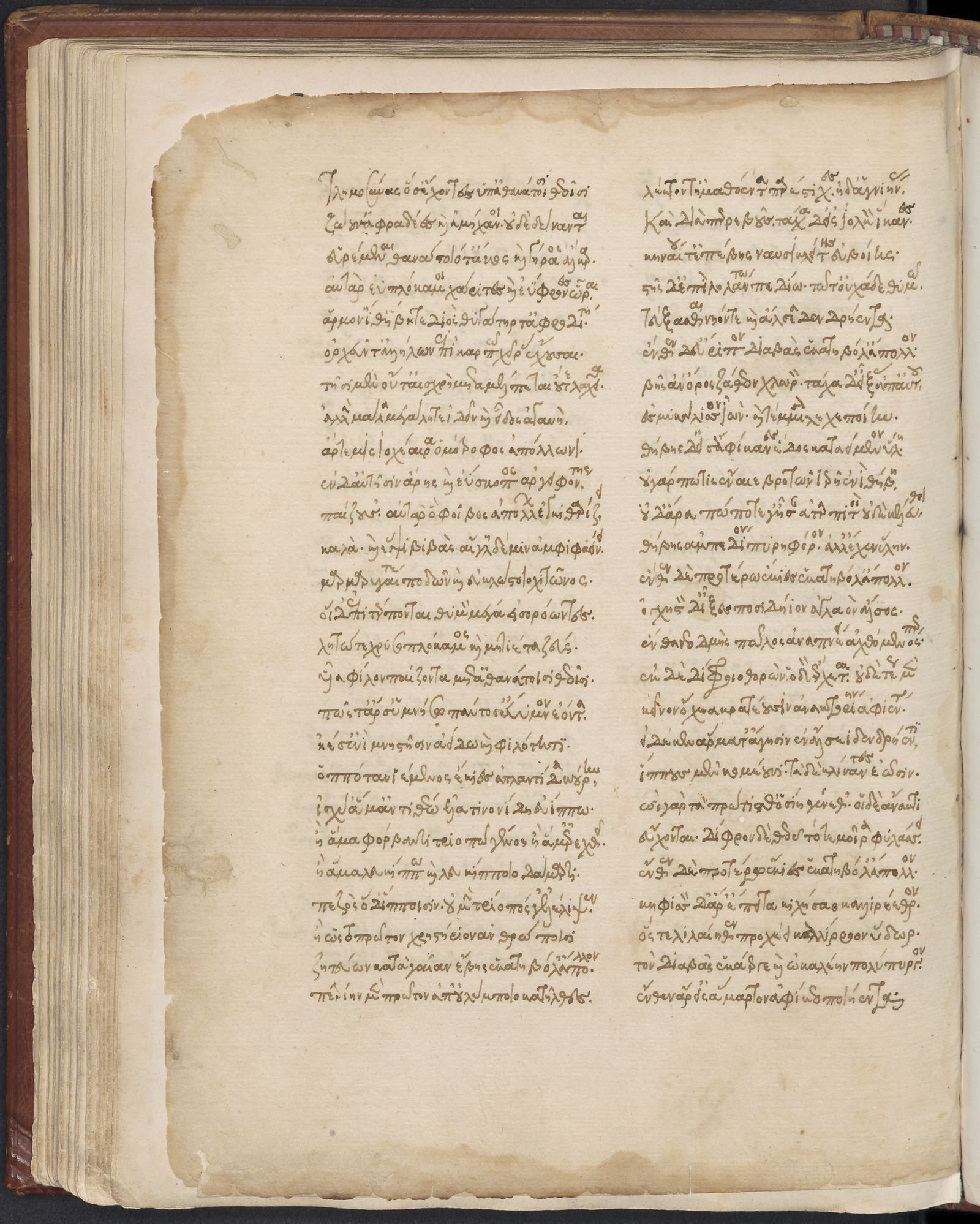
Leiden BPG 33 H, fol. 37v, column a (left): Hymn 3 191-216; begins ‹τλημοσύνας, ὅσʼ ἔχοντες ὑπʼ›, ends ‹πρῶτον ἀπʼ Οὐλύμποιο κατῆλθες·›. Checked on the image: the first and last verses of the column were read and matched to the Greek. The column before ends with Hymn 3 190. The next column begins with Hymn 3 217. English blocks here: 190-194, 195-199, 200-204, 205-209, 210-214.
191τλημοσύνας, ὅσʼ ἔχοντες ὑπʼ ἀθανάτοισι θεοῖσι
192ζώουσʼ ἀφραδέες καὶ ἀμήχανοι, οὐδὲ δύνανται
193εὑρέμεναι θανάτοιό τʼ ἄκος καὶ γήραος ἄλκαρ·
194αὐτὰρ ἐυπλόκαμοι Χάριτες καὶ ἐύφρονες Ὧραι
195Ἁρμονίη θʼ Ἥβη τε Διὸς θυγάτηρ τʼ Ἀφροδίτη
196ὀρχεῦντʼ ἀλλήλων ἐπὶ καρπῷ χεῖρας ἔχουσαι·
197τῇσι μὲν οὔτʼ αἰσχρὴ μεταμέλπεται οὔτʼ ἐλάχεια,
198ἀλλὰ μάλα μεγάλη τε ἰδεῖν καὶ εἶδος ἀγητή,
199Ἄρτεμις ἰοχέαιρα ὁμότροφος Ἀπόλλωνι.
200ἐν δʼ αὖ τῇσιν Ἄρης καὶ ἐύσκοπος Ἀργειφόντης
201παίζουσʼ· αὐτὰρ ὁ Φοῖβος Ἀπόλλων ἐγκιθαρίζει
202καλὰ καὶ ὕψι βιβάς· αἴγλη δέ μιν ἀμφιφαείνει
203μαρμαρυγαί τε ποδῶν καὶ ἐυκλώστοιο χιτῶνος.
204οἳ δʼ ἐπιτέρπονται θυμὸν μέγαν εἰσορόωντες
205Λητώ τε χρυσοπλόκαμος καὶ μητίετα Ζεὺς
206υἷα φίλον παίζοντα μετʼ ἀθανάτοισι θεοῖσι.
207πῶς τʼ ἄρ σʼ ὑμνήσω πάντως εὔυμνον ἐόντα;
208ἠέ σʼ ἐνὶ μνηστῆρσιν ἀείδω καὶ φιλότητι,
209ὅππως μνωόμενος ἔκιες Ἀζαντίδα κούρην
210Ἴσχυʼ ἅμʼ ἀντιθέῳ Ἐλατιονίδῃ εὐίππῳ;
211ἢ ἅμα Φόρβαντι Τριοπέῳ γένος, ἢ ἅμʼ Ἐρευθεῖ;
212ἢ ἅμα Λευκίππῳ καὶ Λευκίπποιο δάμαρτι
213…πεζός, ὃ δʼ ἵπποισιν· οὐ μὴν Τρίοπός γʼ ἐνέλειπεν.
214ἢ ὡς τὸ πρῶτον χρηστήριον ἀνθρώποισι
215ζητεύων κατὰ γαῖαν ἔβης, ἑκατηβόλʼ Ἄπολλον;
216Πιερίην μὲν πρῶτον ἀπʼ Οὐλύμποιο κατῆλθες·
190hymn the unending gifts the gods enjoy and the sufferings of men, all that they endure at the hands of the deathless gods, and how they live witless and helpless and cannot find healing for death or defence against old age. Meanwhile the rich-tressed Graces and cheerful Seasons dance with 195Harmonia and Hebe and Aphrodite, daughter of Zeus, holding each other by the wrist. And among them sings one, not mean nor puny, but tall to look upon and enviable in mien, Artemis who delights in arrows, sister of Apollo. 200Among them sport Ares and the keen-eyed Slayer of Argus, while Apollo plays his lyre stepping high and featly and a radiance shines around him, the gleaming of his feet and close-woven vest. And they, 205even gold-tressed Leto and wise Zeus, rejoice in their great hearts as they watch their dear son playing among the undying gods. How then shall I sing of you —though in all ways you are a worthy theme for song? Shall I sing of you as wooer and in the fields of love, how you went wooing the daughter of Azan 210along with god-like Ischys the son of well-horsed Elatius, or with Phorbas sprung from Triops, or with Ereutheus, or with Leucippus and the wife of Leucippusyou on foot, he with his chariot, yet he fell not short of Triops. Or shall I sing how at the first
Where on the image
Leiden BPG 33 H, fol. 37v, column b (right): Hymn 3 217-243; begins ‹Λέκτον τʼ ἠμαθοέντα παρέστιχες›, ends ‹εἰς Ἁλίαρτον ἀφίκεο ποιήεντα.›. Checked on the image: the first and last verses of the column were read and matched to the Greek. The column before ends with Hymn 3 216. The next column begins with Hymn 3 244. English blocks here: 215-219, 220-224, 225-229, 230-234, 235-239, 240-244.
217Λέκτον τʼ ἠμαθοέντα παρέστιχες ἠδʼ Ἐνιῆνας
218καὶ διὰ Περραιβούς· τάχα δʼ εἰς Ἰαωλκὸν ἵκανες,
219Κηναίου τʼ ἐπέβης ναυσικλειτῆς Εὐβοίης.
220στῆς δʼ ἐπὶ Ληλάντῳ πεδίῳ· τό τοι οὐχ ἅδε θυμῷ
221τεύξασθαι νηόν τε καὶ ἄλσεα δενδρήεντα.
222ἔνθεν δʼ Εὔριπον διαβάς, ἑκατηβόλʼ Ἄπολλον,
223βῆς ἄνʼ ὄρος ζάθεον, χλωρόν· τάχα δʼ ἷξες ἀπʼ αὐτοῦ
224ἐς Μυκαλησσὸν ἰὼν καὶ Τευμησσὸν λεχεποίην.
225Θήβης δʼ εἰσαφίκανες ἕδος καταειμένον ὕλῃ·
226οὐ γάρ πώ τις ἔναιε βροτῶν ἱερῇ ἐνὶ Θήβῃ,
227οὐδʼ ἄρα πω τότε γʼ ἦσαν ἀταρπιτοὶ οὐδὲ κέλευθοι
228Θήβης ἂμ πεδίον πυρηφόρον, ἀλλʼ ἔχεν ὕλη.
229ἔνθεν δὲ προτέρω ἔκιες, ἑκατηβόλʼ Ἄπολλον,
230Ὀγχηστὸν δʼ ἷξες, Ποσιδήιον ἀγλαὸν ἄλσος·
231ἔνθα νεοδμὴς πῶλος ἀναπνέει ἀχθόμενός περ
232ἕλκων ἅρματα καλά· χαμαὶ δʼ ἐλατὴρ ἀγαθός περ
233ἐκ δίφροιο θορὼν ὁδὸν ἔρχεται· οἳ δὲ τέως μὲν
234κείνʼ ὄχεα κροτέουσι ἀνακτορίην ἀφιέντες.
235εἰ δέ κεν ἅρματʼ ἀγῇσιν ἐν ἄλσεϊ δενδρήεντι,
236ἵππους μὲν κομέουσι, τὰ δὲ κλίναντες ἐῶσιν·
237ὣς γὰρ τὰ πρώτισθʼ ὁσίη γένεθʼ· οἳ δὲ ἄνακτι
238εὔχονται, δίφρον δὲ θεοῦ τότε μοῖρα φυλάσσει.
239ἔνθεν δὲ προτέρω ἔκιες, ἑκατηβόλʼ Ἄπολλον·
240Κηφισσὸν δʼ ἄρʼ ἔπειτα κιχήσαο καλλιρέεθρον,
241ὅς τε Λιλαίηθεν προχέει καλλίρροον ὕδωρ.
242τὸν διαβάς, Ἑκάεργε, καὶ Ὠκαλέην πολύπυργον
243ἔνθεν ἄρʼ εἰς Ἁλίαρτον ἀφίκεο ποιήεντα.
215you went about the earth seeking a place of oracle for men, O far-shooting Apollo? To Pieria first you went down from Olympus and passed by sandy Lectus and Enienae and through the land of the Perrhaebi. Soon you came to Iolcus and set foot on Cenaeum in Euboea, famed for ships: 220you stood in the Lelantine plain, but it pleased not your heart to make a temple there and wooded groves. From there you crossed the Euripus, far-shooting Apollo, and went up the green, holy hills, going on to Mycalessus and grassy-bedded Teumessus, 225and so came to the wood-clad abode of Thebe; for as yet no man lived in holy Thebe, nor were there tracks or ways about Thebe's wheat-bearing plain as yet. And further still you went, O far-shooting Apollo, 230and came to Onchestus, Poseidon's bright grove: there the new-broken colt distressed with drawing the trim chariot gets spirit again, and the skilled driver springs from his car and goes on his way. Then the horses for a while rattle the empty car, being rid of guidance; 235and if they break the chariot in the woody grove, men look after the horses, but tilt the chariot and leave it there; for this was the rite from the very first. And the drivers pray to the lord of the shrine; but the chariot falls to the lot of the god. Further yet you went, O far-shooting Apollo, 240and reached next Cephissus' sweet stream which pours forth its sweet-flowing water from Lilaea, and crossing over it, O worker from afar, you passed many-towered Ocalea and reached grassy Haliartus. Then you went towards Telphusa: and there the pleasant place seemed fit for
Where on the image
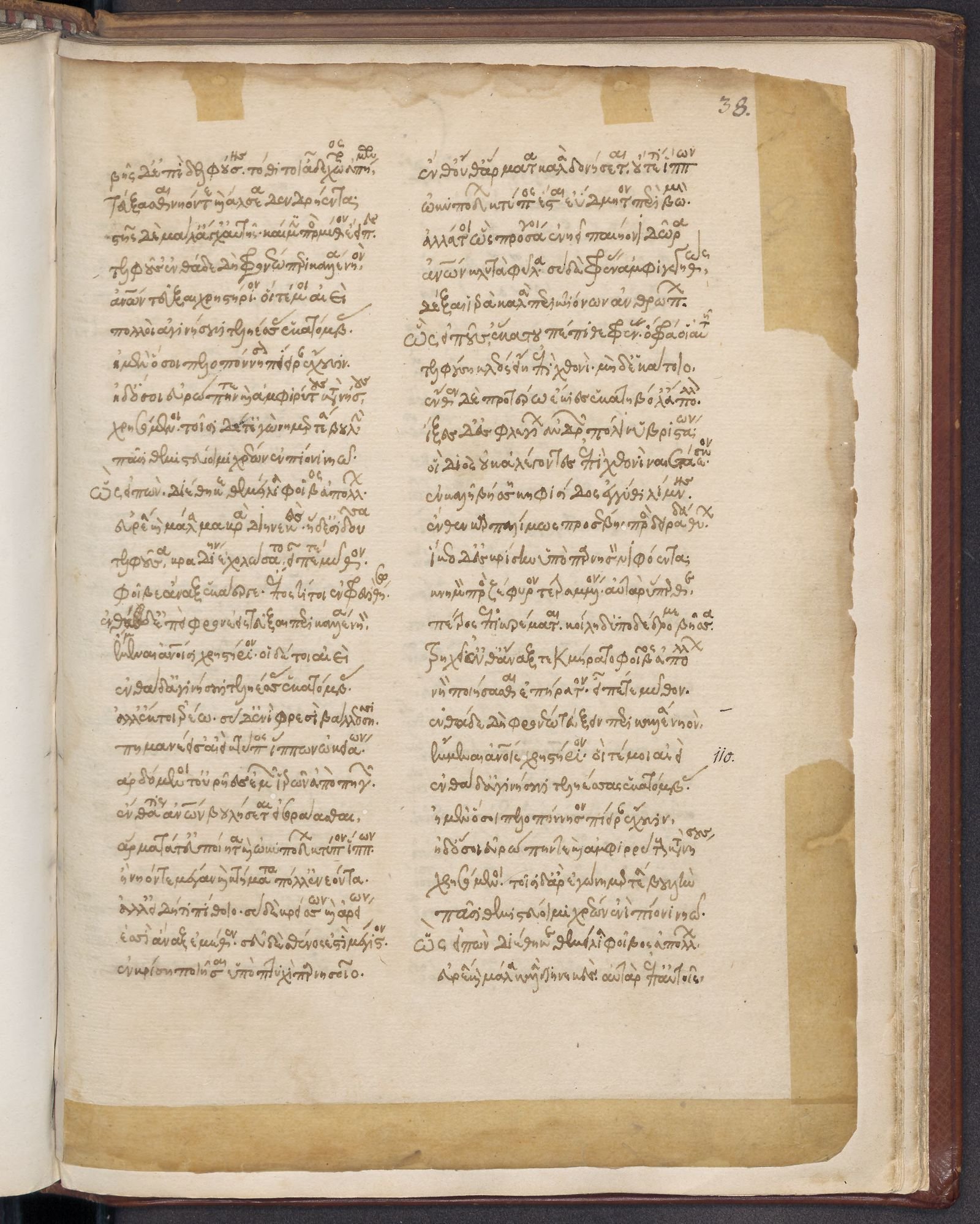
Leiden BPG 33 H, fol. 38r, column a (left): Hymn 3 244-269; begins ‹βῆς δʼ ἐπὶ Τελφούσης·›, ends ‹ποίησαι ὑπὸ πτυχὶ Παρνησοῖο.›. Checked on the image: the first and last verses of the column were read and matched to the Greek. The column before ends with Hymn 3 243. The next column begins with Hymn 3 270. English blocks here: 245-249, 250-254, 255-259, 260-264, 265-266, 267-269.
244βῆς δʼ ἐπὶ Τελφούσης· τόθι τοι ἅδε χῶρος ἀπήμων
245τεύξασθαι νηόν τε καὶ ἄλσεα δενδρήεντα·
246στῆς δὲ μάλʼ ἄγχʼ αὐτῆς καί μιν πρὸς μῦθον ἔειπες·
247Τελφοῦσʼ, ἐνθάδε δὴ φρονέω περικαλλέα νηὸν
248ἀνθρώπων τεῦξαι χρηστήριον, οἵτε μοι αἰεὶ
249ἐνθάδʼ ἀγινήσουσι τεληέσσας ἑκατόμβας,
250ἠμὲν ὅσοι Πελοπόννησον πίειραν ἔχουσιν
251ἠδʼ ὅσοι Εὐρώπην τε καὶ ἀμφιρύτας κατὰ νήσους,
252χρησόμενοι· τοῖσιν δέ κʼ ἐγὼ νημερτέα βουλὴν
253πᾶσι θεμιστεύοιμι χρέων ἐνὶ πίονι νηῷ.
254ὣς εἰπὼν διέθηκε θεμείλια Φοῖβος Ἀπόλλων
255εὐρέα καὶ μάλα μακρὰ διηνεκές· ἣ δὲ ἰδοῦσα
256Τελφοῦσα κραδίην ἐχολώσατο εἶπέ τε μῦθον·
257φοῖβε ἄναξ ἑκάεργε, ἔπος τί τοι ἐν φρεσὶ θήσω.
258ἐνθάδʼ ἐπεὶ φρονέεις τεῦξαι περικαλλέα νηὸν
259ἔμμεναι ἀνθρώποις χρηστήριον, οἵτε τοι αἰεὶ
260ἐνθάδʼ ἀγινήσουσι τεληέσσας ἑκατόμβας·
261ἀλλʼ ἔκ τοι ἐρέω, σὺ δʼ ἐνὶ φρεσὶ βάλλεο σῇσι,
262πημανέει σʼ αἰεὶ κτύπος ἵππων ὠκειάων
263ἀρδόμενοί τʼ οὐρῆες ἐμῶν ἱερῶν ἀπὸ πηγέων·
264ἔνθα τις ἀνθρώπων βουλήσεται εἰσοράασθαι
265ἅρματά τʼ εὐποίητα καὶ ὠκυπόδων κτύπον ἵππων
266ἢ νηόν τε μέγαν καὶ κτήματα πόλλʼ ἐνεόντα.
267ἀλλʼ εἰ δή τι πίθοιο, σὺ δὲ κρείσσων καὶ ἀρείων
268ἐσσί, ἄναξ, ἐμέθεν, σεῦ δὲ σθένος ἐστὶ μέγιστον,
269ἐν Κρίσῃ ποίησαι ὑπὸ πτυχὶ Παρνησοῖο.
245making a temple and wooded grove. You came very near and spoke to her: “Telphusa, here I am minded to make a glorious temple, an oracle for men, and hither they will always bring perfect hecatombs, 250both those who live in rich Peloponnesus and those of Europe and all the wave-washed isles, coming to seek oracles. And I will deliver to them all counsel that cannot fail, giving answer in my rich temple.” So said Phoebus Apollo, and laid out all the foundations 255throughout, wide and very long. But when Telphusa saw this, she was angry in heart and spoke, saying: “Lord Phoebus, worker from afar, I will speak a word of counsel to your heart, since you are minded to make here a glorious temple to be an oracle for men who will always 260bring hither perfect hecatombs for you; yet I will speak out, and do you lay up my words in your heart. The trampling of swift horses and the sound of mules watering at my sacred springs will always irk you, and men will like better to gaze at 265the well-made chariots and stamping, swift-footed horses than at your great temple and the many treasures that are within. 267But if you will be moved by me —for you, lord, are stronger and mightier than I, and your strength is very great —build at Crisa below the glades of Parnassus:
Where on the image
Leiden BPG 33 H, fol. 38r, column b (right): Hymn 3 270-295; begins ‹ἔνθʼ οὔθʼ ἅρματα καλὰ›, ends ‹διηνεκές· αὐτὰρ ἐπʼ αὐτοῖς›. Checked on the image: the first and last verses of the column were read and matched to the Greek. The column before ends with Hymn 3 269. The next column begins with Hymn 3 296. English blocks here: 270-274, 275-279, 280-284, 285-289, 290-294.
270ἔνθʼ οὔθʼ ἅρματα καλὰ δονήσεται οὔτε τοι ἵππων
271ὠκυπόδων κτύπος ἔσται ἐύδμητον περὶ βωμόν,
272ἀλλά τοι ὣς προσάγοιεν Ἰηπαιήονι δῶρα
273ἀνθρώπων κλυτὰ φῦλα· σὺ δὲ φρένας ἀμφιγεγηθὼς
274δέξαιʼ ἱερὰ καλὰ περικτιόνων ἀνθρώπων.
275ὣς εἰποῦσʼ Ἑκάτου πέπιθε φρένας, ὄφρα οἱ αὐτῇ
276Τελφούσῃ κλέος εἴη ἐπὶ χθονί, μηδʼ Ἑκάτοιο.
277ἔνθεν δὲ προτέρω ἔκιες, ἑκατηβόλʼ Ἄπολλον·
278ἷξες δʼ ἐς Φλεγύων ἀνδρῶν πόλιν ὑβριστάων,
279οἳ Διὸς οὐκ ἀλέγοντες ἐπὶ χθονὶ ναιετάασκον
280ἐν καλῇ βήσσῃ Κηφισίδος ἐγγύθι λίμνης.
281ἔνθεν καρπαλίμως προσέβης πρὸς δειράδα θύων
282ἵκεο δʼ ἐς Κρίσην ὑπὸ Παρνησὸν νιφόεντα,
283κνημὸν πρὸς Ζέφυρον τετραμμένον, αὐτὰρ ὕπερθεν
284πέτρη ἐπικρέμαται, κοίλη δʼ ὑποδέδρομε βῆσσα,
285τρηχεῖʼ· ἔνθα ἄναξ τεκμήρατο Φοῖβος Ἀπόλλων
286νηὸν ποιήσασθαι ἐπήρατον εἶπέ τε μῦθον·
287ἐνθάδε δὴ φρονέω τεῦξαι περικαλλέα νηὸν
288ἔμμεναι ἀνθρώποις χρηστήριον, οἵτε μοι αἰεὶ
289ἐνθάδʼ ἀγινήσουσι τεληέσσας ἑκατόμβας,
290ἠμὲν ὅσοι Πελοπόννησον πίειραν ἔχουσιν,
291ἠδʼ ὅσοι Εὐρώπην τε καὶ ἀμφιρύτας κατὰ νήσους,
292χρησόμενοι· τοῖσιν δʼ ἄρʼ ἐγὼ νημερτέα βουλὴν
293πᾶσι θεμιστεύοιμι χρέων ἐνὶ πίονι νηῷ.
294ὣς εἰπὼν διέθηκε θεμείλια Φοῖβος Ἀπόλλων
295εὐρέα καὶ μάλα μακρὰ διηνεκές· αὐτὰρ ἐπʼ αὐτοῖς
270there no bright chariot will clash, and there will be no noise of swift-footed horses near your well-built altar. But so the glorious tribes of men will bring gifts to you as Iepaeon (‘Hail-Healer’), and you will receive with delight rich sacrifices from the people dwelling round about.” 275So said Telphusa, that she alone, and not the Far-Shooter, should have renown there; and she persuaded the Far-Shooter. Further yet you went, far-shooting Apollo, until you came to the town of the presumptuous Phlegyae who dwell on this earth 280in a lovely glade near the Cephisian lake, caring not for Zeus. And thence you went speeding swiftly to the mountain ridge, and came to Crisa beneath snowy Parnassus, a foothill turned towards the west: a cliff hangs over it from above, and a hollow, rugged glade runs under. 285There the lord Phoebus Apollo resolved to make his lovely temple, and thus he said: “In this place I am minded to build a glorious temple to be an oracle for men, and here they will always bring perfect hecatombs, 290both they who dwell in rich Peloponnesus and the men of Europe and from all the wave-washed isles, coming to question me. And I will deliver to them all counsel that cannot fail, answering them in my rich temple.” When he had said this, Phoebus Apollo laid out all the foundations
Where on the image
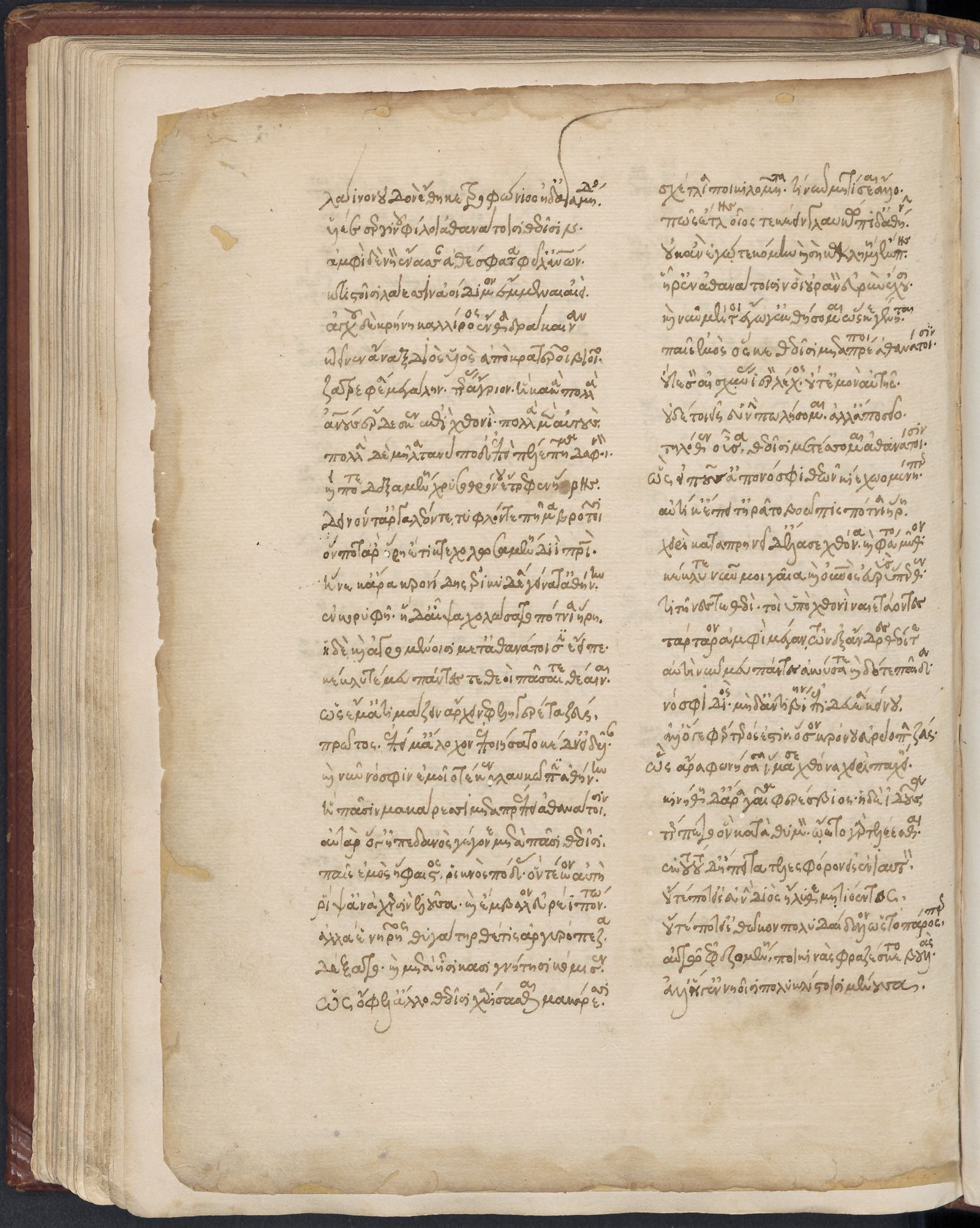
Leiden BPG 33 H, fol. 38v, column a (left): Hymn 3 296-321; begins ‹λάινον οὐδὸν ἔθηκε Τροφώνιος›, ends ‹ἄλλο θεοῖσι χαρίζεσθαι μακάρεσσι.›. Checked on the image: the first and last verses of the column were read and matched to the Greek. The column before ends with Hymn 3 295. The next column begins with Hymn 3 322. Line 317a of the Loeb text (a supplement) is not in the manuscript. English blocks here: 295-299, 300-304, 305-309, 310-314, 315-319.
296λάινον οὐδὸν ἔθηκε Τροφώνιος ἠδʼ Ἀγαμήδης,
297υἱέες Ἐργίνου, φίλοι ἀθανάτοισι θεοῖσιν·
298ἀμφὶ δὲ νηὸν ἔνασσαν ἀθέσφατα φῦλʼ ἀνθρώπων
299ξεστοῖσιν λάεσσιν, ἀοίδιμον ἔμμεναι αἰεί.
300ἀγχοῦ δὲ κρήνη καλλίρροος, ἔνθα δράκαιναν
301κτεῖνεν ἄναξ, Διὸς υἱός, ἀπὸ κρατεροῖο βιοῖο,
302ζατρεφέα, μεγάλην, τέρας ἄγριον, ἣ κακὰ πολλὰ
303ἀνθρώπους ἔρδεσκεν ἐπὶ χθονί, πολλὰ μὲν αὐτούς,
304πολλὰ δὲ μῆλα ταναύποδʼ, ἐπεὶ πέλε πῆμα δαφοινόν.
305καί ποτε δεξαμένη χρυσοθρόνου ἔτρεφεν Ἥρης
306δεινόν τʼ ἀργαλέον τε Τυφάονα, πῆμα βροτοῖσιν·
307ὅν ποτʼ ἄρʼ Ἥρη ἔτικτε χολωσαμένη Διὶ πατρί,
308ἥνικʼ ἄρα Κρονίδης ἐρικυδέα γείνατʼ Ἀθήνην
309ἐν κορυφῇ· ἣ δʼ αἶψα χολώσατο πότνια Ἥρη
310ἠδὲ καὶ ἀγρομένοισι μετʼ ἀθανάτοισιν ἔειπε·
311κέκλυτέ μευ, πάντες τε θεοὶ πᾶσαί τε θέαιναι,
312ὡς ἔμʼ ἀτιμάζειν ἄρχει νεφεληγερέτα Ζεὺς
313πρῶτος, ἐπεί μʼ ἄλοχον ποιήσατο κέδνʼ εἰδυῖαν·
314καὶ νῦν νόσφιν ἐμεῖο τέκε γλαυκῶπιν Ἀθήνην,
315ἣ πᾶσιν μακάρεσσι μεταπρέπει ἀθανάτοισιν·
316αὐτὰρ ὅ γʼ ἠπεδανὸς γέγονεν μετὰ πᾶσι θεοῖσι
317παῖς ἐμὸς Ἥφαιστος, ῥικνὸς πόδας, ὃν τέκον αὐτή·
318ῥῖψʼ ἀνὰ χερσὶν ἑλοῦσα καὶ ἔμβαλον εὐρέι πόντῳ·
319ἀλλά ἑ Νηρῆος θυγάτηρ Θέτις ἀργυρόπεζα
320δέξατο καὶ μετὰ ᾗσι κασιγνήτῃσι κόμισσεν.
321ὡς ὄφελʼ ἄλλο θεοῖσι χαρίζεσθαι μακάρεσσι.
295throughout, wide and very long; and upon these the sons of Erginus, Trophonius and Agamedes, dear to the deathless gods, laid a footing of stone. And the countless tribes of men built the whole temple of wrought stones, to be sung of for ever. 300But near by was a sweet flowing spring, and there with his strong bow the lord, the son of Zeus, killed the bloated, great she-dragon, a fierce monster wont to do great mischief to men upon earth, to men themselves and to their thin-shanked sheep; for she was a very bloody plague. 305She it was who once received from gold-throned Hera and brought up fell, cruel Typhaon to be a plague to men. Once on a time Hera bare him because she was angry with father Zeus, when the Son of Cronos bare all-glorious Athena in his head. Thereupon queenly Hera was angry 310and spoke thus among the assembled gods: “Hear from me, all gods and goddesses, how cloud-gathering Zeus begins to dishonor me wantonly, when he has made me his true-hearted wife. See now, apart from me he has given birth to bright-eyed Athena 315who is foremost among all the blessed gods. But my son Hephaestus whom I bare
Where on the image
Leiden BPG 33 H, fol. 38v, column b (right): Hymn 3 322-347; begins ‹σχέτλιε, ποικιλομῆτα, τί νῦν›, ends ‹ἐν νηοῖσι πολυλλίστοισι μένουσα›. Checked on the image: the first and last verses of the column were read and matched to the Greek. The column before ends with Hymn 3 321. The next column begins with Hymn 3 348. English blocks here: 320-324, 325-329, 330-334, 335-339, 340-344, 345-348.
322σχέτλιε, ποικιλομῆτα, τί νῦν μητίσεαι ἄλλο;
323πῶς ἔτλης οἶος τεκέειν γλαυκῶπιν Ἀθήνην;
324οὐκ ἂν ἐγὼ τεκόμην; καὶ σὴ κεκλημένη ἔμπης
325ἦα ῥʼ ἐν ἀθανάτοισιν, οἳ οὐρανὸν εὐρὺν ἔχουσι.
326καὶ νῦν μέντοι ἐγὼ τεχνήσομαι, ὥς κε γένηται
327παῖς ἐμός, ὅς κε θεοῖσι μεταπρέποι ἀθανάτοισιν,
328οὔτε σὸν αἰσχύνασʼ ἱερὸν λέχος οὔτʼ ἐμὸν αὐτῆς.
329οὐδέ τοι εἰς εὐνὴν πωλήσομαι, ἀλλʼ ἀπὸ σεῖο
330τηλόθʼ ἐοῦσα θεοῖσι μετέσσομαι ἀθανάτοισιν.
331ὣς εἰποῦσʼ ἀπὸ νόσφι θεῶν κίε χωομένη κῆρ.
332αὐτίκʼ ἔπειτʼ ἠρᾶτο βοῶπις πότνια Ἥρη,
333χειρὶ καταπρηνεῖ δʼ ἔλασε χθόνα καὶ φάτο μῦθον·
334κέκλυτε νῦν μευ, Γαῖα καὶ Οὐρανὸς εὐρὺς ὕπερθεν
335Τιτῆνές τε θεοί, τοὶ ὑπὸ χθονὶ ναιετάοντες
336Τάρταρον ἀμφὶ μέγαν, τῶν ἒξ ἄνδρες τε θεοί τε·
337αὐτοὶ νῦν μευ πάντες ἀκούσατε καὶ δότε παῖδα
338νόσφι Διός, μηδέν τι βίην ἐπιδευέα κείνου·
339ἀλλʼ ὅ γε φέρτερος ἔστω, ὅσον Κρόνου εὐρύοπα Ζεύς.
340ὣς ἄρα φωνήσασʼ ἵμασε χθόνα χειρὶ παχείῃ·
341κινήθη δʼ ἄρα Γαῖα φερέσβιος· ἣ δὲ ἰδοῦσα
342τέρπετο ὃν κατὰ θυμόν· ὀίετο γὰρ τελέεσθαι.
343ἐκ τούτου δὴ ἔπειτα τελεσφόρον εἰς ἐνιαυτὸν
344οὔτε πότʼ εἰς εὐνὴν Διὸς ἤλυθε μητιόεντος,
345οὔτε πότʼ ἐς θῶκον πολυδαίδαλον, ὡς τὸ πάρος περ
346αὐτῷ ἐφεζομένη πυκινὰς φραζέσκετο βουλάς·
347ἀλλʼ ἥ γʼ ἐν νηοῖσι πολυλλίστοισι μένουσα
320took and cared for him with her sisters: would that she had done other service to the blessed gods! O wicked one and crafty! What else will you now devise? How dared you by yourself give birth to bright-eyed Athena? Would not I have borne you a child —I, who was at least called your wife 325among the undying gods who hold wide heaven. 330And I will not come to your bed, but will consort with the blessed gods far off from you.” When she had so spoken, she went apart from the gods, being very angry. Then straightway large-eyed queenly Hera prayed, striking the ground flatwise with her hand, and speaking thus: 335“Hear now, I pray, Earth and wide Heaven above and you Titan gods who dwell beneath the earth about great Tartarus, and from whom are sprung both gods and men! Harken you now to me, one and all, and grant that I may bear a child apart from Zeus, no wit lesser than him in strength —nay, let him be as much stronger than Zeus as all-seeing Zeus than Cronos.” 340Thus she cried and lashed the earth with her strong hand. Then the life-giving earth was moved: and when Hera saw it she was glad in heart, for she thought her prayer would be fulfilled. And thereafter she never came to the bed of wise Zeus for a full year, 345nor to sit in her carved chair as aforetime to plan wise counsel for him, but stayed in her temples where many pray, and delighted in her offerings, large-eyed queenly Hera.
Where on the image
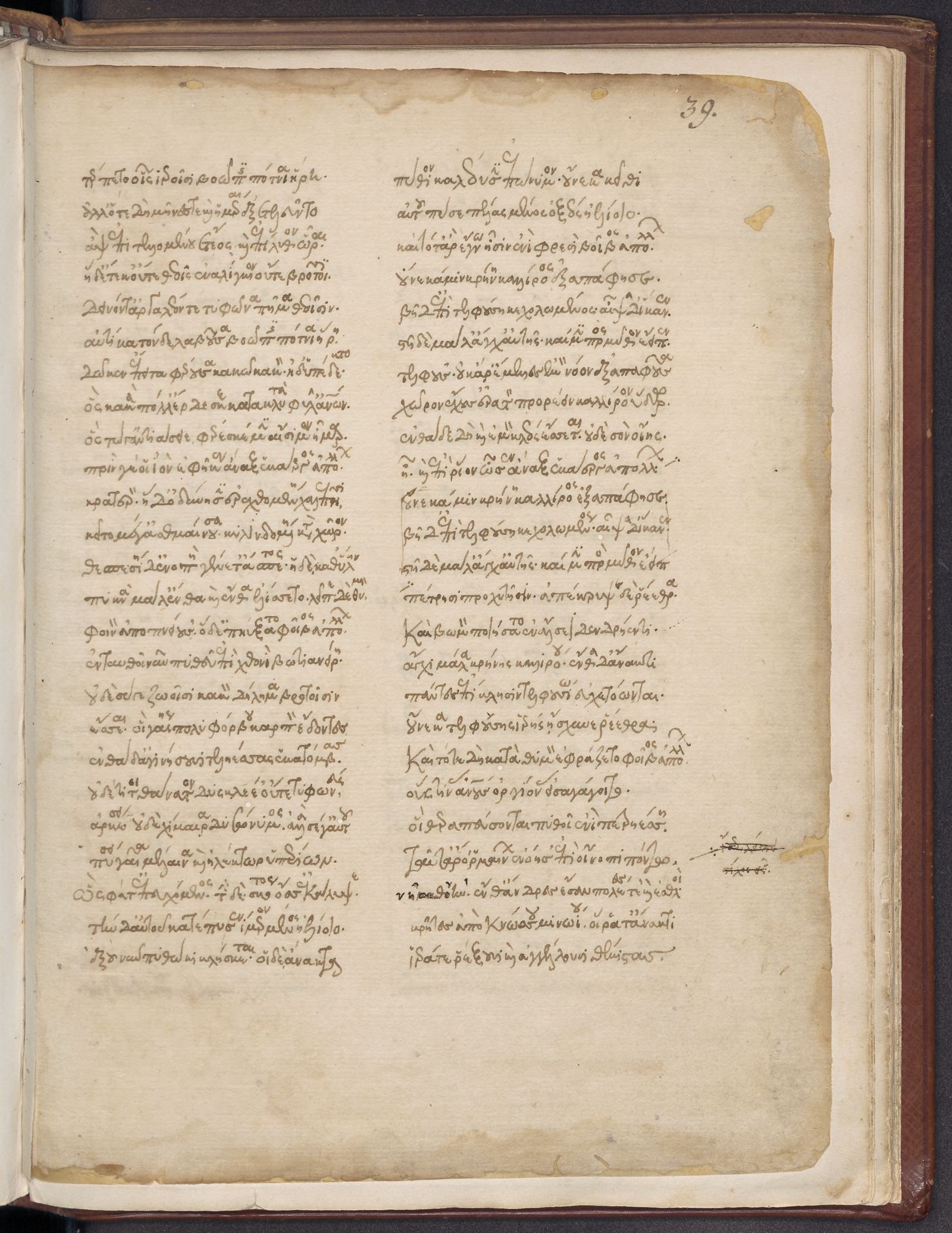
Leiden BPG 33 H, fol. 39r, column a (left): Hymn 3 348-372; begins ‹τέρπετο οἷς ἱεροῖσι βοῶπις›, ends ‹κικλήσκεται· οἳ δὲ ἄνακτα›. Checked on the image: the first and last verses of the column were read and matched to the Greek. The column before ends with Hymn 3 347. The next column begins with Hymn 3 373. English blocks here: 349-349, 350-354, 355-359, 360-364, 365-369, 370-374.
348τέρπετο οἷς ἱεροῖσι βοῶπις πότνια Ἥρη.
349ἀλλʼ ὅτε δὴ μῆνές τε καὶ ἡμέραι ἐξετελεῦντο
350ἂψ περιτελλομένου ἔτεος καὶ ἐπήλυθον ὧραι,
351ἣ δʼ ἔτεκʼ οὔτε θεοῖς ἐναλίγκιον οὔτε βροτοῖσι,
352δεινόν τʼ ἀργαλέον τε Τυφάονα, πῆμα βροτοῖσιν.
353αὐτίκα τόνδε λαβοῦσα βοῶπις πότνια Ἥρη
354δῶκεν ἔπειτα φέρουσα κακῷ κακόν· ἣ δʼ ὑπέδεκτο.
355ὃς κακὰ πόλλʼ ἔρδεσκεν ἀγακλυτὰ φῦλʼ ἀνθρώπων·
356ὃς τῇ γʼ ἀντιάσειε, φέρεσκέ μιν αἴσιμον ἦμαρ,
357πρίν γέ οἱ ἰὸν ἐφῆκε ἄναξ ἑκάεργος Ἀπόλλων
358καρτερόν· ἣ δʼ ὀδύνῃσιν ἐρεχθομένη χαλεπῇσι
359κεῖτο μέγʼ ἀσθμαίνουσα κυλινδομένη κατὰ χῶρον.
360θεσπεσίη δʼ ἐνοπὴ γένετʼ ἄσπετος· ἣ δὲ καθʼ ὕλην
361πυκνὰ μάλʼ ἔνθα καὶ ἔνθα ἑλίσσετο, λεῖπε δὲ θυμὸν
362φοινὸν ἀποπνείουσʼ· ὃ δʼ ἐπηύξατο Φοῖβος Ἀπόλλων·
363ἐνταυθοῖ νῦν πύθευ ἐπὶ χθονὶ βωτιανείρῃ·
364οὐδὲ σύ γε ζώουσα κακὸν δήλημα βροτοῖσιν
365ἔσσεαι, οἳ γαίης πολυφόρβου καρπὸν ἔδοντες
366ἐνθάδʼ ἀγινήσουσι τεληέσσας ἑκατόμβας·
367οὐδέ τί τοι θάνατόν γε δυσηλεγέʼ οὔτε Τυφωεὺς
368ἀρκέσει οὔτε Χίμαιρα δυσώνυμος, ἀλλά σέ γʼ αὐτοῦ
369πύσει Γαῖα μέλαινα καὶ ἠλέκτωρ Ὑπερίων.
370ὣς φάτʼ ἐπευχόμενος· τὴν δὲ σκότος ὄσσε κάλυψε.
371τὴν δʼ αὐτοῦ κατέπυσʼ ἱερὸν μένος Ἠελίοιο,
372ἐξ οὗ νῦν Πυθὼ κικλήσκεται· οἳ δὲ ἄνακτα
349But when the months and days were fulfilled 350and the seasons duly came on as the earth moved round, she bare one neither like the gods nor mortal men, fell, cruel Typhaon, to be a plague to men. Straightway large-eyed queenly Hera took him and bringing one evil thing to another such, gave him to the dragoness; and she received him. 355And this Typhaon used to work great mischief among the famous tribes of men. Whosoever met the dragoness, the day of doom would sweep him away, until the lord Apollo, who deals death from afar, shot a strong arrow at her. Then she, rent with bitter pangs, lay drawing great gasps for breath and rolling about that place. 360An awful noise swelled up unspeakable as she writhed continually this way and that amid the wood: and so she left her life, breathing it forth in blood. Then Phoebus Apollo boasted over her: “Now rot here upon the soil that feeds man' You at least shall live no more to be a fell bane to men 365who eat the fruit of the all-nourishing earth, and who will bring hither perfect hecatombs. Against cruel death neither Typhoeus shall avail you nor ill-famed Chimera, but here shall the Earth and shining Hyperion make you rot.” 370Thus said Phoebus, exulting over her: and darkness covered her eyes. And the holy strength of Helios made her rot away there; wherefore the place is now called Pytho, and men call the lord Apollo by another name, Pythian; because on that spot the power of piercing Helios made the monster rot away.
Where on the image
Leiden BPG 33 H, fol. 39r, column b (right): Hymn 3 373-394; begins ‹Πύθιον ἀγκαλέουσιν ἐπώνυμον, οὕνεκα›, ends ‹ῥέζουσι καὶ ἀγγέλλουσι θέμιστας›. Checked on the image: the first and last verses of the column were read and matched to the Greek. The column before ends with Hymn 3 372. The next column begins with Hymn 3 395. The scribe wrote verses 376-378 twice (after 382 they are repeated before 383); the repetition is marked with χ in the margin. The column has 26 written lines for 22 verses. English blocks here: 375-379, 380-384, 385-389, 390-394.
373Πύθιον ἀγκαλέουσιν ἐπώνυμον, οὕνεκα κεῖθι
374αὐτοῦ πῦσε πέλωρ μένος ὀξέος Ἠελίοιο.
375καὶ τότʼ ἄρʼ ἔγνω ᾗσιν ἐνὶ φρεσὶ Φοῖβος Ἀπόλλων,
376οὕνεκά μιν κρήνη καλλίρροος ἐξαπάφησε·
377βῆ δʼ ἐπὶ Τελφούσῃ κεχολωμένος, αἶψα δʼ ἵκανε·
378στῆ δὲ μάλʼ ἄγχʼ αὐτῆς καί μιν πρὸς μῦθον ἔειπε·
379Τελφοῦσʼ, οὐκ ἄρʼ ἔμελλες ἐμὸν νόον ἐξαπαφοῦσα
380χῶρον ἔχουσʼ ἐρατὸν προρέειν καλλίρροον ὕδωρ.
381ἐνθάδε δὴ καὶ ἐμὸν κλέος ἔσσεται, οὐδὲ σὸν οἴης.
382ἦ καὶ ἐπὶ ῥίον ὦσε ἄναξ ἑκάεργος Ἀπόλλων
383πετραίῃς προχυτῇσιν, ἀπέκρυψεν δὲ ῥέεθρα
384καὶ βωμὸν ποιήσατʼ ἐν ἄλσεϊ δενδρήεντι,
385ἄγχι μάλα κρήνης καλλιρρόου· ἔνθαδʼ ἄνακτι
386πάντες ἐπίκλησιν Τελφουσίῳ εὐχετόωνται,
387οὕνεκα Τελφούσης ἱερῆς ᾔσχυνε ῥέεθρα.
388καὶ τότε δὴ κατὰ θυμὸν ἐφράζετο Φοῖβος Απόλλων,
389οὕστινας ἀνθρώπους ὀργείονας εἰσαγάγοιτο,
390οἳ θεραπεύσονται Πυθοῖ ἔνι πετρηέσσῃ·
391ταῦτʼ ἄρα ὁρμαίνων ἐνόησʼ ἐπὶ οἴνοπι πόντῳ
392νῆα θοήν· ἐν δʼ ἄνδρες ἔσαν πολέες τε καὶ ἐσθλοί,
393Κρῆτες ἀπὸ Κνωσοῦ Μινωίου, οἵ ῥα ἄνακτι
394ἱερά τε ῥέζουσι καὶ ἀγγέλλουσι θέμιστας
375Then Phoebus Apollo saw that the sweet-flowing spring had beguiled him, and he started out in anger against Telphusa; and soon coming to her, he stood close by and spoke to her: “Telphusa, you were not, after all, to keep to yourself this lovely place by deceiving my mind, 380and pour forth your clear flowing water: here my renown shall also be and not yours alone?”Thus spoke the lord, far-working Apollo, and pushed over upon her a crag with a shower of rocks, hiding her streams: and he made himself an altar in a wooded grove 385very near the clear-flowing stream. In that place all men pray to the great one by the name Telphusian, because he humbled the stream of holy Telphusa. Then Phoebus Apollo pondered in his heart what men he should bring in 390to be his ministers in sacrifice and to serve him in rocky Pytho. And while he considered this, he became aware of a swift ship upon the wine-like sea in which were many men and goodly, Cretans from Cnossos, the city of Minos, they who do sacrifice to the prince and announce his decrees,
Where on the image
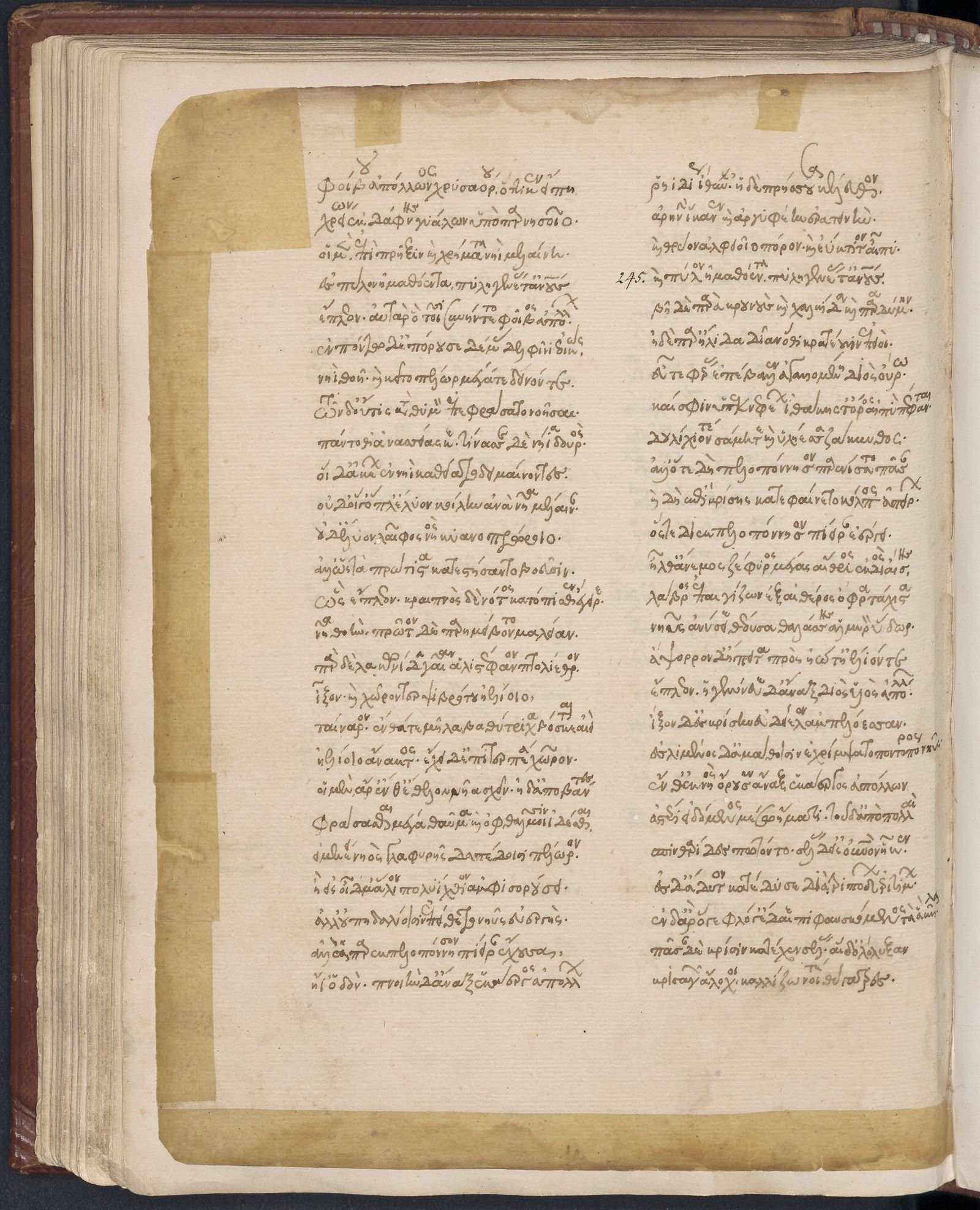
Leiden BPG 33 H, fol. 39v, column a (left): Hymn 3 395-420; begins ‹φοίβου Ἀπόλλωνος χρυσαόρου, ὅττι›, ends ‹δὲ ἄναξ ἑκάεργος Ἀπόλλων›. Checked on the image: the first and last verses of the column were read and matched to the Greek. The column before ends with Hymn 3 394. The next column begins with Hymn 3 421. English blocks here: 395-396, 397-399, 400-404, 405-409, 410-414, 415-419.
395φοίβου Ἀπόλλωνος χρυσαόρου, ὅττι κεν εἴπῃ
396χρείων ἐκ δάφνης γυάλων ὕπο Παρνησοῖο.
397οἳ μὲν ἐπὶ πρῆξιν καὶ χρήματα νηὶ μελαίνῃ
398ἐς Πύλον ἠμαθόεντα Πυλοιγενέας τʼ ἀνθρώπους
399ἔπλεον· αὐτὰρ ὃ τοῖσι συνήντετο Φοῖβος Ἀπόλλων·
400ἐν πόντῳ δʼ ἐπόρουσε δέμας δελφῖνι ἐοικὼς
401νηὶ θοῇ καὶ κεῖτο πέλωρ μέγα τε δεινόν τε·
402τῶν δʼ οὔτις κατὰ θυμὸν ἐπεφράσαθʼ ὥστε νοῆσαι
403πάντοσʼ ἀνασσείσασκε, τίνασσε δὲ νήια δοῦρα.
404οἳ δʼ ἀκέων ἐνὶ νηὶ καθήατο δειμαίνοντες·
405οὐδʼ οἵ γʼ ὅπλʼ ἔλυον κοίλην ἀνὰ νῆα μέλαιναν,
406οὐδʼ ἔλυον λαῖφος νηὸς κυανοπρώροιο,
407ἀλλʼ ὡς τὰ πρώτιστα κατεστήσαντο βοεῦσιν,
408ὣς ἔπλεον· κραιπνὸς δὲ Νότος κατόπισθεν ἔπειγε
409νῆα θοήν· πρῶτον δὲ παρημείβοντο Μάλειαν,
410πὰρ δὲ Λακωνίδα γαῖαν ἁλιστέφανον πτολίεθρον
411ἷξον καὶ χῶρον τερψιμβρότου Ἠελίοιο,
412Ταίναρον, ἔνθα τε μῆλα βαθύτριχα βόσκεται αἰεὶ
413Ἠελίοιο ἄνακτος, ἔχει δʼ ἐπιτερπέα χῶρον.
414οἳ μὲν ἄρʼ ἔνθʼ ἔθελον νῆα σχεῖν ἠδʼ ἀποβάντες
415φράσσασθαι μέγα θαῦμα καὶ ὀφθαλμοῖσιν ἰδέσθαι,
416εἰ μενέει νηὸς γλαφυρῆς δαπέδοισι πέλωρον
417ἢ εἰς οἶδμʼ ἅλιον πολυΐχθυον αὖτις ὀρούσει.
418ἀλλʼ οὐ πηδαλίοισιν ἐπείθετο νηῦς εὐεργής,
419ἀλλὰ παρὲκ Πελοπόννησον πίειραν ἔχουσα
420ἤιʼ ὁδόν· πνοιῇ δὲ ἄναξ ἑκάεργος Ἀπόλλων
395whatsoever Phoebus Apollo, bearer of the golden blade, speaks in answer from his laurel tree below the dells of Parnassus. 397These men were sailing in their black ship for traffic and for profit to sandy Pylos and to the men of Pylos. But Phoebus Apollo met them: 400in the open sea he sprang upon their swift ship, like a dolphin in shape, and lay there, a great and awesome monster, and none of them gave heed so as to understand; 405and did not loose the sheets throughout the black, hollow ship, nor lowered the sail of their dark-prowed vessel, but as they had set it first of all with oxhide ropes, so they kept sailing on; for a rushing south wind hurried on the swift ship from behind. First they passed by Malea, 410and then along the Laconian coast they came to Taenarum, sea-garlanded town and country of Helios who gladdens men, where the thick-fleeced sheep of the lord Helios feed continually and occupy a gladsome country. There they wished to put their ship to shore, and land 415and comprehend the great marvel and see with their eyes whether the monster would remain upon the deck of the hollow ship, or spring back into the briny deep where fishes shoal. But the well-built ship would not obey the helm, but went on its way all along Peloponnesus:
Where on the image
Leiden BPG 33 H, fol. 39v, column b (right): Hymn 3 421-446; begins ‹ῥηιδίως ἴθυνʼ· ἣ δὲ›, ends ‹ἄλοχοι καλλίζωνοί τε θύγατρες›. Checked on the image: the first and last verses of the column were read and matched to the Greek. The column before ends with Hymn 3 420. The next column begins with Hymn 3 447. English blocks here: 420-424, 425-429, 430-434, 435-439, 440-443, 444-444.
421ῥηιδίως ἴθυνʼ· ἣ δὲ πρήσσουσα κέλευθον
422Ἀρήνην ἵκανε καὶ Ἀργυφέην ἐρατεινὴν
423καὶ Θρύον, Ἀλφειοῖο πόρον, καὶ ἐύκτιτον Αἶπυ
424καὶ Πύλον ἠμαθόεντα Πυλοιγενέας τʼ ἀνθρώπους.
425βῆ δὲ παρὰ Κρουνοὺς καὶ Χαλκίδα καὶ παρὰ Δύμην
426ἠδὲ παρʼ Ἤλιδα δῖαν, ὅθι κρατέουσιν Ἐπειοί.
427εὖτε Φερὰς ἐπέβαλλεν, ἀγαλλομένη Διὸς οὔρῳ,
428καί σφιν ὑπὲκ νεφέων Ἰθάκης τʼ ὄρος αἰπὺ πέφαντο
429Δουλίχιόν τε Σάμη τε καὶ ὑλήεσσα Ζάκυνθος.
430ἀλλʼ ὅτε δὴ Πελοπόννησον παρενίσατο πᾶσαν
431καὶ δὴ ἐπὶ Κρίσης κατεφαίνετο κόλπος ἀπείρων,
432ὅστε διὲκ Πελοπόννησον πίειραν ἐέργει·
433ἦλθʼ ἄνεμος Ζέφυρος μέγας, αἴθριος, ἐκ Διὸς αἴσης,
434λάβρος ἐπαιγίζων ἐξ αἰθέρος, ὄφρα τάχιστα
435νηῦς ἀνύσειε θέουσα θαλάσσης ἁλμυρὸν ὕδωρ.
436ἄψορροι δὴ ἔπειτα πρὸς ἠῶ τʼ ἠέλιόν τε
437ἔπλεον· ἡγεμόνευε δʼ ἄναξ Διὸς υἱὸς Ἀπόλλων·
438ἷξον δʼ ἐς Κρίσην εὐδείελον, ἀμπελόεσσαν,
439ἐς λιμένʼ· ἣ δʼ ἀμάθοισιν ἐχρίμψατο ποντοπόρος νηῦς.
440ἔνθʼ ἐκ νηὸς ὄρουσε ἄναξ ἑκάεργος Ἀπόλλων,
441ἀστέρι εἰδόμενος μέσῳ ἤματι· τοῦ δʼ ἀπὸ πολλαὶ
442σπινθαρίδες πωτῶντο, σέλας δʼ εἰς οὐρανὸν ἷκεν·
443ἐς δʼ ἄδυτον κατέδυσε διὰ τριπόδων ἐριτίμων.
444ἔνθʼ ἄρʼ ὅ γε φλόγα δαῖε πιφαυσκόμενος τὰ ἃ κῆλα·
445πᾶσαν δὲ Κρίσην κάτεχεν σέλας· αἳ δʼ ὀλόλυξαν
446Κρισαίων ἄλοχοι καλλίζωνοί τε θύγατρες
420and the lord, far-working Apollo, guided it easily with the breath of the breeze. So the ship ran on its course and came to Arena and lovely Argyphea and Thryon, the ford of Alpheus, and well-placed Aepy and sandy Pylos and the men of Pylos; 425past Cruni it went and Chalcis and past Dyme and fair Elis, where the Epei rule. And at the time when she was making for Pherae, exulting in the breeze from Zeus, there appeared to them below the clouds the steep mountain of Ithaca, and Dulichium and Same and wooded Zacynthus. 430But when they were passed by all the coast of Peloponnesus, then, towards Crisa, that vast gulf began to heave in sight which through all its length cuts off the rich isle of Pelops. There came on them a strong, clear west-wind by ordinance of Zeus and blew from heaven vehemently, that with all speed 435the ship might finish coursing over the briny water of the sea. So they began again to voyage back towards the dawn and the sun: and the lord Apollo, son of Zeus, led them on until they reached far-seen Crisa, land of vines, and into haven: there the sea-coursing ship grounded on the sands. 440Then, like a star at noonday, the lord, far-working Apollo, leaped from the ship: flashes of fire flew from him thick and their brightness reached to heaven. He entered into his shrine between priceless tripods, 444and there made a flame to flare up bright, showing forth the splendor of his shafts, so that their radiance
Where on the image
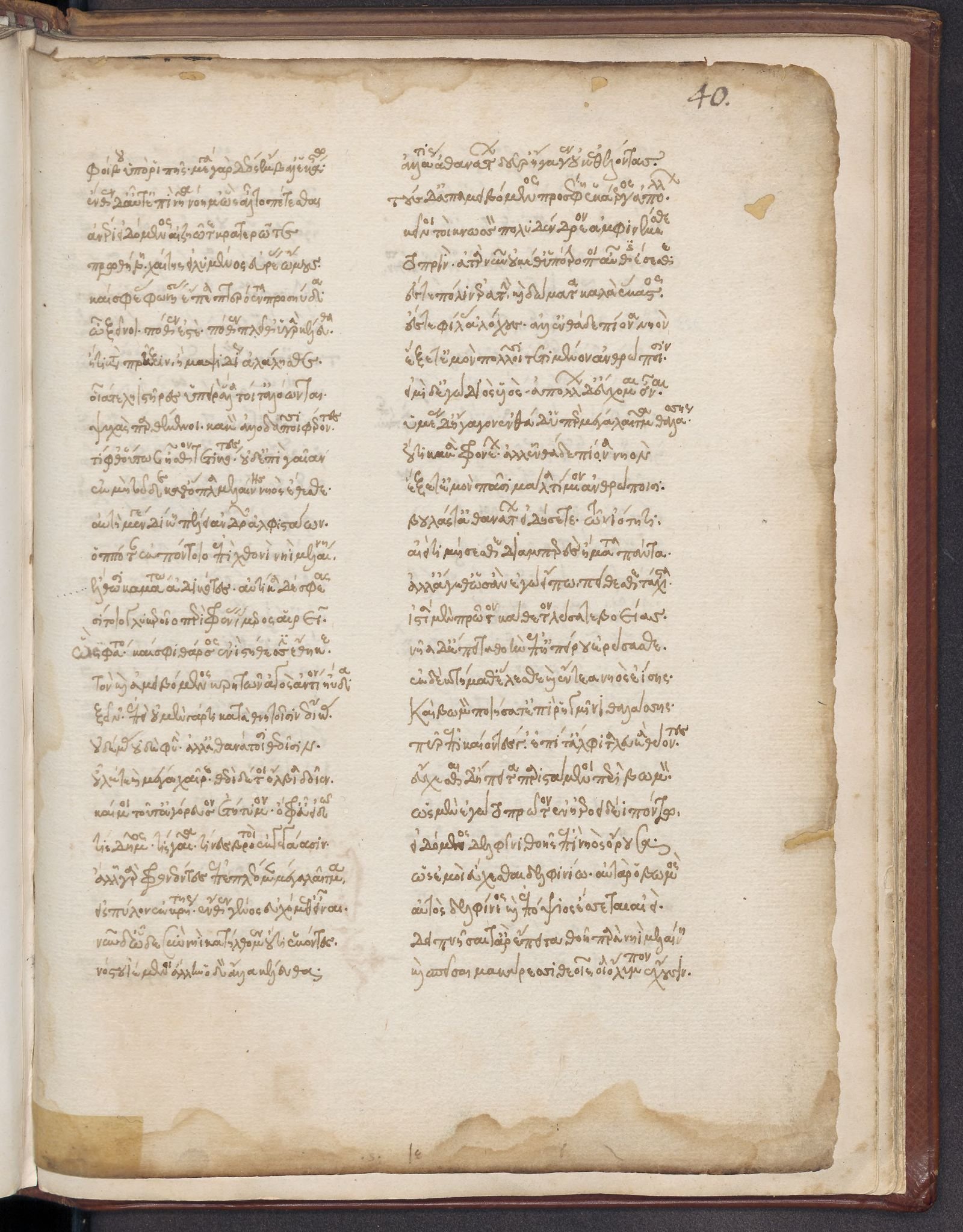
Leiden BPG 33 H, fol. 40r, column a (left): Hymn 3 447-472; begins ‹Φοίβου ὑπὸ ῥιπῆς· μέγα›, ends ‹ἄλλην ὁδόν, ἄλλα κέλευθα·›. Checked on the image: the first and last verses of the column were read and matched to the Greek. The column before ends with Hymn 3 446. The next column begins with Hymn 3 473. English blocks here: 445-449, 450-454, 455-459, 460-464, 465-469, 470-474.
447Φοίβου ὑπὸ ῥιπῆς· μέγα γὰρ δέος ἔμβαλʼ ἑκάστῳ.
448ἔνθεν δʼ αὖτʼ ἐπὶ νῆα νόημʼ ὣς ἆλτο πέτεσθαι,
449ἀνέρι εἰδόμενος αἰζηῷ τε κρατερῷ τε,
450πρωθήβῃ, χαίτῃς εἰλυμένος εὐρέας ὤμους·
451καί σφεας φωνήσας ἔπεα πτερόεντα προσηύδα·
452ὦ ξεῖνοι, τίνες ἐστέ; πόθεν πλεῖθʼ ὑγρὰ κέλευθα;
453ἤ τι κατὰ πρῆξιν ἢ μαψιδίως ἀλάλησθε
454οἷά τε ληιστῆρες ὑπεὶρ ἅλα, τοί τʼ ἀλόωνται
455ψυχὰς παρθέμενοι, κακὸν ἀλλοδαποῖσι φέροντες;
456τίφθʼ οὕτως ἧσθον τετιηότες, οὐδʼ ἐπὶ γαῖαν
457ἐκβῆτʼ, οὐδὲ καθʼ ὅπλα μελαίνης νηὸς ἔθεσθε;
458αὕτη μέν γε δίκη πέλει ἀνδρῶν ἀλφηστάων,
459ὁππότʼ ἂν ἐκ πόντοιο ποτὶ χθονὶ νηὶ μελαίνῃ
460ἔλθωσιν καμάτῳ ἀδηκότες, αὐτίκα δέ σφεας
461σίτοιο γλυκεροῖο περὶ φρένας ἵμερος αἱρεῖ.
462ὣς φάτο καί σφιν θάρσος ἐνὶ στήθεσσιν ἔθηκε.
463τὸν καὶ ἀμειβόμενος Κρητῶν ἀγὸς ἀντίον ηὔδα·
464ξεῖνʼ, ἐπεὶ οὐ μὲν γάρ τι καταθνητοῖσι ἔοικας,
465οὐ δέμας οὐδὲ φυήν, ἀλλʼ ἀθανάτοισι θεοῖσιν,
466οὖλέ τε καὶ μέγα χαῖρε, θεοὶ δέ τοι ὄλβια δοῖεν.
467καί μοι τοῦτʼ ἀγόρευσον ἐτήτυμον, ὄφρʼ εὖ εἰδῶ·
468τίς δῆμος; τίς γαῖα; τίνες βροτοὶ ἐγγεγάασιν;
469ἄλλῃ γὰρ φρονέοντες ἐπεπλέομεν μέγα λαῖτμα
470ἐς Πύλον ἐκ Κρήτης, ἔνθεν γένος εὐχόμεθʼ εἶναι·
471νῦν δʼ ὧδε ξὺν νηὶ κατήλθομεν οὔ τι ἑκόντες,
472νόστου ἱέμενοι, ἄλλην ὁδόν, ἄλλα κέλευθα·
445filled all Crisa, and the wives and well-girded daughters of the Crisaeans raised a cry at that outburst of Phoebus; for he cast great fear upon them all. From his shrine he sprang forth again, swift as a thought, to speed again to the ship, bearing the form of a man, brisk and sturdy, 450in the prime of his youth, while his broad shoulders were covered with his hair: and he spoke to the Cretans, uttering winged words: “Strangers, who are you? Whence come you sailing along the paths of the sea? Are you for traffic, or do you wander at random over the sea as pirates do who put 455their own lives to hazard and bring mischief to men of foreign parts as they roam? Why rest you so and are afraid, and do not go ashore nor stow the gear of your black ship? For that is the custom of men who live by bread, whenever they come to land in their dark ships from the main, 460spent with toil: at once desire for sweet food catches them about the heart.”So speaking, he put courage in their hearts, and the master of the Cretans answered him and said: “Stranger —though you are nothing like mortal men 465in shape or stature, but are as the deathless gods —hail and all happiness to you, and may the gods give you good. Now tell me truly that I may surely know it: what country is this, and what land, and what men live herein? As for us, with thoughts set otherwards, we were sailing over the great sea 470to Pylos from Crete (for from there we declare that we are sprung), but now are come on shipboard to this place by no means willingly —another way and other paths —and gladly would we return. But one of the deathless gods brought us here against our will.” Then far-working Apollo answered them and said:
Where on the image
Leiden BPG 33 H, fol. 40r, column b (right): Hymn 3 473-498; begins ‹ἀλλά τις ἀθανάτων δεῦρʼ›, ends ‹θεοῖς, οἳ Ὄλυμπον ἔχουσιν.›. Checked on the image: the first and last verses of the column were read and matched to the Greek. The column before ends with Hymn 3 472. The next column begins with Hymn 3 499. English blocks here: 475-479, 480-484, 485-489, 490-492, 493-494, 495-499.
473ἀλλά τις ἀθανάτων δεῦρʼ ἤγαγεν οὐκ ἐθέλοντας.
474τοὺς δʼ ἀπαμειβόμενος προσέφη ἑκάεργος Ἀπόλλων·
475ξεῖνοι, τοὶ Κνωσὸν πολυδένδρεον ἀμφενέμεσθε
476τὸ πρίν, ἀτὰρ νῦν οὐκ ἔθʼ ὑπότροποι αὖτις ἔσεσθε
477ἔς τε πόλιν ἐρατὴν καὶ δώματα καλὰ ἕκαστος
478ἔς τε φίλας ἀλόχους· ἀλλʼ ἐνθάδε πίονα νηὸν
479ἕξετʼ ἐμὸν πολλοῖσι τετιμένον ἀνθρώποισιν.
480εἰμὶ δʼ ἐγὼ Διὸς υἱός, Ἀπόλλων δʼ εὔχομαι εἶναι·
481ὑμέας δʼ ἤγαγον ἐνθάδʼ ὑπὲρ μέγα λαῖτμα θαλάσσης,
482οὔ τι κακὰ φρονέων, ἀλλʼ ἐνθάδε πίονα νηὸν
483ἕξετʼ ἐμὸν πᾶσιν μάλα τίμιον ἀνθρώποισι,
484βουλάς τʼ ἀθανάτων εἰδήσετε, τῶν ἰότητι
485αἰεὶ τιμήσεσθε διαμπερὲς ἤματα πάντα.
486ἀλλʼ ἄγεθʼ, ὡς ἂν ἐγὼ εἴπω, πείθεσθε τάχιστα·
487ἱστία μὲν πρῶτον κάθετον λύσαντε βοείας,
488νῆα δʼ ἔπειτα θοὴν μὲν ἐπʼ ἠπείρου ἐρύσασθε,
489ἐκ δὲ κτήμαθʼ ἕλεσθε καὶ ἔντεα νηὸς ἐίσης
490καὶ βωμὸν ποιήσατʼ ἐπὶ ῥηγμῖνι θαλάσσης·
491πῦρ δʼ ἐπικαίοντες ἐπί τʼ ἄλφιτα λευκὰ θύοντες
492εὔχεσθαι δὴ ἔπειτα παριστάμενοι περὶ βωμόν.
493ὡς μὲν ἐγὼ τὸ πρῶτον ἐν ἠεροειδέι πόντῳ
494εἰδόμενος δελφῖνι θοῆς ἐπὶ νηὸς ὄρουσα,
495ὣς ἐμοὶ εὔχεσθαι Δελφινίῳ· αὐτὰρ ὁ βωμὸς
496αὐτὸς Δελφίνιος καὶ ἐπόψιος ἔσσεται αἰεί.
497δειπνῆσαί τʼ ἄρʼ ἔπειτα θοῇ παρὰ νηὶ μελαίνῃ
498καὶ σπεῖσαι μακάρεσσι θεοῖς, οἳ Ὄλυμπον ἔχουσιν.
475“Strangers who once dwelt about wooded Cnossos but now shall return no more each to his loved city and fair house and dear wife; here shall you keep my rich temple that is honored by many men. 480I am the son of Zeus; Apollo is my name: but you I brought here over the wide gulf of the sea, meaning you no hurt; nay, here you shall keep my rich temple that is greatly honored among men, and you shall know the plans of the deathless gods, and by their will 485you shall be honored continually for all time. And now come, make haste and do as I say. First loose the sheets and lower the sail, and then draw the swift ship up upon the land. Take out your goods and the gear of the straight ship, 490and make an altar upon the beach of the sea: light fire upon it and make an offering of white meal. Next, stand side by side around the altar and pray: 493and in as much as at the first on the hazy sea I sprang upon the swift ship in the form of a dolphin, 495pray to me as Apollo Delphinius; also the altar itself shall be called Delphinius and overlooking for ever. Afterwards, sup beside your dark ship and pour an offering to the blessed gods who dwell on Olympus. But when you have put away craving for sweet food,
Where on the image
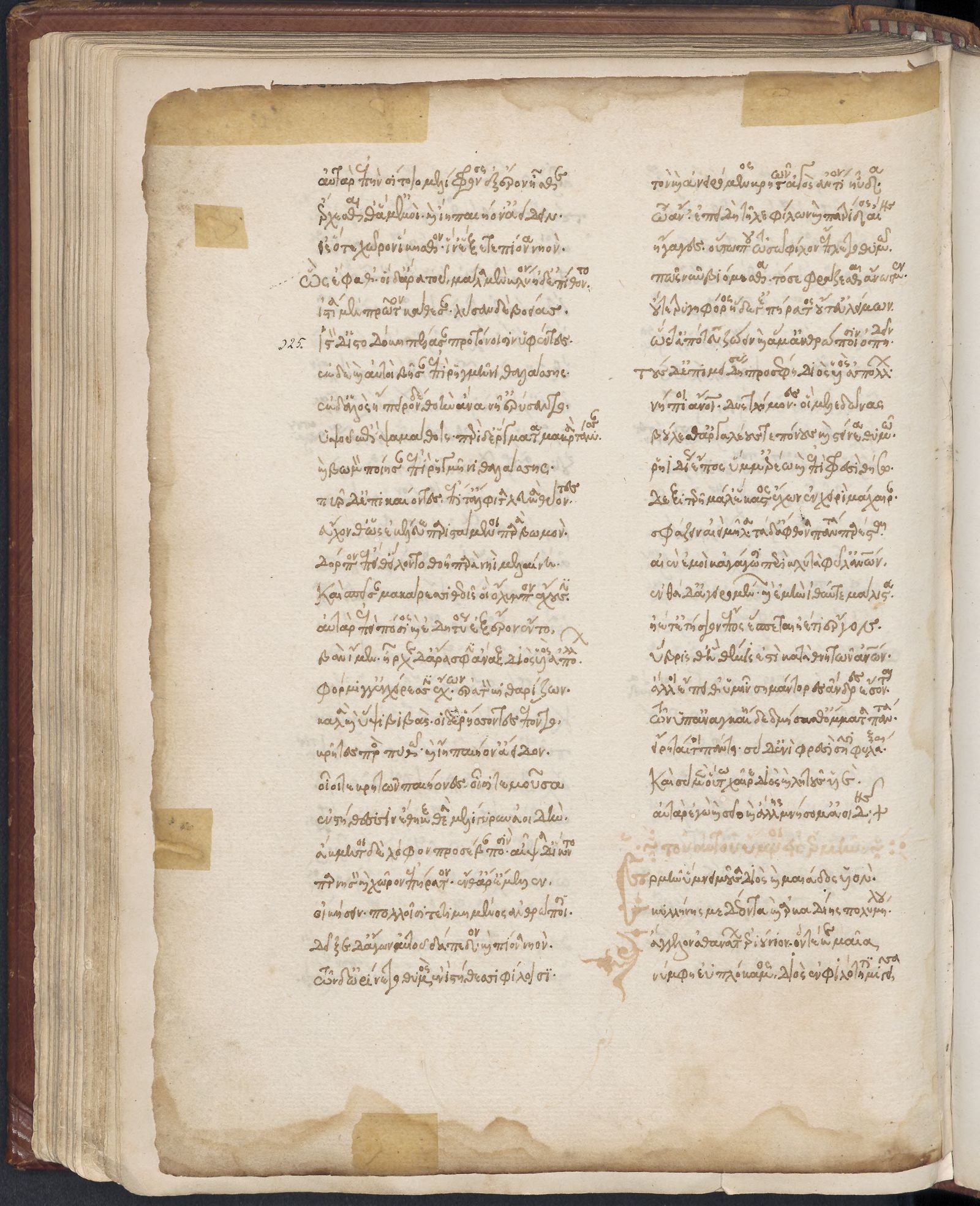
Leiden BPG 33 H, fol. 40v, column a (left): Hymn 3 499-524; begins ‹αὐτὰρ ἐπὴν σίτοιο μελίφρονος›, ends ‹θυμὸς ἐνὶ στήθεσσι φίλοισι·›. Checked on the image: the first and last verses of the column were read and matched to the Greek. The column before ends with Hymn 3 498. The next column begins with Hymn 3 525. English blocks here: 500-504, 505-509, 510-514, 515-519, 520-524.
499αὐτὰρ ἐπὴν σίτοιο μελίφρονος ἐξ ἔρον ἧσθε,
500ἔρχεσθαί θʼ ἅμʼ ἐμοὶ καὶ ἰηπαιήονʼ ἀείδειν,
501εἰς ὅ κε χῶρον ἵκησθον, ἵνʼ ἕξετε πίονα νηόν.
502ὣς ἔφαθʼ· οἳ δʼ ἄρα τοῦ μάλα μὲν κλύον ἠδʼ ἐπίθοντο.
503ἱστία μὲν πρῶτον κάθεσαν, λῦσαν δὲ βοείας,
504ἱστὸν δʼ ἱστοδόκῃ πέλασαν προτόνοισιν ὑφέντες·
505ἐκ δὲ καὶ αὐτοὶ βαῖνον ἐπὶ ῥηγμῖνι θαλάσσης.
506ἐκ δʼ ἁλὸς ἤπειρόνδε θοὴν ἀνὰ νῆʼ ἐρύσαντο
507ὑψοῦ ἐπὶ ψαμάθοις, ὑπὸ δʼ ἕρματα μακρὰ τάνυσσαν·
508καὶ βωμὸν ποίησαν ἐπὶ ῥηγμῖνι θαλάσσης·
509πῦρ δʼ ἐπικαίοντες ἐπί τʼ ἄλφιτα λευκὰ θύοντες
510εὔχονθʼ, ὡς ἐκέλευε, παριστάμενοι περὶ βωμόν.
511δόρπον ἔπειθʼ εἵλοντο θοῇ παρὰ νηὶ μελαίνῃ
512καὶ σπεῖσαν μακάρεσσι θεοῖς, οἳ Ὄλυμπον ἔχουσιν.
513αὐτὰρ ἐπεὶ πόσιος καὶ ἐδητύος ἐξ ἔρον ἕντο,
514βάν ῥʼ ἴμεν· ἦρχε δʼ ἄρα σφιν ἄναξ Διὸς υἱὸς Ἀπόλλων,
515φόρμιγγʼ ἐν χείρεσσιν ἔχων, ἐρατὸν κιθαρίζων,
516καλὰ καὶ ὕψι βιβάς· οἳ δὲ ῥήσσοντες ἕποντο
517Κρῆτες πρὸς Πυθὼ καὶ ἰηπαιήονʼ ἄειδον,
518οἷοί τε Κρητῶν παιήονες, οἷσί τε Μοῦσα
519ἐν στήθεσσιν ἔθηκε θεὰ μελίγηρυν ἀοιδήν.
520ἄκμητοι δὲ λόφον προσέβαν ποσίν, αἶψα δʼ ἵκοντο
521Παρνησὸν καὶ χῶρον ἐπήρατον, ἔνθʼ ἄρʼ ἔμελλον
522οἰκήσειν πολλοῖσι τετιμένοι ἀνθρώποισι·
523δεῖξε δʼ ἄγων ἄδυτον ζάθεον καὶ πίονα νηόν.
524τῶν δʼ ὠρίνετο θυμὸς ἐνὶ στήθεσσι φίλοισι·
500come with me singing the hymn Ie Paean (Hail, Healer!), until you come to the place where you shall keep my rich temple.” So said Apollo. And they readily harkened to him and obeyed him. First they unfastened the sheets and let down the sail and lowered the mast by the forestays upon the mast-rest. 505Then, landing upon the beach of the sea, they hauled up the ship from the water to dry land and fixed long stays under it. Also they made an altar upon the beach of the sea, and when they had lit a fire, made an offering of white meal, 510and prayed standing around the altar as Apollo had bidden them. Then they took their meal by the swift, black ship, and poured an offering to the blessed gods who dwell on Olympus. And when they had put away craving for drink and food, they started out with the lord Apollo, the son of Zeus, to lead them, 515holding a lyre in his hands, and playing sweetly as he stepped high and featly. So the Cretans followed him to Pytho, marching in time as they chanted the Ie Paean after the manner of the Cretan paean-singers and of those in whose hearts the heavenly Muse has put sweet-voiced song. 520With tireless feet they approached the ridge and straightway came to Parnassus and the lovely place where they were to dwell honored by many men. There Apollo brought them and showed them his most holy sanctuary and rich temple. But their spirit was stirred in their dear breasts,
Where on the image
Leiden BPG 33 H, fol. 40v, column b (right): Hymn 3 525-546; Hymn 4 1-4; begins ‹τὸν καὶ ἀνειρόμενος Κρητῶν›, ends ‹Διὸς ἐν φιλότητι μιγεῖσα,›. Checked on the image: the first and last verses of the column were read and matched to the Greek. The column before ends with Hymn 3 524. The next column begins with Hymn 4 5. The Hymn to Apollo ends with verse 546; a red title (faded) introduces the Hymn to Hermes. English blocks here: 525-529, 530-530, 531-534, 535-539, 540-544, 545-546.
525τὸν καὶ ἀνειρόμενος Κρητῶν ἀγὸς ἀντίον ηὔδα·
526ὦ ἄνα, εἰ δὴ τῆλε φίλων καὶ πατρίδος αἴης
527ἤγαγες· οὕτω που τῷ σῷ φίλον ἔπλετο θυμῷ·
528πῶς καὶ νῦν βιόμεσθα; τό σε φράζεσθαι ἄνωγμεν.
529οὔτε τρυγηφόρος ἥδε γʼ ἐπήρατος οὔτʼ εὐλείμων,
530ὥστʼ ἀπό τʼ εὖ ζώειν καὶ ἅμʼ ἀνθρώποισιν ὀπάζειν.
531τοὺς δʼ ἐπιμειδήσας προσέφη Διὸς υἱὸς Ἀπόλλων·
532νήπιοι ἄνθρωποι, δυστλήμονες, οἳ μελεδῶνας
533βούλεσθʼ ἀργαλέους τε πόνους καὶ στείνεα θυμῷ·
534ῥηίδιον ἔπος ὔμμʼ ἐρέω καὶ ἐπὶ φρεσὶ θήσω,
535δεξιτερῇ μάλʼ ἕκαστος ἔχων ἐν χειρὶ μάχαιραν,
536σφάζειν αἰεὶ μῆλα· τὰ δʼ ἄφθονα πάντα παρέσται,
537ὅσσα τʼ ἐμοί κʼ ἀγάγωσι περικλυτὰ φῦλʼ ἀνθρώπων·
538νηὸν δὲ προφύλαχθε, δέδεχθε δὲ φῦλʼ ἀνθρώπων
539ἐνθάδʼ ἀγειρομένων καὶ ἐμὴν ἰθύν τε μάλιστα.
540ἠέ τι τηΰσιον ἔπος ἔσσεται ἠέ τι ἔργον
541ὕβρις θʼ, ἣ θέμις ἐστὶ καταθνητῶν ἀνθρώπων,
542ἄλλοι ἔπειθʼ ὑμῖν σημάντορες ἄνδρες ἔσονται,
543τῶν ὑπʼ ἀναγκαίῃ δεδμήσεσθʼ ἤματα πάντα.
544εἴρηταί τοι πάντα· σὺ δὲ φρεσὶ σῇσι φύλαξαι.
545καὶ σὺ μὲν οὕτω χαῖρε, Διὸς καὶ Λητοῦς υἱέ·
546αὐτὰρ ἐγὼ καὶ σεῖο καὶ ἄλλης μνήσομʼ ἀοιδῆς.
525and the master of the Cretans asked him, saying: “Lord, since you have brought us here far from our dear ones and our fatherland, —for so it seemed good to your heart,—tell us now how we shall live. That we would know of you. This land is not to be desired either for vineyards or for pastures 530so that we can live well thereon and also minister to men.” 531Then Apollo, the son of Zeus, smiled upon them and said: “Foolish mortals and poor drudges are you, that you seek cares and hard toils and straits! Easily will I tell you a word and set it in your hearts. 535Though each one of you with knife in hand should slaughter sheep continually, yet would you always have abundant store, even all that the glorious tribes of men bring here for me. But guard you my temple and receive the tribes of men that gather to this place, 540or if there shall be any idle word or deed and outrage as is common among mortal men, then other men shall be your masters and with a strong hand shall make you subject for ever. All has been told you: do you keep it in your heart.” 545And so, farewell, son of Zeus and Leto; but I will remember you and another hymn also.
Notes
- Greek: H. G. Evelyn-White, Hesiod, the Homeric Hymns and Homerica (Loeb Classical Library, 1914), via Perseus. Square brackets mark the editor's restorations of text lost or doubtful in the manuscript.
- Lines the Loeb numbers with letters (137a, 236a, 317a, 526a and others) are editorial supplements or variants and are left out.
- English: Evelyn-White's translation in the same volume; his footnotes are omitted. English blocks that fall wholly in verses missing from M are left out (Hymn 3: 25-29, 30-34, 35-39, 40-44, 45-46, 47-49, 50-54, 55-59, 60-64, 65-69).
Cite
Sources
- Source: Leiden BPG 33 H (Leiden University Libraries IIIF) + Evelyn-White Greek (Loeb 1914, Perseus) + Evelyn-White English (1914, Perseus) (holding institution)
- Critical edition: Evelyn-White, Loeb 1914, via Perseus
← previous · → next · v cycle view · l back to library