Homeric Hymn 4, To Hermes
Introduction
The Homeric Hymns are 33 hexameter poems to the Greek gods, composed by anonymous poets between about the 7th and the 5th century BCE and handed down under Homer's name. This entry: Homeric Hymn 4, To Hermes. Hermes is born at dawn, invents the lyre by noon and steals Apollo's cattle by night; the brothers are reconciled when he gives Apollo the lyre.
This collection has Hymns 1-18 only. The manuscript shown, M, breaks off at Hymn 18, line 4 (fol. 50r; fol. 50v is blank), so the rest of Hymn 18 (lines 5-12) and Hymns 19-33 (to Pan, Hephaestus, Apollo, Poseidon, Zeus, Hestia, the Muses and Apollo, Dionysus, Artemis, Athena, Hestia, Earth, Helios, Selene and the Dioscuri) are not in it and are not given here.
The page photographs are from Leiden, Universiteitsbibliotheek, BPG 33 H (the 'Moscow' manuscript, M; paper, Greece?, first half of the 15th century; found in Moscow in 1777 by C. F. Matthaei), Homeric Hymns on fols. 31r-50r. M is the only manuscript of the Hymn to Demeter. Each section below is one column of a page (a = left, b = right); its note gives the first and last verse as read on the photograph. This entry is on fol. 40v, 41r, 41v, 42r, 42v, 43r, 43v, 44r, 44v, 45r, 45v, 46r.
Verses of the Loeb text that are not in this manuscript, and so are not shown: Hymn 4: 499.
The Greek is Evelyn-White's Loeb text (1914) via Perseus, not a transcription of the manuscript; where M is damaged the edition's restorations are shown in square brackets. The English is Evelyn-White's prose translation (1914), in blocks of about five lines, so a block can begin a line or two before or after a column break.
How was this verified? (Provenance)
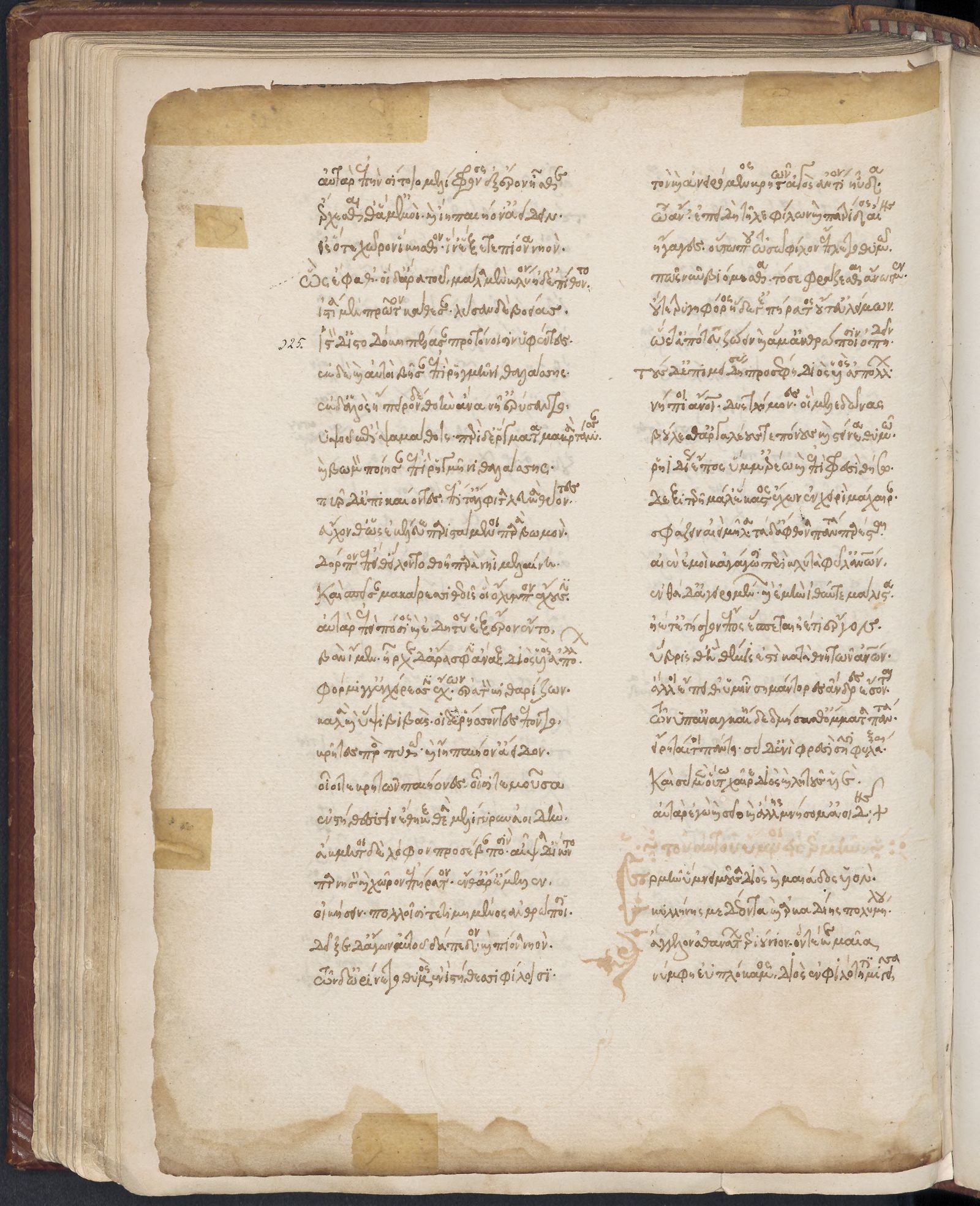
Where on the image
Leiden BPG 33 H, fol. 40v, column b (right): Hymn 3 525-546; Hymn 4 1-4; begins ‹τὸν καὶ ἀνειρόμενος Κρητῶν›, ends ‹Διὸς ἐν φιλότητι μιγεῖσα,›. Checked on the image: the first and last verses of the column were read and matched to the Greek. The column before ends with Hymn 3 524. The next column begins with Hymn 4 5. The Hymn to Apollo ends with verse 546; a red title (faded) introduces the Hymn to Hermes. English blocks here: 1-4.
1Ἑρμῆν ὕμνει, Μοῦσα, Διὸς καὶ Μαιάδος υἱόν,
2Κυλλήνης μεδέοντα καὶ Ἀρκαδίης πολυμήλου,
3ἄγγελον ἀθανάτων ἐριούνιον, ὃν τέκε Μαῖα,
4νύμφη ἐυπλόκαμος, Διὸς ἐν φιλότητι μιγεῖσα,
1Muse, sing of Hermes, the son of Zeus and Maia, lord of Cyllene and Arcadia rich in flocks, the luck-bringing messenger of the immortals whom Maia bare, the rich-tressed nymph, when she was joined in love with Zeus,
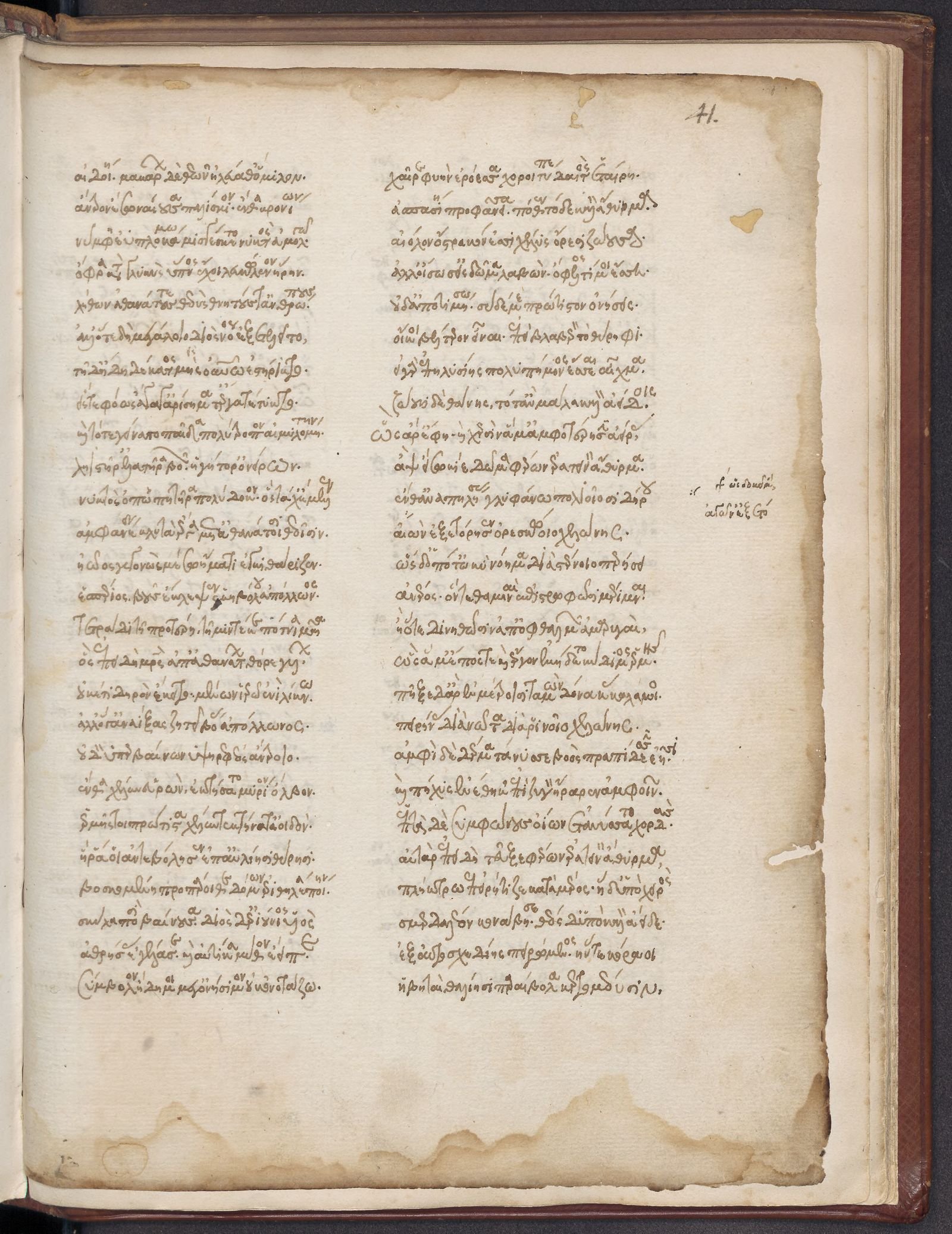
Where on the image
Leiden BPG 33 H, fol. 41r, column a (left): Hymn 4 5-30; begins ‹αἰδοίη· μακάρων δὲ θεῶν›, ends ‹μέγʼ ὀνήσιμον· οὐκ ὀνοτάζω.›. Checked on the image: the first and last verses of the column were read and matched to the Greek. The column before ends with Hymn 4 4. The next column begins with Hymn 4 31. English blocks here: 5-9, 10-14, 15-19, 20-24, 25-29.
5αἰδοίη· μακάρων δὲ θεῶν ἠλεύαθʼ ὅμιλον,
6ἄντρον ἔσω ναίουσα παλισκίον, ἔνθα Κρονίων
7νύμφῃ ἐυπλοκάμῳ μισγέσκετο νυκτὸς ἀμολγῷ,
8ὄφρα κατὰ γλυκὺς ὕπνος ἔχοι λευκώλενον Ἥρην,
9λήθων ἀθανάτους τε θεοὺς θνητούς τʼ ἀνθρώπους.
10ἀλλʼ ὅτε δὴ μεγάλοιο Διὸς νόος ἐξετελεῖτο,
11τῇ δʼ ἤδη δέκατος μεὶς οὐρανῷ ἐστήρικτο,
12εἴς τε φόως ἄγαγεν ἀρίσημά τε ἔργα τέτυκτο·
13καὶ τότʼ ἐγείνατο παῖδα πολύτροπον, αἱμυλομήτην,
14ληιστῆρʼ, ἐλατῆρα βοῶν, ἡγήτορʼ ὀνείρων,
15νυκτὸς ὀπωπητῆρα, πυληδόκον, ὃς τάχʼ ἔμελλεν
16ἀμφανέειν κλυτὰ ἔργα μετʼ ἀθανάτοισι θεοῖσιν.
17ἠῷος γεγονὼς μέσῳ ἤματι ἐγκιθάριζεν,
18ἑσπέριος βοῦς κλέψεν ἑκηβόλου Ἀπόλλωνος
19τετράδι τῇ προτέρῃ, τῇ μιν τέκε πότνια Μαῖα.
20ὃς καί, ἐπειδὴ μητρὸς ἀπʼ ἀθανάτων θόρε γυίων,
21οὐκέτι δηρὸν ἔκειτο μένων ἱερῷ ἐνὶ λίκνῳ,
22ἀλλʼ ὅ γʼ ἀναΐξας ζήτει βόας Ἀπόλλωνος
23οὐδὸν ὑπερβαίνων ὑψηρεφέος ἄντροιο.
24ἔνθα χέλυν εὑρὼν ἐκτήσατο μυρίον ὄλβον·
25Ἑρμῆς τοι πρώτιστα χέλυν τεκτήνατʼ ἀοιδόν·
26ἥ ῥά οἱ ἀντεβόλησεν ἐπʼ αὐλείῃσι θύρῃσι
27βοσκομένη προπάροιθε δόμων ἐριθηλέα ποίην,
28σαῦλα ποσὶν βαίνουσα· Διὸς δʼ ἐριούνιος υἱὸς
29ἀθρήσας ἐγέλασσε καὶ αὐτίκα μῦθον ἔειπε·
30σύμβολον ἤδη μοι μέγʼ ὀνήσιμον· οὐκ ὀνοτάζω.
5—a shy goddess, for she avoided the company of the blessed gods, and lived within a deep, shady cave. There the son of Cronos used to lie with the rich-tressed nymph, unseen by deathless gods and mortal men, at dead of night while sweet sleep should hold white-armed Hera fast. 10And when the purpose of great Zeus was fulfilled, and the tenth moon with her was fixed in heaven, she was delivered and a notable thing was come to pass. For then she bare a son, of many shifts, blandly cunning, a robber, a cattle driver, a bringer of dreams, 15a watcher by night, a thief at the gates, one who was soon to show forth wonderful deeds among the deathless gods. Born with the dawning, at mid-day he played on the lyre, and in the evening he stole the cattle of far-shooting Apollo on the fourth day of the month; for on that day queenly Maia bare him. 20So soon as he had leaped from his mother's heavenly womb, he lay not long waiting in his holy cradle, but he sprang up and sought the oxen of Apollo. But as he stepped over the threshold of the high-roofed cave, he found a tortoise there and gained endless delight. 25For it was Hermes who first made the tortoise a singer. The creature fell in his way at the courtyard gate, where it was feeding on the rich grass before the dwelling, waddling along. When he saw it, the luck-bringing son of Zeus laughed and said:
Where on the image
Leiden BPG 33 H, fol. 41r, column b (right): Hymn 4 31-56; begins ‹χαῖρε, φυὴν ἐρόεσσα, χοροίτυπε,›, ends ‹ἡβηταὶ θαλίῃσι παραιβόλα κερτομέουσιν,›. Checked on the image: the first and last verses of the column were read and matched to the Greek. The column before ends with Hymn 4 30. The next column begins with Hymn 4 57. English blocks here: 30-34, 35-39, 40-44, 45-49, 50-54.
31χαῖρε, φυὴν ἐρόεσσα, χοροίτυπε, δαιτὸς ἑταίρη,
32ἀσπασίη προφανεῖσα· πόθεν τόδε καλὸν ἄθυρμα
33αἰόλον ὄστρακον ἕσσο χέλυς ὄρεσι ζώουσα;
34ἀλλʼ οἴσω σʼ ἐς δῶμα λαβών· ὄφελός τι μοι ἔσσῃ,
35οὐδʼ ἀποτιμήσω· σὺ δέ με πρώτιστον ὀνήσεις
36οἴκοι βέλτερον εἶναι, ἐπεὶ βλαβερὸν τὸ θύρηφιν·
37ἦ γὰρ ἐπηλυσίης πολυπήμονος ἔσσεαι ἔχμα
38ζώουσʼ· ἢν δὲ θάνῃς, τότε κεν μάλα καλὸν ἀείδοις.
39ὣς ἂρʼ ἔφη· καὶ χερσὶν ἅμʼ ἀμφοτέρῃσιν ἀείρας
40ἂψ εἴσω κίε δῶμα φέρων ἐρατεινὸν ἄθυρμα.
41ἔνθʼ ἀναπηρώσας γλυφάνῳ πολιοῖο σιδήρου
42αἰῶνʼ ἐξετόρησεν ὀρεσκῴοιο χελώνης.
43ὡς δʼ ὁπότʼ ὠκὺ νόημα διὰ στέρνοιο περήσῃ
44ἀνέρος, ὅν τε θαμειαὶ ἐπιστρωφῶσι μέριμναι,
45ἢ ὅτε δινηθῶσιν ἀπʼ ὀφθαλμῶν ἀμαρυγαί,
46ὣς ἅμʼ ἔπος τε καὶ ἔργον ἐμήδετο κύδιμος Ἑρμῆς.
47πῆξε δʼ ἄρʼ ἐν μέτροισι ταμὼν δόνακας καλάμοιο
48πειρήνας διὰ νῶτα διὰ ῥίνοιο χελώνης.
49ἀμφὶ δὲ δέρμα τάνυσσε βοὸς πραπίδεσσιν ἑῇσι
50καὶ πήχεις ἐνέθηκʼ, ἐπὶ δὲ ζυγὸν ἤραρεν ἀμφοῖν,
51ἑπτὰ δὲ θηλυτέρων ὀίων ἐτανύσσατο χορδάς.
52αὐτὰρ ἐπεὶ δὴ τεῦξε λύρην ἐρατεινὸν ἄθυρμα,
53πλήκτρῳ ἐπειρήτιζε κατὰ μέρος· ἣ δʼ ὑπὸ χειρὸς
54σμερδαλέον κονάβησε· θεὸς δʼ ὑπὸ καλὸν ἄειδεν
55ἐξ αὐτοσχεδίης πειρώμενος, ἠύτε κοῦροι
56ἡβηταὶ θαλίῃσι παραιβόλα κερτομέουσιν,
30“An omen of great luck for me so soon! I do not slight it. Hail, comrade of the feast, lovely in shape, sounding at the dance! With joy I meet you! Where got you that rich gaud for covering, that spangled shell —a tortoise living in the mountains? But I will take and carry you within: you shall help me 35and I will do you no disgrace, though first of all you must profit me. It is better to be at home: harm may come out of doors. Living, you shall be a spell against mischievous witchcraft; but if you die, then you shall make sweetest song.” Thus speaking, he took up the tortoise in both hands 40and went back into the house carrying his charming toy. Then he cut off its limbs and scooped out the marrow of the mountain-tortoise with a scoop of grey iron. As a swift thought darts through the heart of a man when thronging cares haunt him, 45or as bright glances flash from the eye, so glorious Hermes planned both thought and deed at once. He cut stalks of reed to measure and fixed them, fastening their ends across the back and through the shell of the tortoise, and then stretched ox hide all over it by his skill. 50Also he put in the horns and fitted a cross-piece upon the two of them, and stretched seven strings of sheep-gut. But when he had made it he proved each string in turn with the key, as he held the lovely thing.
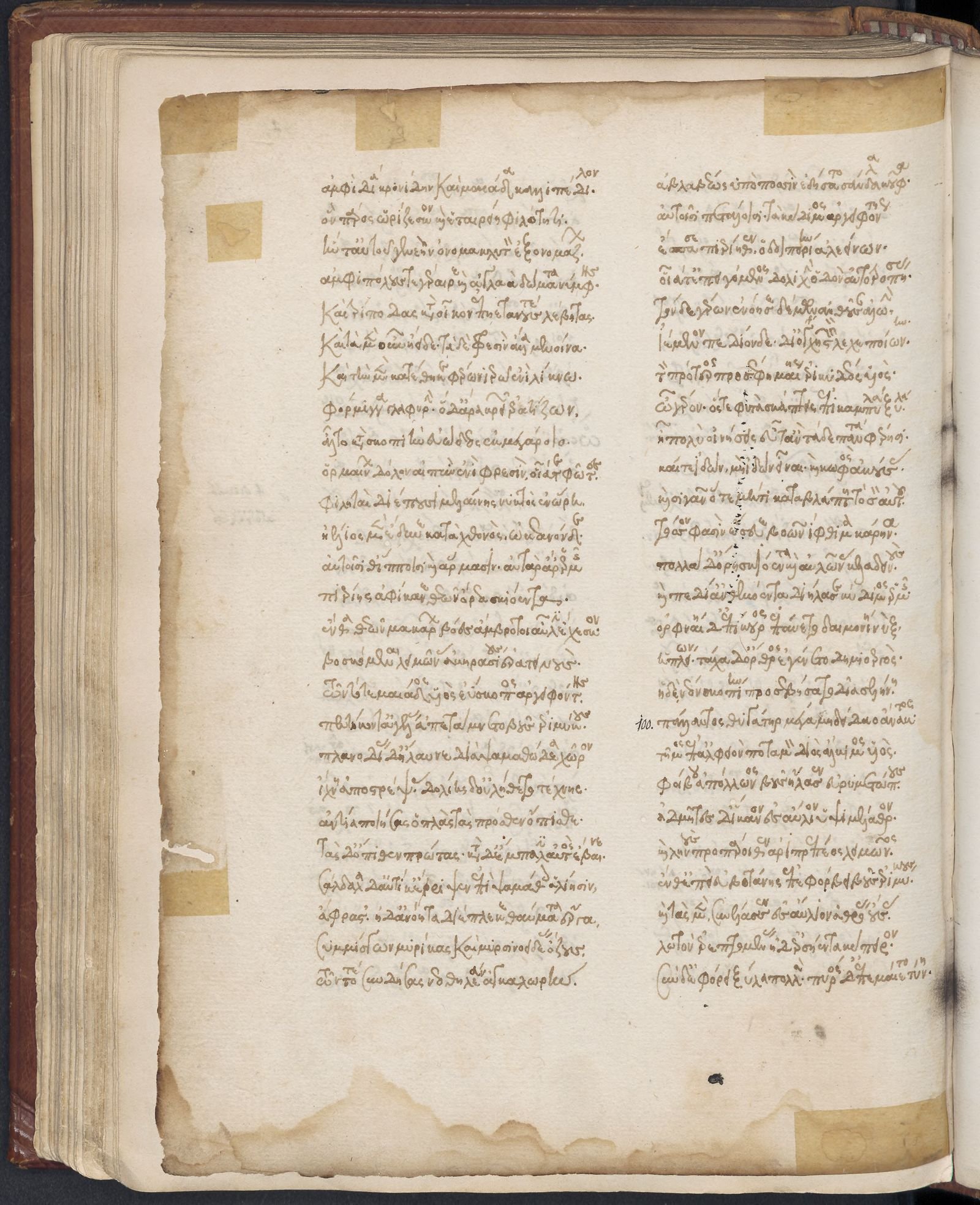
Where on the image
Leiden BPG 33 H, fol. 41v, column a (left): Hymn 4 57-82; begins ‹ἀμφὶ Δία Κρονίδην καὶ›, ends ‹συνδήσας νεοθηλέος ἄγκαλον ὕλης›. Checked on the image: the first and last verses of the column were read and matched to the Greek. The column before ends with Hymn 4 56. The next column begins with Hymn 4 83. English blocks here: 55-59, 60-61, 62-64, 65-69, 70-74, 75-79, 80-84.
57ἀμφὶ Δία Κρονίδην καὶ Μαιάδα καλλιπέδιλον,
58ὡς πάρος ὠρίζεσκον ἑταιρείῃ φιλότητι,
59ἥν τʼ αὐτοῦ γενεὴν ὀνομακλυτὸν ἐξονομάζων·
60ἀμφιπόλους τε γέραιρε καὶ ἀγλαὰ δώματα νύμφης
61καὶ τρίποδας κατὰ οἶκον ἐπηετανούς τε λέβητας.
62καὶ τὰ μὲν οὖν ἤειδε, τὰ δὲ φρεσὶν ἄλλα μενοίνα.
63καὶ τὴν μὲν κατέθηκε φέρων ἱερῷ ἐνὶ λίκνῳ,
64φόρμιγγα γλαφυρήν· ὃ δʼ ἄρα κρειῶν ἐρατίζων
65ἆλτο κατὰ σκοπιὴν εὐώδεος ἐκ μεγάροιο
66ὁρμαίνων δόλον αἰπὺν ἐνὶ φρεσίν, οἷά τε φῶτες
67φηληταὶ διέπουσι μελαίνης νυκτὸς ἐν ὥρῃ.
68ἠέλιος μὲν ἔδυνε κατὰ χθονὸς Ὠκεανόνδε
69αὐτοῖσίν θʼ ἵπποισι καὶ ἅρμασιν· αὐτὰρ ἄρʼ Ἑρμῆς
70Πιερίης ἀφίκανε θέων ὄρεα σκιόεντα,
71ἔνθα θεῶν μακάρων βόες ἄμβροτοι αὖλιν ἔχεσκον
72βοσκόμεναι λειμῶνας ἀκηρασίους, ἐρατεινούς.
73τῶν τότε Μαιάδος υἱός, ἐύσκοπος Ἀργειφόντης,
74πεντήκοντʼ ἀγέλης ἀπετάμνετο βοῦς ἐριμύκους.
75πλανοδίας δʼ ἤλαυνε διὰ ψαμαθώδεα χῶρον
76ἴχνιʼ ἀποστρέψας· δολίης δʼ οὐ λήθετο τέχνης
77ἀντία ποιήσας ὁπλάς, τὰς πρόσθεν ὄπισθεν,
78τὰς δʼ ὄπιθεν πρόσθεν· κατὰ δʼ ἔμπαλιν αὐτὸς ἔβαινε.
79σάνδαλα δʼ αὐτίκα ῥιψὶν ἐπὶ ψαμάθοις ἁλίῃσιν,
80ἄφραστʼ ἠδʼ ἀνόητα διέπλεκε, θαυματὰ ἔργα,
81συμμίσγων μυρίκας καὶ μυρσινοειδέας ὄζους.
82τῶν τότε συνδήσας νεοθηλέος ἄγκαλον ὕλης
55At the touch of his hand it sounded marvelously; and, as he tried it, the god sang sweet random snatches, even as youths bandy taunts at festivals. He sang of Zeus the son of Cronos and neat-shod Maia, the converse which they had before in the comradeship of love, telling all the glorious tale of his own begetting. 60He celebrated, too, the handmaids of the nymph, and her bright home, and the tripods all about the house, and the abundant cauldrons. 62But while he was singing of all these, his heart was bent on other matters. And he took the hollow lyre and laid it in his sacred cradle, 65and sprang from the sweet-smelling hall to a watch-place, pondering sheer trickery in his heart —deeds such as knavish folk pursue in the dark night-time; for he longed to taste flesh. The Sun was going down beneath the earth towards Ocean with his horses and chariot when Hermes 70came hurrying to the shadowy mountains of Pieria, where the divine cattle of the blessed gods had their steads and grazed the pleasant, unmown meadows. Of these the Son of Maia, the sharp-eyed slayer of Argus then cut off from the herd fifty loud-lowing kine, 75and drove them straggling-wise across a sandy place, turning their hoof-prints aside. Also, he bethought him of a crafty ruse and reversed the marks of their hoofs, making the front behind and the hind before, while he himself walked the other way. Then he wove sandals with wicker-work by the sand of the sea, 80wonderful things, unthought of, unimagined; for he mixed together tamarisk and myrtle-twigs, fastening together an armful of their fresh, young wood, and tied them, leaves and all securely under his feet as light sandals. That brushwood the glorious Slayer of Argus
Where on the image
Leiden BPG 33 H, fol. 41v, column b (right): Hymn 4 83-108; begins ‹ἀβλαβέως ὑπὸ ποσσὶν ἐδήσατο›, ends ‹πυρὸς δʼ ἐπεμαίετο τέχνην.›. Checked on the image: the first and last verses of the column were read and matched to the Greek. The column before ends with Hymn 4 82. The next column begins with Hymn 4 109. English blocks here: 85-89, 90-93, 94-94, 95-99, 100-104, 105-109.
83ἀβλαβέως ὑπὸ ποσσὶν ἐδήσατο σάνδαλα κοῦφα
84αὐτοῖσιν πετάλοισι τὰ κύδιμος Ἀργειφόντης
85ἔσπασε Πιερίηθεν ὁδοιπορίην ἀλεγύνων,
86οἷά τʼ ἐπειγόμενος δολιχὴν ὁδόν, αὐτοτροπήσας.†
87τὸν δὲ γέρων ἐνόησε δέμων ἀνθοῦσαν ἀλωὴν
88ἱέμενον πεδίονδε διʼ Ὀγχηστὸν λεχεποίην
89τὸν πρότερος προσέφη Μαίης ἐρικυδέος υἱός·
90ὦ γέρον, ὅστε φυτὰ σκάπτεις ἐπικαμπύλος ὤμους,
91ἦ πολυοινήσεις, εὖτʼ ἂν τάδε πάντα φέρῃσι,
92καί τε ἰδὼν μὴ ἰδὼν εἶναι καὶ κωφὸς ἀκούσας,
93καὶ σιγᾶν ὅτε μή τι καταβλάπτῃ τὸ σὸν αὐτοῦ.
94τόσσον φὰς συνέσευε βοῶν ἴφθιμα κάρηνα.
95πολλὰ δʼ ὄρη σκιόεντα καὶ αὐλῶνας κελαδεινοὺς
96καὶ πεδίʼ ἀνθεμόεντα διήλασε κύδιμος Ἑρμῆς.
97ὀρφναίη δʼ ἐπίκουρος ἐπαύετο δαιμονίη νύξ,
98ἡ πλείων, τάχα δʼ ὄρθρος ἐγίγνετο δημιοεργός·
99ἣ δὲ νέον σκοπιὴν προσεβήσατο δῖα Σελήνη,
100Πάλλαντος θυγάτηρ Μεγαμηδείδαο ἄνακτος.
101τῆμος ἐπʼ Ἀλφειὸν ποταμὸν Διὸς ἄλκιμος υἱὸς
102Φοίβου Ἀπόλλωνος βοῦς ἤλασεν εὐρυμετώπους.
103ἀκμῆτες δʼ ἵκανον ἐπʼ αὔλιον ὑψιμέλαθρον
104καὶ ληνοὺς προπάροιθεν ἀριπρεπέος λειμῶνος.
105ἔνθʼ ἐπεὶ εὖ βοτάνης ἐπεφόρβει βοῦς ἐριμύκους
106καὶ τὰς μὲν συνέλασσεν ἐς αὔλιον ἀθρόας οὔσας,
107λωτὸν ἐρεπτομένας ἠδʼ ἑρσήεντα κύπειρον·
108σὺν δʼ ἐφόρει ξύλα πολλά, πυρὸς δʼ ἐπεμαίετο τέχνην.
85plucked in Pieria as he was preparing for his journey, making shift as one making haste for a long journey. But an old man tilling his flowering vineyard saw him as he was hurrying down the plain through grassy Onchestus. So the Son of Maia began and said to him: 90“Old man, digging about your vines with bowed shoulders, surely you shall have much wine when all these bear fruit, 94When he had said this much, he hurried the strong cattle on together: 95through many shadowy mountains and echoing gorges and flowery plains glorious Hermes drove them. And now the divine night, his dark ally, was mostly passed, and dawn that sets folk to work was quickly coming on, while bright Selene, 100daughter of the lord Pallas, Megamedes' son, had just climbed her watch-post, when the strong Son of Zeus drove the wide-browed cattle of Phoebus Apollo to the river Alpheus. And they came unwearied to the high-roofed byres and the drinking-troughs that were before the noble meadow. 105Then, after he had well-fed the loud-bellowing cattle with fodder and driven them into the byre, close-packed and chewing lotus and dewy galingal, he gathered a pile of wood and began to seek the art of fire. He chose a stout laurel branch and trimmed it with the knife
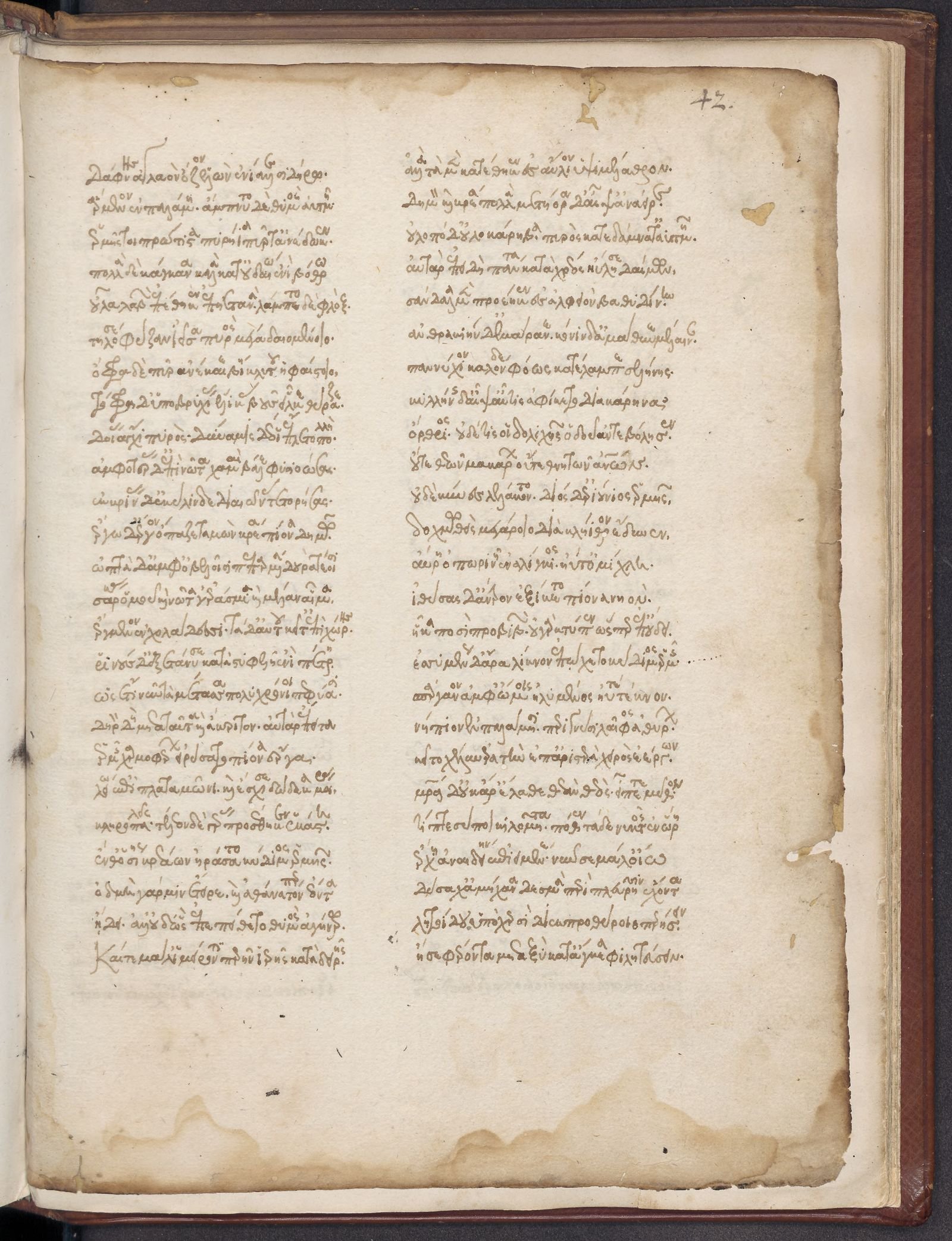
Where on the image
Leiden BPG 33 H, fol. 42r, column a (left): Hymn 4 109-133; begins ‹δάφνης ἀγλαὸν ὄζον ἑλὼν›, ends ‹περῆν† ἱερῆς κατὰ δειρῆς.›. Checked on the image: the first and last verses of the column were read and matched to the Greek. The column before ends with Hymn 4 108. The next column begins with Hymn 4 134. English blocks here: 110-114, 115-119, 120-124, 125-129, 130-133.
109δάφνης ἀγλαὸν ὄζον ἑλὼν ἀπέλεψε σιδήρῳ
110…ἄρμενον ἐν παλάμῃ· ἄμπνυτο δὲ θερμὸς ἀυτμή·
111Ἑρμῆς τοι πρώτιστα πυρήια πῦρ τʼ ἀνέδωκε.
112πολλὰ δὲ κάγκανα κᾶλα κατουδαίῳ ἐνὶ βόθρῳ
113οὖλα λαβὼν ἐπέθηκεν ἐπηετανά· λάμπετο δὲ φλὸξ
114τηλόσε φῦσαν ἱεῖσα πυρὸς μέγα δαιομένοιο.
115ὄφρα δὲ πῦρ ἀνέκαιε βίη κλυτοῦ Ἡφαίστοιο,
116τόφρα δʼ ὑποβρύχους ἕλικας βοῦς εἷλκε θύραζε
117δοιὰς ἄγχι πυρός· δύναμις δέ οἱ ἕσπετο πολλή.
118ἀμφοτέρας δʼ ἐπὶ νῶτα χαμαὶ βάλε φυσιοώσας·
119ἀγκλίνων δʼ ἐκύλινδε διʼ αἰῶνας τετορήσας.
120ἔργῳ δʼ ἔργον ὄπαζε ταμὼν κρέα πίονα δημῷ·
121ὤπτα δʼ ἀμφʼ ὀβελοῖσι πεπαρμένα δουρατέοισι
122σάρκας ὁμοῦ καὶ νῶτα γεράσμια καὶ μέλαν αἷμα
123ἐργμένον ἐν χολάδεσσι· τὰ δʼ αὐτοῦ κεῖτʼ ἐπὶ χώρης·
124ῥινοὺς δʼ ἐξετάνυσσε καταστυφέλῳ ἐνὶ πέτρῃ,
125ὡς ἔτι νῦν τὰ μέτασσα πολυχρόνιοι πεφύασι,
126δηρὸν δὴ μετὰ ταῦτα καὶ ἄκριτον· αὐτὰρ ἔπειτα
127Ἑρμῆς χαρμόφρων εἰρύσατο πίονα ἔργα
128λείῳ ἐπὶ πλαταμῶνι καὶ ἔσχισε δώδεκα μοίρας
129κληροπαλεῖς· τέλεον δὲ γέρας προσέθηκεν ἑκάστῃ.
130ἔνθʼ ὁσίης κρεάων ἠράσσατο κύδιμος Ἑρμῆς·
131ὀδμὴ γάρ μιν ἔτειρε καὶ ἀθάνατόν περ ἐόντα
132ἡδεῖʼ· ἀλλʼ οὐδʼ ὥς οἱ ἐπείθετο θυμὸς ἀγήνωρ,
133καί τε μάλʼ ἱμείροντι, περῆν† ἱερῆς κατὰ δειρῆς.
110held firmly in his hand: and the hot smoke rose up. For it was Hermes who first invented fire-sticks and fire. Next he took many dried sticks and piled them thick and plenty in a sunken trench: and flame began to glow, spreading afar the blast of fierce-burning fire. 115And while the strength of glorious Hephaestus was beginning to kindle the fire, he dragged out two lowing, horned cows close to the fire; for great strength was with him. He threw them both panting upon their backs on the ground, and rolled them on their sides, bending their necks over, and pierced their vital chord. 120Then he went on from task to task: first he cut up the rich, fatted meat, and pierced it with wooden spits, and roasted flesh and the honorable chine and the paunch full of dark blood all together. He laid them there upon the ground, and spread out the hides on a rugged rock: 125and so they are still there many ages afterwards, a long, long time after all this, and are continually. Next glad-hearted Hermes dragged the rich meats he had prepared and put them on a smooth, flat stone, and divided them into twelve portions distributed by lot, making each portion wholly honorable. 130Then glorious Hermes longed for the sacrificial meat, for the sweet savour wearied him, god though he was; nevertheless his proud heart was not prevailed upon to devour the flesh, although he greatly desired.
Where on the image
Leiden BPG 33 H, fol. 42r, column b (right): Hymn 4 134-159; begins ‹ἀλλὰ τὰ μὲν κατέθηκεν›, ends ‹μεταξὺ κατʼ ἄγκεα φηλητεύσειν.›. Checked on the image: the first and last verses of the column were read and matched to the Greek. The column before ends with Hymn 4 133. The next column begins with Hymn 4 160. English blocks here: 134-134, 135-139, 140-144, 145-149, 150-154, 155-159.
134ἀλλὰ τὰ μὲν κατέθηκεν ἐς αὔλιον ὑψιμέλαθρον,
135δημὸν καὶ κρέα πολλά, μετήορα δʼ αἶψʼ ἀνάειρε,
136σῆμα νέης φωρῆς· ἐπὶ δὲ ξύλα κάγκανʼ ἀγείρας
137οὐλόποδʼ, οὐλοκάρηνα πυρὸς κατεδάμνατʼ ἀυτμῇ.
138αὐτὰρ ἐπεί τοι πάντα κατὰ χρέος ἤνυσε δαίμων,
139σάνδαλα μὲν προέηκεν ἐς Ἀλφειὸν βαθυδίνην·
140ἀνθρακιὴν δʼ ἐμάρανε, κόνιν δʼ ἀμάθυνε μέλαιναν
141παννύχιος· καλὸν δὲ φόως κατέλαμπε Σελήνης.
142Κυλλήνης δʼ αἶψʼ αὖτις ἀφίκετο δῖα κάρηνα
143ὄρθριος, οὐδέ τί οἱ δολιχῆς ὁδοῦ ἀντεβόλησεν
144οὔτε θεῶν μακάρων οὔτε θνητῶν ἀνθρώπων,
145οὐδὲ κύνες λελάκοντο· Διὸς δʼ ἐριούνιος Ἑρμῆς
146δοχμωθεὶς μεγάροιο διὰ κλήιθρον ἔδυνεν
147αὔρῃ ὀπωρινῇ ἐναλίγκιος, ἠύτʼ ὀμίχλη.
148ἰθύσας δʼ ἄντρου ἐξίκετο πίονα νηὸν
149ἦκα ποσὶ προβιβῶν· οὐ γὰρ κτύπεν, ὥσπερ ἐπʼ οὔδει.
150ἐσσυμένως δʼ ἄρα λίκνον ἐπῴχετο κύδιμος Ἑρμῆς·
151σπάργανον ἀμφʼ ὤμοις εἰλυμένος, ἠύτε τέκνον
152νήπιον, ἐν παλάμῃσι περʼ ἰγνύσι λαῖφος ἀθύρων
153κεῖτο, χέλυν ἐρατὴν ἐπʼ ἀριστερὰ χειρὸς ἐέργων.
154μητέρα δʼ οὐκ ἄρʼ ἔληθε θεὰν θεὸς εἰπέ τε μῦθον·
155τίπτε σύ, ποικιλομῆτα, πόθεν τόδε νυκτὸς ἐν ὥρῃ
156ἔρχῃ, ἀναιδείην ἐπιειμένε; νῦν σε μάλʼ οἴω
157ἢ τάχʼ ἀμήχανα δεσμὰ περὶ πλευρῇσιν ἔχοντα
158Λητοίδου ὑπὸ χερσὶ διὲκ προθύροιο περήσειν
159ἣ σὲ φέροντα μεταξὺ κατʼ ἄγκεα φηλητεύσειν.
134But he put away in the high-roofed byre 135the fat and all the flesh, placing them high up to be a token of his youthful theft. And after that he gathered dry sticks and utterly destroyed with fire all the hoofs and all the heads. And when the god had duly finished all, he threw his sandals into deep-eddying Alpheus, 140and quenched the embers, covering the black ashes with sand, and so spent the night while Selene's soft light shone down. Then the god went straight back again at dawn to the bright crests of Cyllene, and no one met him on the long journey either of the blessed gods or mortal men, 145nor did any dog bark. And luck-bringing Hermes, the son of Zeus, passed edgeways through the key-hole of the hall like the autumn breeze, even as mist: straight through the cave he went and came to the rich inner chamber, walking softly, and making no noise as one might upon the floor. 150Then glorious Hermes went hurriedly to his cradle, wrapping his swaddling clothes about his shoulders as though he were a feeble babe, and lay playing with the covering about his knees; but at his left hand he kept close his sweet lyre. But the god did not pass unseen by the goddess his mother; but she said to him: 155“How now, you rogue! Whence come you back so at night-time, you that wear shamelessness as a garment? And now I surely believe the son of Leto will soon have you forth out of doors with unbreakable cords about your ribs, or you will live a rogue's life in the glens robbing by whiles.
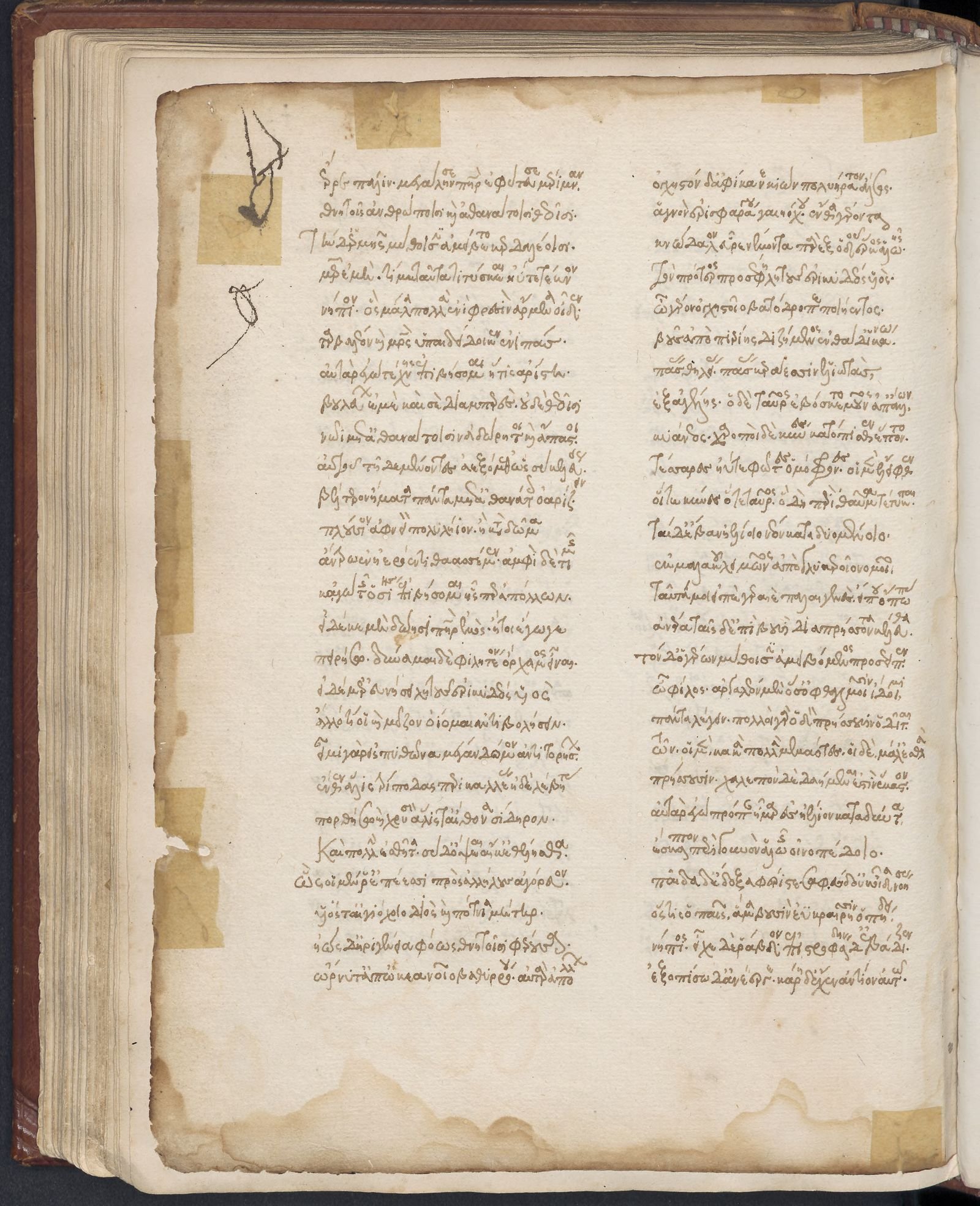
Where on the image
Leiden BPG 33 H, fol. 42v, column a (left): Hymn 4 160-185; begins ‹ἔρρε πάλιν· μεγάλην σε›, ends ‹Ὠκεανοῖο βαθυρρόου· αὐτὰρ Ἀπόλλων›. Checked on the image: the first and last verses of the column were read and matched to the Greek. The column before ends with Hymn 4 159. The next column begins with Hymn 4 186. English blocks here: 160-164, 165-169, 170-173, 174-174, 175-179, 180-184.
160ἔρρε πάλιν· μεγάλην σε πατὴρ ἐφύτευσε μέριμναν
161θνητοῖς ἀνθρώποισι καὶ ἀθανάτοισι θεοῖσι.
162τὴν δʼ Ἑρμῆς μύθοισιν ἀμείβετο κερδαλέοισι·
163μῆτερ ἐμή, τί με ταῦτα δεδίσκεαι, ἠύτε τέκνον
164νήπιον, ὃς μάλα παῦρα μετὰ φρεσὶν αἴσυλα οἶδε,
165ταρβαλέον, καὶ μητρὸς ὑπαιδείδοικεν ἐνιπάς;
166αὐτὰρ ἐγὼ τέχνης ἐπιβήσομαι, ἥ τις ἀρίστη,
167βουκολέων ἐμὲ καὶ σὲ διαμπερές· οὐδὲ θεοῖσι
168νῶι μετʼ ἀθανάτοισιν ἀδώρητοι καὶ ἄλιστοι
169αὐτοῦ τῇδε μένοντες ἀνεξόμεθʼ, ὡς σὺ κελεύεις.
170βέλτερον ἤματα πάντα μετʼ ἀθανάτοις ὀαρίζειν,
171πλούσιον, ἀφνειόν, πολυλήιον, ἢ κατὰ δῶμα
172ἄντρῳ ἐν ἠερόεντι θαασσέμεν· ἀμφὶ δὲ τιμῆς,
173κἀγὼ τῆς ὁσίης ἐπιβήσομαι, ἧς περ Ἀπόλλων.
174εἰ δέ κε μὴ δώῃσι πατὴρ ἐμός, ἧ τοι ἔγωγε
175πειρήσω, δύναμαι, φηλητέων ὄρχαμος εἶναι.
176εἰ δέ μʼ ἐρευνήσει Λητοῦς ἐρικυδέος υἱός,
177ἄλλο τί οἱ καὶ μεῖζον ὀίομαι ἀντιβολήσειν.
178εἶμι γὰρ ἐς Πυθῶνα μέγαν δόμον ἀντιτορήσων·
179ἔνθεν ἅλις τρίποδας περικαλλέας ἠδὲ λέβητας
180πορθήσω καὶ χρυσόν, ἅλις τʼ αἴθωνα σίδηρον
181καὶ πολλὴν ἐσθῆτα· σὺ δʼ ὄψεαι, αἴ κʼ ἐθέλῃσθα.
182ὣς οἳ μέν ῥʼ ἐπέεσσι πρὸς ἀλλήλους ἀγόρευον,
183υἱός τʼ αἰγιόχοιο Διὸς καὶ πότνια Μαῖα.
184Ἠὼς δʼ ἠριγένεια φόως θνητοῖσι φέρουσα
185ὤρνυτʼ ἀπʼ Ὠκεανοῖο βαθυρρόου· αὐτὰρ Ἀπόλλων
160Go to, then; your father got you to be a great worry to mortal men and deathless gods.” Then Hermes answered her with crafty words: “Mother, why do you seek to frighten me like a feeble child whose heart knows few words of blame, 165a fearful babe that fears its mother's scolding? Nay, but I will try whatever plan is best, and so feed myself and you continually. We will not be content to remain here, as you bid, alone of all the gods unfee'd with offerings and prayers. 170Better to live in fellowship with the deathless gods continually, rich, wealthy, and enjoying stores of grain, than to sit always in a gloomy cave: and, as regards honor, I too will enter upon the rite that Apollo has. 174If my father will not give it me, 175I will seek —and I am able —to be a prince of robbers. And if Leto's most glorious son shall seek me out, I think another and a greater loss will befall him. For I will go to Pytho to break into his great house, and will plunder therefrom splendid tripods, and cauldrons, 180and gold, and plenty of bright iron, and much apparel; and you shall see it if you will.” With such words they spoke together, the son of Zeus who holds the aegis, and the lady Maia. Now Eos the early born, bringing light to men,
Where on the image
Leiden BPG 33 H, fol. 42v, column b (right): Hymn 4 186-211; begins ‹Ὀγχηστόνδʼ ἀφίκανε κιών, πολυήρατον›, ends ‹δʼ ἔχεν ἀντίον αὐτῷ.›. Checked on the image: the first and last verses of the column were read and matched to the Greek. The column before ends with Hymn 4 185. The next column begins with Hymn 4 212. English blocks here: 185-189, 190-194, 195-199, 200-204, 205-209.
186Ὀγχηστόνδʼ ἀφίκανε κιών, πολυήρατον ἄλσος
187ἁγνὸν ἐρισφαράγου Γαιηόχου· ἔνθα γέροντα
188κνώδαλον εὗρε νέμοντα παρʼ ἔξοδον ἕρκεος αὐλῆς.
189τὸν πρότερος προσέφη Λητοῦς ἐρικυδέος υἱός·
190ὦ γέρον, Ὀγχηστοῖο βατοδρόπε ποιήεντος,
191βοῦς ἀπὸ Πιερίης διζήμενος ἐνθάδʼ ἱκάνω,
192πάσας θηλείας, πάσας κεράεσσιν ἑλικτάς,
193ἐξ ἀγέλης· ὁ δὲ ταῦρος ἐβόσκετο μοῦνος ἀπʼ ἄλλων
194κυάνεος· χαροποὶ δὲ κύνες κατόπισθεν ἕποντο
195τέσσαρες, ἠύτε φῶτες, ὁμόφρονες· οἳ μὲν ἔλειφθεν,
196οἵ τε κύνες ὅ τε ταῦρος· ὃ δὴ περὶ θαῦμα τέτυκται·
197ταὶ δʼ ἔβαν ἠελίοιο νέον καταδυομένοιο
198ἐκ μαλακοῦ λειμῶνος ἀπὸ γλυκεροῖο νομοῖο.
199ταῦτά μοι εἰπέ, γεραιὲ παλαιγενές, εἴ που ὄπωπας
200ἀνέρα ταῖσδʼ ἐπὶ βουσὶ διαπρήσσοντα κέλευθον.
201τὸν δʼ ὁ γέρων μύθοισιν ἀμειβόμενος προσέειπεν·
202ὦ φίλος, ἀργαλέον μέν, ὅσʼ ὀφθαλμοῖσιν ἴδοιτο,
203πάντα λέγειν· πολλοὶ γὰρ ὁδὸν πρήσσουσιν ὁδῖται,
204τῶν οἳ μὲν κακὰ πολλὰ μεμαότες, οἳ δὲ μάλʼ ἐσθλὰ
205φοιτῶσιν· χαλεπὸν δὲ δαήμεναί ἐστιν ἕκαστον·
206αὐτὰρ ἐγὼ πρόπαν ἦμαρ ἐς ἠέλιον καταδύντα
207ἔσκαπτον περὶ γουνὸν ἀλωῆς οἰνοπέδοιο·
208παῖδα δʼ ἔδοξα, φέριστε, σαφὲς δʼ οὐκ οἶδα, νοῆσαι,
209ὅς τις ὁ παῖς, ἅμα βουσὶν ἐυκραίρῃσιν ὀπήδει
210νήπιος, εἶχε δὲ ῥάβδον· ἐπιστροφάδην δʼ ἐβάδιζεν.
211ἐξοπίσω δʼ ἀνέεργε, κάρη δʼ ἔχεν ἀντίον αὐτῷ.
185was rising from deep-flowing Ocean, when Apollo, as he went, came to Onchestus, the lovely grove and sacred place of the loud-roaring Holder of the Earth. There he found an old man grazing his beast along the pathway from his court-yard fence, and the all-glorious Son of Leto began and said to him. 190“Old man, weeder of grassy Onchestus, I am come here from Pieria seeking cattle, cows all of them, all with curving horns, from my herd. The black bull was grazing alone away from the rest, but fierce-eyed hounds followed the cows, 195four of them, all of one mind, like men. These were left behind, the dogs and the bull —which is a great marvel; but the cows strayed out of the soft meadow, away from the pasture when the sun was just going down. Now tell me this, old man born long ago: have you seen 200one passing along behind those cows?” Then the old man answered him and said: “My son, it is hard to tell all that one's eyes see; for many wayfarers pass to and fro this way, some bent on much evil, and some on good: 205it is difficult to know each one. However, I was digging about my plot of vineyard all day long until the sun went down, and I thought, good sir, but I do not know for certain, that I marked a child, whoever the child was, that followed long-horned cattle—
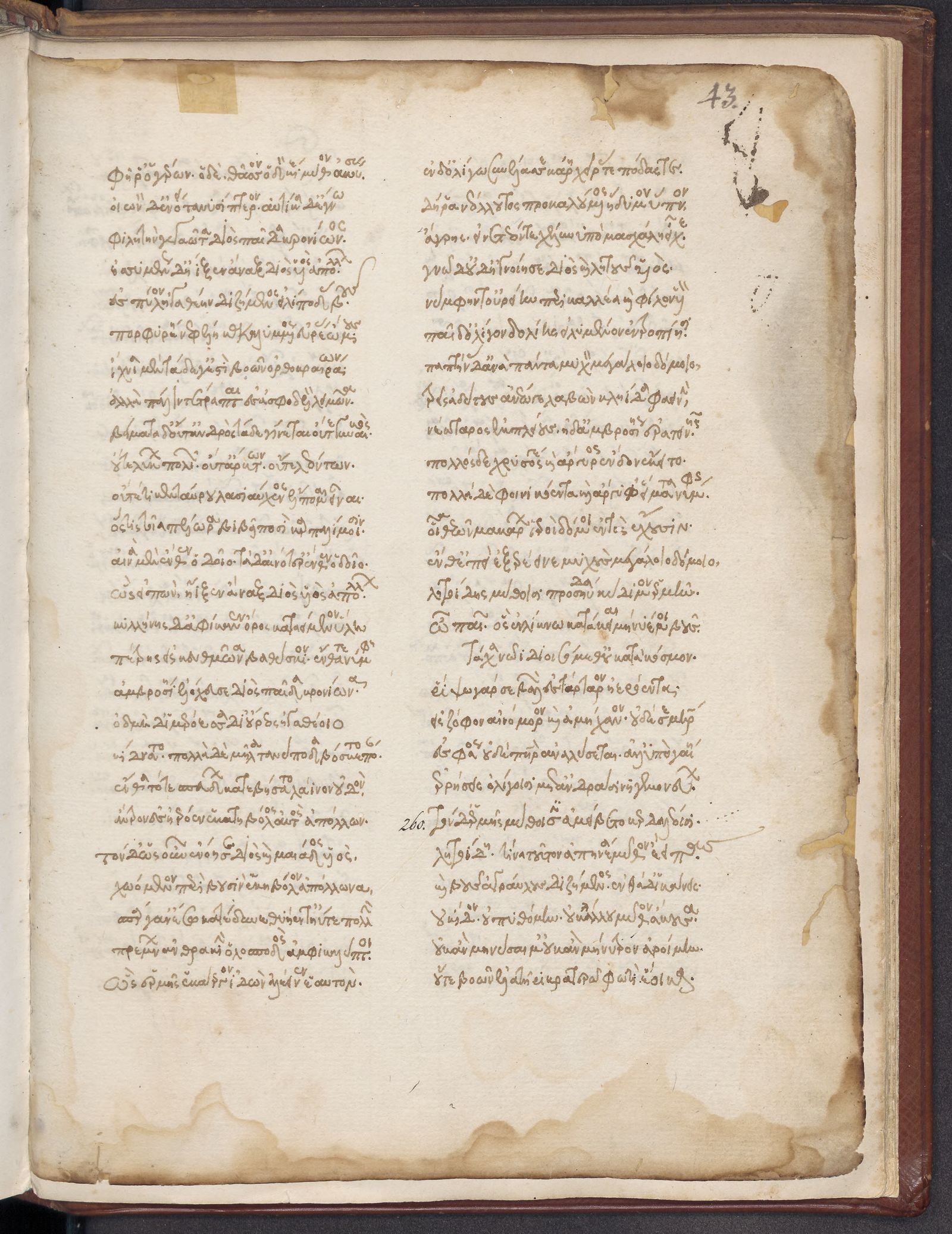
Where on the image
Leiden BPG 33 H, fol. 43r, column a (left): Hymn 4 212-239; begins ‹φῆ ῥʼ ὁ γέρων·›, ends ‹Ἑκάεργον ἰδὼν ἀνέειλεν ἑαυτόν.›. Checked on the image: the first and last verses of the column were read and matched to the Greek. The column before ends with Hymn 4 211. The next column begins with Hymn 4 240. English blocks here: 210-214, 215-219, 220-224, 225-229, 230-234, 235-239.
212φῆ ῥʼ ὁ γέρων· ὃ δὲ θᾶσσον ὁδὸν κίε μῦθον ἀκούσας·
213οἰωνὸν δʼ ἐνόει τανυσίπτερον, αὐτίκα δʼ ἔγνω
214φηλητὴν γεγαῶτα Διὸς παῖδα Κρονίωνος.
215ἐσσυμένως δʼ ἤιξεν ἄναξ Διὸς υἱὸς Ἀπόλλων
216ἐς Πύλον ἠγαθέην διζήμενος εἰλίποδας βοῦς,
217πορφυρέῃ νεφέλῃ κεκαλυμμένος εὐρέας ὤμους·
218ἴχνιά τʼ εἰσενόησεν Ἑκηβόλος εἶπέ τε μῦθον·
219ὦ πόποι, ἦ μέγα θαῦμα τόδʼ ὀφθαλμοῖσιν ὁρῶμαι·
220ἴχνια μὲν τάδε γʼ ἐστὶ βοῶν ὀρθοκραιράων,
221ἀλλὰ πάλιν τέτραπται ἐς ἀσφοδελὸν λειμῶνα·
222βήματα δʼ οὔτʼ ἀνδρὸς τάδε γίγνεται οὔτε γυναικὸς
223οὔτε λύκων πολιῶν οὔτʼ ἄρκτων οὔτε λεόντων·
224οὔτε τι Κενταύρου λασιαύχενος ἔλπομαι εἶναι,
225ὅς τις τοῖα πέλωρα βιβᾷ ποσὶ καρπαλίμοισιν·
226αἰνὰ μὲν ἔνθεν ὁδοῖο, τὰ δʼ αἰνότερʼ ἔνθεν ὁδοῖο.
227ὣς εἰπὼν ἤιξεν ἄναξ Διὸς υἱὸς Ἀπόλλων·
228Κυλλήνης δʼ ἀφίκανεν ὄρος καταείμενον ὕλῃ,
229πέτρης ἐς κευθμῶνα βαθύσκιον, ἔνθα τε νύμφη
230ἀμβροσίη ἐλόχευσε Διὸς παῖδα Κρονίωνος.
231ὀδμὴ δʼ ἱμερόεσσα διʼ οὔρεος ἠγαθέοιο
232κίδνατο, πολλὰ δὲ μῆλα ταναύποδα βόσκετο ποίην.
233ἔνθα τότε σπεύδων κατεβήσατο λάινον οὐδὸν
234ἄντρον ἐς ἠερόεν ἑκατηβόλος αὐτὸς Ἀπόλλων.
235Τὸν δʼ ὡς οὖν ἐνόησε Διὸς καὶ Μαιάδος υἱὸς
236χωόμενον περὶ βουσὶν ἑκηβόλον Ἀπόλλωνα,
237σπάργανʼ ἔσω κατέδυνε θυήεντʼ· ἠύτε πολλὴν
238πρέμνων ἀνθρακιὴν ὕλης σποδὸς ἀμφικαλύπτει,
239ὣς Ἑρμῆς Ἑκάεργον ἰδὼν ἀνέειλεν ἑαυτόν.
210an infant who had a staff and kept walking from side to side: he was driving them backwards way, with their heads towards him.” So said the old man. And when Apollo heard this report, he went yet more quickly on his way, and presently, seeing a long-winged bird, he knew at once by that omen that the thief was the child of Zeus the son of Cronos. 215So the lord Apollo, son of Zeus, hurried on to goodly Pylos seeking his shambling oxen, and he had his broad shoulders covered with a dark cloud. But when the Far-Shooter perceived the tracks, he cried: “Oh, oh! Truly this is a great marvel that my eyes behold! 220These are indeed the tracks of straight-horned oxen, but they are turned backwards towards the flowery meadow. But these others are not the footprints of man or woman or grey wolves or bears or lions, nor do I think they are the tracks of a rough-maned Centaur — 225whoever it be that with swift feet makes such monstrous footprints; wonderful are the tracks on this side of the way, but yet more wonderful are those on that.” When he had so said, the lord Apollo, the Son of Zeus hastened on and came to the forest-clad mountain of Cyllene and the deep-shadowed cave in the rock where the divine nymph 230brought forth the child of Zeus who is the son of Cronos. A sweet odor spread over the lovely hill, and many thin-shanked sheep were grazing on the grass. Then far-shooting Apollo himself stepped down in haste over the stone threshold into the dusky cave. 235Now when the Son of Zeus and Maia saw Apollo in a rage about his cattle, he snuggled down in his fragrant swaddling-clothes; and as wood-ash covers over the deep embers of tree-stumps, so Hermes cuddled himself up when he saw the Far-Shooter.
Where on the image
Leiden BPG 33 H, fol. 43r, column b (right): Hymn 4 240-265; begins ‹ἐν δʼ ὀλίγῳ συνέλασσε›, ends ‹ἐλατῆρι, κραταιῷ φωτί, ἔοικα.›. Checked on the image: the first and last verses of the column were read and matched to the Greek. The column before ends with Hymn 4 239. The next column begins with Hymn 4 266. English blocks here: 240-244, 245-249, 250-254, 255-255, 256-259, 260-264.
240ἐν δʼ ὀλίγῳ συνέλασσε κάρη χεῖράς τε πόδας τε,
241φή ῥα νεόλλουτος, προκαλεύμενος ἥδυμον ὕπνον,
242ἐγρήσσων ἐτεόν γε· χέλυν δʼ ὑπὸ μασχάλῃ εἶχε.
243γνῶ δʼ οὐδʼ ἠγνοίησε Διὸς καὶ Λητοῦς υἱὸς
244νύμφην τʼ οὐρείην περικαλλέα καὶ φίλον υἱόν,
245παῖδʼ ὀλίγον, δολίῃς εἰλυμένον ἐντροπίῃσι.
246παπτήνας δʼ ἀνὰ πάντα μυχὸν μεγάλοιο δόμοιο
247τρεῖς ἀδύτους ἀνέῳγε λαβὼν κληῖδα φαεινὴν
248νέκταρος ἐμπλείους ἠδʼ ἀμβροσίης ἐρατεινῆς·
249πολλὸς δὲ χρυσός τε καὶ ἄργυρος ἔνδον ἔκειτο,
250πολλὰ δὲ φοινικόεντα καὶ ἄργυφα εἵματα νύμφης,
251οἷα θεῶν μακάρων ἱεροὶ δόμοι ἐντὸς ἔχουσιν·
252ἔνθʼ ἐπεὶ ἐξερέεινε μυχοὺς μεγάλοιο δόμοιο
253Λητοΐδης, μύθοισι προσηύδα κύδιμον Ἑρμῆν·
254ὦ παῖ, ὃς ἐν λίκνῳ κατάκειαι, μήνυέ μοι βοῦς
255θᾶσσον· ἐπεὶ τάχα νῶι διοισόμεθʼ οὐ κατὰ κόσμον.
256ῥίψω γάρ σε λαβὼν ἐς Τάρταρον ἠερόεντα,
257ἐς ζόφον αἰνόμορον καὶ ἀμήχανον· οὐδέ σε μήτηρ
258ἐς φάος οὐδὲ πατὴρ ἀναλύσεται, ἀλλʼ ὑπὸ γαίῃ
259ἐρρήσεις ὀλίγοισι μετʼ ἀνδράσιν ἡγεμονεύων.
260Τὸν δʼ Ἑρμῆς μύθοισιν ἀμείβετο κερδαλέοισι·
261Λητοΐδη, τίνα τοῦτον ἀπηνέα μῦθον ἔειπας;
262καὶ βοῦς ἀγραύλους διζήμενος ἐνθάδʼ ἱκάνεις;
263οὐκ ἴδον, οὐ πυθόμην, οὐκ ἄλλου μῦθον ἄκουσα·
264οὐκ ἂν μηνύσαιμʼ, οὐκ ἂν μήνυτρον ἀροίμην·
265οὐδὲ βοῶν ἐλατῆρι, κραταιῷ φωτί, ἔοικα.
240He squeezed head and hands and feet together in a small space, like a new born child seeking sweet sleep, though in truth he was wide awake, and he kept his lyre under his armpit. But the Son of Leto was aware and failed not to perceive the beautiful mountain-nymph and her dear son, 245albeit a little child and swathed so craftily. He peered in every corner of the great dwelling and, taking a bright key, he opened three closets full of nectar and lovely ambrosia. And much gold and silver was stored in them, 250and many garments of the nymph, some purple and some silvery white, such as are kept in the sacred houses of the blessed gods. Then, after the Son of Leto had searched out the recesses of the great house, he spake to glorious Hermes: “Child, lying in the cradle, make haste and tell me of my cattle, 255or we two will soon fall out angrily. 256For I will take and cast you into dusky Tartarus and awful hopeless darkness, and neither your mother nor your father shall free you or bring you up again to the light, but you will wander under the earth and be the leader amongst little folk.” 260Then Hermes answered him with crafty words: “Son of Leto, what harsh words are these you have spoken? And is it cattle of the field you are come here to seek? I have not seen them: I have not heard of them: no one has told me of them. I cannot give news of them, nor win the reward for news.
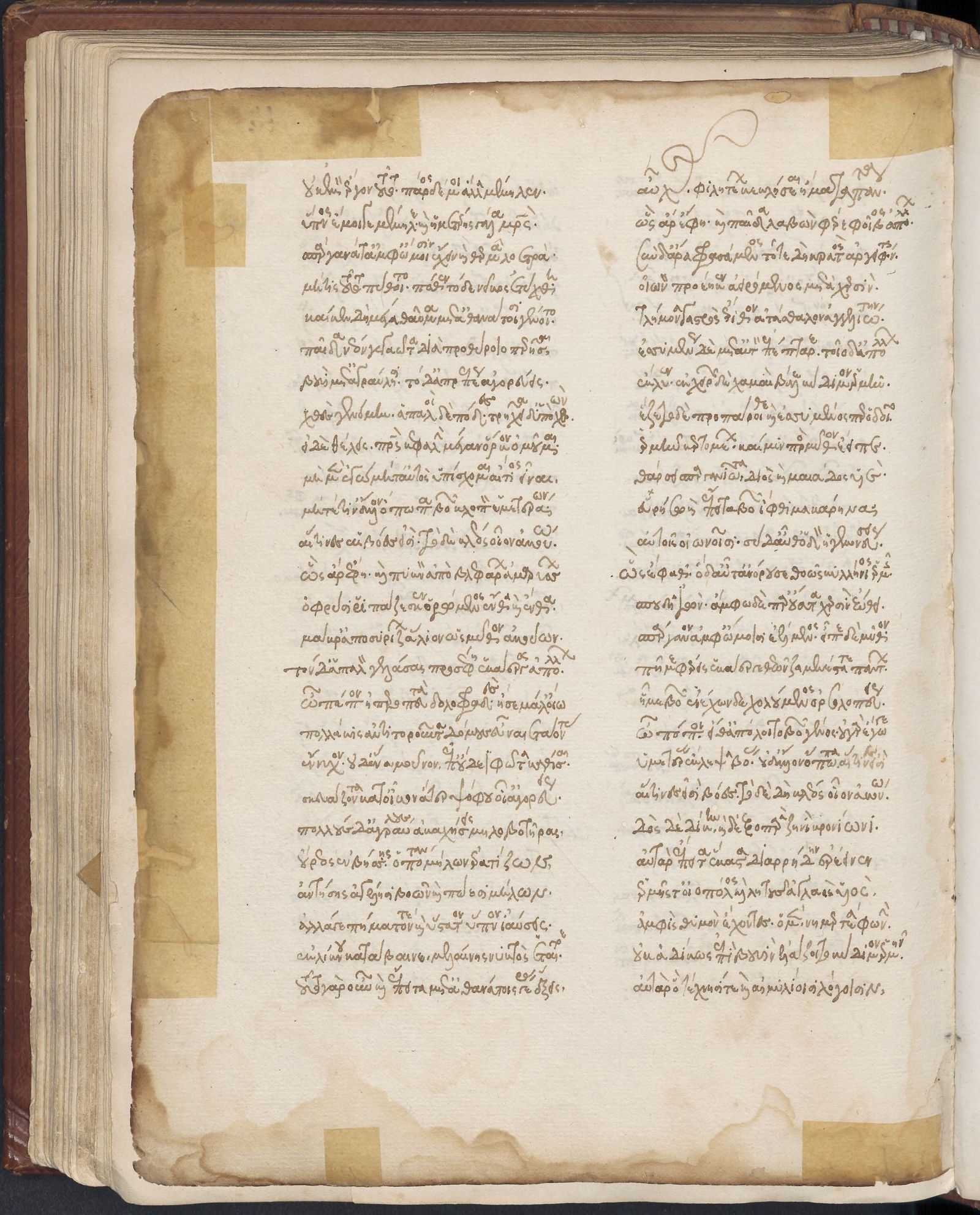
Where on the image
Leiden BPG 33 H, fol. 43v, column a (left): Hymn 4 266-291; begins ‹οὐκ ἐμὸν ἔργον τοῦτο,›, ends ‹μετʼ ἀθανάτοις γέρας ἕξεις.›. Checked on the image: the first and last verses of the column were read and matched to the Greek. The column before ends with Hymn 4 265. The next column begins with Hymn 4 292. English blocks here: 265-269, 270-274, 275-279, 280-284, 285-289.
266οὐκ ἐμὸν ἔργον τοῦτο, πάρος δέ μοι ἄλλα μέμηλεν·
267ὕπνος ἐμοί γε μέμηλε καὶ ἡμετέρης γάλα μητρὸς
268σπάργανά τʼ ἀμφʼ ὤμοισιν ἔχειν καὶ θερμὰ λοετρά.
269μή τις τοῦτο πύθοιτο, πόθεν τόδε νεῖκος ἐτύχθη·
270καί κεν δὴ μέγα θαῦμα μετʼ ἀθανάτοισι γένοιτο,
271παῖδα νέον γεγαῶτα διὲκ προθύροιο περῆσαι
272βουσὶν ἐπʼ ἀγραύλοισι· τὸ δʼ ἀπρεπέως ἀγορεύεις.
273χθὲς γενόμην, ἁπαλοὶ δὲ πόδες, τρηχεῖα δʼ ὕπο χθών.
274εἰ δʼ ἐθέλεις, πατρὸς κεφαλὴν μέγαν ὅρκον ὀμοῦμαι·
275μὴ μὲν ἐγὼ μήτʼ αὐτὸς ὑπίσχομαι αἴτιος εἶναι,
276μήτε τινʼ ἄλλον ὄπωπα βοῶν κλοπὸν ὑμετεράων,
277αἵ τινες αἱ βόες εἰσί· τὸ δὲ κλέος οἶον ἀκούω.
278ὣς ἄρʼ ἔφη καὶ πυκνὸν ἀπὸ βλεφάρων ἀμαρύσσων
279ὀφρῦς ῥιπτάζεσκεν ὁρώμενος ἔνθα καὶ ἔνθα,
280μάκρʼ ἀποσυρίζων, ἅλιον τὸν μῦθον ἀκούων.
281τὸν δʼ ἁπαλὸν γελάσας προσέφη ἑκάεργος Ἀπόλλων·
282ὦ πέπον, ἠπεροπευτά, δολοφραδές, ἦ σε μάλʼ οἴω
283πολλάκις ἀντιτοροῦντα δόμους εὖ ναιετάοντας
284ἔννυχον οὐχ ἕνα μοῦνον ἐπʼ οὔδεϊ φῶτα καθίσσαι,
285σκευάζοντα κατʼ οἶκον ἄτερ ψόφου, οἷʼ ἀγορεύεις·
286πολλοὺς δʼ ἀγραύλους ἀκαχήσεις μηλοβοτῆρας
287οὔρεος ἐν βήσσῃς, ὁπότʼ ἂν κρειῶν ἐρατίζων
288ἀντᾷς βουκολίοισι καὶ εἰροπόκοις ὀίεσσιν.
289ἀλλʼ ἄγε, μὴ πύματόν τε καὶ ὕστατον ὕπνον ἰαύσῃς,
290ἐκ λίκνου κατάβαινε, μελαίνης νυκτὸς ἑταῖρε.
291τοῦτο γὰρ οὖν καὶ ἔπειτα μετʼ ἀθανάτοις γέρας ἕξεις.
265Am I like a cattle-lifter, a stalwart person? This is no task for me: rather I care for other things: I care for sleep, and milk of my mother's breast, and wrappings round my shoulders, and warm baths. Let no one hear the cause of this dispute; 270for this would be a great marvel indeed among the deathless gods, that a child newly born should pass in through the forepart of the house with cattle of the field: herein you speak extravagantly. I was born yesterday, and my feet are soft and the ground beneath is rough; nevertheless, if you will have it so, I will swear a great oath by my father's head and vow that 275neither am I guilty myself, neither have I seen any other who stole your cows —whatever cows may be; for I know them only by hearsay.” So, then, said Hermes, shooting quick glances from his eyes: and he kept raising his brows and looking this way and that, 280whistling long and listening to Apollo's story as to an idle tale. But far-working Apollo laughed softly and said to him: “O rogue, deceiver, crafty in heart, you talk so innocently that I most surely believe that you have broken into many a well-built house and stripped more than one poor wretch bare this night, 285gathering his goods together all over the house without noise. You will plague many a lonely herdsman in mountain glades, when you come on herds and thick-fleeced sheep, and have a hankering after flesh. But come now, if you would not sleep your last and latest sleep,
Where on the image
Leiden BPG 33 H, fol. 43v, column b (right): Hymn 4 292-317; begins ‹ἀρχὸς φηλητέων κεκλήσεαι ἤματα›, ends ‹τε καὶ αἱμυλίοισι λόγοισιν›. Checked on the image: the first and last verses of the column were read and matched to the Greek. The column before ends with Hymn 4 291. The next column begins with Hymn 4 318. English blocks here: 290-294, 295-296, 297-299, 300-304, 305-309, 310-314, 315-319.
292ἀρχὸς φηλητέων κεκλήσεαι ἤματα πάντα.
293ὣς ἄρʼ ἔφη καὶ παῖδα λαβὼν φέρε Φοῖβος Ἀπόλλων.
294σὺν δʼ ἄρα φρασσάμενος τότε δὴ κρατὺς Ἀργειφόντης
295οἰωνὸν προέηκεν ἀειρόμενος μετὰ χερσί,
296τλήμονα γαστρὸς ἔριθον, ἀτάσθαλον ἀγγελιώτην.
297ἐσσυμένως δὲ μετʼ αὐτὸν ἐπέπταρε· τοῖο δʼ Ἀπόλλων
298ἔκλυεν, ἐκ χειρῶν δὲ χαμαὶ βάλε κύδιμον Ἑρμῆν.
299ἕζετο δὲ προπάροιθε καὶ ἐσσύμενός περ ὁδοῖο
300Ἑρμῆν κερτομέων καί μιν πρὸς μῦθον ἔειπε·
301θάρσει, σπαργανιῶτα, Διὸς καὶ Μαιάδος υἱέ·
302εὑρήσω καὶ ἔπειτα βοῶν ἴφθιμα κάρηνα
303τούτοις οἰωνοῖσι· σὺ δʼ αὖθʼ ὁδὸν ἡγεμονεύσεις.
304ὣς φάθʼ· ὃ δʼ αὖτʼ ἀνόρουσε θοῶς Κυλλήνιος Ἑρμῆς,
305σπουδῇ ἰών· ἄμφω δὲ παρʼ οὔατα χερσὶν ἐώθει
306σπάργανον ἀμφʼ ὤμοισιν ἐελμένος, εἶπε δὲ μῦθον·
307πῆ με φέρεις, Ἑκάεργε, θεῶν ζαμενέστατε πάντων;
308ἦ με βοῶν ἕνεχʼ ὧδε χολούμενος ὀρσολοπεύεις;
309ὦ πόποι, εἴθʼ ἀπόλοιτο βοῶν γένος· οὐ γὰρ ἐγώ γε
310ὑμετέρας ἔκλεψα βόας οὐδʼ ἄλλον ὄπωπα,
311αἵτινες αἱ βόες εἰσί· τὸ δὲ κλέος οἶον ἀκούω.
312δὸς δὲ δίκην καὶ δέξο παρὰ Ζηνὶ Κρονίωνι.
313αὐτὰρ ἐπεὶ τὰ ἕκαστα διαρρήδην ἐρίδαινον
314Ἑρμῆς τʼ οἰοπόλος καὶ Λητοῦς ἀγλαὸς υἱός,
315ἀμφὶς θυμὸν ἔχοντες. ὃ μὲν νημερτέα φωνὴν
316…οὐκ ἀδίκως ἐπὶ βουσὶν ἐλάζυτο κύδιμον Ἑρμῆν,
317αὐτὰρ ὃ τέχνῃσίν τε καὶ αἱμυλίοισι λόγοισιν
290get out of your cradle, you comrade of dark night. Surely hereafter this shall be your title amongst the deathless gods, to be called the prince of robbers continually.” So said Phoebus Apollo, and took the child and began to carry him. But at that moment the strong Slayer of Argus 295had his plan, and, while Apollo held him in his hands, sent forth an omen, a hard-worked belly-serf, a rude messenger, 297and sneezed directly after. And when Apollo heard it, he dropped glorious Hermes out of his hands on the ground: 300then sitting down before him, though he was eager to go on his way, he spoke mockingly to Hermes: “Fear not, little swaddling baby, son of Zeus and Maia. I shall find the strong cattle presently by these omens, and you shall lead the way.” When Apollo had so said, Cyllenian Hermes sprang up quickly, 305starting in haste. With both hands he pushed up to his ears the covering that he had wrapped about his shoulders, and said: “Where are you carrying me, Far-Worker, hastiest of all the gods? Is it because of your cattle that you are so angry and harass me? O dear, would that all the sort of oxen might perish; for it is not I 310who stole your cows, nor did I see another steal them —whatever cows may be, and of that I have only heard report. Nay, give right and take it before Zeus, the Son of Cronos.” So Hermes the shepherd and Leto's glorious son 315kept stubbornly disputing each article of their quarrel: Apollo, speaking truly not unfairly sought to seize glorious Hermes because of the cows; but he, the Cyllenian, tried to deceive the God of the Silver Bow with tricks and cunning words. But when, though he had many wiles, he found the other had as many shifts,
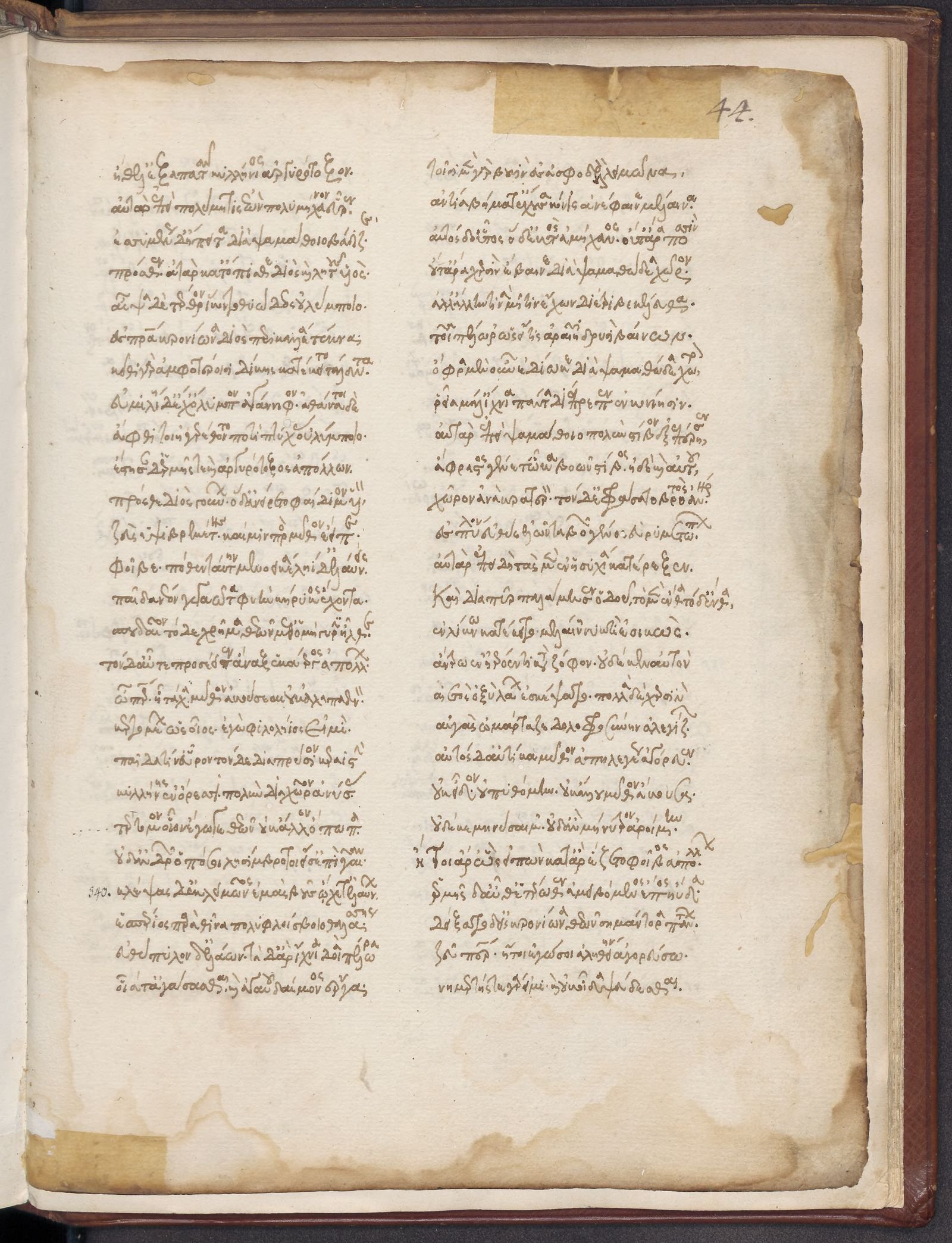
Where on the image
Leiden BPG 33 H, fol. 44r, column a (left): Hymn 4 318-343; begins ‹ἤθελεν ἐξαπατᾶν Κυλλήνιος Ἀργυρότοξον.›, ends ‹καὶ ἀγαυοῦ δαίμονος ἔργα.›. Checked on the image: the first and last verses of the column were read and matched to the Greek. The column before ends with Hymn 4 317. The next column begins with Hymn 4 344. English blocks here: 320-324, 325-329, 330-334, 335-339, 340-343.
318ἤθελεν ἐξαπατᾶν Κυλλήνιος Ἀργυρότοξον.
319αὐτὰρ ἐπεὶ πολύμητις ἐὼν πολυμήχανον εὗρεν,
320ἐσσυμένως δὴ ἔπειτα διὰ ψαμάθοιο βάδιζε
321πρόσθεν, ἀτὰρ κατόπισθε Διὸς καὶ Λητοῦς υἱός.
322αἶψα δὲ τέρθρον ἵκοντο θυώδεος Οὐλύμποιο
323ἐς πατέρα Κρονίωνα Διὸς περικαλλέα τέκνα·
324κεῖθι γὰρ ἀμφοτέροισι δίκης κατέκειτο τάλαντα.
325οὐμιλίη δʼ ἔχʼ Ὄλυμπον ἀγάννιφον, ἀθάνατοι δὲ
326ἄφθιτοι ἠγερέθοντο μετὰ χρυσόθρονον Ἠῶ.
327ἔστησαν δʼ Ἑρμῆς τε καὶ ἀργυρότοξος Ἀπόλλων
328πρόσθε Διὸς γούνων· ὃ δʼ ἀνείρετο φαίδιμον υἱὸν
329Ζεὺς ὑψιβρεμέτης καί μιν πρὸς μῦθον ἔειπε·
330φοῖβε, πόθεν ταύτην μενοεικέα ληίδʼ ἐλαύνεις,
331παῖδα νέον γεγαῶτα, φυὴν κήρυκος ἔχοντα;
332σπουδαῖον τόδε χρῆμα θεῶν μεθʼ ὁμήγυριν ἦλθε.
333τὸν δʼ αὖτε προσέειπεν ἄναξ ἑκάεργος Ἀπόλλων·
334ὦ πάτερ, ἦ τάχα μῦθον ἀκούσεαι οὐκ ἀλαπαδνόν,
335κερτομέων ὡς οἶος ἐγὼ φιλολήιός εἰμι.
336παῖδά τινʼ εὗρον τόνδε διαπρύσιον κεραϊστὴν
337Κυλλήνης ἐν ὄρεσσι, πολὺν διὰ χῶρον ἀνύσσας,
338κέρτομον, οἷον ἐγώ γε θεῶν οὐκ ἄλλον ὄπωπα
339οὐδʼ ἀνδρῶν, ὁπόσοι λησίμβροτοί εἰσʼ ἐπὶ γαίῃ.
340κλέψας δʼ ἐκ λειμῶνος ἐμὰς βοῦς ὤχετʼ ἐλαύνων
341ἑσπέριος παρὰ θῖνα πολυφλοίσβοιο θαλάσσης,
342εὐθὺ Πύλονδʼ ἐλάων· τὰ δʼ ἄρʼ ἴχνια δοῖα πέλωρα,
343οἷά τʼ ἀγάσσασθαι, καὶ ἀγαυοῦ δαίμονος ἔργα.
320he began to walk across the sand, himself in front, while the Son of Zeus and Leto came behind. Soon they came, these lovely children of Zeus, to the top of fragrant Olympus, to their father, the Son of Cronos; for there were the scales of judgement set for them both. 325There was an assembly on snowy Olympus, and the immortals who perish not were gathering after the hour of gold-throned Dawn. Then Hermes and Apollo of the Silver Bow stood at the knees of Zeus: and Zeus who thunders on high spoke to his glorious son and asked him: 330“Phoebus, whence come you driving this great spoil, a child new born that has the look of a herald? This is a weighty matter that is come before the council of the gods.” Then the lord, far-working Apollo, answered him: “O my father, you shall soon hear no trifling tale though you reproach me 335that I alone am fond of spoil. Here is a child, a burgling robber, whom I found after a long journey in the hills of Cyllene: for my part I have never seen one so pert either among the gods or all men that catch folk unawares throughout the world. 340He stole away my cows from their meadow and drove them off in the evening along the shore of the loud-roaring sea, making straight for Pylos. There were double tracks, and wonderful they were, such as one might marvel at, the doing of a clever sprite;
Where on the image
Leiden BPG 33 H, fol. 44r, column b (right): Hymn 4 344-369; begins ‹τῇσιν μὲν γὰρ βουσὶν›, ends ‹καὶ οὐκ οἶδα ψεύδεσθαι.›. Checked on the image: the first and last verses of the column were read and matched to the Greek. The column before ends with Hymn 4 343. The next column begins with Hymn 4 370. English blocks here: 344-344, 345-349, 350-354, 355-359, 360-364, 365-369.
344τῇσιν μὲν γὰρ βουσὶν ἐς ἀσφοδελὸν λειμῶνα
345ἀντία βήματʼ ἔχουσα κόνις ἀνέφαινε μέλαινα·
346αὐτὸς δʼ ἐκτὸς ὁδοῦ, τις ἀμήχανος, οὔτʼ ἄρα ποσσὶν
347οὔτʼ ἄρα χερσὶν ἔβαινε διὰ ψαμαθώδεα χῶρον·
348ἀλλʼ ἄλλην τινὰ μῆτιν ἔχων διέτριβε κέλευθα
349τοῖα πέλωρʼ ὡς εἴ τις ἀραιῇσι δρυσὶ βαίνοι.
350ὄφρα μὲν οὖν ἐδίωκε διὰ ψαμαθώδεα χῶρον,
351ῥεῖα μάλʼ ἴχνια πάντα διέπρεπεν ἐν κονίῃσιν·
352αὐτὰρ ἐπεὶ ψαμάθοιο μέγαν στίβον ἐξεπέρησεν,
353ἄφραστος γένετʼ ὦκα βοῶν στίβος ἠδὲ καὶ αὐτοῦ
354χῶρον ἀνὰ κρατερόν· τὸν δʼ ἐφράσατο βροτὸς ἀνὴρ
355ἐς Πύλον εὐθὺς ἐλῶντα βοῶν γένος εὐρυμετώπων.
356αὐτὰρ ἐπεὶ δὴ τὰς μὲν ἐν ἡσυχίῃ κατέερξε
357καὶ διαπυρπαλάμησεν ὁδοῦ τὸ μὲν ἔνθα, τὸ δʼ ἔνθα,
358ἐν λίκνῳ κατέκειτο μελαίνῃ νυκτὶ ἐοικώς,
359ἄντρῳ ἐν ἠερόεντι κατὰ ζόφον· οὐδέ κεν αὐτὸν
360αἰετὸς ὀξὺ λάων ἐσκέψατο· πολλὰ δὲ χερσὶν
361αὐγὰς ὠμόργαζε δολοφροσύνην ἀλεγύνων.
362αὐτὸς δʼ αὐτίκα μῦθον ἀπηλεγέως ἀγόρευεν·
363οὐκ ἴδον, οὐ πυθόμην, οὐκ ἄλλου μῦθον ἄκουσα
364οὐδέ κε μηνύσαιμʼ, οὐδʼ ἂν μήνυτρον ἀροίμην.
365Ἠ τοι ἄρʼ ὣς εἰπὼν κατʼ ἄρʼ ἕζετο Φοῖβος Ἀπόλλων·
366Ερμῆς δʼ αὖθʼ ἑτέρωθεν ἀμειβόμενος ἔπος ηὔδα,
367δείξατο δʼ ἐς Κρονίωνα, θεῶν σημάντορα πάντων·
368Ζεῦ πάτερ, ἦ τοι ἐγώ σοι ἀληθείην καταλέξω·
369νημερτής τε γάρ εἰμι καὶ οὐκ οἶδα ψεύδεσθαι.
344for as for the cows, the dark dust kept and showed their footprints leading towards the flowery meadow; 345but he himself —bewildering creature —crossed the sandy ground outside the path, not on his feet nor yet on his hands; but, furnished with some other means he trudged his way —wonder of wonders! —as though one walked on slender oak-trees. 350Now while he followed the cattle across sandy ground, all the tracks showed quite clearly in the dust; but when he had finished the long way across the sand, presently the cows' track and his own could not be traced over the hard ground. But a mortal man noticed him 355as he drove the wide-browed kine straight towards Pylos. And as soon as he had shut them up quietly, and had gone home by crafty turns and twists, he lay down in his cradle in the gloom of a dim cave, as still as dark night, so that not even 360an eagle keenly gazing would have spied him. Much he rubbed his eyes with his hands as he prepared falsehood, and himself straightway said roundly: ‘I have not seen them: I have not heard of them: no man has told me of them. I could not tell you of them, nor win the reward of telling.’” 365When he had so spoken, Phoebus Apollo sat down. But Hermes on his part answered and said, pointing at the Son of Cronos, the lord of all the gods: “Zeus, my father, indeed I will speak truth to you; for I am truthful and I cannot tell a lie.
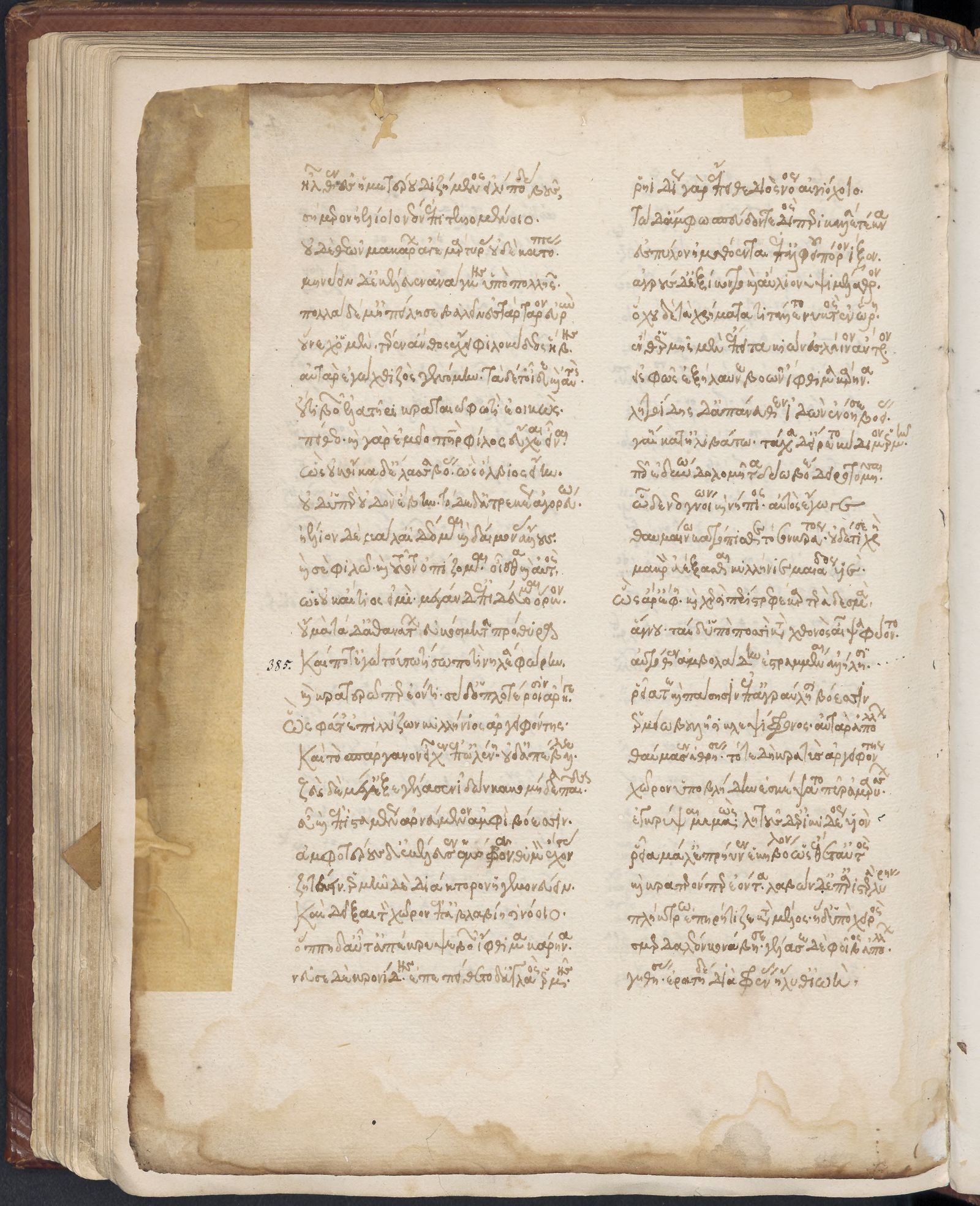
Where on the image
Leiden BPG 33 H, fol. 44v, column a (left): Hymn 4 370-395; begins ‹ἦλθεν ἐς ἡμετέρου διζήμενος›, ends ‹ἐπεπείθετο δʼ ἀγλαὸς Ἑρμῆς·›. Checked on the image: the first and last verses of the column were read and matched to the Greek. The column before ends with Hymn 4 369. The next column begins with Hymn 4 396. English blocks here: 370-374, 375-379, 380-384, 385-386, 387-389, 390-394.
370ἦλθεν ἐς ἡμετέρου διζήμενος εἰλίποδας βοῦς
371σήμερον ἠελίοιο νέον ἐπιτελλομένοιο·
372οὐδὲ θεῶν μακάρων ἄγε μάρτυρας οὐδὲ κατόπτας,
373μηνύειν δʼ ἐκέλευεν ἀναγκαίης ὑπὸ πολλῆς,
374πολλὰ δέ μʼ ἠπείλησε βαλεῖν ἐς Τάρταρον εὐρύν,
375οὕνεχʼ ὃ μὲν τέρεν ἄνθος ἔχει φιλοκυδέος ἥβης,
376αὐτὰρ ἐγὼ χθιζὸς γενόμην, τὰ δέ τʼ οἶδε καὶ αὐτός,
377οὔτι βοῶν ἐλατῆρι, κραταιῷ φωτί, ἐοικώς.
378πείθεο· καὶ γὰρ ἐμεῖο πατὴρ φίλος εὔχεαι εἶναι,
379ὡς οὐκ οἴκαδʼ ἔλασσα βόας, ὣς ὄλβιος εἴην,
380οὐδʼ ὑπὲρ οὐδὸν ἔβην· τὸ δέ τʼ ἀτρεκέως ἀγορεύω.
381Ἠέλιον δὲ μάλʼ αἰδέομαι καὶ δαίμονας ἄλλους,
382καί σε φιλῶ καὶ τοῦτον ὀπίζομαι· οἶσθα καὶ αὐτός,
383ὡς οὐκ αἴτιός εἰμι· μέγαν δʼ ἐπιδώσομαι ὅρκον·
384οὐ μὰ τάδʼ ἀθανάτων εὐκόσμητα προθύραια.
385καί που ἐγὼ τούτῳ τίσω ποτὲ νηλέα φώρην,
386καὶ κρατερῷ περ ἐόντι· σὺ δʼ ὁπλοτέροισιν ἄρηγε.
387ὣς φάτʼ ἐπιλλίζων Κυλλήνιος Ἀργειφόντης·
388καὶ τὸ σπάργανον εἶχεν ἐπʼ ὠλένῃ οὐδʼ ἀπέβαλλε.
389Ζεὺς δὲ μέγʼ ἐξεγέλασσεν ἰδὼν κακομηδέα παῖδα
390εὖ καὶ ἐπισταμένως ἀρνεύμενον ἀμφὶ βόεσσιν.
391ἀμφοτέρους δʼ ἐκέλευσεν ὁμόφρονα θυμὸν ἔχοντας
392ζητεύειν, Ἑρμῆν δὲ διάκτορον ἡγεμονεύειν
393καὶ δεῖξαι τὸν χῶρον ἐπʼ ἀβλαβίῃσι νόοιο,
394ὅππη δὴ αὖτʼ ἀπέκρυψε βοῶν ἴφθιμα κάρηνα.
395νεῦσεν δὲ Κρονίδης, ἐπεπείθετο δʼ ἀγλαὸς Ἑρμῆς·
370He came to our house to-day looking for his shambling cows, as the sun was newly rising. He brought no witnesses with him nor any of the blessed gods who had seen the theft, but with great violence ordered me to confess, threatening much to throw me into wide Tartarus. 375For he has the rich bloom of glorious youth, while I was born but yesterday —as he too knows —, nor am I like a cattle-lifter, a sturdy fellow. Believe my tale (for you claim to be my own father), that I did not drive his cows to my house —so may I prosper— 380nor crossed the threshold: this I say truly. I reverence Helios greatly and the other gods, and you I love and him I dread. You yourself know that I am not guilty: and I will swear a great oath upon it:—No! by these rich-decked porticoes of the gods. 385And some day I will punish him, strong as he is, for this pitiless inquisition; but now do you help the younger.” 387So spake the Cyllenian, the Slayer of Argus, while he kept shooting sidelong glances and kept his swaddling-clothes upon his arm, and did not cast them away. But Zeus laughed out loud to see his evil-plotting child 390well and cunningly denying guilt about the cattle. And he bade them both to be of one mind and search for the cattle, and guiding Hermes to lead the way and, without mischievousness of heart, to show the place where now he had hidden the strong cattle.
Where on the image
Leiden BPG 33 H, fol. 44v, column b (right): Hymn 4 396-421; begins ‹ῥηιδίως γὰρ ἔπειθε Διὸς›, ends ‹διὰ φρένας ἤλυθʼ ἰωὴ›. Checked on the image: the first and last verses of the column were read and matched to the Greek. The column before ends with Hymn 4 395. The next column begins with Hymn 4 422. English blocks here: 395-399, 400-404, 405-408, 409-409, 410-414, 415-419.
396ῥηιδίως γὰρ ἔπειθε Διὸς νόος αἰγιόχοιο.
397τὼ δʼ ἄμφω σπεύδοντε Διὸς περικαλλέα τέκνα
398ἐς Πύλον ἠμαθόεντα ἐπʼ Ἀλφειοῦ πόρον ἷξον·
399ἀγροὺς δʼ ἐξίκοντο καὶ αὔλιον ὑψιμέλαθρον,
400ἡχοῦ δὴ τὰ χρήματʼ ἀτάλλετο νυκτὸς ἐν ὥρῃ.
401ἔνθʼ Ἑρμῆς μὲν ἔπειτα κιὼν παρὰ λάινον ἄντρον
402ἐς φῶς ἐξήλαυνε βοῶν ἴφθιμα κάρηνα·
403Λητοΐδης δʼ ἀπάτερθεν ἰδὼν ἐνόησε βοείας
404πέτρῃ ἐπʼ ἠλιβάτῳ, τάχα δʼ εἴρετο κύδιμον Ἑρμῆν·
405πῶς ἐδύνω, δολομῆτα, δύω βόε δειροτομῆσαι,
406ὧδε νεογνὸς ἐὼν καὶ νήπιος; αὐτὸς ἐγώ γε
407θαυμαίνω κατόπισθε τὸ σὸν κράτος· οὐδέ τί σε χρὴ
408μακρὸν ἀέξεσθαι, Κυλλήνιε, Μαιάδος υἱέ.
409ὣς ἄρ ἔφη καὶ χερσὶ περίστρεφε καρτερὰ δεσμὰ
410ἄγνου· ταὶ δʼ ὑπὸ ποσσὶ κατὰ χθονὸς αἶψα φύοντο
411αὐτόθεν, ἐμβολάδην ἐστραμμέναι ἀλλήλῃσι,
412ῥεῖά τε καὶ πάσῃσιν ἐπʼ ἀγραύλοισι βόεσσιν,
413Ἑρμέω βουλῇσι κλεψίφρονος· αὐτὰρ Ἀπόλλων
414θαύμασεν ἀθρήσας. τότε δὴ κρατὺς Ἀργειφόντης
415χῶρον ὑποβλήδην ἐσκέψατο, πῦρ ἀμαρύσσων,
416…ἐγκρύψαι μεμαώς· Λητοῦς δʼ ἐρικυδέος υἱὸν
417ῥεῖα μάλʼ ἐπρήυνεν ἑκηβόλον, ὡς ἔθελʼ αὐτός,
418καὶ κρατερόν περ ἐόντα· λαβὼν δʼ ἐπʼ ἀριστερὰ χειρὸς
419πλήκτρῳ ἐπειρήτιζε κατὰ μέρος· ἣ δʼ ὑπὸ χειρὸς
420σμερδαλέον κονάβησε· γέλασσε δὲ Φοῖβος Ἀπόλλων
421γηθήσας, ἐρατὴ δὲ διὰ φρένας ἤλυθʼ ἰωὴ
395Then the Son of Cronos bowed his head: and goodly Hermes obeyed him; for the will of Zeus who holds the aegis easily prevailed with him. Then the two all-glorious children of Zeus hastened both to sandy Pylos, and reached the ford of Alpheus, and came to the fields and the high-roofed byre 400where the beasts were cherished at night-time. Now while Hermes went to the cave in the rock and began to drive out the strong cattle, the son of Leto, looking aside, saw the cowhides on the sheer rock. And he asked glorious Hermes at once: 405“How were you able, you crafty rogue, to flay two cows, new-born and babyish as you are? For my part, I dread the strength that will be yours: there is no need you should keep growing long, Cyllenian, son of Maia!” 409So saying, Apollo twisted strong withes with his hands 410and began to grow at once from the ground beneath their feet in that very place. And intertwining with one another, they quickly grew and covered all the wild-roving cattle by the will of thievish Hermes, so that Apollo was astonished as he gazed. Then the strong slayer of Argus 415looked furtively upon the ground with eyes flashing fire desiring to hide Very easily he softened the son of all-glorious Leto as he would, stern though the Far-shooter was. He took the lyre upon his left arm and tried each string in turn with the key, so that at his touch
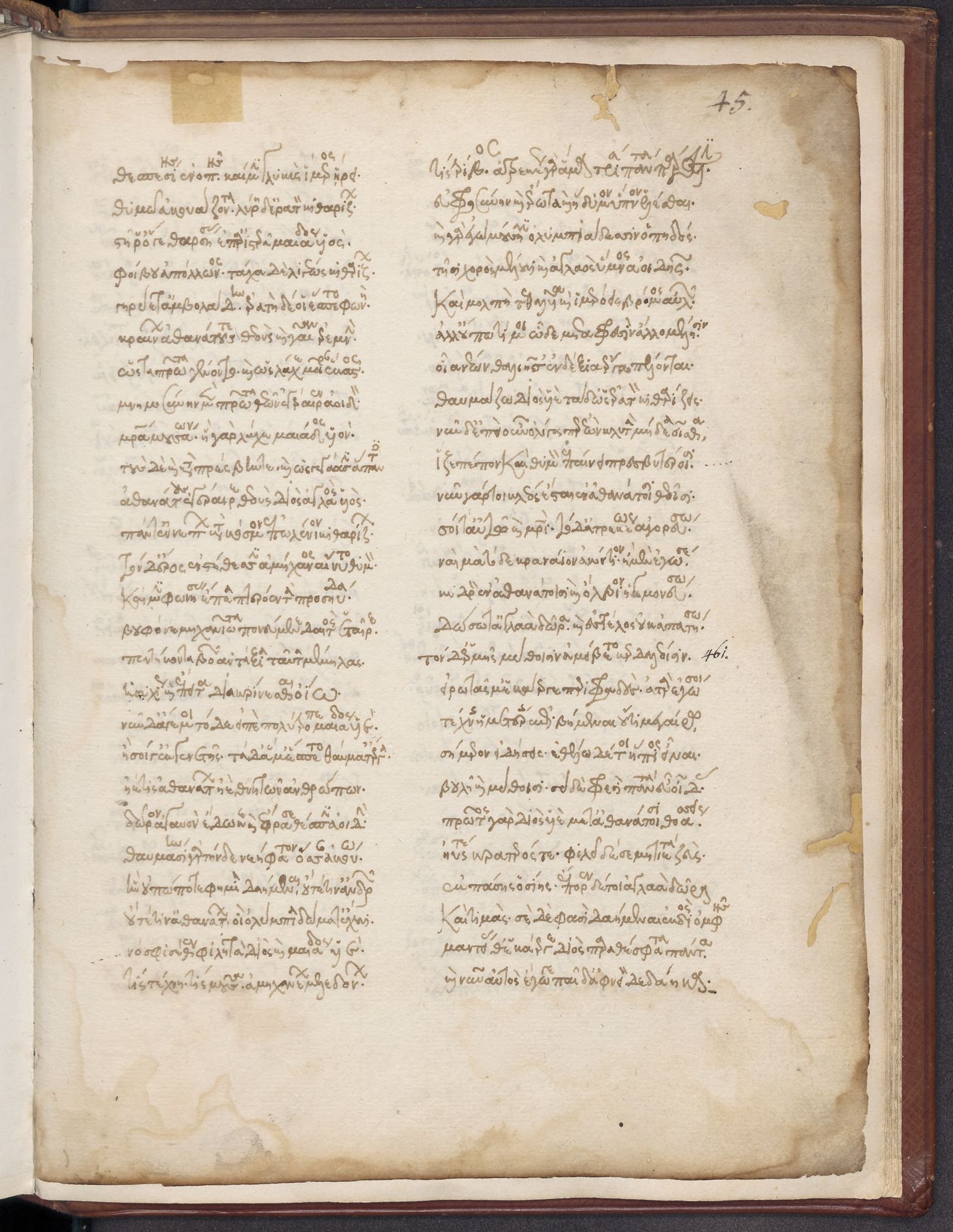
Where on the image
Leiden BPG 33 H, fol. 45r, column a (left): Hymn 4 422-447; begins ‹θεσπεσίης ἐνοπῆς καί μιν›, ends ‹τίς μοῦσα ἀμηχανέων μελεδώνων,›. Checked on the image: the first and last verses of the column were read and matched to the Greek. The column before ends with Hymn 4 421. The next column begins with Hymn 4 448. English blocks here: 420-424, 425-429, 430-434, 435-439, 440-444, 445-445, 446-449.
422θεσπεσίης ἐνοπῆς καί μιν γλυκὺς ἵμερος ᾕρει
423θυμῷ ἀκουάζοντα· λύρῃ δʼ ἐρατὸν κιθαρίζων
424στῆ ῥʼ ὅ γε θαρσήσας ἐπʼ ἀριστερὰ Μαιάδος υἱὸς
425Φοίβου Ἀπόλλωνος· τάχα δὲ λιγέως κιθαρίζων
426γηρύετʼ ἀμβολάδην — ἐρατὴ δέ οἱ ἕσπετο φωνή —
427κραίνων ἀθανάτους τε θεοὺς καὶ γαῖαν ἐρεμνήν,
428ὡς τὰ πρῶτα γένοντο καὶ ὡς λάχε μοῖραν ἕκαστος.
429Μνημοσύνην μὲν πρῶτα θεῶν ἐγέραιρεν ἀοιδῇ,
430μητέρα Μουσάων· ἣ γὰρ λάχε Μαιάδος υἱόν·
431τοὺς δὲ κατὰ πρέσβιν τε καὶ ὡς γεγάασιν ἕκαστος
432ἀθανάτους ἐγέραιρε θεοὺς Διὸς ἀγλαὸς υἱός,
433πάντʼ ἐνέπων κατὰ κόσμον, ἐπωλένιον κιθαρίζων.
434τὸν δʼ ἔρος ἐν στήθεσσιν ἀμήχανος αἴνυτο θυμόν,
435καί μιν φωνήσας ἔπεα πτερόεντα προσηύδα·
436βουφόνε, μηχανιῶτα, πονεύμενε, δαιτὸς ἑταῖρε,
437πεντήκοντα βοῶν ἀντάξια ταῦτα μέμηλας.
438ἡσυχίως καὶ ἔπειτα διακρινέεσθαι ὀίω·
439νῦν δʼ ἄγε μοι τόδε εἰπέ, πολύτροπε Μαιάδος υἱέ,
440ἦ σοί γʼ ἐκ γενετῆς τάδʼ ἅμʼ ἕσπετο θαυματὰ ἔργα
441ἠέ τις ἀθανάτων ἠὲ θνητῶν ἀνθρώπων
442δῶρον ἀγαυὸν ἔδωκε καὶ ἔφρασε θέσπιν ἀοιδήν;
443θαυμασίην γὰρ τήνδε νεήφατον ὄσσαν ἀκούω,
444ἣν οὐ πώ ποτέ φημι δαήμεναι οὔτε τινʼ ἀνδρῶν
445οὔτε τινʼ ἀθανάτων, οἳ Ὀλύμπια δώματʼ ἔχουσι,
446νόσφι σέθεν, φηλῆτα, Διὸς καὶ Μαιάδος υἱέ.
447τίς τέχνη, τίς μοῦσα ἀμηχανέων μελεδώνων,
420it sounded awesomely. And Phoebus Apollo laughed for joy; for the sweet throb of the marvellous music went to his heart, and a soft longing took hold on his soul as he listened. Then the son of Maia, harping sweetly upon his lyre, took courage and stood at the left hand 425of Phoebus Apollo; and soon, while he played shrilly on his lyre, he lifted up his voice and sang, and lovely was the sound of his voice that followed. He sang the story of the deathless gods and of the dark earth, how at the first they came to be, and how each one received his portion. First among the gods he honored Mnemosyne, 430mother of the Muses, in his song; for the son of Maia was of her following. And next the goodly son of Zeus hymned the rest of the immortals according to their order in age, and told how each was born, mentioning all in order as he struck the lyre upon his arm. But Apollo was seized with a longing not to be allayed, 435and he opened his mouth and spoke winged words to Hermes: “Slayer of oxen, trickster, busy one, comrade of the feast, this song of yours is worth fifty cows, and I believe that presently we shall settle our quarrel peacefully. But come now, tell me this, resourceful son of Maia: 440has this marvellous thing been with you from your birth, or did some god or mortal man give it you —a noble gift —and teach you heavenly song? For wonderful is this new-uttered sound I hear, the like of which I vow that no man 445nor god dwelling on Olympus ever yet has known but you,O thievish son of Maia. 446What skill is this? What song for desperate cares? What way of song? For verily here are three things to hand all at once from which to choose, —mirth, and love, and sweet sleep.
Where on the image
Leiden BPG 33 H, fol. 45r, column b (right): Hymn 4 448-473; begins ‹τίς τρίβος; ἀτρεκέως γὰρ›, ends ‹σε μαλʼ ἀφνειὸν δεδάηκα·›. Checked on the image: the first and last verses of the column were read and matched to the Greek. The column before ends with Hymn 4 447. The next column begins with Hymn 4 474. English blocks here: 450-454, 455-459, 460-464, 465-469, 470-474.
448τίς τρίβος; ἀτρεκέως γὰρ ἅμα τρία πάντα πάρεστιν,
449εὐφροσύνην καὶ ἔρωτα καὶ ἥδυμον ὕπνον ἑλέσθαι.
450καὶ γὰρ ἐγὼ Μούσῃσιν Ὀλυμπιάδεσσιν ὀπηδός,
451τῇσι χοροί τε μέλουσι καὶ ἀγλαὸς οἶμος ἀοιδῆς
452καὶ μολπὴ τεθαλυῖα καὶ ἱμερόεις βρόμος αὐλῶν·
453ἀλλʼ οὔ πω τί μοι ὧδε μετὰ φρεσὶν ἄλλο μέλησεν,
454οἷα νέων θαλίῃς ἐνδέξια ἔργα πέλονται.
455θαυμάζω, Διὸς υἱέ, τάδʼ, ὡς ἐρατὸν κιθαρίζεις.
456νῦν δʼ ἐπεὶ οὖν ὀλίγος περ ἐὼν κλυτὰ μήδεα οἶδας,
457ἷζε, πέπον, καὶ μῦθον ἐπαίνει πρεσβυτέροισι·
458νῦν γάρ τοι κλέος ἔσται ἐν ἀθανάτοισι θεοῖσι
459σοί τʼ αὐτῷ καὶ μητρί· τὸ δʼ ἀτρεκέως ἀγορεύσω·
460ναὶ μὰ τόδε κρανέινον ἀκόντιον, ἦ μὲν ἐγώ σε
461κυδρὸν ἐν ἀθανάτοισι καὶ ὄλβιον ἡγεμόνʼ εἵσω
462δώσω τʼ ἀγλαὰ δῶρα καὶ ἐς τέλος οὐκ ἀπατήσω.
463τὸν δʼ Ἑρμῆς μύθοισιν ἀμείβετο κερδαλέοισιν·
464εἰρωτᾷς μʼ, Ἑκάεργε, περιφραδές· αὐτὰρ ἐγώ σοι
465τέχνης ἡμετέρης ἐπιβήμεναι οὔ τι μεγαίρω.
466σήμερον εἰδήσεις· ἐθέλω δέ τοι ἤπιος εἶναι
467βουλῇ καὶ μύθοισι. σὺ δὲ φρεσὶ πάντʼ εὖ οἶδας·
468πρῶτος γάρ, Διὸς υἱέ, μετʼ ἀθανάτοισι θαάσσεις,
469ἠύς τε κρατερός τε· φιλεῖ δέ σε μητίετα Ζεὺς
470ἐκ πάσης ὁσίης, ἔπορεν δέ τοι ἀγλαὰ δῶρα.
471καὶ τιμάς σέ γέ φασι δαήμεναι ἐκ Διὸς ὀμφῆς
472μαντείας θʼ Ἑκάεργε, Διὸς παρά, θέσφατα πάντα
473τῶν νῦν αὐτὸς ἐγώ σε μαλʼ ἀφνειὸν δεδάηκα·
450And though I am a follower of the Olympian Muses who love dances and the bright path of song —the full-toned chant and ravishing thrill of flutes —yet I never cared for any of those feats of skill at young men's revels, as I do now for this: 455I am filled with wonder, O son of Zeus, at your sweet playing. But now, since you, though little, have such glorious skill, sit down, dear boy, and respect the words of your elders For now you shall have renown among the deathless gods, you and your mother also. This I will declare to you exactly: 460by this shaft of cornel wood I will surely make you a leader renowned among the deathless gods, and fortunate, and will give you glorious gifts and will not deceive you from first to last.” Then Hermes answered him with artful words: “You question me carefully, O Far-worker; yet I am 465not jealous that you should enter upon my art: this day you shall know it. For I seek to be friendly with you both in thought and word. Now you well know all things in your heart, since you sit foremost among the deathless gods, O son of Zeus, and are goodly and strong. And wise Zeus loves you 470as all right is, and has given you splendid gifts. And they say that from the utterance of Zeus you have learned both the honors due to the gods, O Far-worker, and oracles from Zeus, even all his ordinances. Of all these I myself have already learned that you have great wealth. Now, you are free to learn whatever you please;
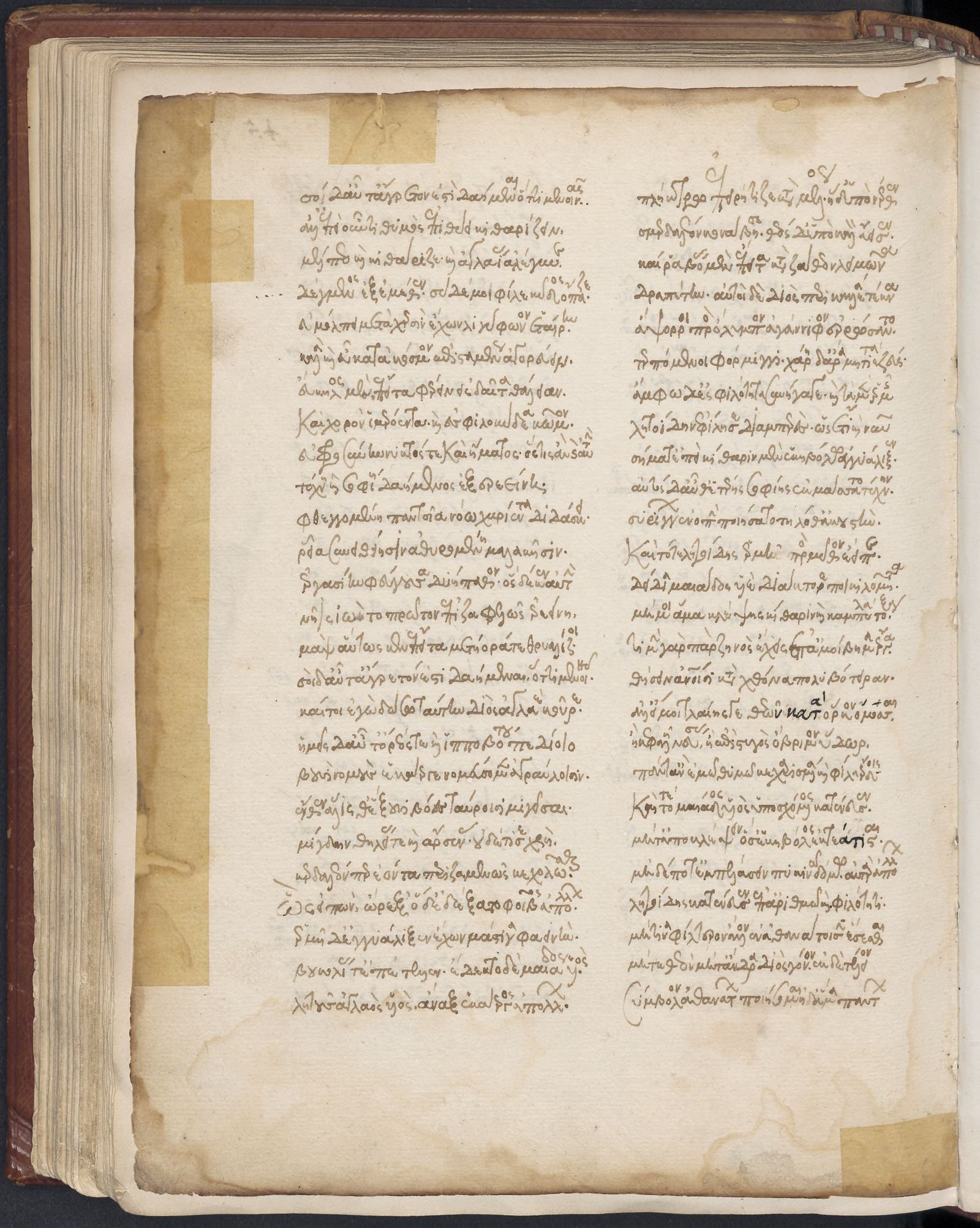
Where on the image
Leiden BPG 33 H, fol. 45v, column a (left): Hymn 4 474-500; begins ‹σοὶ δʼ αὐτάγρετόν ἐστι›, ends ‹υἱός, ἄναξ ἑκάεργος Ἀπόλλων,›. Checked on the image: the first and last verses of the column were read and matched to the Greek. The column before ends with Hymn 4 473. The next column begins with Hymn 4 501. Verse 499 is not in the manuscript: the column passes from 498 to 500 (a χ stands above the last line). English blocks here: 475-479, 480-484, 485-487, 488-489, 490-494, 495-499. The English block(s) 495-499 also cover verses that are not in the manuscript.
474σοὶ δʼ αὐτάγρετόν ἐστι δαήμεναι, ὅττι μενοινᾷς.
475ἀλλʼ ἐπεὶ οὖν τοι θυμὸς ἐπιθύει κιθαρίζειν,
476μέλπεο καὶ κιθάριζε καὶ ἀγλαίας ἀλέγυνε
477δέγμενος ἐξ ἐμέθεν· σὺ δέ μοι, φίλε, κῦδος ὄπαζε.
478εὐμόλπει μετὰ χερσὶν ἔχων λιγύφωνον ἑταίρην,
479καλὰ καὶ εὖ κατὰ κόσμον ἐπιστάμενος ἀγορεύειν.
480εὔκηλος μὲν ἔπειτα φέρειν ἐς δαῖτα θάλειαν
481καὶ χορὸν ἱμερόεντα καὶ ἐς φιλοκυδέα κῶμον
482εὐφροσύνην νυκτός τε καὶ ἤματος. ὅς τις ἂν αὐτὴν
483τέχνῃ καὶ σοφίῃ δεδαημένος ἐξερεείνῃ,
484φθεγγομένη παντοῖα νόῳ χαρίεντα διδάσκει
485ῥεῖα συνηθείῃσιν ἀθυρομένη μαλακῇσιν,
486ἐργασίην φεύγουσα δυήπαθον· ὃς δέ κεν αὐτὴν
487νῆις ἐὼν τὸ πρῶτον ἐπιζαφελῶς ἐρεείνῃ,
488μὰψ αὔτως κεν ἔπειτα μετήορά τε θρυλλίζοι.
489σοὶ δʼ αὐτάγρετόν ἐστι δαήμεναι, ὅττι μενοινᾷς.
490καί τοι ἐγὼ δώσω ταύτην, Διὸς ἀγλαὲ κοῦρε·
491ἡμεῖς δʼ αὖτʼ ὄρεός τε καὶ ἱπποβότου πεδίοιο
492βουσὶ νομούς, Ἑκάεργε, νομεύσομεν ἀγραύλοισιν.
493ἔνθεν ἅλις τέξουσι βόες ταύροισι μιγεῖσαι
494μίγδην θηλείας τε καὶ ἄρσενας· οὐδέ τί σε χρὴ
495κερδαλέον περ ἐόντα περιζαμενῶς κεχολῶσθαι.
496ὣς εἰπὼν ὤρεξʼ· ὃ δʼ ἐδέξατο Φοῖβος Ἀπόλλων,
497Ἐρμῇ δʼ ἐγγυάλιξεν ἑκὼν μάστιγα φαεινήν,
498βουκολίας τʼ ἐπέτελλεν· ἔδεκτο δὲ Μαιάδος υἱὸς
500Λητοῦς ἀγλαὸς υἱός, ἄναξ ἑκάεργος Ἀπόλλων,
475but since, as it seems, your heart is so strongly set on playing the lyre, chant, and play upon it, and give yourself to merriment, taking this as a gift from me, and do you, my friend, bestow glory on me. Sing well with this clear-voiced companion in your hands; for you are skilled in good, well-ordered utterance. 480From now on bring it confidently to the rich feast and lovely dance and glorious revel, a joy by night and by day. Whoso with wit and wisdom enquires of it cunningly, him it teaches 485through its sound all manner of things that delight the mind, being easily played with gentle familiarities, for it abhors toilsome drudgery; but whoso in ignorance enquires of it violently, to him it chatters mere vanity and foolishness. 488But you are able to learn whatever you please. 490So then, I will give you this lyre, glorious son of Zeus, while I for my part will graze down with wild-roving cattle the pastures on hill and horse-feeding plain: so shall the cows covered by the bulls calve abundantly both males and females. And now there is no need for you, 495bargainer though you are, to be furiously angry.” When Hermes had said this, he held out the lyre: and Phoebus Apollo took it, and readily put his shining whip in Hermes' hand, and ordained him keeper of herds. The son of Maia received it joyfully,
Where on the image
Leiden BPG 33 H, fol. 45v, column b (right): Hymn 4 501-527; begins ‹πλήκτρῳ ἐπειρήτιζε κατὰ μέρος·›, ends ‹ποιήσομαι ἠδʼ ἅμα πάντων,›. Checked on the image: the first and last verses of the column were read and matched to the Greek. The column before ends with Hymn 4 500. The next column begins with Hymn 4 528. Line 526a of the Loeb text (a supplement) is not in the manuscript. English blocks here: 500-504, 505-509, 510-512, 513-514, 515-519, 520-524, 525-529.
501πλήκτρῳ ἐπειρήτιζε κατὰ μέρος· ἣ δʼ ὑπένερθε
502σμερδαλέον κονάβησε· θεὸς δʼ ὑπὸ καλὸν ἄεισεν.
503ἔνθα βόας μὲν ἔπειτα ποτὶ ζάθεον λειμῶνα
504ἐτραπέτην· αὐτοὶ δέ, Διὸς περικαλλέα τέκνα,
505ἄψορροι πρὸς Ὄλυμπον ἀγάννιφον ἐρρώσαντο
506τερπόμενοι φόρμιγγι· χάρη δʼ ἄρα μητιέτα Ζεύς,
507ἄμφω δʼ ἐς φιλότητα συνήγαγε· καὶ τὰ μὲν Ἑρμῆς
508Λητοΐδην ἐφίλησε διαμπερὲς ὡς ἔτι καὶ νῦν,
509σήματʼ ἐπεὶ κίθαριν μὲν Ἑκηβόλῳ ἐγγυάλιξεν
510ἱμερτήν, δεδαώς, ὃ δʼ ἐπωλένιον κιθάριζεν·
511αὐτὸς δʼ αὖθʼ ἑτέρης σοφίης ἐκμάσσατο τέχνην·
512συρίγγων ἐνοπὴν ποιήσατο τηλόθʼ ἀκουστήν.
513καὶ τότε Λητοΐδης Ἑρμῆν πρὸς μῦθον ἔειπε·
514δείδια, Μαιάδος υἱέ, διάκτορε, ποικιλομῆτα,
515μή μοι ἅμα κλέψῃς κίθαριν καὶ καμπύλα τόξα·
516τιμὴν γὰρ πὰρ Ζηνὸς ἔχεις ἐπαμοίβια ἔργα
517θήσειν ἀνθρώποισι κατὰ χθόνα πουλυβότειραν.
518ἀλλʼ εἴ μοι τλαίης γε θεῶν μέγαν ὅρκον ὀμόσσαι,
519ἢ κεφαλῇ νεύσας ἢ ἐπὶ Στυγὸς ὄβριμον ὕδωρ,
520πάντʼ ἂν ἐμῷ θυμῷ κεχαρισμένα καὶ φίλα ἔρδοις.
521καὶ τότε Μαιάδος υἱὸς ὑποσχόμενος κατένευσε,
522μή ποτʼ ἀποκλέψειν, ὅσʼ Ἑκηβόλος ἐκτεάτισται,
523μηδέ ποτʼ ἐμπελάσειν πυκινῷ δόμῳ· αὐτὰρ Ἀπόλλων
524Λητοΐδης κατένευσεν ἐπʼ ἀρθμῷ καὶ φιλότητι,
525μή τινα φίλτερον ἄλλον ἐν ἀθανάτοισιν ἔσεσθαι,
526μήτε θεὸν μήτʼ ἄνδρα Διὸς γόνον· ἐκ δὲ τέλειον
527σύμβολον ἀθανάτων ποιήσομαι ἠδʼ ἅμα πάντων,
500while the glorious son of Leto, the lord far-working Apollo, took the lyre upon his left arm and tried each string with the key. Awesomely it sounded at the touch of the god, while he sang sweetly to its note. Afterwards they two, the all-glorious sons of Zeus turned the cows back towards the sacred meadow, 505but themselves hastened back to snowy Olympus, delighting in the lyre. Then wise Zeus was glad and made them both friends. And Hermes loved the son of Leto continually, even as he does now, when he had given the lyre as token to the Far-shooter, 510who played it skilfully, holding it upon his arm. But for himself Hermes found out another cunning art and made himself the pipes whose sound is heard afar. 513Then the son of Leto said to Hermes: “Son of Maia, guide and cunning one, I fear 515you may steal from me the lyre and my curved bow together; for you have an office from Zeus, to establish deeds of barter amongst men throughout the fruitful earth. Now if you would only swear me the great oath of the gods, either by nodding your head, or by the potent water of Styx, 520you would do all that can please and ease my heart.” Then Maia's son nodded his head and promised that he would never steal anything of all the Far-shooter possessed, and would never go near his strong house; but Apollo, son of Leto, swore to be fellow and friend to Hermes, 525vowing that he would love no other among the immortals, neither god nor man sprung from Zeus, better than Hermes:
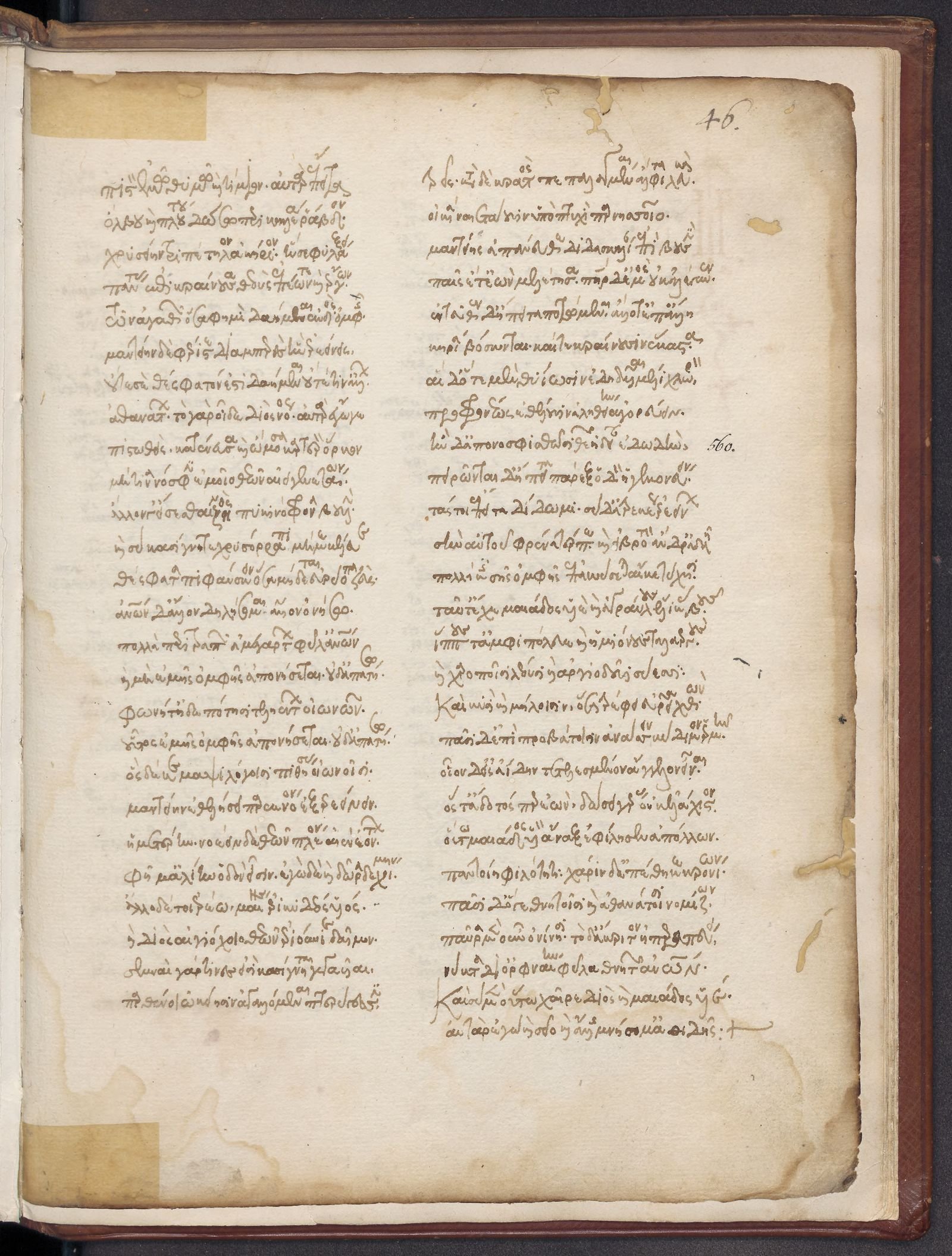
Where on the image
Leiden BPG 33 H, fol. 46r, column a (left): Hymn 4 528-553; begins ‹πιστὸν ἐμῷ θυμῷ καὶ›, ends ‹παρθένοι, ὠκείῃσιν ἀγαλλόμεναι πτερύγεσσι,›. Checked on the image: the first and last verses of the column were read and matched to the Greek. The column before ends with Hymn 4 527. The next column begins with Hymn 4 554. English blocks here: 530-534, 535-539, 540-544, 545-549, 550-554.
528πιστὸν ἐμῷ θυμῷ καὶ τίμιον· αὐτὰρ ἔπειτα
529ὄλβου καὶ πλούτου δώσω περικαλλέα ῥάβδον,
530χρυσείην, τριπέτηλον, ἀκήριον ἥ σε φυλάξει
531πάντας ἐπικραίνουσʼ ἄθλους ἐπέων τε καὶ ἔργων
532τῶν ἀγαθῶν, ὅσα φημὶ δαήμεναι ἐκ Διὸς ὀμφῆς.
533μαντείην δέ, φέριστε, διοτρεφές, ἣν ἐρεείνεις,
534οὔτε σὲ θέσφατόν ἐστι δαήμεναι οὔτε τινʼ ἄλλον
535ἀθανάτων· τὸ γὰρ οἶδε Διὸς νόος· αὐτὰρ ἐγώ γε
536πιστωθεὶς κατένευσα καὶ ὤμοσα καρτερὸν ὅρκον,
537μή τινα νόσφιν ἐμεῖο θεῶν αἰειγενετάων
538ἄλλον γʼ εἴσεσθαι Ζηνὸς πυκινόφρονα βουλήν.
539καὶ σύ, κασίγνητε χρυσόρραπι, μή με κέλευε
540θέσφατα πιφαύσκειν, ὅσα μήδεται εὐρύοπα Ζεύς.
541ἀνθρώπων δʼ ἄλλον δηλήσομαι, ἄλλον ὀνήσω,
542πολλὰ περιτροπέων ἀμεγάρτων φῦλʼ ἀνθρώπων.
543καὶ μὲν ἐμῆς ὀμφῆς ἀπονήσεται, ὅς τις ἂν ἔλθῃ
544φωνῇ καὶ πτερύγεσσι τεληέντων οἰωνῶν·
545οὗτος ἐμῆς ὀμφῆς ἀπονήσεται, οὐδʼ ἀπατήσω.
546ὃς δέ κε μαψιλόγοισι πιθήσας οἰωνοῖσι
547μαντείην ἐθέλῃσι παρὲκ νόον ἐξερεείνειν
548ἡμετέρην, νοέειν δὲ θεῶν πλέον αἰὲν ἐόντων,
549φήμʼ, ἁλίην ὁδὸν εἶσιν. ἐγὼ δέ κε δῶρα δεχοίμην.
550ἄλλο δέ τοι ἐρέω, Μαίης ἐρικυδέος υἱὲ
551καὶ Διὸς αἰγιόχοιο, θεῶν ἐριούνιε δαῖμον·
552σεμναὶ γάρ τινες εἰσί, κασίγνηται γεγαυῖαι,
553παρθένοι, ὠκείῃσιν ἀγαλλόμεναι πτερύγεσσι,
530it is of gold, with three branches, and will keep you scatheless, accomplishing every task, whether of words or deeds that are good, which I claim to know through the utterance of Zeus. But as for sooth-saying, noble, heaven-born child, of which you ask, it is not lawful for you to learn it, nor for any other 535of the deathless gods: only the mind of Zeus knows that. I am pledged and have vowed and sworn a strong oath that no other of the eternal gods save I should know the wise-hearted counsel of Zeus. And do not you, my brother, bearer of the golden wand, bid me 540tell those decrees which all-seeing Zeus intends. As for men, I will harm one and profit another, sorely perplexing the tribes of unenviable men. Whosoever shall come guided by the call and flight of birds of sure omen, 545that man shall have advantage through my voice, and I will not deceive him. But whoso shall trust to idly-chattering birds and shall seek to invoke my prophetic art contrary to my will, and to understand more than the eternal gods, I declare that he shall come on an idle journey; yet his gifts I would take. 550But I will tell you another thing, Son of all-glorious Maia and Zeus who holds the aegis, luck-bringing genius of the gods. There are certain holy ones, sisters born —three virgins gifted with wings: their heads are besprinkled with white meal,
Where on the image
Leiden BPG 33 H, fol. 46r, column b (right): Hymn 4 554-580; begins ‹τρεῖς· κατὰ δὲ κρατὸς›, ends ‹καὶ ἄλλης μνήσομʼ ἀοιδῆς.›. Checked on the image: the first and last verses of the column were read and matched to the Greek. The column before ends with Hymn 4 553. The next column begins with Hymn 5 1. The Hymn to Hermes ends at the foot of the column. English blocks here: 555-559, 560-564, 565-569, 570-574, 575-579, 580-580.
554τρεῖς· κατὰ δὲ κρατὸς πεπαλαγμέναι ἄλφιτα λευκά,
555οἰκία ναιετάουσιν ὑπὸ πτυχὶ Παρνησοῖο,
556μαντείης ἀπάνευθε διδάσκαλοι, ἣν ἐπὶ βουσὶ
557παῖς ἔτʼ ἐὼν μελέτησα· πατὴρ δʼ ἐμὸς οὐκ ἀλέγιζεν,
558ἐντεῦθεν δὴ ἔπειτα ποτώμεναι ἄλλοτε ἄλλη
559κηρία βόσκονται καί τε κραίνουσιν ἕκαστα.
560αἳ δʼ ὅτε μὲν θυΐωσιν ἐδηδυῖαι μέλι χλωρόν,
561προφρονέως ἐθέλουσιν ἀληθείην ἀγορεύειν·
562ἢν δʼ ἀπονοσφισθῶσι θεῶν ἡδεῖαν ἐδωδήν,
563ψεύδονται δὴ ἔπειτα διʼ ἀλλήλων δονέουσαι.
564τάς τοι ἔπειτα δίδωμι· σὺ δʼ ἀτρεκέως ἐρεείνων
565σὴν αὐτοῦ φρένα τέρπε, καὶ εἰ βροτὸν ἄνδρα δαείῃς,
566πολλάκι σῆς ὀμφῆς ἐπακούσεται, αἴ κε τύχῃσι.
567ταῦτʼ ἔχε, Μαιάδος υἱέ, καὶ ἀγραύλους ἕλικας βοῦς
568ἵππους τʼ ἀμφιπόλευε καὶ ἡμιόνους ταλαεργούς.
569καὶ χαροποῖσι λέουσι καὶ ἀργιόδουσι σύεσσι
570καὶ κυσὶ καὶ μήλοισιν, ὅσα τρέφει εὐρεῖα χθών,
571πᾶσι δʼ ἐπὶ προβάτοισιν ἀνάσσειν κύδιμον Ἑρμῆν,
572οἶον δʼ εἰς Ἀΐδην τετελεσμένον ἄγγελον εἶναι,
573ὅς τʼ ἄδοτός περ ἐὼν δώσει γέρας οὐκ ἐλάχιστον.
574οὕτω Μαιάδος υἱὸν ἄναξ ἐφίλησεν Ἀπόλλων
575παντοίῃ φιλότητι· χάριν δʼ ἐπέθηκε Κρονίων.
576πᾶσι δʼ ὅ γε θνητοῖσι καὶ ἀθανάτοισιν ὁμιλεῖ.
577παῦρα μὲν οὖν ὀνίνησι, τὸ δʼ ἄκριτον ἠπεροπεύει
578νύκτα διʼ ὀρφναίην φῦλα θνητῶν ἀνθρώπων.
579καὶ σὺ μὲν οὕτω χαῖρε, Διὸς καὶ Μαιάδος, υἱέ·
580αὐτὰρ ἐγὼ καὶ σεῖο καὶ ἄλλης μνήσομʼ ἀοιδῆς.
555and they dwell under a ridge of Parnassus. These are teachers of divination apart from me, the art which I practised while yet a boy following herds, though my father paid no heed to it. From their home they fly now here, now there, feeding on honey-comb and bringing all things to pass. 560And when they are inspired through eating yellow honey, they are willing to speak truth; but if they be deprived of the gods' sweet food, then they speak falsely, as they swarm in and out together. These, then, I give you; enquire of them strictly 565and delight your heart: and if you should teach any mortal so to do, often will he hear your response —if he have good fortune. Take these, Son of Maia, and tend the wild roving, horned oxen and horses and patient mules.” 570and over dogs and all flocks that the wide earth nourishes, and over all sheep; also that he only should be the appointed messenger to Hades, who, though he takes no gift, shall give him no mean prize. Thus the lord Apollo showed his kindness for the Son of Maia 575by all manner of friendship: and the Son of Cronos gave him grace besides. He consorts with all mortals and immortals: a little he profits, but continually throughout the dark night he cozens the tribes of mortal men. And so, farewell, Son of Zeus and Maia; 580but I will remember you and another song also.
Notes
- Greek: H. G. Evelyn-White, Hesiod, the Homeric Hymns and Homerica (Loeb Classical Library, 1914), via Perseus. Square brackets mark the editor's restorations of text lost or doubtful in the manuscript.
- Lines the Loeb numbers with letters (137a, 236a, 317a, 526a and others) are editorial supplements or variants and are left out.
- English: Evelyn-White's translation in the same volume; his footnotes are omitted.
Cite
Sources
- Source: Leiden BPG 33 H (Leiden University Libraries IIIF) + Evelyn-White Greek (Loeb 1914, Perseus) + Evelyn-White English (1914, Perseus) (holding institution)
- Critical edition: Evelyn-White, Loeb 1914, via Perseus
← previous · → next · v cycle view · l back to library