Homeric Hymn 7, To Dionysus: the pirates, 'to Egypt or Cyprus or the Hyperboreans'
Introduction
The seventh Homeric Hymn, to Dionysus, probably of the 6th century BCE, tells how Tyrrhenian pirates seized the young god on a headland. The helmsman warns that he is a god; the master scoffs that the captive is bound for Egypt or Cyprus or the Hyperboreans or further still (lines 28-29), the Hyperboreans standing for the farthest edge of the world. Wine flows through the ship, a vine and ivy cover the mast, the god becomes a lion, and the sailors leap overboard and become dolphins; only the helmsman is spared.
The manuscript is Leiden, Universiteitsbibliotheek, BPG 33 H, the 'Moscow' manuscript of the Homeric Hymns (M), written in the first half of the 15th century and found in Moscow in 1777; it is the only manuscript that preserves the Hymn to Demeter. Hymn 7 fills fol. 49r and the first column of 49v, two columns of 26 lines to the page.
How was this verified? (Provenance)
Where on the image
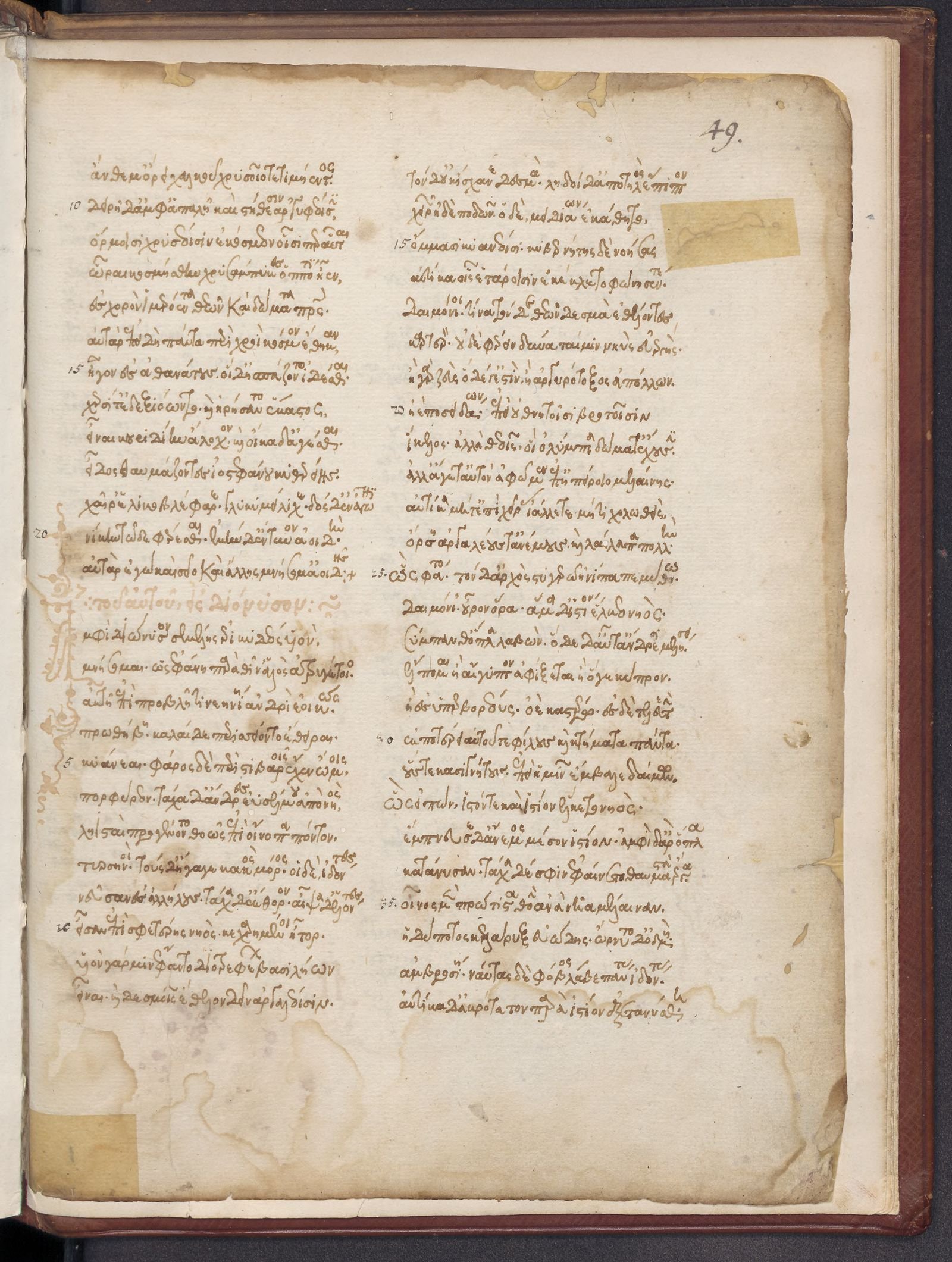
Lines 1-31 stand on Leiden, UB, BPG 33 H (M), fol. 49r. Checked on the images: 49r: the hymn begins at col. 1 line 15, ‹ἀμφὶ Διώνυσον σεμέλης ἐρικυδέος υἱόν›, under the red title ‹τοῦ αὐτοῦ εἰς Διόνυσον› (line 14); col. 1 ends at line 26 with v. 12; col. 2 carries vv. 13-38, from ‹τὸν δ' οὐκ ἴσχανε δεσμά›; the Hyperboreans are col. 2 lines 16-17, ‹ἔλπομαι, ἢ αἴγυπτον› and ‹ἢ ἐς ὑπερβορέους› (vv. 28-29); the scribe numbers every fifth line in the margin
1ἀμφὶ Διώνυσον, Σεμέλης ἐρικυδέος υἱόν,
2μνήσομαι, ὡς ἐφάνη παρὰ θῖν’ ἁλὸς ἀτρυγέτοιο
3ἀκτῇ ἔπι προβλῆτι νεηνίῃ ἀνδρὶ ἐοικώς,
4πρωθήβῃ· καλαὶ δὲ περισσείοντο ἔθειραι,
5κυάνεαι, φᾶρος δὲ περὶ στιβαροῖς ἔχεν ὤμοις
6πορφύρεον· τάχα δ’ ἄνδρες ἐυσσέλμου ἀπὸ νηὸς
7ληισταὶ προγένοντο θοῶς ἐπὶ οἴνοπα πόντον,
8Τυρσηνοί· τοὺς δ’ ἦγε κακὸς μόρος· οἳ δὲ ἰδόντες
9νεῦσαν ἐς ἀλλήλους, τάχα δ’ ἔκθορον. αἶψα δ’ ἑλόντες
10εἷσαν ἐπὶ σφετέρης νηὸς κεχαρημένοι ἦτορ.
11υἱὸν γάρ μιν ἔφαντο διοτρεφέων βασιλήων
12εἶναι καὶ δεσμοῖς ἔθελον δεῖν ἀργαλέοισι.
13τὸν δ’ οὐκ ἴσχανε δεσμά, λύγοι δ’ ἀπὸ τηλόσε πῖπτον
14χειρῶν ἠδὲ ποδῶν· ὃ δὲ μειδιάων ἐκάθητο
15ὄμμασι κυανέοισι· κυβερνήτης δὲ νοήσας
16αὐτίκα οἷς ἑτάροισιν ἐκέκλετο φώνησέν τε·
17δαιμόνιοι, τίνα τόνδε θεὸν δεσμεύεθ’ ἑλόντες,
18καρτερόν; οὐδὲ φέρειν δύναταί μιν νηῦς εὐεργής.
19ἢ γὰρ Ζεὺς ὅδε γ’ ἐστὶν ἢ ἀργυρότοξος Ἀπόλλων
20ἠὲ Ποσειδάων· ἐπεὶ οὐ θνητοῖσι βροτοῖσιν
21εἴκελος, ἀλλὰ θεοῖς, οἳ Ὀλύμπια δώματ’ ἔχουσιν.
22ἀλλ’ ἄγετ’, αὐτὸν ἀφῶμεν ἐπ’ ἠπείροιο μελαίνης
23αὐτίκα· μηδ’ ἐπὶ χεῖρας ἰάλλετε, μή τι χολωθεὶς
24ὄρσῃ ἔπ’ ἀργαλέους τ’ ἀνέμους καὶ λαίλαπα πολλήν.
25Ὣς φάτο· τὸν δ’ ἀρχὸς στυγερῷ ἠνίπαπε μύθῳ·
26δαιμόνι’, οὖρον ὅρα, ἅμα δ’ ἱστίον ἕλκεο νηὸς
27σύμπανθ’ ὅπλα λαβών· ὅδε δ’ αὖτ’ ἄνδρεσσι μελήσει.
28ἔλπομαι, ἢ Αἴγυπτον ἀφίξεται ἢ ὅ γε Κύπρον
29ἢ ἐς Ὑπερβορέους ἢ ἑκαστέρω· ἐς δὲ τελευτὴν
30ἔκ ποτ’ ἐρεῖ αὐτοῦ τε φίλους καὶ κτήματα πάντα
31οὕς τε κασιγνήτους, ἐπεὶ ἡμῖν ἔμβαλε δαίμων.
I will tell of Dionysus, the son of glorious Semele, how he appeared on a jutting headland by the shore of the fruitless sea, seeming like a stripling in the first flush of manhood: his rich, dark hair was waving about him, and on his strong shoulders he wore a purple robe. Presently there came swiftly over the sparkling sea Tyrsenian pirates on a well-decked ship—a miserable doom led them on. When they saw him they made signs to one another and sprang out quickly, and seizing him straightway, put him on board their ship exultingly; for they thought him the son of heaven-nurtured kings. They sought to bind him with rude bonds, but the bonds would not hold him, and the withes fell far away from his hands and feet: and he sat with a smile in his dark eyes. Then the helmsman understood all and cried out at once to his fellows and said: ‘Madmen! What god is this whom you have taken and bind, strong that he is? Not even the well-built ship can carry him. Surely this is either Zeus or Apollo who has the silver bow, or Poseidon, for he looks not like mortal men but like the gods who dwell on Olympus. Come, then, let us set him free upon the dark shore at once: do not lay hands on him, lest he grow angry and stir up dangerous winds and heavy squalls.’ So said he: but the master chid him with taunting words: ‘Madman, mark the wind and help hoist sail on the ship: catch all the sheets. As for this fellow we men will see to him: I reckon he is bound for Egypt or for Cyprus or to the Hyperboreans or further still. But in the end he will speak out and tell us his friends and all his wealth and his brothers, now that providence has thrown him in our way.’
Where on the image
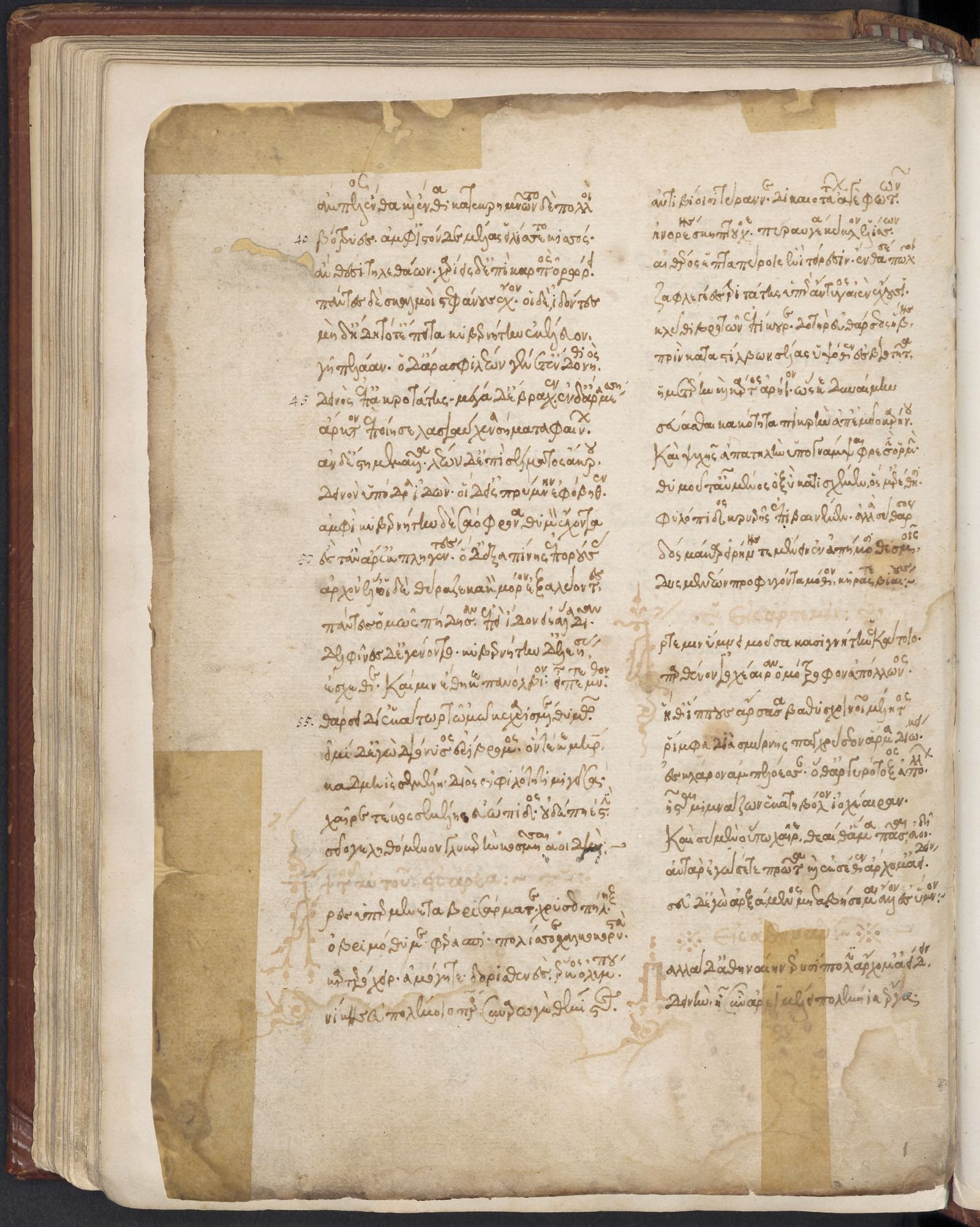
Lines 32-54 stand on Leiden, UB, BPG 33 H (M), fol. 49r and 49v. Checked on the images: 49r: the hymn begins at col. 1 line 15, ‹ἀμφὶ Διώνυσον σεμέλης ἐρικυδέος υἱόν›, under the red title ‹τοῦ αὐτοῦ εἰς Διόνυσον› (line 14); col. 1 ends at line 26 with v. 12; col. 2 carries vv. 13-38, from ‹τὸν δ' οὐκ ἴσχανε δεσμά›; the Hyperboreans are col. 2 lines 16-17, ‹ἔλπομαι, ἢ αἴγυπτον› and ‹ἢ ἐς ὑπερβορέους› (vv. 28-29); the scribe numbers every fifth line in the margin; 49v: col. 1 begins with v. 39, ‹ἄμπελος ἔνθα καὶ ἔνθα›, and the hymn ends at line 21 with v. 59, ‹σεῖο γε ληθόμενον γλυκερὴν κοσμῆσαι ἀοιδήν›; line 22 is the faded red title of the hymn to Ares
32ὣς εἰπὼν ἱστόν τε καὶ ἱστίον ἕλκετο νηός.
33ἔμπνευσεν δ’ ἄνεμος μέσον ἱστίον· ἀμφὶ δ’ ἄρ’ ὅπλα
34καττάνυσαν· τάχα δέ σφιν ἐφαίνετο θαυματὰ ἔργα.
35οἶνος μὲν πρώτιστα θοὴν ἀνὰ νῆα μέλαιναν
36ἡδύποτος κελάρυζ’ εὐώδης, ὤρνυτο δ’ ὀδμὴ
37ἀμβροσίη· ναύτας δὲ τάφος λάβε πάντας ἰδόντας.
38αὐτίκα δ’ ἀκρότατον παρὰ ἱστίον ἐξετανύσθη
39ἄμπελος ἔνθα καὶ ἔνθα, κατεκρημνῶντο δὲ πολλοὶ
40βότρυες· ἀμφ’ ἱστὸν δὲ μέλας εἱλίσσετο κισσός,
41ἄνθεσι τηλεθάων, χαρίεις δ’ ἐπὶ καρπὸς ὀρώρει·
42πάντες δὲ σκαλμοὶ στεφάνους ἔχον· οἳ δὲ ἰδόντες,
43νῆ’ ἤδη τότ’ ἔπειτα κυβερνήτην ἐκέλευον
44γῇ πελάαν· ὃ δ’ ἄρα σφι λέων γένετ’ ἔνδοθι νηὸς
45δεινὸς ἐπ’ ἀκροτάτης, μέγα δ’ ἔβραχεν, ἐν δ’ ἄρα μέσσῃ
46ἄρκτον ἐποίησεν λασιαύχενα, σήματα φαίνων·
47ἂν δ’ ἔστη μεμαυῖα· λέων δ’ ἐπὶ σέλματος ἄκρου
48δεινὸν ὑπόδρα ἰδών· οἳ δ’ ἐς πρύμνην ἐφόβηθεν,
49ἀμφὶ κυβερνήτην δὲ σαόφρονα θυμὸν ἔχοντα
50ἔσταν ἄρ’ ἐκπληγέντες· ὃ δ’ ἐξαπίνης ἐπορούσας
51ἀρχὸν ἕλ’, οἳ δὲ θύραζε κακὸν μόρον ἐξαλύοντες
52πάντες ὁμῶς πήδησαν, ἐπεὶ ἴδον, εἰς ἅλα δῖαν,
53δελφῖνες δ’ ἐγένοντο· κυβερνήτην δ’ ἐλεήσας
54ἔσχεθε καί μιν ἔθηκε πανόλβιον εἶπέ τε μῦθον·
When he had said this, he had mast and sail hoisted on the ship, and the wind filled the sail and the crew hauled taut the sheets on either side. But soon strange things were seen among them. First of all sweet, fragrant wine ran streaming throughout all the black ship and a heavenly smell arose, so that all the seamen were seized with amazement when they saw it. And all at once a vine spread out both ways along the top of the sail with many clusters hanging down from it, and a dark ivy-plant twined about the mast, blossoming with flowers, and with rich berries growing on it; and all the thole-pins were covered with garlands. When the pirates saw all this, then at last they bade the helmsman to put the ship to land. But the god changed into a dreadful lion there on the ship, in the bows, and roared loudly: amidships also he showed his wonders and created a shaggy bear which stood up ravening, while on the forepeak was the lion glaring fiercely with scowling brows. And so the sailors fled into the stern and crowded bemused about the right-minded helmsman, until suddenly the lion sprang upon the master and seized him; and when the sailors saw it they leapt out overboard one and all into the bright sea, escaping from a miserable fate, and were changed into dolphins. But on the helmsman Dionysus had mercy and held him back and made him altogether happy, saying to him:
Where on the image
Lines 55-59 stand on Leiden, UB, BPG 33 H (M), fol. 49v. Checked on the images: 49v: col. 1 begins with v. 39, ‹ἄμπελος ἔνθα καὶ ἔνθα›, and the hymn ends at line 21 with v. 59, ‹σεῖο γε ληθόμενον γλυκερὴν κοσμῆσαι ἀοιδήν›; line 22 is the faded red title of the hymn to Ares
55θάρσει, †δῖε κάτωρ†, τῷ ἐμῷ κεχαρισμένε θυμῷ·
56εἰμὶ δ’ ἐγὼ Διόνυσος ἐρίβρομος, ὃν τέκε μήτηρ
57Καδμηὶς Σεμέλη Διὸς ἐν φιλότητι μιγεῖσα.
58χαῖρε, τέκος Σεμέλης εὐώπιδος· οὐδέ πη ἔστι
59σεῖό γε ληθόμενον γλυκερὴν κοσμῆσαι ἀοιδήν.
‘Take courage, good...; you have found favour with my heart. I am loud-crying Dionysus whom Cadmus’ daughter Semele bare of union with Zeus.’ Hail, child of fair-faced Semele! He who forgets you can in no wise order sweet song.
Notes
- The Homeric Hymns are anonymous; they were transmitted under Homer's name.
- Evelyn-White's English is divided by his own line references, '(ll. 1-16)' and so on; each section here is one or more of his paragraphs, linked to the page(s) carrying those lines.
- Project Gutenberg's endnote numbers are removed; '...' in lines 55-57 marks a lacuna in the Greek, as in Evelyn-White.
Cite
Sources
- Source: Leiden, UB, BPG 33 H (M), fol. via Leiden University Libraries (IIIF) + Evelyn-White's Greek and English (1914; Perseus and Project Gutenberg) (holding institution)
- Critical edition: Perseus editions named per passage
← previous · → next · v cycle view · l back to library