Ignatius of Antioch, To the Magnesians (Laur. Plut. 57.7)
Introduction
Ignatius, bishop of Antioch, wrote seven letters while he was being taken under guard to Rome to be put to death, probably in the reign of Trajan (about 110 AD). This is his letter to the Magnesians. Together the letters are among the earliest witnesses to the Christian bishop, presbyters and deacons, to the eucharist as the flesh of Christ, and to faith in Christ as God and man, written against teachers who said that Christ only seemed to suffer.
The manuscript. The letter is shown on Florence, Biblioteca Medicea Laurenziana, Plut. 57.7 (11th century), the only Greek manuscript of the six other letters in this form. Laur. Plut. 57.7 carries the letters on fol. 242r-252v in the order Smyrnaeans, Polycarp, Ephesians, Magnesians, Philadelphians, Trallians, followed by spurious letters; the scribe numbers them in the margin. The Letter to the Romans is not in it, and is shown from the Paris manuscript. Each section is one chapter, linked to the page or pages that carry it; the first and last words of every page were read on the images.
Texts. The Greek is Kirsopp Lake's edition (1912), proofread here against his printed pages; the English is J. B. Lightfoot's translation (1891). Both follow the middle (seven-letter) recension. They are edited texts, so the wording on the page differs from them in places.
How was this verified? (Provenance)
Where on the image
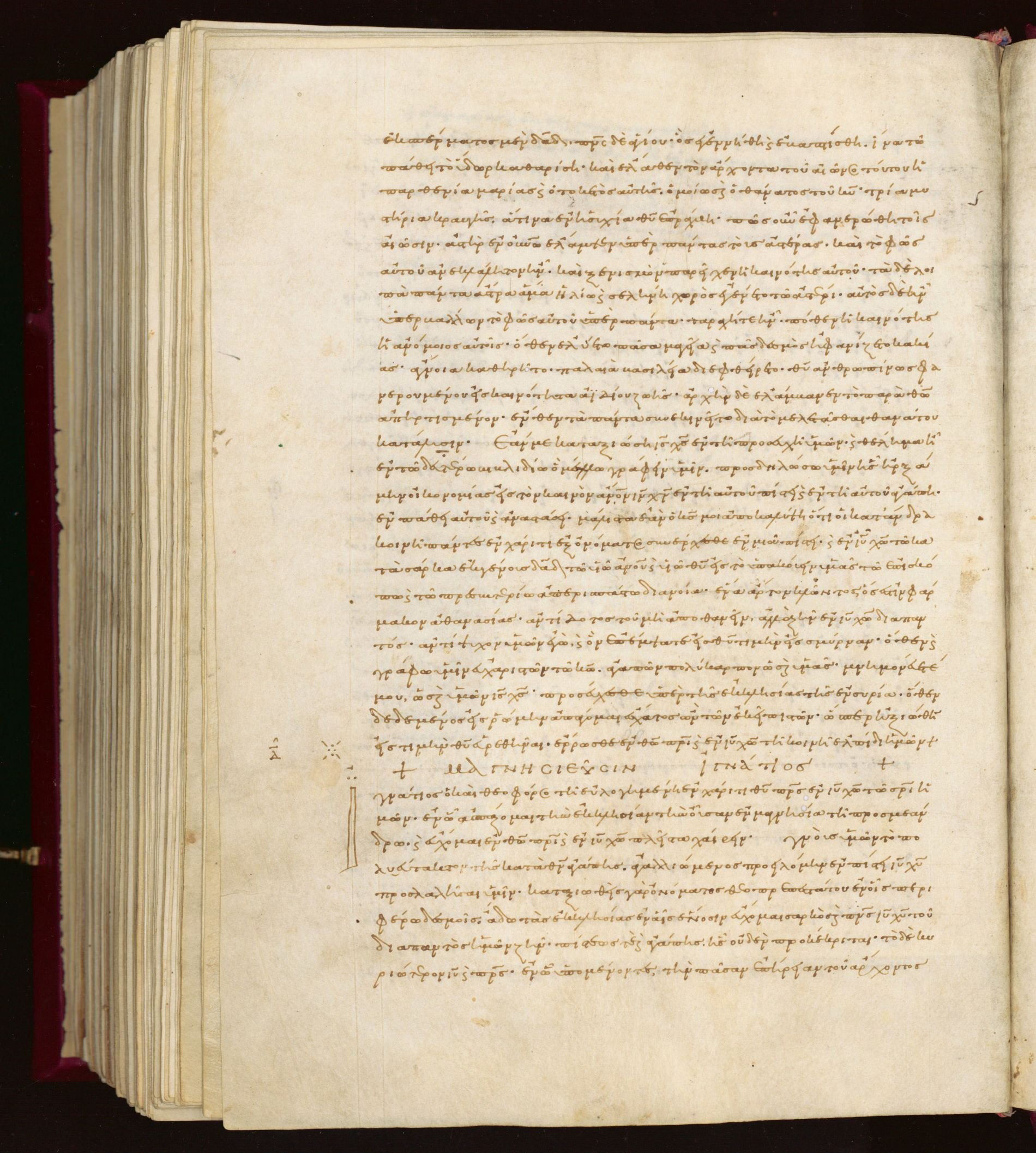
Checked on the images: Laur. Plut. 57.7 fol. 246v: the page begins ‹ἐκ σπέρματος μὲν Δαυείδ (Eph. 18.2)› and ends ‹τὴν πᾶσαν ἐπήρειαν τοῦ ἄρχοντος (Magn. 1.3)›. The span of each page was found by reading its first and last words and locating them in the Greek. The Greek shown is Lake's edited text (1912), not a transcription of the page; the scribe's spellings and abbreviations differ in small details.
Ἰγνάτιος, ὁ καὶ Θεοφόρος, τῇ εὐλογημένῃ ἐν χάριτι θεοῦ πατρὸς ἐν Χριστῷ Ἰησοῦ τῷ σωτῆρι ἡμῶν, ἐν ᾧ ἀσπάζομαι τὴν ἐκκλησίαν τὴν οὖσαν ἐν Μαγνησίᾳ τῇ πρὸς Μαιάνδρῳ καὶ εὔχομαι ἐν θεῷ πατρὶ καὶ ἐν Ἰησοῦ Χριστῷ πλεῖστα χαίρειν.
Ignatius, who is also Theophorus, unto her which hath been blessed through the grace of God the Father in Christ Jesus our Saviour, in whom I salute the church which is in Magnesia on the Maeander, and I wish her abundant greeting in God the Father and in Jesus Christ.
Where on the image
Checked on the images: Laur. Plut. 57.7 fol. 246v: the page begins ‹ἐκ σπέρματος μὲν Δαυείδ (Eph. 18.2)› and ends ‹τὴν πᾶσαν ἐπήρειαν τοῦ ἄρχοντος (Magn. 1.3)›. The span of each page was found by reading its first and last words and locating them in the Greek. The Greek shown is Lake's edited text (1912), not a transcription of the page; the scribe's spellings and abbreviations differ in small details.
1Γνοὺς ὑμῶν τὸ πολυεύτακτον τῆς κατὰ θεὸν ἀγάπης, ἀγαλλιώμενος προειλόμην ἐν πίστει Ἰησοῦ Χριστοῦ προσλαλῆσαι ὑμῖν. 2καταξιωθεὶς γὰρ ὀνόματος θεοπρεπεστάτου, ἐν οἷς περιφέρω δεσμοῖς ᾅδω τὰς ἐκκλησίας, ἐν αἷς ἕνωσιν· εὔχομαι σαρκὸς καὶ πνεύματος Ἰησοῦ Χριστοῦ, τοῦ διὰ παντὸς ἡμῶν ζῆν, πίστεώς τε καὶ ἀγάπης, ἧς οὐδὲν προκέκριται, τὸ δὲ κυριώτερον Ἰησοῦ καὶ πατρός· ἐν ᾧ ὑπομένοντες τὴν πᾶσαν ἐπήρειαν τοῦ ἄρχοντος τοῦ αἰῶνος τούτου καὶ διαφυγόντες θεοῦ τευξόμεθα.
1When I learned the exceeding good order of your love in the ways of God, I was gladdened and I determined to address you in the faith of Jesus Christ. 2For being counted worthy to bear a most godly name, in these bonds, which I carry about, I sing the praise of the churches; and I pray that there may be in them union of the flesh and of the spirit which are Jesus Christ's, our never-failing life -- an union of faith and of love which is preferred before all things, and -- what is more than all -- an union with Jesus and with the Father; in whom if we endure patiently all the despite of the prince of this world and escape therefrom, we shall attain unto God.
Where on the image
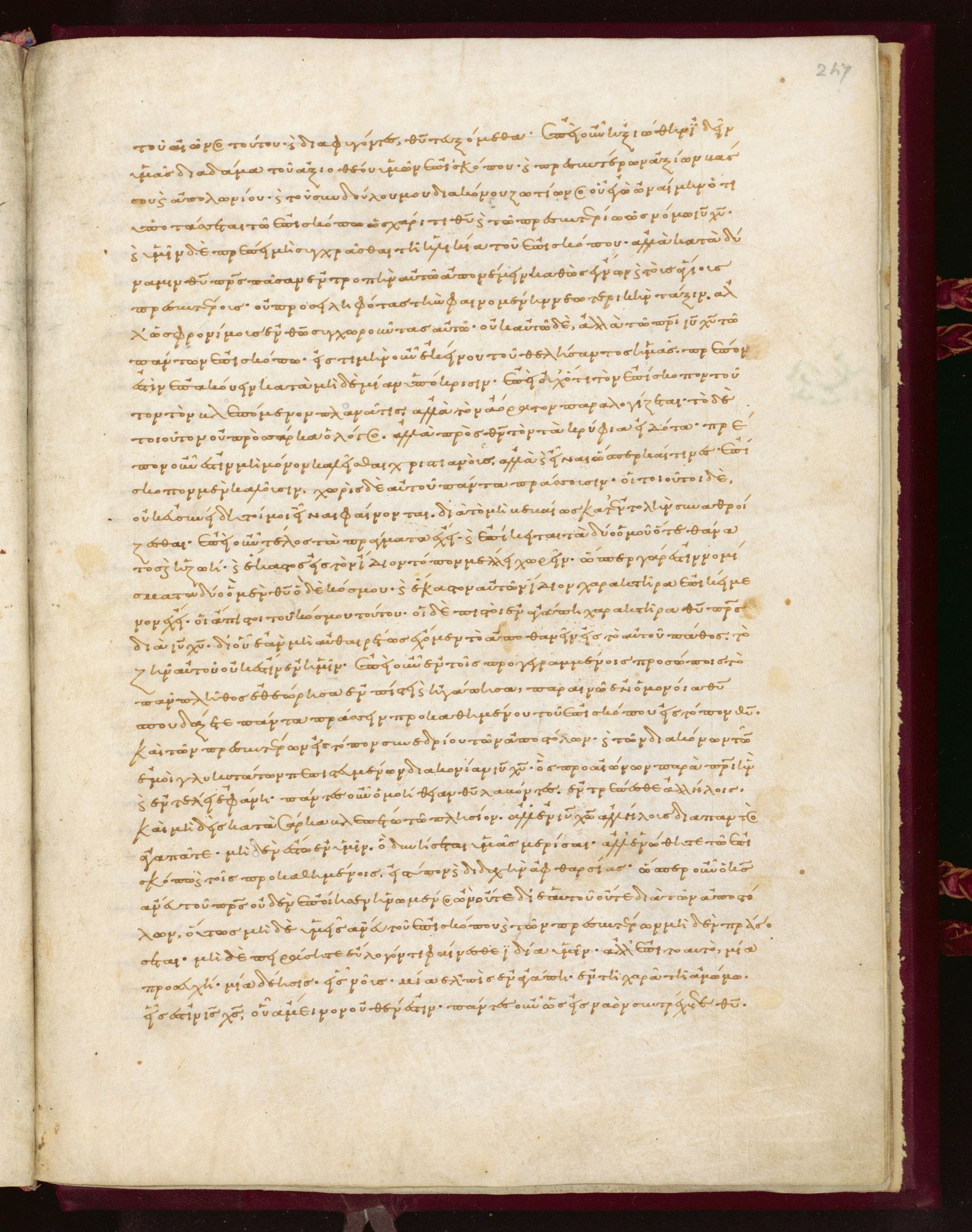
Checked on the images: Laur. Plut. 57.7 fol. 247r: the page begins ‹τοῦ αἰῶνος τούτου καὶ διαφυγόντες (Magn. 1.3)› and ends ‹ὡς εἰς ἕνα ναὸν συντρέχετε θεοῦ (Magn. 7.2)›. The span of each page was found by reading its first and last words and locating them in the Greek. The Greek shown is Lake's edited text (1912), not a transcription of the page; the scribe's spellings and abbreviations differ in small details.
1Ἐπεὶ οὖν ἠξιώθην ἰδεῖν ὑμᾶς διὰ Δαμᾶ τοῦ ἀξιοθέου ὑμῶν ἐπισκόπου καὶ πρεσβυτέρων ἀξίων Βάσσου καὶ Ἀπολλωνίου καὶ τοῦ συνδούλου μου διακόνου Ζωτίωνος, οὗ ἐγὼ ὀναίμην, ὅτι ὑποτάσσεται τῷ ἐπισκόπῳ ὡς χάριτι θεοῦ καὶ τῷ πρεσβυτερίῳ ὡς νόμῳ Ἰησοῦ Χριστοῦ.
1Forasmuch then as I was permitted to see you in the person of Damas your godly bishop and your worthy presbyters Bassus and Apollonius and my fellow-servant the deacon Zotion, of whom I would fain have joy, for that he is subject to the bishop as unto the grace of God and to the presbytery as unto the law of Jesus Christ: --
Where on the image
Checked on the images: Laur. Plut. 57.7 fol. 247r: the page begins ‹τοῦ αἰῶνος τούτου καὶ διαφυγόντες (Magn. 1.3)› and ends ‹ὡς εἰς ἕνα ναὸν συντρέχετε θεοῦ (Magn. 7.2)›. The span of each page was found by reading its first and last words and locating them in the Greek. The Greek shown is Lake's edited text (1912), not a transcription of the page; the scribe's spellings and abbreviations differ in small details.
1Καὶ ὑμῖν δὲ πρέπει μὴ συγχρᾶσθαι τῇ ἡλικίᾳ τοῦ ἐπισκόπου, ἀλλὰ κατὰ δύναμιν θεοῦ πατρὸς πᾶσαν ἐντροπὴν αὐτῷ ἀπονέμειν, καθὼς ἔγνων καὶ τοὺς ἁγίους πρεσβυτέρους οὐ προσειληφότας τὴν φαινομένην νεωτερικὴν τάξιν, ἀλλ’ ὡς φρονίμους ἐν θεῷ συγχωροῦντας αὐτῷ, οὐκ αὐτῷ δέ, ἀλλὰ τῷ πατρὶ Ἰησοῦ Χριστοῦ, τῷ πάντων ἐπισκόπῳ. 2εἰς τιμὴν οὖν ἐκείνου τοῦ θελήσαντος ἡμᾶς πρέπον ἐστὶν ἐπακούειν κατὰ μηδεμίαν ὑπόκρισιν· ἐπεὶ οὐχ ὅτι τὸν ἐπίσκοπον τοῦτον τὸν βλεπόμενον πλανᾷ τις, ἀλλὰ τὸν ἀόρατον παραλογίζεται. τὸ δὲ τοιοῦτον οὐ πρὸς σάρκα ὁ λόγος, ἀλλὰ πρὸς θεὸν τὸν τὰ κρύφια εἰδότα.
1Yea, and it becometh you also not to presume upon the youth of your bishop, but according to the power of God the Father to render unto him all reverence, even as I have learned that the holy presbyters also have not taken advantage of his outwardly youthful estate, but give place to him as to one prudent in God; yet not to him, but to the Father of Jesus Christ, even to the Bishop of all. 2For the honour therefore of Him that desired you, it is meet that ye should be obedient without dissimulation. For a man doth not so much deceive this bishop who is seen, as cheat that other who is invisible; and in such a case he must reckon not with flesh but with God who knoweth the hidden things.
Where on the image
Checked on the images: Laur. Plut. 57.7 fol. 247r: the page begins ‹τοῦ αἰῶνος τούτου καὶ διαφυγόντες (Magn. 1.3)› and ends ‹ὡς εἰς ἕνα ναὸν συντρέχετε θεοῦ (Magn. 7.2)›. The span of each page was found by reading its first and last words and locating them in the Greek. The Greek shown is Lake's edited text (1912), not a transcription of the page; the scribe's spellings and abbreviations differ in small details.
1Πρέπον οὖν ἐστιν μὴ μόνον καλεῖσθαι Χριστιανούς, ἀλλὰ καὶ εἶναι· ὥσπερ καί τινες ἐπίσκοπον μὲν καλοῦσιν, χωρὶς δὲ αὐτοῦ πάντα πράσσουσιν. οἱ τοιοῦτοι δὲ οὐκ εὐσυνείδητοί μοι εἶναι φαίνονται διὰ τὸ μὴ βεβαίως κατ’ ἐντολὴν συναθροίζεσθαι.
1It is therefore meet that we not only be called Christians, but also be such; even as some persons have the bishop's name on their lips, but in everything act apart from him. Such men appear to me not to keep a good conscience, forasmuch as they do not assemble themselves together lawfully according to commandment.
Where on the image
Checked on the images: Laur. Plut. 57.7 fol. 247r: the page begins ‹τοῦ αἰῶνος τούτου καὶ διαφυγόντες (Magn. 1.3)› and ends ‹ὡς εἰς ἕνα ναὸν συντρέχετε θεοῦ (Magn. 7.2)›. The span of each page was found by reading its first and last words and locating them in the Greek. The Greek shown is Lake's edited text (1912), not a transcription of the page; the scribe's spellings and abbreviations differ in small details.
1Ἐπεὶ οὖν τέλος τὰ πράγματα ἔχει καὶ πρόκειται τὰ δύο ὁμοῦ, ὅ τε θάνατος καὶ ἡ ζωή, καὶ ἕκαστος εἰς τὸν ἴδιον τόπον μέλλει χωρεῖν· 2ὥσπερ γάρ ἐστιν νομίσματα δύο, ὃ μὲν θεοῦ, ὃ δὲ κόσμου, καὶ ἕκαστον αὐτῶν ἴδιον χαρακτῆρα ἐπικείμενον ἔχει, οἱ ἄπιστοι τοῦ κόσμου τούτου, οἱ δὲ πιστοὶ ἐν ἀγάπῃ χαρακτῆρα θεοῦ πατρὸς διὰ Ἰησοῦ Χριστοῦ, δι’ οὗ ἐὰν μὴ αὐθαιρέτως ἔχωμεν τὸ ἀποθανεῖν εἰς τὸ αὐτοῦ πάθος, τὸ ζῆν αὐτοῦ οὐκ ἔστιν ἐν ἡμῖν.
1Seeing them that all things have an end, and these two -- life and death -- are set before us together, and each man shall go to his own place; 2for just as there are two coinages, the one of God and the other of the world, and each of them hath its proper stamp impressed upon it, the unbelievers the stamp of this world, but the faithful in love the stamp of God the Father through Jesus Christ, through whom unless of our own free choice we accept to die unto His passion, His life is not in us: --
Where on the image
Checked on the images: Laur. Plut. 57.7 fol. 247r: the page begins ‹τοῦ αἰῶνος τούτου καὶ διαφυγόντες (Magn. 1.3)› and ends ‹ὡς εἰς ἕνα ναὸν συντρέχετε θεοῦ (Magn. 7.2)›. The span of each page was found by reading its first and last words and locating them in the Greek. The Greek shown is Lake's edited text (1912), not a transcription of the page; the scribe's spellings and abbreviations differ in small details.
1Ἐπεὶ οὖν ἐν τοῖς προγεγραμμένοις προσώποις τὸ πᾶν πλῆθος ἐθεώρησα ἐν πίστει καὶ ἠγάπησα, παραινῶ, ἐν ὁμονοίᾳ θεοῦ σπουδάζετε πάντα πράσσειν, προκαθημένου τοῦ ἐπισκόπου εἰς τόπον θεοῦ καὶ τῶν πρεσβυτέρων εἰς τόπον συνεδρίου τῶν ἀποστόλων, καὶ τῶν διακόνων τῶν ἐμοὶ γλυκυτάτων πεπιστευμένων διακονίαν Ἰησοῦ Χριστοῦ, ὃς πρὸ αἰώνων παρὰ πατρὶ ἦν καὶ ἐν τέλει ἐφάνη. 2πάντες οὖν ὁμοήθειαν θεοῦ λαβόντες ἐντρέπεσθε ἀλλήλους καὶ μηδεὶς κατὰ σάρκα βλεπέτω τὸν πλησίον, ἀλλ’ ἐν Ἰησοῦ Χριστῷ ἀλλήλους διὰ παντὸς ἀγαπᾶτε. μηδὲν ἔστω ἐν ὑμῖν, ὃ δυνήσεται ὑμᾶς μερίσαι ἀλλ’ ἑνώθητε τῷ ἐπισκόπῳ καὶ τοῖς προκαθημένοις εἰς τύπον καὶ διδαχὴν ἀφθαρσίας.
1Seeing then that in the aforementioned persons I beheld your whole people in faith and embraced them, I advise you, be ye zealous to do all things in godly concord, the bishop presiding after the likeness of God and the presbyters after the likeness of the council of the Apostles, with the deacons also who are most dear to me, having been entrusted with the diaconate of Jesus Christ, who was with the Father before the worlds and appeared at the end of time. 2Therefore do ye all study conformity to God and pay reverence one to another; and let no man regard his neighbour after the flesh, but love ye one another in Jesus Christ always. Let there be nothing among you which shall have power to divide you, but be ye united with the bishop and with them that preside over you as an ensample and a lesson of incorruptibility.
Where on the image
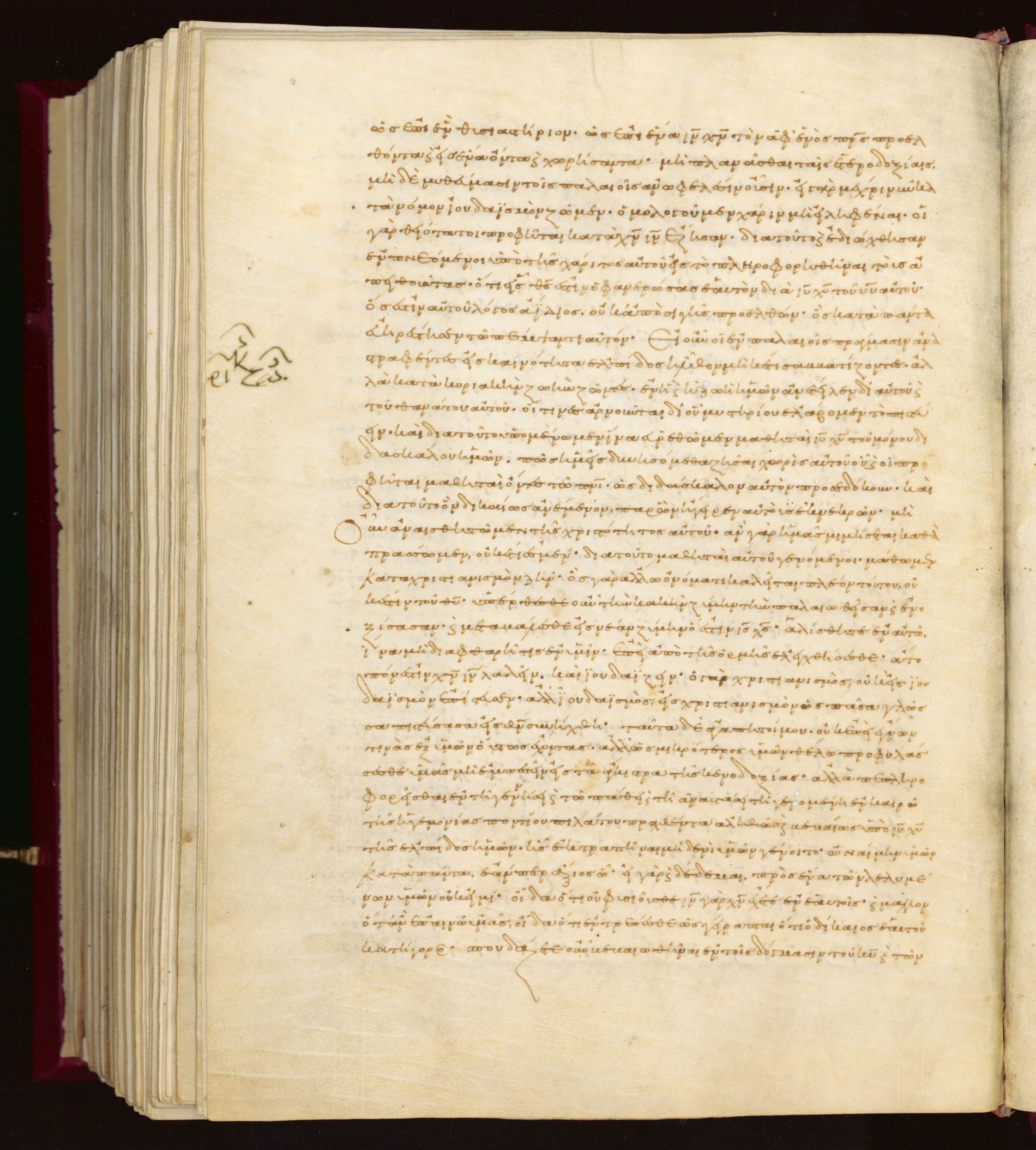
Checked on the images: Laur. Plut. 57.7 fol. 247r: the page begins ‹τοῦ αἰῶνος τούτου καὶ διαφυγόντες (Magn. 1.3)› and ends ‹ὡς εἰς ἕνα ναὸν συντρέχετε θεοῦ (Magn. 7.2)›; Laur. Plut. 57.7 fol. 247v: the page begins ‹ὡς ἐπὶ ἓν θυσιαστήριον (Magn. 7.2)› and ends ‹ἐν τοῖς δόγμασιν τοῦ κυρίου καὶ τῶν (Magn. 13.1)›. The span of each page was found by reading its first and last words and locating them in the Greek. The Greek shown is Lake's edited text (1912), not a transcription of the page; the scribe's spellings and abbreviations differ in small details.
1Ὥσπερ οὖν ὁ κύριος ἄνευ τοῦ πατρὸς οὐδὲν ἐποίησεν, ἡνωμένος ὤν, οὔτε δι’ ἑαυτοῦ οὔτε διὰ τῶν ἀποστόλων· οὕτως μηδὲ ὑμεῖς ἄνευ τοῦ ἐπισκόπου καὶ τῶν πρεσβυτέρων μηδὲν πράσσετε· μηδὲ πειράσητε εὔλογόν τι φαίνεσθαι ἰδίᾳ ὑμῖν, ἀλλ’ ἐπὶ τὸ αὐτὸ μία προσευχή, μία δέησις, εἷς νοῦς, μία ἐλπὶς ἐν ἀγάπῃ, ἐν τῇ χαρᾷ τῇ ἀμώμῳ, ὅ ἐστιν Ἰησοῦς Χριστός, οὗ ἄμεινον οὐδέν ἐστιν. 2πάντες ὡς εἰς ἕνα ναὸν συντρέχετε θεοῦ, ὡς ἐπὶ ἓν θυσιαστήριον, ἐπὶ ἕνα Ἰησοῦν Χριστόν, τὸν ἀφ’ ἑνὸς πατρὸς προελθόντα καὶ εἰς ἕνα ὄντα καὶ χωρήσαντα.
1Therefore as the Lord did nothing without the Father, [being united with Him], either by Himself or by the Apostles, so neither do ye anything without the bishop and the presbyters. And attempt not to think anything right for yourselves apart from others: but let there be one prayer in common, one supplication, one mind, one hope, in love and in joy unblameable, which is Jesus Christ, than whom there is nothing better. 2Hasten to come together all of you, as to one temple, even God; as to one altar, even to one Jesus Christ, who came forth from One Father and is with One and departed unto One.
Where on the image
Checked on the images: Laur. Plut. 57.7 fol. 247v: the page begins ‹ὡς ἐπὶ ἓν θυσιαστήριον (Magn. 7.2)› and ends ‹ἐν τοῖς δόγμασιν τοῦ κυρίου καὶ τῶν (Magn. 13.1)›. The span of each page was found by reading its first and last words and locating them in the Greek. The Greek shown is Lake's edited text (1912), not a transcription of the page; the scribe's spellings and abbreviations differ in small details.
1Μὴ πλανᾶσθε ταῖς ἑτεροδοξίαις μηδὲ μυθεύμασιν τοῖς παλαιοῖς ἀνωφελέσιν οὖσιν. εἰ γὰρ μέχρι νῦν κατὰ Ἰουδαϊσμὸν ζῶμεν, ὁμολογοῦμεν χάριν μὴ εἰληφέναι. 2οἱ γὰρ θειότατοι προφῆται κατὰ Χριστὸν Ἰησοῦν ἔζησαν. διὰ τοῦτο καὶ ἐδιώχθησαν, ἐνπνεόμενοι ὑπὸ τῆς χάριτος αὐτοῦ, εἰς τὸ πληροφορηθῆναι τοὺς ἀπειθοῦντας, ὅτι εἷς θεός ἐστιν, ὁ φανερώσας ἑαυτὸν διὰ Ἰησοῦ Χριστοῦ τοῦ υἱοῦ αὐτοῦ, ὅς ἐστιν αὐτοῦ λόγος ἀπὸ σιγῆς προελθών, ὃς κατὰ πάντα εὐηρέστησεν τῷ πέμψαντι αὐτόν.
1Be not seduced by strange doctrines nor by antiquated fables, which are profitless. For if even unto this day we live after the manner of Judaism, we avow that we have not received grace: 2for the divine prophets lived after Christ Jesus. For this cause also they were persecuted, being inspired by His grace to the end that they which are disobedient might be fully persuaded that there is one God who manifested Himself through Jesus Christ His Son, who is His Word that proceeded from silence, who in all things was well-pleasing unto Him that sent Him.
Where on the image
Checked on the images: Laur. Plut. 57.7 fol. 247v: the page begins ‹ὡς ἐπὶ ἓν θυσιαστήριον (Magn. 7.2)› and ends ‹ἐν τοῖς δόγμασιν τοῦ κυρίου καὶ τῶν (Magn. 13.1)›. The span of each page was found by reading its first and last words and locating them in the Greek. The Greek shown is Lake's edited text (1912), not a transcription of the page; the scribe's spellings and abbreviations differ in small details.
1Εἰ οὖν οἱ ἐν παλαιοῖς πράγμασιν ἀναστραφέντες εἰς καινότητα ἐλπίδος ἦλθον, μηκέτι σαββατίζοντες, ἀλλὰ κατὰ κυριακὴν ζῶντες, ἐν ᾗ καὶ ἡ ζωὴ ἡμῶν ἀνέτειλεν δι’ αὐτοῦ καὶ τοῦ θανάτου αὐτοῦ, ὅν τινες ἀρνοῦνται, δι’ οὗ μυστηρίου ἐλάβομεν τὸ πιστεύειν, καὶ διὰ τοῦτο ὑπομένομεν, ἵνα εὑρεθῶμεν μαθηταὶ Ἰησοῦ Χριστοῦ τοῦ μόνου διδασκάλου ἡμῶν· 2πῶς ἡμεῖς δυνησόμεθα ζῆσαι χωρὶς αὐτοῦ, οὗ καὶ οἱ προφῆται μαθηταὶ ὄντες τῷ πνεύματι ὡς διδάσκαλον αὐτὸν προσεδόκων; καὶ διὰ τοῦτο, ὃν δικαίως ἀνέμενον, παρὼν ἤγειρεν αὐτοὺς ἐκ νεκρῶν.
1If then those who had walked in ancient practices attained unto newness of hope, no longer observing sabbaths but fashioning their lives after the Lord's day, on which our life also arose through Him and through His death which some men deny -- a mystery whereby we attained unto belief, and for this cause we endure patiently, that we may be found disciples of Jesus Christ our only teacher -- 2if this be so, how shall we be able to live apart from Him? seeing that even the prophets, being His disciples, were expecting Him as their teacher through the Spirit. And for this cause He whom they rightly awaited, when He came, raised them from the dead.
Where on the image
Checked on the images: Laur. Plut. 57.7 fol. 247v: the page begins ‹ὡς ἐπὶ ἓν θυσιαστήριον (Magn. 7.2)› and ends ‹ἐν τοῖς δόγμασιν τοῦ κυρίου καὶ τῶν (Magn. 13.1)›. The span of each page was found by reading its first and last words and locating them in the Greek. The Greek shown is Lake's edited text (1912), not a transcription of the page; the scribe's spellings and abbreviations differ in small details.
1Μὴ οὖν ἀναισθητῶμεν τῆς χρηστότητος αὐτοῦ. ἐὰν γὰρ ἡμᾶς μιμήσηται καθὰ πράσσομεν, οὐκέτι ἐσμέν. διὰ τοῦτο, μαθηταὶ αὐτοῦ γενόμενοι, μάθωμεν κατὰ Χριστιανισμὸν ζῆν. ὃς γὰρ ἄλλῳ ὀνόματι καλεῖται πλέον τούτου, οὐκ ἔστιν τοῦ θεοῦ. 2ὑπέρθεσθε οὖν τὴν κακὴν ζύμην, τὴν παλαιωθεῖσαν καὶ ἐνοξίσασαν, καὶ μεταβάλεσθε εἰς νέαν ζύμην, ὅ ἐστιν Ἰησοῦς Χριστός. ἁλίσθητε ἐν αὐτῷ, ἵνα μὴ διαφθαρῇ τις ἐν ὑμῖν, ἐπεὶ ἀπὸ τῆς ὀσμῆς ἐλεγχθήσεσθε. 3ἄτοπόν ἐστιν, Ἰησοῦν Χριστὸν λαλεῖν καὶ ἰουδαΐζειν. ὁ γὰρ Χριστιανισμὸς οὐκ εἰς Ἰουδαῖσμὸν ἐπίστευσεν, ἀλλ’ Ἰουδαϊσμὸς εἰς Χριστιανισμόν, ᾧ πᾶσα γλῶσσα πιστεύσασα εἰς θεὸν συνήχθη.
1Therefore let us not be insensible to His goodness. For if He should imitate us according to our deeds, we are lost. For this cause, seeing that we are become His disciples, let us learn to live as beseemeth Christianity. For whoso is called by another name besides this, is not of God. 2Therefore put away the vile leaven which hath waxed stale and sour, and betake yourselves to the new leaven, which is Jesus Christ. Be ye salted in Him, that none among you grow putrid, seeing that by your savour ye shall be proved. 3It is monstrous to talk of Jesus Christ and to practise Judaism. For Christianity did not believe in Judaism, but Judaism in Christianity, wherein every tongue believed and was gathered together unto God.
Where on the image
Checked on the images: Laur. Plut. 57.7 fol. 247v: the page begins ‹ὡς ἐπὶ ἓν θυσιαστήριον (Magn. 7.2)› and ends ‹ἐν τοῖς δόγμασιν τοῦ κυρίου καὶ τῶν (Magn. 13.1)›. The span of each page was found by reading its first and last words and locating them in the Greek. The Greek shown is Lake's edited text (1912), not a transcription of the page; the scribe's spellings and abbreviations differ in small details.
1Ταῦτα δέ, ἀγαπητοί μου, οὐκ ἐπεὶ ἔγνων τινὰς ἐξ ὑμῶν οὕτως ἔχοντας, ἀλλ’ ὡς μικρότερος ὑμῶν θέλω προφυλάσσεσθαι ὑμᾶς, μὴ ἐμπεσεῖν εἰς τὰ ἄγκιστρα τῆς κενοδοξίας, ἀλλὰ πεπληροφορῆσθαι ἐν τῇ γεννήσει καὶ τῷ πάθει καὶ τῇ ἀναστάσει τῇ γενομένῃ ἐν καιρῷ τῆς ἡγεμονίας Ποντίου Πιλάτου· πραχθέντα ἀληθῶς καὶ βεβαίως ὑπὸ Ἰησοῦ Χριστοῦ, τῆς ἐλπίδος ἡμῶν, ἧς ἐκτραπῆναι μηδενὶ ὑμῶν γένοιτο.
1Now these things I say, my dearly beloved, not because I have learned that any of you are so minded; but as being less than any of you, I would have you be on your guard betimes, that ye fall not into the snares of vain doctrine; but be ye fully persuaded concerning the birth and the passion and the resurrection, which took place in the time of the governorship of Pontius Pilate; for these things were truly and certainly done by Jesus Christ our hope; from which hope may it not befal any of you to be turned aside.
Where on the image
Checked on the images: Laur. Plut. 57.7 fol. 247v: the page begins ‹ὡς ἐπὶ ἓν θυσιαστήριον (Magn. 7.2)› and ends ‹ἐν τοῖς δόγμασιν τοῦ κυρίου καὶ τῶν (Magn. 13.1)›. The span of each page was found by reading its first and last words and locating them in the Greek. The Greek shown is Lake's edited text (1912), not a transcription of the page; the scribe's spellings and abbreviations differ in small details.
1Ὀναίμην ὑμῶν κατὰ πάντα, ἐάνπερ ἄξιος ὦ. εἰ γὰρ καὶ δέδεμαι, πρὸς ἕνα τῶν λελυμένων ὑμῶν οὐκ εἰμί. οἶδα ὅτι οὐ φυσιοῦσθε· Ἰησοῦν γὰρ Χριστὸν ἔχετε ἐν ἑαυτοῖς· καὶ μᾶλλον, ὅταν ἐπαινῶ ὑμᾶς, οἶδα, ὅτι ἐντρέπεσθε, ὡς γέγραπται, ὅτι ὁ δίκαιος ἑαυτοῦ κατήγορος.
1Let me have joy of you in all things, if I be worthy. For even though I am in bonds, yet am I not comparable to one of you who are at liberty. I know that ye are not puffed up; for ye have Jesus Christ in yourselves. And, when I praise you, I know that ye only feel the more shame; as it is written The righteous man is a self-accuser.
Where on the image
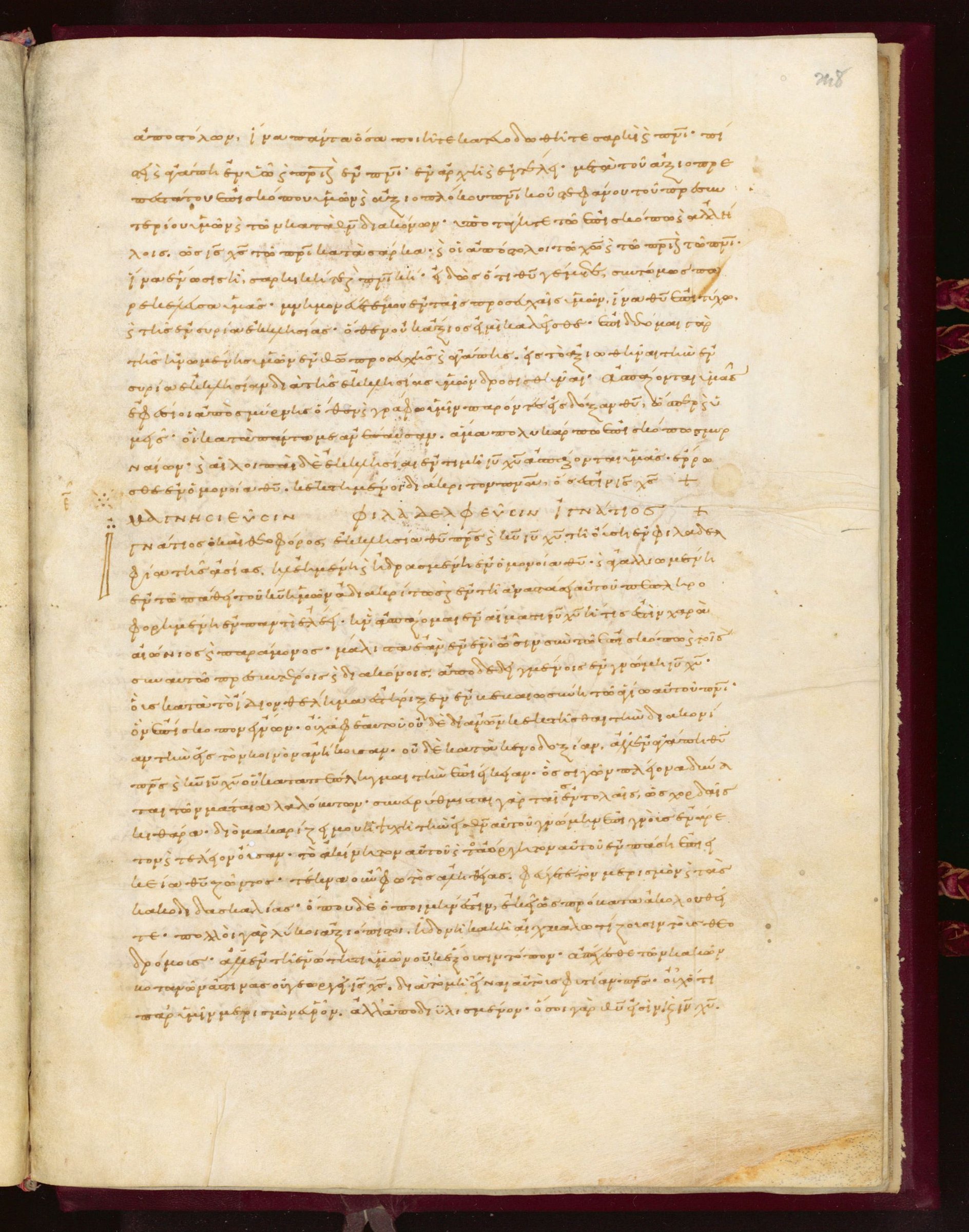
Checked on the images: Laur. Plut. 57.7 fol. 247v: the page begins ‹ὡς ἐπὶ ἓν θυσιαστήριον (Magn. 7.2)› and ends ‹ἐν τοῖς δόγμασιν τοῦ κυρίου καὶ τῶν (Magn. 13.1)›; Laur. Plut. 57.7 fol. 248r: the page begins ‹ἀποστόλων, ἵνα πάντα ὅσα ποιῆτε (Magn. 13.1)› and ends ‹ὅσοι γὰρ θεοῦ εἰσιν καὶ Ἰησοῦ Χριστοῦ (Phld. 3.2)›. The span of each page was found by reading its first and last words and locating them in the Greek. The Greek shown is Lake's edited text (1912), not a transcription of the page; the scribe's spellings and abbreviations differ in small details.
1Σπουδάζετε οὖν βεβαιωθῆναι ἐν τοῖς δόγμασιν τοῦ κυρίου καὶ τῶν ἀποστόλων, ἵνα πάντα, ὅσα ποιεῖτε, κατευοδωθῆτε σαρκὶ καὶ πνεύματι, πίστει καὶ ἀγάπῃ, ἐν υἱῷ καὶ πατρὶ καὶ ἐν πνεύματι, ἐν ἀρχῇ καὶ ἐν τέλει, μετὰ τοῦ ἀξιοπρεπεστάτου ἐπισκόπου ὑμῶν καὶ ἀξιοπλόκου πνευματικοῦ στεφάνου τοῦ πρεσβυτερίου ὑμῶν καὶ τῶν κατὰ θεὸν διακόνων. 2ὑποτάγητε τῷ ἐπισκόπῳ καὶ ἀλλήλοις, ὡς Ἰησοῦς Χριστὸς τῷ πατρὶ καὶ οἱ ἀπόστολοι τῷ Χριστῷ καὶ τῷ πατρὶ ἵνα ἕνωσις ᾖ σαρκική τε καὶ πνευματική.
1Do your diligence therefore that ye be confirmed in the ordinances of the Lord and of the Apostles, that ye may prosper in all things whatsoever ye do in flesh and spirit, by faith and by love, in the Son and Father and in the Spirit, in the beginning and in the end, with your revered bishop, and with the fitly wreathed spiritual circlet of your presbytery, and with the deacons who walk after God. 2Be obedient to the bishop and to one another, as Jesus Christ was to the Father [according to the flesh], and as the Apostles were to Christ and to the Father, that there may be union both of flesh and of spirit.
Where on the image
Checked on the images: Laur. Plut. 57.7 fol. 248r: the page begins ‹ἀποστόλων, ἵνα πάντα ὅσα ποιῆτε (Magn. 13.1)› and ends ‹ὅσοι γὰρ θεοῦ εἰσιν καὶ Ἰησοῦ Χριστοῦ (Phld. 3.2)›. The span of each page was found by reading its first and last words and locating them in the Greek. The Greek shown is Lake's edited text (1912), not a transcription of the page; the scribe's spellings and abbreviations differ in small details.
1Εἰδώς, ὅτι θεοῦ γέμετε, συντόμως παρεκέλευσα ὑμᾶς. μνημονεύετέ μου ἐν ταῖς προσευχαῖς ὑμῶν. ἵνα θεοῦ ἐπιτύχω, καὶ τῆς ἐν Συρίᾳ ἐκκλησίας, ὅθεν οὐκ ἄξιός εἰμι καλεῖσθαι· ἐπιδέομαι γὰρ τῆς ἡνωμένης ὑμῶν ἐν θεῷ προσευχῆς καὶ ἀγάπης, εἰς τὸ ἀξιωθῆναι τὴν ἐν Συρίᾳ ἐκκλησίαν διὰ τῆς ἐκκλησίας ὑμῶν δροσισθῆναι.
1Knowing that ye are full of God, I have exhorted you briefly. Remember me in your prayers, that I may attain unto God; and remember also the church which is in Syria, whereof I am not worthy to be called a member. For I have need of your united prayer and love in God, that it may be granted to the church which is in Syria to be refreshed by the dew of your fervent supplication.
Where on the image
Checked on the images: Laur. Plut. 57.7 fol. 248r: the page begins ‹ἀποστόλων, ἵνα πάντα ὅσα ποιῆτε (Magn. 13.1)› and ends ‹ὅσοι γὰρ θεοῦ εἰσιν καὶ Ἰησοῦ Χριστοῦ (Phld. 3.2)›. The span of each page was found by reading its first and last words and locating them in the Greek. The Greek shown is Lake's edited text (1912), not a transcription of the page; the scribe's spellings and abbreviations differ in small details.
1Ἀσπάζονται ὑμᾶς Ἐφέσιοι ἀπὸ Σμύρνης, ὅθεν καὶ γράφω ὑμῖν, παρόντες εἰς δόξαν θεοῦ, ὥσπερ καὶ ὑμεῖς οἳ κατὰ πάντα με ἀνέπαυσαν ἅμα Πολυκάρπῳ, ἐπισκόπῳ Σμυρναίων. καὶ αἱ λοιπαὶ δὲ ἐκκλησίαι ἐν τιμῇ Ἰησοῦ Χριστοῦ ἀσπάζονται ὑμᾶς. ἔρρωσθε ἐν ὁμονοίᾳ θεοῦ, κεκτημένοι ἀδιάκριτον πνεῦμα, ὅς ἐστιν Ἰησοῦς Χριστός.
1The Ephesians from Smyrna salute you, from whence also I write to you. They are here with me for the glory of God, as also are ye; and they have comforted me in all things, together with Polycarp bishop of the Smyrnaeans. Yea, and all the other churches salute you in the honour of Jesus Christ. Fare ye well in godly concord, and possess ye a stedfast spirit, which is Jesus Christ.
Notes
- Greek: Kirsopp Lake, The Apostolic Fathers I (Loeb Classical Library, 1912), digital text of the First1KGreek project (tlg1443.tlg001, CC BY-SA 4.0); Lake's footnotes are not shown. Elided words are written with an apostrophe and the digital text's colon is shown as the raised dot.
- Proofreading: the Greek pages of Lake (archive.org theapostolicfath00unknuoft, leaves 184-288) were read by OCR twice and aligned with the digital text; every word on which both OCR readings agreed against the digital text, and every form that cannot be right, was looked up on the page image. Corrections in this letter: 0.1 'καῖ' to 'καὶ'; 1.2 'ἡς' to 'ἧς'; 2.1 'ἀξϊων' to 'ἀξίων'; 4.1 'Χρις τιανούς' to 'Χριστιανούς'; 5.1 'πρώγματα' to 'πράγματα'; 6.1 'δς πρὸ' to 'ὃς πρὸ'; 7.1 'οὖ' to 'οὗ'; 8.1 'Ἰουδαῖσμὸν' to 'Ἰουδαϊσμὸν'; 8.2 'εἶς' to 'εἷς'; 8.2 'ἁπὸ' to 'ἀπὸ'; 12.1 'ὀ' to 'ὁ'; 15.1 'οἲ' to 'οἳ'. Kept as Lake prints them (worn or missing accents): Eph. 8.2 οὐδε, Phld. 5.2 ἀξιαγαπητοι, Smyrn. 2.1 το; Lake's quotation marks in Pol. 8.1 are shown as ‘ ’.
- English: J. B. Lightfoot, The Apostolic Fathers (1891, Lightfoot and Harmer), as transcribed at earlychristianwritings.com; Lightfoot's italics are kept.
Cite
Sources
- Source: Laur. Plut. 57.7 (BML IIIF) + Lake 1912 Greek (First1KGreek, CC BY-SA 4.0) + Lightfoot 1891 English (public domain) (holding institution)
- Critical edition: Kirsopp Lake, The Apostolic Fathers I (1912), via First1KGreek
← previous · → next · v cycle view · l back to library