Ignatius of Antioch, To the Trallians (Laur. Plut. 57.7)
Introduction
Ignatius, bishop of Antioch, wrote seven letters while he was being taken under guard to Rome to be put to death, probably in the reign of Trajan (about 110 AD). This is his letter to the Trallians. Together the letters are among the earliest witnesses to the Christian bishop, presbyters and deacons, to the eucharist as the flesh of Christ, and to faith in Christ as God and man, written against teachers who said that Christ only seemed to suffer.
The manuscript. The letter is shown on Florence, Biblioteca Medicea Laurenziana, Plut. 57.7 (11th century), the only Greek manuscript of the six other letters in this form. Laur. Plut. 57.7 carries the letters on fol. 242r-252v in the order Smyrnaeans, Polycarp, Ephesians, Magnesians, Philadelphians, Trallians, followed by spurious letters; the scribe numbers them in the margin. The Letter to the Romans is not in it, and is shown from the Paris manuscript. Each section is one chapter, linked to the page or pages that carry it; the first and last words of every page were read on the images.
Texts. The Greek is Kirsopp Lake's edition (1912), proofread here against his printed pages; the English is J. B. Lightfoot's translation (1891). Both follow the middle (seven-letter) recension. They are edited texts, so the wording on the page differs from them in places.
How was this verified? (Provenance)
Where on the image
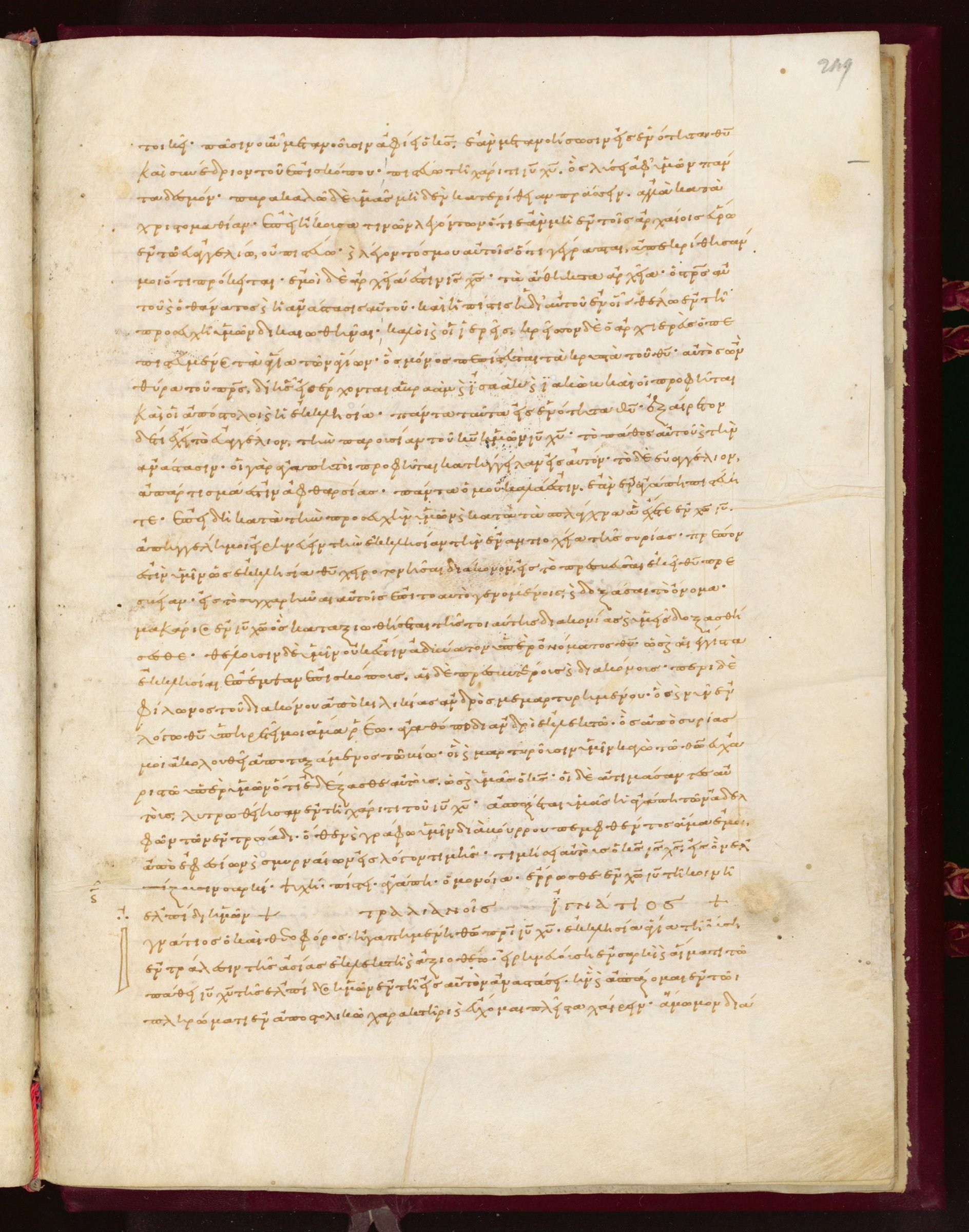
Checked on the images: Laur. Plut. 57.7 fol. 249r: the page begins ‹-τοικεῖ. πᾶσιν οὖν μετανοοῦσιν (Phld. 8.1)› and ends ‹πλεῖστα χαίρειν. ἄμωμον διά- (Trall. 1.1)›. The span of each page was found by reading its first and last words and locating them in the Greek. The Greek shown is Lake's edited text (1912), not a transcription of the page; the scribe's spellings and abbreviations differ in small details.
Ἰγνάτιος, ὁ καὶ Θεοφόρος, ἠγαπημένῃ θεῷ, πατρὶ Ἰησοῦ Χριστοῦ, ἐκκλησίᾳ ἁγίᾳ τῇ οὔσῃ ἐν Τράλλεσιν τῆς Ἀσίας, ἐκλεκτῇ καὶ ἀξιοθέῳ, εἰρηνευούσῃ ἐν σαρκὶ καὶ πνεύματι τῷ πάθει Ἰησοῦ Χριστοῦ, τῆς ἐλπίδος ἡμῶν ἐν τῇ εἰς αὐτὸν ἀναστάσει· ἣν καὶ ἀσπάζομαι ἐν τῷ πληρώματι ἐν ἀποστολικῷ χαρακτῆρι καὶ εὔχομαι πλεῖστα χαίρειν.
Ignatius, who is also Theophorus, unto her that is beloved by God the Father of Jesus Christ; to the holy church which is in Tralles of Asia, elect and worthy of God, having peace in flesh and spirit through the passion of Jesus Christ, who is our hope through our resurrection unto Him; which church also I salute in the Divine plenitude after the apostolic fashion, and I wish her abundant greeting.
Where on the image
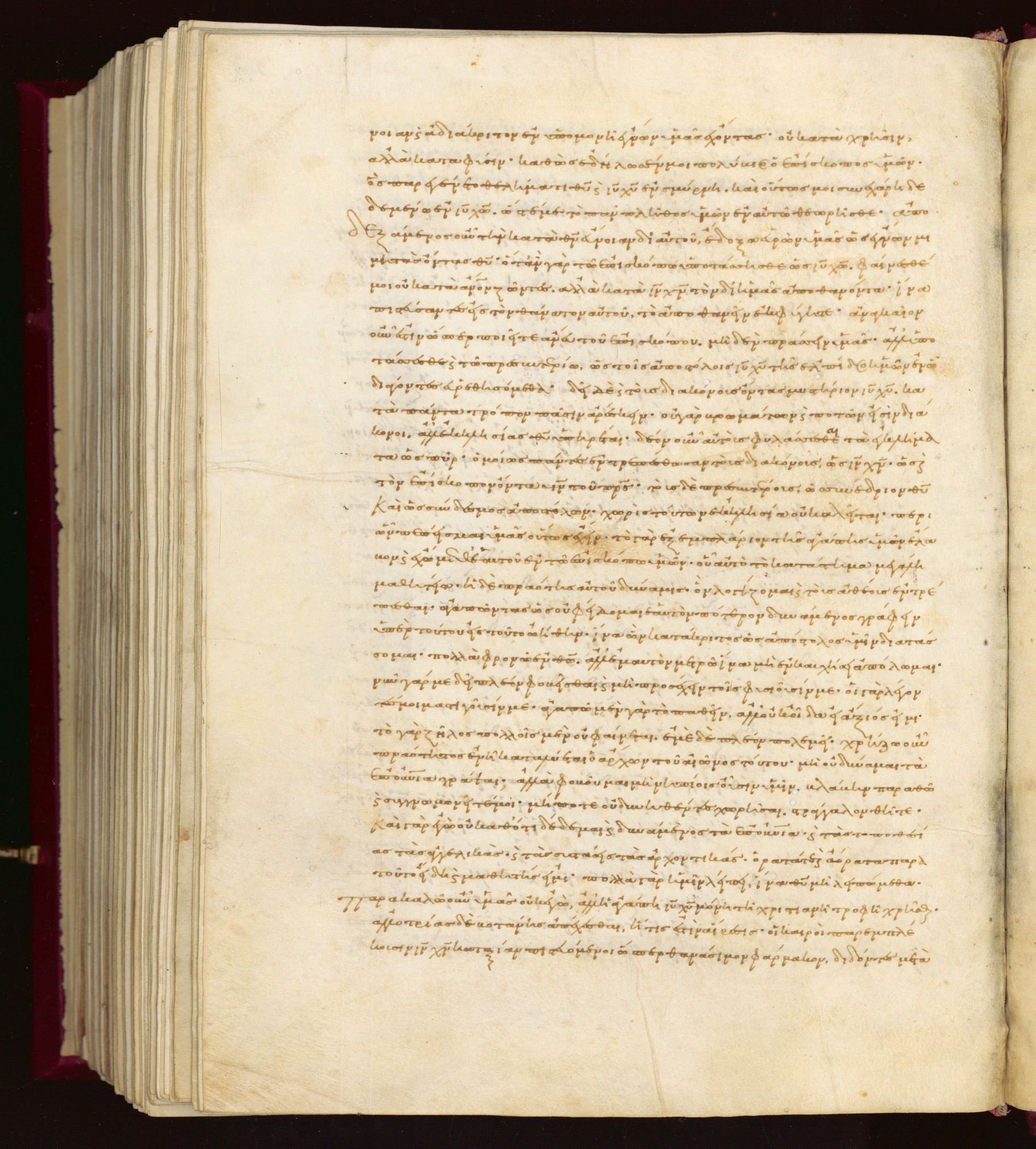
Checked on the images: Laur. Plut. 57.7 fol. 249r: the page begins ‹-τοικεῖ. πᾶσιν οὖν μετανοοῦσιν (Phld. 8.1)› and ends ‹πλεῖστα χαίρειν. ἄμωμον διά- (Trall. 1.1)›; Laur. Plut. 57.7 fol. 249v: the page begins ‹-νοιαν καὶ ἀδιάκριτον ἐν ὑπομονῇ (Trall. 1.1)› and ends ‹ὥσπερ θανάσιμον φάρμακον διδόντες μετὰ (Trall. 6.2)›. The span of each page was found by reading its first and last words and locating them in the Greek. The Greek shown is Lake's edited text (1912), not a transcription of the page; the scribe's spellings and abbreviations differ in small details.
1Ἄμωμον διάνοιαν καὶ ἀδιάκριτον ἐν ὑπομονῇ ἔγνων ὑμᾶς ἔχοντας, οὐ κατὰ χρῆσιν ἀλλὰ κατὰ φύσιν, καθὼς ἐδήλωσέν μοι Πολύβιος, ὁ ἐπίσκοπος ὑμῶν, ὃς παρεγένετο θελήματι θεοῦ καὶ Ἰησοῦ Χριστοῦ ἐν Σμύρνῃ καὶ οὕτως μοι συνεχάρη δεδεμένῳ ἐν Χριστῷ Ἰησοῦ, ὥστε με τὸ πᾶν πλῆθος ὑμῶν ἐν αὐτῷ θεωρεῖσθαι. 2ἀποδεξάμενος οὖν τὴν κατὰ θεὸν εὔνοιαν δι’ αὐτοῦ ἐδόξασα, εὑρὼν ὑμᾶς, ὡς ἔγνων, μιμητὰς ὄντας θεοῦ.
1I have learned that ye have a mind unblameable and stedfast in patience, not from habit, but by nature, according as Polybius your bishop informed me, who by the will of God and of Jesus Christ visited me in Smyrna; and so greatly did he rejoice with me in my bonds in Christ Jesus, that in him I beheld the whole multitude of you. 2Having therefore received your godly benevolence at his hands, I gave glory, forasmuch as I had found you to be imitators of God, even as I had learned.
Where on the image
Checked on the images: Laur. Plut. 57.7 fol. 249v: the page begins ‹-νοιαν καὶ ἀδιάκριτον ἐν ὑπομονῇ (Trall. 1.1)› and ends ‹ὥσπερ θανάσιμον φάρμακον διδόντες μετὰ (Trall. 6.2)›. The span of each page was found by reading its first and last words and locating them in the Greek. The Greek shown is Lake's edited text (1912), not a transcription of the page; the scribe's spellings and abbreviations differ in small details.
1Ὅταν γὰρ τῷ ἐπισκόπῳ ὑποτάσσησθε ὡς Ἱησοῦ Χριστῷ, φαίνεσθέ μοι οὐ κατὰ ἄνθρωπον ζῶντες, ἀλλὰ κατὰ Ἰησοῦν Χριστὸν τὸν δι’ ἡμᾶς ἀποθανόντα, ἵνα πιστεύσαντες εἰς τὸν θάνατον αὐτοῦ τὸ ἀποθανεῖν ἐκφύγητε. 2ἀναγκαῖον οὖν ἐστίν, ὥσπερ ποιεῖτε, ἄνευ τοῦ ἐπισκόπου μηδὲν πράσσειν ὑμᾶς, ἀλλ’ ὑποτάσσεσθαι καὶ τῷ πρεσβυτερίῳ ὡς τοῖς ἀποστόλοις Ἰησοῦ Χριστοῦ τῆς ἐλπίδος ἡμῶν, ἐν ᾧ διάγοντες εὑρεθησόμεθα. 3δεῖ δὲ καὶ τοὺς διακόνους ὄντας μυστηρίων Ἰησοῦ Χριστοῦ κατὰ πάντα τρόπον πᾶσιν ἀρέσκειν. οὐ γὰρ βρωμάτων καὶ ποτῶν εἰσιν διάκονοι, ἀλλ’ ἐκκλησίας θεοῦ ὑπηρέται· δέον οὖν αὐτοὺς φυλάσσεσθαι τὰ ἐγκλήματα ὡς πῦρ.
1For when ye are obedient to the bishop as to Jesus Christ, it is evident to me that ye are living not after men but after Jesus Christ, who died for us, that believing on His death ye might escape death. 2It is therefore necessary, even as your wont is, that ye should do nothing without the bishop; but be ye obedient also to the presbytery, as to the Apostles of Jesus Christ our hope; for if we live in Him, we shall also be found in Him. 3And those likewise who are deacons of the mysteries of Jesus Christ must please all men in all ways. For they are not deacons of meats and drinks but servants of the Church of God. It is right therefore that they should beware of blame as of fire.
Where on the image
Checked on the images: Laur. Plut. 57.7 fol. 249v: the page begins ‹-νοιαν καὶ ἀδιάκριτον ἐν ὑπομονῇ (Trall. 1.1)› and ends ‹ὥσπερ θανάσιμον φάρμακον διδόντες μετὰ (Trall. 6.2)›. The span of each page was found by reading its first and last words and locating them in the Greek. The Greek shown is Lake's edited text (1912), not a transcription of the page; the scribe's spellings and abbreviations differ in small details.
1Ὁμοίως πάντες ἐντρεπέσθωσαν τοὺς διακόνους ὡς Ἰησοῦν Χριστόν, ὡς καὶ τὸν ἐπίσκοπον ὄντα τύπον τοῦ πατρός. τοὺς δὲ πρεσβυτέρους ὡς συνέδριον θεοῦ καὶ ὡς σύνδεσμον ἀποστόλων. χωρὶς τούτων ἐκκλησία οὐ καλεῖται. 2περὶ ὧν πέπεισμαι ὑμᾶς οὕτως ἔχειν. τὸ γὰρ ἐξεμπλάριον τῆς ἀγάπης ὑμῶν ἔλαβον καὶ ἔχω μεθ’ ἑαυτοῦ ἐν τῷ ἐπισκόπῳ ὑμῶν, οὗ αὐτὸ τὸ κατάστημα μεγάλη μαθητεία, ἡ δὲ πραότης αὐτοῦ δύναμις· ὃν λογίζομαι καὶ τοὺς ἀθέους ἐντρέπεσθαι. 3ἀγαπῶν ὑμᾶς φείδομαι, συντονώτερον δυνάμενος γράφειν ὑπὲρ τούτου. οὐκ εἰς τοῦτο ᾠήθην, ἵνα ὢν κατάκριτος ὡς ἀπόστολος ὑμῖν διατάσσωμαι.
1In like manner let all men respect the deacons as Jesus Christ, even as they should respect the bishop as being a type of the Father and the presbyters as the council of God and as the college of Apostles. Apart from these there is not even the name of a church. 2And I am persuaded that ye are so minded as touching these matters: for I received the ensample of your love, and I have it with me, in the person of your bishop, whose very demeanour is a great lesson, while his gentleness is power -- a man to whom I think even the godless pay reverence. 3Seeing that I love you I thus spare you, though I might write more sharply on his behalf: but I did not think myself competent for this, that being a convict I should order you as though I were an Apostle.
Where on the image
Checked on the images: Laur. Plut. 57.7 fol. 249v: the page begins ‹-νοιαν καὶ ἀδιάκριτον ἐν ὑπομονῇ (Trall. 1.1)› and ends ‹ὥσπερ θανάσιμον φάρμακον διδόντες μετὰ (Trall. 6.2)›. The span of each page was found by reading its first and last words and locating them in the Greek. The Greek shown is Lake's edited text (1912), not a transcription of the page; the scribe's spellings and abbreviations differ in small details.
1Πολλὰ φρονῶ ἐν θεῷ, ἀλλ’ ἐμαυτὸν μετρῶ, ἵνα μὴ ἐν καυχήσει ἀπόλωμαι. νῦν γάρ με δεῖ πλέον φοβεῖσθαι καὶ μὴ προσέχειν τοῖς φυσιοῦσίν με. οἱ γὰρ λέγοντές μοι μαστιγοῦσίν με. 2ἀγαπῶ μὲν γὰρ τὸ παθεῖν, ἀλλ’ οὐκ οἶδα, εἰ ἄξιός εἰμι. τὸ γὰρ ζῆλος πολλοῖς μὲν οὐ φαίνεται, ἐμὲ δὲ πλέον πολεμεῖ. χρῄζω οὖν πραότητος, ἐν ᾗ καταλύεται ὁ ἄρχων τοῦ αἰῶνος τούτου.
1I have many deep thoughts in God: but I take the measure of myself, lest I perish in my boasting. For now I ought to be the more afraid and not to give heed to those that would puff me up: for they that say these things to me are a scourge to me. 2For though I desire to suffer, yet I know not whether I am worthy: for the envy of the devil is unseen indeed by many, but against me it wages the fiercer war. So then I crave gentleness, whereby the prince of this world is brought to nought.
Where on the image
Checked on the images: Laur. Plut. 57.7 fol. 249v: the page begins ‹-νοιαν καὶ ἀδιάκριτον ἐν ὑπομονῇ (Trall. 1.1)› and ends ‹ὥσπερ θανάσιμον φάρμακον διδόντες μετὰ (Trall. 6.2)›. The span of each page was found by reading its first and last words and locating them in the Greek. The Greek shown is Lake's edited text (1912), not a transcription of the page; the scribe's spellings and abbreviations differ in small details.
1Μὴ οὐ δύναμαι ὑμῖν τὰ ἐπουράνια γράψαι; ἀλλὰ φοβοῦμαι, μὴ νηπίοις οὖσιν ὑμῖν βλάβην παραθῶ· καὶ συγγνωμονεῖτέ μοι, μήποτε οὐ δυνηθέντες χωρῆσαι στραγγαλωθῆτε. 2καὶ γὰρ ἐγώ, οὐ καθότι δέδεμαι καὶ δύναμαι νοεῖν τὰ ἐπουράνια καὶ τὰς τοποθεσίας τὰς ἀγγελικὰς καὶ τὰς συστάσεις τὰς ἀρχοντικάς, ὁρατά τε καὶ ἀόρατα, παρὰ τοῦτο ἤδη καὶ μαθητής εἰμι. πολλὰ γὰρ ἡμῖν λείπει, ἵνα θεοῦ μὴ λειπώμεθα.
1Am I not able to write to you of heavenly things? But I fear lest I should cause you harm being babes. So bear with me, lest not being able to take them in, ye should be choked. 2For I myself also, albeit I am in bonds and can comprehend heavenly things and the arrays of the angels and the musterings of the principalities, things visible and things invisible -- I myself am not yet by reason of this a disciple. For we lack many things, that God may not be lacking to us.
Where on the image
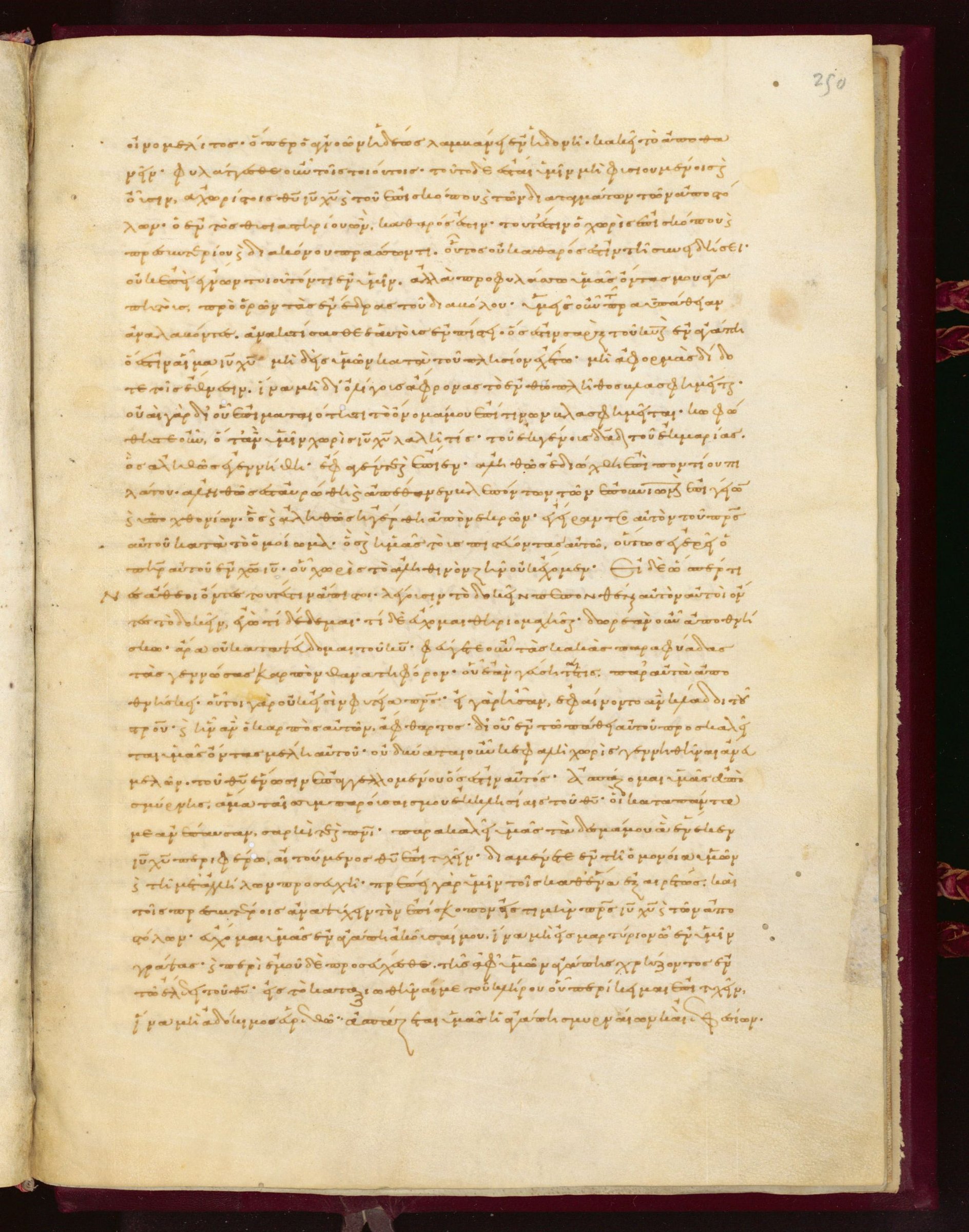
Checked on the images: Laur. Plut. 57.7 fol. 249v: the page begins ‹-νοιαν καὶ ἀδιάκριτον ἐν ὑπομονῇ (Trall. 1.1)› and ends ‹ὥσπερ θανάσιμον φάρμακον διδόντες μετὰ (Trall. 6.2)›; Laur. Plut. 57.7 fol. 250r: the page begins ‹οἰνομέλιτος (Trall. 6.2)› and ends ‹ἀσπάζεται ὑμᾶς ἡ ἀγάπη Σμυρναίων καὶ Ἐφεσίων (Trall. 13.1)›. The span of each page was found by reading its first and last words and locating them in the Greek. The Greek shown is Lake's edited text (1912), not a transcription of the page; the scribe's spellings and abbreviations differ in small details.
1Παρακαλῶ οὖν ὑμᾶς, οὐκ ἐγώ, ἀλλ’ ἡ ἀγάπη Ἰησοῦ Χριστοῦ· μόνῃ τῇ χριστιανῇ τροφῇ χρῆσθε, ἀλλοτρίας δὲ βοτάνης ἀπέχεσθε, ἥτις ἐστὶν αἵρεσις· 2οἳ ἑαυτοῖς παρεμπλέκουσιν Ἰησοῦν Χριστὸν καταξιοπιστευόμενοι, ὥσπερ θανάσιμον φάρμακον διδόντες μετὰ οἰνομέλιτος, ὅπερ ὁ ἀγνοῶν ἡδέως λαμβάνει ἐν ἡδονῇ κακῇ τὸ ἀποθανεῖν.
1I exhort you therefore -- yet not I, but the love of Jesus Christ -- take ye only Christian food, and abstain from strange herbage, which is heresy: 2for these men do even mingle poison with Jesus Christ, imposing upon others by a show of honesty, like persons administering a deadly drug with honied wine, so that one who knoweth it not, fearing nothing, drinketh in death with a baneful delight.
Where on the image
Checked on the images: Laur. Plut. 57.7 fol. 250r: the page begins ‹οἰνομέλιτος (Trall. 6.2)› and ends ‹ἀσπάζεται ὑμᾶς ἡ ἀγάπη Σμυρναίων καὶ Ἐφεσίων (Trall. 13.1)›. The span of each page was found by reading its first and last words and locating them in the Greek. The Greek shown is Lake's edited text (1912), not a transcription of the page; the scribe's spellings and abbreviations differ in small details.
1Φυλάττεσθε οὖν τοὺς τοιούτους. τοῦτο δὲ ἔσται ὑμῖν μὴ φυσιουμένοις καὶ οὖσιν ἀχωρίστοις θεοῦ Ἰησοῦ Χριστοῦ καὶ τοῦ ἐπισκόπου καὶ τῶν διαταγμάτων τῶν ἀποστόλων. 2ὁ ἐντὸς θυσιαστηρίου ὢν καθαρός ἐστιν· ὁ δὲ ἐκτὸς θυσιαστηρίου ὤν οὐ καθαρός ἐστιν. τοῦτ’ ἔστιν, ὁ χωρὶς ἐπισκόπου καὶ πρεσβυτερίου καὶ διακόνων πράσσων τι, οὗτος οὐ καθαρός ἐστιν τῇ συνειδήσει.
1Be ye therefore on your guard against such men. And this will surely be, if ye be not puffed up and if ye be inseparable from [God] Jesus Christ and from the bishop and from the ordinances of the Apostles. 2He that is within the sanctuary is clean; but he that is without the sanctuary is not clean, that is, he that doeth aught without the bishop and presbytery and deacons, this man is not clean in his conscience.
Where on the image
Checked on the images: Laur. Plut. 57.7 fol. 250r: the page begins ‹οἰνομέλιτος (Trall. 6.2)› and ends ‹ἀσπάζεται ὑμᾶς ἡ ἀγάπη Σμυρναίων καὶ Ἐφεσίων (Trall. 13.1)›. The span of each page was found by reading its first and last words and locating them in the Greek. The Greek shown is Lake's edited text (1912), not a transcription of the page; the scribe's spellings and abbreviations differ in small details.
1Οὐκ ἐπεὶ ἔγνων τοιοῦτόν τι ἐν ὑμῖν, ἀλλὰ προφυλάσσω ὑμᾶς ὄντας μου ἀγαπητούς. προορῶν τὰς ἐνέδρας τοῦ διαβόλου. ὑμεῖς οὖν τὴν πραϋπάθειαν ἀναλαβόντες ἀνακτήσασθε ἑαυτοὺς ἐν πίστει ὅ ἐστιν σὰρξ τοῦ κυρίου, καὶ ἐν ἀγάπῃ, ὅ ἐστιν αἷμα Ἰησοῦ Χριστοῦ. 2μηδεὶς ὑμῶν κατὰ τοῦ πλησίον ἐχέτω. μὴ ἀφορμὰς δίδοτε τοῖς ἔθνεσιν, ἵνα μὴ δι’ ὀλίγους ἄφρονας τὸ ἐν θεῷ πλῆθος βλασφημῆται. Οὐαὶ γάρ, δι’ οὗ ἐπὶ ματαιότητι τὸ ὄνομά μου ἐπί τινων βλασφημεῖται.
1Not indeed that I have known of any such thing among you, but I keep watch over you betimes, as my beloved, for I foresee the snares of the devil. Do ye therefore arm yourselves with gentleness and recover yourselves in faith which is the flesh of the Lord, and in love which is the blood of Jesus Christ. 2Let none of you bear a grudge against his neighbour. Give no occasion to the Gentiles, lest by reason of a few foolish men the godly multitude be blasphemed: for Woe unto him through whom My name is vainly blasphemed before some.
Where on the image
Checked on the images: Laur. Plut. 57.7 fol. 250r: the page begins ‹οἰνομέλιτος (Trall. 6.2)› and ends ‹ἀσπάζεται ὑμᾶς ἡ ἀγάπη Σμυρναίων καὶ Ἐφεσίων (Trall. 13.1)›. The span of each page was found by reading its first and last words and locating them in the Greek. The Greek shown is Lake's edited text (1912), not a transcription of the page; the scribe's spellings and abbreviations differ in small details.
1Κωφώθητε οὖν, ὅταν ὑμῖν χωρὶς Ἰησοῦ Χριστοῦ λαλῇ τις, τοῦ ἐκ γένους Δαυείδ, τοῦ ἐκ Μαρίας, ὃς ἀληθῶς ἐγεννήθη, ἔφαγέν τε καὶ ἔπιεν, ἀληθῶς ἐδιώχθη ἐπὶ Ποντίου Πιλάτον, ἀληθῶς ἐσταυρώθη καὶ ἀπέθανεν, βλεπόντων τῶν ἐπουρανίων καὶ ἐπιγείων καὶ ὑποχθονίων. 2ὃς καὶ ἀληθῶς ἠγέρθη ἀπὸ νεκρῶν. ἐγείραντος αὐτὸν τοῦ πατρὸς αὐτοῦ, κατὰ τὸ ὁμοίωμα ὃς καὶ ἡμᾶς τοὺς πιστεύοντας αὐτῷ οὕτως ἐγερεῖ ὁ πατὴρ αὐτοῦ ἐν Χριστῷ Ἰησοῦ, οὗ χωρὶς τὸ ἀληθινὸν ζῆν οὐκ ἔχομεν.
1Be ye deaf therefore, when any man speaketh to you apart from Jesus Christ, who was of the race of David, who was the Son of Mary, who was truly born and ate and drank, was truly persecuted under Pontius Pilate, was truly crucified and died in the sight of those in heaven and those on earth and those under the earth; 2who moreover was truly raised from the dead, His Father having raised Him, who in the like fashion will so raise us also who believe on Him -- His Father, I say, will raise us -- in Christ Jesus, apart from whom we have not true life.
Where on the image
Checked on the images: Laur. Plut. 57.7 fol. 250r: the page begins ‹οἰνομέλιτος (Trall. 6.2)› and ends ‹ἀσπάζεται ὑμᾶς ἡ ἀγάπη Σμυρναίων καὶ Ἐφεσίων (Trall. 13.1)›. The span of each page was found by reading its first and last words and locating them in the Greek. The Greek shown is Lake's edited text (1912), not a transcription of the page; the scribe's spellings and abbreviations differ in small details.
1Εἰ δέ, ὥσπερ τινὲς ἄθεοι ὄντες, τουτέστιν ἄπιστοι, λέγουσιν, τὸ δοκεῖν πεπονθέναι αὐτόν, αὐτοὶ ὄντες τὸ δοκεῖν, ἐγὼ τί δέδεμαι, τί δὲ καὶ εὔχομαι θηριομαχῆσαι; δωρεὰν οὖν ἀποθνήσκω. ἄρα οὖν καταψεύδομαι τοῦ κυρίου.
1But if it were as certain persons who are godless, that is unbelievers, say, that He suffered only in semblance, being themselves mere semblance, why am I in bonds? And why also do I desire to fight with wild beasts? So I die in vain. Truly then I lie against the Lord.
Where on the image
Checked on the images: Laur. Plut. 57.7 fol. 250r: the page begins ‹οἰνομέλιτος (Trall. 6.2)› and ends ‹ἀσπάζεται ὑμᾶς ἡ ἀγάπη Σμυρναίων καὶ Ἐφεσίων (Trall. 13.1)›. The span of each page was found by reading its first and last words and locating them in the Greek. The Greek shown is Lake's edited text (1912), not a transcription of the page; the scribe's spellings and abbreviations differ in small details.
1Φεύγετε οὖν τὰς κακὰς παραφυάδας τὰς γεννώσας καρπὸν θανατηφόρον, οὗ ἐὰν γεύσηταί τις, παρ’ αὐτὰ ἀποθνήσκει. οὗτοι γὰρ οὔκ εἰσιν φυτεία πατρός, 2εἰ γὰρ ἦσαν, ἐφαίνοντο ἂν κλάδοι τοῦ σταυροῦ, καὶ ἦν ἂν ὁ καρπὸς αὐτῶν ἄφθαρτος· δι’ οὗ ἐν τῷ πάθει αὐτοῦ προσκαλεῖται ὑμᾶς ὄντας μέλη αὐτοῦ. οὐ δύναται οὖν κεφαλὴ χωρὶς γεννηθῆναι ἄνευ μελῶν, τοῦ θεοῦ ἕνωσιν ἐπαγγελλομένου, ὅ ἐστιν αὐτός.
1Shun ye therefore those vile offshoots that gender a deadly fruit, whereof if a man taste, forthwith he dieth. For these men are not the Father's planting: for if they had been, they would have been seen to be branches of the Cross, and their fruit imperishable -- the Cross whereby He through His passion inviteth us, being His members. Now it cannot be that a head should be found without members, seeing that God promiseth union, and this union is Himself.
Where on the image
Checked on the images: Laur. Plut. 57.7 fol. 250r: the page begins ‹οἰνομέλιτος (Trall. 6.2)› and ends ‹ἀσπάζεται ὑμᾶς ἡ ἀγάπη Σμυρναίων καὶ Ἐφεσίων (Trall. 13.1)›. The span of each page was found by reading its first and last words and locating them in the Greek. The Greek shown is Lake's edited text (1912), not a transcription of the page; the scribe's spellings and abbreviations differ in small details.
1Ἀσπάζομαι ὑμᾶς ἀπὸ Σμύρνης ἅμα ταῖς συμπαρούσαις μοι ἐκκλησίαις τοῦ θεοῦ, οἲ κατὰ πάντα με ἀνέπαυσαν σαρκί τε καὶ πνεύματι. 2παρακαλεῖ ὑμᾶς τὰ δεσμά μου, ἃ ἕνεκεν Ἰησοῦ Χριστοῦ περιφέρω, αἰτούμενος θεοῦ ἐπιτυχεῖν· διαμένετε ἐν τῇ ὁμονοίᾳ ὑμῶν καὶ τῇ μετ’ ἀλλήλων προσευχῇ. πρέπει γὰρ ὑμῖν τοῖς καθ’ ἕνα, ἐξαιρέτως καὶ τοῖς πρεσβυτέροις, ἀναψύχειν τὸν ἐπίσκοπον εἰς τιμὴν πατρός, Ἰησοῦ Χριστοῦ καὶ τῶν ἀποστόλων. 3εὔχομαι ὑμᾶς ἐν ἀγάπῃ ἀκοῦσαί μου, ἵνα μὴ εἰς μαρτύριον ὦ ἐν ὑμῖν γράψας. καὶ περὶ ἐμοῦ δὲ προσεύχεσθε, τῆς ἀφ’ ὑμῶν ἀγάπης χρῄζοντος ἐν τῷ ἐλέει τοῦ θεοῦ, εἰς τὸ καταξιωθῆναί με τοῦ κλήρου, οὗ περίκειμαι ἐπιτυχεῖν, ἵνα μὴ ἀδόκιμος εὑρεθῶ,
1I salute you from Smyrna, together with the churches of God that are present with me; men who refreshed me in all ways both in flesh and in spirit. 2My bonds exhort you, which for Jesus Christ's sake I bear about, entreating that I may attain unto God; abide ye in your concord and in prayer one with another. For it becometh you severally, and more especially the presbyters, to cheer the soul of your bishop unto the honour of the Father [and to the honour] of Jesus Christ and of the Apostles. 3I pray that ye may hearken unto me in love, lest I be for a testimony against you by having so written. And pray ye also for me who have need of your love in the mercy of God, that I may be vouchsafed the lot which I am eager to attain, to the end that I be not found reprobate.
Where on the image
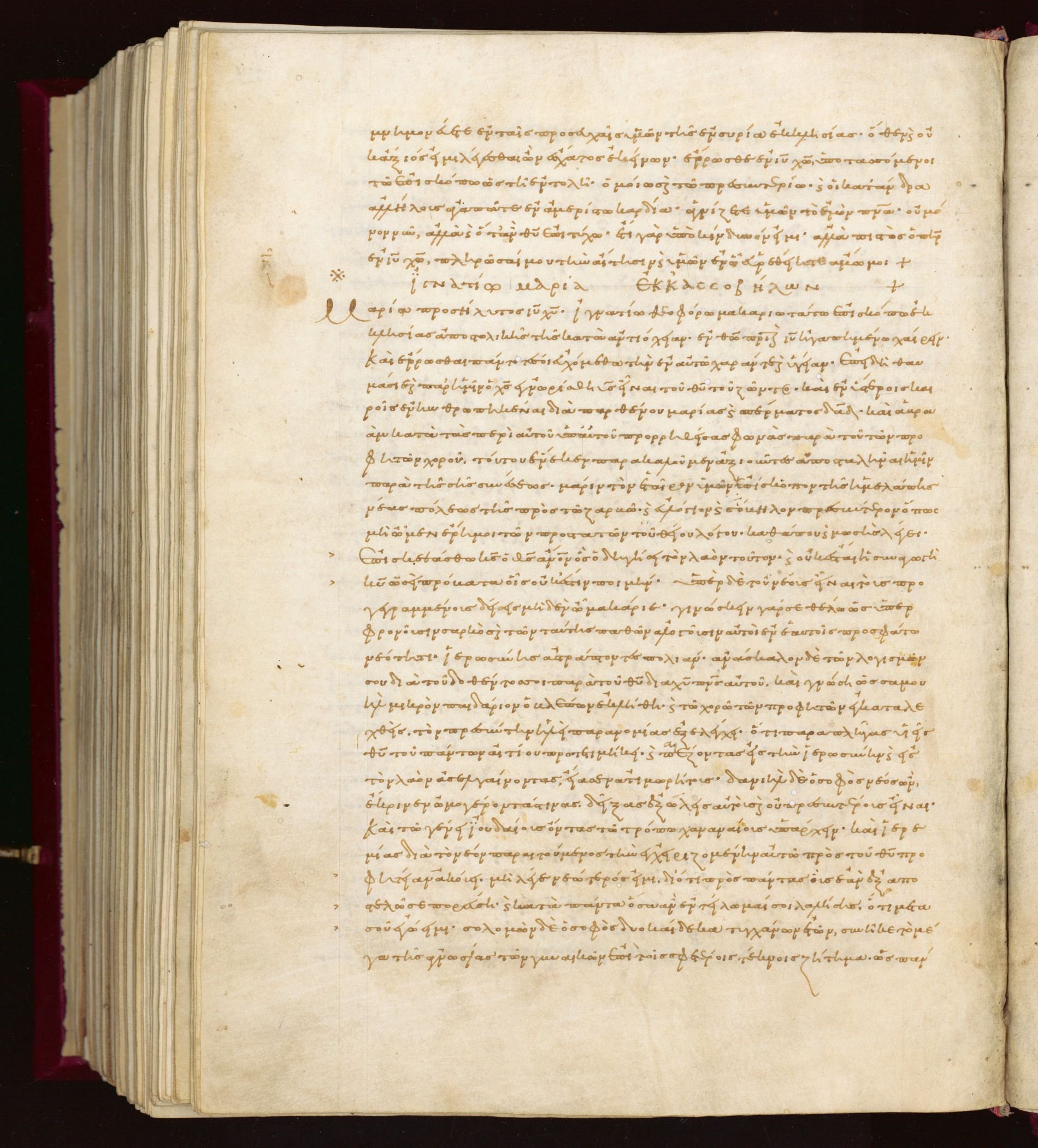
Checked on the images: Laur. Plut. 57.7 fol. 250r: the page begins ‹οἰνομέλιτος (Trall. 6.2)› and ends ‹ἀσπάζεται ὑμᾶς ἡ ἀγάπη Σμυρναίων καὶ Ἐφεσίων (Trall. 13.1)›; Laur. Plut. 57.7 fol. 250v: the page begins ‹μνημονεύετε ἐν ταῖς προσευχαῖς ὑμῶν (Trall. 13.1)› and ends ‹(after Trallians the page goes on with the spurious letter of Mary of Cassobola)›. The span of each page was found by reading its first and last words and locating them in the Greek. The Greek shown is Lake's edited text (1912), not a transcription of the page; the scribe's spellings and abbreviations differ in small details.
1Ἀσπάζεται ὑμᾶς ἡ ἀγάπη Σμυρναίων καὶ Ἐφεσίων. μνημονεύετε ἐν ταῖς προσευχαῖς ὑμῶν τῆς ἐν Συρίᾳ ἐκκλησίας, ὅθεν καὶ οὐκ ἄξιός εἰμι λέγεσθαι, ὢν ἔσχατος ἐκείνων. 2ἔρρωσθε ἐν Ἰησοῦ Χριστῷ, ὑποτασσόμενοι τῷ ἐπισκόπῳ ὡς τῇ ἐντολῇ, ὁμοίως καὶ τῷ πρεσβυτερίῳ. καὶ οἱ κατ’ ἄνδρα ἀλλήλους ἀγαπᾶτε ἐν ἀμερίστῳ καρδίᾳ. 3ἁγνίζεται ὑμῶν τὸ ἐμὸν πνεῦμα οὐ μόνον νῦν, ἀλλὰ καὶ ὅταν θεοῦ ἐπιτύχω. ἔτι γὰρ ὑπὸ κίνδυνόν εἰμι· ἀλλὰ πιστὸς ὁ πατὴρ ἐν Ἰησοῦ Χριστῷ πληρῶσαί μου τὴν αἴτησιν καὶ ὑμῶν, ἐν ᾧ εὑρεθείητε ἄμωμοι.
1The love of the Smyrnaeans and Ephesians saluteth you. Remember in your prayers the church which is in Syria; whereof [also] I am not worthy to be called a member, being the very last of them. 2Fare ye well in Jesus Christ, submitting yourselves to the bishop as to the commandment, and likewise also to the presbytery; and each of you severally love one another with undivided heart. 3My spirit is offered up for you, not only now, but also when I shall attain unto God. For I am still in peril; but the Father is faithful in Jesus Christ to fulfil my petition and yours. May we be found unblameable in Him.
Notes
- Greek: Kirsopp Lake, The Apostolic Fathers I (Loeb Classical Library, 1912), digital text of the First1KGreek project (tlg1443.tlg001, CC BY-SA 4.0); Lake's footnotes are not shown. Elided words are written with an apostrophe and the digital text's colon is shown as the raised dot.
- Proofreading: the Greek pages of Lake (archive.org theapostolicfath00unknuoft, leaves 184-288) were read by OCR twice and aligned with the digital text; every word on which both OCR readings agreed against the digital text, and every form that cannot be right, was looked up on the page image. Corrections in this letter: 2.2 'ᾦ' to 'ᾧ'; 3.2 'οὖ' to 'οὗ'; 3.3 'ὤν' to 'ὢν'; 11.1 'προσκαλεῖταν' to 'προσκαλεῖται'; 12.3 'εἶς' to 'εἰς'; 12.3 'οὖ' to 'οὗ'. Kept as Lake prints them (worn or missing accents): Eph. 8.2 οὐδε, Phld. 5.2 ἀξιαγαπητοι, Smyrn. 2.1 το; Lake's quotation marks in Pol. 8.1 are shown as ‘ ’.
- English: J. B. Lightfoot, The Apostolic Fathers (1891, Lightfoot and Harmer), as transcribed at earlychristianwritings.com; Lightfoot's italics are kept.
Cite
Sources
- Source: Laur. Plut. 57.7 (BML IIIF) + Lake 1912 Greek (First1KGreek, CC BY-SA 4.0) + Lightfoot 1891 English (public domain) (holding institution)
- Critical edition: Kirsopp Lake, The Apostolic Fathers I (1912), via First1KGreek
← previous · → next · v cycle view · l back to library