Ignatius of Antioch, To the Philadelphians (Laur. Plut. 57.7)
Introduction
Ignatius, bishop of Antioch, wrote seven letters while he was being taken under guard to Rome to be put to death, probably in the reign of Trajan (about 110 AD). This is his letter to the Philadelphians. Together the letters are among the earliest witnesses to the Christian bishop, presbyters and deacons, to the eucharist as the flesh of Christ, and to faith in Christ as God and man, written against teachers who said that Christ only seemed to suffer.
The manuscript. The letter is shown on Florence, Biblioteca Medicea Laurenziana, Plut. 57.7 (11th century), the only Greek manuscript of the six other letters in this form. Laur. Plut. 57.7 carries the letters on fol. 242r-252v in the order Smyrnaeans, Polycarp, Ephesians, Magnesians, Philadelphians, Trallians, followed by spurious letters; the scribe numbers them in the margin. The Letter to the Romans is not in it, and is shown from the Paris manuscript. Each section is one chapter, linked to the page or pages that carry it; the first and last words of every page were read on the images.
Texts. The Greek is Kirsopp Lake's edition (1912), proofread here against his printed pages; the English is J. B. Lightfoot's translation (1891). Both follow the middle (seven-letter) recension. They are edited texts, so the wording on the page differs from them in places.
How was this verified? (Provenance)
Where on the image
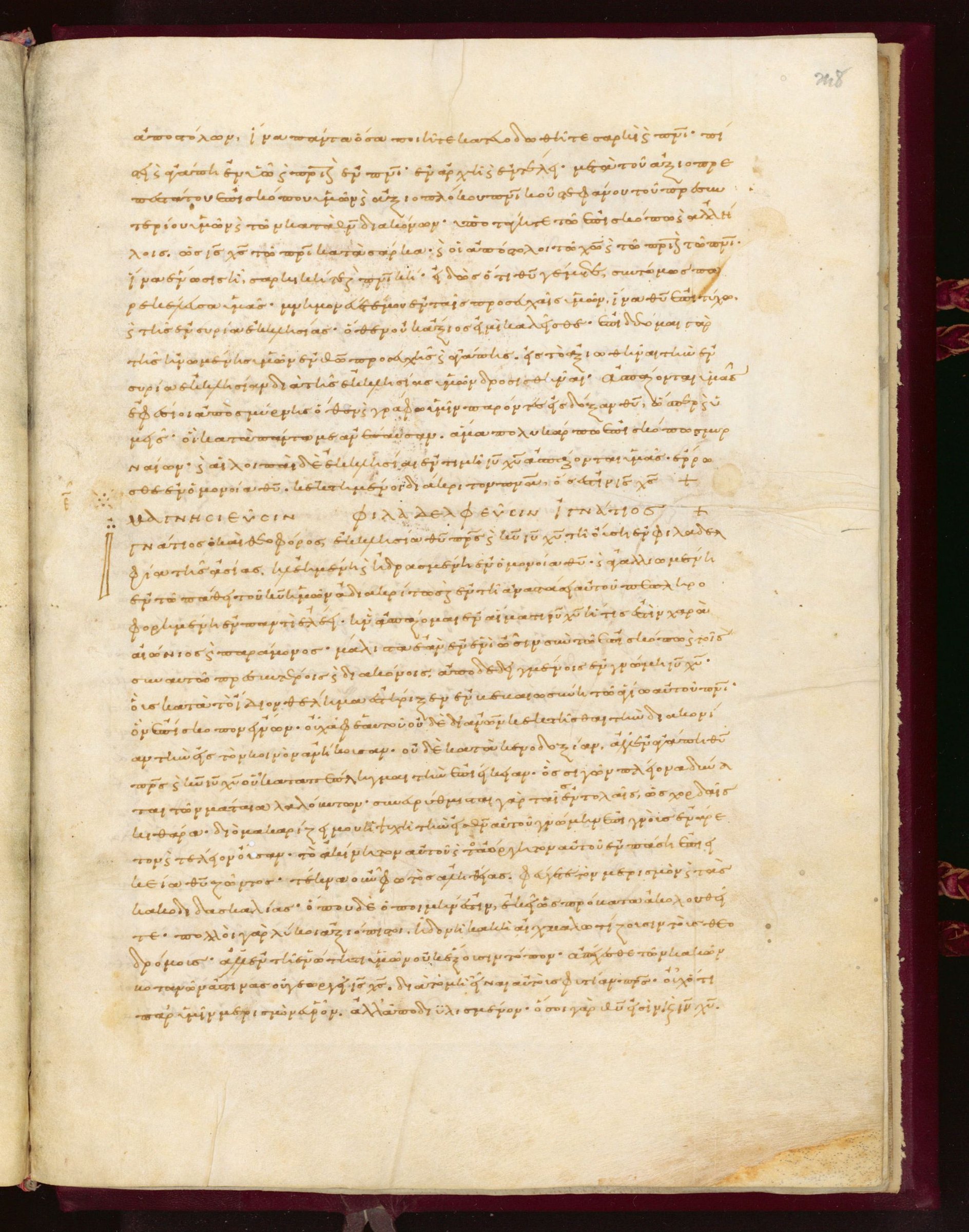
Checked on the images: Laur. Plut. 57.7 fol. 248r: the page begins ‹ἀποστόλων, ἵνα πάντα ὅσα ποιῆτε (Magn. 13.1)› and ends ‹ὅσοι γὰρ θεοῦ εἰσιν καὶ Ἰησοῦ Χριστοῦ (Phld. 3.2)›. The span of each page was found by reading its first and last words and locating them in the Greek. The Greek shown is Lake's edited text (1912), not a transcription of the page; the scribe's spellings and abbreviations differ in small details.
Ἰγνάτιος, ὁ καὶ Θεοφόρος, ἐκκλησίᾳ θεοῦ πατρὸς καὶ κυρίου Ἰησοῦ Χριστοῦ τῇ οὔσῃ ἐν Φιλαδελφίᾳ τῆς Ἀσίας, ἠλεημένῃ καὶ ἡδρασμένῃ ἐν ὁμονοίᾳ θεοῦ καὶ ἀγαλλιωμένῃ ἐν τῷ πάθει τοῦ κυρίου ἡμῶν ἀδιακρίτως καὶ ἐν τῇ ἀναστάσει αὐτοῦ πεπληροφορημένῃ ἐν παντὶ ἐλέει, ἣν ἀσπάζομαι ἐν αἵματι Ἰησοῦ Χριστοῦ, ἥτις ἐστὶν χαρὰ αἰώνιος καὶ παράμονος, μάλιστα ἐὰν ἐν ἑνὶ ὦσιν σὺν τῷ ἐπισκόπῳ καὶ τοῖς σὺν αὐτῷ πρεσβυτέροις καὶ διακόνοις ἀποδεδειγμένοις ἐν γνώμῃ Ἰησοῦ Χριστοῦ, οὓς κατὰ τὸ ἴδιον θέλημα ἐστήριξεν ἐν βεβαιωσύνῃ τῷ ἁγίῳ αὐτοῦ πνεύματι.
Ignatius, who is also Theophorus, to the church of God the Father and of Jesus Christ, which is in Philadelphia of Asia, which hath found mercy and is firmly established in the concord of God and rejoiceth in the passion of our Lord and in His resurrection without wavering, being fully assured in all mercy; which church I salute in the blood of Jesus Christ, that is eternal and abiding joy; more especially if they be at one with the bishop and the presbyters who are with him, and with the deacons that have been appointed according to the mind of Jesus Christ, whom after His own will He confirmed and established by His Holy Spirit.
Where on the image
Checked on the images: Laur. Plut. 57.7 fol. 248r: the page begins ‹ἀποστόλων, ἵνα πάντα ὅσα ποιῆτε (Magn. 13.1)› and ends ‹ὅσοι γὰρ θεοῦ εἰσιν καὶ Ἰησοῦ Χριστοῦ (Phld. 3.2)›. The span of each page was found by reading its first and last words and locating them in the Greek. The Greek shown is Lake's edited text (1912), not a transcription of the page; the scribe's spellings and abbreviations differ in small details.
1Ὃν ἐπίσκοπον ἔγνων οὐκ ἀφ’ ἑαυτοῦ οὐδὲ δι’ ἀνθρώπων κεκτῆσθαι τὴν διακονίαν τὴν εἰς τὸ κοινὸν ἀνήκουσαν οὐδὲ κατὰ κενοδοξίαν, ἀλλ’ ἐν ἀγάπῃ θεοῦ πατρὸς καὶ κυρίου Ἰησοῦ Χριστοῦ· οὗ καταπέπληγμαι τὴν ἐπιείκειαν, ὃς σιγῶν πλείονα δύναται τῶν μάταια λαλούντων. 2συνευρύθμισται γαρ ταῖς ἐντολαῖς ὡς χορδαῖς κιθάρα. διὸ μακαρίζει μου ἡ ψυχὴ τὴν εἰς θεὸν αὐτοῦ γνώμην, ἐπιγνοὺς ἐνάρετον καὶ τέλειον οὖσαν, τὸ ἀκίνητον αὐτοῦ καὶ τὸ ἀόργητον αὐτοῦ ἐν πάσῃ ἐπιεικείᾳ θεοῦ ζῶντος.
1This your bishop I have found to hold the ministry which pertaineth to the common weal, not of himself or through men, nor yet for vain glory, but in the love of God the Father and the Lord Jesus Christ. And I am amazed at his forbearance; whose silence is more powerful than others' speech. 2For he is attuned in harmony with the commandments, as a lyre with its strings. Wherefore my soul blesseth his godly mind, for I have found that it is virtuous and perfect -- even the imperturbable and calm temper which he hath, while living in all godly forbearance.
Where on the image
Checked on the images: Laur. Plut. 57.7 fol. 248r: the page begins ‹ἀποστόλων, ἵνα πάντα ὅσα ποιῆτε (Magn. 13.1)› and ends ‹ὅσοι γὰρ θεοῦ εἰσιν καὶ Ἰησοῦ Χριστοῦ (Phld. 3.2)›. The span of each page was found by reading its first and last words and locating them in the Greek. The Greek shown is Lake's edited text (1912), not a transcription of the page; the scribe's spellings and abbreviations differ in small details.
1Τέκνα οὖν φωτὸς ἀληθείας, φεύγετε τὸν μερισμὸν καὶ τὰς κακοδιδασκαλίας· ὅπου δὲ ὁ ποιμήν ἐστιν, ἐκεῖ ὡς πρόβατα ἀκολουθεῖτε. 2πολλοὶ γὰρ λύκοι ἀξιόπιστοι ἡδονῇ κακῇ αἰχμαλωτίζουσιν τοὺς θεοδρόμους· ἀλλ’ ἐν τῇ ἑνότητι ὑμῶν οὐχ ἕξουσιν τόπον.
1As children therefore [of the light] of the truth, shun division and wrong doctrines; and where the shepherd is, there follow ye as sheep. 2For many specious wolves with baneful delights lead captive the runners in God's race; but, where ye are at one, they will find no place.
Where on the image
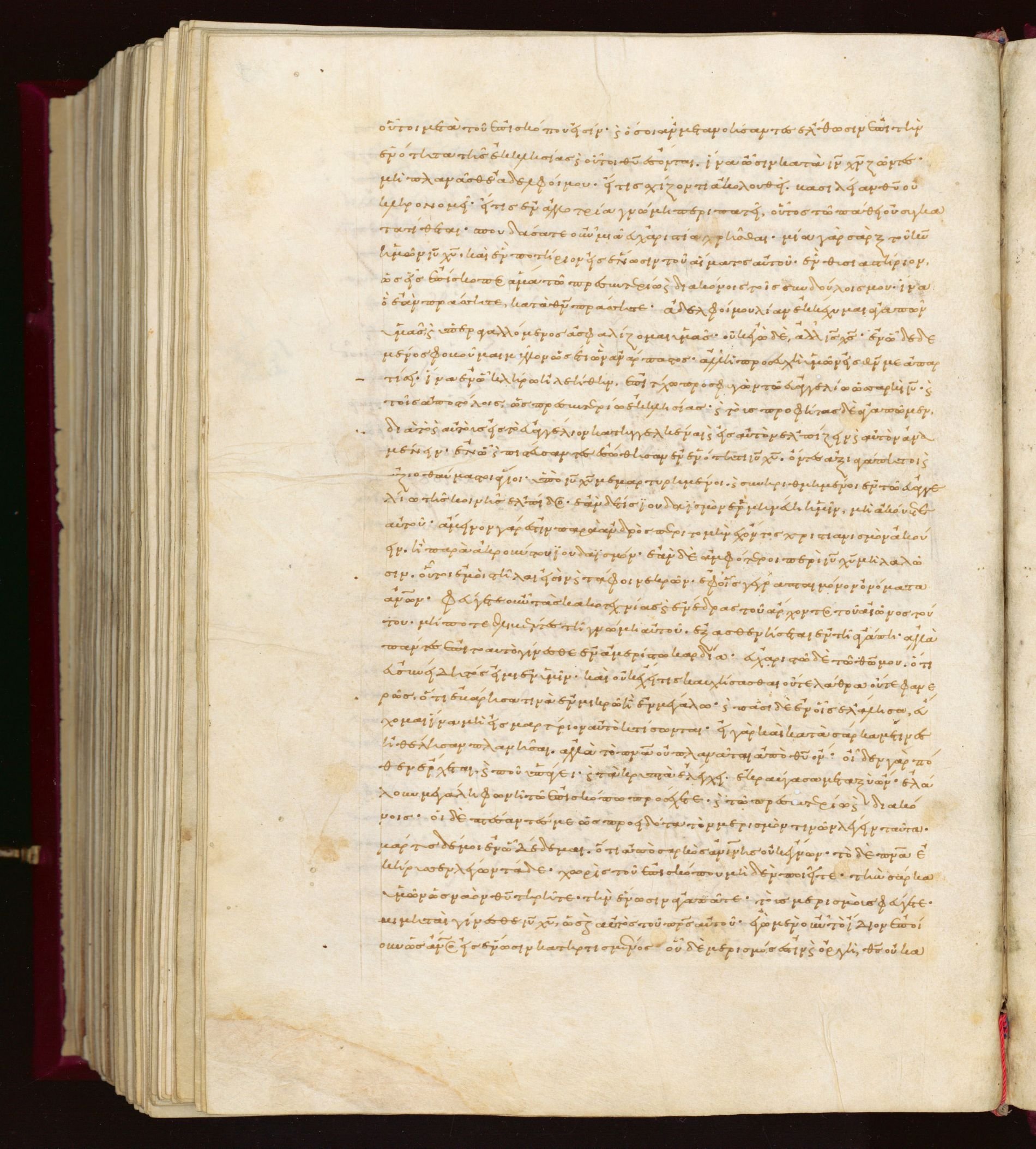
Checked on the images: Laur. Plut. 57.7 fol. 248r: the page begins ‹ἀποστόλων, ἵνα πάντα ὅσα ποιῆτε (Magn. 13.1)› and ends ‹ὅσοι γὰρ θεοῦ εἰσιν καὶ Ἰησοῦ Χριστοῦ (Phld. 3.2)›; Laur. Plut. 57.7 fol. 248v: the page begins ‹οὗτοι μετὰ τοῦ ἐπισκόπου εἰσίν (Phld. 3.2)› and ends ‹οὗ δὲ μερισμός ἐστιν καὶ ὀργή, θεὸς οὐ κα- (Phld. 8.1)›. The span of each page was found by reading its first and last words and locating them in the Greek. The Greek shown is Lake's edited text (1912), not a transcription of the page; the scribe's spellings and abbreviations differ in small details.
1Ἀπέχεσθε τῶν κακῶν βοτανῶν, ἅστινας οὐ γεωργεῖ Ἰησοῦς Χριστός, διὰ τὸ μὴ εἶναι αὐτοὺς φυτείαν πατρός· οὐχ ὅτι παρ’ ὑμῖν μερισμὸν εὗρον, ἀλλ’ ἀποδιϋλισμόν. 2ὅσοι γὰρ θεοῦ εἰσιν καὶ Ἰησοῦ Χριστοῦ, οὗτοι μετὰ τοῦ ἐπισκόπου εἰσίν. καὶ ὅσοι ἂν μετανοήσαντες ἔλθωσιν ἐπὶ τὴν ἑνότητα τῆς ἐκκλησίας, καὶ οὗτοι θεοῦ ἔσονται, ἵνα ὦσιν κατὰ Ἰησοῦν Χριστὸν ζῶντες. 3μὴ πλανᾶσθε, ἀδελφοί μου· εἴ τις σχίζοντι ἀκολουθεῖ. βασιλείαν θεοῦ οὐ κληρονομεῖ· εἴ τις ἐν ἀλλοτρίᾳ γνώμῃ περιπατεῖ, οὗτος τῷ πάθει οὐ συγκατατίθεται.
1Abstain from noxious herbs, which are not the husbandry of Jesus Christ, because they are not the planting of the Father. Not that I have found division among you, but filtering. 2For as many as are of God and of Jesus Christ, they are with the bishop; and as many as shall repent and enter into the unity of the Church, these also shall be of God, that they may be living after Jesus Christ. 3Be not deceived, my brethren. If any man followeth one that maketh a schism, he doth not inherit the kingdom of God. If any man walketh in strange doctrine, he hath no fellowship with the passion.
Where on the image
Checked on the images: Laur. Plut. 57.7 fol. 248v: the page begins ‹οὗτοι μετὰ τοῦ ἐπισκόπου εἰσίν (Phld. 3.2)› and ends ‹οὗ δὲ μερισμός ἐστιν καὶ ὀργή, θεὸς οὐ κα- (Phld. 8.1)›. The span of each page was found by reading its first and last words and locating them in the Greek. The Greek shown is Lake's edited text (1912), not a transcription of the page; the scribe's spellings and abbreviations differ in small details.
1Σπουδάσατε οὖν μιᾷ εὐχαριστίᾳ χρῆσθαι· μία γὰρ σὰρξ τοῦ κυρίου ἡμῶν Ἰησοῦ Χριστοῦ καὶ ἓν ποτήριον εἰς ἕνωσιν τοῦ αἵματος αὐτοῦ, ἓν θυσιαστήριον, ὡς εἷς ἐπίσκοπος ἅμα τῷ πρεσβυτερίῳ καὶ διακόνοις τοῖς συνδούλοις μου· ἵνα, ὃ ἐὰν πράσσητε, κατὰ θεὸν πράσσητε.
1Be ye careful therefore to observe one eucharist (for there is one flesh of our Lord Jesus Christ and one cup unto union in His blood; there is one altar, as there is one bishop, together with the presbtery and the deacons my fellow-servants), that whatsoever ye do, ye may do it after God.
Where on the image
Checked on the images: Laur. Plut. 57.7 fol. 248v: the page begins ‹οὗτοι μετὰ τοῦ ἐπισκόπου εἰσίν (Phld. 3.2)› and ends ‹οὗ δὲ μερισμός ἐστιν καὶ ὀργή, θεὸς οὐ κα- (Phld. 8.1)›. The span of each page was found by reading its first and last words and locating them in the Greek. The Greek shown is Lake's edited text (1912), not a transcription of the page; the scribe's spellings and abbreviations differ in small details.
1Ἀδελφοί μου, λίαν ἐκκέχυμαι ἀγαπῶν ὑμᾶς καὶ ὑπεραγαλλόμενος ἀσφαλίζομαι ὑμᾶς· οὐκ ἐγὼ δέ, ἀλλ’ Ἰησοῦς Χριστός, ἐν ᾧ δεδεμένος φοβοῦμαι μᾶλλον, ὡς ἔτι ὢν ἀναπάρτιστος· ἀλλ’ ἡ προσευχὴ ὑμῶν εἰς θεόν με ἀπαρτίσει, ἵνα ἐν ᾧ κλήρῳ ἠλεήθην ἐπιτύχω, προσφυγὼν τῷ εὐαγγελίῳ ὡς σαρκὶ Ἰησοῦ, καὶ τοῖς ἀποστόλοις ὡς πρεσβυτερίῳ ἐκκλησίας. 2καὶ τοὺς προφήτας δὲ ἀγαπῶμεν, διὰ τὸ καὶ αὐτοὺς εἰς τὸ εὐαγγέλιον κατηγγελκέναι καὶ εἰς αὐτὸν ἐλπίζειν καὶ αὐτὸν ἀναμένειν, ἐν ᾧ καὶ πιστεύσαντες ἐσώθησαν, ἐν ἑνότητι Ἰησοῦ Χριστοῦ ὄντες, ἀξιαγαπητοι καὶ ἀξιοθαύμαστοι ἅγιοι, ὑπὸ Ἰησοῦ Χριστοῦ μεμαρτυρημένοι καὶ συνηριθμημένοι ἐν τῷ εὐαγγελίῳ τῆς κοινῆς ἐλπίδος.
1My brethren, my heart overfloweth altogether in love towards you; and rejoicing above measure I watch over your safety; yet not I, but Jesus Christ, wearing whose bonds I am the more afraid, because I am not yet perfected. But your prayer will make me perfect [unto God], that I may attain unto the inheritance wherein I have found mercy, taking refuge in the Gospel as the flesh of Jesus and in the Apostles as the presbytery of the Church. 2Yea, and we love the prophets also, because they too pointed to the Gospel in their preaching and set their hope on Him and awaited Him; in whom also having faith they were saved in the unity of Jesus Christ, being worthy of all love and admiration as holy men, approved of Jesus Christ and numbered together in the Gospel of our common hope.
Where on the image
Checked on the images: Laur. Plut. 57.7 fol. 248v: the page begins ‹οὗτοι μετὰ τοῦ ἐπισκόπου εἰσίν (Phld. 3.2)› and ends ‹οὗ δὲ μερισμός ἐστιν καὶ ὀργή, θεὸς οὐ κα- (Phld. 8.1)›. The span of each page was found by reading its first and last words and locating them in the Greek. The Greek shown is Lake's edited text (1912), not a transcription of the page; the scribe's spellings and abbreviations differ in small details.
1Ἐὰν δέ τις ἰουδαϊσμὸν ἑρμηνεύῃ ὑμῖν, μὴ ἀκούετε αὐτοῦ. ἄμεινον γάρ ἐστιν παρὰ ἀνδρὸς περιτομὴν ἔχοντος χριστιανισμὸν ἀκούειν, ἢ παρὰ ἀκροβύστου ἰουδαϊσμόν. ἐὰν δὲ ἀμφότεροι περὶ Ἰησοῦ Χριστοῦ μὴ λαλῶσιν, οὗτοι ἐμοὶ στῆλαί εἰσιν καὶ τάφοι νεκρῶν, ἐφ’ οἷς γέγραπται μόνον ὀνόματα ἀνθρώπων. 2φεύγετε οὖν τὰς κακοτεχνίας καὶ ἐνέδρας τοῦ ἄρχοντος τοῦ αἰῶνος τούτου, μήποτε θλιβέντες τῇ γνώμῃ αὐτοῦ ἐξασθενήσετε ἐν τῇ ἀγάπῃ· ἀλλὰ πάντες ἐπὶ τὸ αὐτὸ γίνεσθε ἐν ἀμερίστῳ καρδίᾳ. 3εὐχαριστῶ δὲ τῷ θεῷ μου, ὅτι εὐσυνείδητός εἰμι ἐν ὑμῖν καὶ οὐκ ἔχει τις καυχήσασθαι οὔτε λάθρα οὔτε φανερῶς, ὅτι ἐβάρησά τινα ἐν μικρῷ ἢ ἐν μεγάλῳ. καὶ πᾶσι δέ, ἐν οἷς ἐλάλησα, εὔχομαι, ἵνα μὴ εἰς μαρτύριον αὐτὸ κτήσωνται.
1But if any one propound Judaism unto you, here him not: for it is better to hear Christianity from a man who is circumcised than Judaism from one uncircumcised. But if either the one or the other speak not concerning Jesus Christ, I look on them as tombstones and graves of the dead, whereon are inscribed only the names of men. 2Shun ye therefore the wicked arts and plottings of the prince of this world, lest haply ye be crushed by his devices, and wax weak in your love. But assemble yourselves all together with undivided heart. 3And I give thanks to my God, that I have a good conscience in my dealings with you, and no man can boast either in secret or openly, that I was burdensome to any one in small things or in great. Yea and for all among whom I spoke, it is my prayer that they may not turn it into a testimony against themselves.
Where on the image
Checked on the images: Laur. Plut. 57.7 fol. 248v: the page begins ‹οὗτοι μετὰ τοῦ ἐπισκόπου εἰσίν (Phld. 3.2)› and ends ‹οὗ δὲ μερισμός ἐστιν καὶ ὀργή, θεὸς οὐ κα- (Phld. 8.1)›. The span of each page was found by reading its first and last words and locating them in the Greek. The Greek shown is Lake's edited text (1912), not a transcription of the page; the scribe's spellings and abbreviations differ in small details.
1Εἰ γὰρ καὶ κατὰ σάρκα μέ τινες ἠθέλησαν πλανῆσαι, ἀλλὰ τὸ πνεῦμα οὐ πλανᾶται ἀπὸ θεοῦ ὄν. οἶδεν γάρ, πόθεν ἔρχεται καὶ ποῦ ὑπάγει, καὶ τὰ κρυπτὰ ἐλέγχει. ἐκραύγασα μεταξὺ ὤν, ἐλάλουν μεγάλῃ φωνῇ, θεοῦ φωνῇ· Τῷ ἐπισκοπῳ προσέχετε καὶ τῷ πρεσβυτερίῳ καὶ διακόνοις. 2οἱ δὲ ὑποπτεύσαντές με ὡς προειδότα τὸν μερισμόν τινων λέγειν ταῦτα· μάρτυς δέ μοι, ἐν ᾧ δέδεμαι, ὅτι ἀπὸ σαρκὸς ἀνθρωπίνης οὐκ ἔγνων. τὸ δὲ πνεῦμα ἐκήρυσσεν λέγον τάδε· Χωρὶς τοῦ ἐπισκόπου μηδὲν ποιεῖτε, τὴν σάρκα ὑμῶν ὡς ναὸν θεοῦ τηρεῖτε, τὴν ἕνωσιν ἀγαπᾶτε, τοὺς μερισμοὺς φεύγετε, μιμηταὶ γίνεσθε Ἰησοῦ Χριστοῦ, ὡς καὶ αὐτὸς τοῦ πατρὸς αὐτοῦ.
1For even though certain persons desired to deceive me after the flesh, yet the spirit is not deceived, being from God; for it knoweth whence it cometh and where it goeth, and it searcheth out the hidden things. I cried out, when I was among you; I spake with a loud voice, with God's own voice, Give ye heed to the bishop and the presbytery and deacons. 2Howbeit there were those who suspected me of saying this, because I knew beforehand of the division of certain persons. But He in whom I am bound is my witness that I learned it not from flesh of man; it was the preaching of the Spirit who spake on this wise; Do nothing without the bishop; keep your flesh as a temple of God; cherish union; shun divisions; be imitators of Jesus Christ, as He Himself also was of His Father.
Where on the image
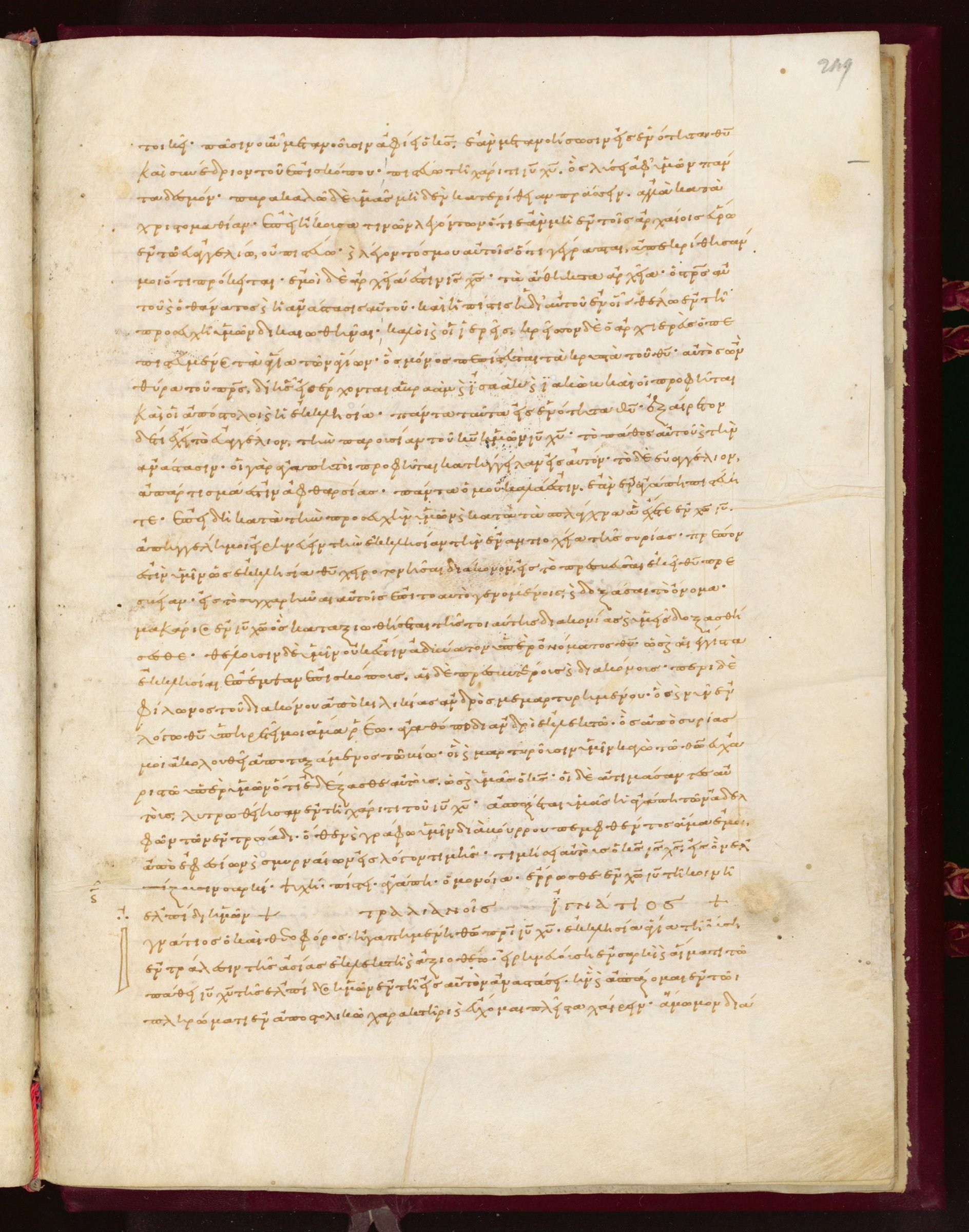
Checked on the images: Laur. Plut. 57.7 fol. 248v: the page begins ‹οὗτοι μετὰ τοῦ ἐπισκόπου εἰσίν (Phld. 3.2)› and ends ‹οὗ δὲ μερισμός ἐστιν καὶ ὀργή, θεὸς οὐ κα- (Phld. 8.1)›; Laur. Plut. 57.7 fol. 249r: the page begins ‹-τοικεῖ. πᾶσιν οὖν μετανοοῦσιν (Phld. 8.1)› and ends ‹πλεῖστα χαίρειν. ἄμωμον διά- (Trall. 1.1)›. The span of each page was found by reading its first and last words and locating them in the Greek. The Greek shown is Lake's edited text (1912), not a transcription of the page; the scribe's spellings and abbreviations differ in small details.
1Ἐγὼ μὲν οὖν τὸ ἴδιον ἐποίουν ὡς ἄνθρωπος εἰς ἕνωσιν κατηρτισμένος. οὗ δὲ μερισμός ἐστιν καὶ ὀργή. θεὸς οὐ κατοικεῖ. πᾶσιν οὖν μετανοοῦσιν ἀφίει ὁ κύριος, ἐὰν μετανοήσωσιν εἰς ἑνότητα θεοῦ καὶ συνέδριον τοῦ ἐπισκόπου. πιστεύω τῇ χάριτι Ἰησοῦ Χριστοῦ, ὃς λύσει ἀφ’ ὑμῶν πάντα δεσμόν. 2παρακαλῶ δὲ ὑμᾶς μηδὲν κατ’ ἐριθείαν πράσσειν, ἀλλὰ κατὰ χριστομαθίαν. ἐπεὶ ἤκουσά τινων λεγόντων, ὅτι ἐὰν μὴ ἐν τοῖς ἀρχείοις εὕρω ἐν τῷ εὐαγγελίῳ οὐ πιστεύω· καὶ λέγοντός μου αὐτοῖς ὅτι γέγραπται, ἀπεκρίθησάν μοι ὅτι πρόκειται. ἐμοὶ δὲ ἀρχεῖά ἐστιν Ἰησοῦς Χριστός, τὰ ἄθικτα ἀρχεῖα ὁ σταυρὸς αὐτοῦ καὶ ὁ θάνατος καὶ ἡ ἀνάστασις αὐτοῦ καὶ ἡ πίστις ἡ δι’ αὐτοῦ, ἐν οἷς θέλω ἐν τῇ προσευχῇ ὑμῶν δικαιωθῆναι.
1I therefore did my own part, as a man composed unto union. But where there is division and anger, there God abideth not. Now the Lord forgiveth all men when they repent, if repenting they return to the unity of God and to the council of the bishop. I have faith in the grace of Jesus Christ, who shall strike off every fetter from you; 2and I entreat you, Do ye nothing in a spirit of factiousness but after the teaching of Christ. For I heard certain persons saying, If I find it not in the charters, I believe it not in the Gospel. And when I said to them, It is written, they answered me That is the question. But as for me, my charter is Jesus Christ, the inviolable charter is His cross and His death and His resurrection, and faith through Him; wherein I desire to be justified through your prayers.
Where on the image
Checked on the images: Laur. Plut. 57.7 fol. 249r: the page begins ‹-τοικεῖ. πᾶσιν οὖν μετανοοῦσιν (Phld. 8.1)› and ends ‹πλεῖστα χαίρειν. ἄμωμον διά- (Trall. 1.1)›. The span of each page was found by reading its first and last words and locating them in the Greek. The Greek shown is Lake's edited text (1912), not a transcription of the page; the scribe's spellings and abbreviations differ in small details.
1Καλοὶ καὶ οἱ ἱερεῖς, κρεῖσσον δὲ ὁ ἀρχιερεὺς ὁ πεπιστευμένος τὰ ἅγια τῶν ἁγίων, ὃς μόνος πεπίστευται τὰ κρυπτὰ τοῦ θεοῦ· αὐτὸς ὢν θύρα τοῦ πατρός, δι’ ἧς εἰσέρχονται Ἀβραὰμ καὶ Ἰσαὰκ καὶ Ἰακὼβ καὶ οἱ προφῆται καὶ ἀπόστολοι καὶ ἡ ἐκκλησία. πάντα ταῦτα εἰς ἑνότητα θεοῦ. 2ἐξαίρετον δέ τι ἔχει τὸ εὐαγγέλιον, τὴν παρουσίαν τοῦ σωτῆρος, κυρίου ἡμῶν Ἰησοῦ Χριστοῦ, τὸ πάθος αὐτοῦ, καὶ τὴν ἀνάστασιν. οἱ γὰρ ἀγαπητοὶ προφῆται κατήγγειλαν εἰς αὐτόν· τὸ δὲ εὐαγγέλιον ἀπάρτισμά ἐστιν ἀφθαρσίας. πάντα ὁμοῦ καλά ἐστιν, ἐὰν ἐν ἀγάπῃ πιστεύητε.
1The priests likewise were good, but better is the High-priest to whom is committed the holy of holies; for to Him alone are committed the hidden things of God; He Himself being the door of the Father, through which Abraham and Isaac and Jacob enter in, and the Prophets and the Apostles and the whole Church; all these things combine in the unity of God. 2But the Gospel hath a singular preeminence in the advent of the Saviour, even our Lord Jesus Christ, and His passion and resurrection. For the beloved Prophets in their preaching pointed to Him; but the Gospel is the completion of immortality. All things together are good, if ye believe through love.
Where on the image
Checked on the images: Laur. Plut. 57.7 fol. 249r: the page begins ‹-τοικεῖ. πᾶσιν οὖν μετανοοῦσιν (Phld. 8.1)› and ends ‹πλεῖστα χαίρειν. ἄμωμον διά- (Trall. 1.1)›. The span of each page was found by reading its first and last words and locating them in the Greek. The Greek shown is Lake's edited text (1912), not a transcription of the page; the scribe's spellings and abbreviations differ in small details.
1Ἐπειδὴ κατὰ τὴν προσευχὴν ὑμῶν καὶ κατὰ τὰ σπλάγχνα, ἃ ἔχετε ἐν Χριστῷ Ἰησοῦ, ἀπηγγέλη μοι εἰρηνεύειν τὴν ἐκκλησίαν τὴν ἐν Ἀντιοχείᾳ τῆς Συρίας, πρέπον ἐστὶν ὑμῖν ὡς ἐκκλησίᾳ θεοῦ, χειροτονῆσαι διάκονον εἰς τὸ πρεσβεῦσαι ἐκεῖ θεοῦ πρεσβείαν, εἰς τὸ συγχαρῆναι αὐτοῖς ἐπὶ τὸ αὐτὸ γενομένοις καὶ δοξάσαι τὸ ὄνομα. 2μακάριος ἐν Ἰησοῦ Χριστῷ, ὃς καταξιωθήσεται τῆς τοιαύτης διακονίας, καὶ ὑμεῖς δοξασθήσεσθε. θέλουσιν δὲ ὑμῖν οὐκ ἔστιν ἀδύνατον ὑπὲρ ὀνόματος θεοῦ, ὡς καὶ αἱ ἔγγιστα ἐκκλησίαι ἔπεμψαν ἐπισκόπους, αἱ δὲ πρεσβυτέρους καὶ διακόνους.
1Seeing that in answer to your prayer and to the tender sympathy which ye have in Christ Jesus, it hath been reported to me that the church which is in Antioch of Syria hath peace, it is becoming for you, as a church of God, to appoint a deacon to go thither as God's ambassador, that he may congratulate them when they are assembled together, and may glorify the Name. 2Blessed in Jesus Christ is he that shall be counted worthy of such a ministration; and ye yourselves shall be glorified. Now if ye desire it, it is not impossible for you to do this for the name of God; even as the churches which are nearest have sent bishops, and others presbyters and deacons.
Where on the image
Checked on the images: Laur. Plut. 57.7 fol. 249r: the page begins ‹-τοικεῖ. πᾶσιν οὖν μετανοοῦσιν (Phld. 8.1)› and ends ‹πλεῖστα χαίρειν. ἄμωμον διά- (Trall. 1.1)›. The span of each page was found by reading its first and last words and locating them in the Greek. The Greek shown is Lake's edited text (1912), not a transcription of the page; the scribe's spellings and abbreviations differ in small details.
1Περὶ δὲ Φίλωνος τοῦ διακόνου ἀπὸ Κιλικίας, ἀνδρὸς μεμαρτυρημένου, ὃς καὶ νῦν ἐν λόγῳ θεοῦ ὑπηρετεῖ μοι ἅμα Ῥέῳ Ἀγαθόποδι, ἀνδρὶ ἐκλεκτῷ, ὃς ἀπὸ Συρίας μοι ἀκολουθεῖ ἀποταξάμενος τῷ βίῳ, οἳ καὶ μαρτυροῦσιν ὑμῖν, κἀγὼ τῷ θεῷ εὐχαριστῶ ὑπὲρ ὑμῶν, ὅτι ἐδέξασθε αὐτούς, ὡς καὶ ὑμᾶς ὁ κύριος· οἱ δὲ ἀτιμάσαντες αὐτοὺς λυτρωθείησαν ἐν τῇ χάριτι τοῦ Ἰησοῦ Χριστοῦ. 2ἀσπάζεται ὑμᾶς ἡ ἀγάπη τῶν ἀδελφῶν τῶν ἐν Τρωάδι· ὅθεν καὶ γράφω ὑμῖν διὰ Βούρρου πεμφθέντος ἄμα ἐμοὶ ἀπὸ Ἐφεσίων καὶ Σμυρναίων εἰς λόγον τιμῆς. τιμήσει αὐτοὺς ὁ κύριος Ἰησοῦς Χριστός, εἰς ὃν ἐλπίζουσιν σαρκί, ψυχῇ, πνεύματι, πίστει, ἀγάπῃ, ὁμονοίᾳ, ἔρρωσθε ἐν Χριστῷ Ἰησοῦ, τῇ κοινῇ ἐλπίδι ἡμῶν.
1But as touching Philo the deacon from Cilicia, a man of good report, who now also ministereth to me in the word of God, together with Rhaius Agathopus, an elect one who followeth me from Syria, having bidden farewell to this present life; the same who also bear witness to you -- and I myself thank God on your behalf, because ye received them, as I trust the Lord will receive you. But may those who treated them with dishonour be redeemed through the grace of Jesus Christ. 2The love of the brethren which are in Troas saluteth you; from whence also I write to you by the hand of Burrhus, who was sent with me by the Ephesians and Smyrnaeans as a mark of honour. The Lord shall honour them, even Jesus Christ, on whom their hope is set in flesh and soul and spirit, by faith, by love, by concord. Fare ye well in Christ Jesus our common hope.
Notes
- Greek: Kirsopp Lake, The Apostolic Fathers I (Loeb Classical Library, 1912), digital text of the First1KGreek project (tlg1443.tlg001, CC BY-SA 4.0); Lake's footnotes are not shown. Elided words are written with an apostrophe and the digital text's colon is shown as the raised dot.
- Proofreading: the Greek pages of Lake (archive.org theapostolicfath00unknuoft, leaves 184-288) were read by OCR twice and aligned with the digital text; every word on which both OCR readings agreed against the digital text, and every form that cannot be right, was looked up on the page image. Corrections in this letter: 3.1 'ὰποδιῡλισμόν.' to 'ἀποδιϋλισμόν.'; 5.2 'ᾦ' to 'ᾧ'; 6.1 'ἰουδαῖσμόν.' to 'ἰουδαϊσμόν.'; 8.2 'οἶς' to 'οἷς'. Kept as Lake prints them (worn or missing accents): Eph. 8.2 οὐδε, Phld. 5.2 ἀξιαγαπητοι, Smyrn. 2.1 το; Lake's quotation marks in Pol. 8.1 are shown as ‘ ’.
- English: J. B. Lightfoot, The Apostolic Fathers (1891, Lightfoot and Harmer), as transcribed at earlychristianwritings.com; Lightfoot's italics are kept.
Cite
Sources
- Source: Laur. Plut. 57.7 (BML IIIF) + Lake 1912 Greek (First1KGreek, CC BY-SA 4.0) + Lightfoot 1891 English (public domain) (holding institution)
- Critical edition: Kirsopp Lake, The Apostolic Fathers I (1912), via First1KGreek
← previous · → next · v cycle view · l back to library