Ignatius of Antioch, To the Romans (Paris gr. 1451)
Introduction
Ignatius, bishop of Antioch, wrote seven letters while he was being taken under guard to Rome to be put to death, probably in the reign of Trajan (about 110 AD). This is his letter to the Romans. Together the letters are among the earliest witnesses to the Christian bishop, presbyters and deacons, to the eucharist as the flesh of Christ, and to faith in Christ as God and man, written against teachers who said that Christ only seemed to suffer.
The manuscript. The letter is shown on Paris, BnF, grec 1451 (11th century), fol. 111r-113v, where the letter is copied inside the account of Ignatius' martyrdom (the 'Martyrium Colbertinum'). The six other letters are shown from Laur. Plut. 57.7, which lacks this one. Each section is one chapter, linked to the page or pages that carry it; the first and last words of every page were read on the images.
Texts. The Greek is Kirsopp Lake's edition (1912), proofread here against his printed pages; the English is J. B. Lightfoot's translation (1891). Both follow the middle (seven-letter) recension. They are edited texts, so the wording on the page differs from them in places.
How was this verified? (Provenance)
Where on the image
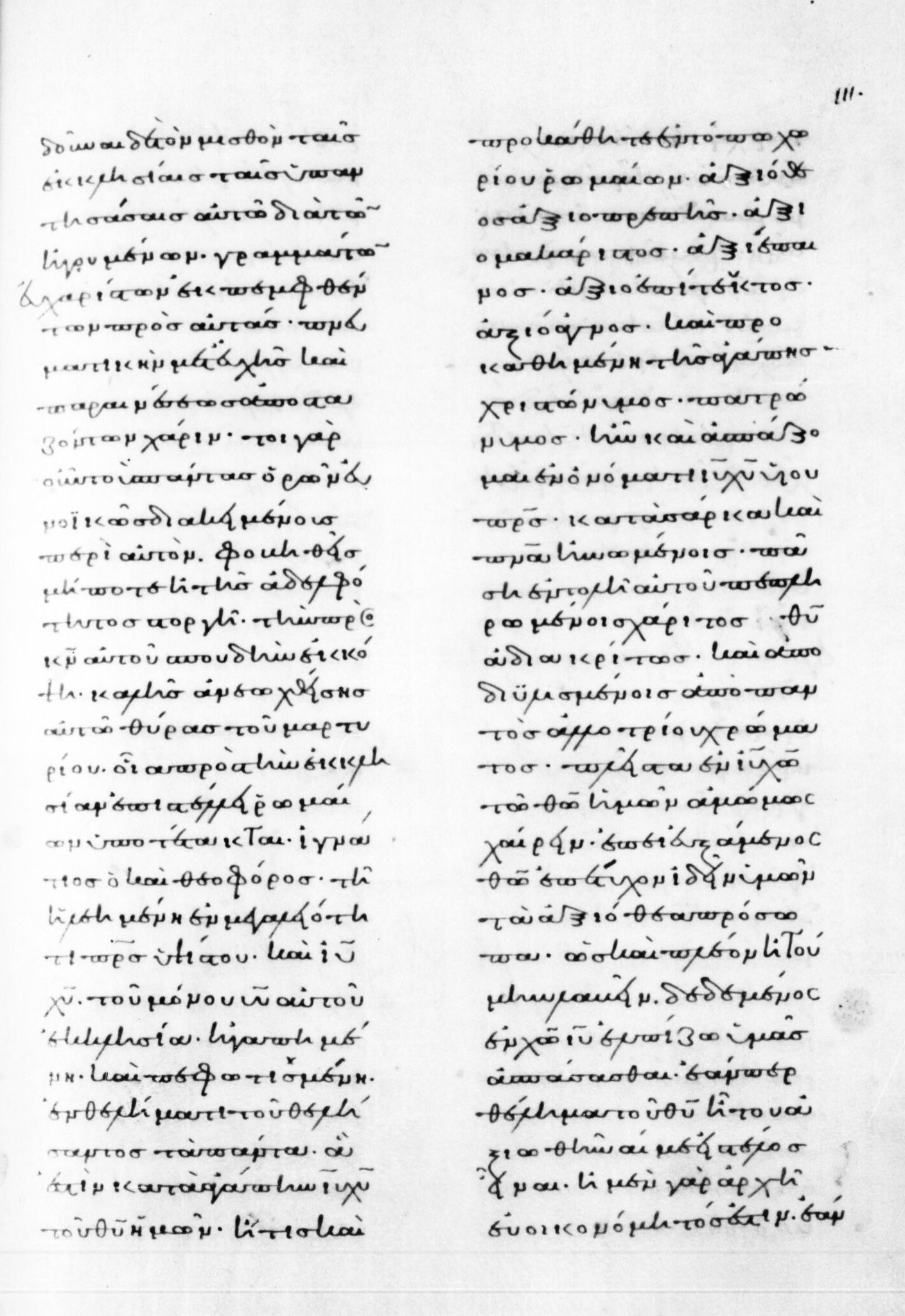
Checked on the images: Paris gr. 1451 fol. 111r: col. a: the Martyrdom's narrative, then the address Ἰγνάτιος ὁ καὶ Θεοφόρος ...; col. b opens ...προκάθηται ἐν τόπῳ χωρίου Ῥωμαίων, ἀξιόθεος (Rom. inscr.); col. b ends ἡ μὲν γὰρ ἀρχὴ εὐοικονόμητός ἐστιν (Rom. 1.2). The span of each page was found by reading its first and last words and locating them in the Greek. The Greek shown is Lake's edited text (1912), not a transcription of the page; the Paris manuscript gives the letter inside the Martyrdom of Ignatius and its wording differs from Lake's text in places.
Ἰγνατιος, ὁ καὶ Θεοφόρος, τῇ ἠλεημένῃ ἐν μεγαλειότητι πατρὸς ὑψίστου καὶ Ἰησοῦ Χριστοῦ τοῦ μόνου υἱοῦ αὐτοῦ ἐκκλησίᾳ ἠγαπημένῃ καὶ πεφωτισμένῃ ἐν θελήματι τοῦ θελήσαντος τὰ πάντα, ἃ ἔστιν, κατὰ ἀγάπην Ἰησοῦ Χριστοῦ, τοῦ θεοῦ ἡμῶν, ἥτις καὶ προκάθηται ἐν τόπῳ χωρίου Ῥωμαίων, ἀξιόθεος, ἀξιοπρεπής, ἀξιομακάριστος, ἀξιέπαινος, ἀξιεπίτευκτος, ἀξίαγνος καὶ προκαθημένη τῆς ἀγάπης, χριστώνυμος, πατρώνυμος, ἣν καὶ ἀσπάζομαι ἐν ὀνόματι Ἰησοῦ Χριστοῦ, υἱοῦ πατρός· κατὰ σάρκα καὶ πνεῦμα ἡνωμένοις πάσῃ ἐντολῇ αὐτοῦ, πεπληρωμένοις χάριτος θεοῦ ἀδιακρίτως καὶ ἀποδιυλισμένοις ἀπὸ παντὸς ἀλλοτρίου χρώματος πλεῖστα ἐν Ἰησοῦ Χριστῷ, τῷ θεῷ ἡμῶν, ἀμώμως χαίρειν.
Ignatius, who is also Theophorus, unto her that hath found mercy in the bountifulness of the Father Most High and of Jesus Christ His only Son; to the church that is beloved and enlightened through the will of Him who willed all things that are, by faith and love towards Jesus Christ our God; even unto her that hath the presidency in the country of the region of the Romans, being worthy of God, worthy of honour, worthy of felicitation, worthy of praise, worthy of success, worthy in purity, and having the presidency of love, walking in the law of Christ and bearing the Father's name; which church also I salute in the name of Jesus Christ the Son of the Father; unto them that in flesh and spirit are united unto His every commandment, being filled with the grace of God without wavering, and filtered clear from every foreign stain; abundant greeting in Jesus Christ our God in blamelessness.
Where on the image
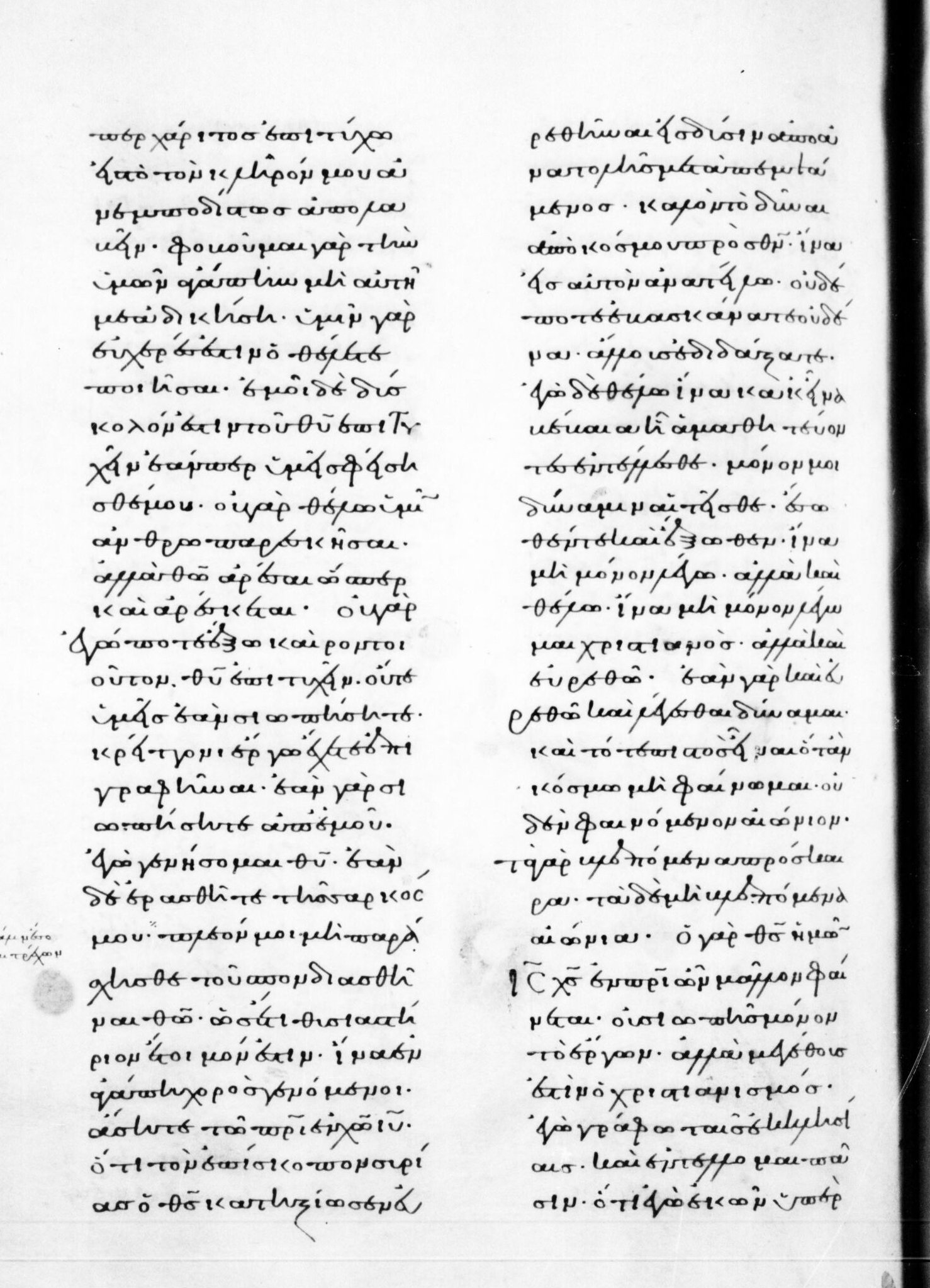
Checked on the images: Paris gr. 1451 fol. 111r: col. a: the Martyrdom's narrative, then the address Ἰγνάτιος ὁ καὶ Θεοφόρος ...; col. b opens ...προκάθηται ἐν τόπῳ χωρίου Ῥωμαίων, ἀξιόθεος (Rom. inscr.); col. b ends ἡ μὲν γὰρ ἀρχὴ εὐοικονόμητός ἐστιν (Rom. 1.2); Paris gr. 1451 fol. 111v: col. a opens ... χάριτος ... τὸν κλῆρόν μου (Rom. 1.2); col. b ends καὶ ἐντέλλομαι πᾶσιν ὅτι ἐγὼ ἑκὼν ὑπὲρ (Rom. 4.1). The span of each page was found by reading its first and last words and locating them in the Greek. The Greek shown is Lake's edited text (1912), not a transcription of the page; the Paris manuscript gives the letter inside the Martyrdom of Ignatius and its wording differs from Lake's text in places.
1Ἐπεὶ εὐξάμενος θεῷ ἐπέτυχον ἰδεῖν ὑμῶν τὰ ἀξιόθεα πρόσωπα, ὡς καὶ πλέον ᾐτούμην λαβεῖν· δεδεμένος γὰρ ἐν Χριστῷ Ἰησοῦ ἐλπίζω ὑμᾶς ἀσπάσασθαι, ἐάνπερ θέλημα ᾖ τοῦ ἀξιωθῆναί με εἰς τέλος εἶναι. 2ἡ μὲν γὰρ ἀρχὴ εὐοικονόμητός ἐστιν, ἐάνπερ χάριτος ἐπιτύχω εἰς τὸ τὸν κλῆρόν μου ἀνεμποδίστως ἀπολαβεῖν. φοβοῦμαι γὰρ τὴν ὑμῶν ἀγάπην, μὴ αὐτή με ἀδικήσῃ. ὑμῖν γὰρ εὐχερές ἐστιν, ὃ θέλετε, ποιῆσαι· ἐμοὶ δὲ δύσκολόν ἐστιν τοῦ θεοῦ ἐπιτυχεῖν, ἐάνπερ ὑμεῖς μὴ φείσησθέ μου.
1Forasmuch as in answer to my prayer to God it hath been granted me to see your godly countenances, so that I have obtained even more than I asked; for wearing bonds in Christ Jesus I hope to salute you, if it be the Divine will that I should be counted worthy to reach unto the end; 2for the beginning verily is well ordered, if so be I shall attain unto the goal, that I may receive mine inheritance without hinderance. For I dread your very love, lest it do me an injury; for it is easy for you to do what ye will, but for me it is difficult to attain unto God, unless ye shall spare me.
Where on the image
Checked on the images: Paris gr. 1451 fol. 111v: col. a opens ... χάριτος ... τὸν κλῆρόν μου (Rom. 1.2); col. b ends καὶ ἐντέλλομαι πᾶσιν ὅτι ἐγὼ ἑκὼν ὑπὲρ (Rom. 4.1). The span of each page was found by reading its first and last words and locating them in the Greek. The Greek shown is Lake's edited text (1912), not a transcription of the page; the Paris manuscript gives the letter inside the Martyrdom of Ignatius and its wording differs from Lake's text in places.
1Οὐ γὰρ θέλω ὑμᾶς ἀνθρωπαρεσκῆσαι, ἀλλὰ θεῷ ἀρέσαι, ὥσπερ καὶ ἀρέσκετε. οὔτε γὰρ ἐγώ ποτε ἕξω καιρὸν τοιοῦτον θεοῦ ἐπιτυχεῖν, οὔτε ὑμεῖς, ἐὰν σιωπήσητε, κρείττονι ἔργῳ ἔχετε ἐπιγραφῆναι. ἐὰν γὰρ σιωπήσητε ἀπ’ ἐμοῦ, ἐγὼ λόγος θεοῦ· ἐὰν δὲ ἐρασθῆτε τῆς σαρκός μου. πάλιν ἔσομαι φωνή. 2πλέον μοι μὴ παράσχησθε τοῦ σπονδισθῆναι θεῷ, ὡς ἔτι θυσιαστήριον ἕτοιμόν ἐστιν, ἵνα ἐν ἀγάπῃ χορὸς γενόμενοι ᾅσητε τῷ πατρὶ ἐν Χριστῷ Ἰησοῦ, ὅτι τὸν ἐπίσκοπον Συρίας ὁ θεὸς κατηξίωσεν εὑρεθῆναι εἰς δύσιν ἀπὸ ἀνατολῆς μεταπεμψάμενος. καλὸν τὸ δῦναι ἀπὸ κόσμου πρὸς θεόν, ἵνα εἰς αὐτὸν ἀνατείλω.
1For I would not have you to be men-pleasers but to please God, as indeed ye do please Him. For neither shall I myself ever find an opportunity such as this to attain unto God, nor can ye, if ye be silent, win the credit of any nobler work. For, if ye be silent and leave me alone, I am a word of God; but if ye desire my flesh, then shall I be again a mere cry. 2[Nay] grant me nothing more than that I be poured out a libation to God, while there is still an altar ready; that forming yourselves into a chorus in love ye may sing to the Father in Jesus Christ, for that God hath vouchsafed that the bishop from Syria should be found in the West, having summoned him from the East. It is good to set from the world unto God, that I may rise unto Him.
Where on the image
Checked on the images: Paris gr. 1451 fol. 111v: col. a opens ... χάριτος ... τὸν κλῆρόν μου (Rom. 1.2); col. b ends καὶ ἐντέλλομαι πᾶσιν ὅτι ἐγὼ ἑκὼν ὑπὲρ (Rom. 4.1). The span of each page was found by reading its first and last words and locating them in the Greek. The Greek shown is Lake's edited text (1912), not a transcription of the page; the Paris manuscript gives the letter inside the Martyrdom of Ignatius and its wording differs from Lake's text in places.
1Οὐδέποτε ἐβασκάνατε οὐδενί, ἄλλους ἐδιδάξατε. ἐγὼ δὲ θέλω, ἵνα κἀκεῖνα βέβαια ᾖ ἃ μαθητεύοντες ἐντέλλεσθε. 2μόνον μοι δύναμιν αἰτεῖσθε ἔσωθέν τε καὶ ἔξωθεν, ἵνα μὴ μόνον λέγω ἀλλὰ καὶ θέλω, ἵνα μὴ μόνον λέγωμαι Χριστιανὸς ἀλλὰ καὶ εὑρεθῶ. ἐὰν γὰρ εὑρεθῶ, καὶ λέγεσθαι δύναμαι, καὶ τότε πιστὸς εἶναι, ὅταν κόσμῳ μὴ φαίνωμαι. 3οὐδὲν φαινόμενον καλόν· ὁ γὰρ θεὸς ἡμῶν Ἰησοῦς Χριστὸς ἐν πατρὶ ὢν μᾶλλον φαίνεται. οὐ πεισμονῆς τὸ ἔργον, ἀλλὰ μεγέθους ἐστὶν ὁ Χριστιανισμός, ὅταν μισῆται ὑπὸ κόσμου.
1Ye never grudged any one; ye were the instructors of others. And my desire is that those lessons shall hold good which as teachers ye enjoin. 2Only pray that I may have power within and without, so that I may not only say it but also desire it; that I may not only be called a Christian, but also be found one. For if I shall be found so, then can I also be called one, and be faithful then, when I am no more visible to the world. 3Nothing visible is good. For our God Jesus Christ, being in the Father, is the more plainly visible. The Work is not of persuasiveness, but Christianity is a thing of might, whensoever it is hated by the world.
Where on the image
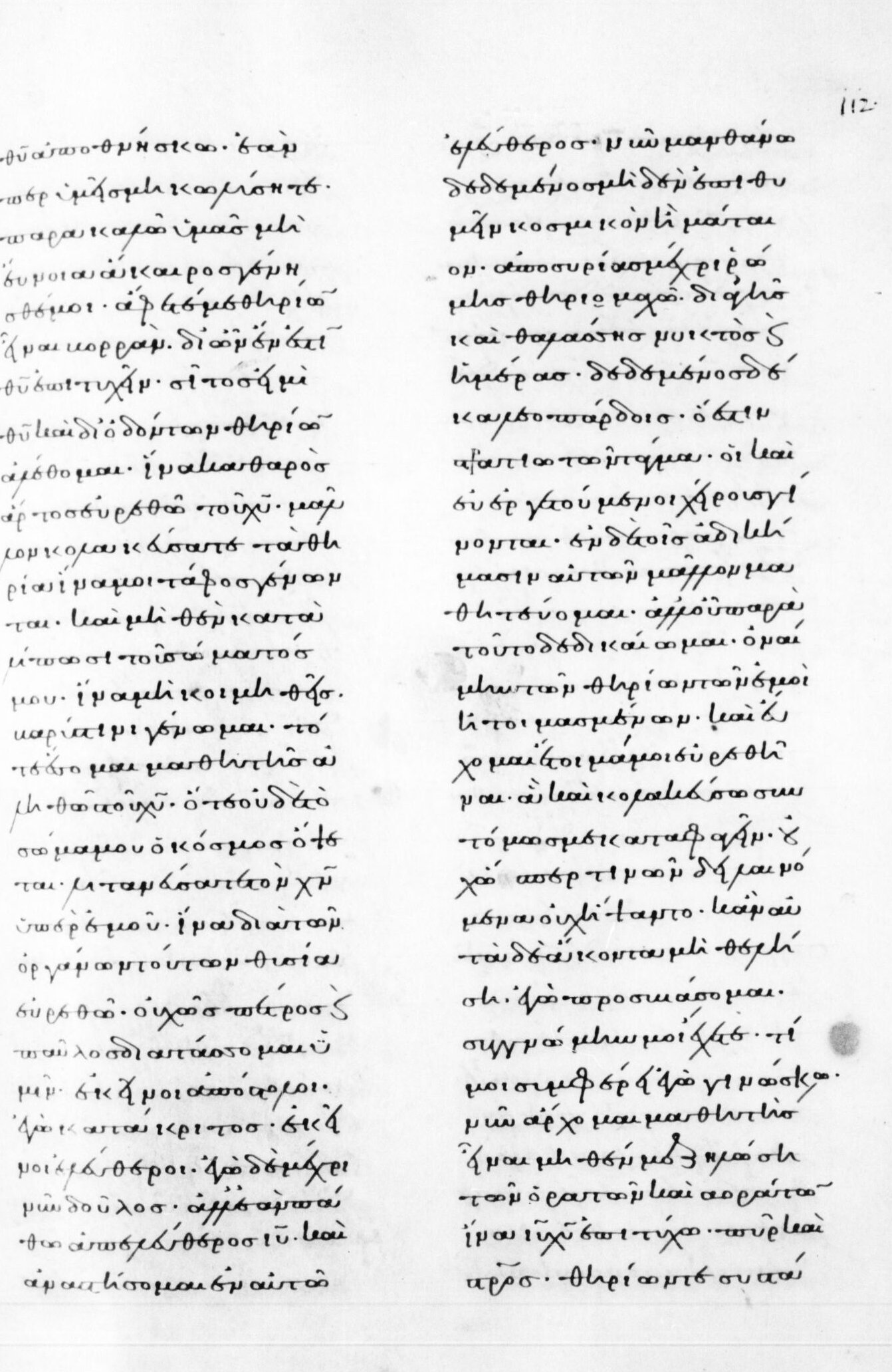
Checked on the images: Paris gr. 1451 fol. 111v: col. a opens ... χάριτος ... τὸν κλῆρόν μου (Rom. 1.2); col. b ends καὶ ἐντέλλομαι πᾶσιν ὅτι ἐγὼ ἑκὼν ὑπὲρ (Rom. 4.1); Paris gr. 1451 fol. 112r: col. a opens [ἀπο]θνήσκω, ἐὰν ὑμεῖς μὴ κωλύσητε (Rom. 4.1); col. b ends πῦρ καὶ σταυρὸς θηρίων τε συστάσεις (Rom. 5.3). The span of each page was found by reading its first and last words and locating them in the Greek. The Greek shown is Lake's edited text (1912), not a transcription of the page; the Paris manuscript gives the letter inside the Martyrdom of Ignatius and its wording differs from Lake's text in places.
1Ἐγὼ γράφω πάσαις ταῖς ἐκκλησίαις, καὶ ἐντέλλομαι πᾶσιν, ὅτι ἐγὼ ἑκὼν ὑπὲρ θεοῦ ἀποθνήσκω, ἐάνπερ ὑμεῖς μὴ κωλύσητε. παρακαλῶ ὑμᾶς, μὴ εὔνοια ἄκαιρος γένησθέ μοι. ἄφετέ με θηρίων εἶναι βοράν, δι’ ὧν ἔνεστιν θεοῦ ἐπιτυχεῖν. σῖτός εἰμι θεοῦ καὶ δι’ ὀδόντων θηρίων ἀλήθομαι, ἵνα καθαρὸς ἄρτος εὑρεθῶ τοῦ Χριστοῦ. 2μᾶλλον κολακεύσατε τὰ θηρία, ἵνα μοι τάφος γένωνται καὶ μηθὲν καταλίπωσι τῶν τοῦ σώματός μου, ἵνα μὴ κοιμηθεὶς βαρύς τινι γένωμαι. τότε ἔσομαι μαθητὴς ἀληθῶς Ἰησοῦ Χριστοῦ, ὅτε οὐδὲ τὸ σῶμά μου ὁ κόσμος ὄψεται. λιτανεύσατε τὸν Χριστὸν ὑπὲρ ἐμοῦ, ἵνα διὰ τῶν ὀργάνων τούτων θυσία εὑρεθῶ. 3οὐχ ὡς Πέτρος καὶ Παῦλος διατάσσομαι ὑμῖν. ἐκεῖνοι ἀπόστολοι, ἐγὼ κατάκριτος· ἐκεῖνοι ἐλεύθεροι, ἐγὼ δὲ μέχρι νῦν δοῦλος. ἀλλ’ ἐὰν πάθω, ἀπελεύθερος γενήσομαι Ἰησοῦ Χριστοῦ καὶ ἀναστήσομαι ἐν αὐτῷ ἐλεύθερος. νῦν μανθάνω δεδεμένος μηδὲν ἐπιθυμεῖν.
1I write to all the churches, and I bid all men know, that of my own free will I die for God, unless ye should hinder me. I exhort you, be ye not an unseasonable kindness to me. Let me be given to the wild beasts, for through them I can attain unto God. I am God's wheat, and I am ground by the teeth of wild beasts that I may be found pure bread [of Christ]. 2Rather entice the wild beasts, that they may become my sepulchre and may leave no part of my body behind, so that I may not, when I am fallen asleep, be burdensome to any one. Then shall I be truly a disciple of Jesus Christ, when the world shall not so much as see my body. Supplicate the Lord for me, that through these instruments I may be found a sacrifice to God. 3I do not enjoin you, as Peter and Paul did. They were Apostles, I am a convict; they were free, but I am a slave to this very hour. Yet if I shall suffer, then am I a freed-man of Jesus Christ, and I shall rise free in Him. Now I am learning in my bonds to put away every desire.
Where on the image
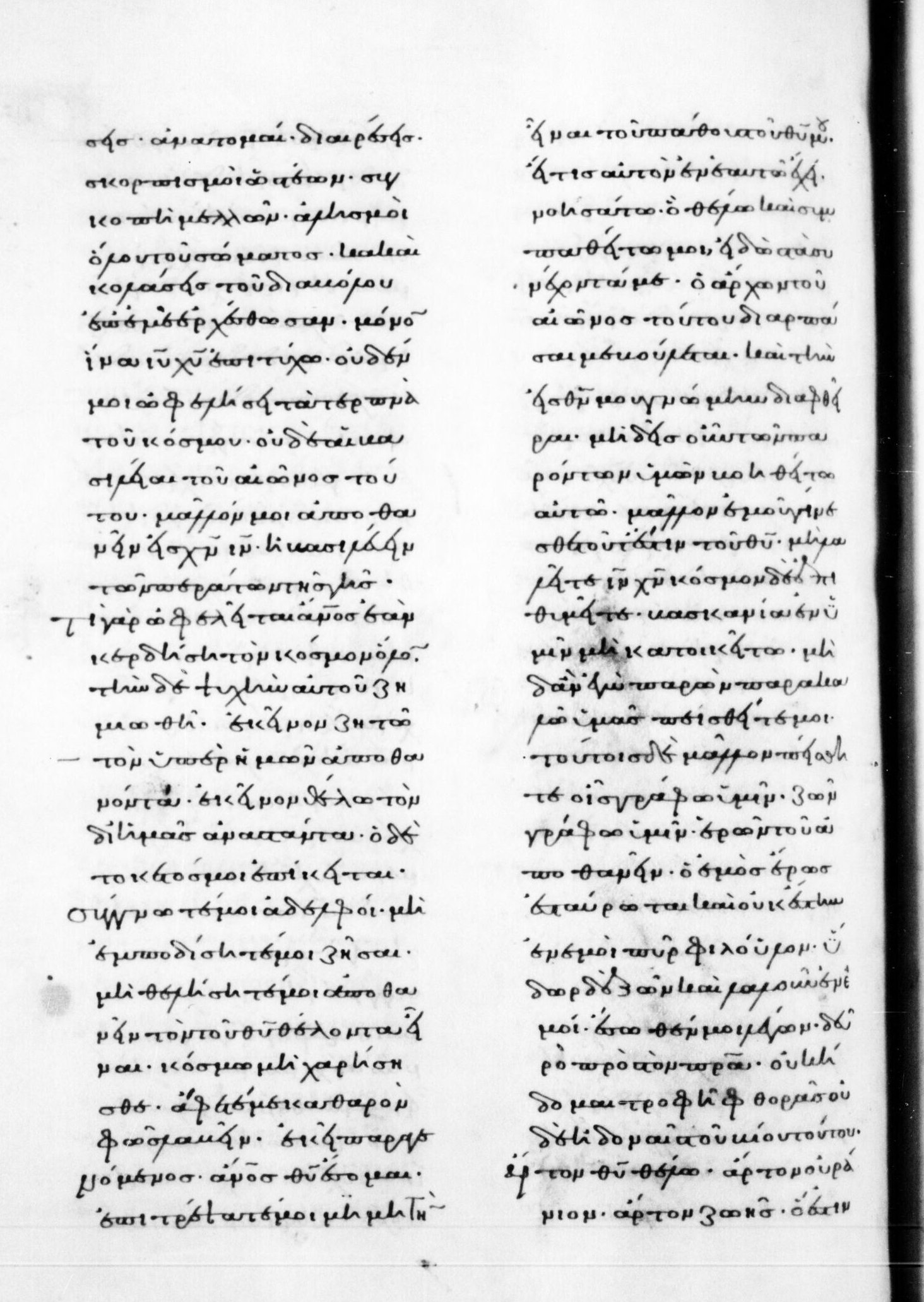
Checked on the images: Paris gr. 1451 fol. 112r: col. a opens [ἀπο]θνήσκω, ἐὰν ὑμεῖς μὴ κωλύσητε (Rom. 4.1); col. b ends πῦρ καὶ σταυρὸς θηρίων τε συστάσεις (Rom. 5.3); Paris gr. 1451 fol. 112v: col. a opens ... ἀνατομαί, διαιρέσεις, σκορπισμοὶ ὀστέων (Rom. 5.3); col. b ends ἄρτον θεοῦ θέλω, ἄρτον οὐράνιον, ἄρτον ζωῆς (Rom. 7.3). The span of each page was found by reading its first and last words and locating them in the Greek. The Greek shown is Lake's edited text (1912), not a transcription of the page; the Paris manuscript gives the letter inside the Martyrdom of Ignatius and its wording differs from Lake's text in places.
1Ἀπὸ Συρίας μέχρι Ῥώμης θηριομαχῶ, διὰ γῆς καὶ θαλάσσης, νυκτὸς καὶ ἡμέρας, δεδεμένος δέκα λεοπάρδοις, ὅ ἐστιν στρατιωτικὸν τάγμα· οἳ καὶ εὐεργετούμενοι χείρους γίνονται. ἐν δὲ τοῖς ἀδικήμασιν αὐτῶν μᾶλλον μαθητεύομαι, ἀλλ’ οὐ παρὰ τοῦτο δεδικαίωμαι. 2ὀναίμην τῶν θηρίων τῶν ἐμοὶ ἡτοιμασμένων καὶ εὔχομαι σύντομά μοι εὑρεθῆναι· ἃ καὶ κολακεύσω, συντόμως με καταφαγεῖν, οὐχ ὥσπερ τινῶν δειλαινόμενα οὐχ ἥψαντο. κἂν αὐτὰ δὲ ἄκοντα μὴ θελήσῃ, ἐγὼ προσβιάσομαι. 3συγγνώμην μοι ἔχετε· τί μοι συμφέρει, ἐγὼ γινώσκω, νῦν ἄρχομαι μαθητὴς εἶναι. μηθέν με ζηλώσαι τῶν ὁρατῶν καὶ ἀοράτων, ἵνα Ἰησοῦ Χριστοῦ ἐπιτύχω. πῦρ καὶ σταυρὸς θηρίων τε συστάσεις, ἀνατομαί, διαιρέσεις, σκορπισμοὶ ὀστέων, συγκοπὴ μελῶν, ἀλεσμοὶ ὅλου τοῦ σώματος, κακαὶ κολάσεις τοῦ διαβόλου ἐπ’ ἐμὲ ἐρχέσθωσαν, μόνον ἵνα Ἰησοῦ Χριστοῦ ἐπιτύχω.
1From Syria even unto Rome I fight with wild beasts, by land and sea, by night and by day, being bound amidst ten leopards, even a company of soldiers, who only wax worse when they are kindly treated. Howbeit through their wrong doings I become more completely a disciple; yet am I not hereby justified. 2May I have joy of the beasts that have been prepared for me; and I pray that I may find them prompt; nay I will entice them that they may devour me promptly, not as they have done to some, refusing to touch them through fear. Yea though of themselves they should not be willing while I am ready, I myself will force them to it. 3Bear with me. I know what is expedient for me. Now am I beginning to be a disciple. May nought of things visible and things invisible envy me; that I may attain unto Jesus Christ. Come fire and cross and grapplings with wild beasts, [cuttings and manglings,] wrenching of bones, hacking of limbs, crushings of my whole body, come cruel tortures of the devil to assail me. Only be it mine to attain unto Jesus Christ.
Where on the image
Checked on the images: Paris gr. 1451 fol. 112v: col. a opens ... ἀνατομαί, διαιρέσεις, σκορπισμοὶ ὀστέων (Rom. 5.3); col. b ends ἄρτον θεοῦ θέλω, ἄρτον οὐράνιον, ἄρτον ζωῆς (Rom. 7.3). The span of each page was found by reading its first and last words and locating them in the Greek. The Greek shown is Lake's edited text (1912), not a transcription of the page; the Paris manuscript gives the letter inside the Martyrdom of Ignatius and its wording differs from Lake's text in places.
1Οὐδέν μοι ὠφελήσει τὰ πέρατα τοῦ κόσμου οὐδὲ αἱ βασιλεῖαι τοῦ αἰῶνος τούτου. καλόν μοι ἀποθανεῖν εἰς Χριστὸν Ἰησοῦν, ἢ βασιλεύειν τῶν περάτων τῆς γῆς. ἐκεῖνον ζητῶ, τὸν ὑπὲρ ἡμῶν ἀποθανόντα· ἐκεῖνον θέλω, τὸν δι’ ἡμᾶς ἀναστάντα. ὁ δὲ τοκετός μοι ἐπίκειται. 2σύγγνωτέ μοι, ἀδελφοί· μὴ ἐμποδίσητέ μοι ζῆσαι, μὴ θελήσητε με ἀποθανεῖν· τὸν τοῦ θεοῦ θέλοντα εἶναι κόσμῳ μὴ χαρίσησθε, μηδὲ ὕλῃ ἐξαπατήσητε· ἄφετέ με καθαρὸν φῶς λαβεῖν· ἐκεῖ παραγενόμενος ἄνθρωπος ἔσομαι. 3ἐπιτρέψατέ μοι μιμητὴν εἶναι τοῦ πάθους τοῦ θεοῦ μου. εἴ τις αὐτὸν ἐν ἑαυτῷ ἔχει, νοησάτω ὃ θέλω, καὶ συμπαθείτω μοι εἰδὼς τὰ συνέχοντά με.
1The farthest bounds of the universe shall profit me nothing, neither the kingdoms of this world. It is good for me to die for Jesus Christ rather than to reign over the farthest bounds of the earth. Him I seek, who died on our behalf; Him I desire, who rose again [for our sake]. The pangs of a new birth are upon me. 2Bear with me, brethren. Do not hinder me from living; do not desire my death. Bestow not on the world one who desireth to be God's, neither allure him with material things. Suffer me to receive the pure light. When I am come thither, then shall I be a man. 3Permit me to be an imitator of the passion of my God. If any man hath Him within himself, let him understand what I desire, and let him have fellow- feeling with me, for he knoweth the things which straiten me.
Where on the image
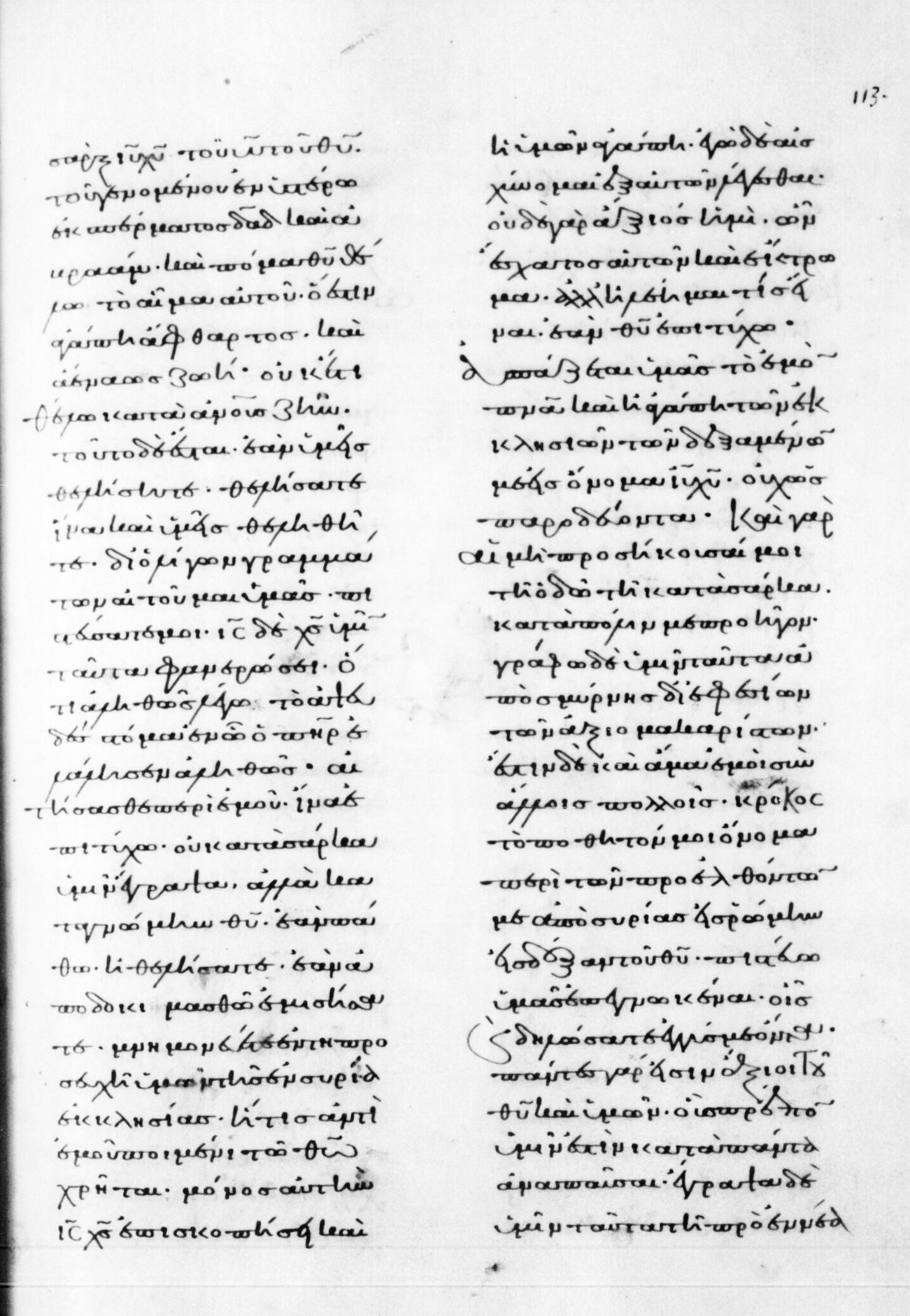
Checked on the images: Paris gr. 1451 fol. 112v: col. a opens ... ἀνατομαί, διαιρέσεις, σκορπισμοὶ ὀστέων (Rom. 5.3); col. b ends ἄρτον θεοῦ θέλω, ἄρτον οὐράνιον, ἄρτον ζωῆς (Rom. 7.3); Paris gr. 1451 fol. 113r: col. a opens Ἰησοῦ Χριστοῦ τοῦ υἱοῦ τοῦ θεοῦ (Rom. 7.3); col. b ends γράφω δὲ ὑμῖν ταῦτα πρὸ ἐννέα (Rom. 10.3). The span of each page was found by reading its first and last words and locating them in the Greek. The Greek shown is Lake's edited text (1912), not a transcription of the page; the Paris manuscript gives the letter inside the Martyrdom of Ignatius and its wording differs from Lake's text in places.
1Ὁ ἄρχων τοῦ αἰῶνος τούτου διαρπάσαι με βούλεται καὶ τὴν εἰς θεόν μου γνώμην διαφθεῖραι. μηδεὶς οὖν τῶν παρόντων ὑμῶν βοηθείτω αὐτῷ· μᾶλλον ἐμοῦ γίνεσθε, τουτέστιν τοῦ θεοῦ. μὴ λαλεῖτε Ἰησοῦν Χριστόν, κόσμον δὲ ἐπιθυμεῖτε. 2βασκανία ἐν ὑμῖν μὴ κατοικείτω. μηδ’ ἂν ἐγὼ παρὼν παρακαλῶ ὑμᾶς, πείσθητέ μοι· τούτοις δὲ μᾶλλον πείσθητε, οἷς γράφω ὑμῖν. ζῶν γὰρ γράφω ὑμῖν, ἐρῶν τοῦ ἀποθανεῖν. ὁ ἐμὸς ἔρως ἐσταύρωται, καὶ οὐκ ἔστιν ἐν ἐμοὶ πῦρ φιλόυλον· ὕδωρ δὲ ζῶν καὶ λαλοῦν ἐν ἐμοί, ἔσωθέν μοι λέγον· Δεῦρο πρὸς τὸν πατέρα. 3οὐχ ἥδομαι τροφῇ φθορᾶς οὐδὲ ἡδοναῖς τοῦ βίου τούτου. ἄρτον θεοῦ θέλω, ὅ ἐστιν σὰρξ Ἰησοῦ Χριστοῦ, τοῦ ἐκ σπέρματος Δαυείδ, καὶ πόμα θέλω τὸ αἷμα αὐτοῦ, ὅ ἐστιν ἀγάπη ἄφθαρτος.
1The prince of this world would fain tear me in pieces and corrupt my mind to Godward. Let not any of you therefore who are near abet him. Rather stand ye on my side, that is on God's side. Speak not of Jesus Christ and withal desire the world. 2Let not envy have a home in you. Even though I myself, when I am with you, should beseech you, obey me not; but rather give credence to these things which I write to you. [For] I write to you in the midst of life, yet lusting after death. My lust hath been crucified, and there is no fire of material longing in me, but only water living +and speaking+ in me, saying within me, Come to the Father. 3I have no delight in the food of corruption or in the delights of this life. I desire the bread of God, which is the flesh of Christ who was of the seed of David; and for a draught I desire His blood, which is love incorruptible.
Where on the image
Checked on the images: Paris gr. 1451 fol. 113r: col. a opens Ἰησοῦ Χριστοῦ τοῦ υἱοῦ τοῦ θεοῦ (Rom. 7.3); col. b ends γράφω δὲ ὑμῖν ταῦτα πρὸ ἐννέα (Rom. 10.3). The span of each page was found by reading its first and last words and locating them in the Greek. The Greek shown is Lake's edited text (1912), not a transcription of the page; the Paris manuscript gives the letter inside the Martyrdom of Ignatius and its wording differs from Lake's text in places.
1Οὐκέτι θέλω κατὰ ἀνθρώπους ζῆν. τοῦτο δὲ ἔσται, ἐὰν ὑμεῖς θελήσητε. θελήσατε, ἵνα καὶ ὑμεῖς θεληθῆτε. 2δι’ ὀλίγων γραμμάτων αἰτοῦμαι ὑμᾶς· πιστεύσατέ μοι. Ἰησοῦς δὲ Χριστὸς ὑμῖν ταῦτα φανερώσει, ὅτι ἀληθῶς λέγω· τὸ ἀψευδὲς στόμα, ἐν ᾧ ὁ πατὴρ ἐλάλησεν ἀληθῶς. 3αἰτήσασθε περὶ ἐμοῦ, ἵνα ἐπιτύχω. οὐ κατὰ σάρκα ὑμῖν ἔγραψα, ἀλλὰ κατὰ γνώμην θεοῦ. ἐὰν πάθω, ἠθελήσατε· ἐὰν ἀποδοκιμασθῶ, ἐμισήσατε.
1I desire no longer to live after the manner of men; and this shall be, if ye desire it. Desire ye, that ye yourselves also may be desired. 2In a brief letter I beseech you; believe me. And Jesus Christ shall make manifest unto you these things, that I speak the truth -- Jesus Christ, the unerring mouth in whom the Father hath spoken [truly]. 3Entreat ye for me, that I may attain [through the Holy Spirit]. I write not unto you after the flesh, but after the mind of God. If I shall suffer, it was your desire; if I shall be rejected, it was your hatred.
Where on the image
Checked on the images: Paris gr. 1451 fol. 113r: col. a opens Ἰησοῦ Χριστοῦ τοῦ υἱοῦ τοῦ θεοῦ (Rom. 7.3); col. b ends γράφω δὲ ὑμῖν ταῦτα πρὸ ἐννέα (Rom. 10.3). The span of each page was found by reading its first and last words and locating them in the Greek. The Greek shown is Lake's edited text (1912), not a transcription of the page; the Paris manuscript gives the letter inside the Martyrdom of Ignatius and its wording differs from Lake's text in places.
1Μνημονεύετε ἐν τῇ προσευχῇ ὑμῶν τῆς ἐν Συρίᾳ ἐκκλησίας, ἥτις ἀντὶ ἐμοῦ ποιμένι τῷ θεῷ χρῆται. μόνος αὐτὴν Ἰησοῦς Χριστὸς ἐπισκοπήσει καὶ ἡ ὑμῶν ἀγάπη. 2ἐγὼ δὲ αἰσχύνομαι ἐξ αὐτῶν λέγεσθαι· οὐδὲ γὰρ ἄξιός εἰμι, ὢν ἔσχατος αὐτῶν καὶ ἔκτρωμα· ἀλλ’ ἠλέημαί τις εἶναι, ἐὰν θεοῦ ἐπιτύχω. 3ἀσπάζεται ὑμᾶς τὸ ἐμὸν πνεῦμα καὶ ἡ ἀγάπη τῶν ἐκκλησιῶν τῶν δεξαμένων με εἰς ὄνομα Ἰησοῦ Χριστοῦ, οὐχ ὡς παροδεύοντα. καὶ γὰρ αἱ μὴ προσήκουσαί μοι τῇ ὁδῷ τῇ κατὰ σάρκα, κατὰ πόλιν με προῆγον.
1Remember in your prayers the church which is in Syria, which hath God for its shepherd in my stead. Jesus Christ alone shall be its bishop -- He and your love. 2But for myself I am ashamed to be called one of them; for neither am I worthy, being the very last of them and an untimely birth: but I have found mercy that I should be some one, if so be I shall attain unto God. 3My spirit saluteth you, and the love of the churches which received me in the name of Jesus Christ, not as a mere wayfarer: for even those churches which did not lie on my route after the flesh went before me from city to city.
Where on the image
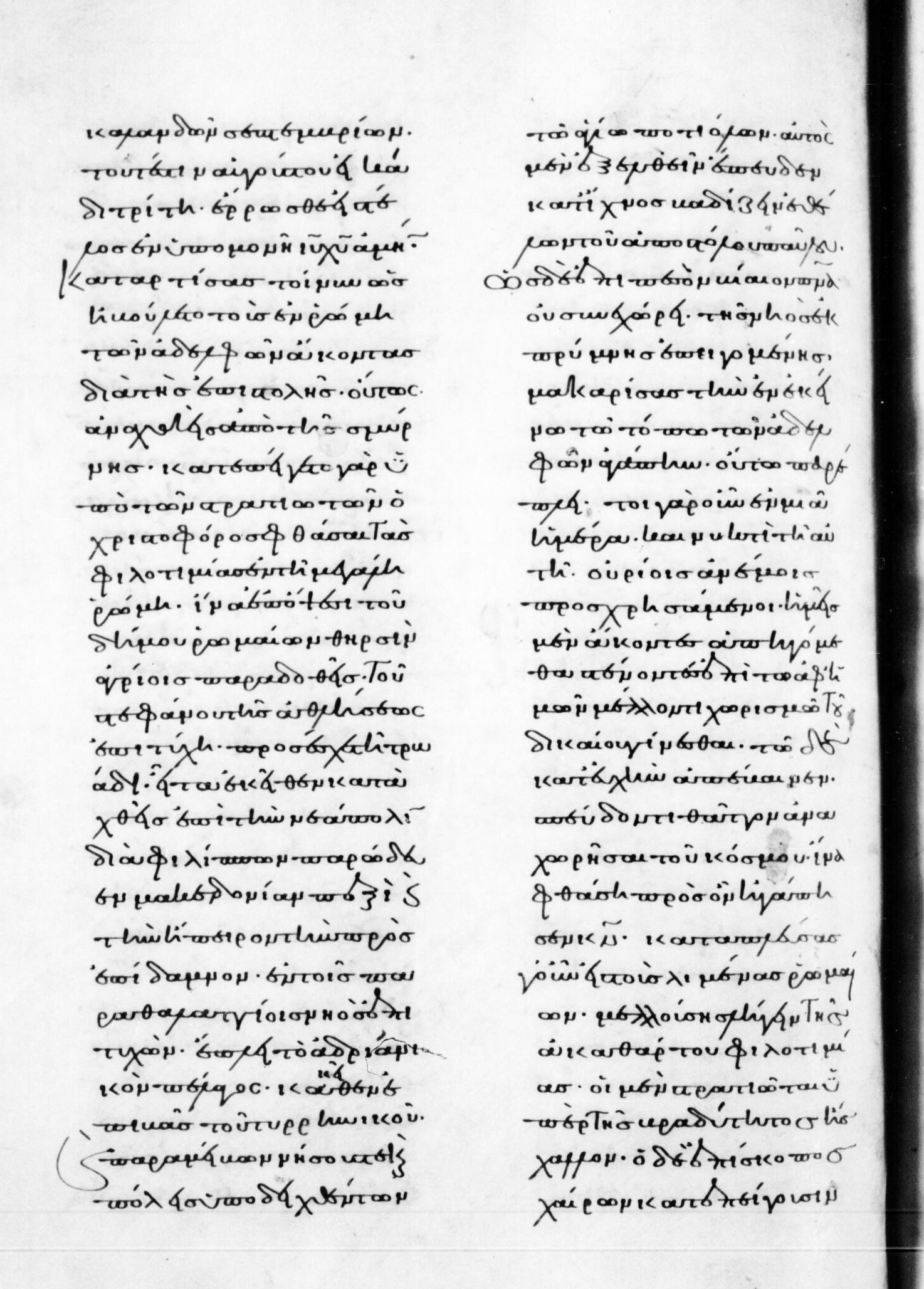
Checked on the images: Paris gr. 1451 fol. 113r: col. a opens Ἰησοῦ Χριστοῦ τοῦ υἱοῦ τοῦ θεοῦ (Rom. 7.3); col. b ends γράφω δὲ ὑμῖν ταῦτα πρὸ ἐννέα (Rom. 10.3); Paris gr. 1451 fol. 113v: col. a opens καλανδῶν Σεπτεμβρίων (Rom. 10.3); the Martyrdom then continues; (rest of the page: the Martyrdom). The span of each page was found by reading its first and last words and locating them in the Greek. The Greek shown is Lake's edited text (1912), not a transcription of the page; the Paris manuscript gives the letter inside the Martyrdom of Ignatius and its wording differs from Lake's text in places.
1Γράφω δὲ ὑμῖν ταῦτα ἀπὸ Σμύρνης δι’ Ἐφεσίων τῶν ἀξιομακαρίστων. ἔστιν δὲ καὶ ἅμα ἐμοὶ σὺν ἄλλοις πολλοῖς καὶ Κρόκος, τὸ ποθητόν μοι ὄνομα. 2περὶ τῶν προελθόντων με ἀπὸ Συρίας εἰς Ῥώμην εἰς δόξαν τοῦ θεοῦ πιστεύω ὑμᾶς ἐπεγνωκέναι, οἷς καὶ δηλώσατε ἐγγύς με ὄντα. πάντες γάρ εἰσιν ἄξιοι τοῦ θεοῦ καὶ ὑμῶν· οὓς πρέπον ὑμῖν ἐστὶν κατὰ πάντα ἀναπαῦσαι. 3ἔγραψα δὲ ὑμῖν ταῦτα τῇ πρὸ ἐννέα καλανδῶν Σεπτεμβρίων. ἔρρωσθε εἰς τέλος ἐν ὑπομονῇ Ἰησοῦ Χριστοῦ.
1Now I write these things to you from Smyrna by the hand of the Ephesians who are worthy of all felicitation. And Crocus also, a name very dear to me, is with me, with many others besides. 2As touching those who went before me from Syria to Rome unto the glory of God, I believe that ye have received instructions; whom also apprise that I am near; for they all are worthy of God and of you, and it becometh you to refresh them in all things. 3These things I write to you on the 9th before the Kalends of September. Fare ye well unto the end in the patient waiting for Jesus Christ.
Notes
- Greek: Kirsopp Lake, The Apostolic Fathers I (Loeb Classical Library, 1912), digital text of the First1KGreek project (tlg1443.tlg001, CC BY-SA 4.0); Lake's footnotes are not shown. Elided words are written with an apostrophe and the digital text's colon is shown as the raised dot.
- Proofreading: the Greek pages of Lake (archive.org theapostolicfath00unknuoft, leaves 184-288) were read by OCR twice and aligned with the digital text; every word on which both OCR readings agreed against the digital text, and every form that cannot be right, was looked up on the page image. Corrections in this letter: 2.1 'ἕσομαι' to 'ἔσομαι'; 4.1 'ὦν' to 'ὧν'; 5.1 'ἧμερας,' to 'ἡμέρας,'; 5.1 'οἲ' to 'οἳ'; 9.2 'ὣν' to 'ὢν'; 10.2 'οὕς πρέπον' to 'οὓς πρέπον'. Kept as Lake prints them (worn or missing accents): Eph. 8.2 οὐδε, Phld. 5.2 ἀξιαγαπητοι, Smyrn. 2.1 το; Lake's quotation marks in Pol. 8.1 are shown as ‘ ’.
- English: J. B. Lightfoot, The Apostolic Fathers (1891, Lightfoot and Harmer), as transcribed at earlychristianwritings.com; Lightfoot's italics are kept.
Cite
Sources
- Source: Paris, BnF, grec 1451 (BnF IIIF) + Lake 1912 Greek (First1KGreek, CC BY-SA 4.0) + Lightfoot 1891 English (public domain) (holding institution)
- Critical edition: Kirsopp Lake, The Apostolic Fathers I (1912), via First1KGreek
← previous · → next · v cycle view · l back to library