Ignatius of Antioch, To the Smyrnaeans (Laur. Plut. 57.7)
Introduction
Ignatius, bishop of Antioch, wrote seven letters while he was being taken under guard to Rome to be put to death, probably in the reign of Trajan (about 110 AD). This is his letter to the Smyrnaeans. Together the letters are among the earliest witnesses to the Christian bishop, presbyters and deacons, to the eucharist as the flesh of Christ, and to faith in Christ as God and man, written against teachers who said that Christ only seemed to suffer.
The manuscript. The letter is shown on Florence, Biblioteca Medicea Laurenziana, Plut. 57.7 (11th century), the only Greek manuscript of the six other letters in this form. Laur. Plut. 57.7 carries the letters on fol. 242r-252v in the order Smyrnaeans, Polycarp, Ephesians, Magnesians, Philadelphians, Trallians, followed by spurious letters; the scribe numbers them in the margin. The Letter to the Romans is not in it, and is shown from the Paris manuscript. Each section is one chapter, linked to the page or pages that carry it; the first and last words of every page were read on the images.
Texts. The Greek is Kirsopp Lake's edition (1912), proofread here against his printed pages; the English is J. B. Lightfoot's translation (1891). Both follow the middle (seven-letter) recension. They are edited texts, so the wording on the page differs from them in places.
How was this verified? (Provenance)
Where on the image
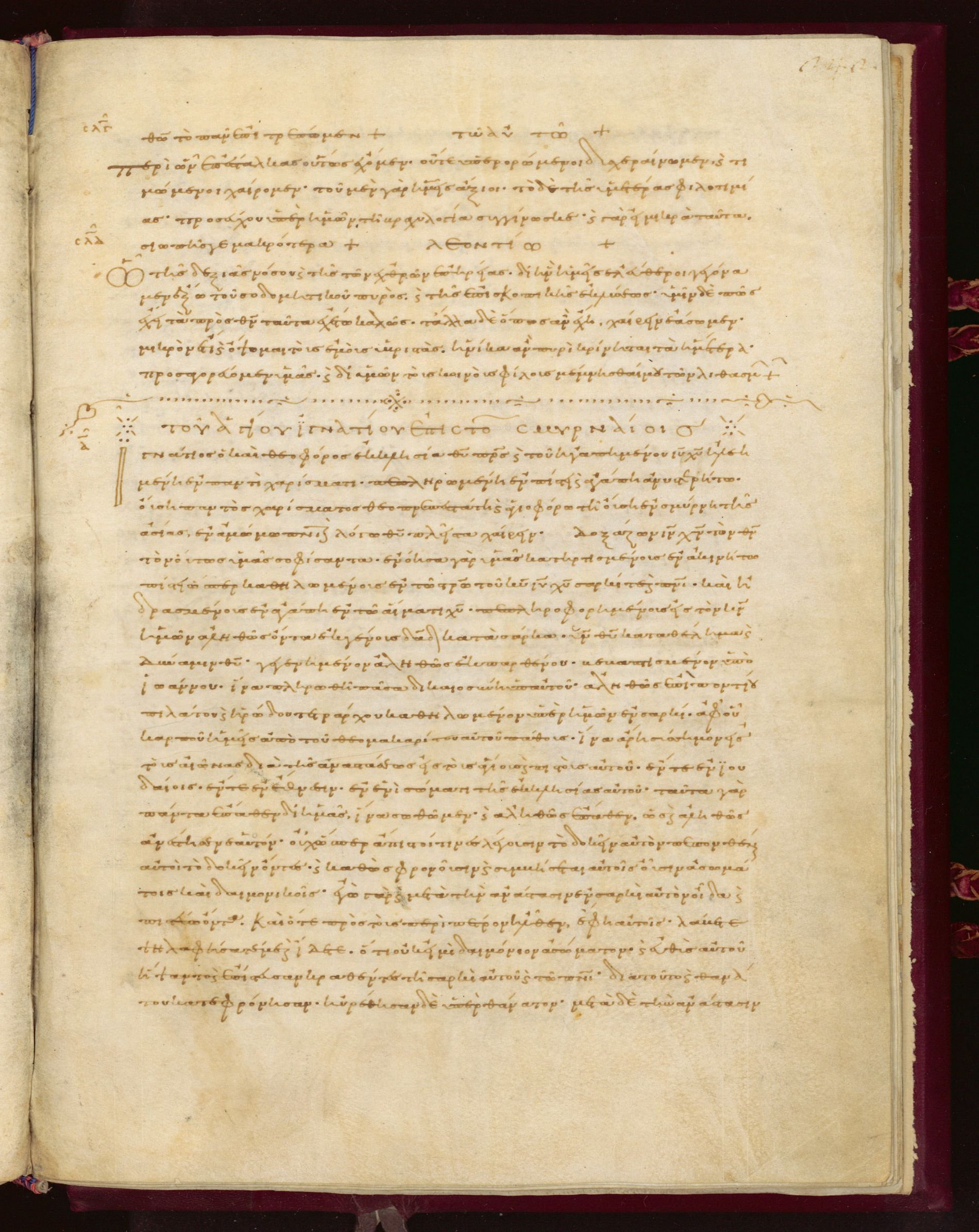
Checked on the images: Laur. Plut. 57.7 fol. 242r: the page begins ‹heading του αγιου ιγνατιου επιστολη σμυρναιοις (mid-page, marginal α', after the end of the preceding text)› and ends ‹μετὰ δὲ τὴν ἀνάστασιν (Smyrn. 3.3)›. The span of each page was found by reading its first and last words and locating them in the Greek. The Greek shown is Lake's edited text (1912), not a transcription of the page; the scribe's spellings and abbreviations differ in small details.
Ἰγνάτιος, ὁ καὶ Θεοφόρος, ἐκκλησίᾳ θεοῦ πατρὸς καὶ τοῦ ἠγαπημένου Ἰησοῦ Χριστοῦ, ἠλεημένῃ ἐν παντὶ χαρίσματι, πεπληρωμένῃ ἐν πίστει καὶ ἀγάπῃ, ἀνυστερήτῳ οὔσῃ παντὸς χαρίσματος, θεοπρεπεστάτῃ καὶ ἁγιοφόρῳ, τῇ οὔσῃ ἐν Σμύρνῃ τῆς Ἀσίας. ἐν ἀμώμῳ πνεύματι καὶ λόγῳ θεοῦ πλεῖστα χαίρειν.
Ignatius, who is also Theophorus, to the church of God the Father and of Jesus Christ the Beloved, which hath been mercifully endowed with every grace, being filled with faith and love and lacking in no grace, most reverend and bearing holy treasures; to the church which is in Smyrna of Asia, in a blameless spirit and in the word of God abundant greeting.
Where on the image
Checked on the images: Laur. Plut. 57.7 fol. 242r: the page begins ‹heading του αγιου ιγνατιου επιστολη σμυρναιοις (mid-page, marginal α', after the end of the preceding text)› and ends ‹μετὰ δὲ τὴν ἀνάστασιν (Smyrn. 3.3)›. The span of each page was found by reading its first and last words and locating them in the Greek. The Greek shown is Lake's edited text (1912), not a transcription of the page; the scribe's spellings and abbreviations differ in small details.
1Δοξάζω Ἰησοῦν Χριστὸν τὸν θεὸν τὸν οὕτως ὑμᾶς σοφίσαντα· ἐνόησα γὰρ ὑμᾶς κατηρτισμένους ἐν ἀκινήτῳ πίστει, ὥσπερ καθηλωμένους ἐν τῷ σταυρῷ τοῦ κυρίου Ἰησοῦ Χριστοῦ σαρκί τε καὶ πνεύματι καὶ ἡδρασμένους ἐν ἀγάπῃ ἐν τῷ αἵματι Χριστοῦ, πεπληροφορημένους εἰς τὸν κύριον ἡμῶν, ἀληθῶς ὄντα ἐκ γένους Δαυεὶδ κατὰ σάρκα, υἱὸν θεοῦ κατὰ θέλημα καὶ δύναμιν θεοῦ, γεγεννημένον ἀληθῶς ἐκ παρθένου, βεβαπτισμένον ὑπὸ Ἰωάννου, ἵνα πληρωθῇ πᾶσα δικαιοσύνη ὑπ’ αὐτοῦ· 2ἀληθῶς ἐπὶ Ποντίου Πιλάτου καὶ Ἡρώδου τετράρχου καθηλωμένον ὑπὲρ ἡμῶν ἐν σαρκί, ἀφ’ οὗ καρποῦ ἡμεῖς ἀπὸ τοῦ θεομακαρίστου αὐτοῦ πάθους, ἵνα ἄρῃ σύσσημον εἰς τοὺς αἰῶνας διὰ τῆς ἀναστάσεως εἰς τοὺς ἁγίους καὶ πιστοὺς αὐτοῦ, εἴτε ἐν Ἰουδαίοις εἴτε ἐν ἔθνεσιν, ἐν ἑνὶ σώματι τῆς ἐκκλησίας αὐτοῦ.
1I give glory to Jesus Christ the God who bestowed such wisdom upon you; for I have perceived that ye are established in faith immovable, being as it were nailed on the cross of the Lord Jesus Christ, in flesh and in spirit, and firmly grounded in love in the blood of Christ, fully persuaded as touching our Lord that He is truly of the race of David according to the flesh, but Son of God by the Divine will and power, truly born of a virgin and baptized by John that all righteousness might be fulfilled by Him, 2truly nailed up in the flesh for our sakes under Pontius Pilate and Herod the tetrarch (of which fruit are we -- that is, of His most blessed passion); that He might set up an ensign unto all the ages through His resurrection, for His saints and faithful people, whether among Jews or among Gentiles, in one body of His Church.
Where on the image
Checked on the images: Laur. Plut. 57.7 fol. 242r: the page begins ‹heading του αγιου ιγνατιου επιστολη σμυρναιοις (mid-page, marginal α', after the end of the preceding text)› and ends ‹μετὰ δὲ τὴν ἀνάστασιν (Smyrn. 3.3)›. The span of each page was found by reading its first and last words and locating them in the Greek. The Greek shown is Lake's edited text (1912), not a transcription of the page; the scribe's spellings and abbreviations differ in small details.
1Ταῦτα γὰρ πάντα ἔπαθεν δι’ ἡμᾶς, ἵνα σωθῶμεν· καὶ ἀληθῶς ἔπαθεν, ὡς καὶ ἀληθῶς ἀνέστησεν ἑαυτόν, οὐχ ὥσπερ ἄπιστοί τινες λέγουσιν, τὸ δοκεῖν αὐτὸν πεπονθέναι, αὐτοὶ το δοκεῖν ὄντες· καὶ καθὼς φρονοῦσιν, καὶ συμβήσεται αὐτοῖς, οὖσιν ἀσωμάτοις καὶ δαιμονικοῖς.
1For He suffered all these things for our sakes [that we might be saved]; and He suffered truly, as also He raised Himself truly; not as certain unbelievers say, that He suffered in semblance, being themselves mere semblance. And according as their opinions are, so shall it happen to them, for they are without body and demon-like.
Where on the image
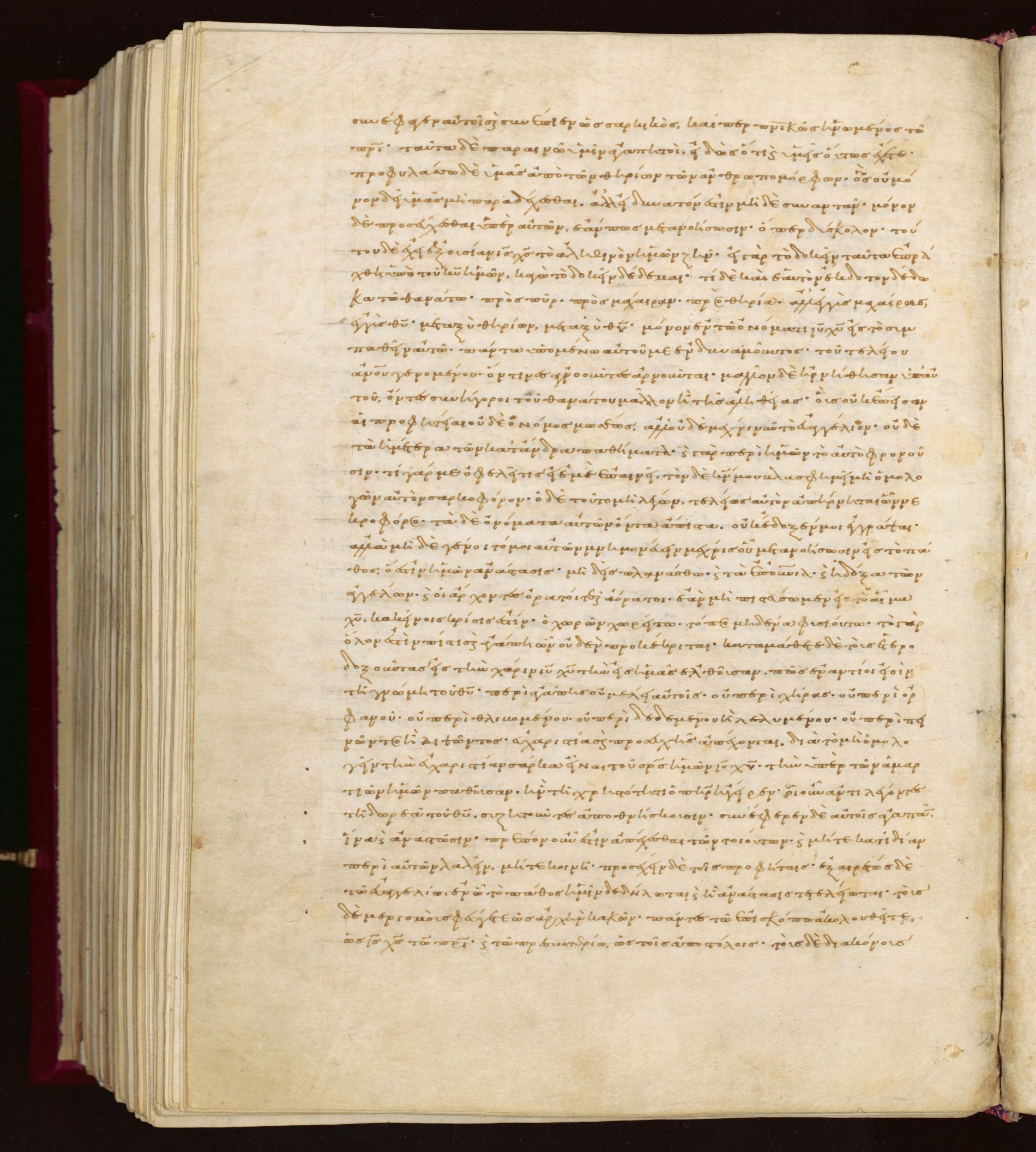
Checked on the images: Laur. Plut. 57.7 fol. 242r: the page begins ‹heading του αγιου ιγνατιου επιστολη σμυρναιοις (mid-page, marginal α', after the end of the preceding text)› and ends ‹μετὰ δὲ τὴν ἀνάστασιν (Smyrn. 3.3)›; Laur. Plut. 57.7 fol. 242v: the page begins ‹συνέφαγεν αὐτοῖς καὶ συνέπιεν ὡς σαρκικός (Smyrn. 3.3)› and ends ‹τοὺς δὲ διακόνους (Smyrn. 8.1)›. The span of each page was found by reading its first and last words and locating them in the Greek. The Greek shown is Lake's edited text (1912), not a transcription of the page; the scribe's spellings and abbreviations differ in small details.
1Ἐγὼ γὰρ καὶ μετὰ τὴν ἀνάστασιν ἐν σαρκὶ αὐτὸν οἶδα καὶ πιστεύω ὄντα. 2καὶ ὅτε πρὸς τοὺς περὶ Πέτρον ἦλθεν, ἔφη αὐτοῖς· Λάβετε, ψηλαφήσατέ με καὶ ἴδετε, ὅτι οὐκ εἰμὶ δαιμόνιον ἀσώματον. καὶ εὐθὺς αὐτοῦ ἥψαντο καὶ ἐπίστευσαν, κραθέντες τῇ σαρκὶ αὐτοῦ καὶ τῷ πνεύματι. διὰ τοῦτο καὶ θανάτου κατεφρόνησαν, ηὑρέθησαν δὲ ὑπὲρ θάνατον. 3μετὰ δὲ τὴν ἀνάστασιν συνέφαγεν αὐτοῖς καὶ συνέπιεν ὡς σαρκικός, καίπερ πνευματικῶς ἡνωμένος τῷ πατρί.
1For I know and believe that He was in the flesh even after the resurrection; 2and when He came to Peter and his company, He said to them, Lay hold and handle me, and see that I am not a demon without body. And straightway they touched Him, and they believed, being joined unto His flesh and His blood. Wherefore also they despised death, nay they were found superior to death. 3And after His resurrection He [both] ate with them and drank with them as one in the flesh, though spiritually He was united with the Father.
Where on the image
Checked on the images: Laur. Plut. 57.7 fol. 242v: the page begins ‹συνέφαγεν αὐτοῖς καὶ συνέπιεν ὡς σαρκικός (Smyrn. 3.3)› and ends ‹τοὺς δὲ διακόνους (Smyrn. 8.1)›. The span of each page was found by reading its first and last words and locating them in the Greek. The Greek shown is Lake's edited text (1912), not a transcription of the page; the scribe's spellings and abbreviations differ in small details.
1Ταῦτα δὲ παραινῶ ὑμῖν, ἀγαπητοί, εἰδὼς ὅτι καὶ ὑμεῖς οὕτως ἔχετε. προφυλάσσω δὲ ὑμᾶς ἀπὸ τῶν θηρίων τῶν ἀνθρωπομόρφων, οὓς οὐ μόνον δεῖ ὑμᾶς μὴ παραδέχεσθαι, ἀλλ’ εἰ δυνατὸν μηδὲ συναντᾶν, μόνον δὲ προσεύχεσθε ὑπὲρ αὐτῶν, ἐάν πως μετανοήσωσιν, ὅπερ δύσκολον, τούτου δὲ ἔχει ἐξουσίαν Ἰησοῦς Χριστός, τὸ ἀληθινὸν ἡμῶν ζῆν. 2εἰ γὰρ τὸ δοκεῖν ταῦτα ἐπράχθη ὑπὸ τοῦ κυρίου ἡμῶν, κἀγὼ τὸ δοκεῖν δέδεμαι. τί δὲ καὶ ἑαυτὸν ἔκδοτον δέδωκα τῷ θανάτῳ, πρὸς πῦρ, πρὸς μάχαιραν, πρὸς θηρία; ἀλλ’ ἐγγὺς μαχαίρας ἐγγὺς θεοῦ, μεταξὺ θηρίων μεταξὺ θεοῦ· μόνον ἐν τῷ ὀνόματι Ἰησοῦ Χριστοῦ εἰς τὸ συμπαθεῖν αὐτῷ πάντα ὑπομένω, αὐτοῦ με ἐνδυναμοῦντος τοῦ τελείου ἀνθρώπου.
1But these things I warn you, dearly beloved, knowing that ye yourselves are so minded. Howbeit I watch over you betimes to protect you from wild beasts in human form -- men whom not only should ye not receive, but, if it were possible, not so much as meet [them]; only pray ye for them, if haply they may repent. This indeed is difficult, but Jesus Christ, our true life, hath power over it. 2For if these things were done by our Lord in semblance, then am I also a prisoner in semblance. And why then have I delivered myself over to death, unto fire, unto sword, unto wild beasts? But near to the sword, near to God; in company with wild beasts, in company with God. Only let it be in the name of Jesus Christ, so that we may suffer together with Him. I endure all things, seeing that He Himself enableth me, who is perfect Man.
Where on the image
Checked on the images: Laur. Plut. 57.7 fol. 242v: the page begins ‹συνέφαγεν αὐτοῖς καὶ συνέπιεν ὡς σαρκικός (Smyrn. 3.3)› and ends ‹τοὺς δὲ διακόνους (Smyrn. 8.1)›. The span of each page was found by reading its first and last words and locating them in the Greek. The Greek shown is Lake's edited text (1912), not a transcription of the page; the scribe's spellings and abbreviations differ in small details.
1Ὅν τινες ἀγνοοῦντες ἀρνοῦνται, μᾶλλον δὲ ἠρνήθησαν ὑπ’ αὐτοῦ, ὄντες συνήγοροι τοῦ θανάτου μᾶλλον ἢ τῆς ἀληθείας· οὓς οὐκ ἔπεισαν αἱ προφητεῖαι οὐδὲ ὁ νόμος Μωύσεως, ἀλλ’ οὐδὲ μέχρι νῦν τὸ εὐαγγέλιον, οὐδὲ τὰ ἡμέτερα τῶν κατ’ ἄνδρα παθήματα. 2καὶ γὰρ περὶ ἡμῶν τὸ αὐτὸ φρονοῦσιν. τί γάρ με ὠφελεῖ τις, εἰ ἐμὲ ἐπαινεῖ, τὸν δὲ κύριόν μου βλασφημεῖ, μὴ ὁμολογῶν αὐτὸν σαρκοφόρον; ὁ δὲ τοῦτο λέγων τελείως αὐτὸν ἀπήρνηται, ὢν νεκροφόρος. 3τὰ δὲ ὀνόματα αὐτῶν, ὄντα ἄπιστα, οὐκ ἔδοξέν μοι ἐγγράψαι. ἀλλὰ μηδὲ γένοιτό μοι αὐτῶν μνημονεύειν, μέχρις οὗ μετανοήσωσιν εἰς τὸ πάθος, ὅ ἐστιν ἡμῶν ἀνάστασις.
1But certain persons ignorantly deny Him, or rather have been denied by Him, being advocates of death rather than of the truth; and they have not been persuaded by the prophecies nor by the law of Moses, nay nor even to this very hour by the Gospel, nor by the sufferings of each of us severally; 2for they are of the same mind also concerning us. For what profit is it [to me], if a man praiseth me, but blasphemeth my Lord, not confessing that He was a bearer of flesh? Yet he that affirmeth not this, doth thereby deny Him altogether, being himself a bearer of a corpse. 3But their names, being unbelievers, I have not thought fit to record in writing; nay, far be it from me even to remember them, until they repent and return to the passion, which is our resurrection.
Where on the image
Checked on the images: Laur. Plut. 57.7 fol. 242v: the page begins ‹συνέφαγεν αὐτοῖς καὶ συνέπιεν ὡς σαρκικός (Smyrn. 3.3)› and ends ‹τοὺς δὲ διακόνους (Smyrn. 8.1)›. The span of each page was found by reading its first and last words and locating them in the Greek. The Greek shown is Lake's edited text (1912), not a transcription of the page; the scribe's spellings and abbreviations differ in small details.
1Μηδεὶς πλανάσθω· καὶ τὰ ἐπουράνια καὶ ἡ δόξα τῶν ἀγγέλων καὶ οἱ ἄρχοντες ὁρατοί τε καὶ ἀόρατοι, ἐὰν μὴ πιστεύσωσιν εἰς τὸ αἷμα Χριστοῦ, κἀκείνοις κρίσις ἐστίν· ὁ χωρῶν χωρείτω. τόπος μηδένα φυσιούτω· τὸ γὰρ ὅλον ἐστὶν πίστις καὶ ἀγάπη, ὧν οὐδὲν προκέκριται. 2καταμάθετε δὲ τοὺς ἑτεροδοξοῦντας εἰς τὴν χάριν Ἰησοῦ Χριστοῦ τὴν εἰς ἡμᾶς ἐλθοῦσαν, πῶς ἐναντίοι εἰσὶν τῇ γνώμῃ τοῦ θεοῦ. περὶ ἀγάπης οὐ μέλει αὐτοῖς, οὐ περὶ χήρας, οὐ περὶ ὀρφανοῦ, οὐ περὶ θλιβομένου, οὐ περὶ δεδεμένου ἢ λελυμένου, οὐ περὶ πεινῶντος ἢ διψῶντος.
1Let no man be deceived. Even the heavenly beings and the glory of the angels and the rulers visible and invisible, if they believe not in the blood of Christ [who is God], judgment awaiteth them also. He that receiveth let him receive. Let not office puff up any man; for faith and love are all in all, and nothing is preferred before them. 2But mark ye those who hold strange doctrine touching the grace of Jesus Christ which came to us, how that they are contrary to the mind of God. They have no care for love, none for the widow, none for the orphan, none for the afflicted, none for the prisoner, none for the hungry or thirsty. They abstain from eucharist (thanksgiving) and prayer, because they allow not that the eucharist is the flesh of our Saviour Jesus Christ, which flesh suffered for our sins, and which the Father of His goodness raised up.
Where on the image
Checked on the images: Laur. Plut. 57.7 fol. 242v: the page begins ‹συνέφαγεν αὐτοῖς καὶ συνέπιεν ὡς σαρκικός (Smyrn. 3.3)› and ends ‹τοὺς δὲ διακόνους (Smyrn. 8.1)›. The span of each page was found by reading its first and last words and locating them in the Greek. The Greek shown is Lake's edited text (1912), not a transcription of the page; the scribe's spellings and abbreviations differ in small details.
1Εὐχαριστίας καὶ προσευχῆς ἀπέχονται, διὰ τὸ μὴ ὁμολογεῖν τὴν εὐχαριστίαν σάρκα εἶναι τοῦ σωτῆρος ἡμῶν Ἰησοῦ Χριστοῦ τὴν ὑπὲρ τῶν ἁμαρτιῶν ἡμῶν παθοῦσαν, ἣν τῇ χρηστότητι ὁ πατὴρ ἤγειρεν. οἱ οὖν ἀντιλέγοντες τῇ δωρεᾷ τοῦ θεοῦ συζητοῦντες ἀποθνήσκουσιν· συνέφερεν δὲ αὐτοῖς ἀγαπᾶν, ἵνα καὶ ἀναστῶσιν. 2πρέπον ἐστὶν ἀπέχεσθαι τῶν τοιούτων καὶ μήτε κατ’ ἰδίαν περὶ αὐτῶν λαλεῖν μήτε κοινῇ, προσέχειν δὲ τοῖς προφήταις, ἐξαιρέτως δὲ τῷ εὐαγγελίῳ, ἐν ᾧ τὸ πάθος ἡμῖν δεδήλωται καὶ ἡ ἀνάστασις τετελείωται. τοὺς δὲ μερισμοὺς φεύγετε ὡς ἀρχὴν κακῶν.
1They therefore that gainsay the good gift of God perish by their questionings. But it were expedient for them to have love, that they may also rise again. 2It is therefore meet that ye should abstain from such, and not speak of them either privately or in public; but should give heed to the Prophets, and especially to the Gospel, wherein the passion is shown unto us and the resurrection is accomplished.
Where on the image
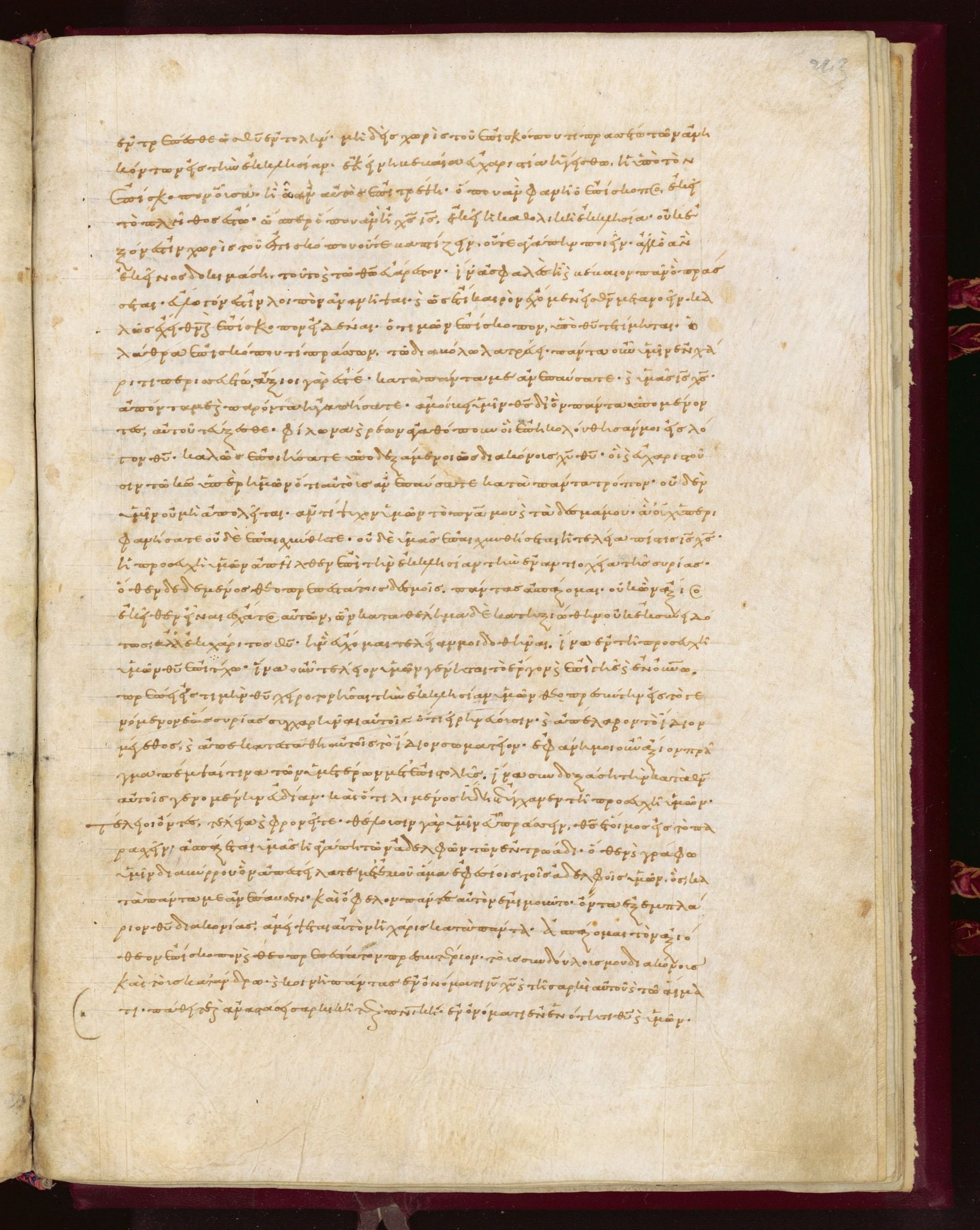
Checked on the images: Laur. Plut. 57.7 fol. 242v: the page begins ‹συνέφαγεν αὐτοῖς καὶ συνέπιεν ὡς σαρκικός (Smyrn. 3.3)› and ends ‹τοὺς δὲ διακόνους (Smyrn. 8.1)›; Laur. Plut. 57.7 fol. 243r: the page begins ‹ἐντρέπεσθε ὡς θεοῦ ἐντολήν (Smyrn. 8.1)› and ends ‹ἐν ἑνότητι θεοῦ καὶ ὑμῶν (Smyrn. 12.2)›. The span of each page was found by reading its first and last words and locating them in the Greek. The Greek shown is Lake's edited text (1912), not a transcription of the page; the scribe's spellings and abbreviations differ in small details.
1Πάντες τῷ ἐπισκόπῳ ἀκολουθεῖτε, ὡς Ἰησοῦς Χριστὸς τῷ πατρί, καὶ τῷ πρεσβυτερίῳ ὡς τοῖς ἀποστόλοις. τοὺς δὲ διακόνους ἐντρέπεσθε ὡς θεοῦ ἐντολήν. μηδεὶς χωρὶς τοῦ ἐπισκόπου τι πρασσέτω τῶν ἀνηκόντων εἰς τὴν ἐκκλησίαν. ἐκείνη βεβαία εὐχαριστία ἡγείσθω, ἡ ὑπὸ ἐπίσκοπον οὖσα ἢ ᾧ ἂν αὐτὸς ἐπιτρέψῃ. 2ὅπου ἂν φανῇ ὁ ἐπίσκοπος, ἐκεῖ τὸ πλῆθος ἤτω, ὥσπερ ὅπου ἂν ᾖ Ἰησοῦς Χριστός, ἐκεῖ ἡ καθολικὴ ἐκκλησία. οὐκ ἐξόν ἐστιν χωρὶς τοῦ ἐπισκόπου οὔτε βαπτίζειν οὔτε ἀγάπην ποιεῖν· ἀλλ’ ὃ ἂν ἐκεῖνος δοκιμάσῃ, τοῦτο καὶ τῷ θεῷ εὐάρεστον, ἵνα ἀσφαλὲς ᾖ καὶ βέβαιον πᾶν ὃ πράσσετε.
1[But] shun divisions, as the beginning of evils. Do ye all follow your bishop, as Jesus Christ followed the Father, and the presbytery as the Apostles; and to the deacons pay respect, as to God's commandment. Let no man do aught of things pertaining to the Church apart from the bishop. Let that be held a valid eucharist which is under the bishop or one to whom he shall have committed it. 2Wheresoever the bishop shall appear, there let the people be; even as where Jesus may be, there is the universal Church. It is not lawful apart from the bishop either to baptize or to hold a love-feast; but whatsoever he shall approve, this is well-pleasing also to God; that everything which ye do may be sure and valid.
Where on the image
Checked on the images: Laur. Plut. 57.7 fol. 243r: the page begins ‹ἐντρέπεσθε ὡς θεοῦ ἐντολήν (Smyrn. 8.1)› and ends ‹ἐν ἑνότητι θεοῦ καὶ ὑμῶν (Smyrn. 12.2)›. The span of each page was found by reading its first and last words and locating them in the Greek. The Greek shown is Lake's edited text (1912), not a transcription of the page; the scribe's spellings and abbreviations differ in small details.
1Εὔλογόν ἐστιν λοιπὸν ἀνανῆψαι ἡμᾶς, ὡς ἔτι καιρὸν ἔχομεν εἰς θεὸν μετανοεῖν. καλῶς ἔχει, θεὸν καὶ ἐπίσκοπον εἰδέναι. ὁ τιμῶν ἐπίσκοπον ὑπὸ θεοῦ τετίμηται· ὁ λάθρα ἐπισκόπου τι πράσσων τῷ διαβόλῳ λατρεύει. 2πάντα οὖν ὑμῖν ἐν χάριτι περισσευέτω· ἄξιοι γάρ ἐστε. κατὰ πάντα με ἀνεπαύσατε, καὶ ὑμᾶς Ἰησοῦς Χριστός. ἀπόντα με καὶ πάροντα ἠγαπήσατε. ἀμοιβὴ ὑμῖν ὁ θεός, δι’ ὃν πάντα ὑπομένοντες αὐτοῦ τεύξεσθε.
1It is reasonable henceforth that we wake to soberness, while we have [still] time to repent and turn to God. It is good to recognise God and the bishop. He that honoureth the bishop is houroured of God; he that doeth aught without the knowledge of the bishop rendereth service to the devil. 2May all things therefore abound unto you in grace, for ye are worthy. Ye refreshed me in all things, and Jesus Christ shall refresh you. In my absence and in my presence ye cherished me. May God recompense you; for whose sake if ye endure all things, ye shall attain unto Him.
Where on the image
Checked on the images: Laur. Plut. 57.7 fol. 243r: the page begins ‹ἐντρέπεσθε ὡς θεοῦ ἐντολήν (Smyrn. 8.1)› and ends ‹ἐν ἑνότητι θεοῦ καὶ ὑμῶν (Smyrn. 12.2)›. The span of each page was found by reading its first and last words and locating them in the Greek. The Greek shown is Lake's edited text (1912), not a transcription of the page; the scribe's spellings and abbreviations differ in small details.
1Φίλωνα καὶ Ῥέον Ἀγαθόπουν, οἳ ἐπηκολούθησάν μοι εἰς λόγον θεοῦ, καλῶς ἐποιήσατε ὑποδεξάμενοι ὡς διακόνους θεοῦ· οἳ καὶ εὐχαριστοῦσιν τῷ κυρίῳ ὑπὲρ ὑμῶν, ὅτι αὐτοὺς ἀνεπαύσατε κατὰ πάντα τρόπον. οὐδὲν ὑμῖν οὐ μὴ ἀπολεῖται. 2ἀντίψυχον ὑμῶν τὸ πνεῦμά μου καὶ τὰ δεσμά μου, ἃ οὐχ ὑπερηφανήσατε οὐδὲ ἐπῃσχύνθητε. οὐδὲ ὑμᾶς ἐπαισχυνθήσεται ἡ τελεία ἐλπίς, Ἰησοῦς Χριστός.
1Philo and Rhaius Agathopus, who followed me in the cause of God, ye did well to receive as ministers of [Christ] God; who also give thanks to the Lord for you, because ye refreshed them in every way. Nothing shall be lost to you. 2My spirit is devoted for you, as also are my bonds, which ye despised not, neither were ashamed of them. Nor shall He, who is perfect faithfulness, be ashamed of you, even Jesus Christ.
Where on the image
Checked on the images: Laur. Plut. 57.7 fol. 243r: the page begins ‹ἐντρέπεσθε ὡς θεοῦ ἐντολήν (Smyrn. 8.1)› and ends ‹ἐν ἑνότητι θεοῦ καὶ ὑμῶν (Smyrn. 12.2)›. The span of each page was found by reading its first and last words and locating them in the Greek. The Greek shown is Lake's edited text (1912), not a transcription of the page; the scribe's spellings and abbreviations differ in small details.
1Ἡ προσευχὴ ὑμῶν ἀπῆλθεν ἐπὶ τὴν ἐκκλησίαν τὴν ἐν Ἀντιοχείᾳ τῆς Συρίας, ὅθεν δεδεμένος θεοπρεπεστάτοις δεσμοῖς πάντας ἀσπάζομαι, οὐκ ὢν ἄξιος ἐκεῖθεν εἶναι, ἔσχατος αὐτῶν ὤν· κατὰ θέλημα δὲ κατηξιώθην, οὐκ ἐκ συνειδότος ἀλλ’ ἐκ χάριτος θεοῦ· ἣν εὔχομαι τελείαν μοι δοθῆναι, ἵνα ἐν τῇ προσευχῇ ὑμῶν θεοῦ ἐπιτύχω. 2ἵνα οὖν ὑμῶν τέλειον γένηται τὸ ἔργον καὶ ἐπὶ γῆς καὶ ἐν οὐρανῷ, πρέπει εἰς τιμὴν θεοῦ χειροτονῆσαι τὴν ἐκκλησίαν ὑμῶν θεοπρεσβεύτην, εἰς τὸ γενόμενον ἐν Συρίᾳ συγχαρῆναι αὐτοῖς, ὅτι εἰρηνεύουσιν καὶ ἀπέλαβον τὸ ἴδιον μέγεθος καὶ ἀπεκατεστάθη αὐτοῖς τὸ ἴδιον σωματεῖον. 3ἐφάνη μοι οὖν θεοῦ ἄξιον πρᾶγμα, πέμψαι τινὰ τῶν ὑμετέρων μετ’ ἐπιστολῆς, ἵνα συνδοξάσῃ τὴν κατὰ θεὸν αὐτοῖς γενομένην εὐδίαν, καὶ ὅτι λιμένος ἤδη ἐτύγχανον τῇ προσευχῇ ὑμῶν. τέλειοι ὄντες τέλεια καὶ φρονεῖτε. θέλουσιν γὰρ ὑμῖν εὖ πράσσειν θεὸς ἕτοιμος εἰς τὸ παρέχειν.
1Your prayer sped forth unto the church which is in Antioch of Syria; whence coming a prisoner in most godly bonds I salute all men, though I am not worthy to belong to it, being the very last of them. By the Divine will was this vouchsafed to me, not of my own complicity, but by God's grace, which I pray may be given to me perfectly, that through your prayers I may attain unto God. 2Therefore that your work may be perfected both on earth and in heaven, it is meet that your church should appoint, for the honour of God, an ambassador of God that he may go as far as Syria and congratulate them because they are at peace, and have recovered their proper stature, and their proper bulk hath been restored to them. 3It seemed to me therefore a fitting thing that ye should send one of your own people with a letter, that he might join with them in giving glory for the calm which by God's will had overtaken them, and because they were already reaching a haven through your prayers. Seeing ye are perfect, let your counsels also be perfect; for if ye desire to do well, God is ready to grant the means.
Where on the image
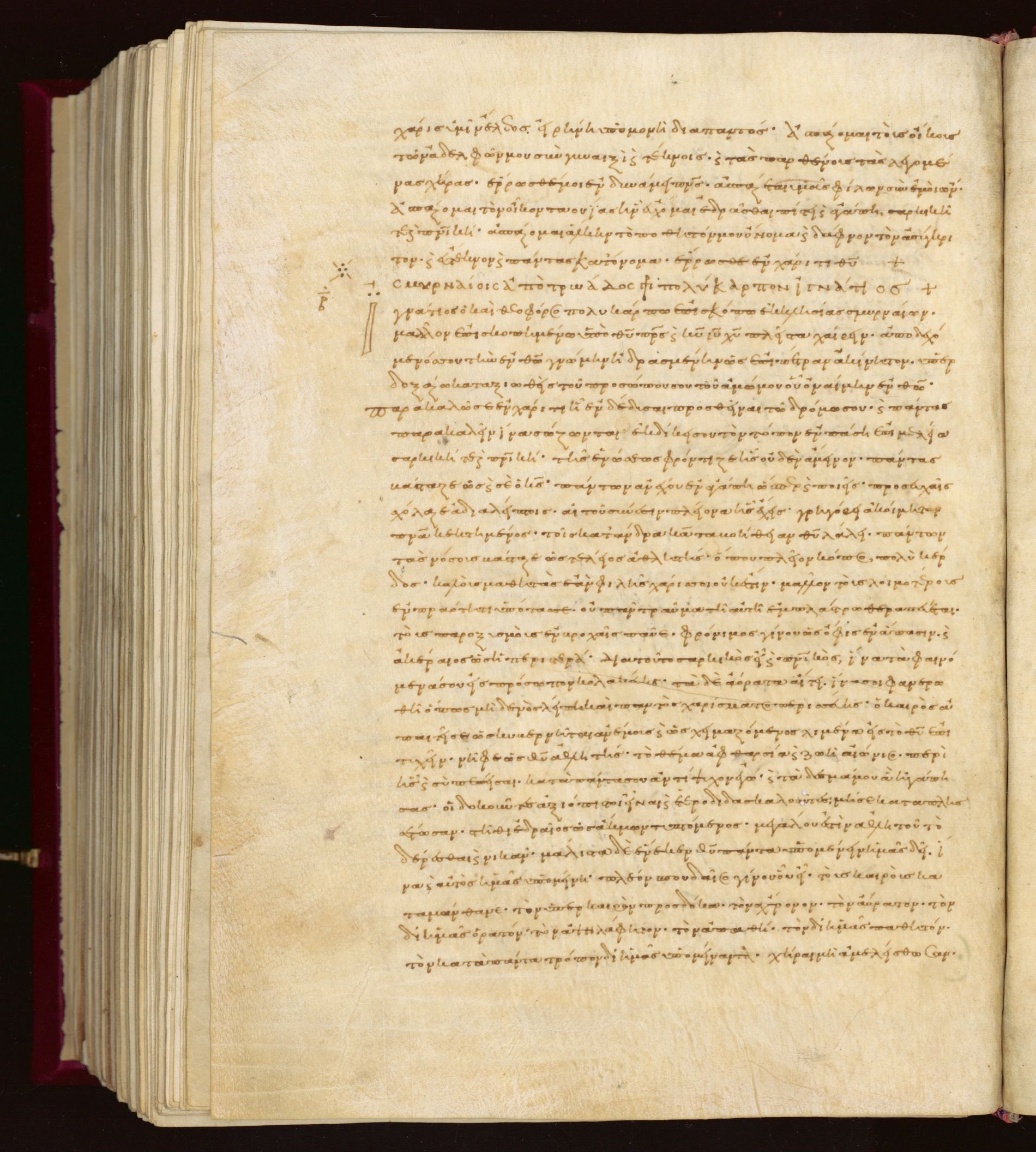
Checked on the images: Laur. Plut. 57.7 fol. 243r: the page begins ‹ἐντρέπεσθε ὡς θεοῦ ἐντολήν (Smyrn. 8.1)› and ends ‹ἐν ἑνότητι θεοῦ καὶ ὑμῶν (Smyrn. 12.2)›; Laur. Plut. 57.7 fol. 243v: the page begins ‹χάρις ὑμῖν, ἔλεος, εἰρήνη (Smyrn. 12.2)› and ends ‹χῆραι μὴ ἀμελείσθωσαν (Pol. 4.1)›. The span of each page was found by reading its first and last words and locating them in the Greek. The Greek shown is Lake's edited text (1912), not a transcription of the page; the scribe's spellings and abbreviations differ in small details.
1Ἀσπάζεται ὑμᾶς ἡ ἀγάπη τῶν ἀδελφῶν τῶν ἐν Τρωάδι, ὅθεν καὶ γράφω ὑμῖν διὰ Βούρρου, ὅν ἀπεστείλατε μετ’ ἐμοῦ ἅμα Ἐφεσίοις, τοῖς ἀδελφοῖς ὑμῶν, ὃς κατὰ πάντα με ἀνέπαυσεν. καὶ ὄφελον πάντες αὐτὸν ἐμιμοῦντο, ὄντα ἐξεμπλάριον θεοῦ διακονίας. ἀμείψεται αὐτὸν ἡ χάρις κατὰ πάντα. 2ἀσπάζομαι τὸν ἀξιόθεον ἐπίσκοπον καὶ θεοπρεπὲς πρεσβυτέριον καὶ τοὺς συνδούλους μου διακόνους καὶ τοὺς κατ’ ἄνδρα καὶ κοινῇ πάντας ἐν ὀνόματι Ἰησοῦ Χριστοῦ καὶ τῇ σαρκὶ αὐτοῦ καὶ τῷ αἵματι, πάθει τε καὶ ἀναστάσει σαρκικῇ τε καὶ πνευματικῇ, ἐν ἑνότητι θεοῦ καὶ ὑμῶν. χάρις ὑμῖν, ἔλεος, εἰρήνη, ὑπομονὴ διὰ παντός.
1The love of the brethren which are in Troas saluteth you; from whence also I write to you by the hand of Burrhus, whom ye sent with me jointly with the Ephesians your brethren. He hath refreshed me in all ways. And I would that all imitated him, for he is an ensample of the ministry of God. The Divine grace shall requite him in all things. 2I salute your godly bishop and your venerable presbytery [and] my fellow-servants the deacons, and all of you severally and in a body, in the name of Jesus Christ, and in His flesh and blood, in His passion and resurrection, which was both carnal and spiritual, in the unity of God and of yourselves. Grace to you, mercy, peace, patience, always.
Where on the image
Checked on the images: Laur. Plut. 57.7 fol. 243v: the page begins ‹χάρις ὑμῖν, ἔλεος, εἰρήνη (Smyrn. 12.2)› and ends ‹χῆραι μὴ ἀμελείσθωσαν (Pol. 4.1)›. The span of each page was found by reading its first and last words and locating them in the Greek. The Greek shown is Lake's edited text (1912), not a transcription of the page; the scribe's spellings and abbreviations differ in small details.
1Ἀσπάζομαι τοὺς οἴκους τῶν ἀδελφῶν μου σὺν γυναιξὶ καὶ τέκνοις καὶ τὰς παρθένους τὰς λεγομένας χήρας. ἔρρωσθέ μοι ἐν δυνάμει πατρός. ἀσπάζεται ὑμᾶς Φίλων σὺν ἐμοὶ ὤν. 2ἀσπάζομαι τὸν οἶκον Ταουΐας, ἣν εὔχομαι ἑδρᾶσθαι πίστει καὶ ἀγάπῃ σαρκικῇ τε καὶ πνευματικῇ. ἀσπάζομαι Ἄλκην, τὸ ποθητόν μοι ὄνομα, καὶ Δάφνον τὸν ἀσύγκριτον καὶ Εὔτεκνον καὶ πάντας κατ’ ὄνομα. ἔρρωσθε ἐν χάριτι θεοῦ.
1I salute the households of my brethren with their wives and children, and the virgins who are called widows. I bid you farewell in the power of the Father. Philo, who is with me, saluteth you. 2I salute the household of Gavia, and I pray that she may be grounded in faith and love both of flesh and of spirit. I salute Alce, a name very dear to me, and Daphnus the incomparable, and Eutecnus, and all by name. Fare ye well in the grace of God.
Notes
- Greek: Kirsopp Lake, The Apostolic Fathers I (Loeb Classical Library, 1912), digital text of the First1KGreek project (tlg1443.tlg001, CC BY-SA 4.0); Lake's footnotes are not shown. Elided words are written with an apostrophe and the digital text's colon is shown as the raised dot.
- Proofreading: the Greek pages of Lake (archive.org theapostolicfath00unknuoft, leaves 184-288) were read by OCR twice and aligned with the digital text; every word on which both OCR readings agreed against the digital text, and every form that cannot be right, was looked up on the page image. Corrections in this letter: 1.2 'οὖ' to 'οὗ'; 7.1 'πρυσευχῆς' to 'προσευχῆς'; 7.1 'δε' to 'δὲ'; 8.1 'ἄν' to 'ἂν'; 12.2 'ἕλεος,' to 'ἔλεος,'. Kept as Lake prints them (worn or missing accents): Eph. 8.2 οὐδε, Phld. 5.2 ἀξιαγαπητοι, Smyrn. 2.1 το; Lake's quotation marks in Pol. 8.1 are shown as ‘ ’.
- English: J. B. Lightfoot, The Apostolic Fathers (1891, Lightfoot and Harmer), as transcribed at earlychristianwritings.com; Lightfoot's italics are kept.
Cite
Sources
- Source: Laur. Plut. 57.7 (BML IIIF) + Lake 1912 Greek (First1KGreek, CC BY-SA 4.0) + Lightfoot 1891 English (public domain) (holding institution)
- Critical edition: Kirsopp Lake, The Apostolic Fathers I (1912), via First1KGreek
← previous · → next · v cycle view · l back to library