Ludlul bel nemeqi, Tablet III: the dreams of deliverance
Introduction
In a series of dreams messengers of Marduk appear and announce his recovery; the illnesses are driven away.
Ludlul bel nemeqi ('I will praise the lord of wisdom'), the Poem of the Righteous Sufferer, is a monologue in five tablets by Shubshi-meshre-Shakkan, a nobleman who lost the favour of his king and his gods, was struck by illness, and was restored by Marduk. It was composed in the late second millennium BCE and copied widely in the first millennium. This page follows the line numbering of the electronic Babylonian Library edition.
How this page is built. Each section is a run of consecutive lines as written on one photographed clay tablet. For every line the eBL edition (https://www.ebl.lmu.de/corpus/L/2/2/SB/III) lists the manuscripts that carry it, with each tablet's own column and line numbers; the tablet chosen for each run is the photographed copy of the work with the most signs preserved there. Commentaries and texts that only quote a line are never chosen. School and excerpt tablets are used only for lines that no photographed library copy preserves as well, and only where they carry the line as text; their sections say so. The original text is eBL's transliteration of that tablet's signs (not a modern composite text): square brackets mark broken signs, x an illegible sign, # a damaged sign, ? an uncertain reading, and words in {braces} are determinatives; the notes give a key to every sign used on this page, and eBL's layout codes are written out in words (for example '(line break)' or '(blank space)'). Superscript numbers are the line numbers of the eBL edition, used in both the Akkadian and the English. The English is B. R. Foster's translation in the eBL edition (CC BY-NC-SA 4.0), one line of English per line of the text; italics mark uncertain renderings, as in the source. Where the tablet is broken, the English still translates the whole line of eBL's composite text; each section's note names the lines that are broken on its tablet.
Finding a line on the photograph. Each section names the tablet, the face and column, and the tablet's own line numbers (a prime, as in 5', counts from the first preserved line of a broken column). On a tablet with six columns the obverse carries columns i-iii from left to right; the reverse, turned over from bottom to top, carries columns iv-vi from right to left. The photographs often show the obverse above the reverse with the edges around them; a fragment preserves only part of this layout.
This page shows 105 of the 121 lines of the eBL edition (87%), from 8 tablets in the British Museum: K.2518 (Nineveh), BM.48732, BM.55481, BM.54821, BM.46826, BM.39320, 2024,6004.283, BM.45732.
Lines not shown. 16 of the 121 lines of the eBL edition are not shown, because no photographed copy of the work used here carries them: 2-4 (no photograph in eBL: VAT.9954 (Vorderasiatisches Museum, Berlin)); 64 (no manuscript preserves it); 65 (no photograph in eBL: Si.55 (Istanbul Archaeological Museum)); 76-78 (no photograph in eBL: Si.55 (Istanbul Archaeological Museum), BM.68435); 79-83 (no photograph in eBL: Si.55 (Istanbul Archaeological Museum)); a+1-b+1 (commentary: K.3291). A line is shown only on a photographed tablet that carries it as text. Commentaries and other texts that quote a line (letters, rituals, god lists) are not used as witnesses, because they carry it with explanations or inside another text; tablets without a photograph in eBL are not used, because the line could not be shown on its tablet.
How was this verified? (Provenance)
Where on the image
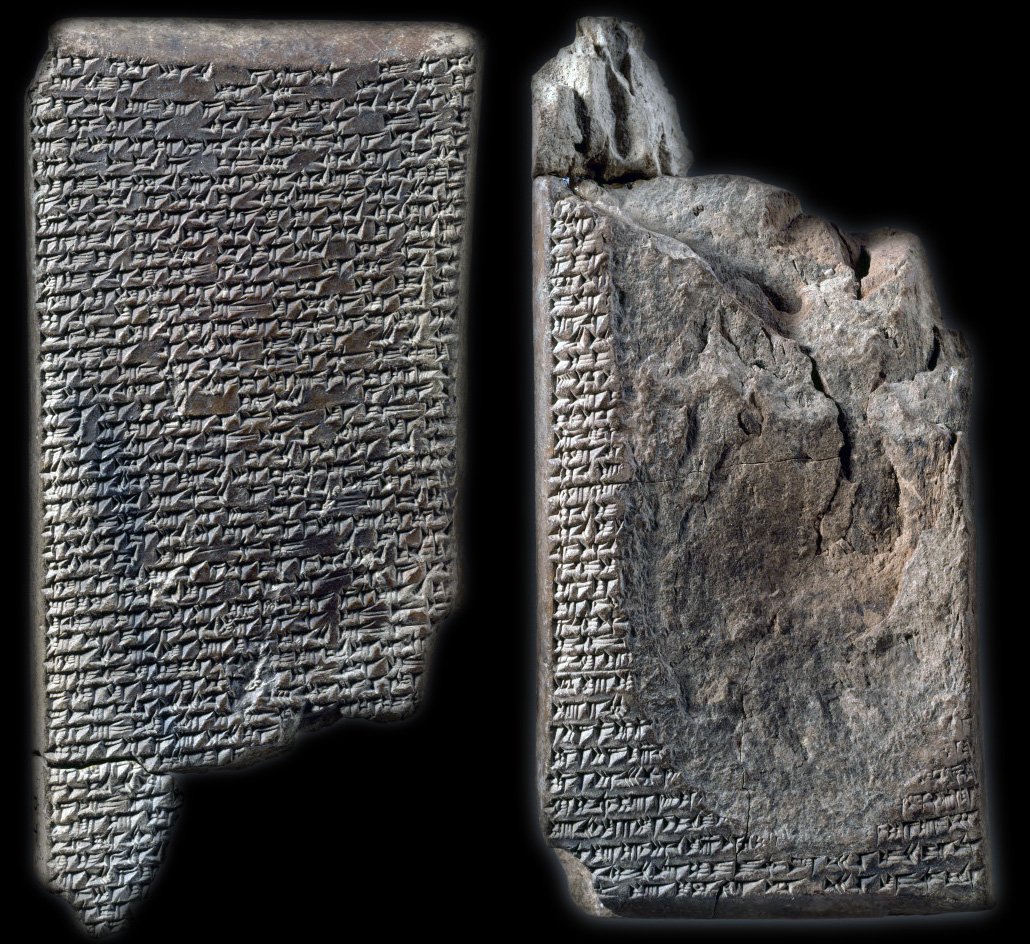
British Museum K.2518: reverse, the tablet's own line 26'. eBL's corpus edition (https://www.ebl.lmu.de/corpus/L/2/2/SB/III) attributes SB III 1 to this manuscript at these column and line numbers. Photograph checked: obverse and reverse side by side, with no scale bar and no ink number visible. About 50 dense lines on the obverse; the reverse has about 40 line-beginnings in a column plus a few lines across the bottom, the rest broken away. Consistent with eBL's obverse 47 and reverse 25 + 1. K.2518, a copy of SB II, carries this line as its catch-line: the opening of the next tablet of the series, copied at the end of the previous one (eBL lists catch-lines among its quotations; unlike commentaries and quotations in other texts, a catch-line is the line itself on a copy of the work). On this tablet of line 1 only one to three signs survive. The English of this line translates eBL's composite text, so it includes words that are not preserved on this tablet but are restored from other manuscripts or by the editors. Square brackets in the English mark eBL's restorations in its composite text; words that survive on other tablets carry no brackets even where this tablet is broken.
1kab-ta-at [x x x x x x x x x x]
1Heavy was his hand upon me, I could not bear it!
Where on the image
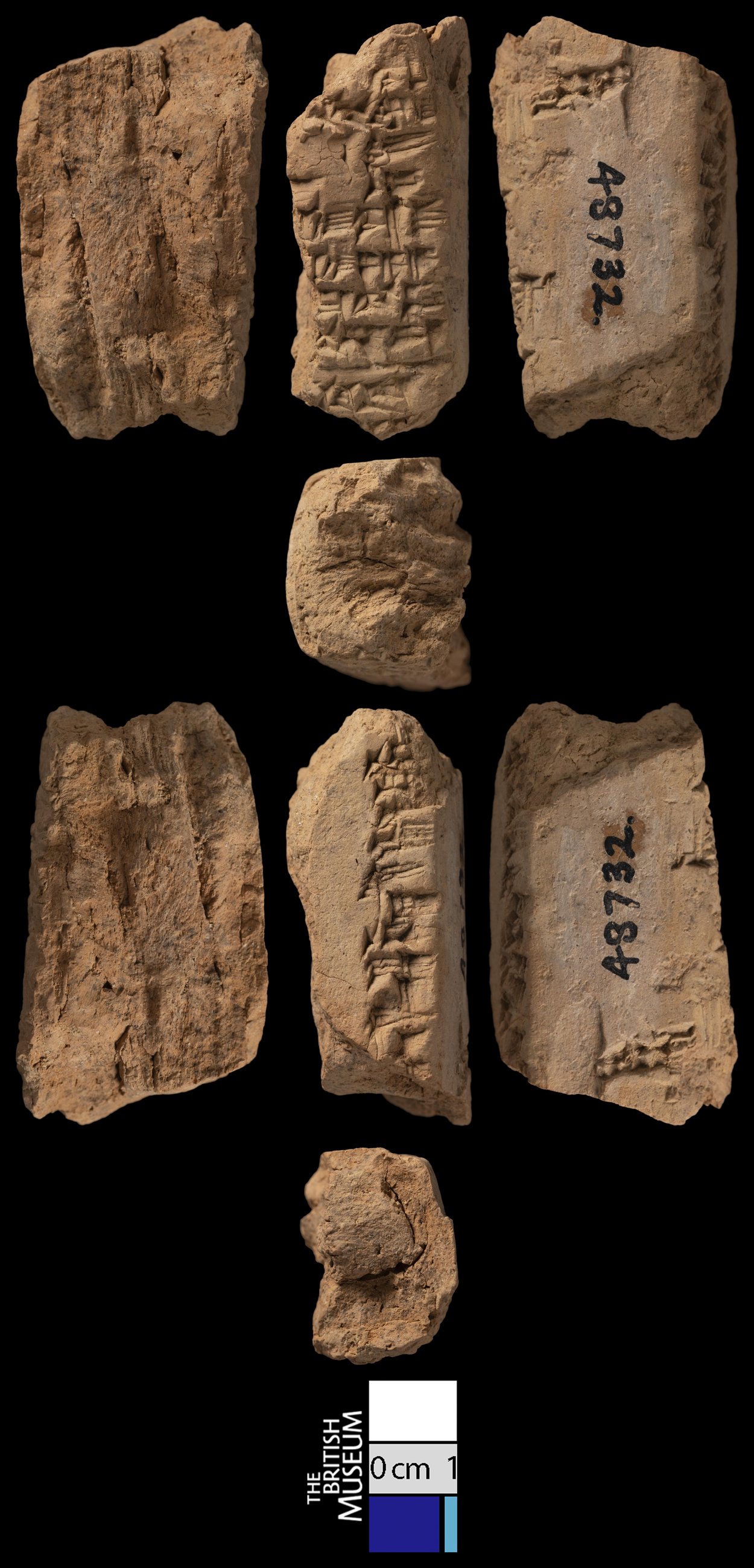
British Museum BM.48732: obverse, the tablet's own lines 1' to 3'. eBL's corpus edition (https://www.ebl.lmu.de/corpus/L/2/2/SB/III) attributes SB III 5-7 to this manuscript at these column and line numbers. Photograph checked: obverse, reverse and edges of a narrow fragment, ink 48732. About 11 lines on one face and 8 or 9 on the other, consistent with eBL's obverse 13 and reverse 8 + 1. On this tablet of line 5 only illegible traces (x) survive and of lines 6-7 only one to three signs survive. The English of these lines translates eBL's composite text, so it includes words that are not preserved on this tablet but are restored from other manuscripts or by the editors. Square brackets in the English mark eBL's restorations in its composite text; words that survive on other tablets carry no brackets even where this tablet is broken.
5[x x x x x x x x x x (x)] x
6[x x x x x x x x x x x ṣal-lu]-ti#
7[x x x x x x x x a(n)-na-ša₂]-ri
5[Ha]rsh, severe illness, without […] my person,
6I lost sight of alertness, […] let my mind stray.
7I was gro[an]ing day and night alike,
Where on the image
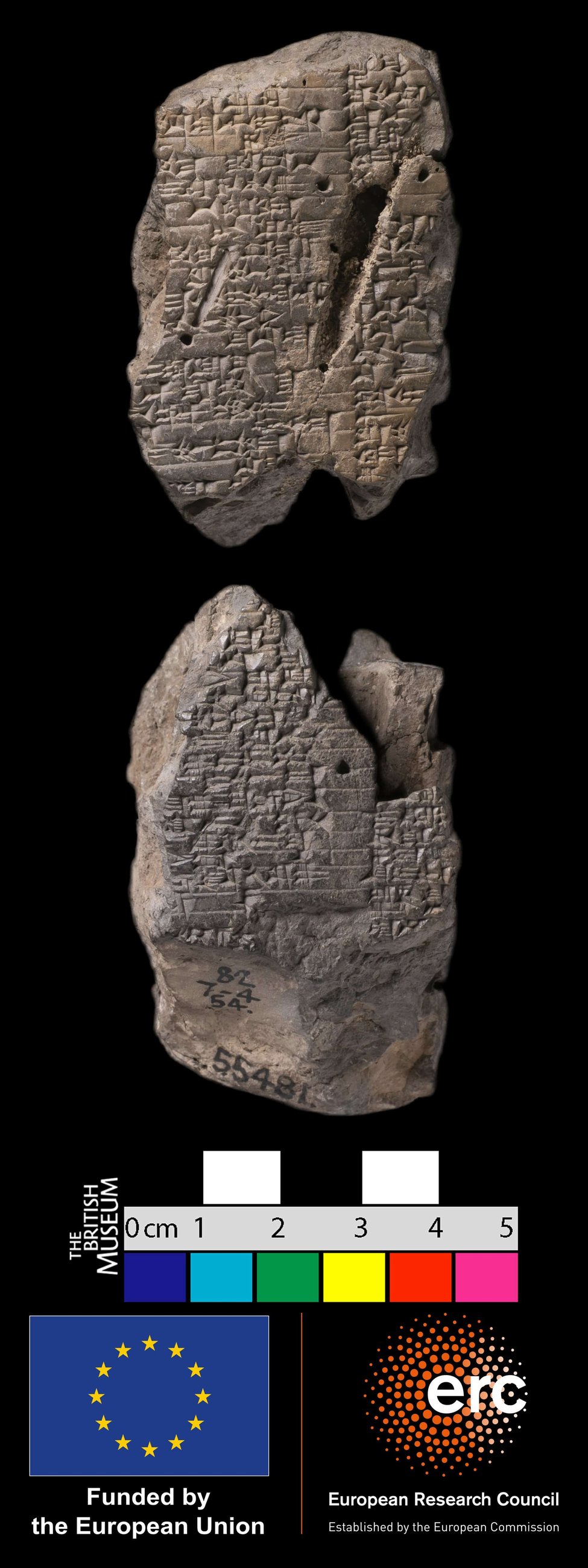
British Museum BM.55481: obverse, the tablet's own lines 1' to 21'. eBL's corpus edition (https://www.ebl.lmu.de/corpus/L/2/2/SB/III) attributes SB III 8-28 to this manuscript at these column and line numbers. Photograph checked: obverse, reverse and edges, inks 55481 and 82-7-4,54. About 20 lines on the obverse and about 17 on the reverse, consistent with eBL's obverse 21 and reverse 19. On this tablet of lines 8-9 only one to three signs survive and lines 10-28 are partly broken (square brackets and x in the Akkadian). The English of these lines translates eBL's composite text, so it includes words that are not preserved on this tablet but are restored from other manuscripts or by the editors. Square brackets in the English mark eBL's restorations in its composite text; words that survive on other tablets carry no brackets even where this tablet is broken.
8[x x x x x x] | mal#-ma-[liš x x x x x]
9[x x x x x] | a-tar [x x x]
10[mi-na-t]i šur#-ru#-uh | lu-bu-uš-t[i x x x]
11[x x x m]u-na-at-ti i-du-šu₂ | gat-ti [x x (x)]
12[me-lam]-mi₃ ha-lip | la-biš [x x x x (x)]
13[i-ru-ba-a]m-ma it-ta-ziz | UGU-[ia]
14[x x x x] i#-ih-ha-mu-u₂ | UZ[U-u₂-a]
15[šu?-m]a* be-el-ka] | i[š]-p[u-ra-(an)-ni]
16[x x (x)] šum-ru-ṣu | [li]-qa-a# [x x x]
17[a?-u₂?-ra?-a]m-ma a#-ta-ma-a | [a-n]a mu-[kil x x x]
18[x x x] iš-pu-ru | [a-m]e-lu [x x]
19[i-qu-lu-m]a ul# i-pu-la-an-n[i | m]a-[am-man]
20[x x iš-m]u-<<ši#/sal#>>-in-ni | a#-na ri-[pi-it-tu x x x]
21[x x x] šu-na-at | a-na-[ṭal]
22[x (x) MAŠ₂.G]I₆ aṭ-ṭu-lu | mu-ši-[ti-ia]
23[iš-t]a-an ra-am-ku | na-aš₂ [x x x x]
24[{giš}ŠINI]G u mul-lil-lu₄ | ta-mi-[ih x x x]
25[lal₃-u]r₂-alim-ma | MAŠ.[MAŠ x x x]
26[x x u]b-bu-bi-ka | iš-p[u-ra-an-ni]
27[x x] na-šu#-u₂# | UGU-[ia x x]
28[(x) x ba-l]a-ṭu# i[d-da-a] | u₂#-maš#-[ši-iʾ x x x]
8Dreaming and waking [I was] equally wretched.
9(There was) an extraordinary young man, of physique surpassing,
10Magnificent of limb, wrapped in a cloak.
11Because I was conscious of him only half awake, his body seemed towering,
12He was clad in splendor, robed in dread.
13He came in upon me, he stood over me!
14[When I saw him, my] flesh grew numb.
15Said he, “Your lord who has sent me,
16“[To say, ‘…] that most wretched man, let him expect his recovery.’”
17When I was fully awake, I kept saying to those in attendance upon me,
18“Who was that man whom the king sent?”
19They kept silent, no one answered,
20Those who heard me took to their heels.
21A second time I had a dream,
22In the dream I had that night,
23(There was) an extraordinary priest, carrying consecrated water,
24He was holding in his hand a purifying (rod of) tamarisk,
25“Laluralimma, the exorcist of Nippur,
26“Has sent me to cleanse you.”
27He tossed over me the water he was carrying,
28He cast a resuscitating spell, he rubbed my body.
Where on the image
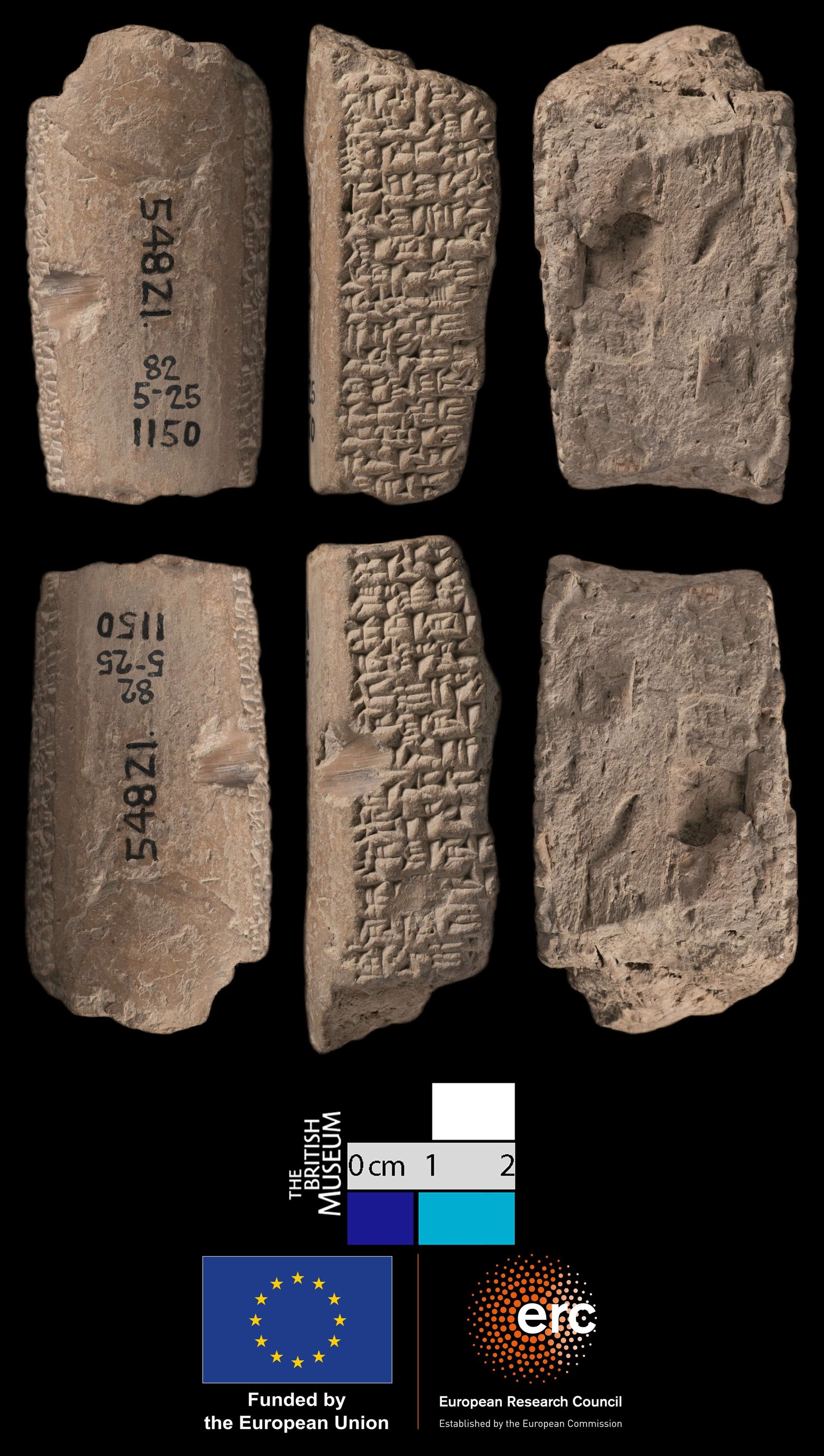
British Museum BM.54821: obverse, the tablet's own lines 1' to 17'. eBL's corpus edition (https://www.ebl.lmu.de/corpus/L/2/2/SB/III) attributes SB III 29-45 to this manuscript at these column and line numbers. Photograph checked: obverse, reverse and edges, inks 54821 and 82-5-25,1150 on the edge. About 15 to 17 lines on each face, consistent with eBL's obverse 17 and reverse 15. On this tablet of lines 29-31, 36, 41 only one to three signs survive and lines 32-35, 37-40, 42-45 are partly broken (square brackets and x in the Akkadian). The English of these lines translates eBL's composite text, so it includes words that are not preserved on this tablet but are restored from other manuscripts or by the editors. Square brackets in the English mark eBL's restorations in its composite text; words that survive on other tablets carry no brackets even where this tablet is broken.
29a[š₂-lu-uš-ma x x x x x x x]
30ina# MAŠ₂#.[GI₆ x x x x x x x]
31iš-te-e[t x x x x x x x x]
32ne₂-siš la ṭ[uh-ha-ti x x x x]
33šar-rat UN-M[EŠ x x x x x (x)]
34i-ru-ba-am-m[a x x x x x x (x)]
35iq-ba-a a-h[u-lap x x x x x x x (x)]
36la ta-pal-[lah x x x x x x x x x]
37u₃ ina mim-ma [x x x x x x (x)]
38iq-bu-u₂ a#-[hu-lap x x x x x x]
39a-a-um-ma# [x x x x x x x x x x]
40ina MAŠ₂.GI₆ u[r-{d}nin-tin-ug₅-ga x x x (x)]
41GURUŠ ṭar₃-r[u x x x x x]
42MAŠ.MAŠ-um-ma [x x x x x]
43{d}AMAR.UTU-m[a x x x x x]]
44a-na šub-š[i-meš-re-e-{d}šakkan x x x x x x]
45ina# ŠU#+MIN-šu₂ KU₃-M[EŠ x x x x x x]
29A third time I had a dream.
30In the dream I had that night,
31(There was) an extraordinary young woman, fair of face,
32While still at a distance, she was very like to a deity,
33A queen she was among people, a woman of prominence in the land.
34She came in upon me, she sat down beside me, […]
35She said, “Mercy on him! He has suffered greatly!”
36“Fear not!” said she, he has caused [a limit] to be set,
37“For in a certain dream, he saw […]”
38They said, “Mercy on him, he has suffered greatly!
39“Whoever saw such a sight in a dream?”
40In the dream (was) Ur-Nintinugga of Babylon,
41A bearded young man, wearing a tiara,
42He was an exorcist, carrying a tablet,
43“It is Marduk who has sent me!
44“To Shubshi-meshre-Shakkan I have brought a sw[athe].”
45In his pure hands he brought me a sw[athe],
Where on the image
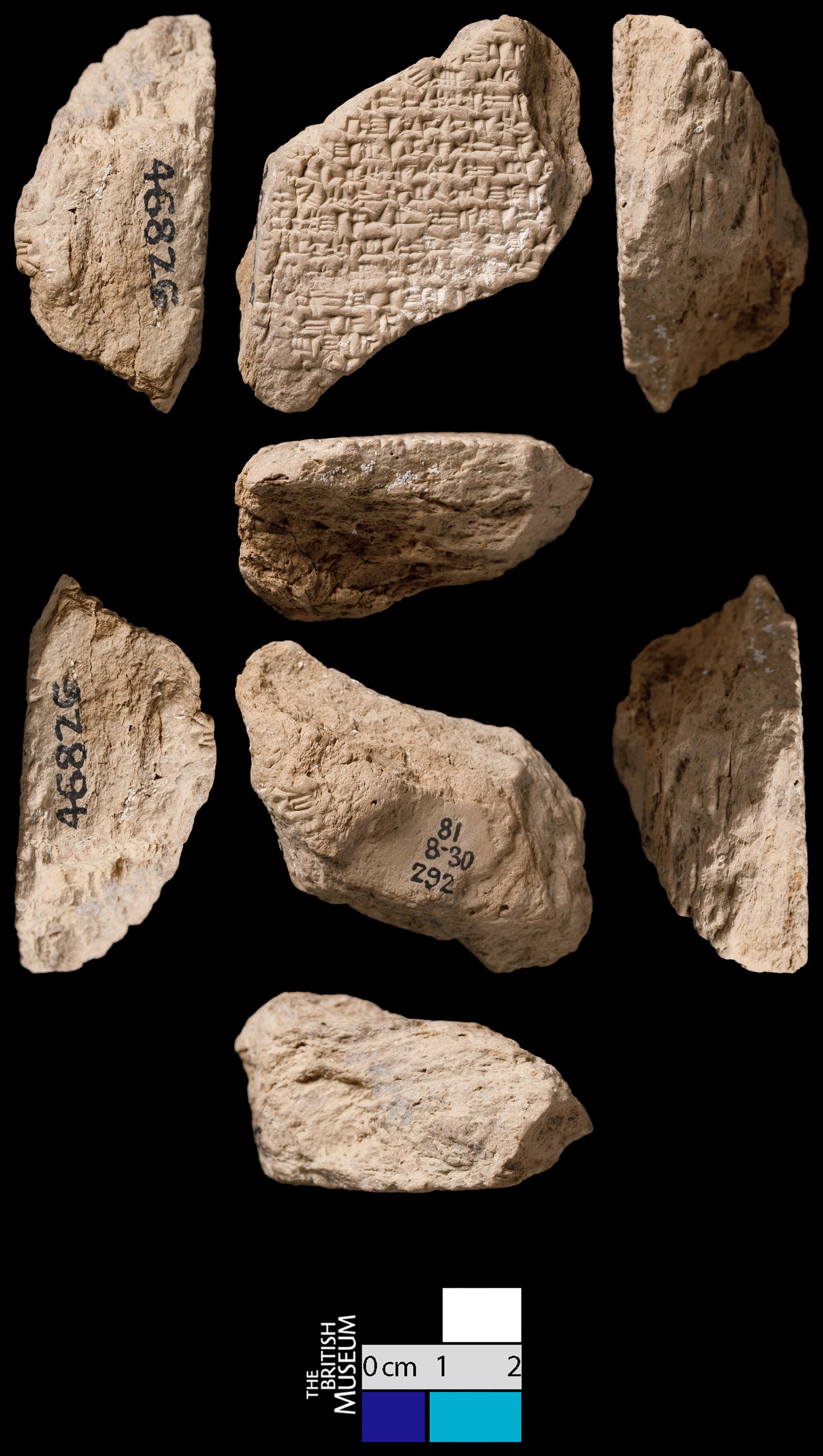
British Museum BM.46826: obverse, the tablet's own lines 4' to 13'. eBL's corpus edition (https://www.ebl.lmu.de/corpus/L/2/2/SB/III) attributes SB III 46-55 to this manuscript at these column and line numbers. Photograph checked: obverse, reverse and edges of a fragment about 4 cm long, ink 46826 on the edge and 81-8-30,292 on the blank reverse. About 15 lines on the obverse, consistent with eBL's obverse 15. On this tablet lines 46-55 are partly broken (square brackets and x in the Akkadian). The English of these lines translates eBL's composite text, so it includes words that are not preserved on this tablet but are restored from other manuscripts or by the editors. Square brackets in the English mark eBL's restorations in its composite text; words that survive on other tablets carry no brackets even where this tablet is broken.
46[x x mu]t-tab-bi-li-ia [x x x x x x]
47[x (x) mu-n]a-at-ti iš-pu-[ra x x x]
48[i]t-[t]u-uš SIG₅-ti₃ UN-M[EŠ-ia x x x]
49[i]-na# si-li-ti i-ri-k[u x x x x]
50[G]IG-MU ar₂-hiš ig-ga-mir [x x x x x x]
51[u]l-tu ša₂ be-li₂-ia lib₃-bi#-š[u₂ x x x]
52[š]a₂ {d#}AMAR.UTU# re-me₂-ni-i ka-bat-[ta-šu₂ x x x x]
53[i]l-qu#-u₂ un-nin#-ni#-ia₅ [x x x x x x x x (x)]
54na#-as#-hur-šu₂ ṭa-a-b[a x x x x x]
55iq#-ba-a a-hu#-[lap x x x x x x]
46He entru[sted] (it) to the hands of the people taking care of me.
47When I was awake, he sent out a message,
48He reve[aled] his favorable sign to my people.
49Though I had been long in my malady, […]
50My illness was quickly over, […] was broken.
51After my lord's heart had quiet[ed],
52The feelings of merciful Marduk having been ap[peased],
53He having accepted my entreaties, he took ... [...],
54He showed me his kind relenting.
55[They sa]id, “Mercy on him, he has suffered greatly!”
Where on the image
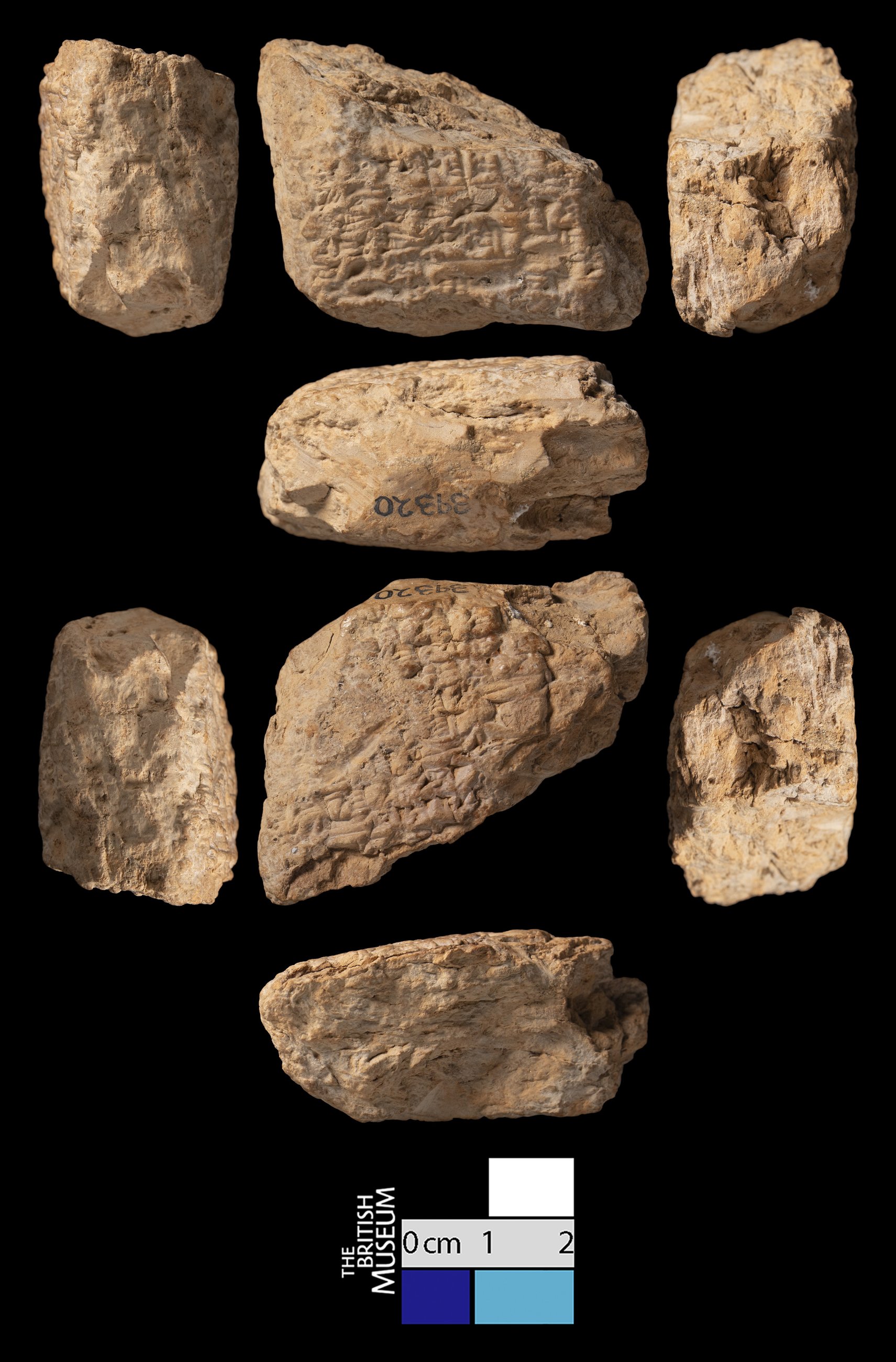
British Museum BM.39320: obverse, the tablet's own lines 1' to 8'. eBL's corpus edition (https://www.ebl.lmu.de/corpus/L/2/2/SB/III) attributes SB III 56-63 to this manuscript at these column and line numbers. Photograph checked: obverse, reverse and edges of a fragment about 3 cm wide, ink 39320 on the edge. About 7 or 8 lines on the obverse and faint traces of about 8 to 10 lines on the worn reverse; consistent with eBL's obverse 8 and reverse 10, though the reverse is very faint. On this tablet of line 63 only illegible traces (x) survive and lines 56-62 are partly broken (square brackets and x in the Akkadian). The English of these lines translates eBL's composite text, so it includes words that are not preserved on this tablet but are restored from other manuscripts or by the editors. Square brackets in the English mark eBL's restorations in its composite text; words that survive on other tablets carry no brackets even where this tablet is broken. eBL gives no English for line(s) 63.
56[še?-re]t-s[u] a#-n[a x x x x x x x x (x)]
57[nar-b]i-šu₂ a#-na dul-lu#-lu# [x x x x x x]
58[i?]-meš ar₂-ni šer₃?#-[ti x x x]
59[uk]-kiš en-ne₂-ti gil₂-l[a-ti x x x]
60[a?-n]a? pi-še-er-ti-ia ina a-[x x x (x)]
61[e-g]a-ti#-ia u₂#-ša₂#-bi[l x (x)]
62[ma?]-me?#-[t]i? ar₂?-ra?#-ta [x x x x x]
63[...] x [...]
56To extol his divinity, […]
57to acclaim his greatness […]
58He disregarded my sin, my crime […]
59He removed my chastisement, my sin […]
60For my release … […]
61He made the wind bear away my derelictions.
62The curse, the anathema upon me […]
63(no English for this line in the eBL edition)
Where on the image
British Museum BM.39320: reverse, the tablet's own lines 1' to 10'. eBL's corpus edition (https://www.ebl.lmu.de/corpus/L/2/2/SB/III) attributes SB III 66-75 to this manuscript at these column and line numbers. Photograph checked: obverse, reverse and edges of a fragment about 3 cm wide, ink 39320 on the edge. About 7 or 8 lines on the obverse and faint traces of about 8 to 10 lines on the worn reverse; consistent with eBL's obverse 8 and reverse 10, though the reverse is very faint. On this tablet of line 66 only illegible traces (x) survive, of lines 67, 69-71 only one to three signs survive and lines 68, 72-75 are partly broken (square brackets and x in the Akkadian). The English of these lines translates eBL's composite text, so it includes words that are not preserved on this tablet but are restored from other manuscripts or by the editors. Square brackets in the English mark eBL's restorations in its composite text; words that survive on other tablets carry no brackets even where this tablet is broken. eBL gives no English for line(s) 66, 67.
66[x x (x)] x x [x x x x x x x x x x (x x)]
67[x x (x)] ki?# ma?# šu?# x [x x x x x x x x x x (x x)]
68[u₂-ṭe₄-eh-ha]-am#-ma# ta-a-šu₂ [x x x x x x x]
69[x x x im]-hul-lu a[na x x x x]
70[x x x x K]I-ti₃ u₂#-[kaš-šid x x]
71[x x x a]p-su-šu₂ [x x x x x]
72[u₂-tuk-k]u la# ne₂-ʾi [x x x x x x]
73[i]s-kip# la-maš-ta [x x x x x x]
74a#-gu#-u₂ ta#-ma-a-t[i x x x x x x x x]
75i#-šid# l[u]-ti# it#-[ta-sah x x x x]
66(no English for this line in the eBL edition)
67(no English for this line in the eBL edition)
68He brought upon me his magic spell of health and well-being.
69He drove away the evil vapor to the ends of the earth,
70He bore off [the migraine] to the breast of hell,
71[He sent] down the malignant specter to its hidden depth,
72The relentless ghost he returned to its dwelling,
73He overthrew the she-demon, sending (her) off to a mountain,
74He made the ague face the wave of the sea.
75He pulled up the roots of debility like a plant,
Where on the image
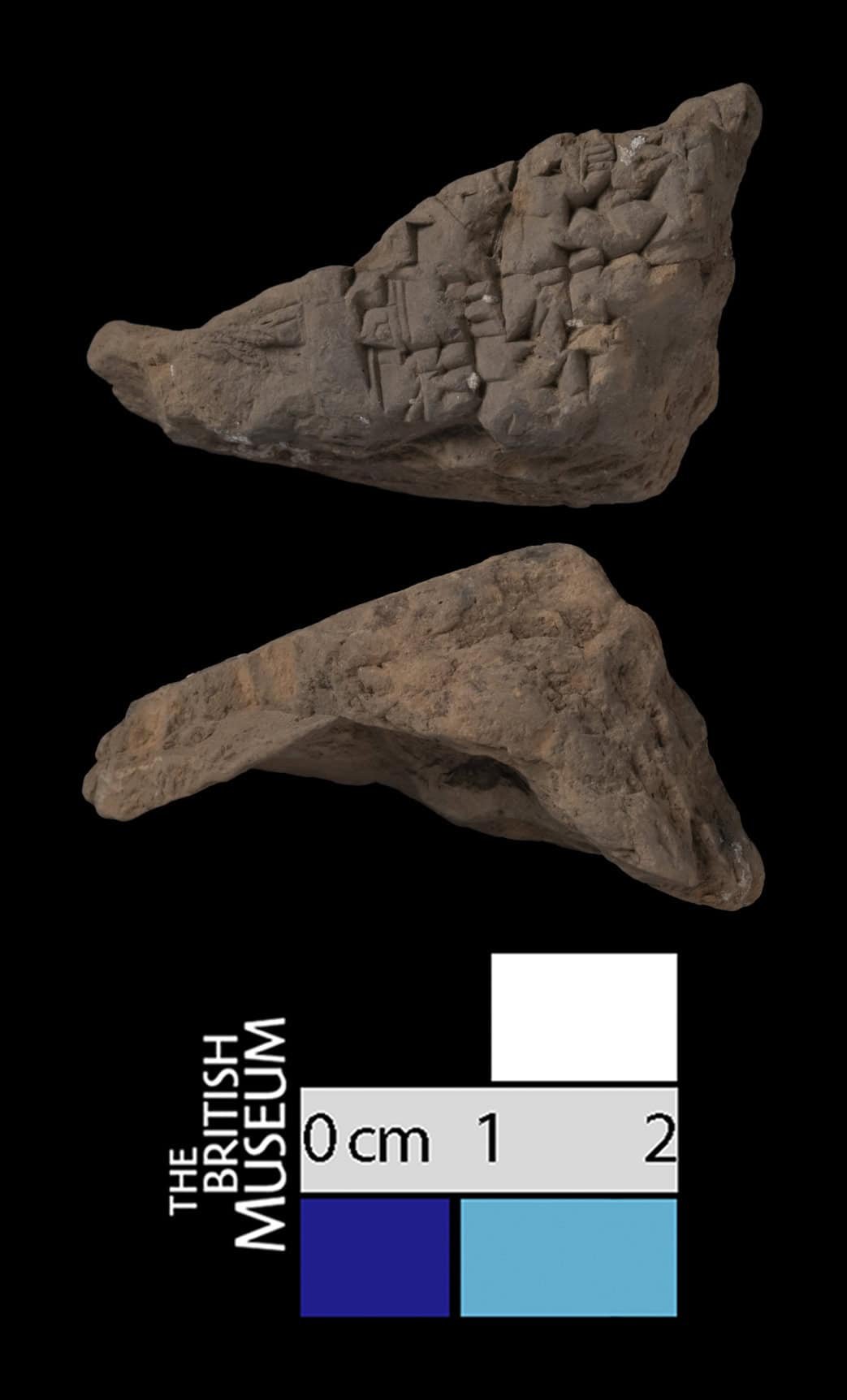
British Museum 2024,6004.283: reverse, the tablet's own lines 1' to 4'. eBL's corpus edition (https://www.ebl.lmu.de/corpus/L/2/2/SB/III) attributes SB III 84-87 to this manuscript at these column and line numbers. Photograph checked: two views of a small wedge-shaped fragment about 2 cm long, no ink number visible; the upper view carries about five lines of signs, the lower view is broken surface. Consistent with eBL's five reverse lines. On this tablet of lines 84-85 only one to three signs survive and lines 86-87 are partly broken (square brackets and x in the Akkadian). The English of these lines translates eBL's composite text, so it includes words that are not preserved on this tablet but are restored from other manuscripts or by the editors. Square brackets in the English mark eBL's restorations in its composite text; words that survive on other tablets carry no brackets even where this tablet is broken.
84[x x x x x x x x x x | us-sa]k-ki#-k[a x x x]
85[x x x x x x | i]p-te#-ti [x x x x]
86[x x x x x x um-m]i | u₂-nap#-pi-q[u x x x x]
87[x x x x x mi-hi-iṣ-ta-šu-m]a | a-nap-pu-u[š x x (x)]
84My ears, which were stopped and clogged like a deaf man’s,
85He removed their blockage, he opened my hearing.
86My nose, whose bre[athing] was choked by symptoms of fever,
87He soothed its affliction so I could breathe [freely].
Where on the image
British Museum BM.54821: reverse, the tablet's own lines 4' to 10'. eBL's corpus edition (https://www.ebl.lmu.de/corpus/L/2/2/SB/III) attributes SB III 88-94 to this manuscript at these column and line numbers. Photograph checked: obverse, reverse and edges, inks 54821 and 82-5-25,1150 on the edge. About 15 to 17 lines on each face, consistent with eBL's obverse 17 and reverse 15. On this tablet of lines 88, 93 only one to three signs survive and lines 89-92, 94 are partly broken (square brackets and x in the Akkadian). The English of these lines translates eBL's composite text, so it includes words that are not preserved on this tablet but are restored from other manuscripts or by the editors. Square brackets in the English mark eBL's restorations in its composite text; words that survive on other tablets carry no brackets even where this tablet is broken.
88šap-ta-a#-[a x x x x x x x x x (x)]
89ik-pur pul-ha[t-si-na x x x x x x]
90pi-ia ša₂ u[k-ta-at-ti-mu x x x x x]
91[i]m-šu-uš k[i-ma x x x x x x x x]
92[ši]n-na-a-a# [x x x x x x x x x x x]
93ip#-ti bi-[rit-si-na-ma x x x x x x x]
94li-ša₂-nu š[a₂ x x x x x x x x x x x x]
88My babbling lips, which had taken on [a crust],
89He wiped away their sores and und[id] their deformation.
90My mouth, which was hard shut, so that proper speech was diffi[cult],
91He scoured like a metal pot, he made its filthy (inside) [gleaming].
92My teeth, which were clenched, locked together firmly,
93[He op]ened their fastening, […] their roots.
94My tongue, which was tied so it [could] not converse,
Where on the image
British Museum BM.55481: reverse, the tablet's own lines 6' to 18'. eBL's corpus edition (https://www.ebl.lmu.de/corpus/L/2/2/SB/III) attributes SB III 95-107 to this manuscript at these column and line numbers. Photograph checked: obverse, reverse and edges, inks 55481 and 82-7-4,54. About 20 lines on the obverse and about 17 on the reverse, consistent with eBL's obverse 21 and reverse 19. On this tablet of line 97 only one to three signs survive and lines 95-96, 98-107 are partly broken (square brackets and x in the Akkadian). The English of these lines translates eBL's composite text, so it includes words that are not preserved on this tablet but are restored from other manuscripts or by the editors. Square brackets in the English mark eBL's restorations in its composite text; words that survive on other tablets carry no brackets even where this tablet is broken.
95[x x x ṭ]u-pu-uš-ta-ša₂#-m[a | x x x x x x x]
96[x x x] ša₂# in-ne₂-es-ru | u₂#-[nap-pi-qu x x x]
97[x x x] i-rit-ti | [x x x x x x x x]
98[x x x x] u₂-tap-pi-qu | l[a x x x x x x]
99[x x x] i-šir₂-ma | i#-[dil-taš x x]
100[x x x x (x) š]u-u₂-lu un-ni-šu₂ | i#-[n]ag-g[a?-ga? x x x x x]
101[x x (x) ki]t?-mur-ti e-liš | i-šap-p[i-ik? x x x x (x)]
102[(x) x š]a₂ u₂-tam-mi-lu | ha-ra-r[i?-iš? x x x x x x x (x)]
103[x x x (x)] x-ta-šu₂ | ṣa-ba-ru x [x x x (x)]
104[x x x x x u]n-ṣu ut-tar-ru-u₂ | ki-i pi-ša₂-a[n-ni x x x]
105[...] a pad | sah-ha-šu [x x x x]
106[i-mah-ha]r ip#-te#-nu# | u₂-ba[l-la? x x x]
107[x x (x) u]z-za-ʾi#-[zu] | at-hu-u₂#-[a? x x x]
95[He] wiped off its coating and my speech became fluent.
96My throat, which was tight and choking, as though on a gobbet,
97He made fair my songs, which it warbled like a flute.
98My [gul]let, which was swollen so it could not take [food],
99Its swelling went down and he opened its obstruction.
100My [lungs], which coughing had weakened and were rasping […]
101The accumulated [phlegm] on top he drained out [below].
102[My manliness], which had lost confidence, [was broken off ] like a palm shoot,
103[He … its … ], … […]
104My intestine, which, long empty for lack of food, had coiled tight as a basket,
105[He …] its bloating, […],
106It would accept nourishment, hold drink.
107[My possessions], which had been parceled out, my companions [recovered],
Where on the image
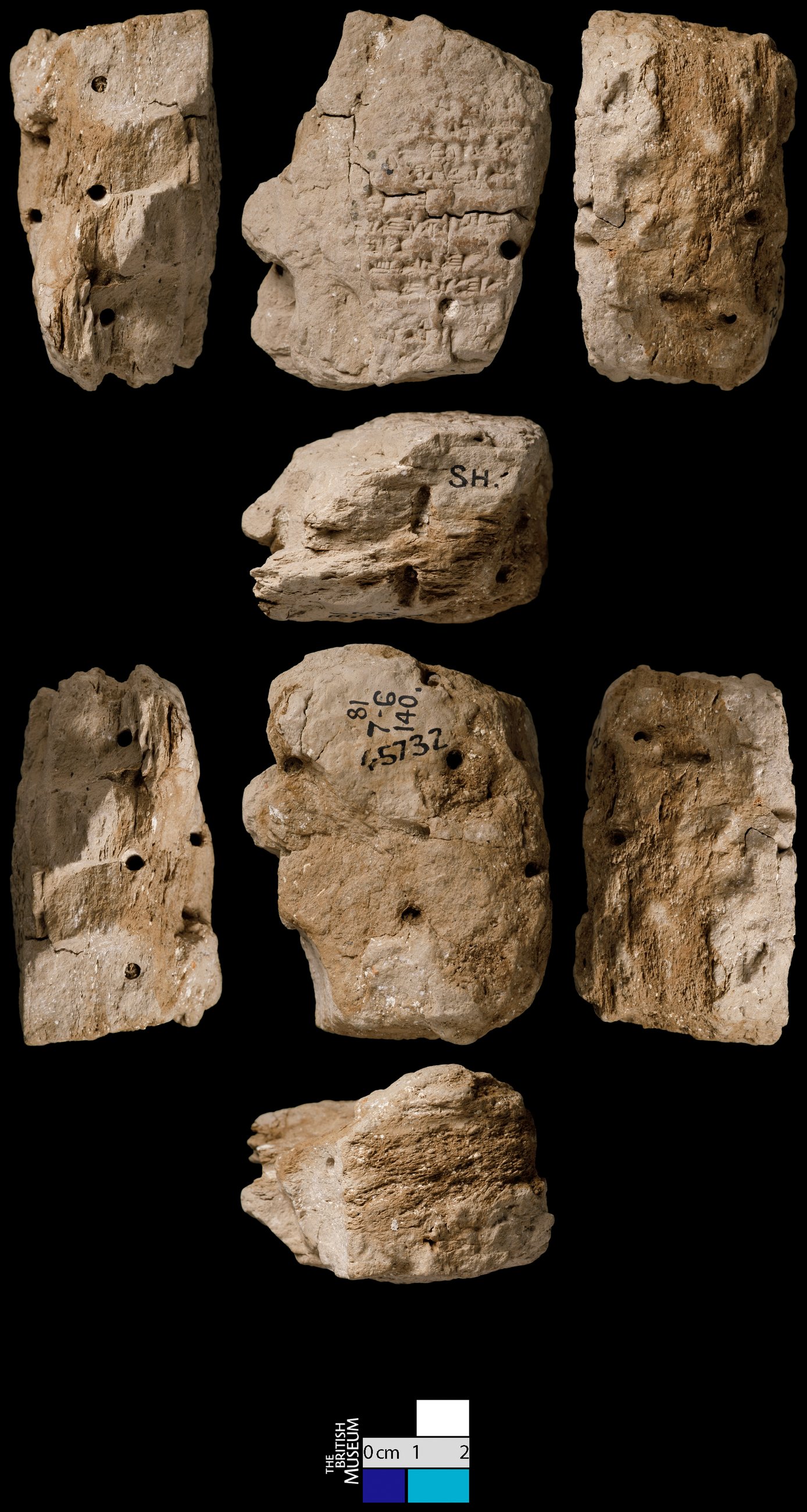
British Museum BM.45732: reverse, the tablet's own lines 10' to 12'. eBL's corpus edition (https://www.ebl.lmu.de/corpus/L/2/2/SB/III) attributes SB III 108-110 to this manuscript at these column and line numbers. Photograph checked: both faces of a fragment about 3.5 cm across, inks 45732 and 81-7-6,140 on the blank face. About 10 lines on the inscribed face (upper lines faint), consistent with eBL's reverse 12. On this tablet of line 110 only illegible traces (x) survive and of lines 108-109 only one to three signs survive. The English of these lines translates eBL's composite text, so it includes words that are not preserved on this tablet but are restored from other manuscripts or by the editors. Square brackets in the English mark eBL's restorations in its composite text; words that survive on other tablets carry no brackets even where this tablet is broken.
108[...] l[u? ...]
109[... (x x)-e]n-na-a?# [...]
110[...] x [...]
108[…] … […]
109[…] … […]
110[…] … […]
Where on the image
British Museum BM.48732: reverse, the tablet's own lines 1' to 8'. eBL's corpus edition (https://www.ebl.lmu.de/corpus/L/2/2/SB/III) attributes SB III 113-120 to this manuscript at these column and line numbers. Photograph checked: obverse, reverse and edges of a narrow fragment, ink 48732. About 11 lines on one face and 8 or 9 on the other, consistent with eBL's obverse 13 and reverse 8 + 1. On this tablet of lines 113, 115-117, 119-120 only one to three signs survive and lines 114, 118 are partly broken (square brackets and x in the Akkadian). The English of these lines translates eBL's composite text, so it includes words that are not preserved on this tablet but are restored from other manuscripts or by the editors. Square brackets in the English mark eBL's restorations in its composite text; words that survive on other tablets carry no brackets even where this tablet is broken. eBL gives no English for line(s) 113, 114, 115, 116, 117, 119, 120.
113[...]-k[a-x]-x
114[...]-gu im-[l]a-a i#-hu#-zu?#
115[...] (erasure)-az
116[...]-x-šur/pad
117[... ṣ]u iš aš₂
118[x x x x x x x x x x x x] ṣu-pur!(NIG₂)-a-a
119[...]-x-nu pi?-ia?
120[... i]k?-ri-iṣ
113(no English for this line in the eBL edition)
114(no English for this line in the eBL edition)
115(no English for this line in the eBL edition)
116(no English for this line in the eBL edition)
117(no English for this line in the eBL edition)
118He pared my nails, which were like the overgrowth of an outcast
119(no English for this line in the eBL edition)
120(no English for this line in the eBL edition)
Notes
- Akkadian: eBL transliteration of the signs on the photographed tablet (manuscript-level ATF), not a composite text.
- English: B. R. Foster's translation in the eBL edition; it renders eBL's composite text, including restorations from other tablets.
- Line numbers: eBL edition. Each section also gives the tablet's own column and line numbers.
- Signs in the Akkadian: [ ] broken away; x illegible sign; # damaged sign; ? uncertain reading; ! sign corrected by the editor; * collated sign; ... broken signs of unknown number; ( ) signs perhaps broken away; { } determinative; << >> sign written in error by the scribe; / alternative readings; | division between the parts of a line written in separate columns on the tablet.
Cite
Sources
- Source: British Museum tablet photographs + eBL manuscript transliterations (eBL corpus edition L II.2, Righteous Sufferer (Ludlul bel nemeqi) (ed. A. Hätinen), SB III) + English of the eBL edition (B. R. Foster (eBL edition)) (holding institution)
- Critical edition: electronic Babylonian Library, Righteous Sufferer (Ludlul bel nemeqi) (ed. A. Hätinen), manuscript transliterations
← previous · → next · v cycle view · l back to library