1 Esdras, Chapter 3 (Codex Alexandrinus)
Introduction
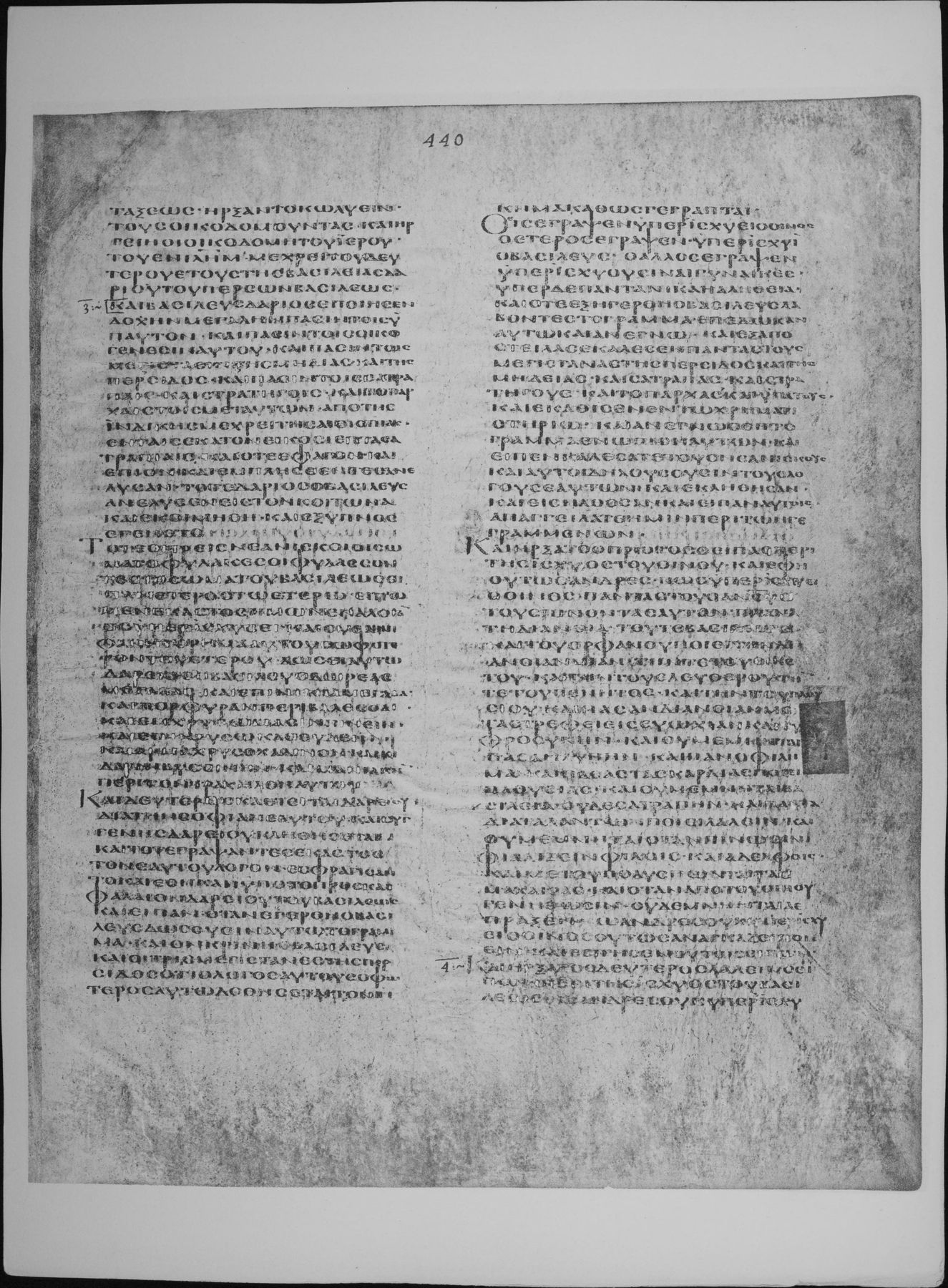
1 Esdras 3 in the Greek Old Testament (the Septuagint) as written in Codex Alexandrinus, a Greek Bible copied in the fifth century, probably in Egypt, and now in the British Library (Royal MS 1 D. VI, the second of its four volumes). It is one of the three great early codices of the whole Greek Bible, with Codex Vaticanus and Codex Sinaiticus.
Numbering: Swete's Greek and Brenton's English number or divide some verses of this chapter differently (Swete 3:16 = Brenton 3:16-17; Swete 3:17-23 = Brenton 3:18-24). Each column keeps its own verse numbers, and sections are cut only where the two texts agree, so each section holds the same passage in both languages.
This entry meets the strict three-criteria standard of the Theosis Library:
- Manuscript scan: the page of Codex Alexandrinus carrying this chapter (fol. 440r), from the full-size photographic (autotype) facsimile published by the British Museum in 1879-1883, as digitised on the Internet Archive. The verse range of every page comes from the reduced photographic facsimile of 1957, which prints it beneath each plate, and the opening words of every page were read on the plate to confirm the page and the verse it begins with. Each section links to the page or pages that hold its verses. Folio numbers are those written at the head of each leaf and visible on the plates.
- Original text: Swete's edition, which here prints the text of Codex Vaticanus (Vat. gr. 1209), the base of his edition, and gives the readings of Alexandrinus only in his apparatus. The Greek column is therefore Vaticanus' text; where Alexandrinus differs, the plate shows what Alexandrinus reads.
- English translation: Sir Lancelot C. L. Brenton, The Septuagint Version of the Old Testament (1844; 1851 edition), a translation of the Greek, public domain, from the eBible.org text.
How was this verified? (Provenance)
Where on the image
1 Esdras 3:1-8 is on fol. 440r (full-size facsimile of 1879-83, Internet Archive codex-alexandrinus leaf 904). The 1957 reduced facsimile prints beneath this page: 1 Esdras ii. 25 (30)-iv. 2. Checked on the plate: the page begins inside 1 Esdras 2:25 (first words read: ΤΑΞΕΩΣ ΗΡΞΑΝΤΟ ΚΩΛΥΕΙΝ ΤΟΥΣ ΟΙΚΟΔΟΜΟΥΝΤΑΣ ΚΑΙ ΗΡΓΕΙ Η ΟΙΚΟΔΟΜΗ ΤΟΥ ΙΕΡΟΥ).
1Καὶ βασιλεὺς Δαρεῖος ἐποίησεν δοχὴν μεγάλην πᾶσιν τοῖς ὑπ᾽ αὐτόν, καὶ πᾶσιν τοῖς οἰκογενέσιν αὐτοῦ, καὶ πᾶσιν τοῖς μεγιστᾶσιν τῆς Μηδείας καὶ τῆς Περσίδος, 2καὶ πᾶσιν τοῖς σατράπαις καὶ στρατηγοῖς καὶ τοπάρχαις τοῖς ὑπ᾽ αὐτὸν ἀπὸ τῆς Ἰνδικῆς μέχρι Αἰθιοπίας ἐν ταῖς ἑκατὸν εἴκοσι ἑπτὰ σατραπείαις. 3καὶ ἐφάγοσαν καὶ ἐπίοσαν, καὶ ἐμπλησθέντες ἀνέλυσαν· ὁ δὲ Δαρεῖος ὁ βασιλεὺς ἀνέλυσεν εἰς τὸν κοιτῶνα καὶ ἐκοιμήθη, καὶ ἔξυπνος ἐγένετο. 4τότε οἱ τρεῖς νεανίσκοι οἱ σωματοφύλακες, οἱ φυλάσσοντες τὸ σῶμα τοῦ βασιλέως, εἶπαν ἕτερος πρὸς τὸν ἕτερον 5Εἴπωμεν ἕκαστος ἡμῶν ἕνα λόγον ὃς ὑπερισχύσει· καὶ οὗ ἂν φανῇ τὸ ῥῆμα αὐτοῦ σοφώτερον τοῦ ἑτέρου, δώσει αὐτῷ Δαρεῖος ὁ βασιλεὺς δωρεὰς μεγάλας καὶ ἐπινίκια μεγάλα, 6καὶ πορφύραν περιβαλέσθαι καὶ ἐν χρυσώμασιν πίνειν καὶ ἐπὶ χρυσῷ καθεύδειν καὶ ἅρμα χρυσοχάλινον καὶ κίδαριν βυσσίνην καὶ μανιάκην περὶ τὸν τράχηλον, 7καὶ δεύτερος καθιεῖται Δαρείου διὰ τὴν σοφίαν αὐτοῦ, καὶ συγγενὴς Δαρείου κληθήσεται. 8καὶ τότε γράψαντες ἕκαστος τὸν ἑαυτοῦ λόγον ἐσφραγίσαντο καὶ ἔθηκαν ὑπὸ τὸ προσκεφάλαιον Δαρείου τοῦ βασιλέως, καὶ εἶπαν
1Now when Darius reigned, he made a great feast unto all his subjects, and unto all his household, and unto all the princes of Media and Persia, 2and to all the governors and captains and lieutenants that were under him, from India unto Ethiopia, in the hundred twenty and seven provinces. 3And when they had eaten and drunken, and being satisfied were gone home, then Darius the king went into his bedchamber, and slept, and soon after awaked. 4Then three young men, that were of the guard that kept the king's body, spake one to another; 5Let every one of us speak a sentence: he that shall overcome, and whose sentence shall seem wiser than the others, unto him shall the king Darius give great gifts, and great things in token of victory: 6as to be clothed in purple, to drink in gold, and to sleep upon gold, and a chariot with bridles of gold, and an headtire of fine linen, and a chain about his neck: 7and he shall sit next to Darius because of his wisdom, and shall be called Darius's cousin. 8And then every one wrote his sentence, sealed it, and laid it under the pillow of king Darius;
Where on the image
1 Esdras 3:9-16 is on fol. 440r (full-size facsimile of 1879-83, Internet Archive codex-alexandrinus leaf 904). The 1957 reduced facsimile prints beneath this page: 1 Esdras ii. 25 (30)-iv. 2. Checked on the plate: the page begins inside 1 Esdras 2:25 (first words read: ΤΑΞΕΩΣ ΗΡΞΑΝΤΟ ΚΩΛΥΕΙΝ ΤΟΥΣ ΟΙΚΟΔΟΜΟΥΝΤΑΣ ΚΑΙ ΗΡΓΕΙ Η ΟΙΚΟΔΟΜΗ ΤΟΥ ΙΕΡΟΥ).
9Ὅταν ἐγερθῇ ὁ βασιλεύς, δώσουσιν αὐτῷ τὸ γράμμα· καὶ ὃν ἂν κρίνῃ ὁ βασιλεὺς καὶ οἱ τρεῖς μεγιστᾶνες τῆς Περσίδος ὅτι οὗ ὁ λόγος αὐτοῦ σοφώτερος, αὐτῷ δοθήσεται τὸ νῖκος, καθὼς γέγραπται. 10ὁ εἷς ἔγραψεν Ὑπερισχύει ὁ οἶνος. 11ὁ ἕτερος ἔγραψεν Ὑπερισχύει ὁ βασιλεύς. 12ὁ τρίτος ἔγραψεν Ὑπερισχύουσιν αἱ γυναῖκες, ὑπὲρ δὲ πάντα νικᾷ ἡ ἀλήθεια. 13καὶ ὅτε ἐξηγέρθη ὁ βασιλεύς, λαβόντες τὸ γράμμα ἔδωκαν αὐτῷ, καὶ ἀνέγνω. 14καὶ ἐξαποστείλας ἐκάλεσεν πάντας τοὺς μεγιστᾶνας τῆς Περσίδος καί τῆς Μηδείας καὶ σατράπας καὶ στρατηγοὺς καὶ τοπάρχας καὶ ὑπάτους, καὶ ἐκάθισεν ἐν τῷ χρηματιστηρίῳ, καὶ ἀνεγνώσθη τὸ γράμμα ἐνώπιον αὐτῶν. 15καὶ εἶπεν Καλέσατε τοὺς νεανίσκους, καὶ αὐτοὶ δηλώσουσιν τοὺς λόγους αὐτῶν· καὶ ἐκλήθησαν, καὶ εἰσήλθοσαν. 16καὶ εἶπαν αὐτοῖς Ἀπαγγείλατε ἡμῖν περὶ τῶν γεγραμμένων. Καὶ ἤρξατο ὁ πρῶτος ὁ εἴπας περὶ τῆς ἰσχύος τοῦ οἴνου, καὶ ἔφη οὕτως
9and said that, when the king is risen, some will give him the writing; and of whose side the king and the three princes of Persia shall judge that his sentence is the wisest, to him shall the victory be given, as was appointed. 10The first wrote, Wine is the strongest. 11The second wrote, The king is strongest. 12The third wrote, Women are strongest: but above all things Truth beareth away the victory. 13Now when the king was risen up, they took their writings, and delivered them unto him, and so he read them: 14and sending forth he called all the princes of Persia and Media, and the governors, and the captains, and the lieutenants, and the chief officers; 15and sat him down in the royal seat of judgment; and the writing was read before them. 16And he said, Call the young men, and they shall declare their own sentences. So they were called, and came in. 17And he said unto them, Declare unto us your mind concerning the writings.
Where on the image
1 Esdras 3:17-23 is on fol. 440r (full-size facsimile of 1879-83, Internet Archive codex-alexandrinus leaf 904). The 1957 reduced facsimile prints beneath this page: 1 Esdras ii. 25 (30)-iv. 2. Checked on the plate: the page begins inside 1 Esdras 2:25 (first words read: ΤΑΞΕΩΣ ΗΡΞΑΝΤΟ ΚΩΛΥΕΙΝ ΤΟΥΣ ΟΙΚΟΔΟΜΟΥΝΤΑΣ ΚΑΙ ΗΡΓΕΙ Η ΟΙΚΟΔΟΜΗ ΤΟΥ ΙΕΡΟΥ).
17Ἄνδρες, πῶς ὑπερισχύει ὁ οἶνος. πάντας τοὺς ἀνθρώπους τοὺς πιόντας αὐτὸν πλανᾷ τὴν διάνοιαν, 18τοῦ τε βασιλέως καὶ τοῦ ὀρφανοῦ ποιεῖ τὴν διάνοιαν μίαν, τήν τε τοῦ οἰκέτου καὶ τὴν τοῦ ἐλευθέρου, τήν τε τοῦ πένητος καὶ τὴν τοῦ πλουσίου· 19καὶ πᾶσαν διάνοιαν μεταστρέφει εἰς εὐωχίαν καὶ εὐφροσύνην, καὶ οὐ μέμνηται πᾶσαν λύπην καὶ πᾶν ὀφείλημα· 20καὶ πάσας καρδίας ποιεῖ πλουσίας, καὶ οὐ μέμνηται βασιλέα οὐδὲ σατράπην· καὶ πάντα διὰ ταλάντων ποιεῖ λαλεῖν. 21καὶ οὐ μέμνηται ὅταν πίνωσιν φιλιάζειν φίλοις καὶ ἀδελφοῖς, καὶ μετ᾽ οὐ πολὺ σπῶνται μαχαίρας· 22καὶ ὅταν ἀπὸ τοῦ οἴνου ἐγερθῶσιν, οὐ μέμνηται ἃ ἔπραξαν. 23ὦ ἄνδρες, οὐχ ὑπερισχύει ὁ οἶνος ὅτι οὕτως ἀναγκάζει ποιεῖν; καὶ ἐσίγησεν οὕτως εἴπας.
18and he said thus, O ye men, how exceeding strong is wine! it causeth all men to err that drink it: 19it maketh the mind of the king and of the fatherless child to be all one; of the bondman and of the freeman, of the poor man and of the rich: 20it turneth also every thought into jollity and mirth, so that a man remembereth neither sorrow nor debt: 21and it maketh every heart rich, so that a man remembereth neither king nor governor; and it maketh to speak all things by talents: 22and when they are in their cups, they forget their love both to friends and brethren, and a little after draw out swords: 23but when they are from the wine, they remember not what they have done. 24O ye men, is not wine the strongest, that enforceth to do thus? And when he had so spoken, he held his peace.
Cite
Sources
- Source: Codex Alexandrinus (British Library Royal MS 1 D. VI) via the British Museum photographic facsimiles of 1879-83 and 1957 (Internet Archive) + Swete's Septuagint + Brenton's English (holding institution)
- Critical edition: H. B. Swete, The Old Testament in Greek according to the Septuagint (1909)
← previous · → next · v cycle view · l back to library