3 Maccabees, Chapter 1 (Codex Alexandrinus)
Introduction
3 Maccabees 1 in the Greek Old Testament (the Septuagint) as written in Codex Alexandrinus, a Greek Bible copied in the fifth century, probably in Egypt, and now in the British Library (Royal MS 1 D. VI, the second of its four volumes). It is one of the three great early codices of the whole Greek Bible, with Codex Vaticanus and Codex Sinaiticus.
Numbering: Swete's Greek and Brenton's English number or divide some verses of this chapter differently (Swete 1:29 = Brenton 1:29-2:1). Each column keeps its own verse numbers, and sections are cut only where the two texts agree, so each section holds the same passage in both languages.
This entry meets the strict three-criteria standard of the Theosis Library:
- Manuscript scan: the pages of Codex Alexandrinus carrying this chapter (fol. 506v, fol. 507r, fol. 507v), from the full-size photographic (autotype) facsimile published by the British Museum in 1879-1883, as digitised on the Internet Archive. The verse range of every page comes from the reduced photographic facsimile of 1957, which prints it beneath each plate, and the opening words of every page were read on the plate to confirm the page and the verse it begins with. Each section links to the page or pages that hold its verses. Folio numbers are those written at the head of each leaf and visible on the plates.
- Original text: Swete's edition, which in the books of Maccabees prints the text of Codex Alexandrinus itself (Codex Vaticanus does not contain these books), with the readings of other manuscripts in his apparatus. Swete adds accents, breathings and punctuation and expands the abbreviated sacred names, so the plate shows the same text in unaccented capitals.
- English translation: Sir Lancelot C. L. Brenton, The Septuagint Version of the Old Testament (1844; 1851 edition), a translation of the Greek, public domain, from the eBible.org text.
How was this verified? (Provenance)
Where on the image
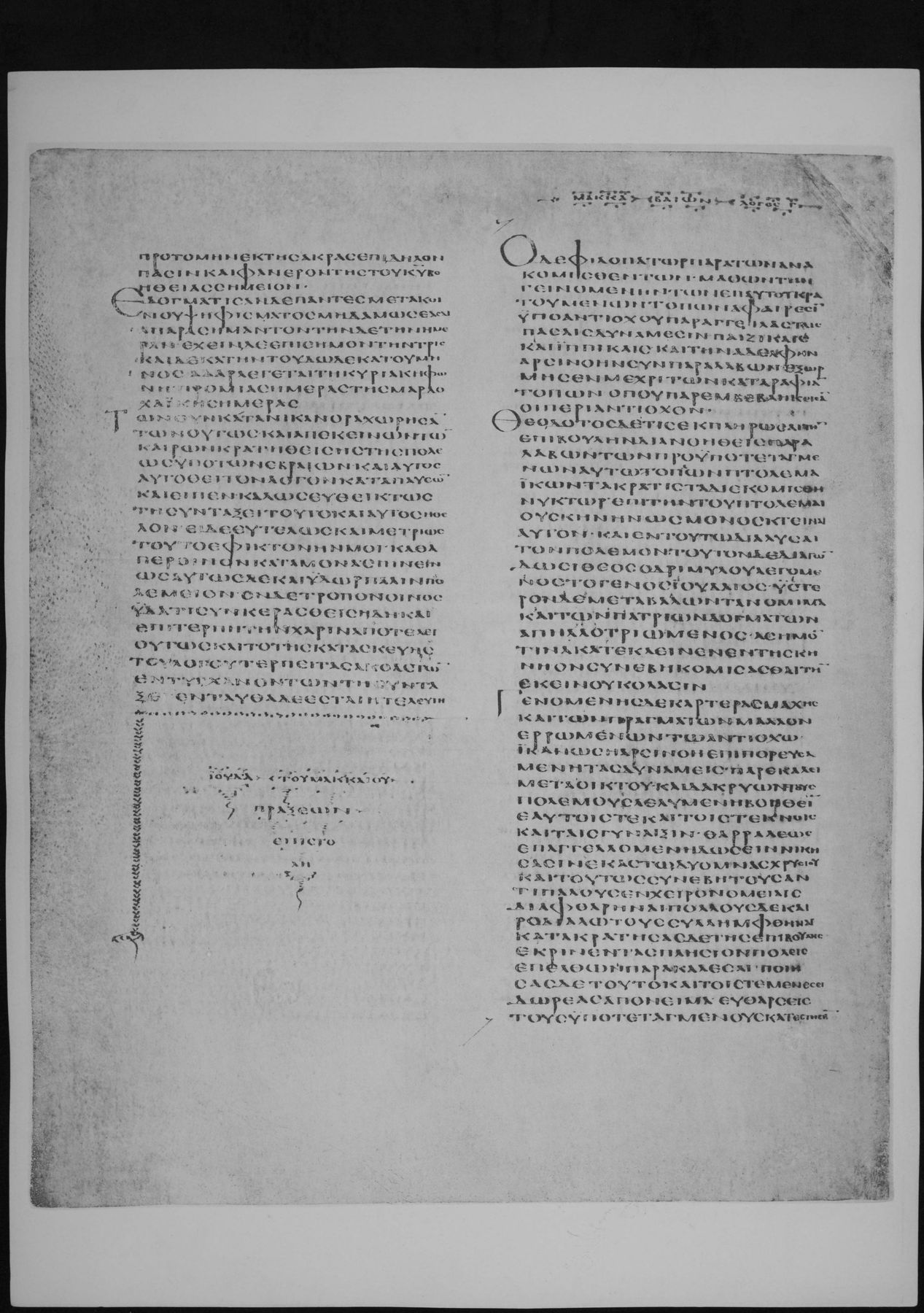
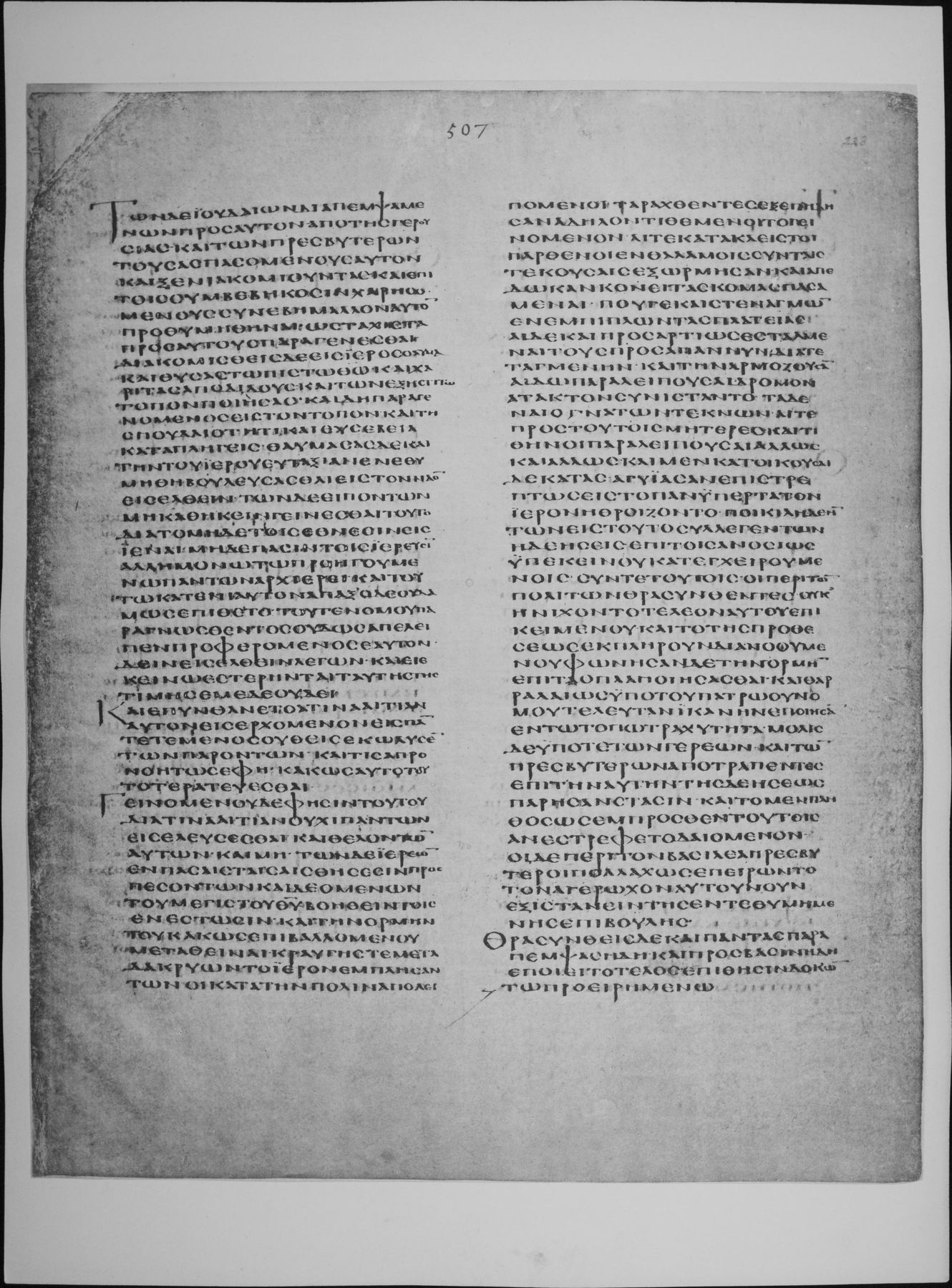
3 Maccabees 1:1-7 is on fol. 506v (full-size facsimile of 1879-83, Internet Archive codex-alexandrinus leaf 1019). The 1957 reduced facsimile prints beneath this page: 2 Maccabees xv. 35-xv. 39 [end], 3 Maccabees i. 1-i. 7. Checked on the plate: the page begins inside 2Ma 15:35 (first words read: ΠΡΟΤΟΜΗΝ ΕΚ ΤΗΣ ΑΚΡΑΣ ΕΠΙΔΗΛΟΝ ΠΑΣΙΝ ΚΑΙ ΦΑΝΕΡΟΝ ΤΗΣ ΤΟΥ ΚΥ ΒΟΗΘΕΙΑΣ ΣΗΜΕΙΟΝ). 3 Maccabees 1:8 is on fol. 507r (full-size facsimile of 1879-83, Internet Archive codex-alexandrinus leaf 1020). The 1957 reduced facsimile prints beneath this page: 3 Maccabees i. 8-i. 26. Checked on the plate: the page begins at the start of 3 Maccabees 1:8 (first words read: ΤΩΝ ΔΕ ΙΟΥΔΑΙΩΝ ΔΙΑΠΕΜΨΑΜΕΝΩΝ ΠΡΟΣ ΑΥΤΟΝ ΑΠΟ ΤΗΣ ΓΕΡΟΥΣΙΑΣ ΚΑΙ ΤΩΝ ΠΡΕΣΒΥΤΕΡΩΝ).
1Ο ΔΕ Φιλοπάτωρ παρὰ τῶν ἀνακομισθέντων μαθὼν τὴν γινομένην τῶν ἐπ᾽ αὐτοῦ κρατουμένων τόπων ἀφαίρεσιν ὑπὸ Ἀντιόχου, παραγγείλας ταῖς πάσαις δυνάμεσιν πεζικαῖς καὶ ἱππικαῖς, καὶ τὴν ἀδελφὴν Ἀρσινόην συνπαραλαβών, ἐξώρμησεν μέχρι τῶν κατὰ Ῥαφίαν τόπων, ὅπου παρεμβεβλήκεισαν οἱ περὶ Ἀντίοχον. 2Θεόδοτος δέ τις ἐκπληρῶσαι τὴν ἐπιβουλὴν διανοηθείς, παραλαβὼν τῶν προυποτεταγμένων αὐτῷ ὅπλων Πτολεμαικῶν τὰ κράτιστα, διεκομίσθη νύκτωρ ἐπὶ τὴν τοῦ Πτολεμαίου σκηνήν, ὡς μόνος κτεῖναι αὐτόν, καὶ ἐν τούτῳ διαλῦσαι τὸν πόλεμον. 3τοῦτον δὲ διάγων Δωσίθεος ὁ Δριμύλου λεγόμενος, τὸ γένος Ἰουδαῖος, ὕστερον δὲ μεταβαλὼν τὰ νὸμιμα καὶ τῶν πατρίων δογμάτων ἀπηλλοτριωμένος, ἄσημόν τινα κατέκλινεν ἐν τῇ σκηνῇ, ὃν συνέβη κομίσασθαι τὴν ἐκείνου κόλασιν. 4γενομένης δὲ καρτερᾶς μάχης καὶ τῶν πραγμάτων μᾶλλον ἐρρωμένων τῷ Ἀντιόχῳ, ἱκανῶς ἡ Ἀρσινόη ἐπιπορευσαμένη τὰς δυνάμεις παρεκάλει μετὰ οἴκτου καὶ δακρύων, τοὺς πλοκάμους λελυμένη, βοηθεῖν ἑαυτοῖς τε καὶ τοῖς τέκνοις καὶ ταῖς γυναιξὶν θαρραλέως, ἐπαγγελλομένη δώσειν νικήσασιν ἑκάστῳ δύο μνᾶς χρυσίου· 5καὶ οὕτως συνέβη τοὺς ἀντιπάλους ἐν χειρονομίαις διαφθαρῆναι, πολλοὺς δὲ καὶ δοριαλώτους συλλημφθῆναι. 6κατακρατήσας δὲ τῆς ἐπιβουλῆς ἔκρινεν τὰς πλησίον πόλεις ἐπελθὼν παρακαλέσαι. 7ποιήσας δὲ τοῦτο, καὶ τοῖς τεμένεσι δωρεὰς ἀπονείμας, εὐθαρσεῖς τοὺς ὑποτεταγμένους κατέστησεν. 8Τῶν δὲ Ἰουδαίων διαπεμψαμένων πρὸς αὐτὸν ἀπὸ τῆς γερουσίας καὶ τῶν πρεσβυτέρων τοὺς ἀσπασομένους αὐτὸν καὶ ξένια κομιοῦντας καὶ ἐπὶ τοῖς συμβεβηκόσιν χαρησομένους, συνέβη μᾶλλον αὐτὸν προθυμηθῆναι, ὡς τάχιστα πρὸς αὐτοὺς παραγενέσθαι.
1Now Philopater, on learning from those who came back that Antiochus had made himself master of the places which belonged to himself, sent orders to all his footmen and horsemen, took with him his sister Arsinoe, and marched out as far as the parts of Raphia, where Antiochus and his forces encamped. 2And one Theodotus, intending to carry out his design, took with him the bravest of the armed men who had been before committed to his trust by Ptolemy, and got through at night to the tent of Ptolemy, to kill him on his own responsibility, and so to end the war. 3But Dositheus, called the son of Drimulus, by birth a Jew, afterward a renegade from the laws and observances of his country, conveyed Ptolemy away, and made an obscure person lie down in his stead in the tent. It befel this man to receive the fate which was meant for the other. 4A fierce battle then took place; and the men of Antiochus prevailing, Arsinoe continually went up and down the ranks, and with dishevelled hair, with tears and entreaties, begged the soldiers to fight manfully for themselves, their children, and wives; and promised that if they proved conquerors, she would give them two minæ of gold apiece. 5It thus fell out that their enemies were defeated in hand-to-hand encounter, and that many of them were taken prisoners. 6Having vanquished this attempt, the king then decided to proceed to the neighbouring cities, and encourage them. 7By doing this, and by making donations to their temples, he inspired his subjects with confidence. 8The Jews also sent some of their council and of their elders to him. The greetings, guest-gifts, and congratulations on the past, bestowed by them, filled him with the greater eagerness to visit their city.
Where on the image
3 Maccabees 1:9-16 is on fol. 507r (full-size facsimile of 1879-83, Internet Archive codex-alexandrinus leaf 1020). The 1957 reduced facsimile prints beneath this page: 3 Maccabees i. 8-i. 26. Checked on the plate: the page begins at the start of 3 Maccabees 1:8 (first words read: ΤΩΝ ΔΕ ΙΟΥΔΑΙΩΝ ΔΙΑΠΕΜΨΑΜΕΝΩΝ ΠΡΟΣ ΑΥΤΟΝ ΑΠΟ ΤΗΣ ΓΕΡΟΥΣΙΑΣ ΚΑΙ ΤΩΝ ΠΡΕΣΒΥΤΕΡΩΝ).
9διακομισθεὶς δὲ εἰς Ἰεροσόλυμα, καὶ θύσας τῷ πιστῷ θεῷ καὶ χάριτας ἀποδιδοὺς καὶ τῶν ἑξῆς τι τῷ τόπῳ ποιήσας, καὶ δὴ παραγενόμενος εἰς τὸν τόπον καὶ τῇ σπουδαιότητι καὶ εὐσεβείᾳ καταπληγείς, 10θαυμάσας δὲ καὶ τὴν τοῦ ἱεροῦ εὐταξίαν, ἐνεθυμήθη βουλεύσασθαι εἰς τὸν ναὸν εἰσελθεῖν. 11τῶν δὲ εἰπόντων μὴ καθήκειν γίνεσθαι τοῦτο, διὰ τὸ μηδὲ τοῖς ἔθνεσιν εἰσιέναι, μηδὲ πᾶσιν τοῖς ἱερεῦσιν, ἀλλ᾽ ἢ μόνῳ τῷ προηγουμένῳ πάντων ἀρχιερεῖ, καὶ τούτῳ κατ᾽ ἐνιαυτὸν ἅπαξ, ὁ δὲ οὐδαμῶς ἐπείθετο. 12τοῦ τε νόμου παραναγνωσθέντος, οὐδ᾽ ὣς ἀπέλειπεν προφερόμενος ἑαυτὸν δεῖν εἰσελθεῖν, λέγων Καὶ εἰ ἐκεῖνοι ἐστέρηνται ταύτης τῆς τιμῆς, ἐμὲ δὲ οὐ δεῖ. 13καὶ ἐπυνθάνετο διὰ τίνα αἰτίαν αὐτὸν εἰσερχόμενον εἰς πᾶν τέμενος οὐθεὶς ἐκώλυσεν τῶν παρόντων. 14καί τις ἀπρονοήτως ἔφη κακῶς αὐτὸ τοῦτο τερατεύεσθαι· 15γινομένου δέ, φησίν, τούτου, διὰ τίνα αἰτίαν οὐχὶ πάντων εἰσελεύσεσθαι, καὶ θελόντων αὐτῶν καὶ μή; 16Τῶν δὲ ἱερέων ἐν πάσαις ταῖς ἐσθήσεσιν προσπεσόντων, καὶ δεομένων τοῦ μεγίστου θεοῦ βοηθεῖν τοῖς ἐνεστῶσιν, καὶ τὴν ὁρμὴν τοῦ κακῶς ἐπιβαλλομένου μεταθεῖναι, κραυγῆς τε μετὰ δακρύων τὸ ἱερὸν ἐμπλησάντων,
9Having arrived at Jerusalem, sacrificed, and offered thank-offerings to the Greatest God, and done whatever else was suitable to the sanctity of the place, and entered the inner court, 10he was so struck with the exact magnificence of the place, and so wondered at the orderly arrangements of the temple, that he conceived the purpose of entering the sanctuary itself. 11And when they told him that this was not permissible, none of the nation, no, nor even the priests in general, but only the supreme high priest of all, and he only once in a year, being allowed to go in, he would by no means give way. 12Then they read the law to him; but he persisted in obtruding himself, exclaiming, that he ought to be allowed: and saying, Be it that they were deprived of this honour, I ought not to be. 13And he put the question, Why, when he entered all temples, none of the priests who were present forbad him? 14He was thoughtlessly answered by some one, That he did wrong to boast of this. 15Well; since I have done this, said he, be the cause what it may, shall I not enter with or without your consent? 16And when the priests fell down in their sacred vestments imploring the Greatest God to come and help in time of need, and to avert the violence of the fierce aggressor, and when they filled the temple with lamentations and tears,
Where on the image
3 Maccabees 1:17-24 is on fol. 507r (full-size facsimile of 1879-83, Internet Archive codex-alexandrinus leaf 1020). The 1957 reduced facsimile prints beneath this page: 3 Maccabees i. 8-i. 26. Checked on the plate: the page begins at the start of 3 Maccabees 1:8 (first words read: ΤΩΝ ΔΕ ΙΟΥΔΑΙΩΝ ΔΙΑΠΕΜΨΑΜΕΝΩΝ ΠΡΟΣ ΑΥΤΟΝ ΑΠΟ ΤΗΣ ΓΕΡΟΥΣΙΑΣ ΚΑΙ ΤΩΝ ΠΡΕΣΒΥΤΕΡΩΝ).
17οἱ κατὰ τὴν πόλιν ἀπολειπόμενοι ταραχθέντες ἐξεπήδησαν, ἄδηλον τιθέμενοι τὸ γινόμενον. 18αἵ τε κατάκλειστοι παρθένοι ἐν θαλάμοις σὺν ταῖς τεκούσαις ἐξώρμησαν· καὶ ἀπέδωκαν κόνει τὰς κόμας πασάμεναι, πού γε καὶ στεναγμῶν ἐνεμπίπλων τὰς πλατείας. 19αἱ δὲ καὶ προσαρτίως ἐσταλμέναι, τοὺς πρὸς ἅπαν νῦν διατεταγμένους καὶ τὴν ἁρμόζουσαν αἰδὼ παραλείπουσαι, δρόμον ἄτακτον συνίσταντο. 20τὰ δὲ νεογνὰ τῶν τέκνων αἱ πρὸς τούτοις μητέρες καὶ τιθηνοὶ παραλείπουσαι ἄλλως καὶ ἄλλως, αἱ μὲν κατ᾽ οἴκους, αἱ δὲ κατὰ τὰς ἀγυιὰς ἀνεπιστρέπτως εἰς τὸ πανυπέρτατον ἱερὸν ἠθροίζοντο. 21ποικίλη δὲ ἦν τῶν εἰς τοῦτο συλλεγέντων ἡ δέησις ἐπὶ τοῖς ἀνοσίως ὑπ᾽ ἐκείνου κατεγχειρουμένοις. 22σύν τε τούτοις οἱ περὶ τῶν πολιτῶν θρασυνθέντες οὐκ ἠνείχοντο τέλεον αὐτοῦ ἐπικειμένου καὶ τὸ τῆς προθέσεως ἐκπληροῦν διανοουμένου· 23φωνήσαντες δὲ τὴν ὁρμὴν ἐπὶ τὰ ὅπλα ποιήσασθαι, καὶ θαρραλέως ὑπὸ τοῦ πατρῴου νόμου τελευτᾷν, ἱκανὴν ἐποίησαν ἐν τῷ τόπῳ τραχύτητα, μόλις δὲ ὑπό τε τῶν γεραιῶν καὶ τῶν πρεσβυτέρων ἀποτραπέντες, ἐπὶ τὴν αὐτὴν τῆς δεήσεως παρῆσαν στάσιν. 24καὶ τὸ μὲν πλῆθος ὡς ἔμπροσθεν τούτοις ἀνεστρέφετο δεόμενον.
17then those who had been left behind in the city were scared, and rushed forth, uncertain of the event. 18Virgins, who had been shut up within their chambers, came out with their mothers, scattering dust and ashes on their heads, and filling the streets with outcries. 19Women, but recently separated off, left their bridal chambers, left the reserve that befitted them, and ran about the city in a disorderly manner. 20Newborn babes were deserted by the mothers or nurses who waited upon them; some here, some there, in houses, or in fields; these now, with an ardour which could not be checked, swarmed into the Most High temple. 21Various were the prayers offered up by those who assembled in this place, on account of the unholy attempt of the king. 22Along with these there were some of the citizens who took courage, and would not submit to his obstinacy, and his intention of carrying out his purpose. 23Calling out to arms, and to die bravely in defence of the law of their fathers, they created a great uproar in the place, and were with difficulty brought back by the aged and the elders to the station of prayer which they had occupied before. 24During this time the multitude kept on praying.
Where on the image
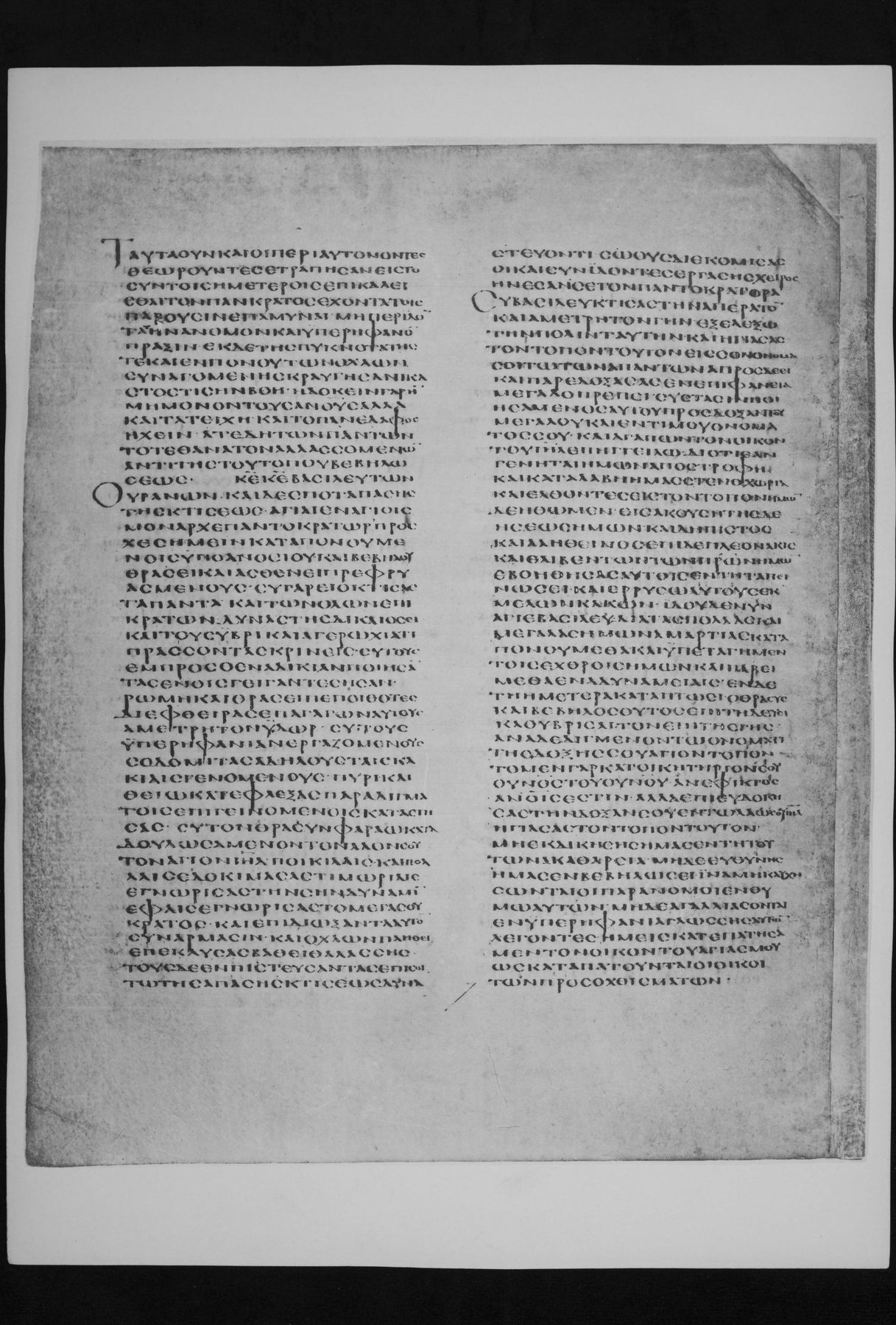
3 Maccabees 1:25-26 is on fol. 507r (full-size facsimile of 1879-83, Internet Archive codex-alexandrinus leaf 1020). The 1957 reduced facsimile prints beneath this page: 3 Maccabees i. 8-i. 26. Checked on the plate: the page begins at the start of 3 Maccabees 1:8 (first words read: ΤΩΝ ΔΕ ΙΟΥΔΑΙΩΝ ΔΙΑΠΕΜΨΑΜΕΝΩΝ ΠΡΟΣ ΑΥΤΟΝ ΑΠΟ ΤΗΣ ΓΕΡΟΥΣΙΑΣ ΚΑΙ ΤΩΝ ΠΡΕΣΒΥΤΕΡΩΝ). 3 Maccabees 1:27-29 is on fol. 507v (full-size facsimile of 1879-83, Internet Archive codex-alexandrinus leaf 1021). The 1957 reduced facsimile prints beneath this page: 3 Maccabees i. 27-ii. 18. Checked on the plate: the page begins at the start of 3 Maccabees 1:27 (first words read: ΤΑΥΤΑ ΟΥΝ ΚΑΙ ΟΙ ΠΕΡΙ ΑΥΤΟΝ ΟΝΤΕΣ ΘΕΩΡΟΥΝΤΕΣ ΕΤΡΑΠΗΣΑΝ ΕΙΣ ΤΟ ΣΥΝ ΤΟΙΣ ΗΜΕΤΕΡΟΙΣ).
25οἱ δὲ περὶ τὸν βασιλέα πρεσβύτεροι πολλαχῶς ἐπειρῶντο τὸν ἀγέρωχον αὐτοῦ νοῦν ἐξιστάνειν τῆς ἐντεθυμημένης ἐπιβουλῆς. 26θρασυνθεὶς δὲ καὶ πάντας παραπέμψας ἤδη, καὶ πρόσβασιν ἤδη ἐποιεῖτο, τέλος ἐπιθήσειν δοκῶν τῷ προειρημένῳ. 27ταῦτα οὖν καὶ οἱ περὶ αὐτὸν ὄντες θεωροῦντες ἐτράπησαν εἰς τὸ σὺν τοῖς ἡμετέροις ἐπικαλεῖσθαι τὸν πᾶν κράτος ἔχοντα τοῖς παροῦσιν ἐπαμῦναι, μὴ περιιδόντα τὴν ἄνομον καὶ ὑπερήφανον πρᾶξιν. 28ἐκ δὲ τῆς πυκνοτάτης τε καὶ ἐνπόνου τῶν ὄχλων συναγομένης κραυγῆς ἀνείκαστός τις ἦν βοή. 29δοκεῖν γὰρ ἦν μὴ μόνον τοὺς ἀνθρώπους, ἀλλὰ καὶ τὰ τείχη καὶ τὸ πᾶν ἔδαφος ἠχεῖν, ἅτε δὴ τῶν πάντων τότε θάνατον ἀλλασσομένων ἀντὶ τῆς τοῦ τόπου βεβηλώσεως.
25The elders who surrounded the king strove in many ways to divert his haughty mind from the design which he had formed. 26He, in his hardened mood, insensible to all persuasion, was going onwards, with the view of carrying out this design. 27Yet even his own officers, when they saw this, joined the Jews in an appeal to Him who has all power, to aid in the present crisis, and not wink at such overweening lawlessness. 28Such was the frequency and the vehemence of the cry of the assembled crowd, that an indescribable noise ensued. 29Not the men only, the very walls and floor seemed to sound forth; all things preferring dissolution rather than to see the place defiled. 2:1Now was it that the high priest Simon bowed his knees over against the holy place, and spread out his hands in reverent form, and uttered the following supplication:
Cite
Sources
- Source: Codex Alexandrinus (British Library Royal MS 1 D. VI) via the British Museum photographic facsimiles of 1879-83 and 1957 (Internet Archive) + Swete's Septuagint + Brenton's English (holding institution)
- Critical edition: H. B. Swete, The Old Testament in Greek according to the Septuagint (1909)
← previous · → next · v cycle view · l back to library