4 Kingdoms (2 Kings), Chapter 8 (Codex Alexandrinus)
Introduction
4 Kingdoms (2 Kings) 8 in the Greek Old Testament (the Septuagint) as written in Codex Alexandrinus, a Greek Bible copied in the fifth century, probably in Egypt, and now in the British Library (Royal MS 1 D. V, the first of its four volumes). It is one of the three great early codices of the whole Greek Bible, with Codex Vaticanus and Codex Sinaiticus.
This entry meets the strict three-criteria standard of the Theosis Library:
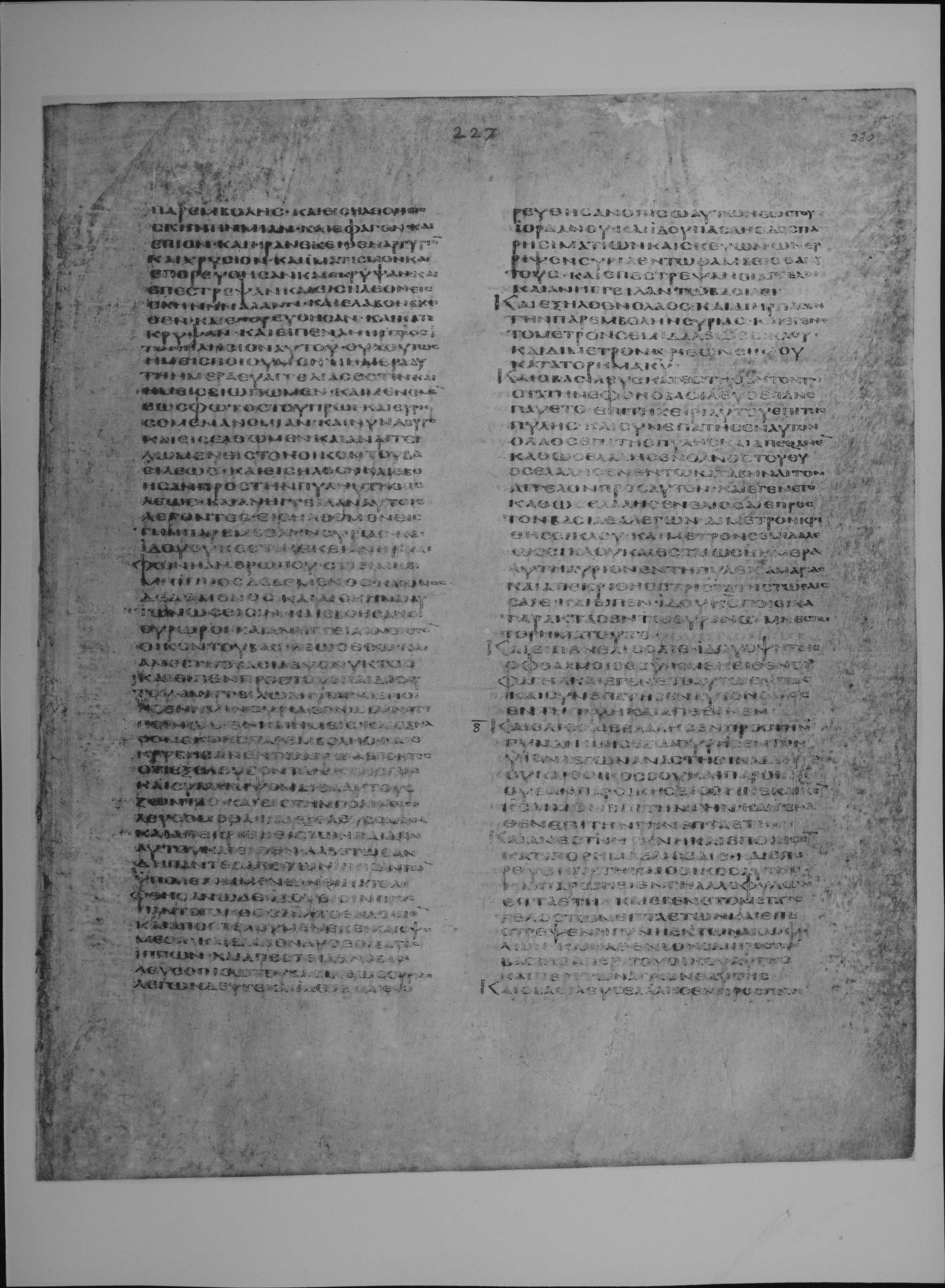
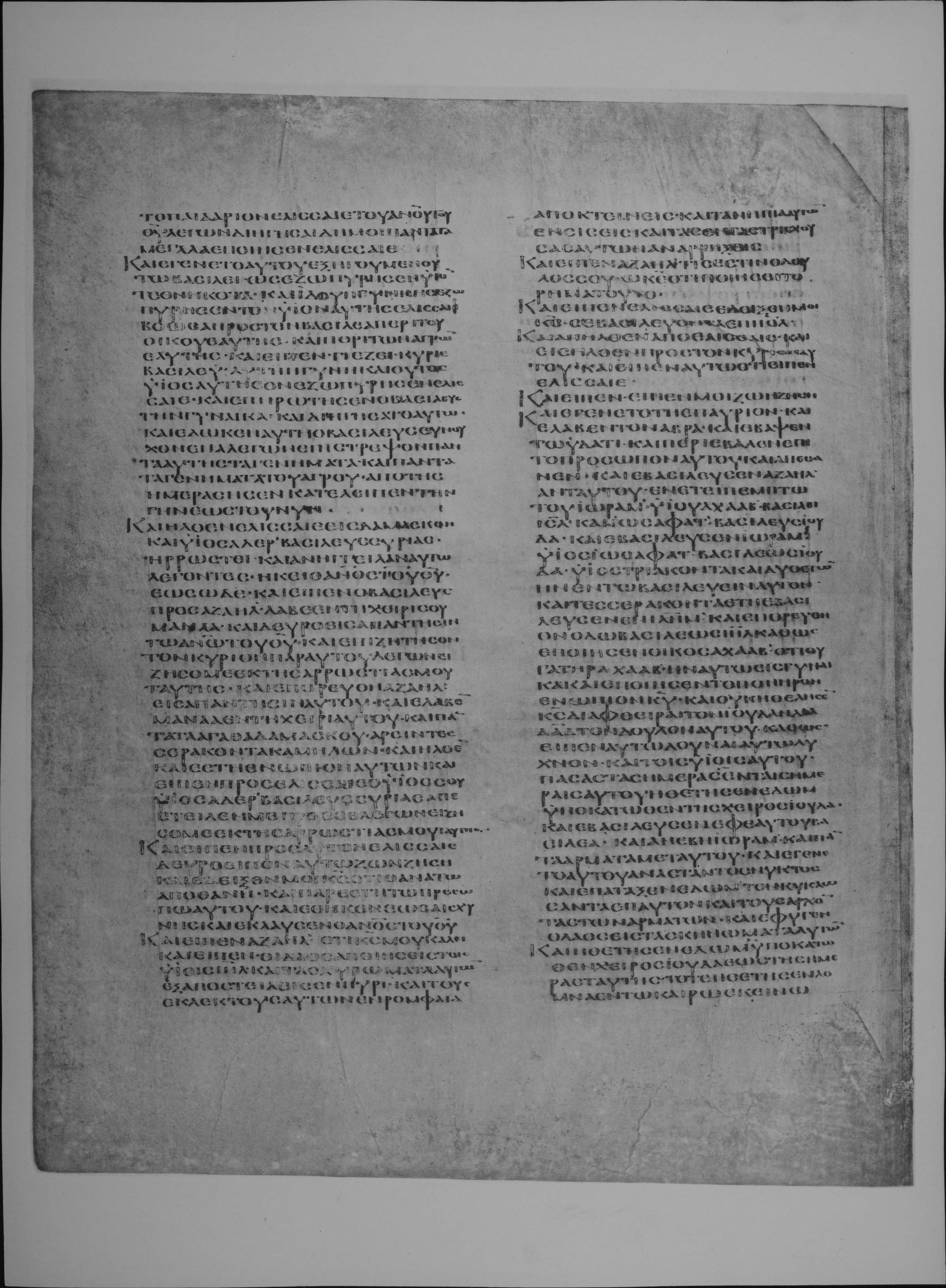
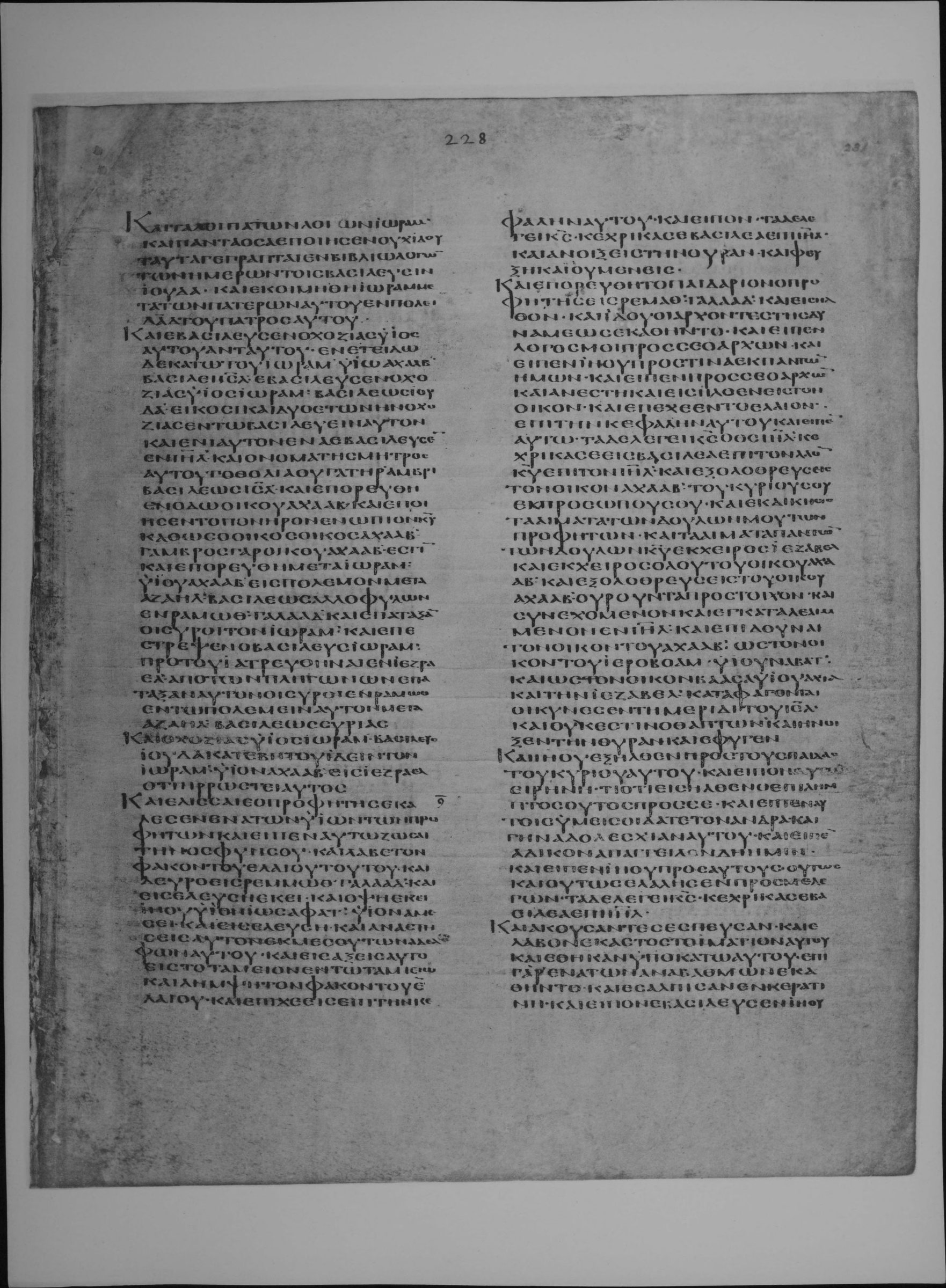
- Manuscript scan: the pages of Codex Alexandrinus carrying this chapter (fol. 227r, fol. 227v, fol. 228r), from the full-size photographic (autotype) facsimile published by the British Museum in 1879-1883, as digitised on the Internet Archive. The verse range of every page comes from the reduced photographic facsimile of 1930, which prints it beneath each plate, and the opening words of every page were read on the plate to confirm the page and the verse it begins with. Each section links to the page or pages that hold its verses. Folio numbers are those written at the head of each leaf and visible on the plates.
- Original text: Swete's edition, which here prints the text of Codex Vaticanus (Vat. gr. 1209), the base of his edition, and gives the readings of Alexandrinus only in his apparatus. The Greek column is therefore Vaticanus' text; where Alexandrinus differs, the plate shows what Alexandrinus reads.
- English translation: Sir Lancelot C. L. Brenton, The Septuagint Version of the Old Testament (1844; 1851 edition), a translation of the Greek, public domain, from the eBible.org text.
How was this verified? (Provenance)
Where on the image
4 Kingdoms (2 Kings) 8:1-4 is on fol. 227r (full-size facsimile of 1879-83, Internet Archive codex-alexandrinus leaf 472). The 1930 reduced facsimile prints beneath this page: 2 Kings vii. 8-viii. 4. Checked on the plate: the page begins inside 4 Kingdoms (2 Kings) 7:8 (first words read: ΠΑΡΕΜΒΟΛΗΣ ΚΑΙ ΕΙΣΗΛΘΟΝ ΕΙΣ ΣΚΗΝΗΝ ΜΙΑΝ ΚΑΙ ΕΦΑΓΟΝ ΚΑΙ ΕΠΙΟΝ ΚΑΙ ΗΡΑΝ ΕΚΕΙΘΕΝ ΑΡΓΥΡΙΟΝ ΚΑΙ ΧΡΥΣΙΟΝ). 4 Kingdoms (2 Kings) 8:4-8 is on fol. 227v (full-size facsimile of 1879-83, Internet Archive codex-alexandrinus leaf 473). The 1930 reduced facsimile prints beneath this page: 2 Kings viii. 4-22. Checked on the plate: the page begins inside 4 Kingdoms (2 Kings) 8:4 (first words read: ΤΟ ΠΑΙΔΑΡΙΟΝ ΕΛΙΣΑΙΕ ΤΟΥ ΑΝΘΡΩΠΟΥ ΤΟΥ ΘΥ ΛΕΓΩΝ ΔΙΗΓΗΣΑΙ ΔΗ ΜΟΙ ΠΑΝΤΑ ΤΑ ΜΕΓΑΛΑ).
1Καὶ Ἐλεισαῖε ἐλάλησεν πρὸς τὴν γυναῖκα ἧς ἐζωπύρησεν τὸν υἱὸν λέγων Ἀνάστηθι καὶ δεῦρο σὺ καὶ ὁ οἶκός σου καὶ παροίκει οὗ ἐὰν παροικήσῃς, ὅτι κέκληκεν Κύριος λιμὸν ἐπὶ τὴν γῆν, καὶ γε ἦλθεν ἐπὶ τὴν γῆν ἑπτὰ ἔτη. 2καὶ ἀνέστη ἡ γυνὴ καὶ ἐποίησεν κατὰ τὸ ῥῆμα Ἐλεισαῖε, καὶ ἐπορεύθη αὐτὴ καὶ ὁ οἶκος αὐτῆς· καὶ παρῴκει ἐν γῇ ἀλλοφύλων ἑπτὰ ἔτη. 3καὶ ἐγένετο μετὰ τὸ τέλος τῶν ἑπτὰ ἐτῶν καὶ ἐπέστρεψεν ἡ γυνὴ ἐκ γῆς ἀλλοφύλων εἰς τὴν πόλιν, καὶ ἦλθεν βοῆσαι πρὸς τὸν βασιλέα περὶ τοῦ οἴκου ἑαυτῆς καὶ περὶ τῶν ἀγρῶν ἑαυτῆς. 4καὶ ὁ βασιλεὺς ἐλάλει πρὸς Γιεζεὶ τὸ παιδάριον Ἐλεισαῖε τοῦ ἀνθρώπου τοῦ θεοῦ λέγων Διήγησαι δή μοι πάντα τὰ μεγάλα ἃ ἐποίησεν Ἐλεισαῖε. 5καὶ ἐγένετο αὐτοῦ ἐξηγουμένου τῷ βασιλεῖ ὡς ἐζωπύρησεν υἱὸν τεθνηκότα, καὶ ἰδοὺ ἡ γυνὴ ἧς ἐζωπύρησεν τὸν υἱὸν αὐτῆς Ἐλεισαῖε βοῶσα πρὸς τὸν βασιλέα περὶ τοῦ οἴκου ἑαυτῆς καὶ περὶ τῶν ἀγρῶν ἑαυτῆς· καὶ εἶπεν Γιεζεί Κύριε βασιλεῦ, αὕτη ἡ γυνὴ καὶ οὗτος ὁ υἱὸς αὐτῆς ὃν ἐζωπύρησεν Ἐλεισαῖε. 6καὶ ἐπηρώτησεν ὁ βασιλεὺς τὴν γυναῖκα, καὶ διηγήσατο αὐτῷ· καὶ ἔδωκεν αὐτῇ ὁ βασιλεὺς εὐνοῦχον ἕνα λέγων Ἐπίστρεψον πάντα αὐτῆς τὰ γενήματα τοῦ ἀγροῦ, ἀπὸ τῆς ἡμέρας ἧς κατέλιπεν τὴν γῆν ἕως τοῦ νῦν. 7Καὶ ἦλθεν Ἐλεισαῖε εἰς Δαμασκόν· καὶ υἱὸς Ἁδὲρ βασιλεὺς Συρίας ἠρρώστησεν· καὶ ἀνήγγειλαν αὐτῷ λέγοντες Ἥκει ὁ ἄνθρωπος τοῦ θεοῦ ἕως ὧδε. 8καὶ εἶπεν ὁ βασιλεὺς πρὸς Ἁζαήλ Λάβε ἐν τῇ χειρί σου μαανά, καὶ δεῦρο εἰς ἀπαντὴν τῷ ἀνθρώπῳ τοῦ θεοῦ, καὶ ἐπιζήτησον τὸν κύριον παρ᾽ αὐτοῦ λέγων Εἰ ζήσομαι ἐκ τῆς ἀρρωστίας μου ταύτης;
1And Elisaie spoke to the woman, whose son he had restored to life, saying, Arise, and go thou and thy house, and sojourn wherever thou mayest sojourn: for the Lord has called for a famine upon the land; indeed it is come upon the land for seven years. 2And the woman arose, and did according to the word of Elisaie, both she and her house; and they sojourned in the land of the Philistines seven years. 3And it came to pass after the expiration of the seven years, that the woman returned out of the land of the Philistines to the city; and came to cry to the king for her house and for her lands. 4And the king spoke to Giezi the servant of Elisaie the man of God, saying, Tell me, I pray thee, all the great things which Elisaie has done. 5And it came to pass, as he was telling the king how he had restored to life the dead son, behold, the woman whose son Elisaie restored to life came crying to the king for her house and for her lands. And Giezi said, My lord, O king, this is the woman, and this is her son, whom Elisaie restored to life. 6And the king asked the woman, and she told him: and the king appointed her a eunuch, saying, Restore all that was hers, and all the fruits of the field from the day that she left the land until now. 7And Elisaie came to Damascus; and the king of Syria the son of Ader was ill, and they brought him word, saying, The man of God is come hither. 8And the king said to Azael, Take in thine hand a present, and go to meet the man of God, and enquire of the Lord by him, saying, Shall I recover of this my disease?
Where on the image
4 Kingdoms (2 Kings) 8:9-16 is on fol. 227v (full-size facsimile of 1879-83, Internet Archive codex-alexandrinus leaf 473). The 1930 reduced facsimile prints beneath this page: 2 Kings viii. 4-22. Checked on the plate: the page begins inside 4 Kingdoms (2 Kings) 8:4 (first words read: ΤΟ ΠΑΙΔΑΡΙΟΝ ΕΛΙΣΑΙΕ ΤΟΥ ΑΝΘΡΩΠΟΥ ΤΟΥ ΘΥ ΛΕΓΩΝ ΔΙΗΓΗΣΑΙ ΔΗ ΜΟΙ ΠΑΝΤΑ ΤΑ ΜΕΓΑΛΑ).
9καὶ ἐπορεύθη Ἁζαὴλ εἰς ἀπαντὴν αὐτοῦ, καὶ ἔλαβεν μαανὰ ἐν τῇ χειρὶ αὐτοῦ καὶ πάντα τὰ ἀγαθὰ Δαμασκοῦ, ἄρσιν τεσσεράκοντα καμήλων, δῶρα· καὶ ἦλθεν καὶ ἔστη ἐνώπιον αὐτοῦ καὶ εἶπεν πρὸς Ἐλεισαῖε Υἱός σου υἱὸς Ἁδὲρ βασιλεὺς Συρίας ἀπέστειλέν με πρὸς σὲ ἐπερωτῆσαι λέγων Εἰ ζήσομαι ἐκ τῆς ἀρρωστίας μου ταύτης; 10καὶ εἶπεν Ἐλεισαῖε Δεῦρο εἰπόν Ζωῇ ζήσῃ· καὶ ἔδειξέν μοι Κύριος ὅτι θανάτῳ ἀποθανῇ. 11καὶ παρέστη τῷ προσώπῳ αὐτοῦ, καὶ ἔθηκεν ἕως αἰσχύνης· καὶ ἔκλαυσεν ὁ ἄνθρωπος τοῦ θεοῦ. 12καὶ εἶπεν Ἁζαήλ Τί ὅτι ὁ κύριός μου κλαίει; καὶ εἶπεν Ὅτι οἶδα ὅσα ποιήσεις τοῖς υἱοῖς Ἰσραὴλ κακά· τὰ ὀχυρώματα αὐτῶν ἐξαποστελεῖς ἐν πυρί, καὶ τοὺς ἐκλεκτοὺς αὐτῶν ἐν ῥομφαίᾳ ἀποκτενεῖς, καὶ τὰ νήπια αὐτῶν ἐνσείσεις, καὶ τὰς ἐν γαστρὶ ἐχούσας αὐτῶν ἀναρήξεις. 13καὶ εἶπεν Ἁζαήλ Τίς ἐστιν ὁ δοῦλός σου, ὁ κύων ὁ τεθνηκώς, ὅτι ποιήσει τὸ ῥῆμα τοῦτο; καὶ εἶπεν Ἐλεισαῖε Ἔδειξέν μοι Κύριός σε βασιλεύοντα ἐπὶ Ἰσραήλ. 14καὶ ἀπῆλθεν ἀπὸ Ἐλεισαῖε, καὶ εἰσῆλθεν πρὸς τὸν κύριον αὐτοῦ· καὶ εἶπεν αὐτῷ Ὅ τι εἶπέν σοι Ἐλεισαῖε; καὶ εἶπεν Εἶπέν μοι Ζωῇ ζήσῃ. 15καὶ ἐγένετο τῇ ἐπαύριον καὶ ἔλαβεν τὸν χαββὰ καὶ ἔβαψεν τῷ ὕδατι καὶ περιέβαλεν ἐπὶ τὸ πρόσωπον αὐτοῦ, καὶ ἀπέθανεν· καὶ ἐβασίλευσεν Ἁζαὴλ ἀντ᾽ αὐτοῦ. 16Ἐν ἔτει πέμπτῳ τῷ Ἰωρὰμ υἱῷ Ἀχαὰβ βασιλεῖ Ἰσραὴλ καὶ Ἰωσαφάθ βασιλεῖ Ἰούδα ἐβασίλευσεν Ἰωρὰμ υἱὸς Ἰωσαφὰθ βασιλεὺς Ἰούδα.
9And Azael went to meet him, and he took a present in his hand, and all the good things of Damascus, forty camels' load, and came and stood before him, and said to Elisaie, Thy son the son of Ader, the king of Syria, has sent me to thee to enquire, saying, Shall I recover of this my disease? 10And Elisaie said, Go, say, Thou shalt certainly live; yet the Lord has shewed me that thou shalt surely die. 11And he stood before him, and fixed his countenance till he was ashamed: and the man of God wept. 12And Azael said, Why does my lord weep? And he said, Because I know all the evil that thou wilt do to the children of Israel: thou wilt utterly destroy their strong holds with fire, and thou wilt slay their choice men with the sword, and thou wilt dash their infants against the ground, and their women with child thou wilt rip up. 13And Azael said, Who is thy servant? a dead dog, that he should do this thing? And Elisaie said, The Lord has shewn me thee ruling over Syria. 14And he departed from Elisaie, and went in to his lord; and he said to him, What said Elisaie to thee? and he said, He said to me, Thou shalt surely live. 15And it came to pass on the next day that he took a thick cloth, and dipped it in water, and put it on his face, and he died: and Azael reigned in his stead. 16In the fifth year of Joram son of Achaab king of Israel, and while Josaphat was king of Juda, Joram the son of Josaphat king of Juda began to reign.
Where on the image
4 Kingdoms (2 Kings) 8:17-22 is on fol. 227v (full-size facsimile of 1879-83, Internet Archive codex-alexandrinus leaf 473). The 1930 reduced facsimile prints beneath this page: 2 Kings viii. 4-22. Checked on the plate: the page begins inside 4 Kingdoms (2 Kings) 8:4 (first words read: ΤΟ ΠΑΙΔΑΡΙΟΝ ΕΛΙΣΑΙΕ ΤΟΥ ΑΝΘΡΩΠΟΥ ΤΟΥ ΘΥ ΛΕΓΩΝ ΔΙΗΓΗΣΑΙ ΔΗ ΜΟΙ ΠΑΝΤΑ ΤΑ ΜΕΓΑΛΑ). 4 Kingdoms (2 Kings) 8:23-24 is on fol. 228r (full-size facsimile of 1879-83, Internet Archive codex-alexandrinus leaf 474). The 1930 reduced facsimile prints beneath this page: 2 Kings viii. 23-ix. 13. Checked on the plate: the page begins at the start of 4 Kingdoms (2 Kings) 8:23 (first words read: ΚΑΙ ΤΑ ΛΟΙΠΑ ΤΩΝ ΛΟΓΩΝ ΙΩΡΑΜ ΚΑΙ ΠΑΝΤΑ ΟΣΑ ΕΠΟΙΗΣΕΝ ΟΥΧΙ ΤΑΥΤΑ ΓΕΓΡΑΜΜΕΝΑ).
17υἱὸς τριάκοντα καὶ δύο ἐτῶν ἦν ἐν τῷ βασιλεύειν αὐτόν, καὶ τεσσεράκοντα ἔτη ἐβασίλευσεν ἐν Ἰερουσαλήμ. 18καὶ ἐπορεύθη ἐν ὁδῷ βασιλέων Ἰσραὴλ καθὼς ἐποίησεν οἶκος Ἀχαάβ, ὅτι θυγάτηρ Ἀχαὰβ ἦν αὐτῷ εἰς γυναῖκα· καὶ ἐποίησεν τὸ πονηρὸν ἐνώπιον Κυρίου. 19καὶ οὐκ ἠθέλησεν Κύριος διαφθεῖραι τὸν Ἰούδαν διὰ Δαυεὶδ τὸν δοῦλον αὐτοῦ, καθὼς εἶπεν δοῦναι αὐτῷ λύχνον πάσας τὰς ἡμέρας. 20ἐν ταῖς ἡμέραις αὐτοῦ ἠθέτησεν Ἐδὼμ ὑποκάτωθεν χειρὸς Ἰούδα, καὶ ἐβασίλευσαν ἐφ᾽ ἑαυτοὺς βασιλέα. 21καὶ ἀνέβη Ἰωρὰμ εἰς Σειὼρ καὶ πάντα τὰ ἅρματα μετ᾽ αὐτοῦ· καὶ ἐγένετο αὐτοῦ ἀναστάντος, καὶ ἐπάταξεν τὸν Ἐδὼμ τὸν κυκλώσαντα ἐπ᾽ αὐτὸν καὶ τοὺς ἄρχοντας τῶν ἁρμάτων, καὶ ἔφυγεν ὁ λαὸς εἰς τὰ σκηνώματα αὐτῶν. 22καὶ ἠθέτησεν Ἐδὼμ ὑποκάτω τῆς χειρὸς Ἰούδα ἕως τῆς ἡμέρας ταύτης. τότε ἠθέτησεν Σεννὰ ἐν τῷ καιρῷ ἐκείνῳ. 23καὶ τὰ λοιπὰ τῶν λόγων Ἰωρὰμ καὶ πάντα ὅσα ἐποίησεν, οὐκ ἰδοὺ ταῦτα γέγραπται ἐπὶ βιβλίῳ λόγων τῶν ἡμερῶν τοῖς βασιλεῦσιν Ἰούδα; 24καὶ ἐκοιμήθη Ἰωρὰμ μετὰ τῶν πατέρων αὐτοῦ, καὶ ἐτάφη μετὰ τῶν πατέρων αὐτοῦ ἐν πόλει Δαυεὶδ τοῦ πατρὸς αὐτοῦ· καὶ ἐβασίλευσεν Ὀχοζείας υἱὸς αὐτοῦ ἀντ᾽ αὐτοῦ.
17Thirty and two years old was he when he began to reign, and he reigned eight years in Jerusalem. 18And he walked in the way of the kings of Israel, as did the house of Achaab; for the daughter of Achaab was his wife: and he did that which was evil in the sight of the Lord. 19But the Lord would not destroy Juda for David his servant's sake, as he said he would give a light to him and to his sons continually. 20In his days Edom revolted from under the hand of Juda, and they made a king over themselves. 21And Joram went up to Sior, and all the chariots that were with him: and it came to pass after he had arisen, that he smote Edom who compassed him about, and the captains of the chariots; and the people fled to their tents. 22Yet Edom revolted from under the hand of Juda till this day. Then Lobna revolted at that time. 23And the rest of the acts of Joram, and all that he did, behold, are not these written in the book of the chronicles of the kings of Juda? 24So Joram slept with his fathers, and was buried with his fathers in the city of his father David: and Ochozias his son reigned in his stead.
Where on the image
4 Kingdoms (2 Kings) 8:25-29 is on fol. 228r (full-size facsimile of 1879-83, Internet Archive codex-alexandrinus leaf 474). The 1930 reduced facsimile prints beneath this page: 2 Kings viii. 23-ix. 13. Checked on the plate: the page begins at the start of 4 Kingdoms (2 Kings) 8:23 (first words read: ΚΑΙ ΤΑ ΛΟΙΠΑ ΤΩΝ ΛΟΓΩΝ ΙΩΡΑΜ ΚΑΙ ΠΑΝΤΑ ΟΣΑ ΕΠΟΙΗΣΕΝ ΟΥΧΙ ΤΑΥΤΑ ΓΕΓΡΑΜΜΕΝΑ).
25Ἐν ἔτει δωδεκάτῳ τῷ Ἰωρὰμ υἱῷ Ἀχαὰβ βασιλεῖ Ἰσραήλ ἐβασίλευσεν Ὀχοζείας υἱὸς Ἰωράμ. 26υἱὸς εἴκοσι καὶ δύο ἐτῶν Ὀχοζείας ἐν τῷ βασιλεύειν αὐτόν, καὶ ἐνιαυτὸν ἕνα ἐβασίλευσεν ἐν Ἰσραήλ. καὶ ὄνομα τῆς μητρὸς αὐτοῦ Γοθολία θυγάτηρ Ἀμβρεὶ βασιλέως Ἰσραήλ. 27καὶ ἐπορεύθη ἐν ὁδῷ οἴκου Ἀχαάβ, καὶ ἐποίησεν τὸ πονηρὸν ἐνώπιον Κυρίου καθὼς ὁ οἶκος Ἀχαάβ. 28καὶ ἐπορεύθη μετὰ Ἰωρὰμ υἱοῦ Ἀχαὰβ εἰς πόλεμον μετὰ Ἁζαὴλ βασιλέως ἀλλοφύλων ἐν Ῥεμμὼθ Γαλαάδ, καὶ ἐπάταξαν οἱ Σύροι τὸν Ἰωράμ. 29καὶ ἐπέστρεψεν ὁ βασιλεὺς Ἰωρὰμ τοῦ ἰατρευθῆναι ἐν Ἰσραὴλ ἀπὸ τῶν πληγῶν ὧν ἐπάταξαν αὐτὸν ἐν Ῥεμμὼθ ἐν τῷ πολεμεῖν αὐτὸν μετὰ Ἁζαὴλ βασιλέως Συρίας· καὶ Ὀχοζεὶ υἱὸς Ἰωρὰμ κατέβη τοῦ ἰδεῖν τὸν Ἰωρὰμ υἱὸν Ἀχαὰβ ἐν Ἰσραήλ, ὅτι ἠρρώστει αὐτός.
25In the twelfth year of Joram son of Achaab king of Israel, Ochozias son of Joram began to reign. 26Twenty and two years old was Ochozias when he began to reign, and he reigned one year in Jerusalem: and the name of his mother was Gotholia, daughter of Ambri king of Israel. 27And he walked in the way of the house of Achaab, and did that which was evil in the sight of the Lord, as did the house of Achaab. 28And he went with Joram the son of Achaab to war against Azael king of the Syrians in Remmoth Galaad; and the Syrians wounded Joram. 29And king Joram returned to be healed in Jezrael of the wounds with which they wounded him in Remmoth, when he fought with Azael king of Syria. And Ochozias son of Joram went down to see Joram the son of Achaab in Jezrael, because he was sick.
Cite
Sources
- Source: Codex Alexandrinus (British Library Royal MS 1 D. V) via the British Museum photographic facsimiles of 1879-83 and 1930 (Internet Archive) + Swete's Septuagint + Brenton's English (holding institution)
- Critical edition: H. B. Swete, The Old Testament in Greek according to the Septuagint (1909)
← previous · → next · v cycle view · l back to library