4 Maccabees, Chapter 2 (Codex Alexandrinus)
Introduction
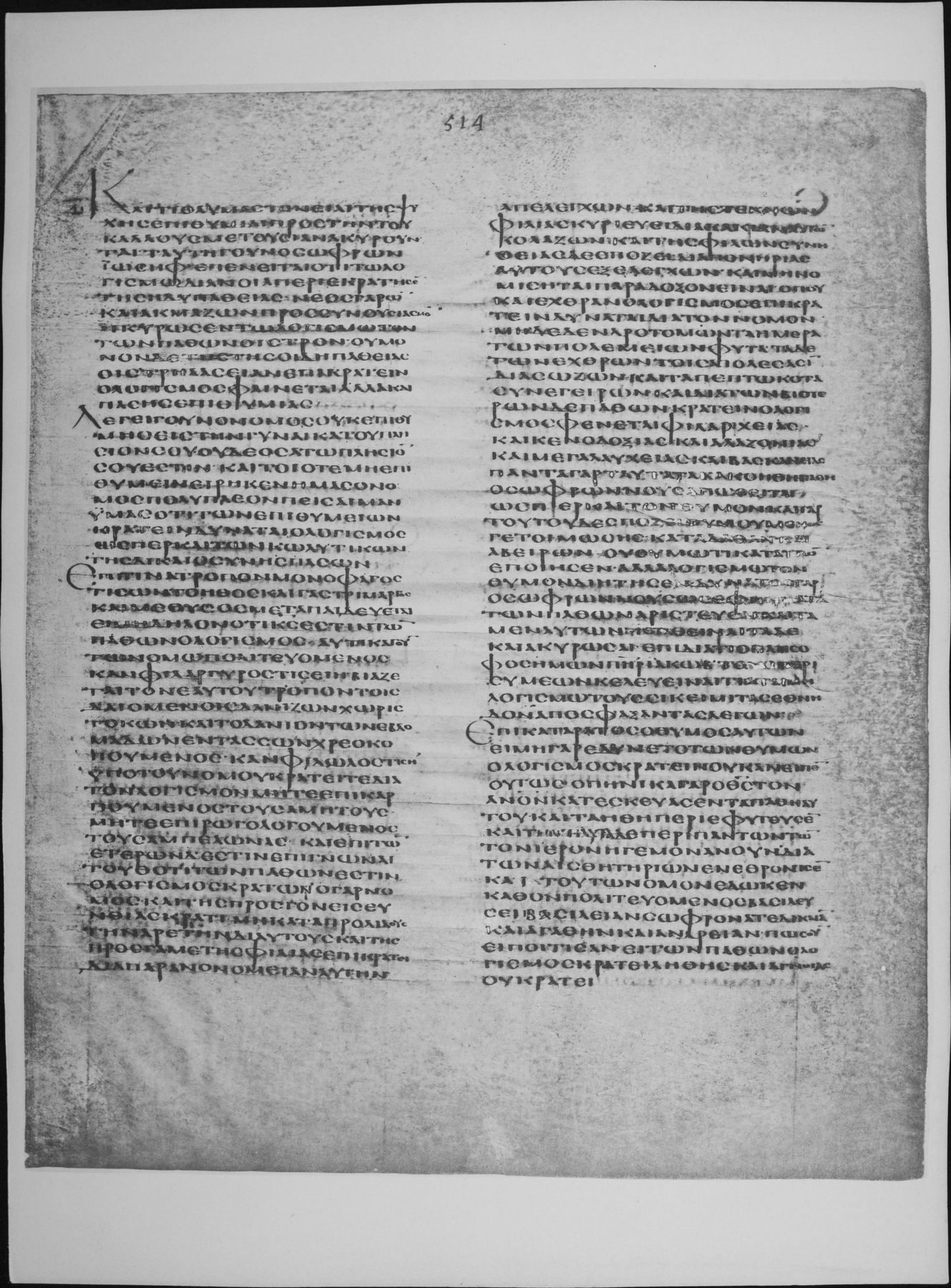
4 Maccabees 2 in the Greek Old Testament (the Septuagint) as written in Codex Alexandrinus, a Greek Bible copied in the fifth century, probably in Egypt, and now in the British Library (Royal MS 1 D. VI, the second of its four volumes). It is one of the three great early codices of the whole Greek Bible, with Codex Vaticanus and Codex Sinaiticus.
This entry meets the strict three-criteria standard of the Theosis Library:
- Manuscript scan: the page of Codex Alexandrinus carrying this chapter (fol. 514r), from the full-size photographic (autotype) facsimile published by the British Museum in 1879-1883, as digitised on the Internet Archive. The verse range of every page comes from the reduced photographic facsimile of 1957, which prints it beneath each plate, and the opening words of every page were read on the plate to confirm the page and the verse it begins with. Each section links to the page or pages that hold its verses. Folio numbers are those written at the head of each leaf and visible on the plates.
- Original text: Swete's edition, which in the books of Maccabees prints the text of Codex Alexandrinus itself (Codex Vaticanus does not contain these books), with the readings of other manuscripts in his apparatus. Swete adds accents, breathings and punctuation and expands the abbreviated sacred names, so the plate shows the same text in unaccented capitals.
- English translation: Sir Lancelot C. L. Brenton, The Septuagint Version of the Old Testament (1844; 1851 edition), a translation of the Greek, public domain, from the eBible.org text.
How was this verified? (Provenance)
Where on the image
4 Maccabees 2:1-8 is on fol. 514r (full-size facsimile of 1879-83, Internet Archive codex-alexandrinus leaf 1034). The 1957 reduced facsimile prints beneath this page: 4 Maccabees ii. 1-ii. 24. Checked on the plate: the page begins at the start of 4 Maccabees 2:1 (first words read: ΚΑΙ ΤΙ ΘΑΥΜΑΣΤΟΝ ΕΙ ΑΙ ΤΗΣ ΨΥΧΗΣ ΕΠΙΘΥΜΙΑΙ).
1Καὶ τί θαυμαστόν, εἰ αἱ τῆς ψυχῆς ἐπιθυμίαι πρὸς τὴν τοῦ κάλλους μετουσίαν ἀκυροῦνται; 2ταύτῃ γοῦν ὁ σώφρων Ἰωσὴφ ἐπαινεῖται, ὅτι τῷ λογισμῷ διανοίᾳ περιεκράτησεν τῆς ἡδυπαθείας. 3νέος γὰρ ὢν καὶ ἀκμάζων πρὸς συνουσιασμὸν ἠκύρωσεν τῷ λογισμῷ τὸν τῶν παθῶν οἶστρον. 4οὐ μόνον δὲ τὴν τῆς ἡδυπαθείας οἰστρηλασίαν ἐπικρατεῖν ὁ λογισμὸς φαίνεται, ἀλλὰ καὶ πάσης ἐπιθυμίας. 5λέγει γοῦν ὁ νόμος Οὐκ ἐπιθυμήσεις τὴν γυναῖκα τοῦ πλησίον σου, οὐδὲ ὅσα τῷ πλησίον σού ἐστιν. 6καίτοι ὅτε μὴ ἐπιθυμεῖν εἴρηκεν ἡμᾶς ὁ νόμος, πολὺ πλέον πείσαιμ᾽ ἂν ὑμᾶς ὅτι τῶν ἐπιθυμιῶν κρατεῖν δύναται ὁ λογισμός, ὥσπερ καὶ τῶν κωλυτικῶν τῆς δικαιοσύνης παθῶν. 7ἐπεὶ τίνα τρόπον μονοφάγος τις ὢν τὸ ἦθος καὶ γαστρίμαργος καὶ μέθυσος μεταπαιδεύεται, εἰ μὴ δῆλον ὅτι κύριός ἐστιν τῶν παθῶν ὁ λογισμός; 8αὐτίκα γοῦν τῷ νόμῳ πολιτευόμενος, κἂν φιλάργυρός τις εἴη, βιάζεται τὸν ἑαυτοῦ τρόπον, τοῖς δεομένοις δανίζων χωρὶς τόκων, καὶ τὸ δάνιον τῶν ἑβδομάδων ἐνστασῶν χρεοκοπούμενος.
1And what wonder? if the lusts of the soul, after participation with what is beautiful, are frustrated, 2on this ground, therefore, the temperate Joseph is praised in that by reasoning, he subdued, on reflection, the indulgence of sense. 3For, although young, and ripe for sexual intercourse, he abrogated by reasoning the stimulus of his passions. 4And it is not merely the stimulus of sensual indulgence, but that of every desire, that reasoning is able to master. 5For instance, the law says, Thou shalt not covet thy neighbour's wife, nor anything that belongs to thy neighbour. 6Now, then, since it is the law which has forbidden us to desire, I shall much the more easily persuade you, that reasoning is able to govern our lusts, just as it does the affections which are impediments to justice. 7Since in what way is a solitary eater, and a glutton, and a drunkard reclaimed, unless it be clear that reasoning is lord of the passions? 8A man, therefore, who regulates his course by the law, even if he be a lover of money, straightway puts force upon his own disposition; lending to the needy without interest, and cancelling the debt of the incoming sabbath.
Where on the image
4 Maccabees 2:9-16 is on fol. 514r (full-size facsimile of 1879-83, Internet Archive codex-alexandrinus leaf 1034). The 1957 reduced facsimile prints beneath this page: 4 Maccabees ii. 1-ii. 24. Checked on the plate: the page begins at the start of 4 Maccabees 2:1 (first words read: ΚΑΙ ΤΙ ΘΑΥΜΑΣΤΟΝ ΕΙ ΑΙ ΤΗΣ ΨΥΧΗΣ ΕΠΙΘΥΜΙΑΙ).
9κἂν φειδωλός τις ᾖ, ὑπὸ τοῦ νόμου κρατεῖται διὰ τὸν λογισμόν, μήτε ἐπικαρπούμενος τοὺς ἀμήτους, μήτε ἐπιρωγολογούμενος τοὺς ἀμπελῶνας· καὶ ἐπὶ τῶν ἑτέρων δ᾽ ἔστιν ἐπιγνῶναι τοῦθ᾽, ὅτι τῶν παθῶν ἐστιν ὁ λογισμὸς κρατῶν. 10ὁ γὰρ νόμος καὶ τῆς πρὸς γονεῖς εὐνοίας κρατεῖ, μὴ καταπροδιδοὺς τὴν ἀρετὴν δι᾽ αὐτούς· 11καὶ τῆς πρὸς γαμετῆς φιλίας ἐπικρατεῖ, διὰ παρανομίαν αὐτὴν ἀπελέγχων· 12καὶ τῆς τέκνων φιλίας κυριεύει, διὰ κακίαν αὐτῶν κολάζων· καὶ τῆς φίλων συνηθείας δεσπόζει, διὰ πονηρίας αὐτοὺς ἐξελέγχων. 13καὶ μὴ νομίσητε παράδοξον εἶναι, ὅπου καὶ ἔχθραν ὁ λογισμὸς ἐπικρατεῖν δύναται διὰ τὸν νόμον, 14μηδὲ δενδροτομῶν τὰ ἥμερα τῶν πολεμίων φυτά, τὰ δὲ τῶν ἐχθρῶν τοῖς ἀπολέσασιν διασώζων, καὶ τὰ πεπτωκότα συνεγείρων. 15Καὶ διὰ τῶν βιαιοτέρων δὲ παθῶν κρατεῖν ὁ λογισμὸς φαίνεται, φιλαρχίας καὶ κενοδοξίας καὶ ἀλαζονίας καὶ μεγαλαυχίας καὶ βασκανίας. 16πάντα γὰρ ταῦτα τὰ κακοήθη πάθη ὁ σώφρων νοῦς ἀπωθεῖται, ὥσπερ καὶ τὸν θυμόν· καὶ γὰρ τούτου δεσπόζει.
9And should a man be parsimonious, he is ruled by the law acting through reasoning; so that he does not glean his harvest crops, nor vintage: and in reference to other points we may perceive that it is reasoning that conquers his passions. 10For the law conquers even affection toward parents, not surrendering virtue on their account. 11And it prevails over marriage love, condemning it when transgressing law. 12And it lords it over the love of parents toward their children, for they punish them for vice; and it domineers over the intimacy of friends, reproving them when wicked. 13And think it not a strange assertion that reasoning can in behalf of the law conquer even enmity. 14It alloweth not to cut down the cultivated herbage of an enemy, but preserveth it from the destroyers, and collecteth their fallen ruins. 15And reasoning appears to be master of the more violent passions, as love of empire and empty boasting, and arrogance, and loud boasting, and slander. 16For the temperate understanding repels all these malignant passions, as it does wrath: for it masters even this.
Where on the image
4 Maccabees 2:17-24 is on fol. 514r (full-size facsimile of 1879-83, Internet Archive codex-alexandrinus leaf 1034). The 1957 reduced facsimile prints beneath this page: 4 Maccabees ii. 1-ii. 24. Checked on the plate: the page begins at the start of 4 Maccabees 2:1 (first words read: ΚΑΙ ΤΙ ΘΑΥΜΑΣΤΟΝ ΕΙ ΑΙ ΤΗΣ ΨΥΧΗΣ ΕΠΙΘΥΜΙΑΙ).
17θυμούμενος γέ τοι Μωσῆς κατὰ Δαθὰν καὶ Ἀβειρών, οὐ θυμῷ τι κατ᾽ αὐτῶν ἐποίησεν, ἀλλὰ λογισμῷ τὸν θυμὸν διῄτησεν. 18δυνατὸς γὰρ ὁ σώφρων νοῦς, ὡς ἔφην, κατὰ τῶν παθῶν ἀριστεῦσαι, καὶ τὰ μὲν αὐτῶν μεταθεῖναι, τὰ δὲ καὶ ἀκυρῶσαι. 19ἐπεὶ διὰ τί ὁ πάνσοφος ἡμῶν πατὴρ Ἰακὼβ τοὺς περὶ Συμεὼν καὶ Λευεὶν αἰτιᾶται μὴ λογισμῷ τοὺς Σικιμίτας ἐθνηδὸν ἀποσφάξαντας, λέγων Ἐπικατάρατος ὁ θυμὸς αὐτῶν; 20εἰ μὴ γὰρ ἐδύνατο τῶν θυμῶν ὁ λογισμὸς κρατεῖν, οὐκ ἂν εἶπεν οὕτως. 21ὁπηνίκα γὰρ ὁ θεὸς τὸν ἄνθρωπον κατεσκεύασεν, τὰ πάθη αὐτοῦ καὶ τὰ ἤθη περιεφύτευσεν· 22καὶ τηνικαῦτα δὲ περὶ πάντων τὸν ἱερὸν ἡγεμόνα νοῦν διὰ τῶν αἰσθητηρίων ἐνεθρόνισεν· 23καὶ τούτῳ νόμον ἔδωκεν, καθ᾽ ὃν πολιτευόμενος βασιλεύσει βασιλείαν σώφρονά τε καὶ δικαίαν καὶ ἀγαθὴν καὶ ἀνδρείαν. 24Πῶς οὖν, εἴποι τις ἄν, εἰ τῶν παθῶν ὁ λογισμὸς κρατεῖ, λήθης καὶ ἀγνοίας οὐ κρατεῖ;
17Thus Moses, when angered against Dathan and Abiram, did nothing to them in wrath, but regulated his anger by reasoning. 18For the temperate mind is able, as I said, to be superior to the passions, and to transfer some, and destroy others. 19For why, else, does our most wise father Jacob blame Simeon and Levi for having irrationally slain the whole race of the Shechemites, saying, Cursed be their anger. 20For if reasoning did not possess the power of subduing angry affections, he would not have spoken thus. 21For at the time when God created man, He implanted within him his passions and moral nature. 22And at that time He enthroned above all the holy leader mind, through the medium of the senses. 23And He gave a law to this mind, by living according to which it will maintain a temperate, and just, and good, and manly reign. 24How, then, a man may say, if reasoning be master of the passions, has it no control over forgetfulness and ignorance?
Cite
Sources
- Source: Codex Alexandrinus (British Library Royal MS 1 D. VI) via the British Museum photographic facsimiles of 1879-83 and 1957 (Internet Archive) + Swete's Septuagint + Brenton's English (holding institution)
- Critical edition: H. B. Swete, The Old Testament in Greek according to the Septuagint (1909)
← previous · → next · v cycle view · l back to library