Amos, Chapter 8 (Codex Alexandrinus)
Introduction
Amos 8 in the Greek Old Testament (the Septuagint) as written in Codex Alexandrinus, a Greek Bible copied in the fifth century, probably in Egypt, and now in the British Library (Royal MS 1 D. VI, the second of its four volumes). It is one of the three great early codices of the whole Greek Bible, with Codex Vaticanus and Codex Sinaiticus.
Numbering: Swete's Greek and Brenton's English number or divide some verses of this chapter differently (Swete 8:1-2 = Brenton 8:1-2). Each column keeps its own verse numbers, and sections are cut only where the two texts agree, so each section holds the same passage in both languages.
This entry meets the strict three-criteria standard of the Theosis Library:
- Manuscript scan: the page of Codex Alexandrinus carrying this chapter (fol. 284r), from the full-size photographic (autotype) facsimile published by the British Museum in 1879-1883, as digitised on the Internet Archive. The verse range of every page comes from the reduced photographic facsimile of 1936, which prints it beneath each plate, and the opening words of every page were read on the plate to confirm the page and the verse it begins with. Each section links to the page or pages that hold its verses. Folio numbers are those written at the head of each leaf and visible on the plates.
- Original text: Swete's edition, which here prints the text of Codex Vaticanus (Vat. gr. 1209), the base of his edition, and gives the readings of Alexandrinus only in his apparatus. The Greek column is therefore Vaticanus' text; where Alexandrinus differs, the plate shows what Alexandrinus reads.
- English translation: Sir Lancelot C. L. Brenton, The Septuagint Version of the Old Testament (1844; 1851 edition), a translation of the Greek, public domain, from the eBible.org text.
How was this verified? (Provenance)
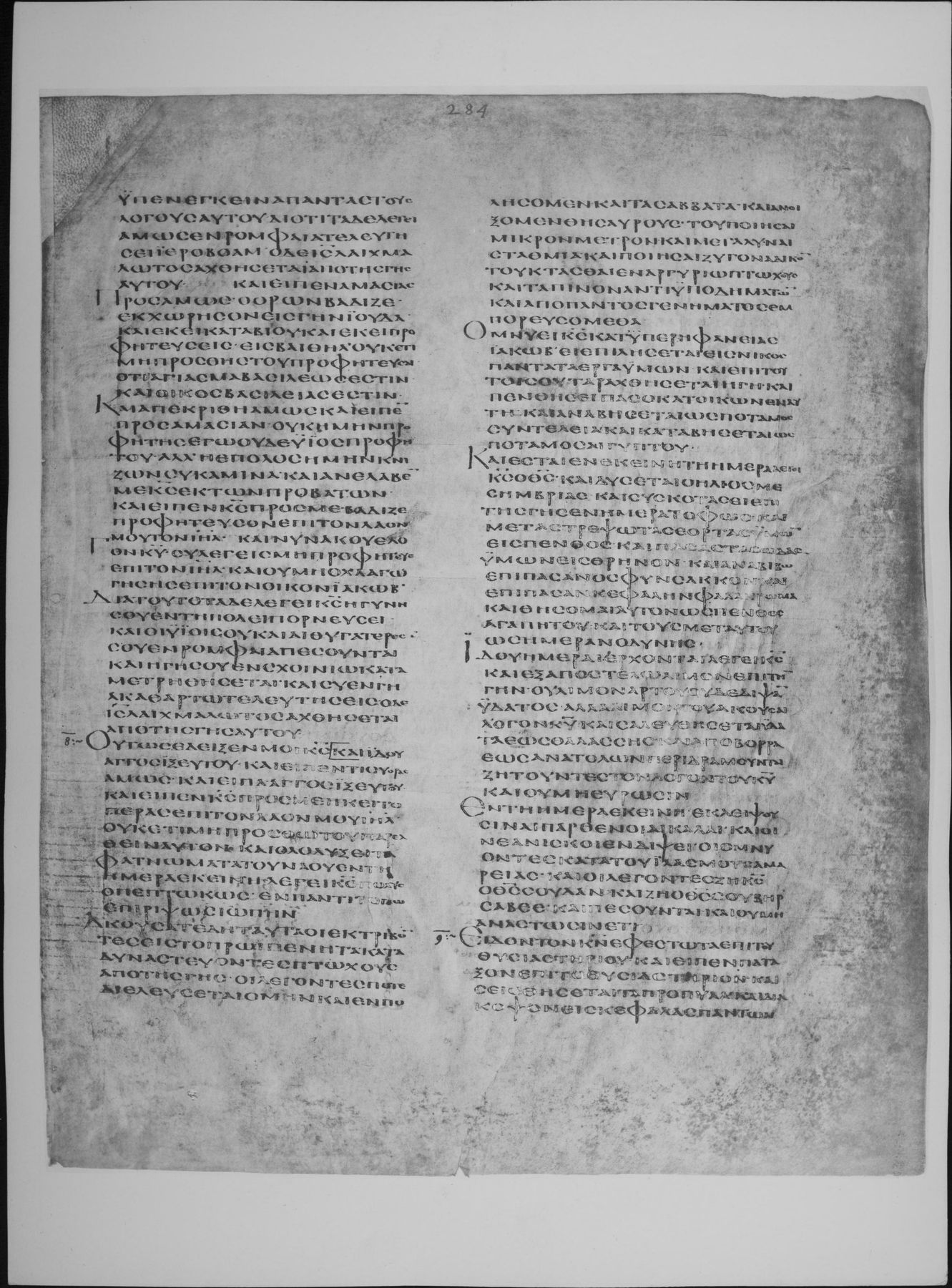
Where on the image
Amos 8:1-8 is on fol. 284r (full-size facsimile of 1879-83, Internet Archive codex-alexandrinus leaf 592). The 1936 reduced facsimile prints beneath this page: Amos vii. 10-ix. 1. Checked on the plate: the page begins inside Amos 7:10 (first words read: ΥΠΕΝΕΓΚΕΙΝ ΑΠΑΝΤΑΣ ΤΟΥΣ ΛΟΓΟΥΣ ΑΥΤΟΥ ΔΙΟΤΙ ΤΑΔΕ ΛΕΓΕΙ ΑΜΩΣ ΕΝ ΡΟΜΦΑΙΑ ΤΕΛΕΥΤΗΣΕΙ ΙΕΡΟΒΟΑΜ).
1Οὕτως ἔδειξέν μοι κύριος Κύριος, καὶ ἰδοὺ ἄγγος ἰξευτοῦ· καὶ εἶπεν Τί σὺ βλέπεις, Ἀμώς; καὶ εἶπα Ἄγγος ἰξευτοῦ. 2καὶ εἶπεν Κύριος πρὸς μέ Ἥκει τὸ πέρας ἐπὶ τὸν λαόν μου Ἰσραήλ, οὐ προσθήσω ἔτι τοῦ παρελθεῖν αὐτόν. 3καὶ ὀλολύξει τὰ φατνώματα τοῦ ναοῦ ἐν ἐκείνῃ τῇ ἡμέρᾳ, λέγει κύριος Κύριος· πολὺς ὁ πεπτωκὼς ἐν παντὶ τόπῳ, ἐπιρρίψω σιωπήν. 4ἀκούσατε δὴ ταῦτα οἱ ἐκτρίβοντες εἰς τὸ πρωὶ πένητα, καὶ καταδυναστεύοντες πτωχοὺς ἀπὸ τῆς γῆς, 5λέγοντες Πότε διελεύσεται ὁ μὴν καὶ ἐμπολήσομεν, καὶ τὰ σάββατα καὶ ἀνοίξομεν θησαυρὸν τοῦ ποιῆσαι μικρὸν μέτρον, καὶ τοῦ μεγαλῦναι στάθμιον καὶ ποιῆσαι ζυγὸν ἄδικον, 6τοῦ κτᾶσθαι ἐν ἀργυρίῳ καὶ πτωχοὺς καὶ ταπεινὸν ἀντὶ ὑποδημάτων, καὶ ἀπὸ παντὸς γενήματος ἐμπορευσόμεθα; 7ὀμνύει Κύριος κατὰ τῆς ὑπερηφανίας Ἰακώβ Εἰ ἐπιλησθήσεται εἰς νῖκος πάντα τὰ ἔργα ὑμῶν, 8καὶ ἐπὶ τούτοις οὐ ταραχθήσεται ἡ γῆ, καὶ πενθήσει πᾶς ὁ κατοικῶν ἐν αὐτῇ, καὶ ἀναβήσεται ὡς ποταμὸς συντέλεια, καὶ καταβήσεται ὡς ποταμὸς Αἰγύπτου.
1And behold a fowler's basket. 2And he said, What seest thou, Amos? And I said, A fowler's basket. And the Lord said to me, The end is come upon my people Israel; I will not pass by them any more. 3And the ceilings of the temple shall howl in that day, saith the Lord God: there shall be many a fallen one in every place; I will bring silence upon them. 4Hear now this, ye that oppress the poor in the morning, and drive the needy ones by tyranny from the earth, 5saying, When will the month pass away, and we shall sell, and the sabbath, and we shall open the treasure, to make the measure small, and to enlarge the weight, and make the balance unfair? 6That we may buy the poor for silver, and the needy for shoes; and we will trade in every kind of fruit. 7The Lord swears against the pride of Jacob, None of your works shall ever be forgotten. 8And shall not the land be troubled for these things, and shall not every one who dwells in it mourn? whereas destruction shall come up as a river, and shall descend as the river of Egypt.
Where on the image
Amos 8:9-14 is on fol. 284r (full-size facsimile of 1879-83, Internet Archive codex-alexandrinus leaf 592). The 1936 reduced facsimile prints beneath this page: Amos vii. 10-ix. 1. Checked on the plate: the page begins inside Amos 7:10 (first words read: ΥΠΕΝΕΓΚΕΙΝ ΑΠΑΝΤΑΣ ΤΟΥΣ ΛΟΓΟΥΣ ΑΥΤΟΥ ΔΙΟΤΙ ΤΑΔΕ ΛΕΓΕΙ ΑΜΩΣ ΕΝ ΡΟΜΦΑΙΑ ΤΕΛΕΥΤΗΣΕΙ ΙΕΡΟΒΟΑΜ).
9καὶ ἔσται ἐν ἐκείνῃ τῇ ἡμέρᾳ, λέγει κύριος Κύριος, καὶ δύσεται ὁ ἥλιος μεσημβρίας, καὶ συσκοτάσει ἐπὶ τῆς γῆς ἐν ἡμέρᾳ τὸ φῶς· 10καὶ μεταστρέψω τὰς ἑορτὰς ὑμῶν εἰς πένθος, καὶ πάσας τὰς ᾠδὰς ὑμῶν εἰς θρῆνον, καὶ ἀναβιβῶ ἐπὶ πᾶσαν ὀσφὺν σάκκον, καὶ ἐπὶ πᾶσαν κεφαλὴν φαλάκρωμα, καὶ θήσομαι αὐτὸν ὡς πένθος ἀγαπητοῦ, καὶ τοὺς μετ᾽ αὐτοῦ ὡς ἡμέραν ὀδύνης. 11ἰδοὺ ἡμέραι ἔρχονται, λέγει Κύριος, καὶ ἐξαποστελῶ λιμὸν ἐπὶ τὴν γῆν, οὐ λιμὸν ἄρτων οὐδὲ δίψαν ὕδατος, ἀλλὰ λιμὸν τοῦ ἀκοῦσαι λόγον Κύριου· 12καὶ σαλευθήσονται ὕδατα τῆς θαλάσσης, καὶ ἀπὸ βορρᾶ ἕως ἀνατολῶν περιδραμοῦνται ζητοῦντες τὸν λόγον Κυρίου καὶ οὐ μὴ εὕρωσιν. 13ἐν τῇ ἡμέρᾳ ἐκείνῃ ἐκλείψουσιν αἱ παρθένοι αἱ καλαὶ καὶ οἱ νεανίσκοι ἐν δίψει, 14οἱ ὀμνύοντες κατὰ τοῦ ἱλασμοῦ Σαμαρείας, καὶ οἱ λέγοντες Ζῇ ὁ θεός σου, Δάν, καὶ ζῇ ὁ θεός σου, Βηρσάβεε. καὶ πεσοῦνται καὶ οὐ μὴ ἀναστῶσιν ἔτι.
9And it shall come to pass in that day, saith the Lord God, that the sun shall go down at noon, and the light shall be darkened on the earth by day: 10and I will turn your feasts into mourning, and all your songs into lamentation; and I will bring up sackcloth on all loins, and baldness on every head; and I will make them as the mourning of a beloved friend, and those with them as a day of grief. 11Behold, the days come, saith the Lord, that I will send forth a famine on the land, not a famine of bread, nor a thirst for water, but a famine of hearing the word of the Lord. 12And the waters shall be troubled from sea to sea, and from the north to the east shall men run hither and thither, seeking the word of the Lord, and they shall not find it. 13In that day shall the fair virgins and the young men faint for thirst; 14they who swear by the propitiation of Samaria, and who say, Thy god, O Dan, lives; and, Thy god, O Bersabee, lives; and they shall fall, and shall no more rise again.
Cite
Sources
- Source: Codex Alexandrinus (British Library Royal MS 1 D. VI) via the British Museum photographic facsimiles of 1879-83 and 1936 (Internet Archive) + Swete's Septuagint + Brenton's English (holding institution)
- Critical edition: H. B. Swete, The Old Testament in Greek according to the Septuagint (1909)
← previous · → next · v cycle view · l back to library