Esther, Chapter 7 (Codex Alexandrinus)
Introduction
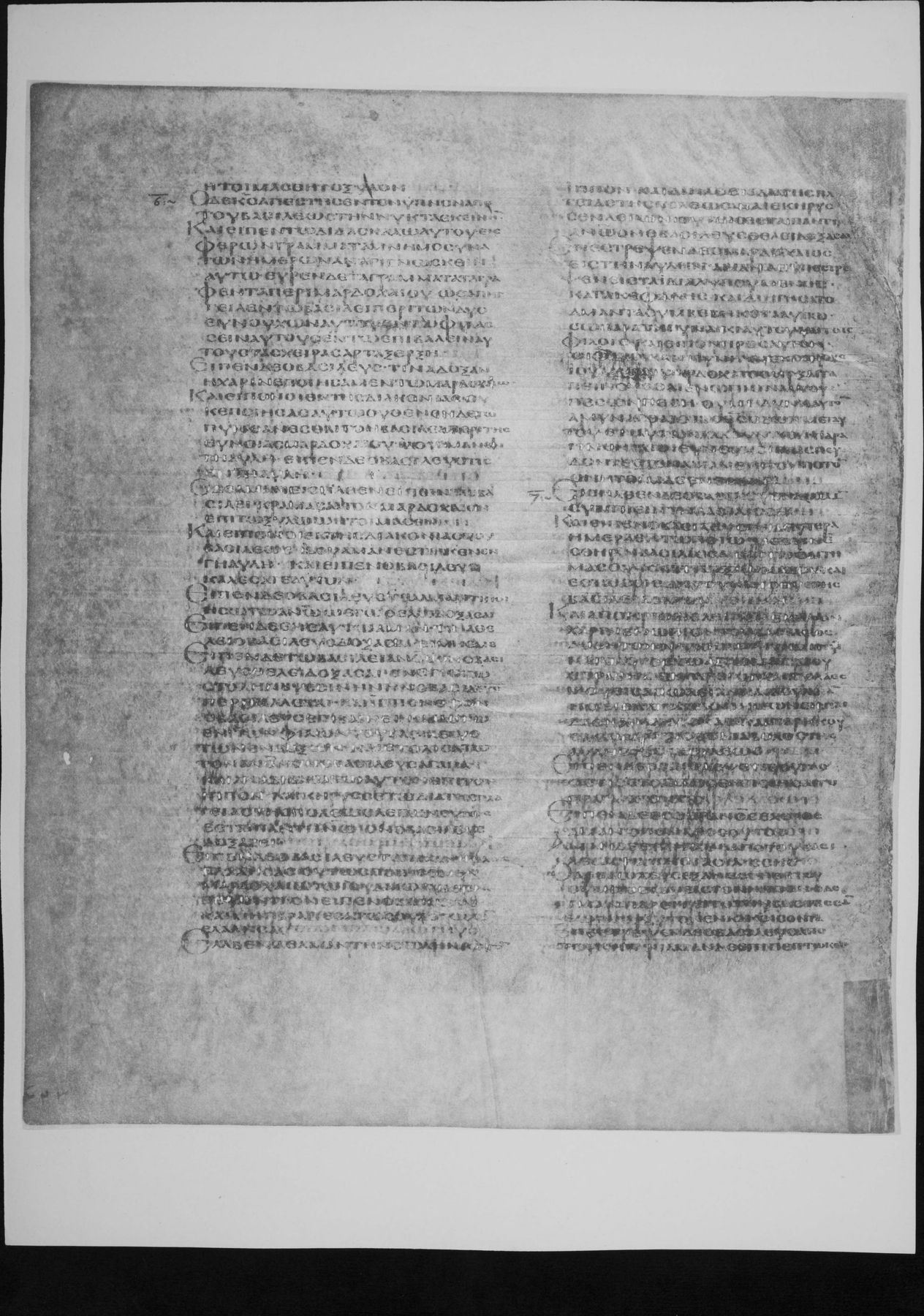
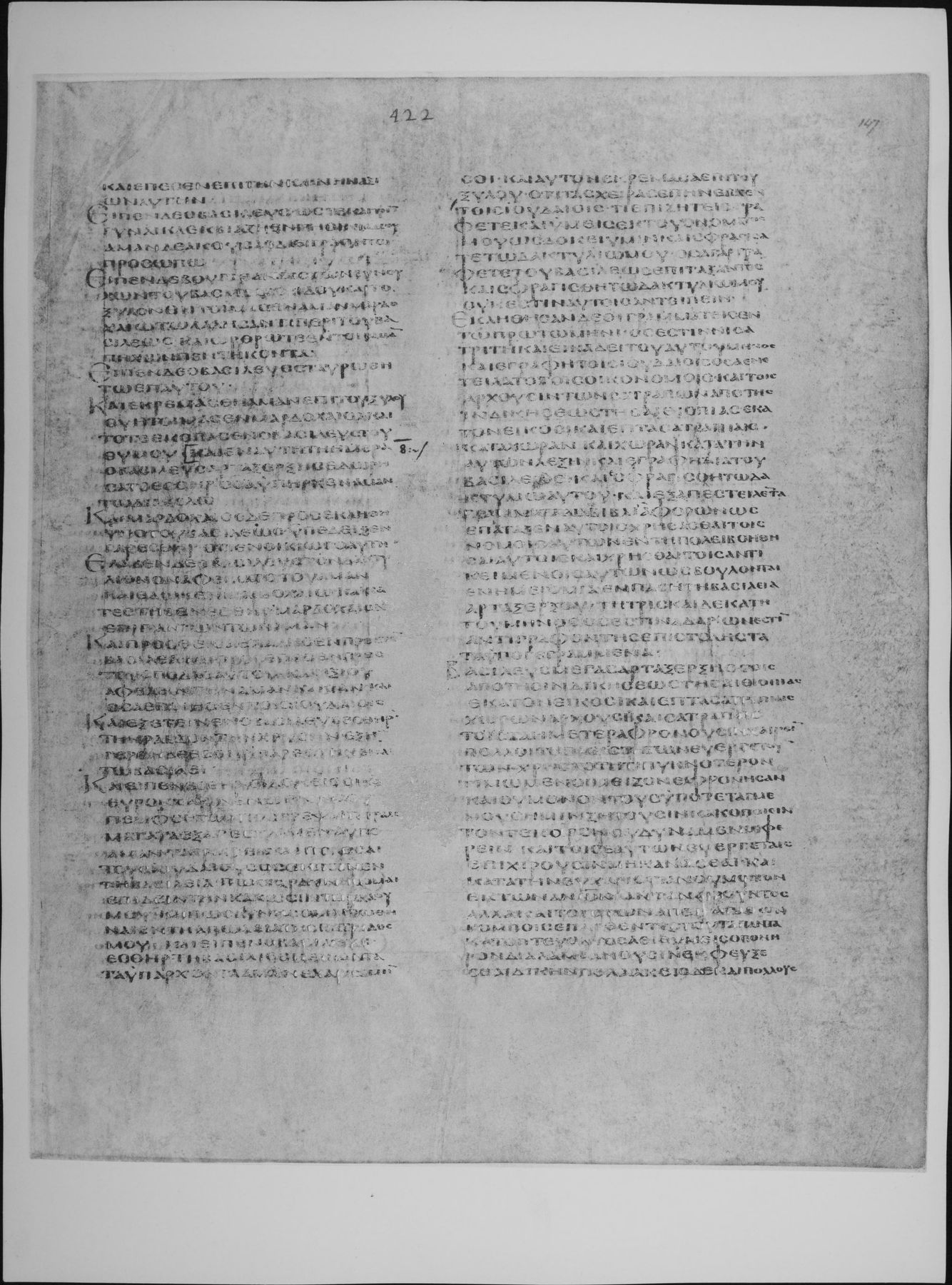
Esther 7 in the Greek Old Testament (the Septuagint) as written in Codex Alexandrinus, a Greek Bible copied in the fifth century, probably in Egypt, and now in the British Library (Royal MS 1 D. VI, the second of its four volumes). It is one of the three great early codices of the whole Greek Bible, with Codex Vaticanus and Codex Sinaiticus.
The Greek additions: the Greek book of Esther has six passages that the Hebrew book lacks (often lettered A to F; in the Latin Bible they are gathered as 10:4-16:24). Swete prints them in their places in the story, inside the verses they follow (1:1, 3:13, 4:17, 5:1-2, 8:12 and 10:3), marking their own verses with numbers in square brackets, and Brenton's English does the same. The captions of the 1936 facsimile name them by letter and by their Latin chapter and verse.
This entry meets the strict three-criteria standard of the Theosis Library:
- Manuscript scan: the pages of Codex Alexandrinus carrying this chapter (fol. 421v, fol. 422r), from the full-size photographic (autotype) facsimile published by the British Museum in 1879-1883, as digitised on the Internet Archive. The verse range of every page comes from the reduced photographic facsimile of 1936, which prints it beneath each plate, and the opening words of every page were read on the plate to confirm the page and the verse it begins with. Each section links to the page or pages that hold its verses. Folio numbers are those written at the head of each leaf and visible on the plates.
- Original text: Swete's edition, which here prints the text of Codex Vaticanus (Vat. gr. 1209), the base of his edition, and gives the readings of Alexandrinus only in his apparatus. The Greek column is therefore Vaticanus' text; where Alexandrinus differs, the plate shows what Alexandrinus reads.
- English translation: Sir Lancelot C. L. Brenton, The Septuagint Version of the Old Testament (1844; 1851 edition), a translation of the Greek, public domain, from the eBible.org text.
How was this verified? (Provenance)
Where on the image
Esther 7:1-8 is on fol. 421v (full-size facsimile of 1879-83, Internet Archive codex-alexandrinus leaf 867). The 1936 reduced facsimile prints beneath this page: Esther v. 14-vii. 8. Checked on the plate: the page begins inside Esther 5:14 (first words read: ΗΤΟΙΜΑΣΘΗ ΤΟ ΞΥΛΟΝ Ο ΔΕ ΚΣ ΑΠΕΣΤΗΣΕΝ ΤΟΝ ΥΠΝΟΝ ΑΠΟ ΤΟΥ ΒΑΣΙΛΕΩΣ ΤΗΝ ΝΥΚΤΑ ΕΚΕΙΝΗΝ). Esther 7:8-10 is on fol. 422r (full-size facsimile of 1879-83, Internet Archive codex-alexandrinus leaf 868). The 1936 reduced facsimile prints beneath this page: Esther vii. 8-viii. 12, [E=xvi. 1-5]. Checked on the plate: the page begins inside Esther 7:8 (first words read: ΕΙΠΕΝ ΔΕ Ο ΒΑΣΙΛΕΥΣ ΩΣΤΕ ΚΑΙ ΤΗΝ ΓΥΝΑΙΚΑ ΒΙΑΖΗ). Note: the first lines of the column are faint on the plate; the words given are the first that can be read with confidence (the third line, ΕΙΠΕΝ ΔΕ Ο ΒΑΣΙΛΕΥΣ, is inside Esth. 7:8, as the caption shows).
1Εἰσῆλθεν δὲ ὁ βασιλεὺς καὶ Ἁμὰν συνπιεῖν τῇ βασιλίσσῃ. 2εἶπεν δὲ ὁ βασιλεὺς Ἐσθὴρ τῇ δευτέρᾳ ἡμέρᾳ ἐν τῷ πότῳ Τί ἐστιν, Ἐσθὴρ βασίλισσα, καὶ τί τὸ αἴτημά σου καὶ τί τὸ ἀξίωμά σου; καὶ ἔστω σοι ἕως τοῦ ἡμίσους τῆς βασιλείας μου. 3καὶ ἀποκριθεῖσα εἶπεν Εἰ εὗρον χάριν ἐνώπιον τοῦ βασιλέως, δοθήτω ἡ ψυχὴ τῷ αἰτήματί μου, καὶ ὁ λόγος μου τῷ ἀξιώματί μου. 4ἐπράθημεν γὰρ ἐγώ τε καὶ ὁ λαός μου εἰς ἀπωλίαν καὶ διαρπαγὴν καὶ δουλίαν, ἡμεῖς καὶ τὰ τέκνα ἡμῶν εἰς παῖδας καὶ παιδίσκας, καὶ παρήκουσα· οὐ γὰρ ἄξιος ὁ διάβολος τῆς αὐλῆς τοῦ βασιλέως. 5εἶπεν δὲ ὁ βασιλεύς Τίς οὗτος ὅστις ἐτόλμησεν ποιῆσαι τὸ πρᾶγμα τοῦτο; 6εἶπεν δὲ Ἐσθήρ Ἄνθρωπος ἐχθρὸς Ἁμὰν ὁ πονηρὸς οὗτος. Ἁμὰν δὲ ἐταράχθη ἀπὸ τοῦ βασιλέως καὶ τῆς βασιλίσσης. 7ὁ δὲ βασιλεὺς ἐξανέστη ἀπὸ τοῦ συμποσίου εἰς τὸν κῆπον· ὁ δὲ Ἁμὰν παρῃτεῖτο τὴν βασίλισσαν, ἑώρα γὰρ ἑαυτὸν ἐν κακοῖς ὄντα. 8ἐπέστρεψεν δὲ ὁ βασιλεὺς ἐκ τοῦ κήπου, Ἁμὰν δὲ ἐπιπεπτώκει ἐπὶ τὴν κλίνην ἀξιῶν τὴν βασίλισσαν· εἶπεν δὲ ὁ βασιλεύς Ὥστε καὶ τὴν γυναῖκα βιάζῃ ἐν τῇ οἰκίᾳ μου; Ἁμὰν δὲ ἀκούσας διετράπη τῷ προσώπῳ. 9εἶπεν δὲ Βουγαθὰν εἷς τῶν εὐνούχων πρὸς τὸν βασιλέα Ἰδοὺ καὶ ξύλον ἡτοίμασεν Ἁμὰν Μαρδοχαίῳ τῷ λαλήσαντι περὶ τοῦ βασιλέως, καὶ ὤρθωται ἐν τοῖς Ἁμὰν ξύλον πηχῶν πεντήκοντα. εἶπεν δὲ ὁ βασιλεύς Σταυρωθήτω ἐπ᾽ αὐτοῦ. 10καὶ ἐκρεμάσθη Ἁμὰν ἐπὶ τοῦ ξύλου ὃ ἡτοιμάσθη Μαρδοχαίῳ. καὶ τότε ὁ βασιλεὺς ἐκόπασεν τοῦ θυμοῦ.
1So the king and Aman went in to drink with the queen. 2And the king said to Esther at the banquet on the second day, What is it, queen Esther? and what is thy request, and what is thy petition? and it shall be done for thee, to the half of my kingdom. 3And she answered and said, If I have found favour in the sight of the king, let my life be granted to my petition, and my people to my request. 4For both I and my people are sold for destruction, and pillage, and slavery; both we and our children for bondmen and bondwomen: and I consented not to it, for the slanderer is not worthy of the king's palace. 5And the king said, Who is this that has dared to do this thing? 6And Esther said, The adversary is Aman, this wicked man. Then Aman was troubled before the king and the queen. 7And the king rose up from the banquet to go into the garden: and Aman began to intreat the queen; for he saw that he was in an evil case. 8And the king returned from the garden; and Aman had fallen upon the bed, intreating the queen. And the king said, Wilt thou even force my wife in my house? And when Aman heard it, he changed countenance. 9And Bugathan, one of the chamberlains, said to the king, Behold, Aman has also prepared a gallows for Mardochæus, who spoke concerning the king, and a gallows of fifty cubits high has been set up in the premises of Aman. And the king said, Let him be hanged thereon. 10So Aman was hanged on the gallows that had been prepared for Mardochæus: and then the king's wrath was appeased.
Cite
Sources
- Source: Codex Alexandrinus (British Library Royal MS 1 D. VI) via the British Museum photographic facsimiles of 1879-83 and 1936 (Internet Archive) + Swete's Septuagint + Brenton's English (holding institution)
- Critical edition: H. B. Swete, The Old Testament in Greek according to the Septuagint (1909)
← previous · → next · v cycle view · l back to library