2 Esdras (Ezra), Chapter 9 (Codex Alexandrinus)
Introduction
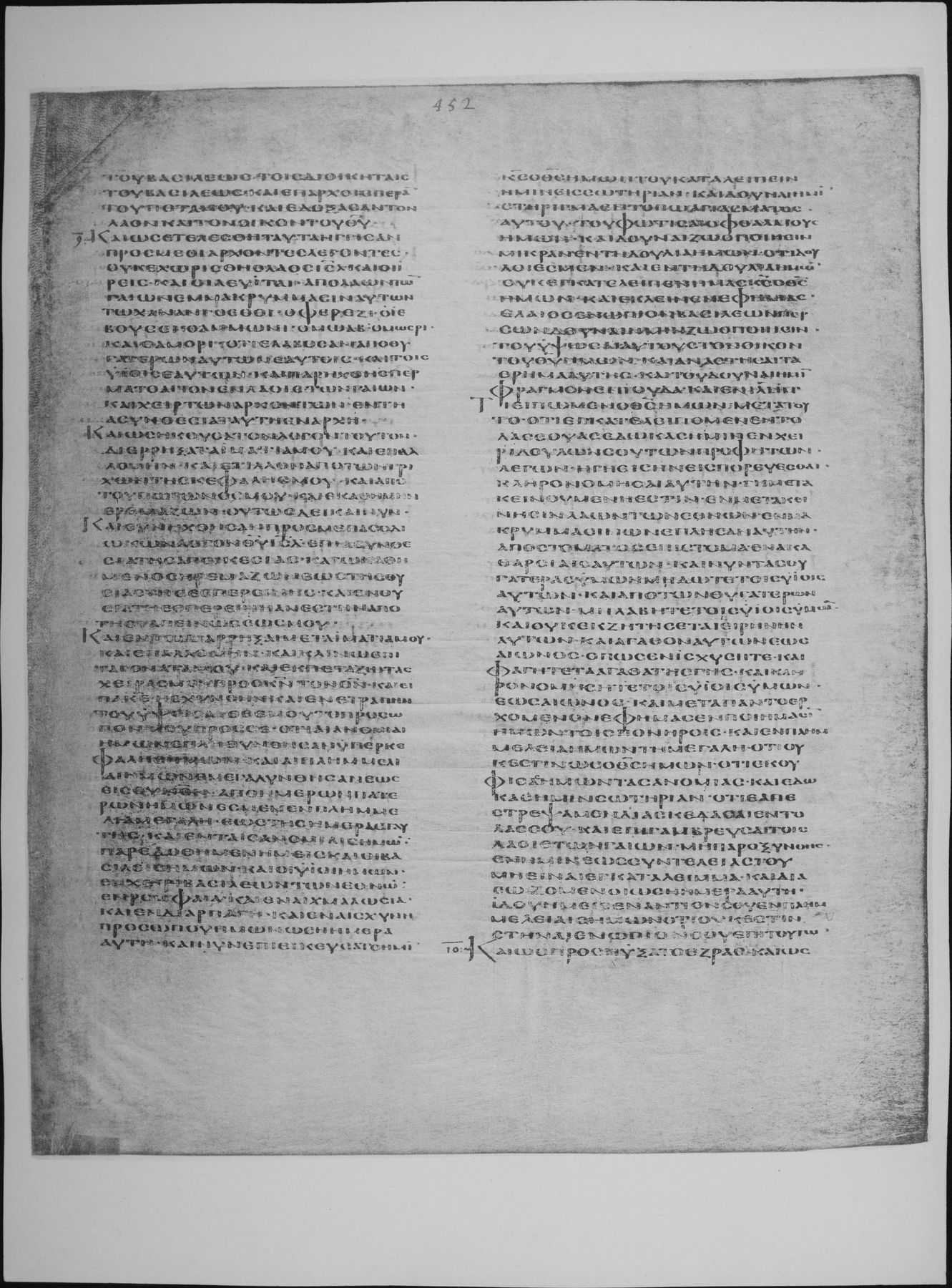
2 Esdras (Ezra) 9 in the Greek Old Testament (the Septuagint) as written in Codex Alexandrinus, a Greek Bible copied in the fifth century, probably in Egypt, and now in the British Library (Royal MS 1 D. VI, the second of its four volumes). It is one of the three great early codices of the whole Greek Bible, with Codex Vaticanus and Codex Sinaiticus.
2 Esdras: the Septuagint gives Ezra and Nehemiah as one book, 2 Esdras (Esdras B); its chapters 1-10 are the book of Ezra, numbered here as in Ezra.
This entry meets the strict three-criteria standard of the Theosis Library:
- Manuscript scan: the page of Codex Alexandrinus carrying this chapter (fol. 452r), from the full-size photographic (autotype) facsimile published by the British Museum in 1879-1883, as digitised on the Internet Archive. The verse range of every page comes from the reduced photographic facsimile of 1957, which prints it beneath each plate, and the opening words of every page were read on the plate to confirm the page and the verse it begins with. Each section links to the page or pages that hold its verses. Folio numbers are those written at the head of each leaf and visible on the plates.
- Original text: Swete's edition, which here prints the text of Codex Vaticanus (Vat. gr. 1209), the base of his edition, and gives the readings of Alexandrinus only in his apparatus. The Greek column is therefore Vaticanus' text; where Alexandrinus differs, the plate shows what Alexandrinus reads.
- English translation: Sir Lancelot C. L. Brenton, The Septuagint Version of the Old Testament (1844; 1851 edition), a translation of the Greek, public domain, from the eBible.org text.
How was this verified? (Provenance)
Where on the image
2 Esdras (Ezra) 9:1-8 is on fol. 452r (full-size facsimile of 1879-83, Internet Archive codex-alexandrinus leaf 928). The 1957 reduced facsimile prints beneath this page: 2 Esdras (Ezra) viii. 36-x. 1. Checked on the plate: the page begins inside 2 Esdras (Ezra) 8:36 (first words read: ΤΟΥ ΒΑΣΙΛΕΩΣ ΤΟΙΣ ΔΙΟΙΚΗΤΑΙΣ ΤΟΥ ΒΑΣΙΛΕΩΣ ΚΑΙ ΕΠΑΡΧΟΙΣ ΠΕΡΑΝ ΤΟΥ ΠΟΤΑΜΟΥ).
1Καὶ ὡς ἐτελέσθη ταῦτα, ἤγγισαν πρὸς μὲ οἱ ἄρχοντες λέγοντες Οὐκ ἐχωρίσθη ὁ λαὸς Ἰσραὴλ καὶ οἱ ἱερεῖς καὶ οἱ Λευεῖται ἀπὸ λαῶν τῶν γαιῶν ἐν μακρύμμασιν αὐτῶν· τῷ Χανανεί, ὁ Ἑθεί, ὁ Φερεσθεί, ὁ Ἰεβουσεί, ὁ Ἀμμωνεί, ὁ Μωάβ, ὁ Μοσερεὶ καὶ ὁ Ἀμορεί· 2ὅτι ἐλάβοσαν ἀπὸ θυγατέρων αὐτῶν αὐτοῖς καὶ τοῖς υἱοῖς αὐτῶν, καὶ παρήχθη σπέρμα τὸ ἅγιον ἐν λαοῖς τῶν γαιῶν, καὶ χεὶρ τῶν ἀρχόντων ἐν τῇ ἀσυνθεσίᾳ ταύτῃ. 3καὶ ὡς ἤκουσα τὸν λόγον τοῦτον, διέρρηξα τὰ ἱμάτιά μου καὶ ἐπαλλόμην, καὶ ἔτιλλον ἀπὸ τῶν τριχῶν τῆς κεφαλῆς μου καὶ ἀπὸ τοῦ πώγωνός μου, καὶ ἐκαθήμην ἠρεμάζων. 4καὶ συνήχθησαν πρὸς μὲ πᾶς ὁ διώκων λόγον θεοῦ Ἰσραὴλ ἐπὶ ἀσυνθεσίᾳ τῆς ἀποικίας· καὶ ἐγὼ καθήμενος ἠρεμάζων ἕως τῆς θυσίας τῆς ἑσπερινῆς. 5καὶ ἐν θυσίᾳ τῇ ἑσπερινῇ ἀνέστην ἀπὸ ταπεινώσεώς μου· καὶ ἐν τῷ διαρρῆξαί με τὰ ἱμάτιά μου καὶ ἐπαλλόμην, καὶ κλίνω ἐπὶ τὰ γόνατά μου καὶ ἐκπετάζω χεῖράς μου πρὸς τὸν θεόν, 6καὶ εἶπα, ᾘσχύνθην καὶ ἐνετράπην τοῦ ὑψῶσαι τὸ πρόσωπόν μου πρὸς σέ, ὅτι αἱ ἀνομίαι ἡμῶν ἐπληθύνθησαν ὑπὲρ κεφαλῆς ἡμῶν, καὶ αἱ πλημμέλειαι ἡμῶν ἐμεγαλύνθησαν ἕως εἰς οὐρανόν. 7ἀπὸ ἡμερῶν πατέρων ἡμῶν ἐσμεν ἐν πλημμελείᾳ μεγάλῃ ἕως τῆς ἡμέρας ταύτης· καὶ ἐν ταῖς ἀνομίαις ἡμῶν παρεδόθημεν ἡμεῖς καὶ οἱ βασιλεῖς ἡμῶν καὶ οἱ υἱοὶ ἡμῶν ἐν χειρὶ βασιλέων τῶν ἐθνῶν, ἐν ῥομφαίᾳ καὶ ἐν αἰχμαλωσίᾳ, ἐν διαρπαγῇ καὶ ἐν αἰσχύνῃ προσώπου ἡμῶν, ὡς ἡ ἡμέρα αὕτη. 8καὶ νῦν ἐπεσκευάσατο ἡμῖν ὁ θεὸς ἡμῶν τοῦ καταλιπεῖν ἡμῖν εἰς σωτηρίαν καὶ δοῦναι ἡμῖν στήρισμα ἐν τόπῳ ἁγιάσματος αὐτοῦ, τοῦ φωτίσαι ὀφθαλμοὺς ἡμῶν καὶ δοῦναι ζωοποίησιν μικρὰν ἐν τῇ δουλείᾳ ἡμῶν.
1And when these things were finished, the princes drew near to me, saying, The people of Israel, and the priests, and the Levites, have not separated themselves from the people of the lands in their abominations, even the Chananite, the Ethite, the Pherezite, the Jebusite, the Ammonite, the Moabite, and the Moserite and the Amorite. 2For they have taken of their daughters for themselves and their sons; and the holy seed has passed among the nations of the lands, and the hand of the rulers has been first in this transgression. 3And when I heard this thing, I rent my garments, and trembled, and plucked some of the hairs of my head and of my beard, and sat down mourning. 4Then there assembled to me all that followed the word of the God of Israel, on account of the transgression of the captivity; and I remained mourning until the evening sacrifice. 5And at the evening sacrifice I rose up from my humiliation; and when I had rent my garments, then I trembled, and I bow myself on my knees, and spread out my hands to the Lord God, 6and I said, O Lord, I am ashamed and confounded, O my God, to lift up my face to thee: for our transgressions have abounded over our head, and our trespasses have increased even to heaven. 7From the days of our fathers we have been in a great trespass until this day: and because of our iniquities we, and our kings, and our children, have been delivered into the hand of the kings of the Gentiles by the sword, and by captivity, and by spoil, and with shame of our face, as at this day. 8And now our God has dealt mercifully with us, so as to leave us to escape, and to give us an establishment in the place of his sanctuary, to enlighten our eyes, and to give a little quickening in our servitude.
Where on the image
2 Esdras (Ezra) 9:9-15 is on fol. 452r (full-size facsimile of 1879-83, Internet Archive codex-alexandrinus leaf 928). The 1957 reduced facsimile prints beneath this page: 2 Esdras (Ezra) viii. 36-x. 1. Checked on the plate: the page begins inside 2 Esdras (Ezra) 8:36 (first words read: ΤΟΥ ΒΑΣΙΛΕΩΣ ΤΟΙΣ ΔΙΟΙΚΗΤΑΙΣ ΤΟΥ ΒΑΣΙΛΕΩΣ ΚΑΙ ΕΠΑΡΧΟΙΣ ΠΕΡΑΝ ΤΟΥ ΠΟΤΑΜΟΥ).
9ὅτι δοῦλοί ἐσμεν, καὶ ἐν τῇ δουλείᾳ ἡμῶν οὐκ ἐνκατέλειπεν ἡμᾶς Κύριος ὁ θεὸς ἡμῶν, καὶ ἔκλινεν ἐφ᾽ ἡμᾶς ἔλεος ἐνώπιον βασιλέων Περσῶν, δοῦναι ἡμῖν ζωοποίησιν, τοῦ ὑψῶσαι αὐτοὺς τὸν οἶκον τοῦ θεοῦ ἡμῶν καὶ ἀναστῆσαι τὰ ἔρημα αὐτῆς, καὶ τοῦ δοῦναι ἡμῖν φραγμὸν ἐν Ἰούδᾳ καὶ ἐν Ἰερουσαλήμ. 10τί εἴπωμεν, ὁ θεὸς ἡμῶν, μετὰ τοῦτο; ὅτι ἐνκατελίπομεν ἐντολάς σου 11ἃς ἔδωκας ἡμῖν ἐν χειρὶ δούλων σου τῶν προφητῶν Ἡ γῆ εἰς ἣν εἰσπορεύεσθε κληρονομῆσαι αὐτὴν γῆ μετακινουμένη ἐστὶν ἐν μετακινήσει λαῶν τῶν ἐθνῶν, ἐν μακρύμμασιν αὐτῶν, ὧν ἔπλησαν αὐτὴν ἀπὸ στόματος ἐπὶ στόμα ἐν ἀκαθαρσίαις αὐτῶν. 12καὶ νῦν τὰς θυγατέρας ὑμῶν μὴ δῶτε τοῖς υἱοῖς αὐτῶν, καὶ ἀπὸ θυγατέρων αὐτῶν μὴ λάβητε τοῖς υἱοῖς ὑμῶν, καὶ οὐκ ἐκζητήσετε εἰρήνην αὐτῶν καὶ ἀγαθὸν αὐτῶν ἕως αἰῶνος, ὅπως ἐνισχύσητε καὶ φάγητε τὰ ἀγαθὰ τῆς γῆς καὶ κληροδοτήσητε τοῖς υἱοῖς ὑμῶν ἕως αἰῶνος. 13καὶ μετὰ πᾶν τὸ ἐρχόμενον ἐφ᾽ ὑμᾶς ἐν ποιήμασιν ὑμῶν τοῖς πονηροῖς καὶ ἐν πλημμελείᾳ ὑμῶν τῇ μεγάλῃ· ὅτι οὐκ ἔστιν ὡς ὁ θεὸς ἡμῶν, ὅτι ἐκούφισας ἡμῶν τὰς ἀνομίας καὶ ἔδωκας ἡμῖν σωτηρίαν· 14ὅτι ἐπεστρέψαμεν διασκεδάσαι ἐντολάς σου καὶ γαμβρεῦσαι τοῖς λαοῖς· μὴ παροξυνθῇς ἐν ἡμῖν ἕως συντελείας τοῦ μὴ εἶναι ἐνκατάλειμμα καὶ διασωζόμενον. 15Κύριε ὁ θεὸς Ἰσραήλ, δίκαιος σύ, ὅτι κατελείφθημεν διασωζόμενοι ὡς ἡ ἡμέρα αὕτη· ἐναντίον σου ἐν πλημμελείαις ἡμῶν, ὅτι οὐκ ἔστιν στῆναι ἐνώπιόν σου ἐπὶ τούτῳ·
9For we are slaves, yet in our servitude the Lord our God has not deserted us; and he has extended favour to us in the sight of the kings of the Persians, to give us a quickening, that they should raise up the house of our God, and restore the desolate places of it, and to give us a fence in Juda and Jerusalem. 10What shall we say, our God, after this? for we have forsaken thy commandments, 11which thou hast given us by the hand of thy servants the prophets, saying, The land, into which ye go to inherit it, is a land subject to disturbance by the removal of the people of the nations for their abominations, wherewith they have filled it from one end to the other by their uncleannesses. 12And now give not your daughters to their sons, and take not of their daughters for your sons, neither shall ye seek their peace or their good for ever: that ye may be strong, and eat the good of the land, and transmit it as an inheritance to your children for ever. 13And after all that is come upon us because of our evil deeds, and our great trespass, it is clear that there is none such as our God, for thou hast lightly visited our iniquities, and given us deliverance; 14whereas we have repeatedly broken thy commandments, and intermarried with the people of the lands: be not very angry with us to our utter destruction, so that there should be no remnant or escaping one. 15O Lord God of Israel, thou art righteous; for we remain yet escaped, as at this day: behold, we are before thee in our trespasses: for we cannot stand before thee on this account.
Cite
Sources
- Source: Codex Alexandrinus (British Library Royal MS 1 D. VI) via the British Museum photographic facsimiles of 1879-83 and 1957 (Internet Archive) + Swete's Septuagint + Brenton's English (holding institution)
- Critical edition: H. B. Swete, The Old Testament in Greek according to the Septuagint (1909)
← previous · → next · v cycle view · l back to library