Genesis, Chapter 13 (Codex Alexandrinus)
Introduction
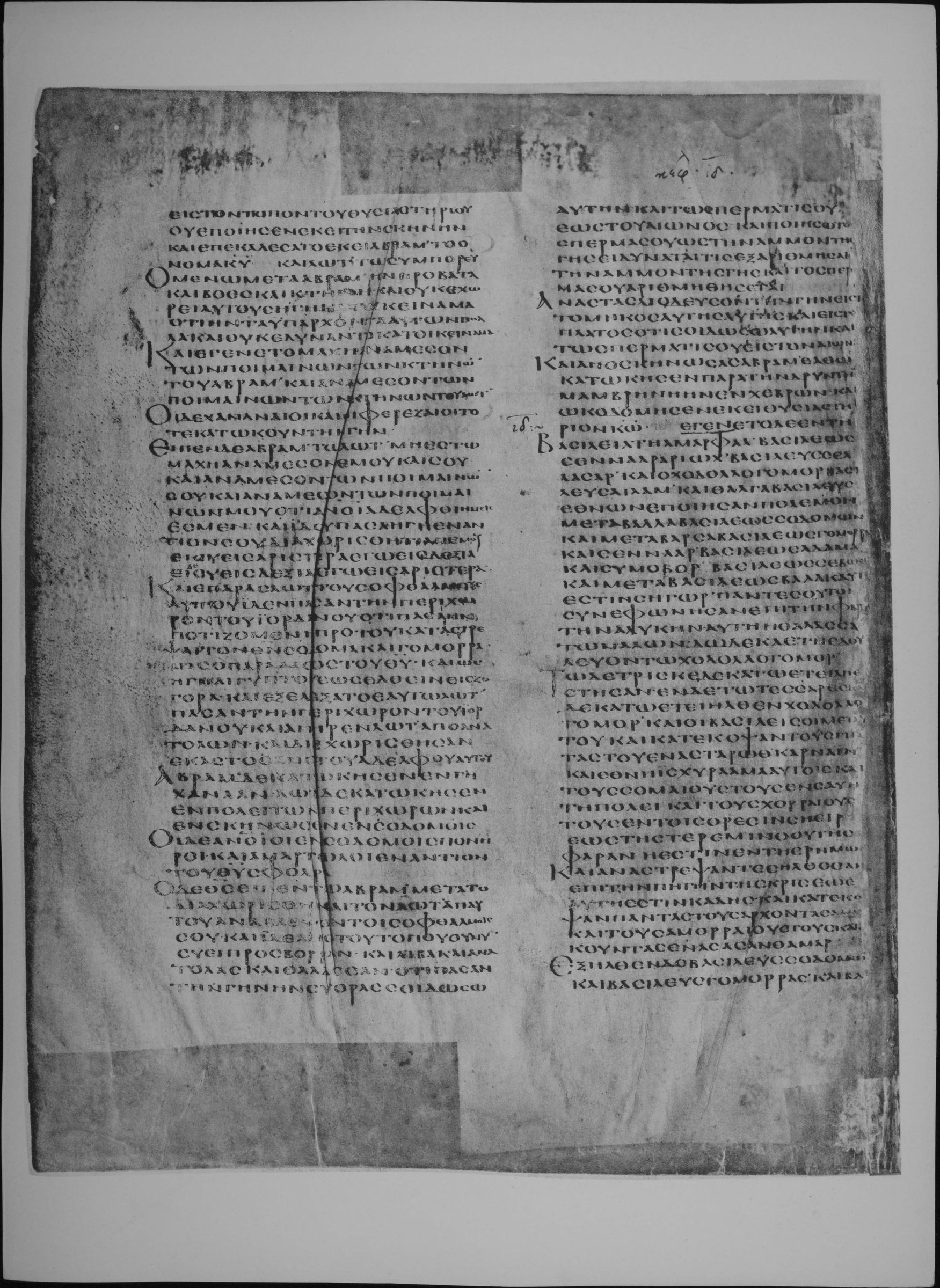
Genesis 13 in the Greek Old Testament (the Septuagint) as written in Codex Alexandrinus, a Greek Bible copied in the fifth century, probably in Egypt, and now in the British Library (Royal MS 1 D. V, the first of its four volumes). It is one of the three great early codices of the whole Greek Bible, with Codex Vaticanus and Codex Sinaiticus, and for Genesis 1:1-46:28, which Codex Vaticanus has lost, it is the oldest surviving complete Greek text (older papyri such as the Berlin Genesis papyrus and Chester Beatty 961 survive only in part).
This entry meets the strict three-criteria standard of the Theosis Library:
- Manuscript scan: the pages of Codex Alexandrinus carrying this chapter (fol. 7r, fol. 7v), from the full-size photographic (autotype) facsimile published by the British Museum in 1879-1883, as digitised on the Internet Archive. The verse range of every page comes from the reduced photographic facsimile of 1915, which prints it beneath each plate, and the opening words of every page were read on the plate to confirm the page and the verse it begins with. Each section links to the page or pages that hold its verses. Folio numbers are those written at the head of each leaf and visible on the plates.
- Original text: Swete's edition, which in Genesis 1:1-46:28 prints the text of Codex Alexandrinus itself (Codex Vaticanus has lost these chapters), with the spelling of A for the most part. Swete adds accents, breathings and punctuation and expands the abbreviated sacred names, so the plate shows the same text in unaccented capitals.
- English translation: Sir Lancelot C. L. Brenton, The Septuagint Version of the Old Testament (1844; 1851 edition), a translation of the Greek, public domain, from the eBible.org text.
How was this verified? (Provenance)
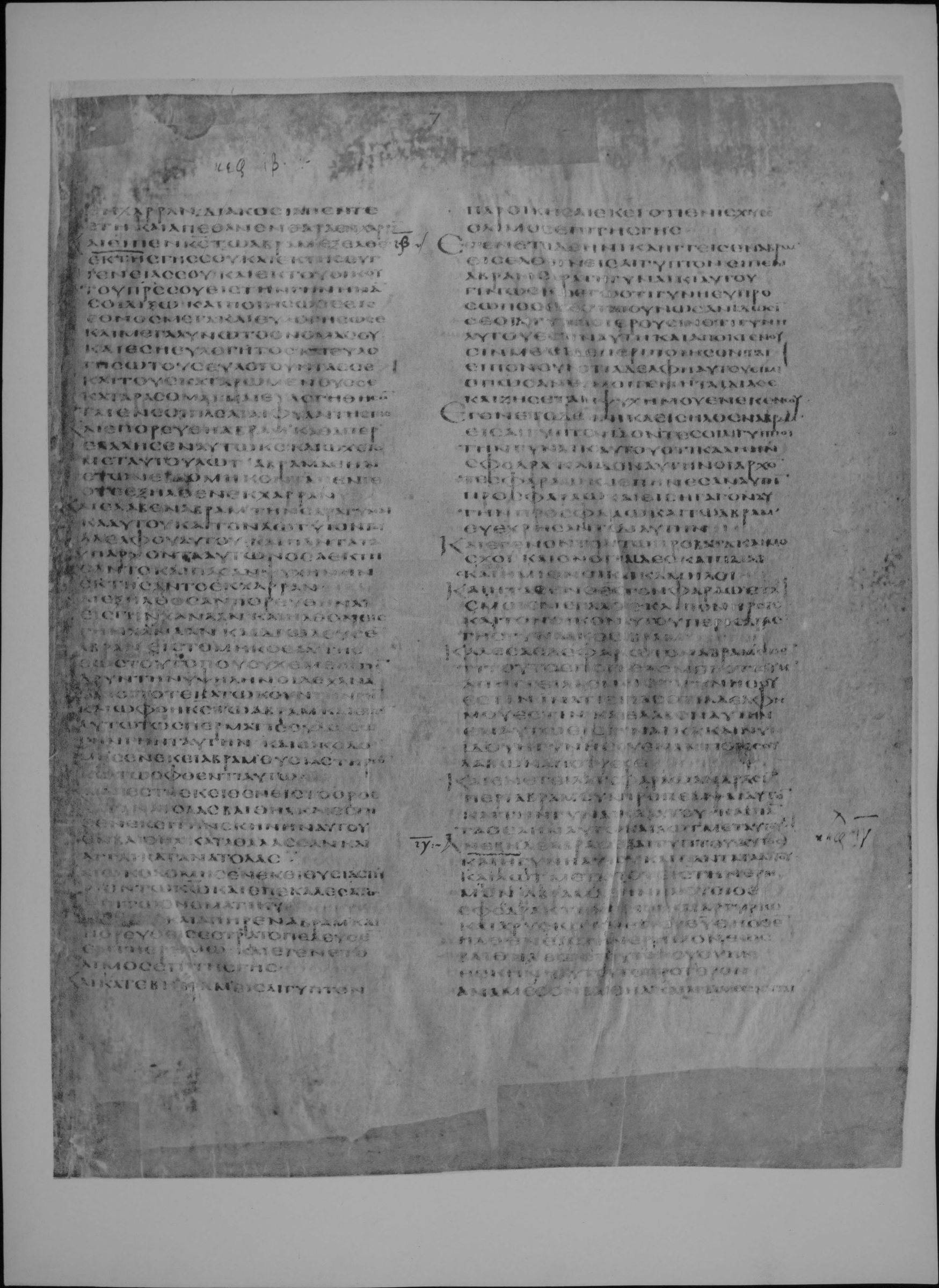
Where on the image
Genesis 13:1-3 is on fol. 7r (full-size facsimile of 1879-83, Internet Archive codex-alexandrinus leaf 34). The 1915 reduced facsimile prints beneath this page: Gen. xi. 32-xiii. 3. Checked on the plate: the page begins inside Genesis 11:32 (first words read: ΕΝ ΧΑΡΡΑΝ ΔΙΑΚΟΣΙΑ ΠΕΝΤΕ ΕΤΗ ΚΑΙ ΑΠΕΘΑΝΕΝ ΘΑΡΡΑ). Genesis 13:4-8 is on fol. 7v (full-size facsimile of 1879-83, Internet Archive codex-alexandrinus leaf 35). The 1915 reduced facsimile prints beneath this page: Gen. xiii. 4-xiv. 8. Checked on the plate: the page begins at the start of Genesis 13:4 (first words read: ΕΙΣ ΤΟΝ ΤΟΠΟΝ ΤΟΥ ΘΥΣΙΑΣΤΗΡΙΟΥ ΟΥ ΕΠΟΙΗΣΕΝ ΕΚΕΙ).
1Ἀνέβη δὲ Ἀβρὰμ ἐξ Αἰγύπτου αὐτὸς καὶ ἡ γυνὴ αὐτοῦ καὶ πάντα τὰ αὐτοῦ καὶ Λὼτ μετ᾽ αὐτοῦ εἰς τὴν ἔρημον. 2Ἀβρὰμ δὲ ἦν πλούσιος σφόδρα κτήνεσιν καὶ ἀργυρίῳ καὶ χρυσίῳ. 3καὶ ἐπορεύθη ὅθεν ἦλθεν εἰς τὴν ἔρημον ἕως Βαιθήλ, ἕως τοῦ τόπου οὗ ἦν ἡ σκηνὴ αὐτοῦ τὸ πρότερον, ἀνὰ μέσον Βαιθὴλ καὶ ἀνὰ μέσον Ἁγγαί, 4εἰς τὸν τόπον τοῦ θυσιαστηρίου οὗ ἐποίησεν ἐκεῖ τὴν σκηνήν· καὶ ἐπεκαλέσατο ἐκεῖ Ἀβρὰμ τὸ ὄνομα Κυρίου. 5καὶ Λὼτ τῷ συμπορευομένῳ μετὰ Ἀβρὰμ ἦν πρόβατα καὶ βόες καὶ κτήνη. 6καὶ οὐκ ἐχώρει αὐτοὺς ἡ γῆ κατοικεῖν ἅμα, ὅτι ἦν τὰ ὑπάρχοντα αὐτῶν πολλά· καὶ οὐκ ἐδύναντο κατοικεῖν ἅμα. 7καὶ ἐγένετο μάχη ἀνὰ μέσον τῶν ποιμένων τῶν κτηνῶν τοῦ Ἀβρὰμ καὶ ἀνὰ μέσον τῶν ποιμένων τῶν κτηνῶν τοῦ Λώτ· οἱ δὲ Χαναναῖοι καὶ οἱ Φερεζαῖοι τότε κατῴκουν τὴν γῆν. 8εἶπεν δὲ Ἀβρὰμ τῷ Λώτ Μὴ ἔστω μάχη ἀνὰ μέσον ἐμοῦ καὶ σοῦ, καὶ ἀνὰ μέσον τῶν ποιμένων σοῦ καὶ ἀνὰ μέσον τῶν ποιμένων μοῦ, ὅτι ἄνθρωποι ἀδελφοὶ ἡμεῖς ἐσμέν.
1And Abram went up out of Egypt, he and his wife, and all that he had, and Lot with him, into the wilderness. 2And Abram was very rich in cattle, and silver, and gold. 3And he went to the place whence he came, into the wilderness as far as Bæthel, as far as the place where his tent was before, between Bæthel and Aggai, 4to the place of the altar, which he built there at first, and Abram there called on the name of the Lord. 5And Lot who went out with Abram had sheep, and oxen, and tents. 6And the land was not large enough for them to live together, because their possessions were great; and the land was not large enough for them to live together. 7And there was a strife between the herdmen of Abram's cattle, and the herdmen of Lot's cattle, and the Chananites and the Pherezites then inhabited the land. 8And Abram said to Lot, Let there not be a strife between me and thee, and between my herdmen and thy herdmen, for we are brethren.
Where on the image
Genesis 13:9-18 is on fol. 7v (full-size facsimile of 1879-83, Internet Archive codex-alexandrinus leaf 35). The 1915 reduced facsimile prints beneath this page: Gen. xiii. 4-xiv. 8. Checked on the plate: the page begins at the start of Genesis 13:4 (first words read: ΕΙΣ ΤΟΝ ΤΟΠΟΝ ΤΟΥ ΘΥΣΙΑΣΤΗΡΙΟΥ ΟΥ ΕΠΟΙΗΣΕΝ ΕΚΕΙ).
9καὶ ἰδοὺ πᾶσα ἡ γῆ ἐναντίον σου· διαχωρίσθητι ἀπ᾽ ἐμοῦ. εἰ σὺ εἰς ἀριστερά, ἐγὼ εἰς δεξιά· εἰ δὲ σὺ εἰς δεξιά, ἐγὼ εἰς ἀριστερά. 10καὶ ἐπάρας Λὼτ τοὺς ὀφθαλμοὺς αὐτοῦ ἴδεν πᾶσαν τὴν περίχωρον τοῦ Ἰορδάνου, ὅτι πᾶσα ἦν ποτιζομένη πρὸ τοῦ καταστρέψαι τὸν θεὸν Σόδομα καὶ Γόμορρα ὡς ὁ παράδεισος τοῦ θεοῦ καὶ ὡς ἡ γῆ Αἰγύπτου, ἕως ἐλθεῖν εἰς Ζόγορα. 11καὶ ἐξελέξατο ἑαυτῷ Λὼτ πᾶσαν τὴν περίχωρον τοῦ Ἰορδάνου, καὶ ἀπῆρεν Λὼτ ἀπὸ ἀνατολῶν· καὶ διεχωρίσθησαν ἕκαστος ἀπὸ τοῦ ἀδελφοῦ αὐτοῦ. 12Ἀβρὰμ δὲ κατῴκησεν ἐν γῇ Χανάαν· Λὼτ δὲ κατῴκησεν ἐν πόλει τῶν περιχώρων καὶ ἐσκήνωσεν ἐν Σοδόμοις. 13οἱ δὲ ἄνθρωποι οἱ ἐν Σοδόμοις πονηροὶ καὶ ἁμαρτωλοὶ ἐναντίον τοῦ θεοῦ σφόδρα. 14Ὁ δὲ θεὸς εἶπεν τῷ Ἀβρὰμ μετὰ τὸ διαχωρισθῆναι τὸν Λὼτ ἀπ᾽ αὐτοῦ Ἀνάβλεψον τοῖς ὀφθαλμοῖς σου καὶ ἴδε ἀπὸ τοῦ τόπου οὗ νῦν σὺ εἶ πρὸς βορρᾶν καὶ λίβα καὶ ἀνατολὰς καὶ θάλασσαν· 15ὅτι πᾶσαν τὴν γῆν ἣν σὺ ὁρᾷς, σοὶ δώσω αὐτὴν καὶ τῷ σπέρματί σου ἕως τοῦ αἰῶνος. 16καὶ ποιήσω τὸ σπέρμα σου ὡς τὴν ἄμμον τῆς γῆς· εἰ δύναταί τις ἐξαριθμῆσαι τὴν ἄμμον τῆς γῆς, καὶ τὸ σπέρμα σου ἀριθμηθήσεται. 17ἀναστὰς διόδευσον τὴν γῆν εἴς τε τὸ μῆκος αὐτῆς καὶ εἰς τὸ πλάτος· ὅτι σοὶ δώσω αὐτὴν καὶ τῷ σπέρματί σου εἰς τὸν αἰῶνα. 18καὶ ἀποσκηνώσας Ἀβρὰμ ἐλθὼν κατῴκησεν παρὰ τὴν δρῦν τὴν Μαμβρήν, ἣ ἦν ἐν Χεβρών· καὶ ᾠκοδόμησεν ἐκεῖ θυσιαστήριον Κυρίῳ.
9Lo! is not the whole land before thee? Separate thyself from me; if thou goest to the left, I will go to the right, and if thou goest to the right, I will go to the left. 10And Lot having lifted up his eyes, observed all the country round about Jordan, that it was all watered, before God overthrew Sodom and Gomorrha, as the garden of the Lord, and as the land of Egypt, until thou come to Zogora. 11And Lot chose for himself all the country round Jordan, and Lot went from the east, and they were separated each from his brother. And Abram dwelt in the land of Chanaan. 12And Lot dwelt in a city of the neighbouring people, and pitched his tent in Sodom. 13But the men of Sodom were evil, and exceedingly sinful before God. 14And God said to Abram after Lot was separated from him, Look up with thine eyes, and behold from the place where thou now art northward and southward, and eastward and seaward; 15for all the land which thou seest, I will give it to thee and to thy seed for ever. 16And I will make thy seed like the dust of the earth; if any one is able to number the dust of the earth, then shall thy seed be numbered. 17Arise and traverse the land, both in the length of it and in the breadth; for to thee will I give it, and to thy seed for ever. 18And Abram having removed his tent, came and dwelt by the oak of Mambre, which was in Chebrom, and he there built an altar to the Lord.
Cite
Sources
- Source: Codex Alexandrinus (British Library Royal MS 1 D. V) via the British Museum photographic facsimiles of 1879-83 and 1915 (Internet Archive) + Swete's Septuagint + Brenton's English (holding institution)
- Critical edition: H. B. Swete, The Old Testament in Greek according to the Septuagint (1909)
← previous · → next · v cycle view · l back to library