Genesis, Chapter 14 (Codex Alexandrinus)
Introduction
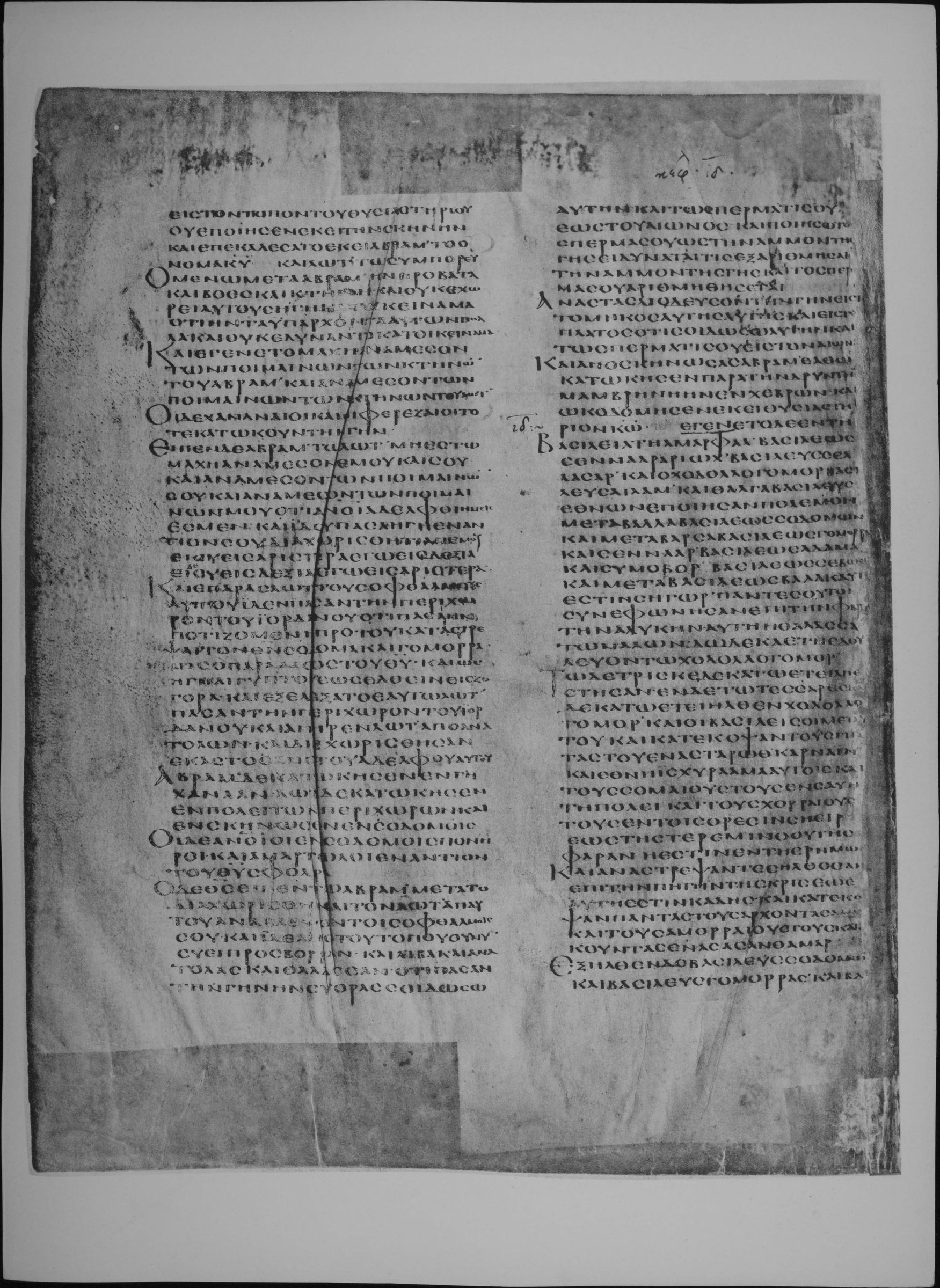
Genesis 14 in the Greek Old Testament (the Septuagint) as written in Codex Alexandrinus, a Greek Bible copied in the fifth century, probably in Egypt, and now in the British Library (Royal MS 1 D. V, the first of its four volumes). It is one of the three great early codices of the whole Greek Bible, with Codex Vaticanus and Codex Sinaiticus, and for Genesis 1:1-46:28, which Codex Vaticanus has lost, it is the oldest surviving complete Greek text (older papyri such as the Berlin Genesis papyrus and Chester Beatty 961 survive only in part).
This entry meets the strict three-criteria standard of the Theosis Library:
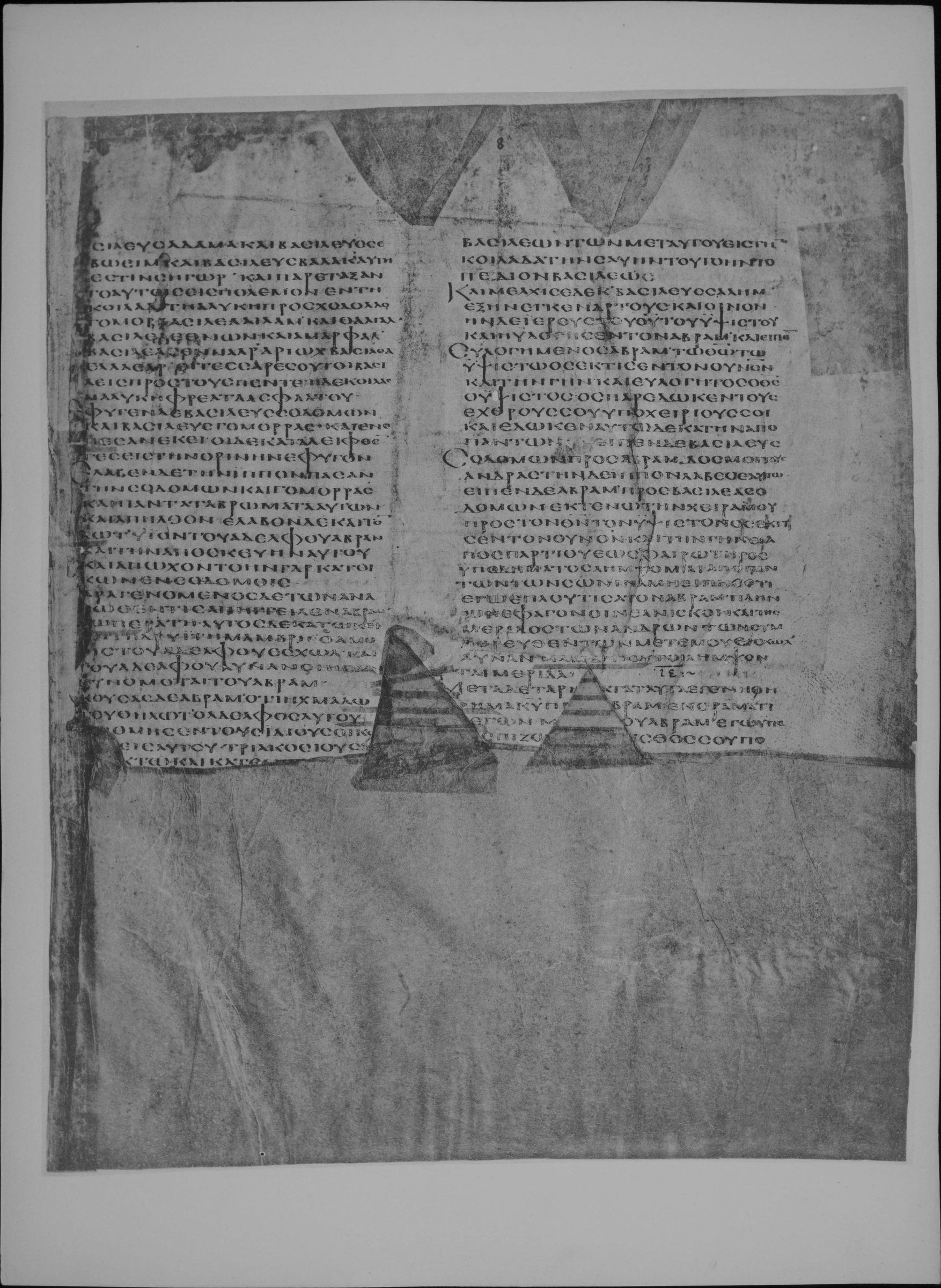
- Manuscript scan: the pages of Codex Alexandrinus carrying this chapter (fol. 7v, fol. 8r), from the full-size photographic (autotype) facsimile published by the British Museum in 1879-1883, as digitised on the Internet Archive. The verse range of every page comes from the reduced photographic facsimile of 1915, which prints it beneath each plate, and the opening words of every page were read on the plate to confirm the page and the verse it begins with. Each section links to the page or pages that hold its verses. Folio numbers are those written at the head of each leaf and visible on the plates.
- Original text: Swete's edition, which in Genesis 1:1-46:28 prints the text of Codex Alexandrinus itself (Codex Vaticanus has lost these chapters), with the spelling of A for the most part. Swete adds accents, breathings and punctuation and expands the abbreviated sacred names, so the plate shows the same text in unaccented capitals.
- English translation: Sir Lancelot C. L. Brenton, The Septuagint Version of the Old Testament (1844; 1851 edition), a translation of the Greek, public domain, from the eBible.org text.
How was this verified? (Provenance)
Where on the image
Genesis 14:1-8 is on fol. 7v (full-size facsimile of 1879-83, Internet Archive codex-alexandrinus leaf 35). The 1915 reduced facsimile prints beneath this page: Gen. xiii. 4-xiv. 8. Checked on the plate: the page begins at the start of Genesis 13:4 (first words read: ΕΙΣ ΤΟΝ ΤΟΠΟΝ ΤΟΥ ΘΥΣΙΑΣΤΗΡΙΟΥ ΟΥ ΕΠΟΙΗΣΕΝ ΕΚΕΙ). Genesis 14:8 is on fol. 8r (full-size facsimile of 1879-83, Internet Archive codex-alexandrinus leaf 36). The 1915 reduced facsimile prints beneath this page: Gen. xiv. 8-xv. 1. Checked on the plate: the page begins inside Genesis 14:8 (first words read: ΣΙΛΕΥΣ ΑΔΑΜΑ ΚΑΙ ΒΑΣΙΛΕΥΣ ΣΕΒΩΕΙΜ ΚΑΙ ΒΑΣΙΛΕΥΣ ΒΑΛΑΚ).
1Ἐγένετο δὲ ἐν τῇ βασιλείᾳ τῇ Ἀμαρφὰλ βασιλέως Σενναάρ, Ἀριὼχ βασιλεὺς Ἐλλασὰρ καὶ ὁ Χοδολλογόμορ βασιλεὺς Αἰλὰμ καὶ Θαλγὰ βασιλεὺς ἐθνῶν 2ἐποίησαν πόλεμον μετὰ Βάλλα βασιλέως Σοδόμων καὶ μετὰ Βαρσὰ βασιλέως Γομόρρας καὶ Σενναὰρ βασιλέως Ἀδαμὰ καὶ Συμόβορ βασιλέως Σεβωεὶμ καὶ μετὰ βασιλέως Βάλακ· αὕτη ἐστὶν Σήγωρ. 3πάντες οὗτοι συνεφώνησαν ἐπὶ τὴν φάραγγα τὴν ἁλυκήν· αὕτη ἡ θάλασσα τῶν ἁλῶν. 4δώδεκα ἔτη ἐδούλευον τῷ Χοδολλογόμορ, τῷ δὲ τρισκαιδεκάτῳ ἔτει ἀπέστησαν. 5ἐν δὲ τῷ τεσσαρεσκαιδεκάτῳ ἔτει ἦλθεν Χοδολλογόμορ καὶ οἱ βασιλεῖς οἱ μετ᾽ αὐτοῦ, καὶ κατέκοψαν τοὺς γίγαντας τοὺς ἐν Ἀσταρὼθ Καρνάιν, καὶ ἔθνη ἰσχυρὰ ἅμα αὐτοῖς, καὶ τοὺς Σομαίους τοὺς ἐν Σαυὴ τῇ πόλει, 6καὶ τοὺς Χορραίους τοὺς ἐν τοῖς ὄρεσιν Σηείρ, ἕως τῆς τερεμίνθου τῆς Φαράν, ἥ ἐστιν ἐν τῇ ἐρήμῳ. 7καὶ ἀναστρέψαντες ἤλθοσαν ἐπὶ τὴν πηγὴν τῆς κρίσεως, αὕτη ἐστὶν Καδής, καὶ κατέκοψαν πάντας τοὺς ἄρχοντας Ἀμαλὴκ καὶ τοὺς Ἀμορραίους τοὺς κατοικοῦντας ἐν Ἁσασὰν Θαμάρ. 8ἐξῆλθεν δὲ βασιλεὺς Σοδόμων καὶ βασιλεὺς Γομόρρας καὶ βασιλεὺς Ἀδαμὰ καὶ βασιλεὺς Σεβωεὶμ καὶ βασιλεὺς Βάλακ, αὕτη ἐστὶν Σήγωρ, καὶ παρετάξαντο αὐτοῖς εἰς πόλεμον ἐν τῇ κοιλάδι τῇ ἁλυκῇ,
1And it came to pass in the reign of Amarphal king of Sennaar, and Arioch king of Ellasar, that Chodollogomor king of Elam, and Thargal king of nations, 2made war with Balla king of Sodom, and with Barsa king of Gomorrha, and with Sennaar, king of Adama, and with Symobor king of Seboim and the king of Balac, this is Segor. 3All these met with one consent at the salt valley; this is now the sea of salt. 4Twelve years they served Chodollogomor, and the thirteenth year they revolted. 5And in the fourteenth year came Chodollogomor, and the kings with him, and cut to pieces the giants in Astaroth, and Carnain, and strong nations with them, and the Ommæans in the city Save. 6And the Chorrhæans in the mountains of Seir, to the turpentine tree of Pharan, which is in the desert. 7And having turned back they came to the well of judgment; this is Cades, and they cut in pieces all the princes of Amalec, and the Amorites dwelling in Asasonthamar. 8And the king of Sodom went out, and the king of Gomorrha, and king of Adama, and king of Seboim, and king of Balac, this is Segor, and they set themselves in array against them for war in the salt valley,
Where on the image
Genesis 14:9-16 is on fol. 8r (full-size facsimile of 1879-83, Internet Archive codex-alexandrinus leaf 36). The 1915 reduced facsimile prints beneath this page: Gen. xiv. 8-xv. 1. Checked on the plate: the page begins inside Genesis 14:8 (first words read: ΣΙΛΕΥΣ ΑΔΑΜΑ ΚΑΙ ΒΑΣΙΛΕΥΣ ΣΕΒΩΕΙΜ ΚΑΙ ΒΑΣΙΛΕΥΣ ΒΑΛΑΚ). The lower part of fol. 8 is torn away, so part of this text is lost in Codex Alexandrinus (Swete: Gen. 14:14-17, 15:1-5, 15:16-19, 16:6-9). The Greek column marks the gap; the English translates the full text as Brenton printed it from other manuscripts.
9πρὸς Χοδολλογόμορ βασιλέα Αἰλὰμ καὶ Θαλγὰλ βασιλέα ἐθνῶν καὶ Ἀμαρφὰλ βασιλέα Σενναὰρ καὶ Ἀριὼχ βασιλέα Ἐλλασάρ, οἱ τέσσαρες οὗτοι βασιλεῖς πρὸς τοὺς πέντε. 10ἡ δὲ κοιλὰς ἡ ἁλυκὴ φρέατα ἀσφάλτου. ἔφυγεν δὲ βασιλεὺς Σοδόμων καὶ βασιλεὺς Γομόρρας, καὶ ἐνέπεσαν ἐκεῖ· οἱ δὲ καταλειφθέντες εἰς τὴν ὀρινὴν ἔφυγον. 11ἔλαβεν δὲ τὴν ἵππον πᾶσαν τὴν Σοδόμων καὶ Γομόρρας καὶ πάντα τὰ βρώματα αὐτῶν, καὶ ἀπῆλθον. 12ἔλαβον δὲ καὶ τὸν Λὼτ υἱὸν τοῦ ἀδελφοῦ Ἀβρὰμ καὶ τὴν ἀποσκευὴν αὐτοῦ, καὶ ἀπῴχοντο· ἦν γὰρ κατοικῶν ἐν Σοδόμοις. 13παραγενόμενος δὲ τῶν ἀνασωθέντων τις ἀπήγγειλεν Ἀβρὰμ τῷ περάτῃ· αὐτὸς δὲ κατῴκει ἐν τῇ δρυὶ τῇ Μαμβρὴ ὁ Ἄμορις τοῦ ἀδελφοῦ Ἐσχὼλ καὶ τοῦ ἀδελφοῦ Αὐνάν, οἳ ἦσαν συνωμόται τοῦ Ἀβράμ. 14ἀκούσας δὲ Ἀβρὰμ ὅτι ᾐχμαλωτεύθη Λὼτ ὁ ἀδελφὸς αὐτοῦ, ἠρίθμησεν τοὺς ἰδίους οἰκογενεῖς αὐτοῦ, τριακοσίους δέκα καὶ ὀκτώ, καὶ κατεδίωξεν […lost in A…] 15[…lost in A…] 16[…lost in A…]
9against Chodollogomor king of Elam, and Thargal king of nations, and Amarphal king of Sennaar, and Arioch king of Ellasar, the four kings against the five. 10Now the salt valley consists of slime-pits. And the king of Sodom fled and the king of Gomorrha, and they fell in there: and they that were left fled to the mountain country. 11And they took all the cavalry of Sodom and Gomorrha, and all their provisions, and departed. 12And they took also Lot the son of Abram's brother, and his baggage, and departed, for he dwelt in Sodom. 13And one of them that had been rescued came and told Abram the Hebrew; and he dwelt by the oak of Mamre the Amorite the brother of Eschol, and the brother of Aunan, who were confederates with Abram. 14And Abram having heard that Lot his nephew had been taken captive, numbered his own home-born servants three hundred and eighteen, and pursued after them to Dan. 15And he came upon them by night, he and his servants, and he smote them and pursued them as far as Choba, which is on the left of Damascus. 16And he recovered all the cavalry of Sodom, and he recovered Lot his nephew, and all his possessions, and the women and the people.
Where on the image
Genesis 14:17-24 is on fol. 8r (full-size facsimile of 1879-83, Internet Archive codex-alexandrinus leaf 36). The 1915 reduced facsimile prints beneath this page: Gen. xiv. 8-xv. 1. Checked on the plate: the page begins inside Genesis 14:8 (first words read: ΣΙΛΕΥΣ ΑΔΑΜΑ ΚΑΙ ΒΑΣΙΛΕΥΣ ΣΕΒΩΕΙΜ ΚΑΙ ΒΑΣΙΛΕΥΣ ΒΑΛΑΚ). The lower part of fol. 8 is torn away, so part of this text is lost in Codex Alexandrinus (Swete: Gen. 14:14-17, 15:1-5, 15:16-19, 16:6-9). The Greek column marks the gap; the English translates the full text as Brenton printed it from other manuscripts.
17[…lost in A…] βασιλέων τῶν μετ᾽ αὐτοῦ, εἰς τὴν κοιλάδα τὴν Σαύην· τοῦτο ἦν τὸ πεδίον βασιλέως. 18καὶ Μελχισέδεκ βασιλεὺς Σαλὴμ ἐξήνεγκεν ἄρτους καὶ οἶνον· ἦν δὲ ἱερεὺς τοῦ θεοῦ τοῦ ὑψίστου. 19καὶ ηὐλόγησεν τὸν Ἀβρὰμ καὶ εἶπεν Εὐλογημένος Ἀβρὰμ τῷ θεῷ τῷ ὑψίστῳ, ὃς ἔκτισεν τὸν οὐρανὸν καὶ τὴν γῆν· 20καὶ εὐλογητὸς ὁ θεὸς ὁ ὕψιστος, ὃς παρέδωκεν τοὺς ἐχθρούς σου ὑποχειρίους σοι. καὶ ἔδωκεν αὐτῷ δεκάτην ἀπὸ πάντων. 21εἶπεν δὲ βασιλεὺς Σοδόμων πρὸς Ἀβράμ Δός μοι τοὺς ἄνδρας, τὴν δὲ ἵππον λάβε σεαυτῷ. 22εἶπεν δὲ Ἀβρὰμ πρὸς βασιλέα Σοδόμων Ἐκτενῶ τὴν χεῖρά μου πρὸς τὸν θεὸν τὸν ὕψιστον, ὃς ἔκτισεν τὸν οὐρανὸν καὶ τὴν γῆν, 23εἰ ἀπὸ σπαρτίου ἕως σφαιρωτῆρος ὑποδήματος λήμψομαι ἀπὸ πάντων τῶν σῶν· ἵνα μὴ εἴπῃς ὅτι Ἐγὼ ἐπλούτισα τὸν Ἀβράμ. 24πλήν ὧν ἔφαγον οἱ νεανίσκοι καὶ τῆς μερίδος τῶν ἀνδρῶν τῶν συμπορευθέντων μετ᾽ ἐμοῦ, Ἐσχώλ, Αὐνάν, Μαμβρή· οὗτοι λήμψονται μερίδα.
17And the king of Sodom went out to meet him, after he returned from the slaughter of Chodollogomor, and the kings with him, to the valley of Saby; this was the plain of the kings. 18And Melchisedec king of Salem brought forth loaves and wine, and he was the priest of the most high God. 19And he blessed Abram, and said, Blessed be Abram of the most high God, who made heaven and earth, 20and blessed be the most high God who delivered thine enemies into thy power. And Abram gave him the tithe of all. 21And the king of Sodom said to Abram, Give me the men, and take the horses to thyself. 22And Abram said to the king of Sodom, I will stretch out my hand to the Lord the most high God, who made the heaven and the earth, 23that I will not take from all thy goods from a string to a shoe-latchet, lest thou shouldest say, I have made Abram rich. 24Except what things the young men have eaten, and the portion of the men that went with me, Eschol, Aunan, Mambre, these shall take a portion.
Cite
Sources
- Source: Codex Alexandrinus (British Library Royal MS 1 D. V) via the British Museum photographic facsimiles of 1879-83 and 1915 (Internet Archive) + Swete's Septuagint + Brenton's English (holding institution)
- Critical edition: H. B. Swete, The Old Testament in Greek according to the Septuagint (1909)
← previous · → next · v cycle view · l back to library