Genesis, Chapter 22 (Codex Alexandrinus)
Introduction
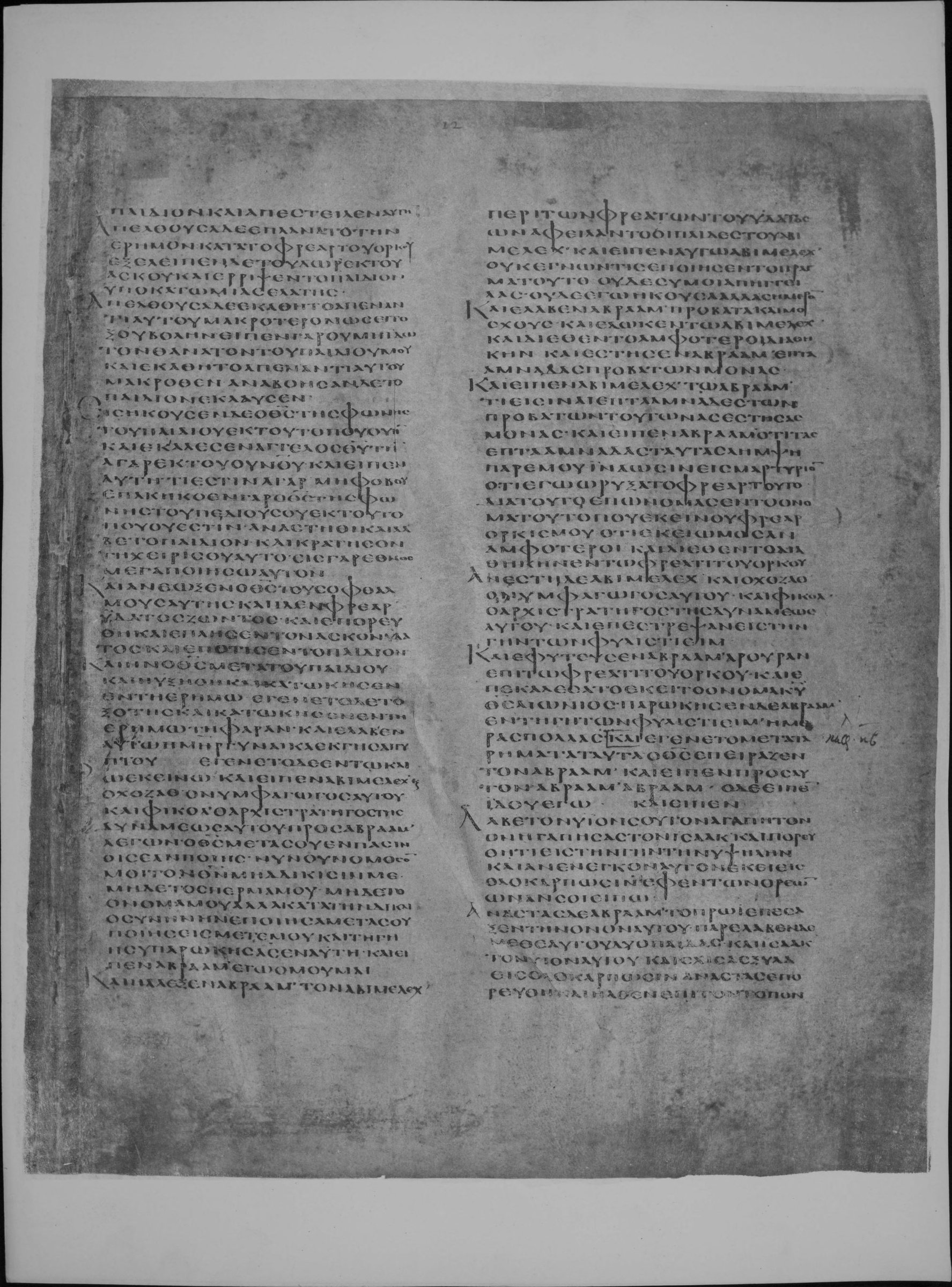
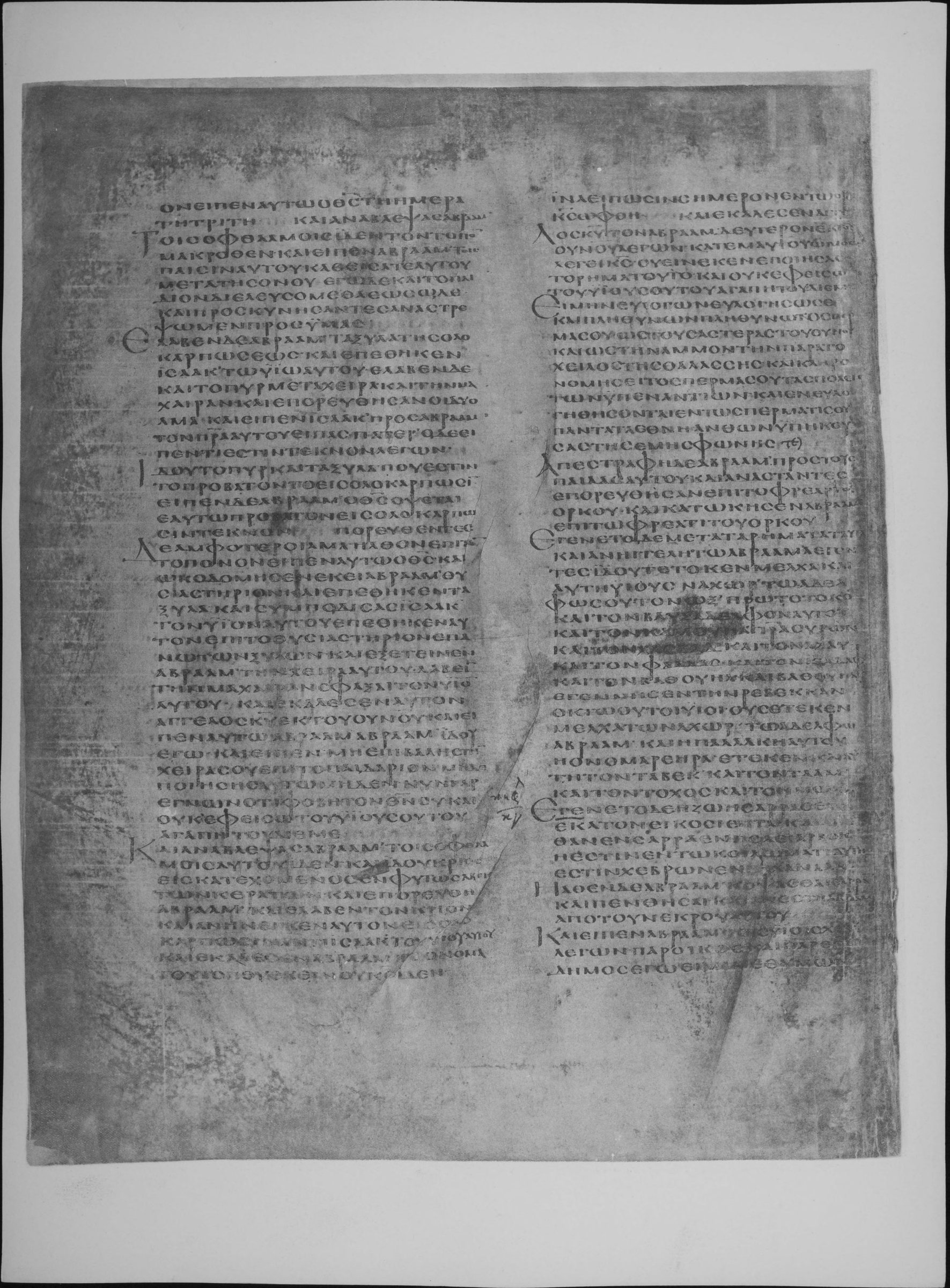
Genesis 22 in the Greek Old Testament (the Septuagint) as written in Codex Alexandrinus, a Greek Bible copied in the fifth century, probably in Egypt, and now in the British Library (Royal MS 1 D. V, the first of its four volumes). It is one of the three great early codices of the whole Greek Bible, with Codex Vaticanus and Codex Sinaiticus, and for Genesis 1:1-46:28, which Codex Vaticanus has lost, it is the oldest surviving complete Greek text (older papyri such as the Berlin Genesis papyrus and Chester Beatty 961 survive only in part).
This entry meets the strict three-criteria standard of the Theosis Library:
- Manuscript scan: the pages of Codex Alexandrinus carrying this chapter (fol. 12r, fol. 12v), from the full-size photographic (autotype) facsimile published by the British Museum in 1879-1883, as digitised on the Internet Archive. The verse range of every page comes from the reduced photographic facsimile of 1915, which prints it beneath each plate, and the opening words of every page were read on the plate to confirm the page and the verse it begins with. Each section links to the page or pages that hold its verses. Folio numbers are those written at the head of each leaf and visible on the plates.
- Original text: Swete's edition, which in Genesis 1:1-46:28 prints the text of Codex Alexandrinus itself (Codex Vaticanus has lost these chapters), with the spelling of A for the most part. Swete adds accents, breathings and punctuation and expands the abbreviated sacred names, so the plate shows the same text in unaccented capitals.
- English translation: Sir Lancelot C. L. Brenton, The Septuagint Version of the Old Testament (1844; 1851 edition), a translation of the Greek, public domain, from the eBible.org text.
How was this verified? (Provenance)
Where on the image
Genesis 22:1-3 is on fol. 12r (full-size facsimile of 1879-83, Internet Archive codex-alexandrinus leaf 44). The 1915 reduced facsimile prints beneath this page: Gen. xxi. 14-xxii. 3. Checked on the plate: the page begins inside Genesis 21:14 (first words read: ΠΑΙΔΙΟΝ ΚΑΙ ΑΠΕΣΤΕΙΛΕΝ ΑΥΤΗΝ ΑΠΕΛΘΟΥΣΑ ΔΕ ΕΠΛΑΝΑΤΟ ΤΗΝ ΕΡΗΜΟΝ). Genesis 22:3-8 is on fol. 12v (full-size facsimile of 1879-83, Internet Archive codex-alexandrinus leaf 45). The 1915 reduced facsimile prints beneath this page: Gen. xxii. 3-xxiii. 4. Checked on the plate: the page begins inside Genesis 22:3 (first words read: ΟΝ ΕΙΠΕΝ ΑΥΤΩ Ο ΘΣ ΤΗ ΗΜΕΡΑ ΤΗ ΤΡΙΤΗ ΚΑΙ ΑΝΑΒΛΕΨΑΣ ΑΒΡΑΑΜ).
1Καὶ ἐγένετο μετὰ τὰ ῥήματα ταῦτα ὁ θεὸς ἐπείραζεν τὸν Ἀβραάμ· καὶ εἶπεν πρὸς αὐτόν Ἀβραὰμ Ἀβραάμ. ὁ δὲ εἶπεν Ἰδοὺ ἐγώ. 2καὶ εἶπεν Λάβε τὸν υἱόν σου τὸν ἀγαπητὸν ὃν ἠγάπησας, τὸν Ἰσαάκ, καὶ πορεύθητι εἰς τὴν γῆν τὴν ὑψηλήν, καὶ ἀνένεγκον αὐτὸν ἐκεῖ εἰς ὁλοκάρπωσιν ἐφ᾽ ἓν τῶν ὀρέων ὧν ἄν σοι εἴπω. 3ἀναστὰς δὲ Ἀβραὰμ τὸ πρωὶ ἐπέσαξεν τὴν ὄνον αὐτοῦ. παρέλαβεν δὲ μεθ᾽ ἑαυτοῦ δύο παῖδας καὶ Ἰσαὰκ τὸν υἱὸν αὐτοῦ, καὶ σχὶσας ξύλα εἰς ὁλοκάρπωσιν ἀναστὰς ἐπορεύθη. καὶ ἦλθεν ἐπὶ τὸν τόπον ὃν εἶπεν αὐτῷ ὁ θεὸς 4τῇ ἡμέρᾳ τῇ τρίτῃ. καὶ ἀναβλέψας Ἀβραὰμ τοῖς ὀφθαλμοῖς ἴδεν τὸν τόπον μακρόθεν· 5καὶ εἶπεν Ἀβραὰμ τοῖς παισὶν αὐτοῦ Καθίσατε αὐτοῦ μετὰ τῆς ὄνου, ἐγὼ δὲ καὶ τὸ παιδίον διελευσόμεθα ἕως ὧδε· καὶ προσκυνήσαντες ἀναστρέψωμεν πρὸς ὑμᾶς. 6ἔλαβεν δὲ Ἀβραὰμ τὰ ξύλα τῆς ὁλοκαρπώσεως καὶ ἐπέθηκεν Ἰσαὰκ τῷ υἱῷ αὐτοῦ· ἔλαβεν δὲ καὶ τὸ πῦρ μετὰ χεῖρα καὶ τὴν μάχαιραν, καὶ ἐπορεύθησαν οἱ δύο ἅμα. 7καὶ εἶπεν Ἰσαὰκ πρὸς Ἀβραὰμ τὸν πατέρα αὐτοῦ εἴπας Πάτερ· ὁ δὲ εἶπεν Τί ἐστιν, τέκνον; λέγων Ἰδού τὸ πῦρ καὶ τὰ ξύλα· ποῦ ἔστιν τὸ πρόβατον τὸ εἰς ὁλοκάρπωσιν; 8εἶπεν δὲ Ἀβραάμ Ὁ θεὸς ὄψεται ἑαυτῷ πρόβατον εἰς ὁλοκάρπωσιν, τέκνον. πορευθέντες δὲ ἀμφότεροι ἅμα
1And it came to pass after these things that God tempted Abraam, and said to him, Abraam, Abraam; and he said, Lo! I am here. 2And he said, Take thy son, the beloved one, whom thou hast loved—Isaac, and go into the high land, and offer him there for a whole-burnt-offering on one of the mountains which I will tell thee of. 3And Abraam rose up in the morning and saddled his ass, and he took with him two servants, and Isaac his son, and having split wood for a whole-burnt-offering, he arose and departed, and came to the place of which God spoke to him, 4on the third day; and Abraam having lifted up his eyes, saw the place afar off. 5And Abraam said to his servants, Sit ye here with the ass, and I and the lad will proceed thus far, and having worshipped we will return to you. 6And Abraam took the wood of the whole-burnt-offering, and laid it on Isaac his son, and he took into his hands both the fire and the knife, and the two went together. 7And Isaac said to Abraam his father, Father. And he said, What is it, son? And he said, Behold the fire and the wood, where is the sheep for a whole-burnt-offering? 8And Abraam said, God will provide himself a sheep for a whole-burnt-offering, my son. And both having gone together,
Where on the image
Genesis 22:9-16 is on fol. 12v (full-size facsimile of 1879-83, Internet Archive codex-alexandrinus leaf 45). The 1915 reduced facsimile prints beneath this page: Gen. xxii. 3-xxiii. 4. Checked on the plate: the page begins inside Genesis 22:3 (first words read: ΟΝ ΕΙΠΕΝ ΑΥΤΩ Ο ΘΣ ΤΗ ΗΜΕΡΑ ΤΗ ΤΡΙΤΗ ΚΑΙ ΑΝΑΒΛΕΨΑΣ ΑΒΡΑΑΜ).
9ἦλθον ἐπὶ τὸν τόπον ὃν εἶπεν αὐτῷ ὁ θεός. καὶ ᾠκοδόμησεν ἐκεῖ Ἀβραὰμ θυσιαστήριον καὶ ἐπέθηκεν τὰ ξύλα· καὶ συμποδίσας Ἰσαὰκ τὸν υἱὸν αὐτοῦ ἐπέθηκεν αὐτὸν ἐπὶ τὸ θυσιαστήριον ἐπάνω τῶν ξύλων. 10καὶ ἐξέτεινεν Ἀβραὰμ τὴν χεῖρα αὐτοῦ λαβεῖν τὴν μάχαιραν, σφάξαι τὸν υἱὸν αὐτοῦ. 11καὶ ἐκάλεσεν αὐτὸν ἄγγελος Κυρίου ἐκ τοῦ οὐρανοῦ καὶ εἶπεν αὐτῷ Ἀβραὰμ Ἀβραάμ. ὁ δὲ εἶπεν Ἰδού ἐγώ. 12καὶ εἶπεν Μὴ ἐπιβάλῃς τὴν χεῖρά σου ἐπὶ τὸ παιδάριον, μηδὲ ποιήσῃς αὐτῷ μηδέν· νῦν γὰρ ἔγνων ὅτι φοβῇ τὸν θεὸν σύ, καὶ οὐκ ἐφείσω τοῦ υἱοῦ σου τοῦ ἀγαπητοῦ δι᾽ ἐμέ. 13καὶ ἀναβλέψας Ἀβραὰμ τοῖς ὀφθαλμοῖς αὐτοῦ ἴδεν, καὶ ἰδοὺ κριὸς εἷς κατεχόμενος ἐν φυτῷ σαβὲκ τῶν κεράτων. καὶ ἐπορεύθη Ἀβραὰμ καὶ ἔλαβεν τὸν κριόν, καὶ ἀνήνεγκεν αὐτὸν εἰς ὁλοκάρπωσιν ἀντὶ Ἰσαὰκ τοῦ υἱοῦ αὐτοῦ. 14καὶ ἐκάλεσεν Ἀβραὰμ τὸ ὄνομα τοῦ τόπου ἐκείνου Κύριος ἴδεν· ἵνα εἴπωσιν σήμερον Ἐν τῷ ὄρει Κύριος ὤφθη. 15καὶ ἐκάλεσεν ἄγγελος Κυρίου τὸν Ἀβραὰμ δεύτερον ἐκ τοῦ οὐρανοῦ 16λέγων Κατ᾽ ἐμαυτοῦ ὤμοσα, λέγει Κύριος, οὗ εἵνεκεν ἐποίησας τὸ ῥῆμα τοῦτο καὶ οὐκ ἐφείσω τοῦ υἱοῦ σου τοῦ ἀγαπητοῦ δι᾽ ἐμέ,
9came to the place which God spoke of to him; and there Abraam built the altar, and laid the wood on it, and having bound the feet of Isaac his son together, he laid him on the altar upon the wood. 10And Abraam stretched forth his hand to take the knife to slay his son. 11And an angel of the Lord called him out of heaven, and said, Abraam, Abraam. And he said, Behold, I am here. 12And he said, Lay not thine hand upon the child, neither do anything to him, for now I know that thou fearest God, and for my sake thou hast not spared thy beloved son. 13And Abraam lifted up his eyes and beheld, and lo! a ram caught by his horns in a plant of Sabec; and Abraam went and took the ram, and offered him up for a whole-burnt-offering in the place of Isaac his son. 14And Abraam called the name of that place, The Lord hath seen; that they might say to-day, In the mount the Lord was seen. 15And an angel of the Lord called Abraam the second time out of heaven, 16saying, I have sworn by myself, says the Lord, because thou hast done this thing, and on my account hast not spared thy beloved son,
Where on the image
Genesis 22:17-24 is on fol. 12v (full-size facsimile of 1879-83, Internet Archive codex-alexandrinus leaf 45). The 1915 reduced facsimile prints beneath this page: Gen. xxii. 3-xxiii. 4. Checked on the plate: the page begins inside Genesis 22:3 (first words read: ΟΝ ΕΙΠΕΝ ΑΥΤΩ Ο ΘΣ ΤΗ ΗΜΕΡΑ ΤΗ ΤΡΙΤΗ ΚΑΙ ΑΝΑΒΛΕΨΑΣ ΑΒΡΑΑΜ).
17εἰ μήν εὐλογῶν εὐλογήσω σε, καὶ πληθύνων πληθυνῶ τὸ σπέρμα σου ὡς τοὺς ἀστέρας τοῦ οὐρανοῦ καὶ ὡς τὴν ἄμμον τὴν παρὰ τὸ χεῖλος τῆς θαλάσσης· καὶ κληρονομήσει τὸ σπέρμα σου τὰς πόλεις τῶν ὑπεναντίων. 18καὶ ἐνευλογηθήσονται ἐν τῷ σπέρματι σου πάντα τὰ ἔθνη, ἀνθ᾽ ὧν ὑπήκουσας τῆς ἐμῆς φωνῆς. 19ἀπεστράφη δὲ Ἀβραὰμ πρὸς τοὺς παῖδας αὐτοῦ, καὶ ἀναστάντες ἐπορεύθησαν ἐπὶ τὸ φρέαρ τοῦ ὃρκου· καὶ κατῴκησεν Ἀβραὰμ ἐπὶ τῷ φρέατι τοῦ ὅρκου. 20Ἐγένετο· δὲ μετὰ τὰ ῥήματα ταῦτα καὶ ἀνηγγέλη τῷ Ἀβραὰμ λέγοντες Ἰδοὺ τέτοκεν Μελχὰ καὶ αὐτὴ υἱοὺς Ναχὼρ τῷ ἀδελφῷ σου, 21τὸν Ὢξ πρωτότοκον καὶ τὸν Βαὺξ ἀδελφὸν αὐτοῦ, καὶ τὸν Καμουὴλ πατέρα Σύρων, 22καὶ τὸν Χάσζαδ καὶ τὸν Ἁζαῦ καὶ τὸν φαλδὰς καὶ τὸν Ἰελδὰφ καὶ τὸν Βαθουήλ. 23καὶ Βαθουὴλ ἐγέννησεν τὴν Ῥεβέκκαν. ὀκτὼ οὗτοι υἱοὶ οὓς ἔτεκεν Μελχὰ τῷ Ναχὼρ τῷ ἀδελφῷ Ἀβραάμ. 24καὶ ἡ παλλακὴ αὐτοῦ ᾗ ὄνομα Ῥεηρά, ἔτεκεν καὶ αὐτὴ τὸν Τάβεκ καὶ τὸν Τάαμ καὶ τὸν Τόχος καὶ τὸν Μωχά.
17surely blessing I will bless thee, and multiplying I will multiply thy seed as the stars of heaven, and as the sand which is by the shore of the sea, and thy seed shall inherit the cities of their enemies. 18And in thy seed shall all the nations of the earth be blessed, because thou hast hearkened to my voice. 19And Abraam returned to his servants, and they arose and went together to the well of the oath; and Abraam dwelt at the well of the oath. 20And it came to pass after these things, that it was reported to Abraam, saying, Behold, Melcha herself too has born sons to Nachor thy brother, 21Uz the first-born, and Baux his brother, and Camuel the father of the Syrians, and Chazad, and 22Azav and Phaldes, and Jeldaph, and Bathuel, and Bathuel begot Rebecca; 23these are eight sons, which Melcha bore to Nachor the brother of Abraam. 24And his concubine whose name was Rheuma, she also bore Tabec, and Taam, and Tochos, and Mocha.
Cite
Sources
- Source: Codex Alexandrinus (British Library Royal MS 1 D. V) via the British Museum photographic facsimiles of 1879-83 and 1915 (Internet Archive) + Swete's Septuagint + Brenton's English (holding institution)
- Critical edition: H. B. Swete, The Old Testament in Greek according to the Septuagint (1909)
← previous · → next · v cycle view · l back to library