Habakkuk, Chapter 1 (Codex Alexandrinus)
Introduction
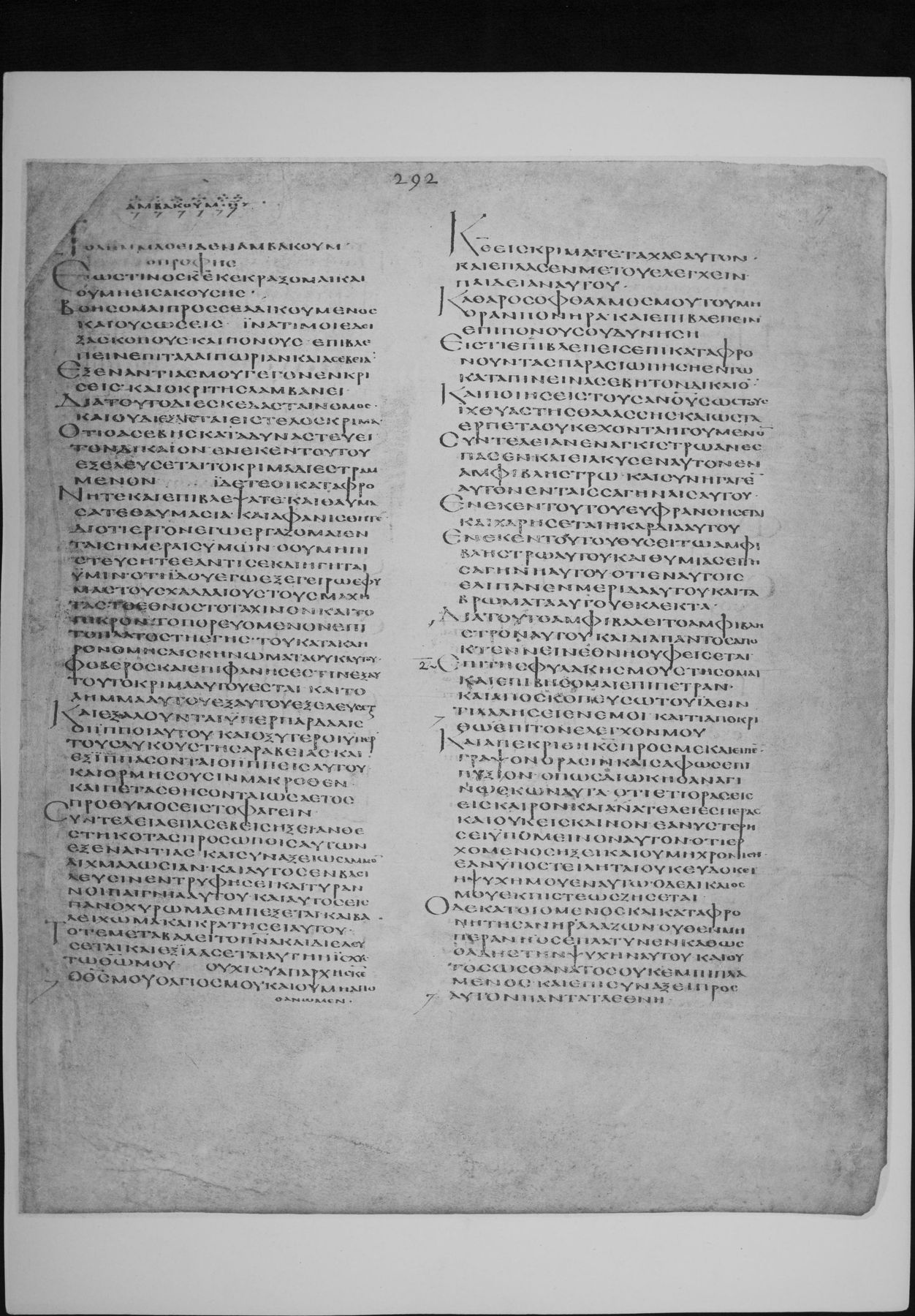
Habakkuk 1 in the Greek Old Testament (the Septuagint) as written in Codex Alexandrinus, a Greek Bible copied in the fifth century, probably in Egypt, and now in the British Library (Royal MS 1 D. VI, the second of its four volumes). It is one of the three great early codices of the whole Greek Bible, with Codex Vaticanus and Codex Sinaiticus.
This entry meets the strict three-criteria standard of the Theosis Library:
- Manuscript scan: the page of Codex Alexandrinus carrying this chapter (fol. 292r), from the full-size photographic (autotype) facsimile published by the British Museum in 1879-1883, as digitised on the Internet Archive. The verse range of every page comes from the reduced photographic facsimile of 1936, which prints it beneath each plate, and the opening words of every page were read on the plate to confirm the page and the verse it begins with. Each section links to the page or pages that hold its verses. Folio numbers are those written at the head of each leaf and visible on the plates.
- Original text: Swete's edition, which here prints the text of Codex Vaticanus (Vat. gr. 1209), the base of his edition, and gives the readings of Alexandrinus only in his apparatus. The Greek column is therefore Vaticanus' text; where Alexandrinus differs, the plate shows what Alexandrinus reads.
- English translation: Sir Lancelot C. L. Brenton, The Septuagint Version of the Old Testament (1844; 1851 edition), a translation of the Greek, public domain, from the eBible.org text.
How was this verified? (Provenance)
Where on the image
Habakkuk 1:1-8 is on fol. 292r (full-size facsimile of 1879-83, Internet Archive codex-alexandrinus leaf 608). The 1936 reduced facsimile prints beneath this page: Hab. i. 1-ii. 5. Checked on the plate: the page begins at the start of Habakkuk 1:1 (first words read: ΤΟ ΛΗΜΜΑ Ο ΕΙΔΕΝ ΑΜΒΑΚΟΥΜ Ο ΠΡΟΦΗΤΗΣ ΕΩΣ ΤΙΝΟΣ ΚΕ ΚΕΚΡΑΞΟΜΑΙ ΚΑΙ ΟΥ ΜΗ ΕΙΣΑΚΟΥΣΗΣ).
1ΤΟ λῆμμα ὃ εἶδεν Ἁμβακοὺμ ὁ προφήτης. 2Ἕως τίνος, Κύριε, κράξομαι, καὶ οὐ μὴ εἰσακούσῃς; βοήσομαι πρὸς σὲ ἀδικούμενος, καὶ οὐ σώσεις; 3ἵνα τί ἔδειξάς μοι κόπους καὶ πόνους ἐπιβλέπειν, ταλαιπωρίαν καὶ ἀσέβειαν; ἐξ ἐναντίας μου γέγονεν κρίσις, καὶ ὁ κριτὴς λαμβάνει· 4διὰ τοῦτο διεσκέδασται νόμος, καὶ οὐ διεξάγεται εἰς τέλος κρίμα, ὅτι ἀσεβὴς καταδυναστεύει τὸν δίκαιον· ἕνεκεν τούτου ἐξελεύσεται τὸ κρίμα διεστραμμένον. 5ἴδετε, οἱ καταφρονηταί, καὶ ἐπιβλέψατε, καὶ θαυμάσατε θαυμάσια καὶ ἀφανίσθητε· διότι ἔργον ἐγὼ ἐργάζομαι ἐν ταῖς ἡμέραις ὑμῶν ὃ οὐ μὴ πιστεύσητε ἐάν τις ἐκδιηγῆται. 6διότι ἰδοὺ ἐγὼ ἐξεγείρω τοὺς Χαλδαίους, τὸ ἔθνος τὸ πικρὸν καὶ τὸ ταχινόν, τὸ πορευόμενον ἐπὶ τὰ πλάτη τῆς γῆς τοῦ κατακληρονομῆσαι σκηνώματα οὐκ αὐτοῦ· 7φοβερὸς καὶ ἐπιφανής ἐστιν, ἐξ αὐτοῦ τὸ κρίμα αὐτοῦ ἔσται, καὶ τὸ λῆμμα αὐτοῦ ἐξ αὐτοῦ ἐξελεύσεται· 8καὶ ἐξαλοῦνται ὑπὲρ παρδάλεις οἱ ἵπποι αὐτοῦ, καὶ ὀξύτεροι ὑπὲρ τοὺς λύκους τῆς Ἀραβίας· καὶ ἐξιππάσονται οἱ ἱππεῖς αὐτοῦ καὶ ὁρμήσουσιν μακρόθεν, καὶ πετασθήσονται ὡς ἀετὸς πρόθυμος εἰς τὸ φαγεῖν.
1The burden which the prophet Ambacum saw. 2How long, O Lord, shall I cry out, and thou wilt not hearken? how long shall I cry out to thee being injured, and thou wilt not save? 3Wherefore hast thou shewn me troubles and griefs to look upon, misery and ungodliness? judgment is before me, and the judge receives a reward. 4Therefore the law is frustrated, and judgment proceeds not effectually, for the ungodly man prevails over the just; therefore perverse judgment will proceed. 5Behold, ye despisers, and look, and wonder marvellously, and vanish: for I work a work in your days, which ye will in no wise believe, though a man declare it to you. 6Wherefore, behold, I stir up the Chaldeans, the bitter and hasty nation, that walks upon the breadth of the earth, to inherit tabernacles not his own. 7He is terrible and famous; his judgment shall proceed of himself, and his dignity shall come out of himself. 8And his horses shall bound more swiftly than leopards, and they are fiercer than the wolves of Arabia: and his horsemen shall ride forth, and shall rush from far; and they shall fly as an eagle hasting to eat.
Where on the image
Habakkuk 1:9-17 is on fol. 292r (full-size facsimile of 1879-83, Internet Archive codex-alexandrinus leaf 608). The 1936 reduced facsimile prints beneath this page: Hab. i. 1-ii. 5. Checked on the plate: the page begins at the start of Habakkuk 1:1 (first words read: ΤΟ ΛΗΜΜΑ Ο ΕΙΔΕΝ ΑΜΒΑΚΟΥΜ Ο ΠΡΟΦΗΤΗΣ ΕΩΣ ΤΙΝΟΣ ΚΕ ΚΕΚΡΑΞΟΜΑΙ ΚΑΙ ΟΥ ΜΗ ΕΙΣΑΚΟΥΣΗΣ).
9συντέλεια εἰς ἀσεβεῖς ἥξει, ἀνθεστηκότας προσώποις αὐτῶν ἐξ ἐναντίας, καὶ συνάξει ὡς ἄμμον αἰχμαλωσίαν. 10καὶ αὐτὸς ἐν βασιλεῦσιν ἐντρυφήσει καὶ τύραννοι παίγνια αὐτοῦ, καὶ αὐτὸς εἰς πᾶν ὀχύρωμα ἐμπαίξεται, καὶ βαλεῖ χῶμα καὶ κρατήσει αὐτοῦ. 11τότε μεταβαλεῖ τὸ πνεῦμα, καὶ διελεύσεται καὶ ἐξιλάσεται· αὕτη ἡ ἰσχὺς τῷ θεῷ μου. 12Οὐχὶ σὺ ἀπ᾽ ἀρχῆς, Κύριε ὁ θεός, ὁ ἅγιός μου; καὶ οὐ μὴ ἀποθάνωμεν. Κύριε, εἰς κρίμα τέταχας αὐτό· καὶ ἔπλασέν με τοῦ ἐλέγχειν παιδείαν αὐτοῦ. 13καθαρὸς ὀφθαλμὸς τοῦ μὴ ὁρᾷν πονηρὰ καὶ ἐπιβλέπειν ἐπὶ πόνους ὀδύνης· ἵνα τί ἐπιβλέπεις ἐπὶ καταφρονοῦντας; παρασιωπήσῃ ἐν τῷ καταπίνειν ἀσεβῆ τὸν δίκαιον; 14καὶ ποιήσεις τοὺς ἀνθρώπους ὡς τοὺς ἰχθύας τῆς θαλάσσης, καὶ ὡς τὰ ἑρπετὰ τὰ οὐκ ἔχοντα ἡγούμενον; 15συντέλειαν ἐν ἀγκίστρῳ ἀνέσπασεν, καὶ εἵλκυσεν αὐτὸν ἐν ἀμφιβλήστρῳ, καὶ συνήγαγεν αὐτὸν ἐν ταῖς σαγήναις αὐτοῦ. 16ἕνεκεν τούτου εὐφρανθήσεται καὶ χαρήσεται ἡ καρδία αὐτοῦ· ἕνεκεν τούτου θύσει τῇ σαγήνῃ αὐτοῦ καὶ θυμιάσει τῷ ἀμφιβλήστρῳ αὐτοῦ, ὅτι ἐν αὐτοῖς ἐλίπανεν μερίδα αὐτοῦ καὶ τὰ βρώματα αὐτοῦ ἐκλεκτά· 17διὰ τοῦτο ἀμφιβαλεῖ τὸ ἀμφίβληστρον αὐτοῦ, καὶ διὰ παντὸς ἀποκτέννειν ἔθνη οὐ φείσεται.
9Destruction shall come upon ungodly men, resisting with their adverse front, and he shall gather the captivity as the sand. 10And he shall be at his ease with kings, and princes are his toys, and he shall mock at every strong-hold, and shall cast a mound, and take possession of it. 11Then shall he change his spirit, and he shall pass through, and make an atonement, saying, This strength belongs to my god. 12Art not thou from the beginning, O Lord God, my Holy One? and surely we shall not die. O Lord, thou hast established it for judgment, and he has formed me to chasten with his correction. 13His eye is too pure to behold evil doings, and to look upon grievous afflictions: wherefore dost thou look upon despisers? wilt thou be silent when the ungodly swallows up the just? 14And wilt thou make men as the fishes of the sea, and as the reptiles which have no guide? 15He has brought up destruction with a hook, and drawn one with a casting net, and caught another in his drags: therefore shall his heart rejoice and be glad. 16Therefore will he sacrifice to his drag, and burn incense to his casting-net, because by them he has made his portion fat, and his meats choice. 17Therefore will he cast his net, and will not spare to slay the nations continually.
Cite
Sources
- Source: Codex Alexandrinus (British Library Royal MS 1 D. VI) via the British Museum photographic facsimiles of 1879-83 and 1936 (Internet Archive) + Swete's Septuagint + Brenton's English (holding institution)
- Critical edition: H. B. Swete, The Old Testament in Greek according to the Septuagint (1909)
← previous · → next · v cycle view · l back to library