Isaiah, Chapter 15 (Codex Alexandrinus)
Introduction
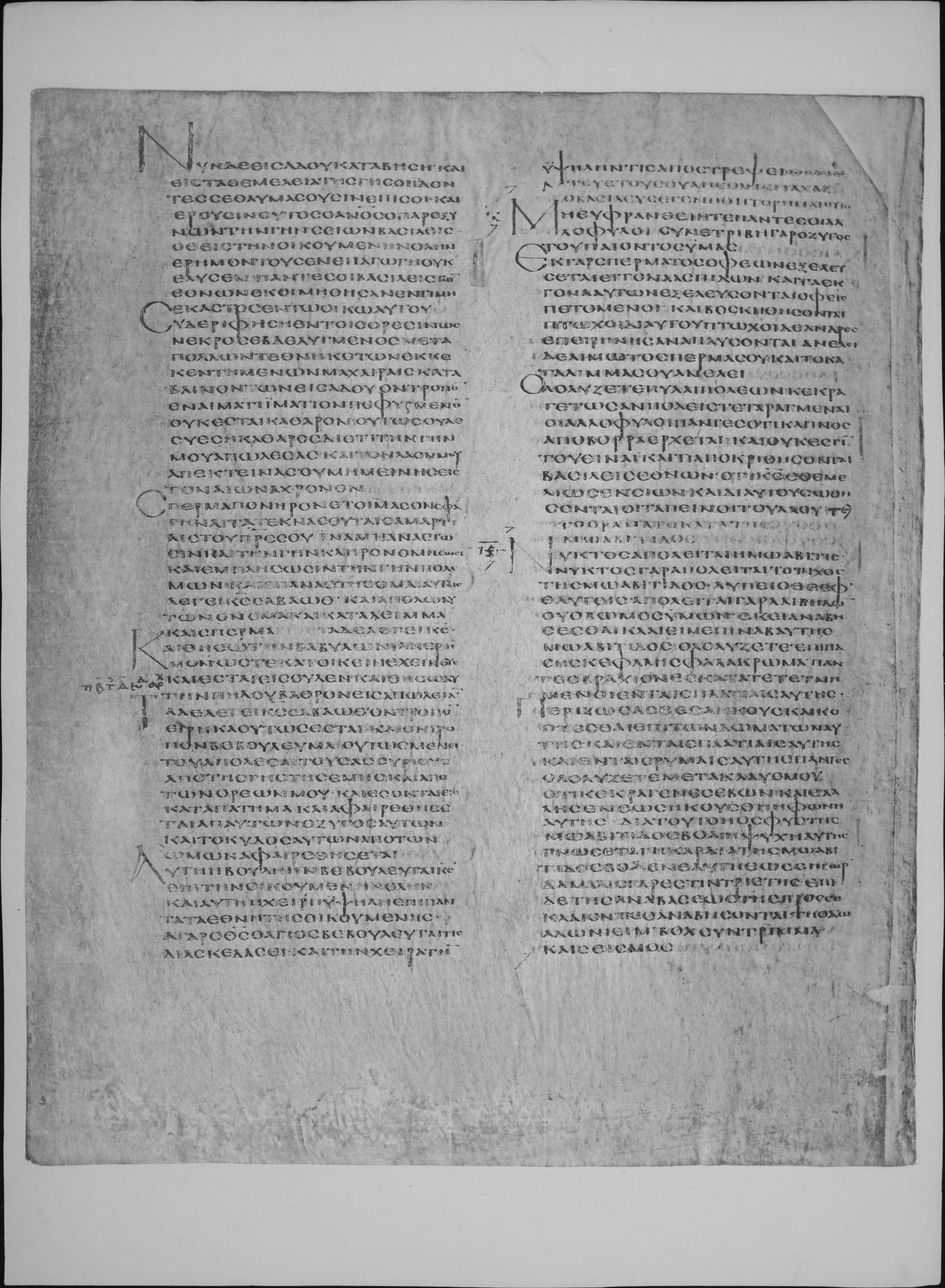
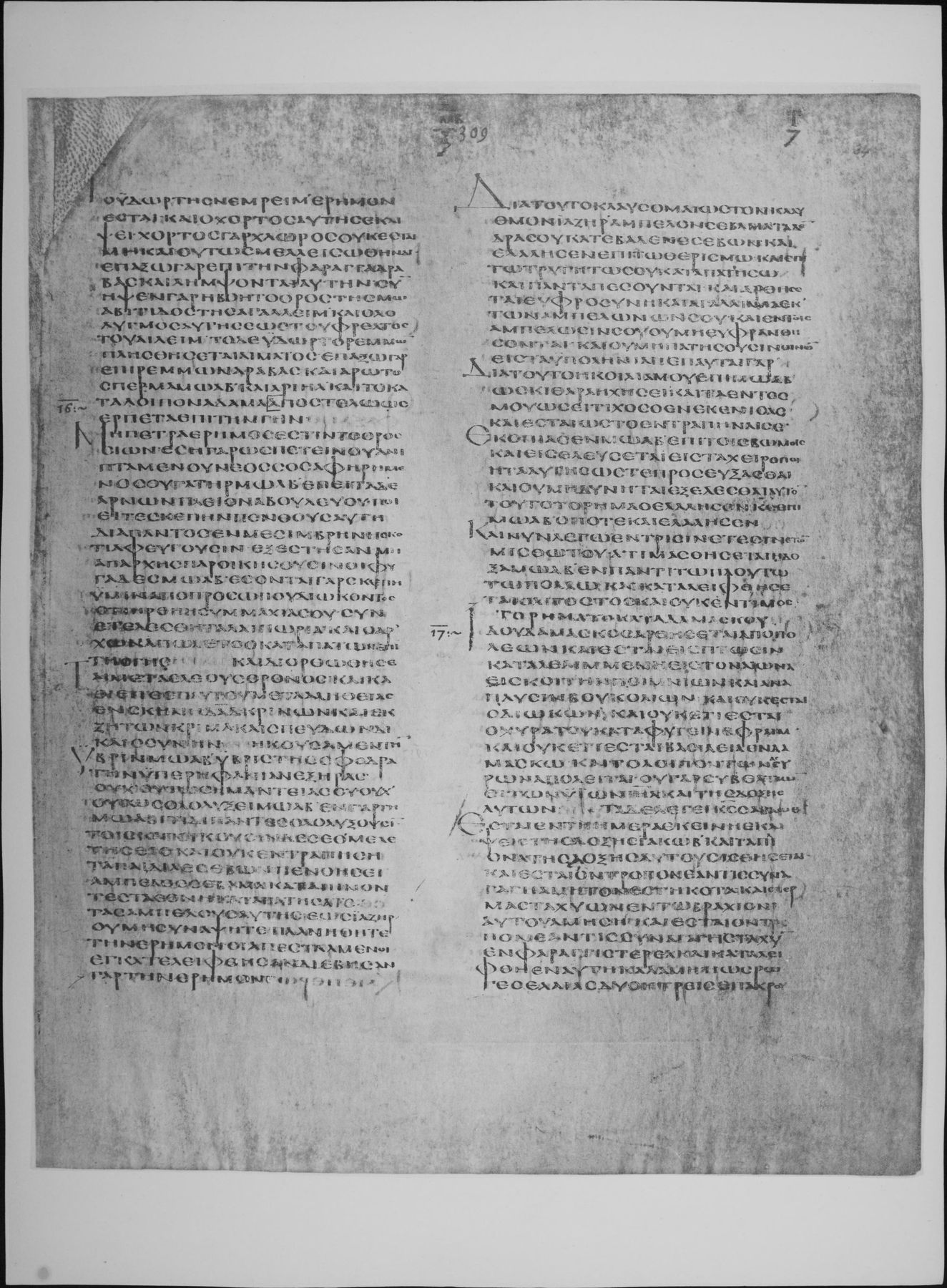
Isaiah 15 in the Greek Old Testament (the Septuagint) as written in Codex Alexandrinus, a Greek Bible copied in the fifth century, probably in Egypt, and now in the British Library (Royal MS 1 D. VI, the second of its four volumes). It is one of the three great early codices of the whole Greek Bible, with Codex Vaticanus and Codex Sinaiticus.
Numbering: Swete's Greek and Brenton's English number or divide some verses of this chapter differently (Swete 15:1-2 = Brenton 15:1-2). Each column keeps its own verse numbers, and sections are cut only where the two texts agree, so each section holds the same passage in both languages.
This entry meets the strict three-criteria standard of the Theosis Library:
- Manuscript scan: the pages of Codex Alexandrinus carrying this chapter (fol. 308v, fol. 309r), from the full-size photographic (autotype) facsimile published by the British Museum in 1879-1883, as digitised on the Internet Archive. The verse range of every page comes from the reduced photographic facsimile of 1936, which prints it beneath each plate, and the opening words of every page were read on the plate to confirm the page and the verse it begins with. Each section links to the page or pages that hold its verses. Folio numbers are those written at the head of each leaf and visible on the plates.
- Original text: Swete's edition, which here prints the text of Codex Vaticanus (Vat. gr. 1209), the base of his edition, and gives the readings of Alexandrinus only in his apparatus. The Greek column is therefore Vaticanus' text; where Alexandrinus differs, the plate shows what Alexandrinus reads.
- English translation: Sir Lancelot C. L. Brenton, The Septuagint Version of the Old Testament (1844; 1851 edition), a translation of the Greek, public domain, from the eBible.org text.
How was this verified? (Provenance)
Where on the image
Isaiah 15:1-5 is on fol. 308v (full-size facsimile of 1879-83, Internet Archive codex-alexandrinus leaf 641). The 1936 reduced facsimile prints beneath this page: (caption not legible in the scan; range bounded by the captions of leaves 68 and 70). Checked on the plate: the page begins at the start of Isaiah 14:15 (first words read: ΝΥΝ ΔΕ ΕΙΣ ΑΔΟΥ ΚΑΤΑΒΗΣΗ ΚΑΙ ΕΙΣ ΤΑ ΘΕΜΕΛΙΑ ΤΗΣ ΓΗΣ ΟΙ ΙΔΟΝΤΕΣ ΣΕ ΘΑΥΜΑΣΟΥΣΙΝ). Isaiah 15:6-9 is on fol. 309r (full-size facsimile of 1879-83, Internet Archive codex-alexandrinus leaf 642). The 1936 reduced facsimile prints beneath this page: (caption not legible in the scan; range bounded by the captions of leaves 69 and 71). Checked on the plate: the page begins at the start of Isaiah 15:6 (first words read: ΤΟ ΥΔΩΡ ΤΟΥ ΝΕΜΡΕΙΜ ΕΡΗΜΟΝ ΕΣΤΑΙ ΚΑΙ Ο ΧΟΡΤΟΣ ΑΥΤΗΣ ΕΚΛΕΙΨΕΙ).
1Τὸ ῥῆμα τὸ κατὰ τῆς Μωαβείτιδος. Νυκτὸς ἀπολεῖται ἡ Μωαβεῖτις, νυκτὸς γὰρ ἀπολεῖται τὸ τεῖχος τῆς Μωαβείτιδος. 2λυπεῖσθε ἐφ᾽ ἑαυτούς, ἀπολεῖται γὰρ καὶ Δηβών, οὗ ὁ βωμὸς ὑμῶν· ἐκεῖ ἀναβήσεσθε κλαίειν, ἐπὶ Ναβαὺ τῆς Μωαβείτιδος. ὀλολύξατε, ἐπὶ πάσης κεφαλῆς φαλάκρωμα, πάντες βραχίονες κατατετμημένοι, 3ἐν ταῖς πλατείαις αὐτῆς περιζώσασθε σάκκους, καὶ κόπτεσθε ἐπὶ τῶν δωμάτων αὐτῆς καὶ ἐν ταῖς ῥύμαις αὐτῆς, πάντες ὀλολύζετε μετὰ κλαυθμοῦ. 4ὅτι κέκραγεν Ἑσεβὼν καὶ Ἐλεαλή, ἕως Ἰάσσα ἠκούσθη ἡ φωνὴ αὐτῶν· διὰ τοῦτο ἡ ὀσφὺς τῆς Μωαβείτιδος βοᾷ, ἡ ψυχὴ αὐτῆς γνώσεται. 5ἡ καρδία τῆς Μωαβείτιδος βοᾷ ἐν αὐτῇ ἕως Σήγωρ· δάμαλις γάρ ἐστιν τριετής, ἐπὶ δὲ τῆς ἀναβάσεως Λουεὶθ πρὸς σὲ κλαίοντες ἀναβήσονται τῇ ὁδῷ Ἁρωνιείμ· βοᾷ σύντριμμα καὶ σεισμὸς, 6τὸ ὕδωρ τῆς Νεμηρεὶμ ἔρημος ἔσται καὶ ὁ χόρτος αὐτῆς ἐκλείψει· χόρτος γὰρ χλωρὸς οὐκ ἔσται. 7μὴ καὶ οὕτως μέλλει σωθῆναι; ἐπάξω γὰρ ἐπὶ τὴν φάραγγα Ἄραβας καὶ λήμψονται αὐτήν. 8συνῆψεν γὰρ ἡ βοὴ τὸ ὅριον τῆς Μωαβείτιδος τῆς Ἀγαλείμ, καὶ ὀλολυγμὸς αὐτῆς ἕως τοῦ φρέατος τοῦ Αἰλείμ. 9τὸ δὲ ὕδωρ τὸ Δειμὼν πλησθήσεται αἵματος· ἐπάξω γὰρ ἐπὶ Δειμὼν Ἄραβας, καὶ ἀρῶ τὸ σπέρμα Μωὰβ καὶ Ἀριὴλ καὶ τὸ κατάλοιπον Ἀδαμά.
1The Word against the Land of Moab. 2Grieve for yourselves; for even Debon, where your altar is, shall be destroyed: thither shall ye go up to weep, over Nabau of the land of Moab: howl ye: baldness shall be on every head, and all arms shall be wounded. 3Gird yourselves with sackcloth in her streets: and lament upon her roofs, and in her streets, and in her ways; howl all of you with weeping. 4For Esebon and Eleale have cried: their voice was heard to Jassa: therefore the loins of the region of Moab cry aloud; her soul shall know. 5The heart of the region of Moab cries within her to Segor; for it is as a heifer of three years old: and on the ascent of Luith they shall go up to thee weeping by the way of Aroniim: she cries, Destruction, and trembling. 6The water of Nemerim shall be desolate, and the grass thereof shall fail: for there shall be no green grass. 7Shall Moab even thus be delivered? for I will bring the Arabians upon the valley, and they shall take it. 8For the cry has reached the border of the region of Moab, even of Agalim; and her howling has gone as far as the well of Ælim. 9And the water of Dimon shall be filled with blood: for I will bring Arabians upon Dimon, and I will take away the seed of Moab, and Ariel, and the remnant of Adama.
Cite
Sources
- Source: Codex Alexandrinus (British Library Royal MS 1 D. VI) via the British Museum photographic facsimiles of 1879-83 and 1936 (Internet Archive) + Swete's Septuagint + Brenton's English (holding institution)
- Critical edition: H. B. Swete, The Old Testament in Greek according to the Septuagint (1909)
← previous · → next · v cycle view · l back to library