Isaiah, Chapter 16 (Codex Alexandrinus)
Introduction
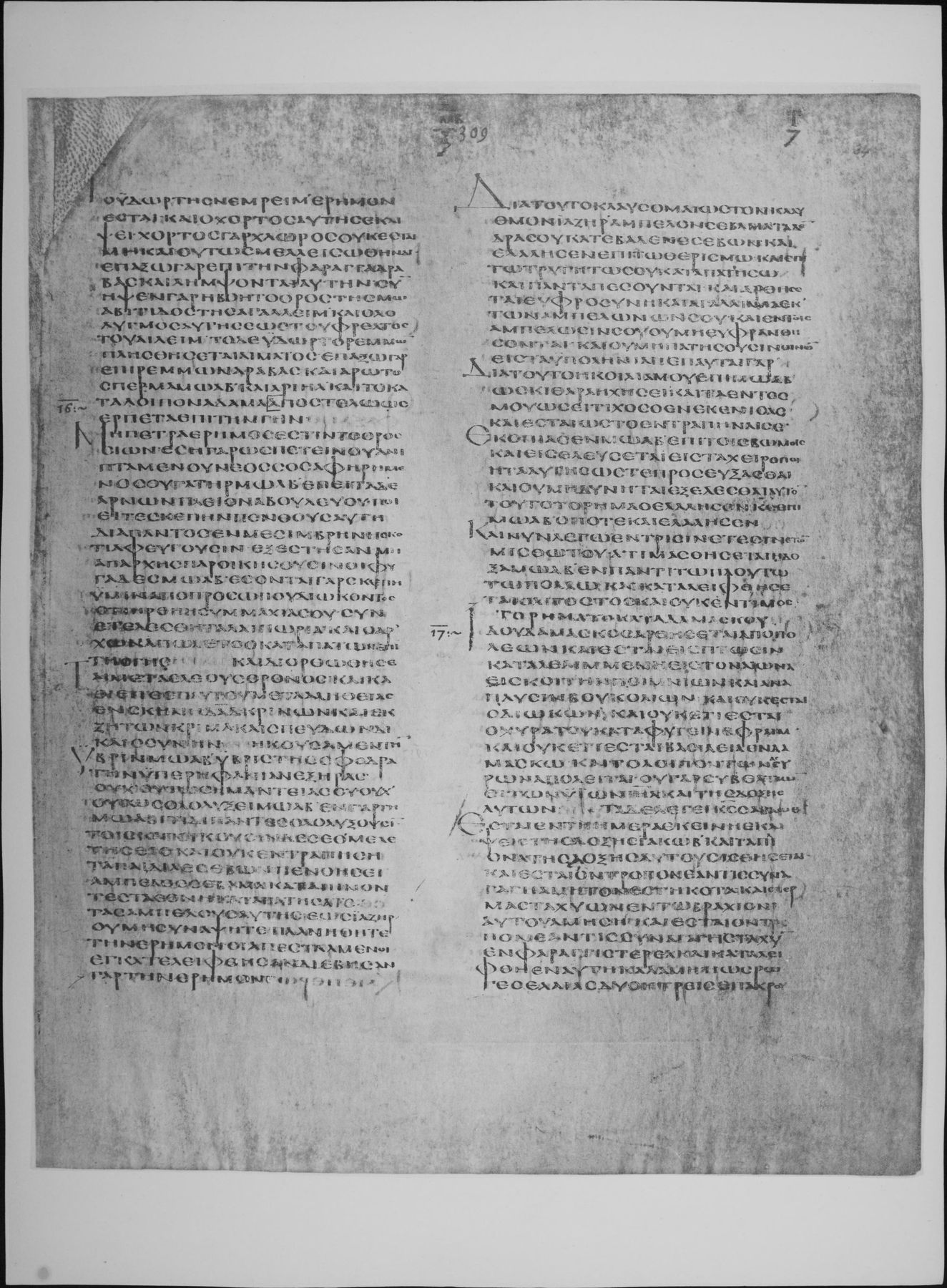
Isaiah 16 in the Greek Old Testament (the Septuagint) as written in Codex Alexandrinus, a Greek Bible copied in the fifth century, probably in Egypt, and now in the British Library (Royal MS 1 D. VI, the second of its four volumes). It is one of the three great early codices of the whole Greek Bible, with Codex Vaticanus and Codex Sinaiticus.
This entry meets the strict three-criteria standard of the Theosis Library:
- Manuscript scan: the page of Codex Alexandrinus carrying this chapter (fol. 309r), from the full-size photographic (autotype) facsimile published by the British Museum in 1879-1883, as digitised on the Internet Archive. The verse range of every page comes from the reduced photographic facsimile of 1936, which prints it beneath each plate, and the opening words of every page were read on the plate to confirm the page and the verse it begins with. Each section links to the page or pages that hold its verses. Folio numbers are those written at the head of each leaf and visible on the plates.
- Original text: Swete's edition, which here prints the text of Codex Vaticanus (Vat. gr. 1209), the base of his edition, and gives the readings of Alexandrinus only in his apparatus. The Greek column is therefore Vaticanus' text; where Alexandrinus differs, the plate shows what Alexandrinus reads.
- English translation: Sir Lancelot C. L. Brenton, The Septuagint Version of the Old Testament (1844; 1851 edition), a translation of the Greek, public domain, from the eBible.org text.
How was this verified? (Provenance)
Where on the image
Isaiah 16:1-8 is on fol. 309r (full-size facsimile of 1879-83, Internet Archive codex-alexandrinus leaf 642). The 1936 reduced facsimile prints beneath this page: (caption not legible in the scan; range bounded by the captions of leaves 69 and 71). Checked on the plate: the page begins at the start of Isaiah 15:6 (first words read: ΤΟ ΥΔΩΡ ΤΟΥ ΝΕΜΡΕΙΜ ΕΡΗΜΟΝ ΕΣΤΑΙ ΚΑΙ Ο ΧΟΡΤΟΣ ΑΥΤΗΣ ΕΚΛΕΙΨΕΙ).
1Ἀποστελῶ ὡς ἑρπετὰ ἐπὶ τὴν γῆν· μὴ πέτρα ἔρημός ἐστιν τὸ ὄρος θυγατρὸς Σειών; 2ἔσῃ γὰρ ὡς πετεινοῦ ἀνιπταμένου νοσσὸς ἀφῃρημένος, ἔσῃ, θυγάτηρ Μωάβ· ἐπὶ τάδε, Ἀρνών, πλείονα 3βουλεύου, ποιεῖτε σκέπην πένθους αὐτῇ διὰ παντός· ἐν μεσημβρινῇ σκοτίᾳ φεύγουσιν, ἐξέστησαν· μὴ ἀχθῇς. 4παροικήσουσίν σοι οἱ φυγάδες Μωάβ· ἔσονται σκέπη ὑμῖν ἀπὸ προσώπου διώκοντος, ὅτι ἤρθη ἡ συμμαχία σου, καὶ ὁ ἄρχων ἀπώλετο ὁ καταπατῶν ἀπὸ τῆς γῆς. 5καὶ διορθωθήσεται μετ᾽ ἐλέους θρόνος, καὶ καθιεῖται ἐπ᾽ αὐτοῦ μετὰ ἀληθείας ἐν σκηνῇ Δαυείδ, κρίνων καὶ ἐκζητῶν κρίμα καὶ σπεύδων δικαιοσύνην. 6Ἠκούσαμεν τὴν ὕβριν Μωάβ, ὑβριστὴς σφόδρα, τὴν ὑπερηφανίαν ἐξῆρα. οὐχ οὕτως ἡ μαντία σου, οὐχ οὕτως. 7ὀλολύξει Μωάβ, ἐν γὰρ τῇ Μωαβείτιδι πάντες ὀλολύξουσιν· τοῖς κατοικοῦσιν Δέσεθ μελετήσεις, καὶ οὐκ ἐντραπήσῃ. 8τὰ πεδία Ἑσεβὼν πενθήσει, ἄμπελος Σεβαμά· καταπίνοντες τὰ ἔθνη, καταπατήσετε τὰς ἀμπέλους αὐτῆς ἕως Ἰαζήρ· οὐ μὴ συνάψητε, πλανήθητε τὴν ἔρημον· οἱ ἀπεσταλμένοι ἐνκατελείφθησαν, διέβησαν γὰρ τὴν θάλασσαν.
1I will send as it were reptiles on the land: is not the mount of the daughter of Sion a desolate rock? 2For thou shalt be as a young bird taken away from a bird that has flown: even thou shalt be so, daughter of Moab: and then do thou, O Arnon, 3take farther counsel, and continually make thou a shelter from grief: they flee in darkness at mid-day; they are amazed; be not thou led captive. 4The fugitives of Moab shall sojourn with thee; they shall be to you a shelter from the face of the pursuer: for thine alliance has been taken away, and the oppressing ruler has perished from off the earth. 5And a throne shall be established with mercy; and one shall sit upon it with truth in the tabernacle of David, judging, and earnestly seeking judgments, and hasting righteousness. 6We have heard of the pride of Moab; he is very proud. I have cut off his pride: thy prophecy shall not be thus, no not thus. 7Moab shall howl; for all shall howl in the land of Moab: but thou shalt care for them that dwell in Seth, and thou shalt not be ashamed. 8The plains of Esebon shall mourn, the vine of Sebama: swallowing up the nations, trample ye her vines, even to Jazer: ye shall not come together; wander ye in the desert: they that were sent are deserted, for they have gone over to the sea.
Where on the image
Isaiah 16:9-14 is on fol. 309r (full-size facsimile of 1879-83, Internet Archive codex-alexandrinus leaf 642). The 1936 reduced facsimile prints beneath this page: (caption not legible in the scan; range bounded by the captions of leaves 69 and 71). Checked on the plate: the page begins at the start of Isaiah 15:6 (first words read: ΤΟ ΥΔΩΡ ΤΟΥ ΝΕΜΡΕΙΜ ΕΡΗΜΟΝ ΕΣΤΑΙ ΚΑΙ Ο ΧΟΡΤΟΣ ΑΥΤΗΣ ΕΚΛΕΙΨΕΙ).
9διὰ τοῦτο κλαύσομαι ὡς τὸν κλαυθμὸν Ἰαζὴρ ἄμπελον Σεβαμά· τὰ δένδρα σου κατέβαλεν Ἑσεβὼν καὶ Ἐλεαλή, ὅτι ἐπὶ τῷ θερισμῷ καὶ ἐπὶ τῷ τρυγητῷ σου καταπατήσω, καὶ πάντα πεσοῦνται. 10καὶ ἀρθήσεται εὐφροσύνη καὶ ἀγαλλίαμα ἐκ τῶν ἀμπελώνων, καὶ ἐν τοῖς ἀμπελῶσίν σου οὐ μὴ εὐφρανθήσονται, καὶ οὐ μὴ πατήσουσιν οἶνον εἰς τὰ ὑπολήνια, πέπαυται γάρ. 11διὰ τοῦτο ἡ κοιλία μου ἐπὶ Μωὰβ ὡς κιθάρα ἠχήσει, καὶ τὰ ἐντός μου ὡς τεῖχος ἐνεκαίνισας. 12καὶ ἔσται εἰς τὸ ἐντραπῆναί σε, ὅτι ἐκοπίασεν Μωὰβ ἐπὶ τοῖς βωμοῖς, καὶ εἰσελεύσεται εἰς τὰ χειροποίητα αὐτῆς ὥστε προσεύξασθαι, καὶ οὐ μὴ δύνηται ἐξελέσθαι αὐτόν. 13τοῦτο ῥῆμα ὃ ἐλάλησεν Κύριος ἐπὶ Μωάβ, ὁπότε ἐλάλησεν. 14καὶ νῦν λέγω Ἐν τρισὶν ἔτεσιν ἐτῶν μισθωτοῦ ἀτιμασθήσεται ἡ δόξα Μωὰβ παντὶ τῷ πλούτῳ τῷ πολλῷ, καὶ καταλειφθήσεται ὀλιγοστὸς καὶ οὐκ ἔντιμος.
9Therefore will I weep as with the weeping of Jazer for the vine of Sebama; Esebon and Eleale have cast down thy trees; for I will trample on thy harvest and on thy vintages, and all thy plants shall fall. 10And gladness and rejoicing shall be taken away from the vineyards; and they shall not rejoice at all in thy vineyards; and they shall not at all tread wine into the vats; for the vintage has ceased. 11Therefore my belly shall sound as a harp for Moab, and thou hast repaired my inward parts as a wall. 12And it shall be to thy shame, (for Moab is wearied at the altars,) that he shall go in to the idols thereof to pray, but they shall not be at all able to deliver him. 13This is the word which the Lord spoke against Moab, when he spoke. 14And now I say, In three years, of the years of an hireling, the glory of Moab shall be dishonoured with all his great wealth; and he shall be left few in number, and not honoured.
Cite
Sources
- Source: Codex Alexandrinus (British Library Royal MS 1 D. VI) via the British Museum photographic facsimiles of 1879-83 and 1936 (Internet Archive) + Swete's Septuagint + Brenton's English (holding institution)
- Critical edition: H. B. Swete, The Old Testament in Greek according to the Septuagint (1909)
← previous · → next · v cycle view · l back to library