Isaiah, Chapter 27 (Codex Alexandrinus)
Introduction
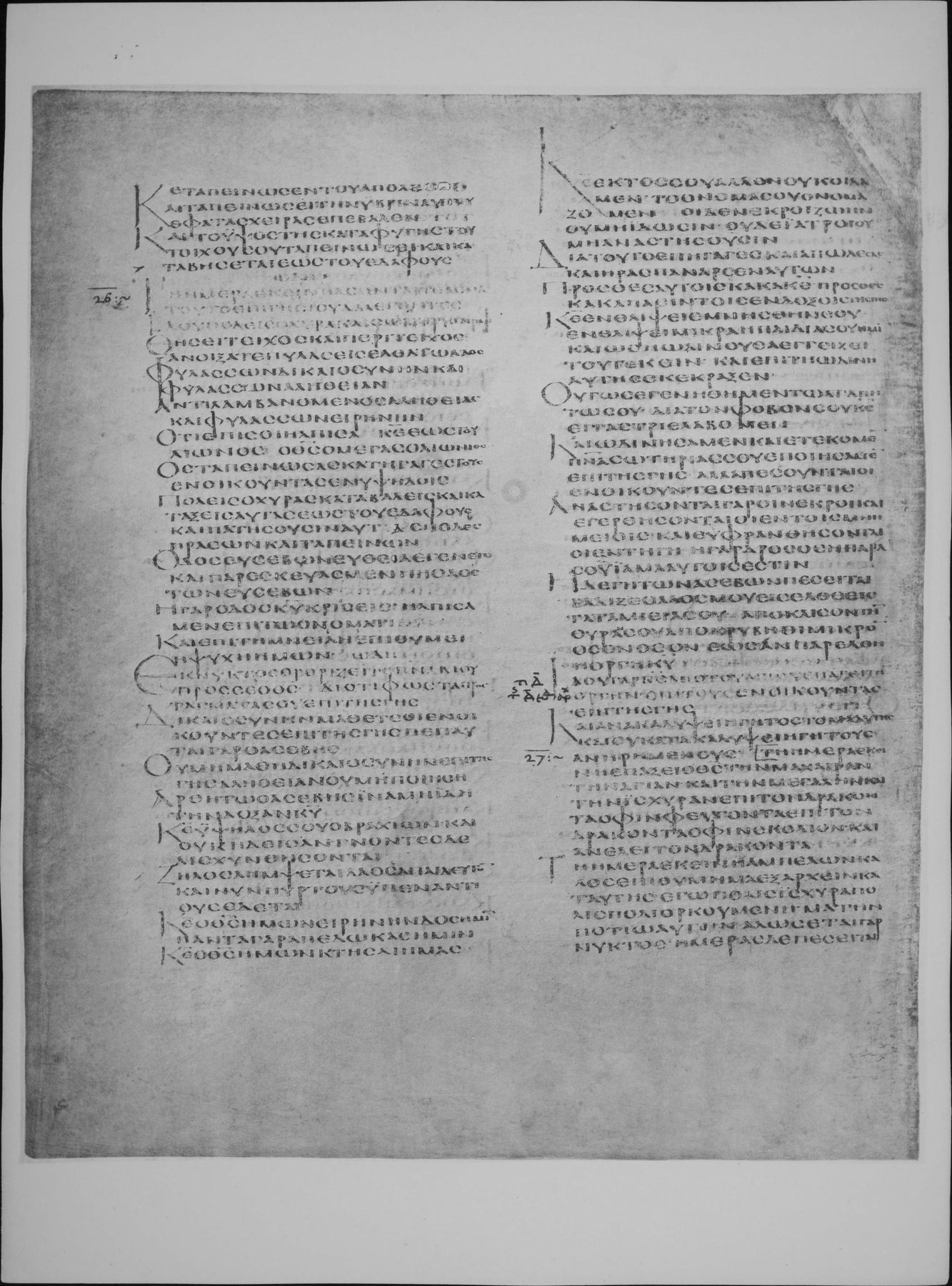
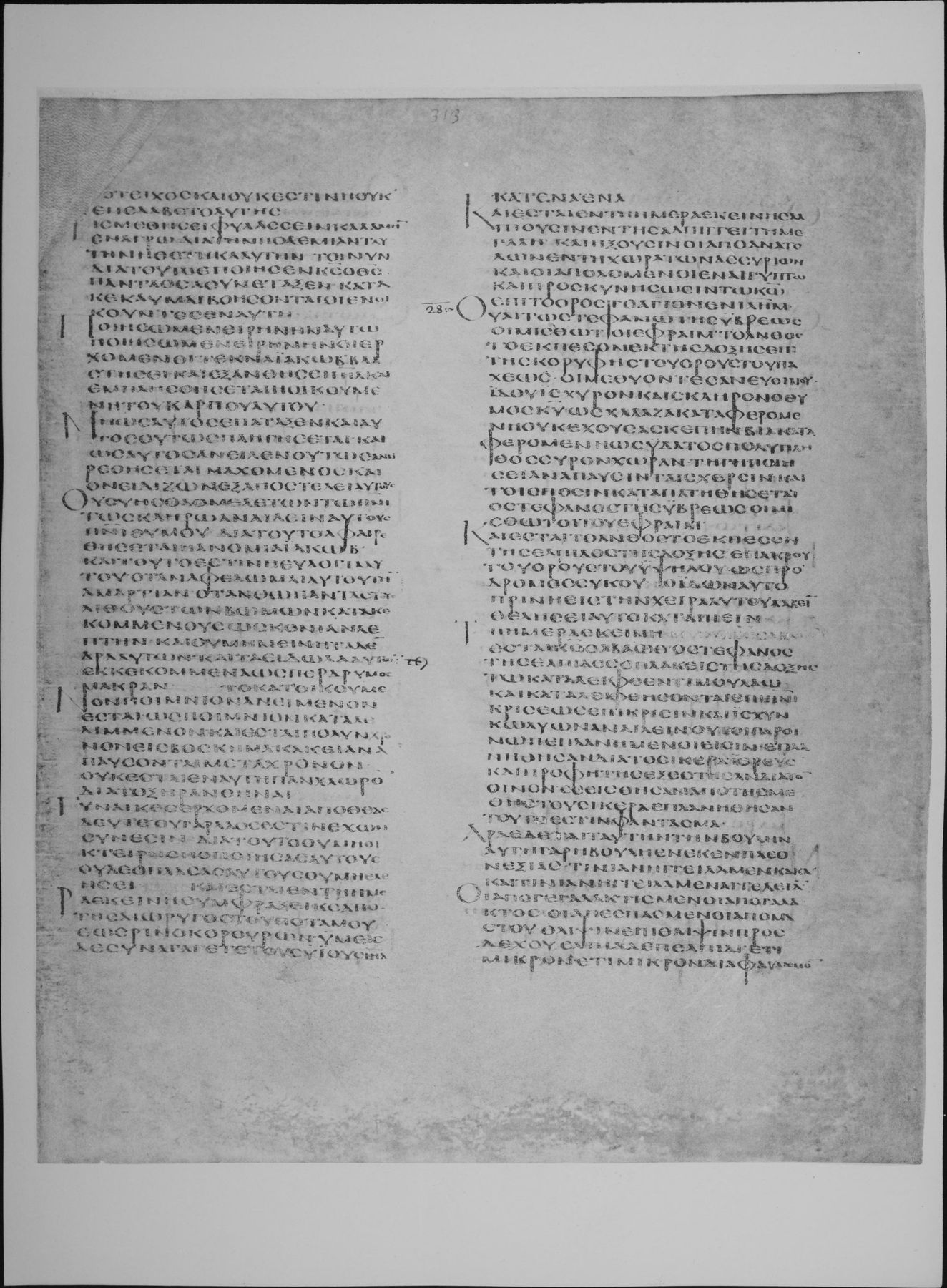
Isaiah 27 in the Greek Old Testament (the Septuagint) as written in Codex Alexandrinus, a Greek Bible copied in the fifth century, probably in Egypt, and now in the British Library (Royal MS 1 D. VI, the second of its four volumes). It is one of the three great early codices of the whole Greek Bible, with Codex Vaticanus and Codex Sinaiticus.
This entry meets the strict three-criteria standard of the Theosis Library:
- Manuscript scan: the pages of Codex Alexandrinus carrying this chapter (fol. 312v, fol. 313r), from the full-size photographic (autotype) facsimile published by the British Museum in 1879-1883, as digitised on the Internet Archive. The verse range of every page comes from the reduced photographic facsimile of 1936, which prints it beneath each plate, and the opening words of every page were read on the plate to confirm the page and the verse it begins with. Each section links to the page or pages that hold its verses. Folio numbers are those written at the head of each leaf and visible on the plates.
- Original text: Swete's edition, which here prints the text of Codex Vaticanus (Vat. gr. 1209), the base of his edition, and gives the readings of Alexandrinus only in his apparatus. The Greek column is therefore Vaticanus' text; where Alexandrinus differs, the plate shows what Alexandrinus reads.
- English translation: Sir Lancelot C. L. Brenton, The Septuagint Version of the Old Testament (1844; 1851 edition), a translation of the Greek, public domain, from the eBible.org text.
How was this verified? (Provenance)
Where on the image
Isaiah 27:1-3 is on fol. 312v (full-size facsimile of 1879-83, Internet Archive codex-alexandrinus leaf 649). The 1936 reduced facsimile prints beneath this page: Is. xxv. 11-xxvii. 3. Checked on the plate: the page begins inside Isaiah 25:11 (first words read: ΚΑΙ ΤΑΠΕΙΝΩΣΕΙ ΤΗΝ ΥΒΡΙΝ ΑΥΤΟΥ ΕΦ Α ΤΑΣ ΧΕΙΡΑΣ ΕΠΕΒΑΛΕΝ ΚΑΙ ΤΟ ΥΨΟΣ ΤΗΣ ΚΑΤΑΦΥΓΗΣ). Isaiah 27:3-8 is on fol. 313r (full-size facsimile of 1879-83, Internet Archive codex-alexandrinus leaf 650). The 1936 reduced facsimile prints beneath this page: Is. xxvii. 3-xxviii. 11. Checked on the plate: the page begins inside Isaiah 27:3 (first words read: ΤΕΙΧΟΣ ΚΑΙ ΟΥΚ ΕΣΤΙΝ Η ΟΥΚ ΕΠΕΛΑΒΕΤΟ ΑΥΤΗΣ ΤΙΣ ΜΕ ΘΗΣΕΙ ΦΥΛΑΣΣΕΙΝ ΚΑΛΑΜΗΝ ΕΝ ΑΓΡΩ). Note: the first line holds the last word of 27:3 (ΤΕΙΧΟΣ); 27:4 follows.
1Τῇ ἡμέρᾳ ἐκείνῃ ἐπάξει ὁ θεὸς τὴν μάχαιραν τὴν ἁγίαν καὶ τὴν μεγάλην καὶ τὴν ἰσχυρὰν ἐπὶ τὸν δράκοντα ὄφιν φεύγοντα, ἐπὶ τὸν δράκοντα ὄφιν σκολιόν, ἀνελεῖ τὸν δράκοντα. 2Τῇ ἡμέρᾳ ἐκείνῃ ἀμπελὼν καλός· ἐπιθύμημα ἐξάρχειν κατ᾽ αὐτῆς. 3ἐγὼ πόλις ὀχυρά, πόλις πολιορκουμένη, μάτην ποτιῶ αὐτήν· ἁλώσεται γὰρ νυκτός, ἡμέρας δὲ πεσεῖται τεῖχος. 4οὐκ ἔστιν ἣ οὐκ ἐπελάβετο αὐτῆς· τίς με θήσει φυλάσσειν καλάμην ἐν ἀγρῷ; διὰ τὴν πολεμίαν ταύτην ἠθέτηκα αὐτήν. τοίνυν διὰ τοῦτο ἐποίησεν Κύριος πάντα ὅσα συνέταξεν. κατακέκαυμαι, 5βοήσονται οἱ ἐνοικοῦντες ἐν αὐτῇ, ποιήσωμεν εἰρήνην. 6οἱ ἐρχόμενοι, τέκνα Ἰακώβ, βλαστήσει καὶ ἐξανθήσει Ἰσραήλ, καὶ πλησθήσεται ἡ οἰκουμένη τοῦ καρποῦ αὐτοῦ. 7μὴ ὡς αὐτὸς ἐπάταξεν, καὶ αὐτὸς οὕτως πληγήσεται; καὶ ὡς αὐτὸς ἀνεῖλεν, οὕτως ἀναιρεθήσεται; 8μαχόμενος καὶ ὀνειδίζων ἐξαποστελεῖ αὐτούς· οὐ σὺ ἦσθα μελετῶν τῷ πνεύματι τῷ σκληρῷ, ἀνελεῖν αὐτοὺς πνεύματι θυμοῦ;
1In that day God shall bring his holy and great and strong sword upon the dragon, even the serpent that flees, upon the dragon, the crooked serpent: he shall destroy the dragon. 2In that day there shall be a fair vineyard, and a desire to commence a song concerning it. 3I am a strong city, a city in a siege: in vain shall I water it; for it shall be taken by night, and by day the wall shall fall. 4There is no woman that has not taken hold of it; who will set me to watch stubble in the field? because of this enemy I have set her aside; therefore on this account the Lord has done all that he appointed. 5I am burnt up; they that dwell in her shall cry, Let us make peace with him, let us make peace, 6they that are coming are the children of Jacob. Israel shall bud and blossom, and the world shall be filled with his fruit. 7Shall he himself be thus smitten, even as he smote? and as he slew, shall he be thus slain? 8Fighting and reproaching he will dismiss them; didst thou not meditate with a harsh spirit, to slay them with a wrathful spirit?
Where on the image
Isaiah 27:9-13 is on fol. 313r (full-size facsimile of 1879-83, Internet Archive codex-alexandrinus leaf 650). The 1936 reduced facsimile prints beneath this page: Is. xxvii. 3-xxviii. 11. Checked on the plate: the page begins inside Isaiah 27:3 (first words read: ΤΕΙΧΟΣ ΚΑΙ ΟΥΚ ΕΣΤΙΝ Η ΟΥΚ ΕΠΕΛΑΒΕΤΟ ΑΥΤΗΣ ΤΙΣ ΜΕ ΘΗΣΕΙ ΦΥΛΑΣΣΕΙΝ ΚΑΛΑΜΗΝ ΕΝ ΑΓΡΩ). Note: the first line holds the last word of 27:3 (ΤΕΙΧΟΣ); 27:4 follows.
9διὰ τοῦτο ἀφαιρεθήσεται ἀνομία Ἰακώβ, καὶ τοῦτό ἐστιν ἡ εὐλογία αὐτοῦ, ὅταν ἀφέλωμαι αὐτοῦ τὴν ἁμαρτίαν, ὅταν θῶσιν πάντας τοὺς λίθους τῶν βωμῶν κατακεκομμένους ὡς κονίαν λεπτήν· καὶ οὐ μὴ μείνῃ τὰ δένδρα αὐτῶν, καὶ τὰ εἴδωλα αὐτῶν ἐκκεκομμένα ὥσπερ δρυμὸς μακράν. 10τὸ κατοικούμενον ποίμνιον ἀνειμένον ἔσται, ὡς ποίμνιον καταλελιμμένον· καὶ ἔσται πολὺν χρόνον εἰς βόσκημα, καὶ ἐκεῖ ἀναπαύσονται. 11καὶ μετὰ χρόνον οὐκ ἔσται ἐν αὐτῇ πᾶν χλωρὸν διὰ τὸ ξηρανθῆναι. γυναῖκες ἐρχόμεναι ἀπὸ θέας, δεῦτε· οὐ γὰρ λαός ἐστιν ἔχων σύνεσιν, διὰ τοῦτο οὐ μὴ οἰκτειρήσῃ ὁ ποιήσας αὐτούς, οὐδὲ ὁ πλάσας αὐτοὺς οὐ μὴ ἐλεήσῃ. 12Καὶ ἔσται ἐν τῇ ἡμέρᾳ ἐκείνῃ συμφράξει ὁ θεὸς ἀπὸ τῆς διώρυχος τοῦ ποταμοῦ ἕως Ῥινοκορούρων· ὑμεῖς δὲ συναγάγετε κατὰ ἕνα τοὺς υἱοὺς Ἰσραήλ. 13Καὶ ἔσται ἐν τῇ ἡμέρᾳ ἐκείνῃ σαλπιοῦσιν τῇ σάλπιγγι τῇ μεγάλῃ, καὶ ἥξουσιν οἱ ἀπολόμενοι ἐν τῇ χώρᾳ τῶν Ἀσσυρίων καὶ οἱ ἀπολόμενοι ἐν Αἰγύπτῳ, καὶ προσκυνήσουσιν τῷ κυρίῳ ἐπὶ τὸ ὄρος τὸ ἅγιον Ἰερουσαλήμ.
9Therefore shall the iniquity of Jacob be taken away; and this is his blessing, when I shall have taken away his sin; when they shall have broken to pieces all the stones of the altars as fine dust, and their trees shall not remain, and their idols shall be cut off, as a thicket afar off. 10The flock that dwelt there shall be left, as a deserted flock; and the ground shall be for a long time for pasture, and there shall flocks lie down to rest. 11And after a time there shall be in it no green thing because of the grass being parched. Come hither, ye women that come from a sight; for it is a people of no understanding; therefore he that made them shall have no pity upon them, and he that formed them shall have no mercy upon them. 12And it shall come to pass in that day that God shall fence men off from the channel of the river as far as Rhinocorura; but do ye gather one by one the children of Israel. 13And it shall come to pass in that day, that they shall blow the great trumpet, and the lost ones in the land of the Assyrians shall come, and the lost ones in Egypt, and shall worship the Lord on the holy mountain in Jerusalem.
Cite
Sources
- Source: Codex Alexandrinus (British Library Royal MS 1 D. VI) via the British Museum photographic facsimiles of 1879-83 and 1936 (Internet Archive) + Swete's Septuagint + Brenton's English (holding institution)
- Critical edition: H. B. Swete, The Old Testament in Greek according to the Septuagint (1909)
← previous · → next · v cycle view · l back to library