Judith, Chapter 3 (Codex Alexandrinus)
Introduction
Judith 3 in the Greek Old Testament (the Septuagint) as written in Codex Alexandrinus, a Greek Bible copied in the fifth century, probably in Egypt, and now in the British Library (Royal MS 1 D. VI, the second of its four volumes). It is one of the three great early codices of the whole Greek Bible, with Codex Vaticanus and Codex Sinaiticus.
This entry meets the strict three-criteria standard of the Theosis Library:
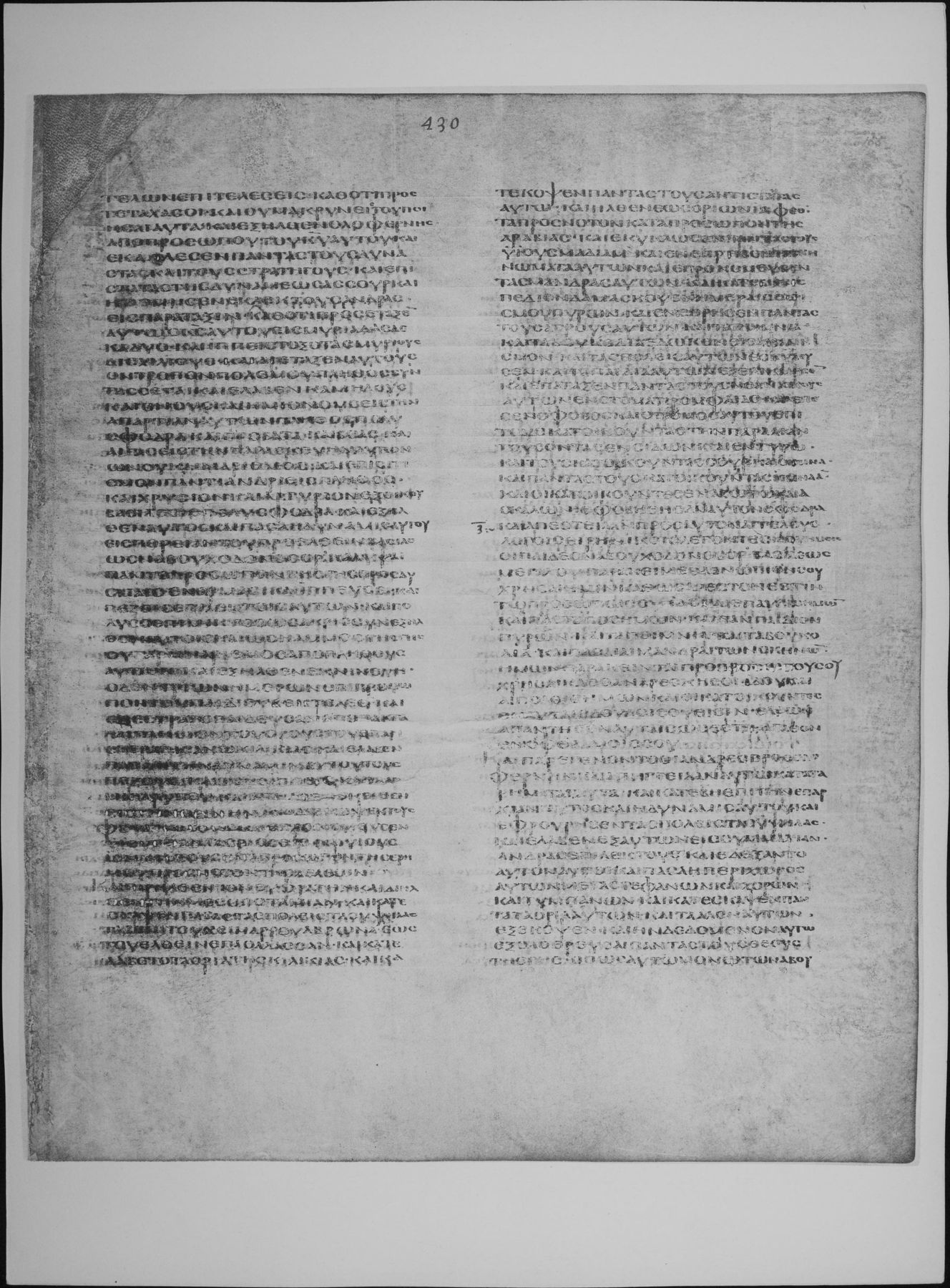
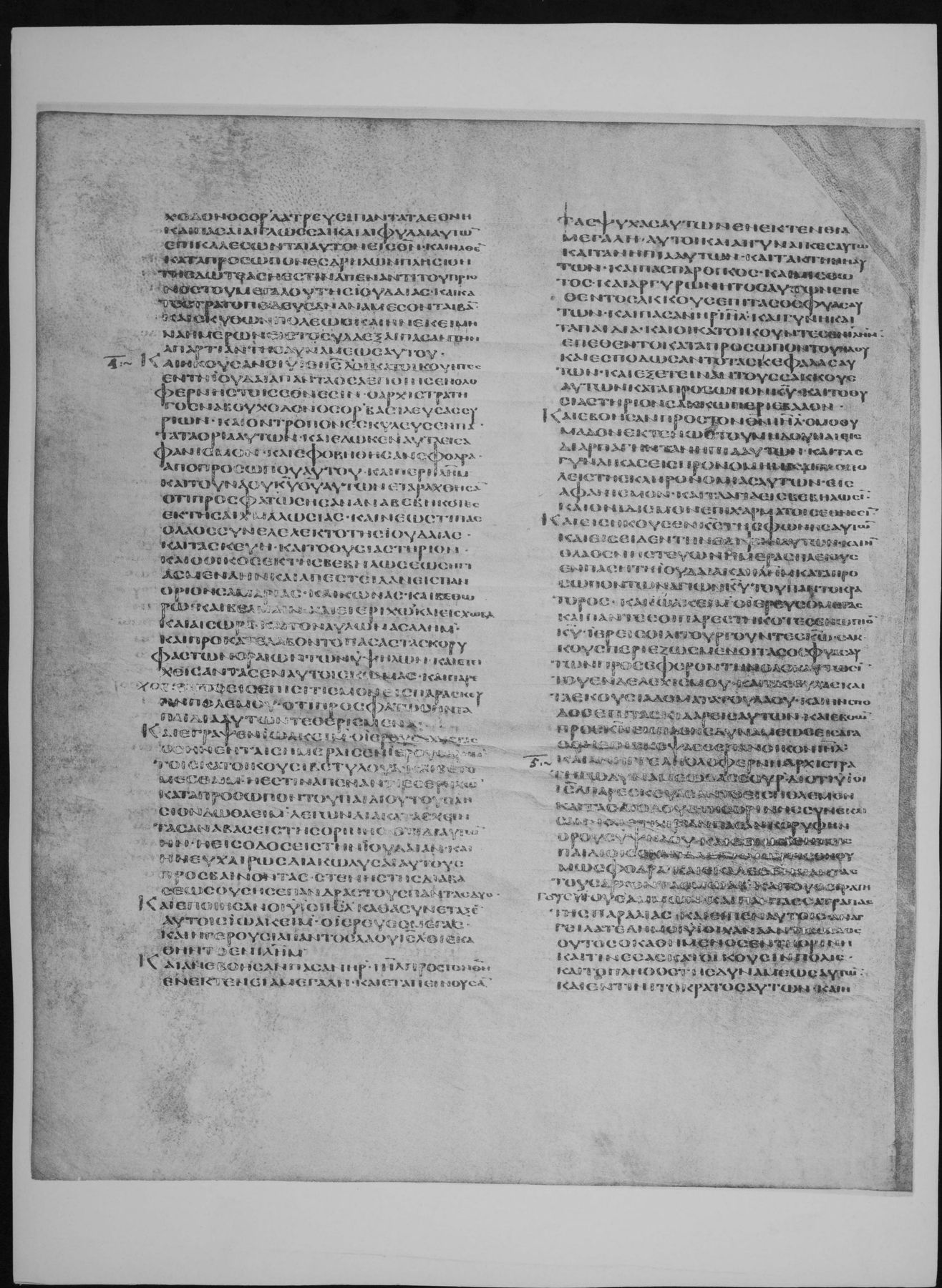
- Manuscript scan: the pages of Codex Alexandrinus carrying this chapter (fol. 430r, fol. 430v), from the full-size photographic (autotype) facsimile published by the British Museum in 1879-1883, as digitised on the Internet Archive. The verse range of every page comes from the reduced photographic facsimile of 1936, which prints it beneath each plate, and the opening words of every page were read on the plate to confirm the page and the verse it begins with. Each section links to the page or pages that hold its verses. Folio numbers are those written at the head of each leaf and visible on the plates.
- Original text: Swete's edition, which here prints the text of Codex Vaticanus (Vat. gr. 1209), the base of his edition, and gives the readings of Alexandrinus only in his apparatus. The Greek column is therefore Vaticanus' text; where Alexandrinus differs, the plate shows what Alexandrinus reads.
- English translation: Sir Lancelot C. L. Brenton, The Septuagint Version of the Old Testament (1844; 1851 edition), a translation of the Greek, public domain, from the eBible.org text.
How was this verified? (Provenance)
Where on the image
Judith 3:1-8 is on fol. 430r (full-size facsimile of 1879-83, Internet Archive codex-alexandrinus leaf 884). The 1936 reduced facsimile prints beneath this page: Judith ii. 13-iii. 8. Checked on the plate: the page begins inside Judith 2:13 (first words read: ΤΕΛΩΣ ΕΠΙΤΕΛΕΣΕΙΣ ΚΑΘΟΤΙ ΠΡΟΣΤΕΤΑΧΑ ΣΟΙ ΚΑΙ ΟΥ ΜΗ ΑΝΑΒΑΛΗ ΤΟΥ ΠΟΙΗΣΑΙ ΑΥΤΑ). Judith 3:8-10 is on fol. 430v (full-size facsimile of 1879-83, Internet Archive codex-alexandrinus leaf 885). The 1936 reduced facsimile prints beneath this page: Judith iii. 8-v. 3. Checked on the plate: the page begins inside Judith 3:8 (first words read: ΧΟΔΟΝΟΣΟΡ ΛΑΤΡΕΥΣΙ ΠΑΝΤΑ ΤΑ ΕΘΝΗ ΚΑΙ ΠΑΣΑΙ ΑΙ ΓΛΩΣΣΑΙ ΚΑΙ ΑΙ ΦΥΛΑΙ ΑΥΤΩΝ).
1Καὶ ἀπέστειλαν πρὸς αὐτὸν ἀγγέλους λόγοις εἰρηνικοῖς λέγοντες 2Ἰδοὺ ἡμεῖς οἱ παῖδες Ναβουχοδονοσὸρ βασιλέως μεγάλου παρακείμεθα ἐνώπιόν σου, χρῆσαι ἡμῖν καθὼς ἀρεστόν ἐστιν τῷ προσώπῳ σου· 3ἰδοὺ αἱ ἐπαύλεις ἡμῶν καὶ πᾶν πεδίον πυρῶν καὶ τὰ ποίμνια καὶ τὰ βουκόλια καὶ πᾶσαι αἱ μάνδραι τῶν σκηνῶν ἡμῶν παράκεινται πρὸ προσώπου σου, χρῆσαι καθ᾽ ὃ ἂν ἀρέσκῃ σοι· 4ἰδοὺ καὶ αἱ πόλεις ἡμῶν καὶ οἱ κατοικοῦντες ἐν αὐταῖς δοῦλοι σοί εἰσιν, ἐλθὼν ἀπάντησον αὐταῖς ὡς ἔστιν ἀγαθὸν ἐν ὀφθαλμοῖς σου. 5καὶ παρεγένοντο οἱ ἄνδρες πρὸς Ὀλοφέρνην καὶ ἀπήγγειλαν αὐτῷ κατὰ τὰ ῥήματα ταῦτα. 6καὶ κατέβη ἐπὶ τὴν παραλίαν αὐτὸς καὶ ἡ δύναμις αὐτοῦ, καὶ ἐφρούρωσε τὰς πόλεις τὰς ὑψηλάς, καὶ ἔλαβον ἐξ αὐτῶν εἰς συμμαχίαν ἄνδρας ἐπιλέκτους· 7καὶ ἐδέξαντο αὐτὸν αὐτοὶ καὶ πᾶσα ἡ περίχωρος αὐτῶν μετὰ στεφάνων καὶ χορῶν καὶ τυμπάνων. 8καὶ κατέσκαψεν πάντα τὰ ὅρια αὐτῶν, καὶ τὰ ἄλση αὐτῶν ἐξέκοψεν· καὶ ἦν δεδομένον αὐτῷ ἐξολεθρεῦσαι πάντας τοὺς θεοὺς τῆς γῆς, ὅπως αὐτῷ μόνῳ τῷ Ναβουχοδονοσὸρ λατρεύωσι πάντα τὰ ἔθνη, καὶ πᾶσαι αἱ γλῶσσαι καὶ πᾶσαι αἱ φυλαὶ αὐτῶν ἐπικαλέσωνται αὐτὸν εἰς θεόν. 9καὶ ἦλθεν κατὰ πρόσωπον Ἐσδραηλὼν πλησίον τῆς Δωταίας, ἥ ἐστιν ἀπέναντι τοῦ πρίονος τοῦ μεγάλου τῆς Ἰουδαίας, 10καὶ κατεστρατοπέδευσαν ἀνὰ μέσον Γαιβαὶ καὶ Σκυθῶν πόλεως, καὶ ἦν ἐκεῖ μῆνα ἡμερῶν εἰς τὸ συλλέξαι πᾶσαν τὴν ἀπαρτίαν τῆς δυνάμεως αὐτοῦ.
1So they sent ambassadors unto him to treat of peace, saying, 2Behold, we the servants of Nabuchodonosor the great king lie before thee; use us as shall be good in thy sight. 3Behold, our houses, and all our places, and all our fields of wheat, and flocks, and herds, and all the lodges of our tents, lie before thy face; use them as it pleaseth thee. 4Behold, even our cities and the inhabitants thereof are thy servants; come and deal with them as seemeth good unto thee. 5So the men came to Holofernes, and declared unto him after this manner. 6Then came he down toward the sea coast, both he and his army, and set garrisons in the high cities, and took out of them chosen men for aid. 7So they and all the country round about received him with garlands, with dances, and with timbrels. 8Yet he did cast down their frontiers, and cut down their groves: for he had decreed to destroy all the gods of the land, that all nations should worship Nabuchodonosor only, and that all tongues and tribes should call upon him as a god. 9Also he came over against Esdraelon near unto Judea, over against the great strait of Judea. 10And he pitched between Geba and Scythopolis, and there he tarried a whole month, that he might gather together all the carriages of his army.
Cite
Sources
- Source: Codex Alexandrinus (British Library Royal MS 1 D. VI) via the British Museum photographic facsimiles of 1879-83 and 1936 (Internet Archive) + Swete's Septuagint + Brenton's English (holding institution)
- Critical edition: H. B. Swete, The Old Testament in Greek according to the Septuagint (1909)
← previous · → next · v cycle view · l back to library