Micah, Chapter 1 (Codex Alexandrinus)
Introduction
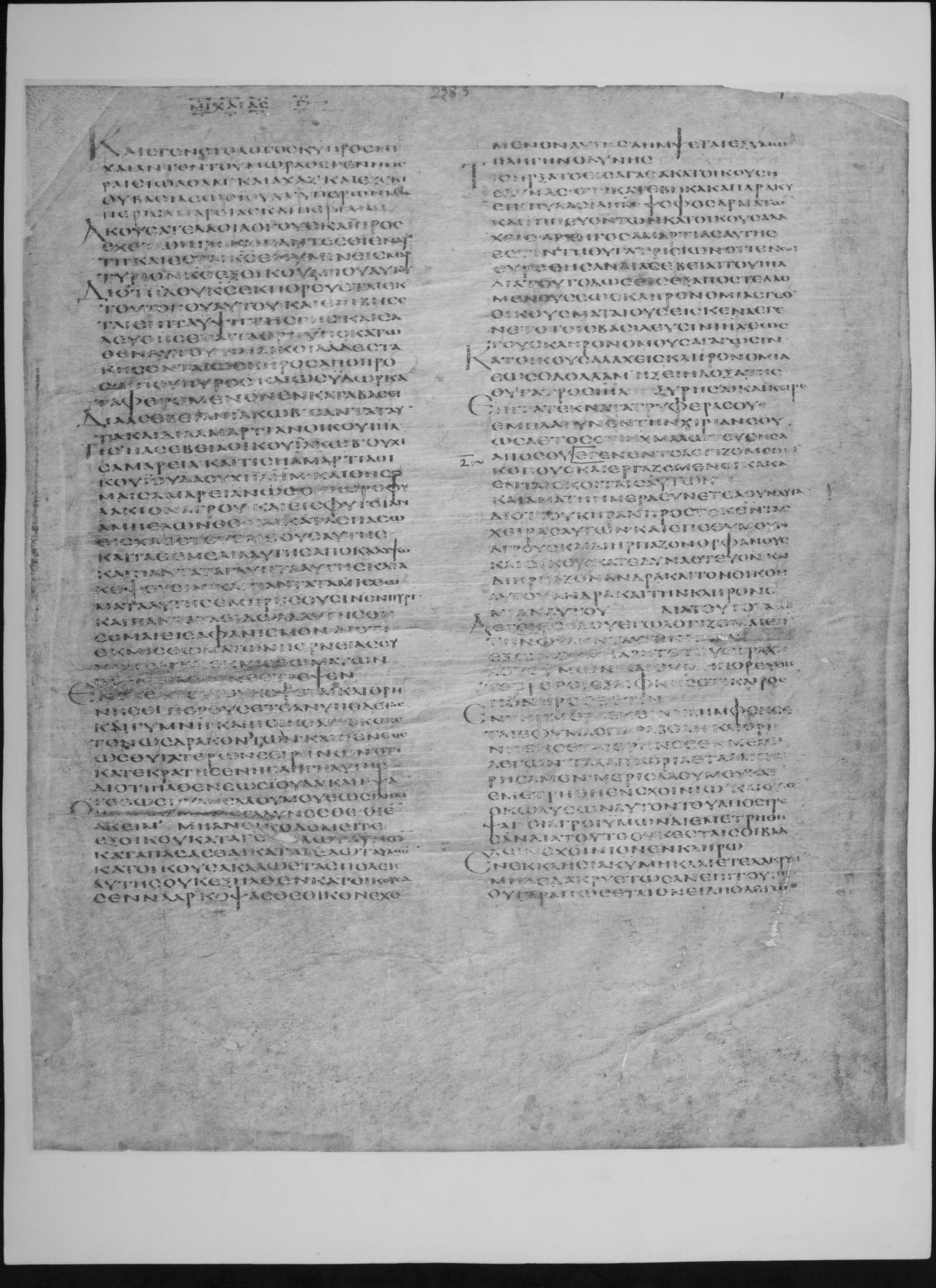
Micah 1 in the Greek Old Testament (the Septuagint) as written in Codex Alexandrinus, a Greek Bible copied in the fifth century, probably in Egypt, and now in the British Library (Royal MS 1 D. VI, the second of its four volumes). It is one of the three great early codices of the whole Greek Bible, with Codex Vaticanus and Codex Sinaiticus.
This entry meets the strict three-criteria standard of the Theosis Library:
- Manuscript scan: the page of Codex Alexandrinus carrying this chapter (fol. 285r), from the full-size photographic (autotype) facsimile published by the British Museum in 1879-1883, as digitised on the Internet Archive. The verse range of every page comes from the reduced photographic facsimile of 1936, which prints it beneath each plate, and the opening words of every page were read on the plate to confirm the page and the verse it begins with. Each section links to the page or pages that hold its verses. Folio numbers are those written at the head of each leaf and visible on the plates.
- Original text: Swete's edition, which here prints the text of Codex Vaticanus (Vat. gr. 1209), the base of his edition, and gives the readings of Alexandrinus only in his apparatus. The Greek column is therefore Vaticanus' text; where Alexandrinus differs, the plate shows what Alexandrinus reads.
- English translation: Sir Lancelot C. L. Brenton, The Septuagint Version of the Old Testament (1844; 1851 edition), a translation of the Greek, public domain, from the eBible.org text.
How was this verified? (Provenance)
Where on the image
Micah 1:1-8 is on fol. 285r (full-size facsimile of 1879-83, Internet Archive codex-alexandrinus leaf 594). The 1936 reduced facsimile prints beneath this page: Mic. i. 1-ii. 7. Checked on the plate: the page begins at the start of Micah 1:1 (first words read: ΚΑΙ ΕΓΕΝΕΤΟ ΛΟΓΟΣ ΚΥ ΠΡΟΣ ΜΙΧΑΙΑΝ ΤΟΝ ΤΟΥ ΜΩΡΑΣΘΕΙ ΕΝ ΗΜΕΡΑΙΣ ΙΩΑΘΑΜ ΚΑΙ ΑΧΑΖ).
1ΚΑΙ ἐγένετο λόγος Κυρίου πρὸς Μειχαίαν τὸν τοῦ Μωρασθεὶ ἐν ἡμέραις Ἰωαθὰμ καὶ Ἀχὰζ καὶ Ἑζεκίου βασιλέων Ἰούδα, ὑπὲρ ὧν εἶδεν περὶ Σαμαρείας καὶ περὶ Ἰερουσαλήμ. 2Ἀκούσατε, λαοί, λόγους, καὶ προσεχέτω ἡ γῆ καὶ πάντες οἱ ἐν αὐτῇ, καὶ ἔσται κύριος Κύριος ἐν ὑμῖν εἰς μαρτύριον, Κύριος ἐξ οἴκου ἁγίου αὐτοῦ. 3διότι ἰδοὺ Κύριος ἐκπορεύεται ἐκ τοῦ τόπου αὐτοῦ, καὶ καταβήσεται ἐπὶ τὰ ὕψη τῆς γῆς, 4καὶ σαλευθήσεται τὰ ὄρη ὑποκάτωθεν αὐτοῦ, καὶ αἱ κοιλάδες τακήσονται ὡς κηρὸς ἀπὸ προσώπου πυρός, καὶ ὡς ὕδωρ καταφερόμενον ἐν καταβάσει. 5διὰ ἀσέβειαν Ἰακὼβ πάντα ταῦτα, καὶ διὰ ἁμαρτίαν οἴκου Ἰσραήλ. τίς ἡ ἀσέβεια τοῦ Ἰακώβ, οὐ Σαμάρεια; καὶ τίς ἡ ἁμαρτία οἴκου Ἰούδα, οὐχὶ Ἰερουσαλήμ; 6καὶ θήσομαι Σαμάρειαν εἰς ὀπωροφυλάκιον ἀγροῦ καὶ εἰς φυτίαν ἀμπελῶνος, καὶ κατασπάσω εἰς χάος τοὺς λίθους αὐτῆς, καὶ τὰ θεμέλια αὐτῆς ἀποκαλύψω· 7καὶ πάντα τὰ γλυπτὰ αὐτῆς κατακόψουσιν, καὶ πάντα τὰ μισθώματα αὐτῆς ἐμπρήσουσιν ἐν πυρί, καὶ πάντα τὰ εἴδωλα αὐτῆς θήσομαι εἰς ἀφανισμόν· διότι ἐκ μισθωμάτων πορνείας συνήγαγεν, καὶ ἐκ μισθωμάτων πορνείας συνέστρεψεν. 8ἕνεκεν τούτου κόψεται καὶ θρηνήσει, πορεύσεται ἀνυπόδετος καὶ γυμνή, ποιήσεται κοπετὸν ὡς δρακόντων καὶ πένθος ὡς θυγατέρων σειρήνων·
1And the word of the Lord came to Michæas the son of Morasthi, in the days of Joatham, and Achaz, and Ezekias, kings of Juda, concerning what he saw regarding Samaria and Jerusalem. 2Hear these words, ye people; and let the earth give heed, and all that are in it: and the Lord God shall be among you for a testimony, the Lord out of his holy habitation. 3For, behold, the Lord comes forth out of his place, and will come down, and will go upon the high places of the earth. 4And the mountains shall be shaken under him, and the valleys shall melt like wax before the fire, and as water rushing down a declivity. 5All these calamities are for the transgression of Jacob, and for the sin of the house of Israel. What is the transgression of Jacob? is it not Samaria? and what is the sin of the house of Juda? is it not Jerusalem? 6Therefore I will make Samaria as a store-house of the fruits of the field, and as a planting of a vineyard: and I will utterly demolish her stones, and I will expose her foundations. 7And they shall cut in pieces all the graven images, and all that she has hired they shall burn with fire, and I will utterly destroy all her idols: because she has gathered of the hires of fornication, and of the hires of fornication has she amassed wealth. 8Therefore shall she lament and wail, she shall go barefooted, and being naked she shall make lamentation as that of serpents, and mourning as of the daughters of sirens.
Where on the image
Micah 1:9-16 is on fol. 285r (full-size facsimile of 1879-83, Internet Archive codex-alexandrinus leaf 594). The 1936 reduced facsimile prints beneath this page: Mic. i. 1-ii. 7. Checked on the plate: the page begins at the start of Micah 1:1 (first words read: ΚΑΙ ΕΓΕΝΕΤΟ ΛΟΓΟΣ ΚΥ ΠΡΟΣ ΜΙΧΑΙΑΝ ΤΟΝ ΤΟΥ ΜΩΡΑΣΘΕΙ ΕΝ ΗΜΕΡΑΙΣ ΙΩΑΘΑΜ ΚΑΙ ΑΧΑΖ).
9ὅτι κατεκράτησεν ἡ πληγὴ αὐτῆς, διότι ἦλθεν ἕως Ἰούδα καὶ ἥψατο ἕως πύλης λαοῦ μου, ἕως Ἰερουσαλήμ. 10Οἱ ἐν Γέθ, μὴ μεγαλύνεσθε, οἱ ἐν Ἀκείμ, μὴ ἀνοικοδομεῖτε ἐξ οἴκου καταγέλωτα· γῆν καταπάσασθε καταγέλωτα ὑμῶν· 11κατοικοῦσα καλῶς τὰς πόλεις αὐτῆς, οὐκ ἐξῆλθεν κατοικοῦσα Σενναάρ, κόψασθαι οἶκον ἐχόμενον αὐτῆς· λήμψεται ἐξ ὑμῶν πληγὴν ὀδύνης. 12τίς ἤρξατο εἰς ἀγαθὰ κατοικούσῃ ὀδύνας; ὅτι κατέβη κακὰ παρὰ Κυρίου ἐπὶ πύλας Ἰερουσαλήμ, 13ψόφος ἁρμάτων καὶ ἱππευόντων. κατοικοῦσα Λαχεὶς ἀρχηγὸς ἁμαρτίας αὕτη ἐστὶν τῇ θυγατρὶ Σειών, ὅτι ἐν σοὶ εὑρέθησαν ἀσέβειαι τοῦ Ἰσραήλ. 14διὰ τοῦτο δώσει ἐξαποστελλομένους ἕως κληρονομίας Γέθ, οἴκους ματαίους, εἰς κενὸν ἐγένοντο τοῖς βασιλεῦσιν τοῦ Ἰσραήλ· 15ἕως τοὺς κληρονόμους ἀγάγωσιν, κατοικοῦσα Λαχείς· κληρονομία ἕως Ὀδολλὰμ ἥξει, ἡ δόξα τῆς θυγατρὸς Ἰσραήλ. 16ξύρησαι καὶ κεῖραι ἐπὶ τὰ τέκνα τὰ τρυφερά σου, ἐνπλάτυνον τὴν χηρίαν σου ὡς ἀετός, ὅτι ᾐχμαλωτεύθησαν ἀπὸ σοῦ.
9For her plague has become grievous; for it has come even to Juda; and has reached to the gate of my people, even to Jerusalem. 10Ye that are in Geth, exalt not yourselves, and ye Enakim, do not rebuild from the ruins of the house in derision: sprinkle dust in the place of your laughter. 11The inhabitant of Sennaar, fairly inhabiting her cities, came not forth to mourn for the house next to her: she shall receive of you the stroke of grief. 12Who has begun to act for good to her that dwells in sorrow? for calamities have come down from the Lord upon the gates of Jerusalem, 13even a sound of chariots and horsemen: the inhabitants of Lachis, she is the leader of sin to the daughter of Sion: for in thee were found the transgressions of Israel. 14Therefore shall he cause men to be sent forth as far as the inheritance of Geth, even vain houses; they are become vanity to the kings of Israel; 15until they bring the heirs, O inhabitant of Lachis: the inheritance shall reach to Odollam, even the glory of the daughter of Israel. 16Shave thine hair, and make thyself bald for thy delicate children; increase thy widowhood as an eagle; for thy people are gone into captivity from thee.
Cite
Sources
- Source: Codex Alexandrinus (British Library Royal MS 1 D. VI) via the British Museum photographic facsimiles of 1879-83 and 1936 (Internet Archive) + Swete's Septuagint + Brenton's English (holding institution)
- Critical edition: H. B. Swete, The Old Testament in Greek according to the Septuagint (1909)
← previous · → next · v cycle view · l back to library