Micah, Chapter 5 (Codex Alexandrinus)
Introduction
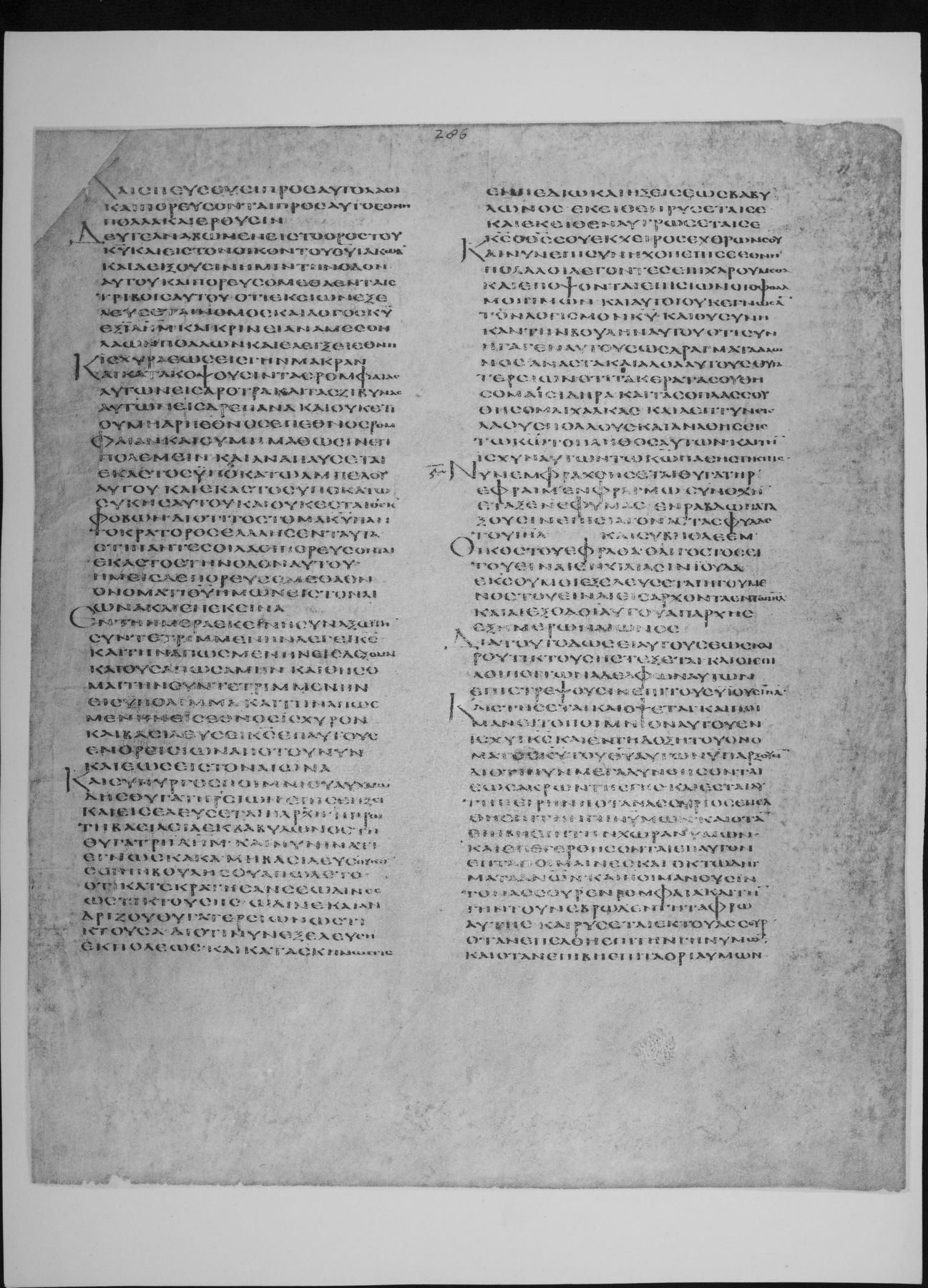
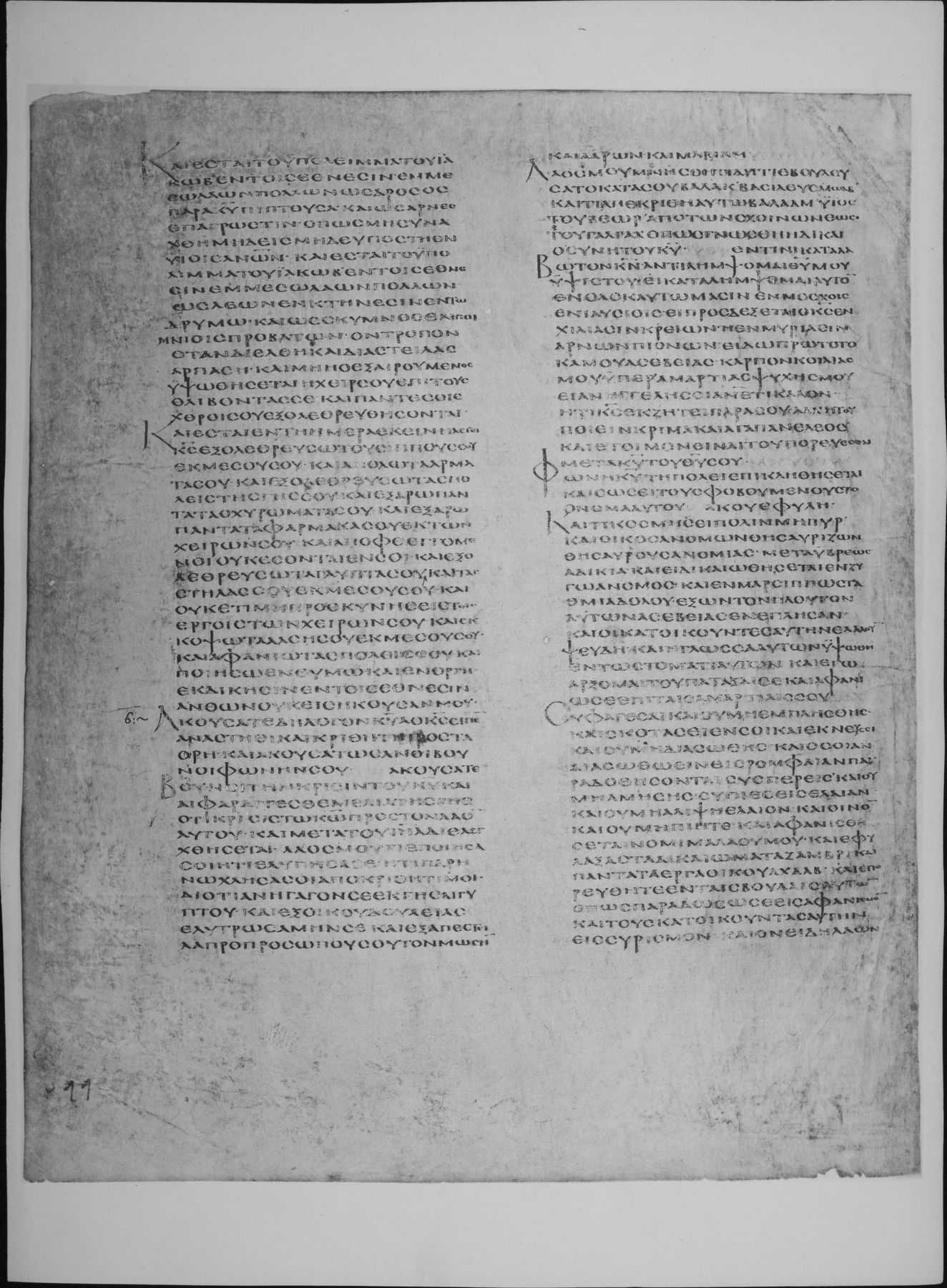
Micah 5 in the Greek Old Testament (the Septuagint) as written in Codex Alexandrinus, a Greek Bible copied in the fifth century, probably in Egypt, and now in the British Library (Royal MS 1 D. VI, the second of its four volumes). It is one of the three great early codices of the whole Greek Bible, with Codex Vaticanus and Codex Sinaiticus.
Numbering: Swete's Greek and Brenton's English number or divide some verses of this chapter differently (Swete 5:1 = Brenton 4:14; Swete 5:2-15 = Brenton 5:1-14). Each column keeps its own verse numbers, and sections are cut only where the two texts agree, so each section holds the same passage in both languages.
This entry meets the strict three-criteria standard of the Theosis Library:
- Manuscript scan: the pages of Codex Alexandrinus carrying this chapter (fol. 286r, fol. 286v), from the full-size photographic (autotype) facsimile published by the British Museum in 1879-1883, as digitised on the Internet Archive. The verse range of every page comes from the reduced photographic facsimile of 1936, which prints it beneath each plate, and the opening words of every page were read on the plate to confirm the page and the verse it begins with. Each section links to the page or pages that hold its verses. Folio numbers are those written at the head of each leaf and visible on the plates.
- Original text: Swete's edition, which here prints the text of Codex Vaticanus (Vat. gr. 1209), the base of his edition, and gives the readings of Alexandrinus only in his apparatus. The Greek column is therefore Vaticanus' text; where Alexandrinus differs, the plate shows what Alexandrinus reads.
- English translation: Sir Lancelot C. L. Brenton, The Septuagint Version of the Old Testament (1844; 1851 edition), a translation of the Greek, public domain, from the eBible.org text.
How was this verified? (Provenance)
Where on the image
Micah 5:1-6 is on fol. 286r (full-size facsimile of 1879-83, Internet Archive codex-alexandrinus leaf 596). The 1936 reduced facsimile prints beneath this page: Mic. iv. 1-v. 6. Checked on the plate: the page begins inside Micah 4:1 (first words read: ΚΑΙ ΣΠΕΥΣΟΥΣΙΝ ΠΡΟΣ ΑΥΤΟ ΛΑΟΙ ΚΑΙ ΠΟΡΕΥΣΟΝΤΑΙ ΕΘΝΗ ΠΟΛΛΑ ΚΑΙ ΕΡΟΥΣΙΝ ΔΕΥΤΕ ΑΝΑΒΩΜΕΝ). Micah 5:7-8 is on fol. 286v (full-size facsimile of 1879-83, Internet Archive codex-alexandrinus leaf 597). The 1936 reduced facsimile prints beneath this page: (caption not legible in the scan; range bounded by the captions of leaves 24 and 26). Checked on the plate: the page begins at the start of Micah 5:7 (first words read: ΚΑΙ ΕΣΤΑΙ ΤΟ ΥΠΟΛΕΙΜΜΑ ΤΟΥ ΙΑΚΩΒ ΕΝ ΤΟΙΣ ΕΘΝΕΣΙΝ ΕΝ ΜΕΣΩ ΛΑΩΝ ΠΟΛΛΩΝ ΩΣ ΔΡΟΣΟΣ ΠΑΡΑ ΚΥ).
1νῦν ἐμφραχθήσεται θυγάτηρ ἐμφραγμῷ, συνοχὴν ἔταξεν ἐφ᾽ ὑμᾶς, ἐν ῥάβδῳ πατάξουσιν ἐπὶ σιαγόνα τὰς πύλας τοῦ Ἰσραήλ. 2Καὶ σύ, Βηθλέεμ οἶκος Ἐφράθα, ὀλιγοστὸς εἶ τοῦ εἶναι ἐν χιλιάσιν Ἰούδα· ἐξ οὗ μοι ἐξελεύσεται τοῦ εἶναι εἰς ἄρχοντα τοῦ Ἰσραήλ, καὶ ἔξοδοι αὐτοῦ ἀπ᾽ ἀρχῆς ἐξ ἡμερῶν αἰῶνος. 3διὰ τοῦτο δώσει αὐτοὺς ἕως καιροῦ τικτούσης τέξεται, καὶ οἱ ἐπίλοιποι τῶν ἀδελφῶν αὐτῶν ἐπιστρέψουσιν ἐπὶ τοὺς υἱοὺς Ἰσραήλ. 4καὶ στήσεται καὶ ὄψεται, καὶ ποιμανεῖ τὸ ποίμνιον αὐτοῦ ἐν ἰσχύι Κύριος, καὶ ἐν τῇ δόξῃ ὀνόματος Κυρίου θεοῦ αὐτῶν ὑπάρξουσιν· διότι νῦν μεγαλυνθήσεται ἕως ἄκρων τῆς γῆς. 5καὶ ἔσται αὕτη εἰρήνη· Ἀσσοὺρ ὅταν ἐπέλθῃ ἐπὶ τὴν γῆν ὑμῶν καὶ ὅταν ἐπιβῇ ἐπὶ τὴν χώραν ὑμῶν, καὶ ἐπεγερθήσονται ἐπ᾽ αὐτὸν ἑπτὰ ποιμένες καὶ ὀκτὼ δήγματα ἀνθρώπων· 6καὶ ποιμανοῦσιν τὸν Ἀσσοὺρ ἐν ῥομφαίᾳ καὶ τὴν γῆν τοῦ Νεβρὼδ ἐν τῇ τάφρῳ αὐτῆς· καὶ ῥύσεται ἐκ τοῦ Ἀσσούρ, ὅταν ἐπέλθῃ ἐπὶ τὴν γῆν ὑμῶν καὶ ὅταν ἐπιβῇ ἐπὶ τὰ ὅρια ὑμῶν. 7καὶ ἔσται τὸ ὑπόλιμμα τοῦ Ἰακὼβ ἐν τοῖς ἔθνεσιν ἐν μέσῳ λαῶν πολλῶν ὡς δρόσος παρὰ Κυρίου πίπτουσα καὶ ὡς ἄρνες ἐπὶ ἄγρωστιν, ὅπως μὴ συναχθῇ μηδεὶς μηδὲ ὑποστῇ ἐν υἱοῖς ἀνθρώπων. 8καὶ ἔσται τὸ ὑπόλιμμα Ἰακὼβ ἐν τοῖς ἔθνεσιν ἐν μέσῳ πολλῶν λαῶν ὡς λέων ἐν κτήνεσιν ἐν τῷ δρυμῷ καὶ ὡς σκύμνος ἐν ποιμνίοις προβάτων, ὃν τρόπον ὅταν διέλθῃ καὶ διαστείλας ἁρπάσῃ, καὶ μὴ ᾖ ὁ ἐξαιρούμενος.
4:14Now shall the daughter of Sion be completely hedged in: he has laid siege against us: they shall smite the tribes of Israel with a rod upon the cheek. 1And thou, Bethleem, house of Ephratha, art few in number to be reckoned among the thousands of Juda; yet out of thee shall one come forth to me, to be a ruler of Israel; and his goings forth were from the beginning, even from eternity. 2Therefore shall he appoint them to wait till the time of her that travails: she shall bring forth, and then the remnant of their brethren shall return to the children of Israel. 3And the Lord shall stand, and see, and feed his flock with power, and they shall dwell in the glory of the name of the Lord their God: for now shall they be magnified to the ends of the earth. 4And she shall have peace when Assur shall come into your land, and when he shall come up upon your country; and there shall be raised up against him seven shepherds, and eight attacks of men. 5And they shall tend the Assyrian with a sword, and the land of Nebrod with her trench: and he shall deliver you from the Assyrian, when he shall come upon your land, and when he shall invade your coasts. 6And the remnant of Jacob shall be among the Gentiles in the midst of many peoples, as dew falling from the Lord, and as lambs on the grass; that none may assemble nor resist among the sons of men. 7And the remnant of Jacob shall be among the Gentiles in the midst of many nations, as a lion in the forest among cattle, and as a lion's whelp among flocks of sheep, even as when he goes through, and selects, and carries off his prey, and there is none to deliver.
Where on the image
Micah 5:9-15 is on fol. 286v (full-size facsimile of 1879-83, Internet Archive codex-alexandrinus leaf 597). The 1936 reduced facsimile prints beneath this page: (caption not legible in the scan; range bounded by the captions of leaves 24 and 26). Checked on the plate: the page begins at the start of Micah 5:7 (first words read: ΚΑΙ ΕΣΤΑΙ ΤΟ ΥΠΟΛΕΙΜΜΑ ΤΟΥ ΙΑΚΩΒ ΕΝ ΤΟΙΣ ΕΘΝΕΣΙΝ ΕΝ ΜΕΣΩ ΛΑΩΝ ΠΟΛΛΩΝ ΩΣ ΔΡΟΣΟΣ ΠΑΡΑ ΚΥ).
9ὑψωθήσεται ἡ χείρ σου ἐπὶ τοὺς θλίβοντάς σε, καὶ πάντες οἱ ἐχθροί σου ἐξολεθρευθήσονται. 10Καὶ ἔσται ἐν τῇ ἡμέρᾳ, λέγει Κύριος, ἐξολεθρεύσω τοὺς ἵππους ἐκ μέσου σου καὶ ἀπολῶ τὰ ἅρματά σου, 11καὶ ἐξολεθρεύσω τὰς πόλεις τῆς γῆς σου καὶ ἐξαρῶ πάντα τὰ ὀχυρώματά σου, 12καὶ ἐξολεθρεύσω τὰ φάρμακά σου ἐκ τῶν χειρῶν σου, καὶ ἀποφθεγγόμενοι οὐκ ἔσονται ἐν σοί· 13καὶ ἐξολεθρεύσω τὰ γλυπτά σου καὶ τὰς στήλας σου ἐκ μέσου σου, καὶ οὐκέτι μὴ προσκυνήσῃς τοῖς ἔργοις τῶν χειρῶν σου, 14καὶ ἐκκόψω τὰ ἄλση ἐκ μέσου σου, καὶ ἀφανιῶ τὰς πόλεις σου, 15καὶ ποιήσω ἐν ὀργῇ καὶ ἐν θυμῷ ἐκδίκησιν ἐν τοῖς ἔθνεσιν, ἀνθ᾽ ὧν οὐκ εἰσήκουσαν.
8Thine hand shall be lifted up against them that afflict thee, and all thine enemies shall be utterly destroyed. 9And it shall come to pass in that day, saith the Lord, that I will utterly destroy the horses out of the midst of thee, and destroy thy chariots: 10and I will utterly destroy the cities of thy land, and demolish all thy strong-holds: 11and I will utterly destroy thy sorceries out of thine hands; and there shall be no soothsayers in thee. 12And I will utterly destroy thy graven images, and thy statues out of the midst of thee; and thou shalt never any more worship the works of thine hands. 13And I will cut off the groves out of the midst of thee, and I will abolish thy cities. 14And I will execute vengeance on the heathen in anger and wrath, because they hearkened not.
Cite
Sources
- Source: Codex Alexandrinus (British Library Royal MS 1 D. VI) via the British Museum photographic facsimiles of 1879-83 and 1936 (Internet Archive) + Swete's Septuagint + Brenton's English (holding institution)
- Critical edition: H. B. Swete, The Old Testament in Greek according to the Septuagint (1909)
← previous · → next · v cycle view · l back to library