Nahum, Chapter 2 (Codex Alexandrinus)
Introduction
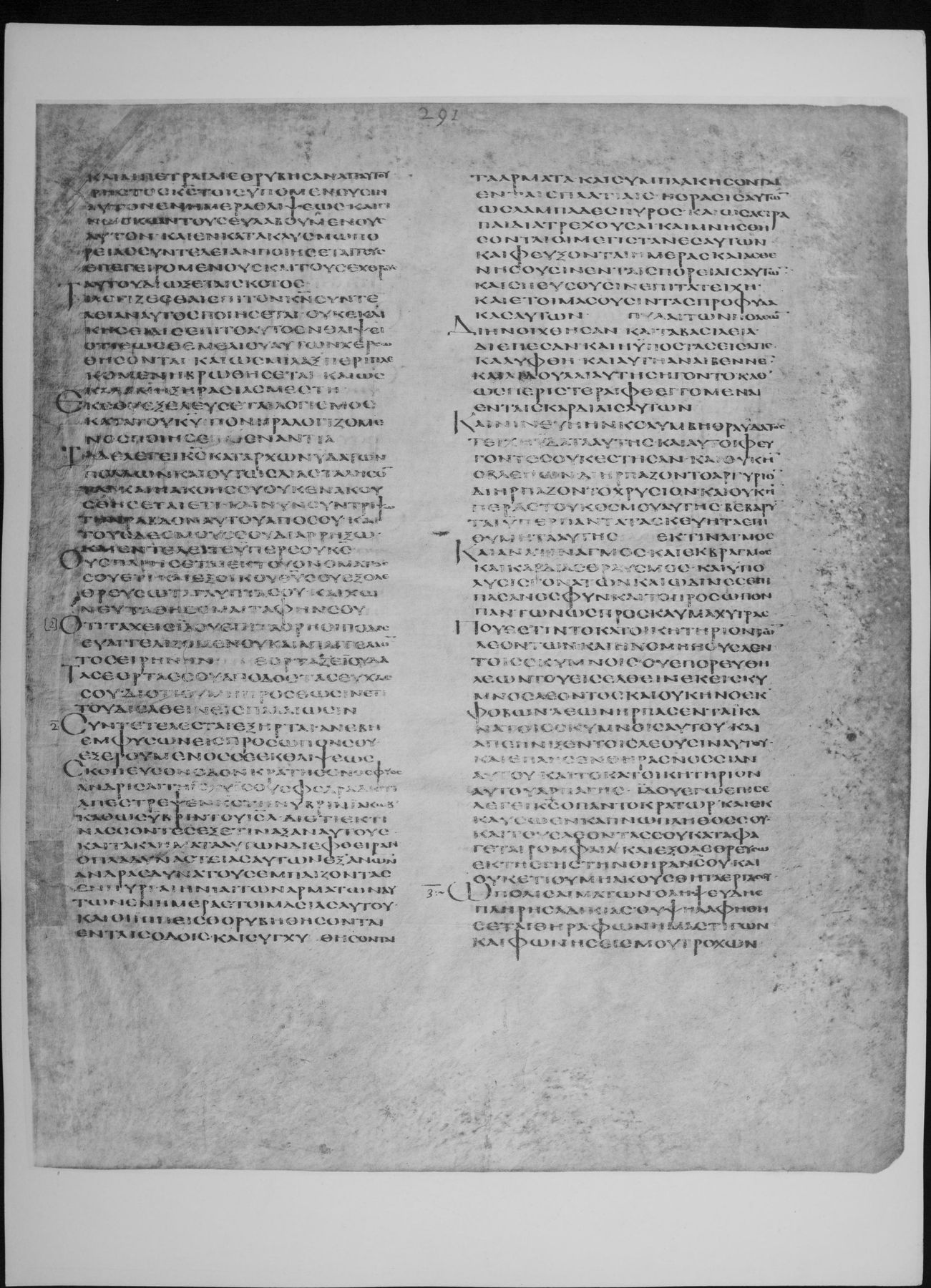
Nahum 2 in the Greek Old Testament (the Septuagint) as written in Codex Alexandrinus, a Greek Bible copied in the fifth century, probably in Egypt, and now in the British Library (Royal MS 1 D. VI, the second of its four volumes). It is one of the three great early codices of the whole Greek Bible, with Codex Vaticanus and Codex Sinaiticus.
Numbering: Swete's Greek and Brenton's English number or divide some verses of this chapter differently (Swete 2:1-2 = Brenton 2:2). Each column keeps its own verse numbers, and sections are cut only where the two texts agree, so each section holds the same passage in both languages.
This entry meets the strict three-criteria standard of the Theosis Library:
- Manuscript scan: the page of Codex Alexandrinus carrying this chapter (fol. 291r), from the full-size photographic (autotype) facsimile published by the British Museum in 1879-1883, as digitised on the Internet Archive. The verse range of every page comes from the reduced photographic facsimile of 1936, which prints it beneath each plate, and the opening words of every page were read on the plate to confirm the page and the verse it begins with. Each section links to the page or pages that hold its verses. Folio numbers are those written at the head of each leaf and visible on the plates.
- Original text: Swete's edition, which here prints the text of Codex Vaticanus (Vat. gr. 1209), the base of his edition, and gives the readings of Alexandrinus only in his apparatus. The Greek column is therefore Vaticanus' text; where Alexandrinus differs, the plate shows what Alexandrinus reads.
- English translation: Sir Lancelot C. L. Brenton, The Septuagint Version of the Old Testament (1844; 1851 edition), a translation of the Greek, public domain, from the eBible.org text.
How was this verified? (Provenance)
Where on the image
Nahum 2:1-8 is on fol. 291r (full-size facsimile of 1879-83, Internet Archive codex-alexandrinus leaf 606). The 1936 reduced facsimile prints beneath this page: Nahum i. 6-iii. 2. Checked on the plate: the page begins inside Nahum 1:6 (first words read: ΚΑΙ ΑΙ ΠΕΤΡΑΙ ΔΙΕΘΡΥΒΗΣΑΝ ΑΠ ΑΥΤΟΥ ΧΡΗΣΤΟΣ ΚΣ ΤΟΙΣ ΥΠΟΜΕΝΟΥΣΙΝ ΑΥΤΟΝ).
1Συντετέλεσται, ἐξῆρται· 2ἀνέβη ἐμφυσῶν εἰς πρόσωπόν σου, ἐξαιρούμενος ἐκ θλίψεως. σκόπευσον ὁδόν, κράτησον ὀσφύος, ἄνδρισαι τῇ ἰσχύι σφόδρα· 3διότι ἀπέστρεψεν Κύριος τὴν ὕβριν Ἰακὼβ καθὼς ὕβριν τοῦ Ἰσραήλ, διότι ἐκτινάσσοντες ἐξετίναξαν αὐτοὺς καὶ τὰ κλήματα αὐτῶν· διέφθειραν 4ὅπλα δυναστείας αὐτῶν ἐξ ἀνθρώπων, ἄνδρας δυνατοὺς ἐμπαίζοντας ἐν πυρί· αἱ ἡνίαι τῶν ἁρμάτων αὐτῶν ἐν ἡμέρᾳ ἑτοιμασίας αὐτοῦ, καὶ οἱ ἱππεῖς θορυβηθήσονται 5ἐν ταῖς ὁδοῖς, καὶ συγχυθήσονται τὰ ἅρματα καὶ συνπλακήσονται ἐν ταῖς πλατείαις ἡ ὅρασις αὐτῶν ὡς λαμπάδες πυρὸς καὶ ὡς ἀστραπαὶ διατρέχουσαι. 6καὶ μνησθήσονται οἱ μεγιστᾶνες αὐτῶν, καὶ φεύξονται ἡμέρας καὶ ἀσθενήσουσιν ἐν τῇ πορίᾳ αὐτῶν, καὶ σπεύσουσιν ἐπὶ τὰ τείχη αὐτῆς καὶ ἑτοιμάσουσιν τὰς προφυλακὰς αὐτῶν. 7πύλαι τῶν πόλεων διηνοίχθησαν, καὶ τὰ βασίλεια διέπεσεν, 8καὶ ἡ ὑπόστασις ἀπεκαλύφθη καὶ αὕτη ἀνέβαινεν καὶ αἱ δοῦλαι αὐτῆς ἤγοντο καθὼς περιστεραὶ φθεγγόμεναι ἐν καρδίαις αὐτῶν.
2It is all over with him, he has been removed, one who has been delivered from affliction has come up panting into thy presence, watch the way, strengthen thy loins, be very valiant in thy strength. 3For the Lord has turned aside the pride of Jacob, as the pride of Israel: for they have utterly rejected them, and have destroyed their branches. 4They have destroyed the arms of their power from among men, their mighty men sporting with fire: the reins of their chariots shall be destroyed in the day of his preparation, and the horsemen shall be thrown into confusion 5in the ways, and the chariots shall clash together, and shall be entangled in each other in the broad ways: their appearance is as lamps of fire, and as gleaming lightnings. 6And their mighty men shall bethink themselves and flee by day; and they shall be weak as they go; and they shall hasten to her walls, and shall prepare their defences. 7The gates of the cities have been opened, and the palaces have fallen into ruin, 8and the foundation has been exposed; and she has gone up, and her maid-servants were led away as doves moaning in their hearts.
Where on the image
Nahum 2:9-14 is on fol. 291r (full-size facsimile of 1879-83, Internet Archive codex-alexandrinus leaf 606). The 1936 reduced facsimile prints beneath this page: Nahum i. 6-iii. 2. Checked on the plate: the page begins inside Nahum 1:6 (first words read: ΚΑΙ ΑΙ ΠΕΤΡΑΙ ΔΙΕΘΡΥΒΗΣΑΝ ΑΠ ΑΥΤΟΥ ΧΡΗΣΤΟΣ ΚΣ ΤΟΙΣ ΥΠΟΜΕΝΟΥΣΙΝ ΑΥΤΟΝ).
9καὶ Νινευή, ὡς κολυμβήθρα ὕδατος τὰ ὕδατα αὐτῆς, καὶ αὐτοὶ φεύγοντες οὐκ ἔστησαν, καὶ οὐκ ἦν ὁ ἐπιβλέπων. 10διήρπασαν τὸ ἀργύριον, διήρπαζον τὸ χρυσίον, καὶ οὐκ ἦν πέρας τοῦ κόσμου αὐτῆς· βεβάρυνται ἐπὶ πάντα σκεύη τὰ ἐπιθυμητὰ αὐτῆς. 11ἐκτιναγμὸς καὶ ἀνατιναγμὸς καὶ ἐκβρασμὸς καὶ καρδίας θραυσμός, καὶ ὑπόλυσις γονάτων καὶ ὠδῖνες ἐπὶ πᾶσαν ὀσφύν, καὶ τὸ πρόσωπον πάντων ὡς πρόσκαυμα χύτρας. 12ποῦ ἐστιν τὸ κατοικητήριον τῶν λεόντων, καὶ ἡ νομὴ ἡ οὖσα τοῖς σκύμνοις; ποῦ ἐπορεύθη λέων τοῦ εἰσελθεῖν ἐκεῖ σκύμνον λέοντος, καὶ οὐκ ἦν ὁ ἐκφοβῶν; 13λέων ἥρπασεν τὰ ἱκανὰ τοῖς σκύμνοις αὐτοῦ καὶ ἀπέπνιξεν τοῖς λέουσιν αὐτοῦ, καὶ ἔπλησεν θήρας νοσσιὰν αὐτοῦ καὶ τὸ κατοικητήριον αὐτοῦ ἁρπαγῆς. 14ἰδοὺ ἐγὼ ἐπὶ σέ, λέγει Κύριος Παντοκράτωρ, καὶ ἐκκαύσω ἐν καπνῷ πλῆθός σου, καὶ τοὺς λέοντάς σου καταφάγεται ῥομφαία, καὶ ἐξολεθρεύσω ἐκ τῆς γῆς τὴν θήραν σου, καὶ οὐ μὴ ἀκουσθῇ οὐκέτι τὰ ἔργα σου.
9And as for Nineve, her waters shall be as a pool of water: and they fled, and staid not, and there was none to look back. 10They plundered the silver, they plundered the gold, and there was no end of their adorning; they were loaded with it upon all their pleasant vessels. 11There is thrusting forth, and shaking, and tumult, and heart-breaking, and loosing of knees, and pangs on all loins; and the faces of all are as the blackening of a pot. 12Where is the dwelling-place of the lions, and the pasture that belonged to the whelps? where did the lion go, that the lion's whelp should enter in there, and there was none to scare him away? 13The lion seized enough prey for his whelps, and strangled for his young lions, and filled his lair with prey, and his dwelling-place with spoil. 14Behold, I am against thee, saith the Lord Almighty, and I will burn up thy multitude in the smoke, and the sword shall devour thy lions; and I will utterly destroy thy prey from off the land, and thy deeds shall no more at all be heard of.
Cite
Sources
- Source: Codex Alexandrinus (British Library Royal MS 1 D. VI) via the British Museum photographic facsimiles of 1879-83 and 1936 (Internet Archive) + Swete's Septuagint + Brenton's English (holding institution)
- Critical edition: H. B. Swete, The Old Testament in Greek according to the Septuagint (1909)
← previous · → next · v cycle view · l back to library