Tobit, Chapter 4 (Codex Alexandrinus)
Introduction
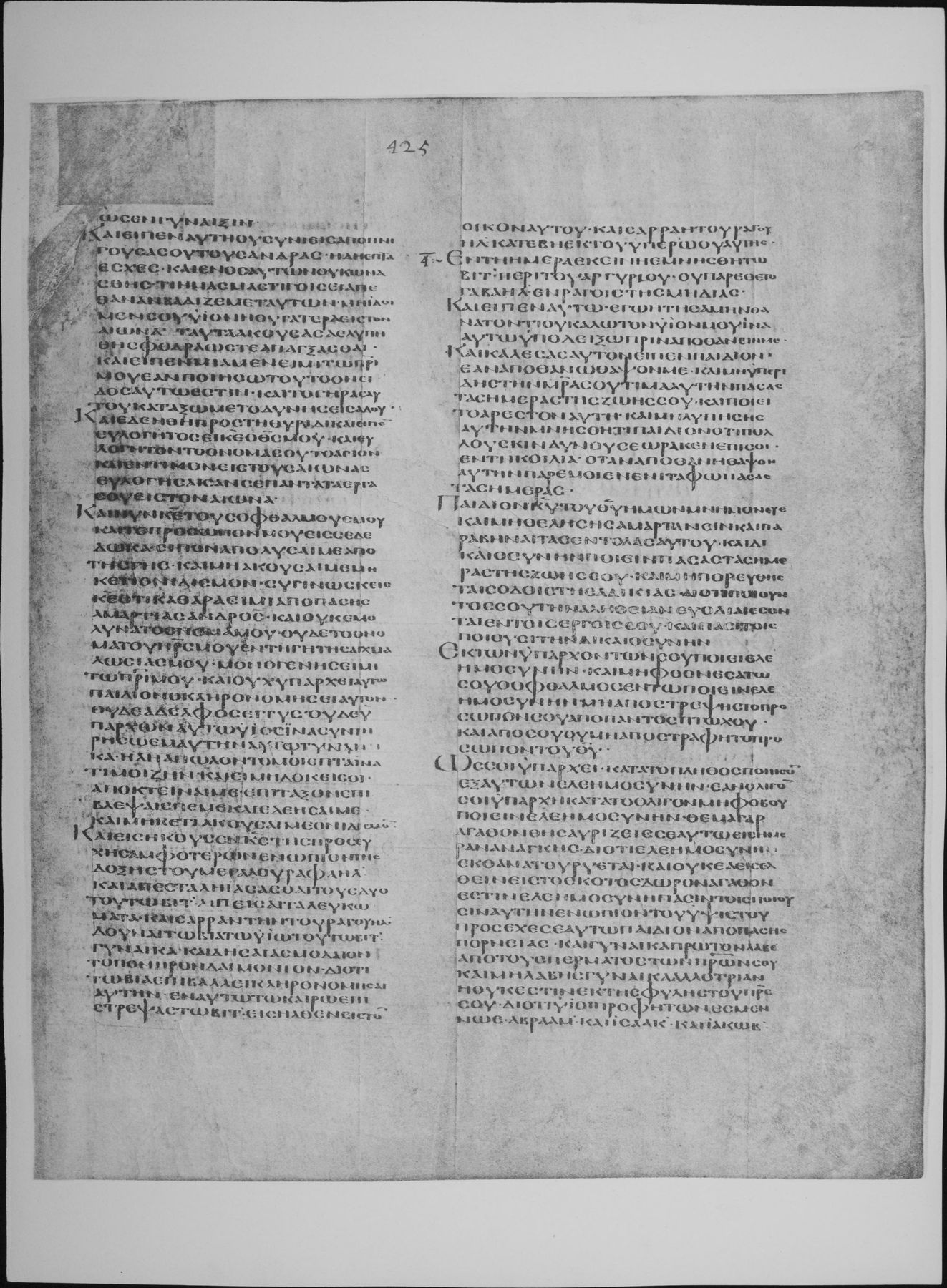
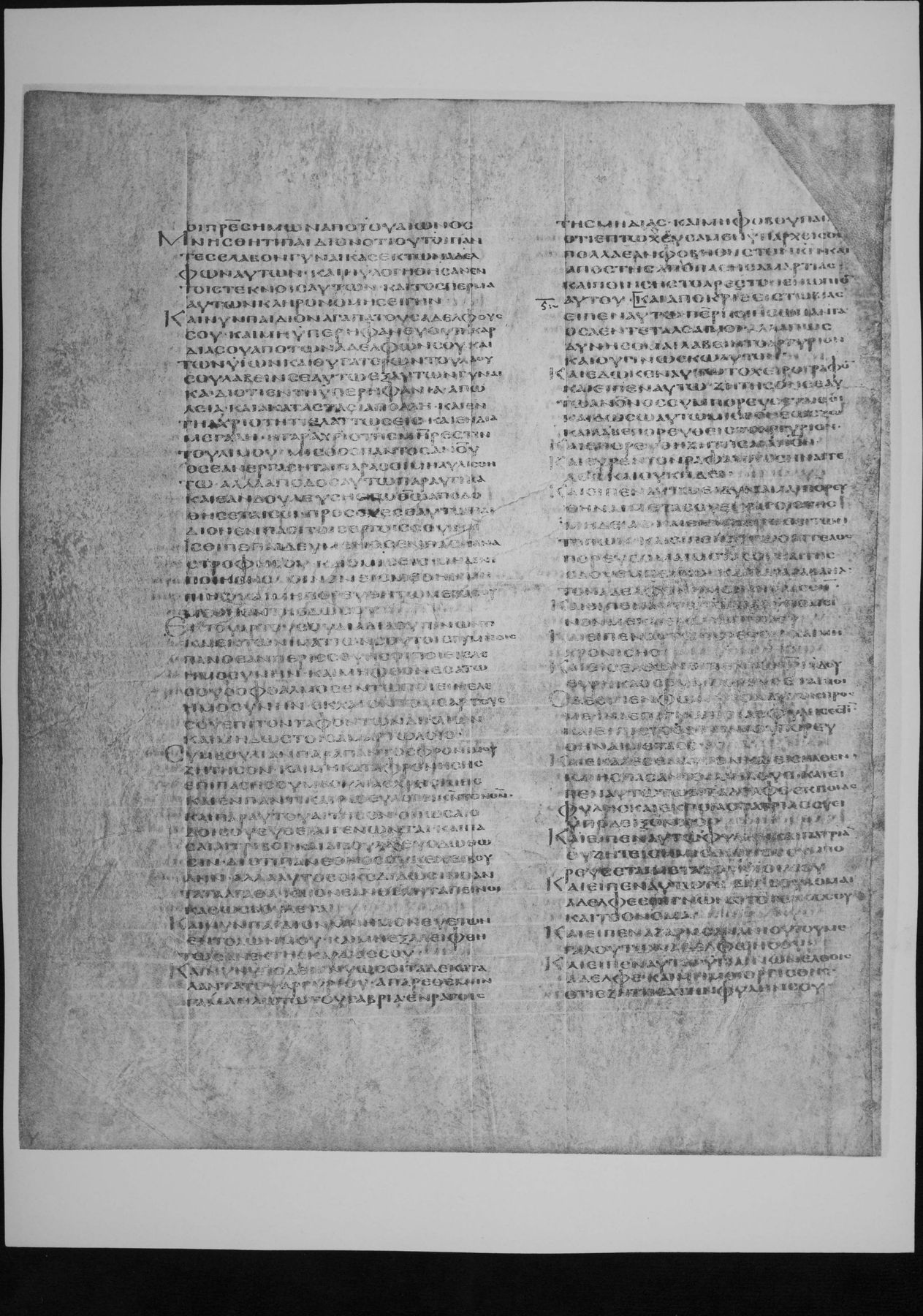
Tobit 4 in the Greek Old Testament (the Septuagint) as written in Codex Alexandrinus, a Greek Bible copied in the fifth century, probably in Egypt, and now in the British Library (Royal MS 1 D. VI, the second of its four volumes). It is one of the three great early codices of the whole Greek Bible, with Codex Vaticanus and Codex Sinaiticus.
Two Greek forms of Tobit: Tobit survives in a shorter and a longer Greek form. Codex Alexandrinus, like Codex Vaticanus, has the shorter form, which Swete prints from Vaticanus as his main text (he prints the longer form of Codex Sinaiticus beneath it; that form is not used here). Brenton's English also translates the shorter form.
Numbering: Swete's Greek and Brenton's English number or divide some verses of this chapter differently (Swete 4:7-18 = Brenton 4:7). Each column keeps its own verse numbers, and sections are cut only where the two texts agree, so each section holds the same passage in both languages.
This entry meets the strict three-criteria standard of the Theosis Library:
- Manuscript scan: the pages of Codex Alexandrinus carrying this chapter (fol. 425r, fol. 425v), from the full-size photographic (autotype) facsimile published by the British Museum in 1879-1883, as digitised on the Internet Archive. The verse range of every page comes from the reduced photographic facsimile of 1936, which prints it beneath each plate, and the opening words of every page were read on the plate to confirm the page and the verse it begins with. Each section links to the page or pages that hold its verses. Folio numbers are those written at the head of each leaf and visible on the plates.
- Original text: Swete's edition, which here prints the text of Codex Vaticanus (Vat. gr. 1209), the base of his edition, and gives the readings of Alexandrinus only in his apparatus. The Greek column is therefore Vaticanus' text; where Alexandrinus differs, the plate shows what Alexandrinus reads.
- English translation: Sir Lancelot C. L. Brenton, The Septuagint Version of the Old Testament (1844; 1851 edition), a translation of the Greek, public domain, from the eBible.org text.
How was this verified? (Provenance)
Where on the image
Tobit 4:1-12 is on fol. 425r (full-size facsimile of 1879-83, Internet Archive codex-alexandrinus leaf 874). The 1936 reduced facsimile prints beneath this page: Tobit iii. 8-iv. 12. Checked on the plate: the page begins inside Tobit 3:8 (first words read: ΩΣ ΕΝ ΓΥΝΑΙΞΙΝ ΚΑΙ ΕΙΠΕΝ ΑΥΤΗ ΟΥ ΣΥΝΙΕΙΣ ΑΠΟΠΝΙΓΟΥΣΑ ΣΟΥ ΤΟΥΣ ΑΝΔΡΑΣ). Tobit 4:12-18 is on fol. 425v (full-size facsimile of 1879-83, Internet Archive codex-alexandrinus leaf 875). The 1936 reduced facsimile prints beneath this page: Tobit iv. 12-v. 14. Checked on the plate: the page begins inside Tobit 4:12 (first words read: ΟΙ ΠΡΕΣ ΗΜΩΝ ΑΠΟ ΤΟΥ ΑΙΩΝΟΣ ΜΝΗΣΘΗΤΙ ΠΑΙΔΙΟΝ ΟΤΙ ΟΥΤΟΙ ΠΑΝΤΕΣ).
1Ἐν τῇ ἡμέρᾳ ἐκείνῃ ἐμνήσθη Τωβεὶτ περὶ τοῦ ἀργυρίου οὗ παρέθετο Γαβαὴλ ἐν Ῥάγοις τῆς Μηδίας. 2καὶ εἶπεν ἐν ἑαυτῷ Ἐγὼ ᾐτησάμην θάνατον, τί οὐ καλῶ Τωβίαν τὸν υἱόν μου ἵνα αὐτῷ ὑποδείξω πρὶν ἀποθανεῖν με; 3καὶ καλέσας αὐτὸν εἶπεν Παιδίον, ἐὰν ἀποθάνω θάψον με, καὶ μὴ ὑπερίδῃς τὴν μητέρα σου· τίμα αὐτὴν πάσας τὰς ἡμέρας τῆς ζωῆς σου, καὶ ποίει τὸ ἀρεστὸν αὐτῇ καὶ μὴ λυπήσῃς αὐτήν. 4μνήσθητι, παιδίον, ὅτι πολλοὺς κινδύνους ἑόρακεν ἐπὶ σοὶ ἐν τῇ κοιλίᾳ· ὅταν ἀποθάνῃ, θάψον αὐτὴν παρ᾽ ἐμοὶ ἐν ἑνὶ τάφῳ. 5πάσας τὰς ἡμέρας, παιδίον, Κυρίου τοῦ θεοῦ ἡμῶν μνημόνευε· μὴ θελήσῃς παραβῆναι τὰς ἐντολὰς αὐτοῦ. δικαιοσύνην ποίει πάσας τὰς ἡμέρας τῆς ζωῆς σου, καὶ μὴ πορευθῇς ταῖς ὁδοῖς τῆς ἀδικίας. 6διότι ποιοῦντός σου τὴν ἀλήθειαν εὐοδίαι ἔσονται ἐν τοῖς ἔργοις σου καὶ πᾶσι τοῖς ποιοῦσι τὴν δικαιοσύνην. 7ἐκ τῶν ὑπαρχόντων σοι ποίει ἐλεημοσύνην, καὶ μὴ φθονεσάτω σου ὁ ὀφθαλμὸς ἐν τῷ ποιεῖν σε ἐλεημοσύνην· καὶ μὴ ἀποστρέψῃς τὸ πρόσωπόν σου ἀπὸ παντὸς πτωχοῦ, καὶ ἀπὸ σοῦ οὐ μὴ ἀποστραφῇ τὸ πρόσωπον τοῦ θεοῦ. 8ὡς σοὶ ὑπάρχει κατὰ τὸ πλῆθος, ποίησον ἐξ αὐτῶν ἐλεημοσύνην· ἐὰν ὀλίγον σοι ὑπάρχῃ, κατὰ τὸ ὀλίγον μὴ φοβοῦ ποιεῖν ἐλεημοσύνην. 9θέμα γὰρ ἀγαθὸν θησαυρίζεις σεαυτῷ εἰς ἡμέραν ἀνάγκης. 10διότι ἐλεημοσύνη ἐκ θανάτου ῥύεται, καὶ οὐκ ἐάσει ἐλθεῖν εἰς τὸ σκότος. 11δῶρον γὰρ ἀγαθόν ἐστιν ἐλεημοσύνη πᾶσι τοῖς ποιοῦσιν αὐτὴν ἐνώπιον τοῦ ὑψίστου. 12πρόσεχε σεαυτῷ, παιδίον, ἀπὸ πάσης πορνείας, καὶ γυναῖκα πρῶτον λάβε ἀπὸ τοῦ σπέρματος τῶν πατέρων σου· μὴ λάβῃς γυναῖκα ἀλλοτρίαν ἣ οὐκ ἔστιν ἐκ τῆς φυλῆς τοῦ πατρός σου, διότι υἱοὶ προφητῶν ἐσμεν. Νῶε, Ἀβραάμ, Ἰσαάκ, Ἰακώβ, οἱ πατέρες ἡμῶν ἀπὸ τοῦ αἰῶνος, μνήσθητι, παιδίον, ὅτι αὐτοὶ πάντες ἔλαβον γυναῖκας ἐκ τῶν ἀδελφῶν αὐτῶν, καὶ εὐλογήθησαν ἐν τοῖς τέκνοις αὐτῶν, καὶ τὸ σπέρμα αὐτῶν κληρονομήσει γῆν. 13καὶ νῦν, παιδίον, ἀγάπα τοὺς ἀδελφούς σου, καὶ μὴ ὑπερηφανεύου τῇ καρδίᾳ σου ἀπὸ τῶν ἀδελφῶν σου καὶ τῶν υἱῶν καὶ θυγατέρων τοῦ λαοῦ σου, λαβεῖν σεαυτῷ ἐξ αὐτῶν γυναῖκα. διότι ἐν τῇ ὑπερηφανίᾳ ἀπωλία καὶ ἀκαταστασία πολλή, καὶ ἐν τῇ ἀχρεότητι ἐλάττωσις καὶ ἔνδεια μεγάλη· ἡ γὰρ ἀχρεότης μήτηρ ἐστὶν τοῦ λιμοῦ. 14μισθὸς παντὸς ἀνθρώπου ὃς ἐὰν ἐργάσηται παρὰ σοὶ μὴ αὐλισθήτω, ἀλλὰ ἀπόδος αὐτῷ παραυτίκα· ἐὰν δουλεύσῃς τῷ θεῷ, ἀποδοθήσεταί σοι. πρόσεχε σεαυτῷ, παιδίον, ἐν πᾶσι τοῖς ἔργοις σου, καὶ ἴσθι πεπαιδευμένος ἐν πάσῃ ἀναστροφῇ σου. 15καὶ ὃ μισεῖς μηδενὶ ποιήσῃς. οἶνον εἰς μέθην μὴ πίῃς, καὶ μὴ πορευθήτω μετὰ σοῦ μέθη ἐν τῇ ὁδῷ σου. 16ἐκ τοῦ ἄρτου σου δίδου πεινῶντι, καὶ ἐκ τῶν ἱματίων σου τοῖς γυμνοῖς· πᾶν ὃ ἐὰν περισσεύσῃ σοι ποίει ἐλεημοσύνην, καὶ μὴ φθονεσάτω σου ὁ ὀφθαλμὸς ἐν τῷ ποιεῖν σε ἐλεημοσύνην. 17ἔκχεον τοὺς ἄρτους σου ἐπὶ τὸν τάφον τῶν δικαίων, καὶ μὴ δῷς τοῖς ἁμαρτωλοῖς. 18συμβουλίαν παρὰ παντὸς φρονίμου ζήτησον, καὶ μὴ καταφρονήσῃς ἐπὶ πάσης συμβουλίας χρησίμης.
1In that day Tobit remembered the money which he had committed to Gabael in Rages of Media, 2and said with himself, I have wished for death; wherefore do I not call for my son Tobias, that I may signify to him of the money before I die? 3And when he had called him, he said, My son, when I am dead, bury me; and despise not thy mother, but honour her all the days of thy life, and do that which shall please her, and grieve her not. 4Remember, my son, that she saw many dangers for thee, when thou wast in her womb; and when she is dead, bury her by me in one grave. 5My son, be mindful of the Lord our God all thy days, and let not thy will be set to sin, or to transgress his commandments: do uprightly all thy life long, and follow not the ways of unrighteousness. 6For if thou deal truly, thy doings shall prosperously succeed to thee, and to all them that live justly. 7Give alms of thy substance; and when thou givest alms, let not thine eye be envious, neither turn thy face from any poor, and the face of God shall not be turned away from thee. If thou hast abundance, give alms accordingly: if thou have but a little, be not afraid to give according to that little: for thou layest up a good treasure for thyself against the day of necessity. Because that alms do deliver from death, and suffereth not to come into darkness. For alms is a good gift unto all that give it in the sight of the most High. Beware of all whoredom, my son, and chiefly take a wife of the seed of thy fathers, and take not a strange woman to wife, which is not of thy father's tribe: for we are the children of the prophets, Noe, Abraham, Isaac, and Jacob. Remember, my son, that our fathers from the beginning, even that they all married wives of their own kindred, and were blessed in their children, and their seed shall inherit the land. Now therefore, my son, love thy brethren, and despise not in thy heart thy brethren, the sons and daughters of thy people, in not taking a wife of them: for in pride is destruction and much trouble, and in lewdness is decay and great want: for lewdness is the mother of famine. Let not the wages of any man, which hath wrought for thee, tarry with thee, but give him it out of hand: for if thou serve God, he will also repay thee: be circumspect, my son, in all things thou doest, and be wise in all thy conversation. Do that to no man which thou hatest: drink not wine to make thee drunken: neither let drunkenness go with thee in thy journey. Give of thy bread to the hungry, and of thy garments to them that are naked; and according to thine abundance give alms; and let not thine eye be envious, when thou givest alms. Pour out thy bread on the burial of the just, but give nothing to the wicked. Ask counsel of all that are wise, and despise not any counsel that is profitable.
Where on the image
Tobit 4:19-21 is on fol. 425v (full-size facsimile of 1879-83, Internet Archive codex-alexandrinus leaf 875). The 1936 reduced facsimile prints beneath this page: Tobit iv. 12-v. 14. Checked on the plate: the page begins inside Tobit 4:12 (first words read: ΟΙ ΠΡΕΣ ΗΜΩΝ ΑΠΟ ΤΟΥ ΑΙΩΝΟΣ ΜΝΗΣΘΗΤΙ ΠΑΙΔΙΟΝ ΟΤΙ ΟΥΤΟΙ ΠΑΝΤΕΣ).
19καὶ ἐν παντὶ καιρῷ εὐλόγει Κύριον τὸν θεόν, καὶ παρ᾽ αὐτοῦ αἴτησον ὅπως αἱ ὁδοί σου εὐθεῖαι γένωνται καὶ πᾶσαι αἱ τρίβοι καὶ βουλαὶ εὐοδωθῶσιν. διότι πᾶν ἔθνος οὐκ ἔχει βουλήν, ἀλλὰ αὐτὸς ὁ κύριος δίδωσιν πάντα τὰ ἀγαθὰ καὶ ὃ ἐὰν θέλῃ ταπεινοῖ, καθὼς βούλονται. καὶ νῦν, παιδίον, μνημόνευε τῶν ἐντολῶν μου, καὶ μὴ ἐξαλειφθήτωσαν ἐκ τῆς καρδίας σου. 20καὶ νῦν ἐπιδεικνύω σοι τὰ δέκα τάλαντα τοῦ ἀργυρίου ἃ παρεθέμην Γαβαήλῳ τῷ τοῦ Γαβρεία ἐν Ῥάγοις τῆς Μηδείας. 21καὶ μὴ φοβοῦ, παιδίον, ὅτι ἐπτωχεύσαμεν· ὑπάρχει σοι πολλά, ἐὰν φοβηθῇς τὸν θεὸν καὶ ἀποστῇς ἀπὸ πάσης ἁμαρτίας καὶ ποιήσῃς τὸ ἀρεστὸν ἐνώπιον αὐτοῦ.
19Bless the Lord thy God alway, and desire of him that thy ways may be directed, and that all thy paths and counsels may prosper: for every nation hath not counsel; but the Lord himself giveth all good things, and he humbleth whom he will, as he will; now therefore, my son, remember my commandments, neither let them be put out of thy mind. 20And now I signify this to thee, that I committed ten talents to Gabael the son of Gabrias at Rages in Media. 21And fear not, my son, that we are made poor: for thou hast much wealth, if thou fear God, and depart from all sin, and do that which is pleasing in his sight.
Cite
Sources
- Source: Codex Alexandrinus (British Library Royal MS 1 D. VI) via the British Museum photographic facsimiles of 1879-83 and 1936 (Internet Archive) + Swete's Septuagint + Brenton's English (holding institution)
- Critical edition: H. B. Swete, The Old Testament in Greek according to the Septuagint (1909)
← previous · → next · v cycle view · l back to library