Homer, Odyssey, Book 19: Penelope and the beggar; the scar
Introduction
The Odyssey, composed around 700 BCE and attributed to Homer, tells of Odysseus' ten-year journey home from Troy and his return to Ithaca. Book 19 (604 lines): Penelope and the beggar; the scar.
The page photographs are from Florence, Biblioteca Medicea Laurenziana, Plut. 32.24 (parchment, 10th century, 234 folios; the oldest manuscript of the Odyssey with published images), in the Biblioteca Medicea Laurenziana's Teca Digitale. This book is on fol. 185v-197v; each section below is one page, with its first and last line as read on the photograph. Many pages carry interlinear glosses and a few marginal notes in later hands.
The Greek is A. T. Murray's Loeb text (1919) via Perseus, not a transcription of this manuscript, whose wording differs in places. The English is Murray's prose translation (1919), divided every five lines; at a page break a five-line block goes with the page holding most of it, except at the page breaks where a section's note says the English is cut at the end of Murray's sentence. Each section's note gives its English line range.
Where the scribe left out a line, wrote one in the margin, changed the order or added a line not in Murray's text, the section's note on the photograph says so; the Greek and English shown are Murray's full text for the page's range.
How was this verified? (Provenance)
Where on the image
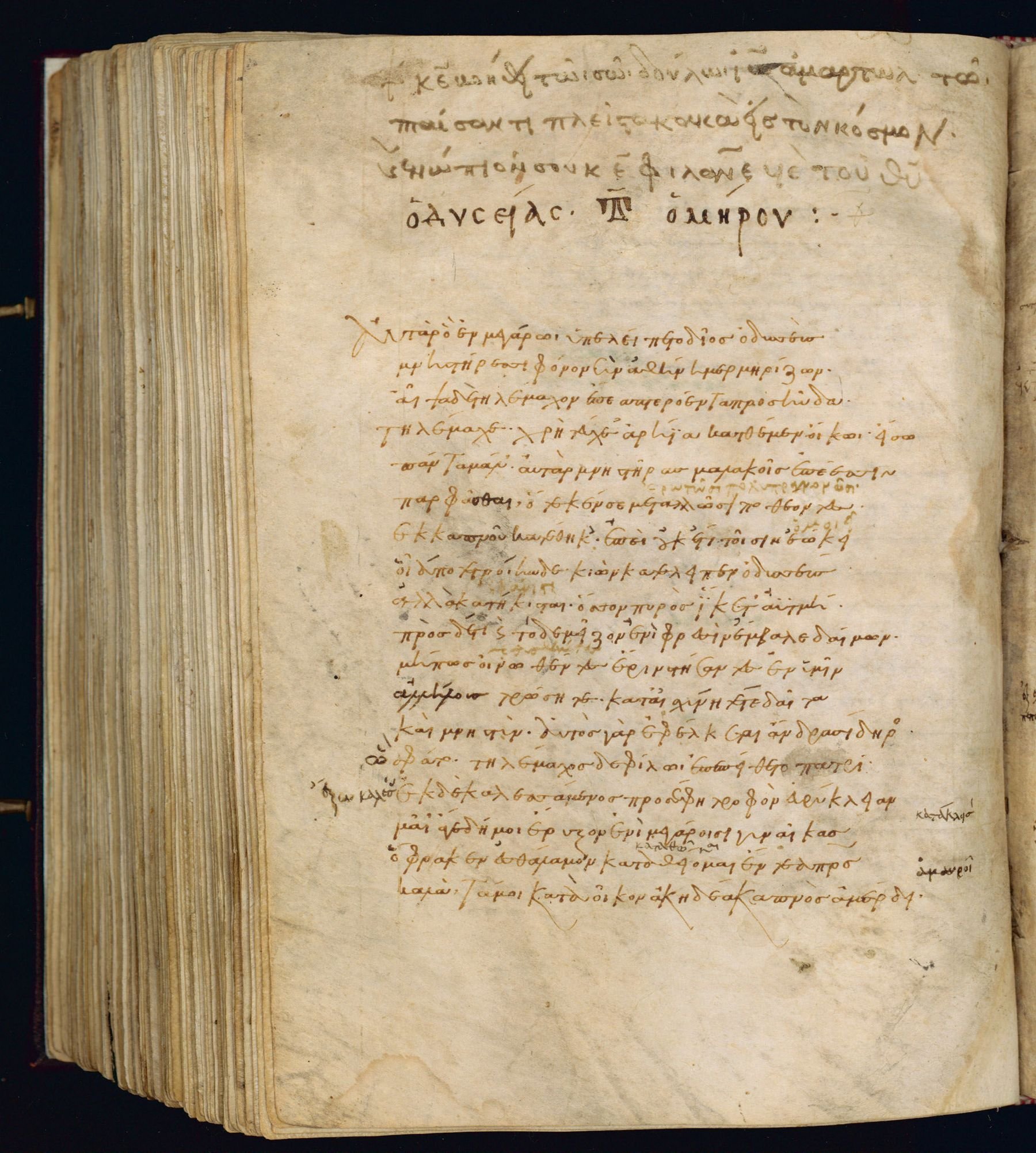
Laur. Plut. 32.24, fol. 185v: Odyssey 19.1-18, begins ‹αὐτὰρ ὁ ἐν μεγάρῳ›, ends ‹οἶκον ἀκηδέα καπνὸς ἀμέρδει›. Checked on the image: first and last lines read and matched to the Greek. Fol. 186r begins with 19.19. The top of the page has three lines in large script in a later hand (a note by a reader, not Odyssey text); the heading ὀδυσσείας τ ὁμήρου follows in capitals, and book 19 begins after a space. English blocks here: 1-4, 5-9, 10-14, 15-19.
1αὐτὰρ ὁ ἐν μεγάρῳ ὑπελείπετο δῖος Ὀδυσσεύς,
2μνηστήρεσσι φόνον σὺν Ἀθήνῃ μερμηρίζων·
3αἶψα δὲ Τηλέμαχον ἔπεα πτερόεντα προσηύδα·
4Τηλέμαχε, χρὴ τεύχεʼ ἀρήϊα κατθέμεν εἴσω
5πάντα μάλʼ· αὐτὰρ μνηστῆρας μαλακοῖς ἐπέεσσι
6παρφάσθαι, ὅτε κέν σε μεταλλῶσιν ποθέοντες·
7ἐκ καπνοῦ κατέθηκʼ, ἐπεὶ οὐκέτι τοῖσιν ἐῴκει
8οἷά ποτε Τροίηνδε κιὼν κατέλειπεν Ὀδυσσεύς,
9ἀλλὰ κατῄκισται, ὅσσον πυρὸς ἵκετʼ ἀϋτμή.
10πρὸς δʼ ἔτι καὶ τόδε μεῖζον ἐνὶ φρεσὶν ἔμβαλε δαίμων
11μή πως οἰνωθέντες, ἔριν στήσαντες ἐν ὑμῖν,
12ἀλλήλους τρώσητε καταισχύνητέ τε δαῖτα
13καὶ μνηστύν· αὐτὸς γὰρ ἐφέλκεται ἄνδρα σίδηρος.
14ὣς φάτο, Τηλέμαχος δὲ φίλῳ ἐπεπείθετο πατρί,
15ἐκ δὲ καλεσσάμενος προσέφη τροφὸν Εὐρύκλειαν·
16μαῖʼ, ἄγε δή μοι ἔρυξον ἐνὶ μεγάροισι γυναῖκας,
17ὄφρα κεν ἐς θάλαμον καταθείομαι ἔντεα πατρὸς
18καλά, τά μοι κατὰ οἶκον ἀκηδέα καπνὸς ἀμέρδει
1So goodly Odysseus was left behind in the hall, planning with Athena's aid the slaying of the wooers, and he straightway spoke winged words to Telemachus: “Telemachus, the weapons of war thou must needs lay away within 5one and all, and when the wooers miss them and question thee, thou must beguile them with gentle words, saying: ‘Out of the smoke have I laid them, since they are no longer like those which of old Odysseus left behind him, when he went forth to Troy, but are all befouled, so far as the breath of fire has reached them. 10And furthermore this greater fear has a god put in my heart, lest haply, when heated with wine, you may set a quarrel afoot among you, and wound one another, and so bring shame on your feast and on your wooing. For of itself does the iron draw a man to it.’” So he spoke, and Telemachus hearkened to his dear father, 15and calling forth the nurse Eurycleia, said to her: “Nurse, come now, I bid thee, shut up the women in their rooms, while I lay away in the store-room the weapons of my father, the goodly weapons which all uncared-for the smoke bedims in the hall since my father went forth, and I was still a child.
Where on the image
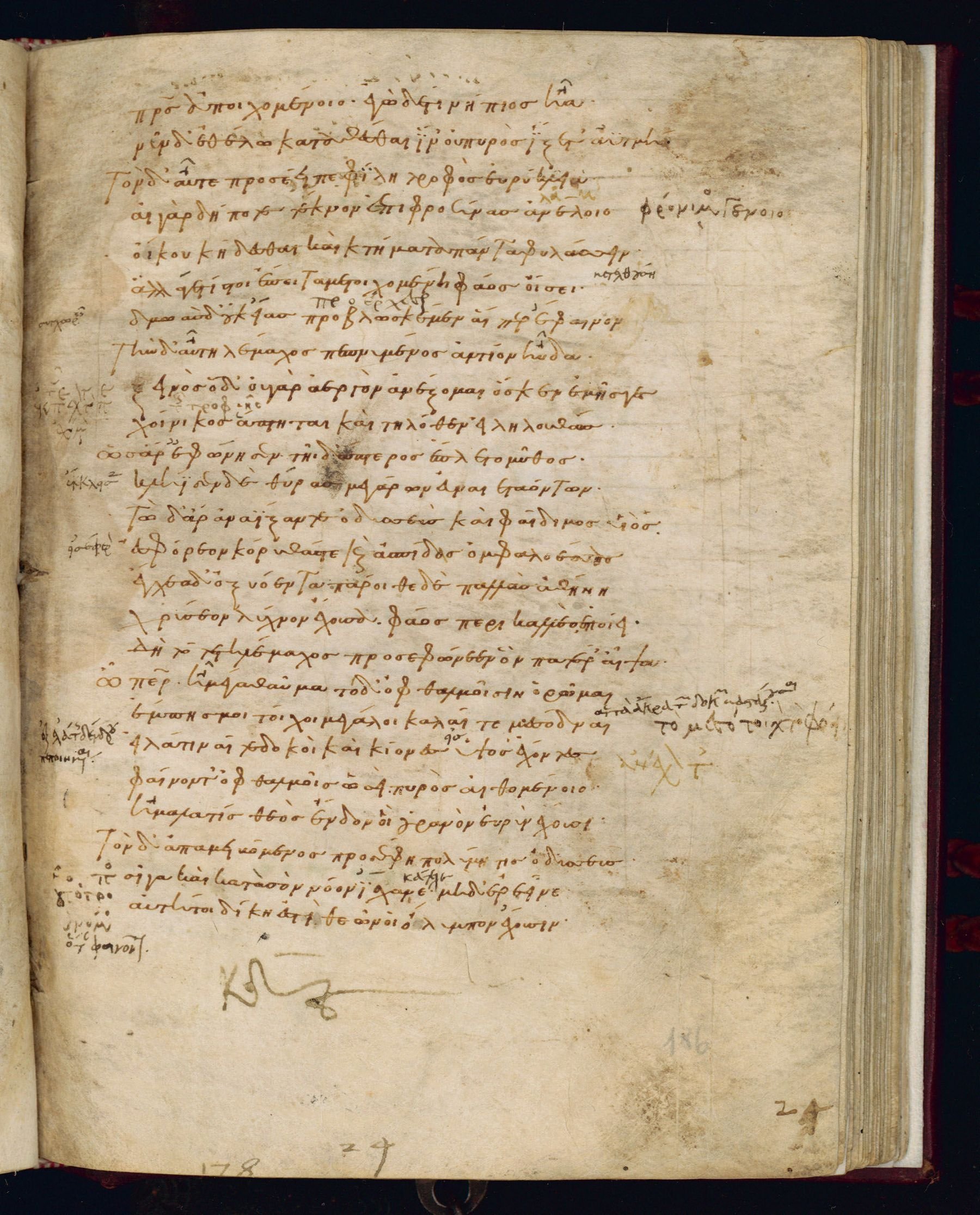
Laur. Plut. 32.24, fol. 186r: Odyssey 19.19-43, begins ‹πατρὸς ἀποιχομένοιο· ἐγὼ δʼ›, ends ‹θεῶν, οἳ Ὄλυμπον ἔχουσιν.›. Checked on the image: first and last lines read and matched to the Greek. Fol. 185v ends with 19.18. Fol. 186v begins with 19.44. English blocks here: 20-24, 25-29, 30-34, 35-39, 40-44.
19πατρὸς ἀποιχομένοιο· ἐγὼ δʼ ἔτι νήπιος ἦα.
20νῦν δʼ ἐθέλω καταθέσθαι, ἵνʼ οὐ πυρὸς ἵξετʼ ἀϋτμή.
21τὸν δʼ αὖτε προσέειπε φίλη τροφὸς Εὐρύκλεια·
22αἲ γὰρ δή ποτε, τέκνον, ἐπιφροσύνας ἀνέλοιο
23οἴκου κήδεσθαι καὶ κτήματα πάντα φυλάσσειν.
24ἀλλʼ ἄγε, τίς τοι ἔπειτα μετοιχομένη φάος οἴσει;
25δμῳὰς δʼ οὐκ εἴας προβλωσκέμεν, αἵ κεν ἔφαινον.
26τὴν δʼ αὖ Τηλέμαχος πεπνυμένος ἀντίον ηὔδα·
27ξεῖνος ὅδʼ· οὐ γὰρ ἀεργὸν ἀνέξομαι ὅς κεν ἐμῆς γε
28χοίνικος ἅπτηται, καὶ τηλόθεν εἰληλουθώς.
29ὣς ἄρʼ ἐφώνησεν, τῇ δʼ ἄπτερος ἔπλετο μῦθος.
30κλήϊσεν δὲ θύρας μεγάρων εὖ ναιεταόντων.
31τὼ δʼ ἄρʼ ἀναΐξαντʼ Ὀδυσεὺς καὶ φαίδιμος υἱὸς
32ἐσφόρεον κόρυθάς τε καὶ ἀσπίδας ὀμφαλοέσσας
33ἔγχεά τʼ ὀξυόεντα· πάροιθε δὲ Παλλὰς Ἀθήνη,
34χρύσεον λύχνον ἔχουσα, φάος περικαλλὲς ἐποίει.
35δὴ τότε Τηλέμαχος προσεφώνεεν ὃν πατέρʼ αἶψα·
36ὦ πάτερ, ἦ μέγα θαῦμα τόδʼ ὀφθαλμοῖσιν ὁρῶμαι.
37ἔμπης μοι τοῖχοι μεγάρων καλαί τε μεσόδμαι,
38εἰλάτιναί τε δοκοί, καὶ κίονες ὑψόσʼ ἔχοντες
39φαίνοντʼ ὀφθαλμοῖς ὡς εἰ πυρὸς αἰθομένοιο.
40ἦ μάλα τις θεὸς ἔνδον, οἳ οὐρανὸν εὐρὺν ἔχουσι.
41τὸν δʼ ἀπαμειβόμενος προσέφη πολύμητις Ὀδυσσεύς·
42σίγα καὶ κατὰ σὸν νόον ἴσχανε μηδʼ ἐρέεινε·
43αὕτη τοι δίκη ἐστὶ θεῶν, οἳ Ὄλυμπον ἔχουσιν.
20But now I am minded to lay them away, where the breath of the fire will not come upon them.” Then the dear nurse Eurycleia answered him: “Aye, child, I would thou mightest ever take thought to care for the house and guard all its wealth. But come, who then shall fetch a light and bear it for thee, 25since thou wouldest not suffer the maids, who might have given light, to go before thee?” Then wise Telemachus answered her; “This stranger here; for I will suffer no man to be idle who touches my portion of meal, even though he has come from afar.” So he spoke, but her word remained unwinged, and she locked the doors of the stately hall. 30Then the two sprang up, Odysseus and his glorious son, and set about bearing within the helmets and the bossy shields and the sharp-pointed spears; and before them Pallas Athena, bearing a golden lamp, made a most beauteous light. 35Then Telemachus suddenly spoke to his father, and said: “Father, verily this is a great marvel that my eyes behold; certainly the walls of the house and the fair beams and cross-beams of fir and the pillars that reach on high, glow in my eyes as with the light of blazing fire. 40Surely some god is within, one of those who hold broad heaven.” Then Odysseus of many wiles answered him, and said: “Hush, check thy thought, and ask no question; this, I tell thee, is the way of the gods that hold Olympus. But do thou go and take thy rest and I will remain behind here,
Where on the image
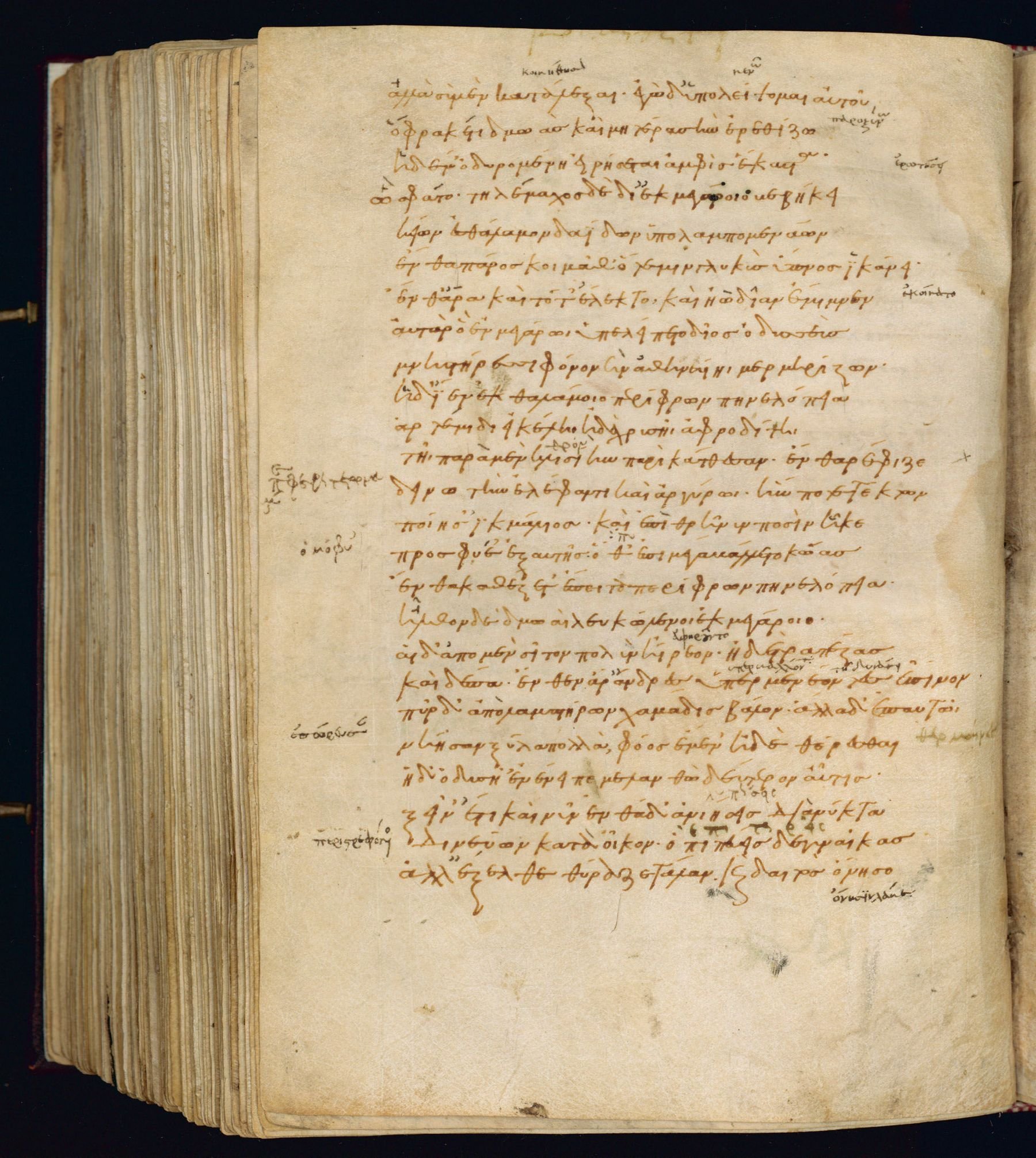
Laur. Plut. 32.24, fol. 186v: Odyssey 19.44-68, begins ‹ἀλλὰ σὺ μὲν κατάλεξαι,›, ends ‹τάλαν, καὶ δαιτὸς ὄνησο·›. Checked on the image: first and last lines read and matched to the Greek. Fol. 186r ends with 19.43. Fol. 187r begins with 19.69. English blocks here: 45-46, 47-49, 50-54, 55-59, 60-64, 65-69.
44ἀλλὰ σὺ μὲν κατάλεξαι, ἐγὼ δʼ ὑπολείψομαι αὐτοῦ,
45ὄφρα κʼ ἔτι δμῳὰς καὶ μητέρα σὴν ἐρεθίζω·
46ἡ δέ μʼ ὀδυρομένη εἰρήσεται ἀμφὶς ἕκαστα.
47ὣς φάτο, Τηλέμαχος δὲ διὲκ μεγάροιο βεβήκει
48κείων ἐς θάλαμον, δαΐδων ὕπο λαμπομενάων,
49ἔνθα πάρος κοιμᾶθʼ, ὅτε μιν γλυκὺς ὕπνος ἱκάνοι·
50ἔνθʼ ἄρα καὶ τότʼ ἔλεκτο καὶ Ἠῶ δῖαν ἔμιμνεν.
51αὐτὰρ ὁ ἐν μεγάρῳ ὑπελείπετο δῖος Ὀδυσσεύς,
52μνηστήρεσσι φόνον σὺν Ἀθήνῃ μερμηρίζων.
53ἡ δʼ ἴεν ἐκ θαλάμοιο περίφρων Πηνελόπεια,
54Ἀρτέμιδι ἰκέλη ἠὲ χρυσέῃ Ἀφροδίτῃ.
55τῇ παρὰ μὲν κλισίην πυρὶ κάτθεσαν, ἔνθʼ ἄρʼ ἐφῖζε,
56δινωτὴν ἐλέφαντι καὶ ἀργύρῳ· ἥν ποτε τέκτων
57ποίησʼ Ἰκμάλιος, καὶ ὑπὸ θρῆνυν ποσὶν ἧκε
58προσφυέʼ ἐξ αὐτῆς, ὅθʼ ἐπὶ μέγα βάλλετο κῶας.
59ἔνθα καθέζετʼ ἔπειτα περίφρων Πηνελόπεια.
60ἦλθον δὲ δμῳαὶ λευκώλενοι ἐκ μεγάροιο.
61αἱ δʼ ἀπὸ μὲν σῖτον πολὺν ᾕρεον ἠδὲ τραπέζας
62καὶ δέπα, ἔνθεν ἄρʼ ἄνδρες ὑπερμενέοντες ἔπινον·
63πῦρ δʼ ἀπὸ λαμπτήρων χαμάδις βάλον, ἄλλα δʼ ἐπʼ αὐτῶν
64νήησαν ξύλα πολλά, φόως ἔμεν ἠδὲ θέρεσθαι.
65ἡ δʼ Ὀδυσῆʼ ἐνένιπε Μελανθὼ δεύτερον αὖτις·
66ξεῖνʼ, ἔτι καὶ νῦν ἐνθάδʼ ἀνιήσεις διὰ νύκτα
67δινεύων κατὰ οἶκον, ὀπιπεύσεις δὲ γυναῖκας;
68ἀλλʼ ἔξελθε θύραζε, τάλαν, καὶ δαιτὸς ὄνησο·
45that I may stir yet more the minds of the maids and of thy mother; and she with weeping shall ask me of each thing separately.” 47So he spoke, and Telemachus went forth through the hall by the light of blazing torches to go to his chamber to lie down, where he had heretofore been wont to rest, when sweet sleep came upon him. 50There now too he lay down and waited for the bright Dawn. But goodly Odysseus was left behind in the hall, planning with Athena's aid the slaying of the wooers. Then wise Penelope came forth from her chamber like unto Artemis or golden Aphrodite, 55and for her they set by the fire, where she was wont to sit, a chair inlaid with spirals of ivory and silver, which of old the craftsman Icmalius had made, and had set beneath it a foot-stool for the feet, that was part of the chair, and upon it a great fleece was wont to be laid. On this then wise Penelope sat down, 60and the white-armed maids came forth from the women's hall. These began to take away the abundant food, the tables, and the cups from which the lordly men had been drinking, and they cast the embers from the braziers on to the floor, and piled upon the braziers fresh logs in abundance, to give light and warmth. 65But Melantho began again a second time to rate Odysseus, saying: “Stranger, wilt thou even now still be a plague to us through the night, roaming through the house, and wilt thou spy upon the women? Nay, get thee forth, thou wretch, and be content with thy supper, or straightway shalt thou even be smitten with a torch, and so go forth.”
Where on the image
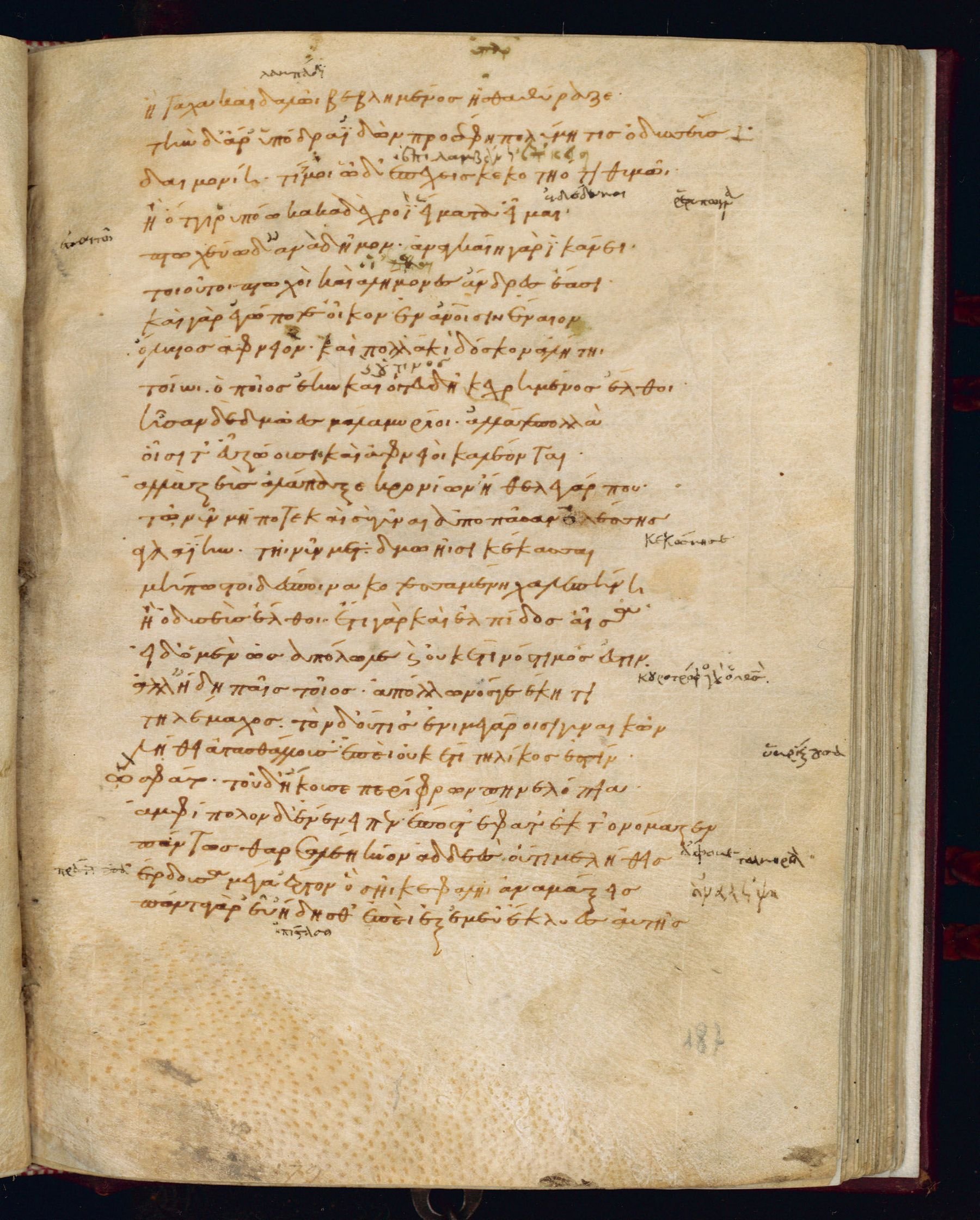
Laur. Plut. 32.24, fol. 187r: Odyssey 19.69-93, begins ‹ἢ τάχα καὶ δαλῷ›, ends ‹ἐξ ἐμεῦ ἔκλυες αὐτῆς›. Checked on the image: first and last lines read and matched to the Greek. Fol. 186v ends with 19.68. Fol. 187v begins with 19.94. English blocks here: 70-74, 75-79, 80-84, 85-88, 89-89, 90-94.
69ἢ τάχα καὶ δαλῷ βεβλημένος εἶσθα θύραζε.
70τὴν δʼ ἄρʼ ὑπόδρα ἰδὼν προσέφη πολύμητις Ὀδυσσεύς·
71δαιμονίη, τί μοι ὧδʼ ἐπέχεις κεκοτηότι θυμῷ;
72ἦ ὅτι δὴ ῥυπόω, κακὰ δὲ χροῒ εἵματα εἷμαι,
73πτωχεύω δʼ ἀνὰ δῆμον; ἀναγκαίη γὰρ ἐπείγει.
74τοιοῦτοι πτωχοὶ καὶ ἀλήμονες ἄνδρες ἔασι
75καὶ γὰρ ἐγώ ποτε οἶκον ἐν ἀνθρώποισιν ἔναιον
76ὄλβιος ἀφνειὸν καὶ πολλάκι δόσκον ἀλήτῃ,
77τοίῳ ὁποῖος ἔοι καὶ ὅτευ κεχρημένος ἔλθοι·
78ἦσαν δὲ δμῶες μάλα μυρίοι, ἄλλα τε πολλὰ
79οἷσίν τʼ εὖ ζώουσι καὶ ἀφνειοὶ καλέονται.
80ἀλλὰ Ζεὺς ἀλάπαξε Κρονίων· ἤθελε γάρ που·
81τῷ νῦν μήποτε καὶ σύ, γύναι, ἀπὸ πᾶσαν ὀλέσσῃς
82ἀγλαΐην, τῇ νῦν γε μετὰ δμῳῇσι κέκασσαι·
83μή πώς τοι δέσποινα κοτεσσαμένη χαλεπήνῃ,
84ἢ Ὀδυσεὺς ἔλθῃ· ἔτι γὰρ καὶ ἐλπίδος αἶσα.
85εἰ δʼ ὁ μὲν ὣς ἀπόλωλε καὶ οὐκέτι νόστιμός ἐστιν,
86ἀλλʼ ἤδη παῖς τοῖος Ἀπόλλωνός γε ἕκητι,
87Τηλέμαχος· τὸν δʼ οὔ τις ἐνὶ μεγάροισι γυναικῶν
88λήθει ἀτασθάλλουσʼ, ἐπεὶ οὐκέτι τηλίκος ἐστίν.
89ὣς φάτο, τοῦ δʼ ἤκουσε περίφρων Πηνελόπεια,
90ἀμφίπολον δʼ ἐνένιπεν ἔπος τʼ ἔφατʼ ἔκ τʼ ὀνόμαζε·
91πάντως, θαρσαλέη, κύον ἀδεές, οὔ τί με λήθεις
92ἔρδουσα μέγα ἔργον, ὃ σῇ κεφαλῇ ἀναμάξεις·
93πάντα γὰρ εὖ ᾔδησθʼ, ἐπεὶ ἐξ ἐμεῦ ἔκλυες αὐτῆς
70Then with an angry glance from beneath his brows Odysseus of many wiles answered her: “Good woman, why, pray, dost thou thus assail me with angry heart? Is it because I am foul and wear mean raiment on my body, and beg through the land? Aye, for necessity compels me. Of such sort are beggars and vagabond folk. 75For I too once dwelt in a house of my own among men, a rich man in a wealthy house, and full often I gave gifts to a wanderer, whosoever he was and with whatsoever need he came. Slaves too I had past counting and all other things in abundance whereby men live well and are reputed wealthy. 80But Zeus, son of Cronos, brought all to naught; so, I ween, was his good pleasure. Wherefore, woman, beware lest thou too some day lose all the glory whereby thou now hast excellence among the handmaids; lest perchance thy mistress wax wroth and be angry with thee, or Odysseus come home; for there is yet room for hope. 85But if, even as it seems, he is dead, and is no more to return, yet now is his son by the favour of Apollo such as he was—even Telemachus. Him it escapes not if any of the women in the halls work wantonness; for he is no longer the child he was.” 89So he spoke, and wise Penelope heard him; 90and she rebuked the handmaid and spoke, and addressed her: “Be sure, thou bold and shameless thing, that thy outrageous deed is in no wise hid from me, and with thine own head shalt thou wipe out its stain. Full well didst thou know, for thou hast heard it from my own lips, that I was minded
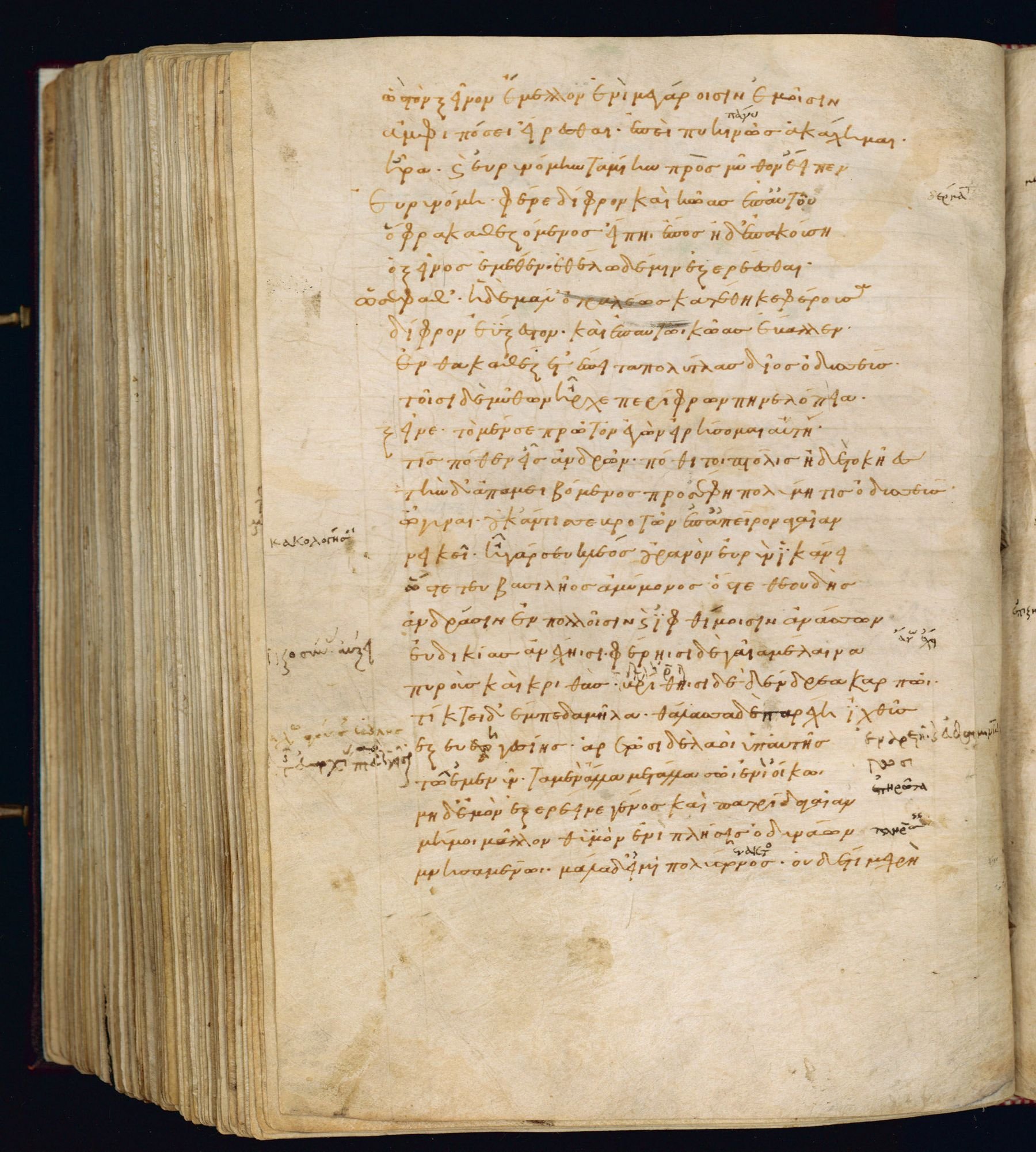
Where on the image
Laur. Plut. 32.24, fol. 187v: Odyssey 19.94-118, begins ‹ὡς τὸν ξεῖνον ἔμελλον›, ends ‹οὐδέ τί με χρὴ›. Checked on the image: first and last lines read and matched to the Greek. Fol. 187r ends with 19.93. Fol. 188r begins with 19.119. English blocks here: 95-99, 100-104, 105-109, 110-114, 115-119.
94ὡς τὸν ξεῖνον ἔμελλον ἐνὶ μεγάροισιν ἐμοῖσιν
95ἀμφὶ πόσει εἴρεσθαι, ἐπεὶ πυκινῶς ἀκάχημαι.
96ἦ ῥα καὶ Εὐρυνόμην ταμίην πρὸς μῦθον ἔειπεν·
97Εὐρυνόμη, φέρε δὴ δίφρον καὶ κῶας ἐπʼ αὐτοῦ,
98ὄφρα καθεζόμενος εἴπῃ ἔπος ἠδʼ ἐπακούσῃ
99ὁ ξεῖνος ἐμέθεν· ἐθέλω δέ μιν ἐξερέεσθαι.
100ὣς ἔφαθʼ, ἡ δὲ μάλʼ ὀτραλέως κατέθηκε φέρουσα
101δίφρον ἐΰξεστον καὶ ἐπʼ αὐτῷ κῶας ἔβαλλεν·
102ἔνθα καθέζετʼ ἔπειτα πολύτλας δῖος Ὀδυσσεύς.
103τοῖσι δὲ μύθων ἦρχε περίφρων Πηνελόπεια·
104ξεῖνε, τὸ μέν σε πρῶτον ἐγὼν εἰρήσομαι αὐτή·
105τίς πόθεν εἶς ἀνδρῶν; πόθι τοι πόλις ἠδὲ τοκῆες;
106τὴν δʼ ἀπαμειβόμενος προσέφη πολύμητις Ὀδυσσεύς·
107ὦ γύναι, οὐκ ἄν τίς σε βροτῶν ἐπʼ ἀπείρονα γαῖαν
108νεικέοι· ἦ γάρ σευ κλέος οὐρανὸν εὐρὺν ἱκάνει,
109ὥς τέ τευ ἢ βασιλῆος ἀμύμονος, ὅς τε θεουδὴς
110ἀνδράσιν ἐν πολλοῖσι καὶ ἰφθίμοισιν ἀνάσσων
111εὐδικίας ἀνέχῃσι, φέρῃσι δὲ γαῖα μέλαινα
112πυροὺς καὶ κριθάς, βρίθῃσι δὲ δένδρεα καρπῷ,
113τίκτῃ δʼ ἔμπεδα μῆλα, θάλασσα δὲ παρέχῃ ἰχθῦς
114ἐξ εὐηγεσίης, ἀρετῶσι δὲ λαοὶ ὑπʼ αὐτοῦ.
115τῷ ἐμὲ νῦν τὰ μὲν ἄλλα μετάλλα σῷ ἐνὶ οἴκῳ,
116μηδʼ ἐμὸν ἐξερέεινε γένος καὶ πατρίδα γαῖαν,
117μή μοι μᾶλλον θυμὸν ἐνιπλήσῃς ὀδυνάων
118μνησαμένῳ μάλα δʼ εἰμὶ πολύστονος· οὐδέ τί με χρὴ
95to question the stranger in my halls concerning my husband; for I am sore distressed.” With this she spoke also to the housewife Eurynome, and said: “Eurynome, bring hither a chair and a fleece upon it, that the stranger may sit down and tell his tale, and listen to me; for I am fain to ask him of all things.” 100So she spoke, and Eurynome speedily brought a polished chair and set it in place, and on it cast a fleece. Then the much-enduring, goodly Odysseus sat down upon it, and the wise Penelope spoke first, and said: “Stranger, this question will I myself ask thee first. 105Who art thou among men, and from whence? Where is thy city, and where thy parents?” Then Odysseus of many wiles answered her, and said: “Lady, no one of mortals upon the boundless earth could find fault with thee, for thy fame goes up to the broad heaven, as does the fame of some blameless king, who with the fear of the gods in his heart, 110is lord over many mighty men, upholding justice; and the black earth bears wheat and barley, and the trees are laden with fruit, the flocks bring forth young unceasingly, and the sea yields fish, all from his good leading; and the people prosper under him. 115Wherefore question me now in thy house of all things else, but ask not concerning my race and my native land, lest thou fill my heart the more with pains, as I think thereon; for I am a man of many sorrows. Moreover it is not fitting
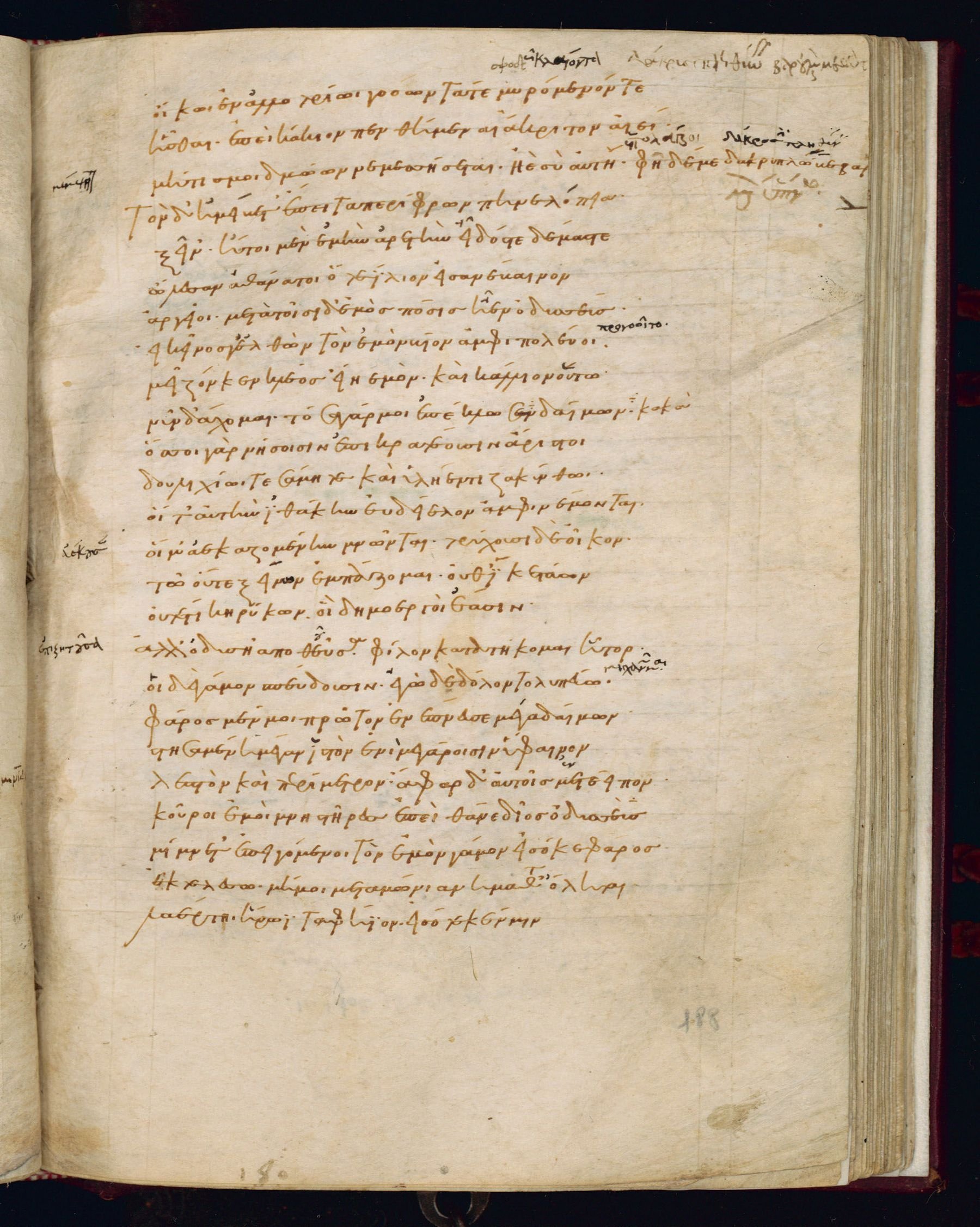
Where on the image
Laur. Plut. 32.24, fol. 188r: Odyssey 19.119-144, begins ‹οἴκῳ ἐν ἀλλοτρίῳ γοόωντά›, ends ‹εἰς ὅτε κέν μιν›. Checked on the image: first and last lines read and matched to the Greek. Fol. 187v ends with 19.118. Fol. 188v begins with 19.145. 19.122 is written after 19.121 at the end of the same line, running into the right margin (25 lines). English blocks here: 120-124, 125-129, 130-134, 135-139, 140-144.
119οἴκῳ ἐν ἀλλοτρίῳ γοόωντά τε μυρόμενόν τε
120ἧσθαι, ἐπεὶ κάκιον πενθήμεναι ἄκριτον αἰεί·
121μή τίς μοι δμῳῶν νεμεσήσεται, ἠὲ σύ γʼ αὐτή,
122φῇ δὲ δακρυπλώειν βεβαρηότα με φρένας οἴνῳ.
123τὸν δʼ ἠμείβετʼ ἔπειτα περίφρων Πηνελόπεια·
124ξεῖνʼ, ἦ τοι μὲν ἐμὴν ἀρετὴν εἶδός τε δέμας τε
125ὤλεσαν ἀθάνατοι, ὅτε Ἴλιον εἰσανέβαινον
126Ἀργεῖοι, μετὰ τοῖσι δʼ ἐμὸς πόσις ᾖεν Ὀδυσσεύς
127εἰ κεῖνός γʼ ἐλθὼν τὸν ἐμὸν βίον ἀμφιπολεύοι,
128μεῖζον κε κλέος εἴη ἐμὸν καὶ κάλλιον οὕτως.
129νῦν δʼ ἄχομαι· τόσα γάρ μοι ἐπέσσευεν κακὰ δαίμων.
130ὅσσοι γὰρ νήσοισιν ἐπικρατέουσιν ἄριστοι,
131Δουλιχίῳ τε Σάμῃ τε καὶ ὑλήεντι Ζακύνθῳ,
132οἵ τʼ αὐτὴν Ἰθάκην εὐδείελον ἀμφινέμονται,
133οἵ μʼ ἀεκαζομένην μνῶνται, τρύχουσι δὲ οἶκον.
134τῷ οὔτε ξείνων ἐμπάζομαι οὔθʼ ἱκετάων
135οὔτε τι κηρύκων, οἳ δημιοεργοὶ ἔασιν·
136ἀλλʼ Ὀδυσῆ ποθέουσα φίλον κατατήκομαι ἦτορ.
137οἱ δὲ γάμον σπεύδουσιν· ἐγὼ δὲ δόλους τολυπεύω.
138φᾶρος μέν μοι πρῶτον ἐνέπνευσε φρεσὶ δαίμων,
139στησαμένῃ μέγαν ἱστόν, ἐνὶ μεγάροισιν ὑφαίνειν,
140λεπτὸν καὶ περίμετρον· ἄφαρ δʼ αὐτοῖς μετέειπον·
141κοῦροι, ἐμοὶ μνηστῆρες, ἐπεὶ θάνε δῖος Ὀδυσσεύς,
142μίμνετʼ ἐπειγόμενοι τὸν ἐμὸν γάμον, εἰς ὅ κε φᾶρος
143ἐκτελέσω—μή μοι μεταμώνια νήματʼ ὄληται—
144Λαέρτῃ ἥρωϊ ταφήϊον, εἰς ὅτε κέν μιν
120that I should sit weeping and wailing in another's house, for it is ill to grieve ever without ceasing. I would not that one of thy maidens or thine own self be vexed with me, and say that I swim in tears because my mind is heavy with wine.” Then wise Penelope answered him: “Stranger, all excellence of mine, both of beauty and of form, 125the immortals destroyed on the day when the Argives embarked for Ilios, and with them went my husband, Odysseus. If he might but come, and watch over this life of mine, greater would be my fame and fairer. But now I am in sorrow, so many woes has some god brought upon me. 130For all the princes who hold sway over the islands—Dulichium and Same and wooded Zacynthus—and those who dwell around in clear-seen Ithaca itself, all these woo me against my will, and lay waste my house. Wherefore I pay no heed to strangers or to suppliants 135or in any wise to heralds, whose trade is a public one; but in longing for Odysseus I waste my heart away. So these men urge on my marriage, and I wind a skein of wiles. First some god breathed the thought in my heart to set up a great web in my halls and fall to weaving a robe— 140fine of thread was the web and very wide; and I straightway spoke among them: “‘Young men, my wooers, since goodly Odysseus is dead, be patient, though eager for my marriage, until I finish this robe—I would not that my spinning should come to naught—a shroud for the lord Laertes against the time when
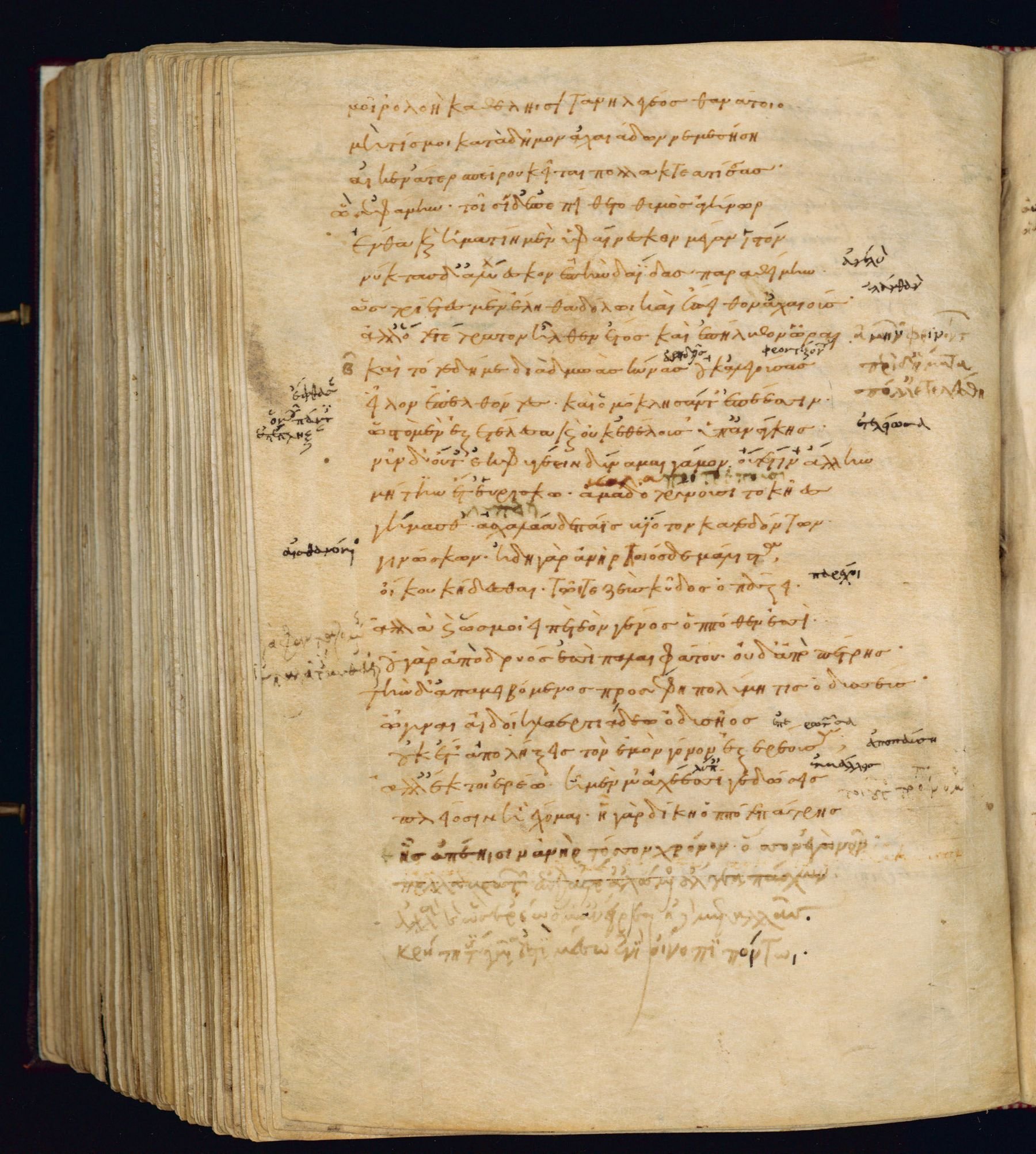
Where on the image
Laur. Plut. 32.24, fol. 188v: Odyssey 19.145-172, begins ‹μοῖρʼ ὀλοὴ καθέλῃσι τανηλεγέος›, ends ‹μέσῳ ἐνὶ οἴνοπι πόντῳ,›. Checked on the image: first and last lines read and matched to the Greek. Fol. 188r ends with 19.144. Fol. 189r begins with 19.173. 19.153 is not in the text column; it is written in the right margin beside 19.152. The last three verses, 19.170-172, are in much fainter ink at the foot of the page, and 19.170 has a stroke through it. English blocks here: 145-147, 148-149, 150-154, 155-159, 160-164, 165-169, 170-174.
145μοῖρʼ ὀλοὴ καθέλῃσι τανηλεγέος θανάτοιο·
146μή τίς μοι κατὰ δῆμον Ἀχαιϊάδων νεμεσήσῃ,
147αἴ κεν ἄτερ σπείρου κεῖται πολλὰ κτεατίσσας.
148ὣς ἐφάμην, τοῖσιν δʼ ἐπεπείθετο θυμὸς ἀγήνωρ.
149ἔνθα καὶ ἠματίη μὲν ὑφαίνεσκον μέγαν ἱστόν,
150νύκτας δʼ ἀλλύεσκον, ἐπεὶ δαΐδας παραθείμην.
151ὣς τρίετες μὲν ἔληθον ἐγὼ καὶ ἔπειθον Ἀχαιούς·
152ἀλλʼ ὅτε τέτρατον ἦλθεν ἔτος καὶ ἐπήλυθον ὧραι,
153μηνῶν φθινόντων, περὶ δʼ ἤματα πόλλʼ ἐτελέσθη,
154καὶ τότε δή με διὰ δμῳάς, κύνας οὐκ ἀλεγούσας,
155εἷλον ἐπελθόντες καὶ ὁμόκλησαν ἐπέεσσιν.
156ὣς τὸ μὲν ἐξετέλεσσα, καὶ οὐκ ἐθέλουσʼ, ὑπʼ ἀνάγκης·
157νῦν δʼ οὔτʼ ἐκφυγέειν δύναμαι γάμον οὔτε τινʼ ἄλλην
158μῆτιν ἔθʼ εὑρίσκω· μάλα δʼ ὀτρύνουσι τοκῆες
159γήμασθʼ, ἀσχαλάᾳ δὲ πάϊς βίοτον κατεδόντων,
160γιγνώσκων· ἤδη γὰρ ἀνὴρ οἷός τε μάλιστα
161οἴκου κήδεσθαι, τῷ τε Ζεὺς κῦδος ὀπάζει.
162ἀλλὰ καὶ ὥς μοι εἰπὲ τεὸν γένος, ὁππόθεν ἐσσί.
163οὐ γὰρ ἀπὸ δρυός ἐσσι παλαιφάτου οὐδʼ ἀπὸ πέτρης.
164τὴν δʼ ἀπαμειβόμενος προσέφη πολύμητις Ὀδυσσεύς·
165ὦ γύναι αἰδοίη Λαερτιάδεω Ὀδυσῆος,
166οὐκέτʼ ἀπολλήξεις τὸν ἐμὸν γόνον ἐξερέουσα;
167ἀλλʼ ἔκ τοι ἐρέω· ἦ μέν μʼ ἀχέεσσί γε δώσεις
168πλείοσιν ἢ ἔχομαι· ἡ γὰρ δίκη, ὁππότε πάτρης
169ἧς ἀπέῃσιν ἀνὴρ τόσσον χρόνον ὅσσον ἐγὼ νῦν,
170πολλὰ βροτῶν ἐπὶ ἄστεʼ ἀλώμενος, ἄλγεα πάσχων·
171ἀλλὰ καὶ ὣς ἐρέω ὅ μʼ ἀνείρεαι ἠδὲ μεταλλᾷς.
172Κρήτη τις γαῖʼ ἔστι, μέσῳ ἐνὶ οἴνοπι πόντῳ,
145the fell fate of grievous death shall strike him down; lest any one of the Achaean women in the land should be wroth with me, if he were to lie without a shroud, who had won great possessions.’ 148“So I spoke, and their proud hearts consented. Then day by day I would weave at the great web, 150but by night would unravel it, when I had let place torches by me. Thus for three years I kept the Achaeans from knowing, and beguiled them; but when the fourth year came, as the seasons rolled on, as the months waned, and the many days were brought in their course, then verily by the help of my maidens, shameless creatures and reckless, 155they came upon me and caught me, and upbraided me loudly. So I finished the web against my will perforce. And now I can neither escape the marriage nor devise any counsel more, and my parents are pressing me to marry, and my son frets, while these men devour his livelihood, 160as he takes note of it all; for by now he is a man, and fully able to care for a household to which Zeus grants honor. Yet even so tell me of thy stock from whence thou art; for thou art not sprung from an oak of ancient story, or from a stone.” Then Odysseus of many wiles answered her, and said: 165“Honored wife of Odysseus, son of Laertes, wilt thou never cease to ask me of my lineage? Well, I will tell thee; though verily thou wilt give me over to pains yet more than those by which I am now held in thrall; for so it ever is, when a man has been far from his country as long as I have now, 170wandering through the many cities of men in sore distress. Yet even so will I tell thee what thou dost ask and enquire. There is a land called Crete, in the midst of the wine-dark sea, a fair, rich land, begirt with water, and therein are many men, past counting, and ninety cities.
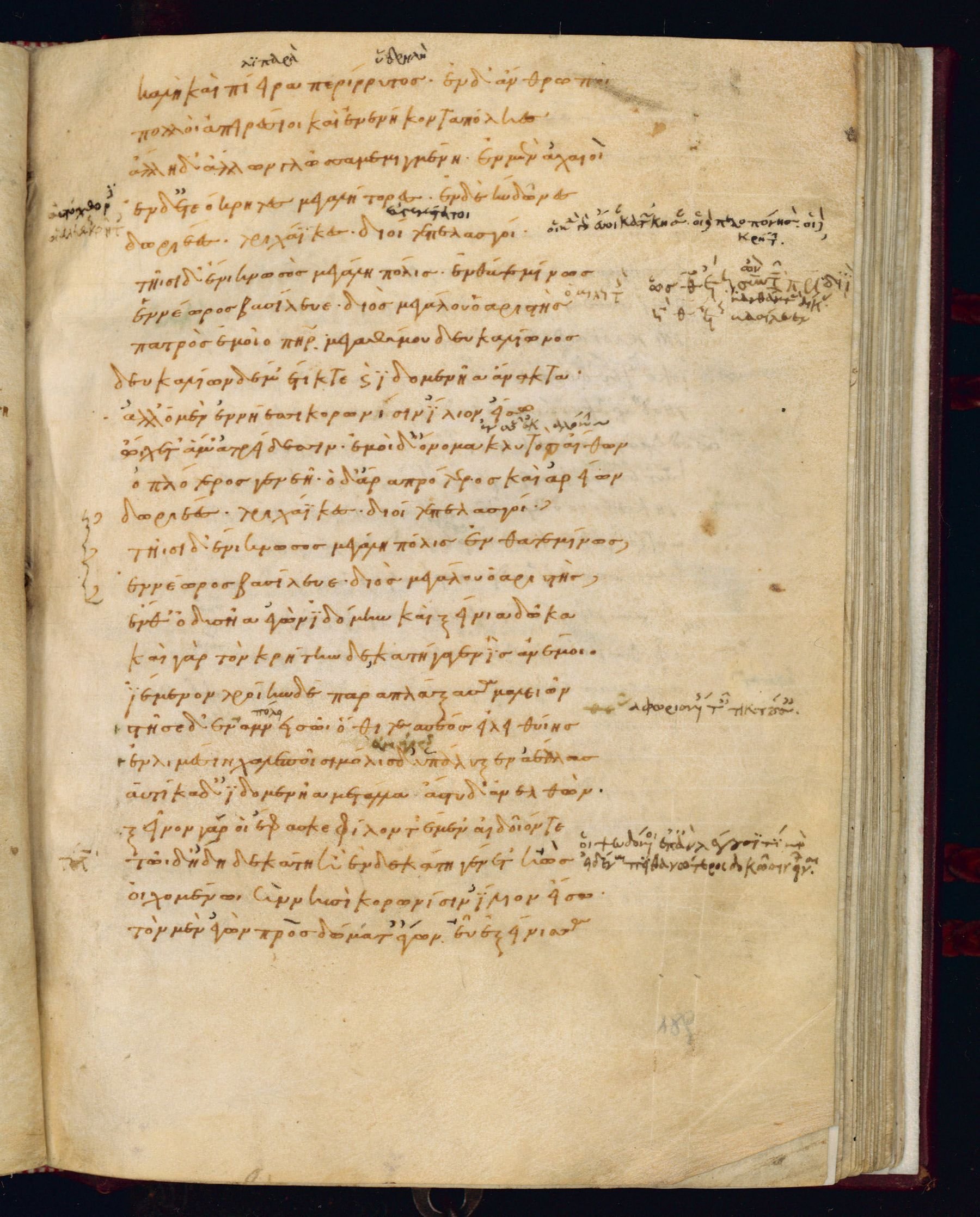
Where on the image
Laur. Plut. 32.24, fol. 189r: Odyssey 19.173-194, begins ‹καλὴ καὶ πίειρα, περίρρυτος·›, ends ‹δώματʼ ἄγων ἐῢ ἐξείνισσα,›. Checked on the image: first and last lines read and matched to the Greek. Fol. 188v ends with 19.172. Fol. 189v begins with 19.195. 19.177-179 are written twice: after 19.184 the scribe repeats them, and the repeated lines are marked with signs in the left margin (25 lines for 22 verses). English blocks here: 175-179, 180-184, 185-189, 190-194.
173καλὴ καὶ πίειρα, περίρρυτος· ἐν δʼ ἄνθρωποι
174πολλοί, ἀπειρέσιοι, καὶ ἐννήκοντα πόληες.
175ἄλλη δʼ ἄλλων γλῶσσα μεμιγμένη· ἐν μὲν Ἀχαιοί,
176ἐν δʼ Ἐτεόκρητες μεγαλήτορες, ἐν δὲ Κύδωνες,
177Δωριέες τε τριχάϊκες δῖοί τε Πελασγοί.
178τῇσι δʼ ἐνὶ Κνωσός, μεγάλη πόλις, ἔνθα τε Μίνως
179ἐννέωρος βασίλευε Διὸς μεγάλου ὀαριστής,
180πατρὸς ἐμοῖο πατήρ, μεγαθύμου Δευκαλίωνος
181Δευκαλίων δʼ ἐμὲ τίκτε καὶ Ἰδομενῆα ἄνακτα·
182ἀλλʼ ὁ μὲν ἐν νήεσσι κορωνίσιν Ἴλιον εἴσω
183ᾤχεθʼ ἅμʼ Ἀτρείδῃσιν, ἐμοὶ δʼ ὄνομα κλυτὸν Αἴθων,
184ὁπλότερος γενεῇ· ὁ δʼ ἄρα πρότερος καὶ ἀρείων.
185ἔνθʼ Ὀδυσῆα ἐγὼν ἰδόμην καὶ ξείνια δῶκα.
186καὶ γὰρ τὸν Κρήτηνδε κατήγαγεν ἲς ἀνέμοιο,
187ἱέμενον Τροίηνδε παραπλάγξασα Μαλειῶν·
188στῆσε δʼ ἐν Ἀμνισῷ, ὅθι τε σπέος Εἰλειθυίης,
189ἐν λιμέσιν χαλεποῖσι, μόγις δʼ ὑπάλυξεν ἀέλλας.
190αὐτίκα δʼ Ἰδομενῆα μετάλλα ἄστυδʼ ἀνελθών·
191ξεῖνον γάρ οἱ ἔφασκε φίλον τʼ ἔμεν αἰδοῖόν τε.
192τῷ δʼ ἤδη δεκάτη ἢ ἑνδεκάτη πέλεν ἠὼς
193οἰχομένῳ σὺν νηυσὶ κορωνίσιν Ἴλιον εἴσω.
194τὸν μὲν ἐγὼ πρὸς δώματʼ ἄγων ἐῢ ἐξείνισσα,
175They have not all the same speech, but their tongues are mixed. There dwell Achaeans, there great-hearted native Cretans, there Cydonians, and Dorians of waving plumes, and goodly Pelasgians. Among their cities is the great city Cnosus, where Minos reigned when nine years old, he that held converse with great Zeus, 180and was father of my father, great-hearted Deucalion. Now Deucalion begat me and prince Idomeneus. Idomeneus had gone forth in his beaked ships to Ilios with the sons of Atreus; but my famous name is Aethon; I was the younger by birth, while he was the elder and the better man. 185There it was that I saw Odysseus and gave him gifts of entertainment; for the force of the wind had brought him too to Crete, as he was making for the land of Troy, and drove him out of his course past Malea. So he anchored his ships at Amnisus, where is the cave of Eilithyia, in a difficult harbor, and hardly did he escape the storm. 190Then straightway he went up to the city and asked for Idomeneus; for he declared that he was his friend, beloved and honored. But it was now the tenth or the eleventh dawn since Idomeneus had gone in his beaked ships to Ilios. So I took him to the house, and gave him entertainment
Where on the image
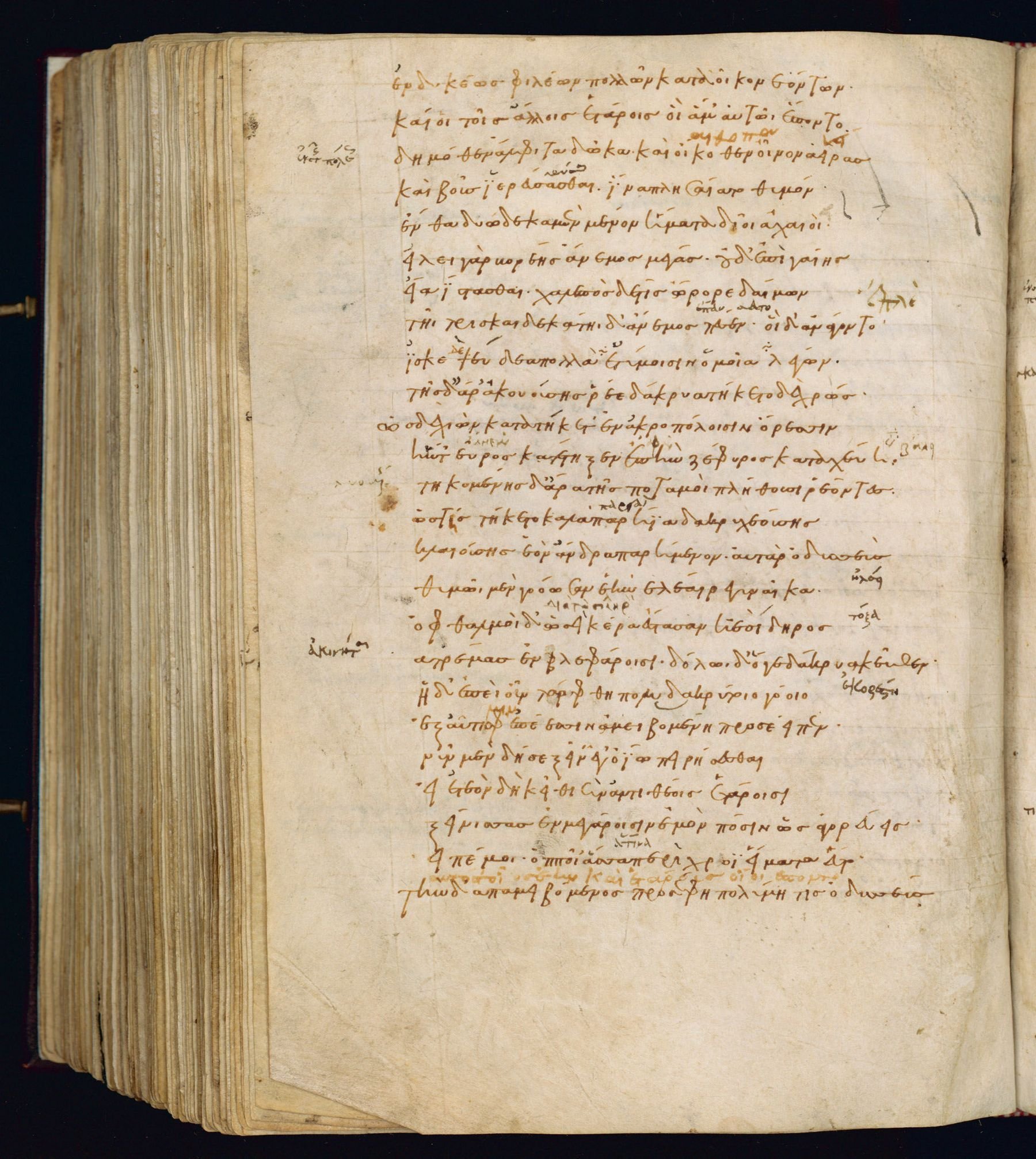
Laur. Plut. 32.24, fol. 189v: Odyssey 19.195-220, begins ‹ἐνδυκέως φιλέων, πολλῶν κατὰ›, ends ‹ἀπαμειβόμενος προσέφη πολύμητις Ὀδυσσεύς·›. Checked on the image: first and last lines read and matched to the Greek. Fol. 189r ends with 19.194. Fol. 190r begins with 19.221. 19.219 is written in smaller, fainter letters squeezed in between 19.218 and 19.220. English blocks here: 195-199, 200-204, 205-209, 210-214, 215-219.
195ἐνδυκέως φιλέων, πολλῶν κατὰ οἶκον ἐόντων·
196καί οἱ τοῖς ἄλλοις ἑτάροις, οἳ ἅμʼ αὐτῷ ἕποντο,
197δημόθεν ἄλφιτα δῶκα καὶ αἴθοπα οἶνον ἀγείρας
198καὶ βοῦς ἱρεύσασθαι, ἵνα πλησαίατο θυμόν.
199ἔνθα δυώδεκα μὲν μένον ἤματα δῖοι Ἀχαιοί·
200εἴλει γὰρ Βορέης ἄνεμος μέγας οὐδʼ ἐπὶ γαίῃ
201εἴα ἵστασθαι, χαλεπὸς δέ τις ὤρορε δαίμων.
202τῇ τρισκαιδεκάτῃ δʼ ἄνεμος πέσε, τοὶ δʼ ἀνάγοντο.
203ἴσκε ψεύδεα πολλὰ λέγων ἐτύμοισιν ὁμοῖα·
204τῆς δʼ ἄρʼ ἀκουούσης ῥέε δάκρυα, τήκετο δὲ χρώς·
205ὡς δὲ χιὼν κατατήκετʼ ἐν ἀκροπόλοισιν ὄρεσσιν,
206ἥν τʼ Εὖρος κατέτηξεν, ἐπὴν Ζέφυρος καταχεύῃ·
207τηκομένης δʼ ἄρα τῆς ποταμοὶ πλήθουσι ῥέοντες·
208ὣς τῆς τήκετο καλὰ παρήϊα δάκρυ χεούσης,
209κλαιούσης ἑὸν ἄνδρα παρήμενον. αὐτὰρ Ὀδυσσεὺς
210θυμῷ μὲν γοόωσαν ἑὴν ἐλέαιρε γυναῖκα,
211ὀφθαλμοὶ δʼ ὡς εἰ κέρα ἕστασαν ἠὲ σίδηρος
212ἀτρέμας ἐν βλεφάροισι· δόλῳ δʼ ὅ γε δάκρυα κεῦθεν.
213ἡ δʼ ἐπεὶ οὖν τάρφθη πολυδακρύτοιο γόοιο,
214ἐξαῦτίς μιν ἔπεσσιν ἀμειβομένη προσέειπε·
215νῦν μὲν δή σευ, ξεῖνέ γʼ, ὀΐω πειρήσεσθαι,
216εἰ ἐτεὸν δὴ κεῖθι σὺν ἀντιθέοις ἑτάροισι
217ξείνισας ἐν μεγάροισιν ἐμὸν πόσιν, ὡς ἀγορεύεις.
218εἰπέ μοι ὁπποῖʼ ἄσσα περὶ χροῒ εἵματα ἕστο,
219αὐτός θʼ οἷος ἔην, καὶ ἑταίρους, οἵ οἱ ἕποντο.
220τὴν δʼ ἀπαμειβόμενος προσέφη πολύμητις Ὀδυσσεύς·
195with kindly welcome of the rich store that was in the house, and to the rest of his comrades who followed with him I gathered and gave out of the public store barley meal and flaming wine and bulls for sacrifice, that their hearts might be satisfied. There for twelve days the goodly Achaeans tarried, 200for the strong North Wind penned them there, and would not suffer them to stand upon their feet on the land, for some angry god had roused it. But on the thirteenth day the wind fell and they put to sea.” He spoke, and made the many falsehoods of his tale seem like the truth, and as she listened her tears flowed and her face melted 205as the snow melts on the lofty mountains, the snow which the East Wind thaws when the West Wind has strewn it, and as it melts the streams of the rivers flow full: so her fair cheeks melted as she wept and mourned for her husband, who even then was sitting by her side. And Odysseus 210in his heart had pity for his weeping wife, but his eyes stood fixed between his lids as though they were horn or iron, and with guile he hid his tears. But she, when she had had her fill of tearful wailing, again answered him and spoke, saying: 215“Now verily, stranger, am I minded to put thee to the test, whether or no thou didst in very truth entertain there in thy halls my husband with his godlike comrades, even as thou sayest. Tell me what manner of raiment he wore about his body, and what manner of man he was himself; and tell me of the comrades who followed him.”
Where on the image
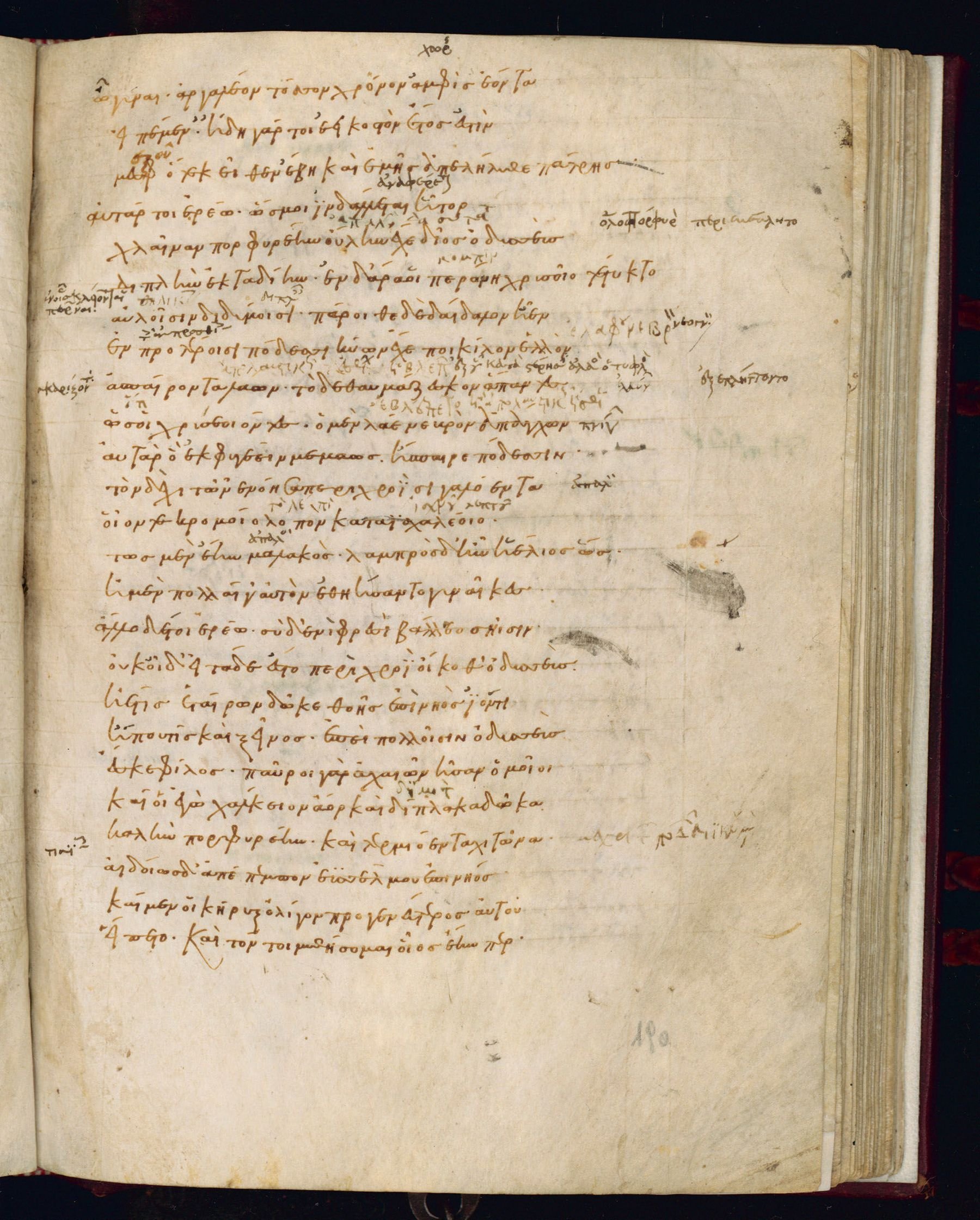
Laur. Plut. 32.24, fol. 190r: Odyssey 19.221-245, begins ‹ὦ γύναι, ἀργαλέον τόσσον›, ends ‹μυθήσομαι, οἷος ἔην περ.›. Checked on the image: first and last lines read and matched to the Greek. Fol. 189v ends with 19.220. Fol. 190v begins with 19.246. English blocks here: 220-224, 225-229, 230-234, 235-239, 240-240, 241-244.
221ὦ γύναι, ἀργαλέον τόσσον χρόνον ἀμφὶς ἐόντα
222εἰπέμεν· ἤδη γάρ οἱ ἐεικοστὸν ἔτος ἐστὶν
223ἐξ οὗ κεῖθεν ἔβη καὶ ἐμῆς ἀπελήλυθε πάτρης·
224αὐτάρ τοι ἐρέω ὥς μοι ἰνδάλλεται ἦτορ.
225χλαῖναν πορφυρέην οὔλην ἔχε δῖος Ὀδυσσεύς,
226διπλῆν· αὐτάρ οἱ περόνη χρυσοῖο τέτυκτο
227αὐλοῖσιν διδύμοισι· πάροιθε δὲ δαίδαλον ἦεν·
228ἐν προτέροισι πόδεσσι κύων ἔχε ποικίλον ἐλλόν,
229ἀσπαίροντα λάων· τὸ δὲ θαυμάζεσκον ἅπαντες,
230ὡς οἱ χρύσεοι ἐόντες ὁ μὲν λάε νεβρὸν ἀπάγχων,
231αὐτὰρ ὁ ἐκφυγέειν μεμαὼς ἤσπαιρε πόδεσσι.
232τὸν δὲ χιτῶνʼ ἐνόησα περὶ χροῒ σιγαλόεντα,
233οἷόν τε κρομύοιο λοπὸν κάτα ἰσχαλέοιο·
234τὼς μὲν ἔην μαλακός, λαμπρὸς δʼ ἦν ἠέλιος ὥς·
235ἦ μὲν πολλαί γʼ αὐτὸν ἐθηήσαντο γυναῖκες.
236ἄλλο δέ τοι ἐρέω, σὺ δʼ ἐνὶ φρεσὶ βάλλεο σῇσιν·
237οὐκ οἶδʼ ἢ τάδε ἕστο περὶ χροῒ οἴκοθʼ Ὀδυσσεύς,
238ἦ τις ἑταίρων δῶκε θοῆς ἐπὶ νηὸς ἰόντι,
239ἤ τίς που καὶ ξεῖνος, ἐπεὶ πολλοῖσιν Ὀδυσσεὺς
240ἔσκε φίλος· παῦροι γὰρ Ἀχαιῶν ἦσαν ὁμοῖοι.
241καί οἱ ἐγὼ χάλκειον ἄορ καὶ δίπλακα δῶκα
242καλὴν πορφυρέην καὶ τερμιόεντα χιτῶνα,
243αἰδοίως δʼ ἀπέπεμπον ἐϋσσέλμου ἐπὶ νηός.
244καὶ μέν οἱ κῆρυξ ὀλίγον προγενέστερος αὐτοῦ
245εἵπετο· καὶ τόν τοι μυθήσομαι, οἷος ἔην περ.
220Then Odysseus of many wiles answered her, and said: “Lady, hard is it for one that has been so long afar to tell thee this, for it is now the twentieth year since he went thence and departed from my country. But I will tell thee as my mind pictures him. 225A fleecy cloak of purple did goodly Odysseus wear, a cloak of double fold, but the brooch upon it was fashioned of gold with double clasps, and on the front it was curiously wrought: a hound held in his fore paws a dappled fawn, and pinned it in his jaws as it writhed. And at this all men marvelled, 230how, though they were of gold, the hound was pinning the fawn and strangling it, and the fawn was writhing with its feet and striving to flee. And I noted the tunic about his body, all shining as is the sheen upon the skin of a dried onion, so soft it was; and it glistened like the sun. 235Verily many women gazed at him in wonder. And another thing will I tell thee, and do thou lay it to heart. I know not whether Odysseus was thus clothed at home, or whether one of his comrades gave him the raiment when he went on board the swift ship, or haply even some stranger, since to many men 240was Odysseus dear, for few of the Achaeans were his peers. 241I, too, gave him a sword of bronze, and a fair purple cloak of double fold, and a fringed tunic, and with all honor sent him forth on his benched ship. Furthermore, a herald
Where on the image
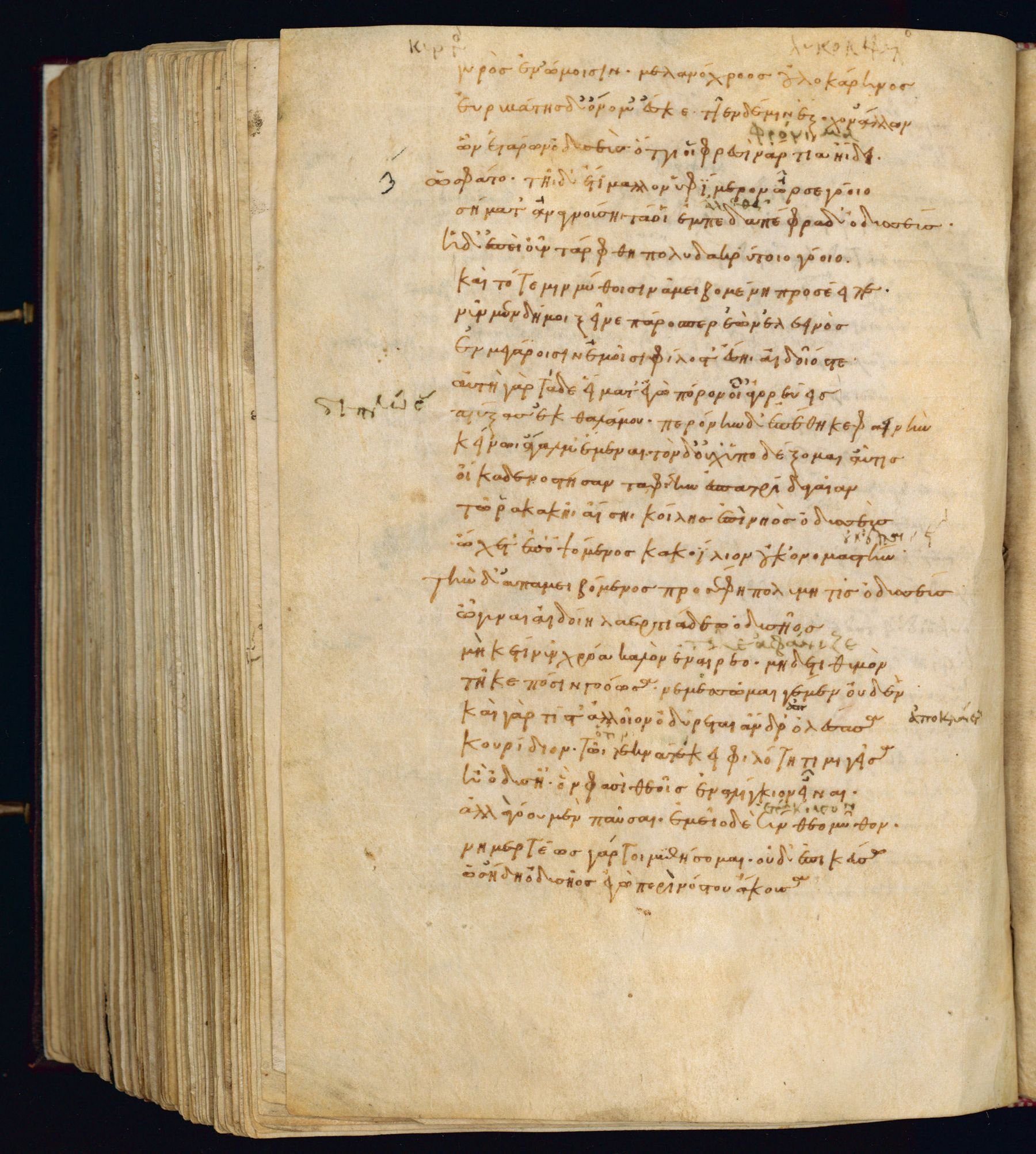
Laur. Plut. 32.24, fol. 190v: Odyssey 19.246-270, begins ‹γυρὸς ἐν ὤμοισιν, μελανόχροος,›, ends ‹ἐγὼ περὶ νόστου ἄκουσα›. Checked on the image: first and last lines read and matched to the Greek. Fol. 190r ends with 19.245. Fol. 191r begins with 19.271. English blocks here: 245-249, 250-254, 255-259, 260-264, 265-269.
246γυρὸς ἐν ὤμοισιν, μελανόχροος, οὐλοκάρηνος,
247Εὐρυβάτης δʼ ὄνομʼ ἔσκε· τίεν δέ μιν ἔξοχον ἄλλων
248ὧν ἑτάρων Ὀδυσεύς, ὅτι οἱ φρεσὶν ἄρτια ᾔδη.
249ὣς φάτο, τῇ δʼ ἔτι μᾶλλον ὑφʼ ἵμερον ὦρσε γόοιο,
250σήματʼ ἀναγνούσῃ τά οἱ ἔμπεδα πέφραδʼ Ὀδυσσεύς.
251ἡ δʼ ἐπεὶ οὖν τάρφθη πολυδακρύτοιο γόοιο.
252καὶ τότε μιν μύθοισιν ἀμειβομένη προσέειπε·
253νῦν μὲν δή μοι, ξεῖνε, πάρος περ ἐὼν ἐλεεινός,
254ἐν μεγάροισιν ἐμοῖσι φίλος τʼ ἔσῃ αἰδοῖός τε·
255αὐτὴ γὰρ τάδε εἵματʼ ἐγὼ πόρον, οἷʼ ἀγορεύεις,
256πτύξασʼ ἐκ θαλάμου, περόνην τʼ ἐπέθηκα φαεινὴν
257κείνῳ ἄγαλμʼ ἔμεναι· τὸν δʼ οὐχ ὑποδέξομαι αὖτις
258οἴκαδε νοστήσαντα φίλην ἐς πατρίδα γαῖαν.
259τῷ ῥα κακῇ αἴσῃ κοίλης ἐπὶ νηὸς Ὀδυσσεὺς
260ᾤχετʼ ἐποψόμενος Κακοΐλιον οὐκ ὀνομαστήν.
261τὴν δʼ ἀπαμειβόμενος προσέφη πολύμητις Ὀδυσσεύς·
262ὦ γύναι αἰδοίη Λαερτιάδεω Ὀδυσῆος,
263μηκέτι νῦν χρόα καλὸν ἐναίρεο, μηδέ τι θυμὸν
264τῆκε, πόσιν γοόωσα. νεμεσσῶμαί γε μὲν οὐδέν·
265καὶ γάρ τίς τʼ ἀλλοῖον ὀδύρεται ἄνδρʼ ὀλέσασα
266κουρίδιον, τῷ τέκνα τέκῃ φιλότητι μιγεῖσα,
267ἢ Ὀδυσῆʼ, ὅν φασι θεοῖς ἐναλίγκιον εἶναι.
268ἀλλὰ γόου μὲν παῦσαι, ἐμεῖο δὲ σύνθεο μῦθον·
269νημερτέως γάρ τοι μυθήσομαι οὐδʼ ἐπικεύσω
270ὡς ἤδη Ὀδυσῆος ἐγὼ περὶ νόστου ἄκουσα
245attended him, a little older than he, and I will tell thee of him too, what manner of man he was. He was round-shouldered, dark of skin, and curly-haired, and his name was Eurybates; and Odysseus honored him above his other comrades, because he was like-minded with himself.” So he spoke, and in her heart aroused yet more the desire of weeping, 250as she recognized the sure tokens that Odysseus told her. But she, when she had had her fill of tearful wailing, made answer and said to him: “Now verily, stranger, though before thou wast pitied, shalt thou be dear and honored in my halls, 255for it was I that gave him this raiment, since thou describest it thus, and folded it, and brought it forth from the store-room, and added thereto the shining brooch to be a thing of joy to him. But my husband I shall never welcome back, returning home to his dear native land. Wherefore it was with an evil fate that Odysseus 260went forth in the hollow ship to see evil Ilios, that should never be named.” Then Odysseus of many wiles answered her, and said: “Honored wife of Odysseus, son of Laertes, mar not now thy fair face any more, nor waste thy heart at all in weeping for thy husband. I count it indeed no blame in thee; 265for any woman weeps when she has lost her wedded husband, to whom she has borne children in her love, though he were far other than Odysseus, who, they say, is like unto the gods. Yet do thou cease from weeping, and hearken to my words; for I will tell thee with sure truth, and will hide nothing,
Where on the image
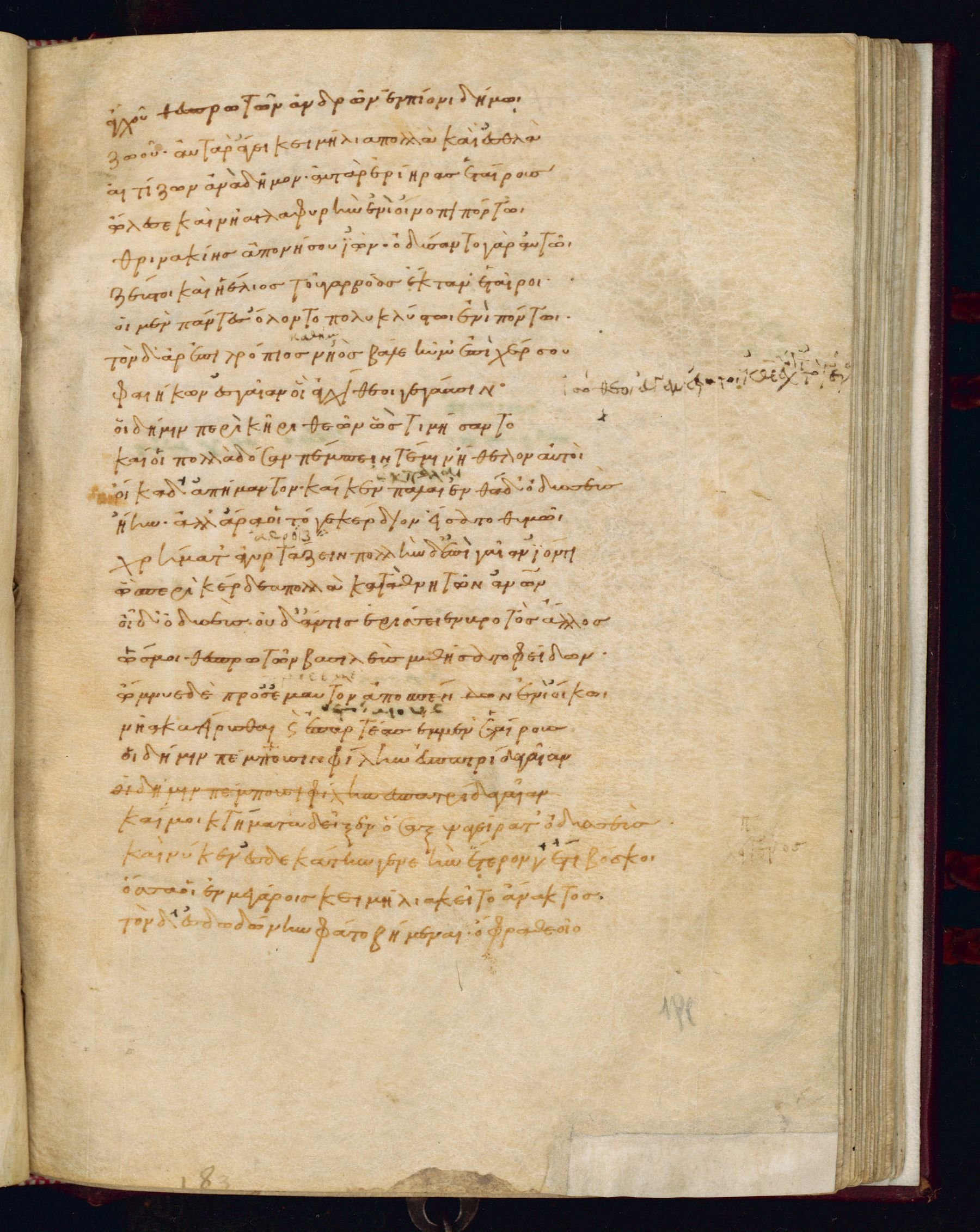
Laur. Plut. 32.24, fol. 191r: Odyssey 19.271-296, begins ‹ἀγχοῦ, Θεσπρωτῶν ἀνδρῶν ἐν›, ends ‹φάτο βήμεναι, ὄφρα θεοῖο›. Checked on the image: first and last lines read and matched to the Greek. Fol. 190v ends with 19.270. Fol. 191v begins with 19.297. 19.290 is written twice and the repeat is struck through; 19.291-292 (ἀλλʼ ἐμὲ πρὶν ἀπέπεμψε ... and ἀνδρῶν Θεσπρωτῶν ἐς Δουλίχιον ...) are not on the page: the scribe passes from 19.290 to 19.293. English blocks here: 270-274, 275-276, 277-279, 280-284, 285-289, 290-294.
271ἀγχοῦ, Θεσπρωτῶν ἀνδρῶν ἐν πίονι δήμῳ,
272ζωοῦ· αὐτὰρ ἄγει κειμήλια πολλὰ καὶ ἐσθλὰ
273αἰτίζων ἀνὰ δῆμον. ἀτὰρ ἐρίηρας ἑταίρους
274ὤλεσε καὶ νῆα γλαφυρὴν ἐνὶ οἴνοπι πόντῳ,
275Θρινακίης ἄπο νήσου ἰών· ὀδύσαντο γὰρ αὐτῷ
276Ζεύς τε καὶ Ἠέλιος· τοῦ γὰρ βόας ἔκταν ἑταῖροι.
277οἱ μὲν πάντες ὄλοντο πολυκλύστῳ ἐνὶ πόντῳ·
278τὸν δʼ ἄρʼ ἐπὶ τρόπιος νεὸς ἔκβαλε κῦμʼ ἐπὶ χέρσου,
279Φαιήκων ἐς γαῖαν, οἳ ἀγχίθεοι γεγάασιν,
280οἳ δή μιν περὶ κῆρι θεὸν ὣς τιμήσαντο
281καί οἱ πολλὰ δόσαν πέμπειν τέ μιν ἤθελον αὐτοὶ
282οἴκαδʼ ἀπήμαντον. καί κεν πάλαι ἐνθάδʼ Ὀδυσσεὺς
283ἤην· ἀλλʼ ἄρα οἱ τό γε κέρδιον εἴσατο θυμῷ,
284χρήματʼ ἀγυρτάζειν πολλὴν ἐπὶ γαῖαν ἰόντι·
285ὣς περὶ κέρδεα πολλὰ καταθνητῶν ἀνθρώπων
286οἶδʼ Ὀδυσεύς, οὐδʼ ἄν τις ἐρίσσειε βροτὸς ἄλλος.
287ὥς μοι Θεσπρωτῶν βασιλεὺς μυθήσατο Φείδων·
288ὤμνυε δὲ πρὸς ἔμʼ αὐτόν, ἀποσπένδων ἐνὶ οἴκῳ,
289νῆα κατειρύσθαι καὶ ἐπαρτέας ἔμμεν ἑταίρους,
290οἳ δή μιν πέμψουσι φίλην ἐς πατρίδα γαῖαν.
291ἀλλʼ ἐμὲ πρὶν ἀπέπεμψε· τύχησε γὰρ ἐρχομένη νηῦς
292ἀνδρῶν Θεσπρωτῶν ἐς Δουλίχιον πολύπυρον.
293καί μοι κτήματʼ ἔδειξεν, ὅσα ξυναγείρατʼ Ὀδυσσεύς·
294καί νύ κεν ἐς δεκάτην γενεὴν ἕτερόν γʼ ἔτι βόσκοι,
295ὅσσα οἱ ἐν μεγάροις κειμήλια κεῖτο ἄνακτος.
296τὸν δʼ ἐς Δωδώνην φάτο βήμεναι, ὄφρα θεοῖο
270how but lately I heard of the return of Odysseus, that he is near at hand in the rich land of the Thesprotians, and yet alive, and he is bringing with him many rich treasures, as he begs through the land. But he lost his trusty comrades and his hollow ship on the wine-dark sea, 275as he journeyed from the isle Thrinacia; for Zeus and Helios waxed wroth against him because his comrades had slain the kine of Helios. 277So they all perished in the surging sea, but he on the keel of his ship was cast forth by the wave on the shore, on the land of the Phaeacians, who are near of kin to the gods. 280These heartily showed him all honor, as if he were a god, and gave him many gifts, and were fain themselves to send him home unscathed. Yea, and Odysseus would long since have been here, only it seemed to his mind more profitable to gather wealth by roaming over the wide earth; 285so truly does Odysseus beyond all mortal men know many gainful ways, nor could any mortal beside vie with him. Thus Pheidon, king of the Thesprotians, told me the tale. Moreover he swore in my own presence, as he poured libations in his halls, that the ship was launched and the men ready 290who were to convey him to his dear native land. But me he sent forth first, for a ship of the Thesprotians chanced to be setting out for Dulichium, rich in wheat. And he showed me all the treasure that Odysseus had gathered; verily unto the tenth generation would it feed his children after him,
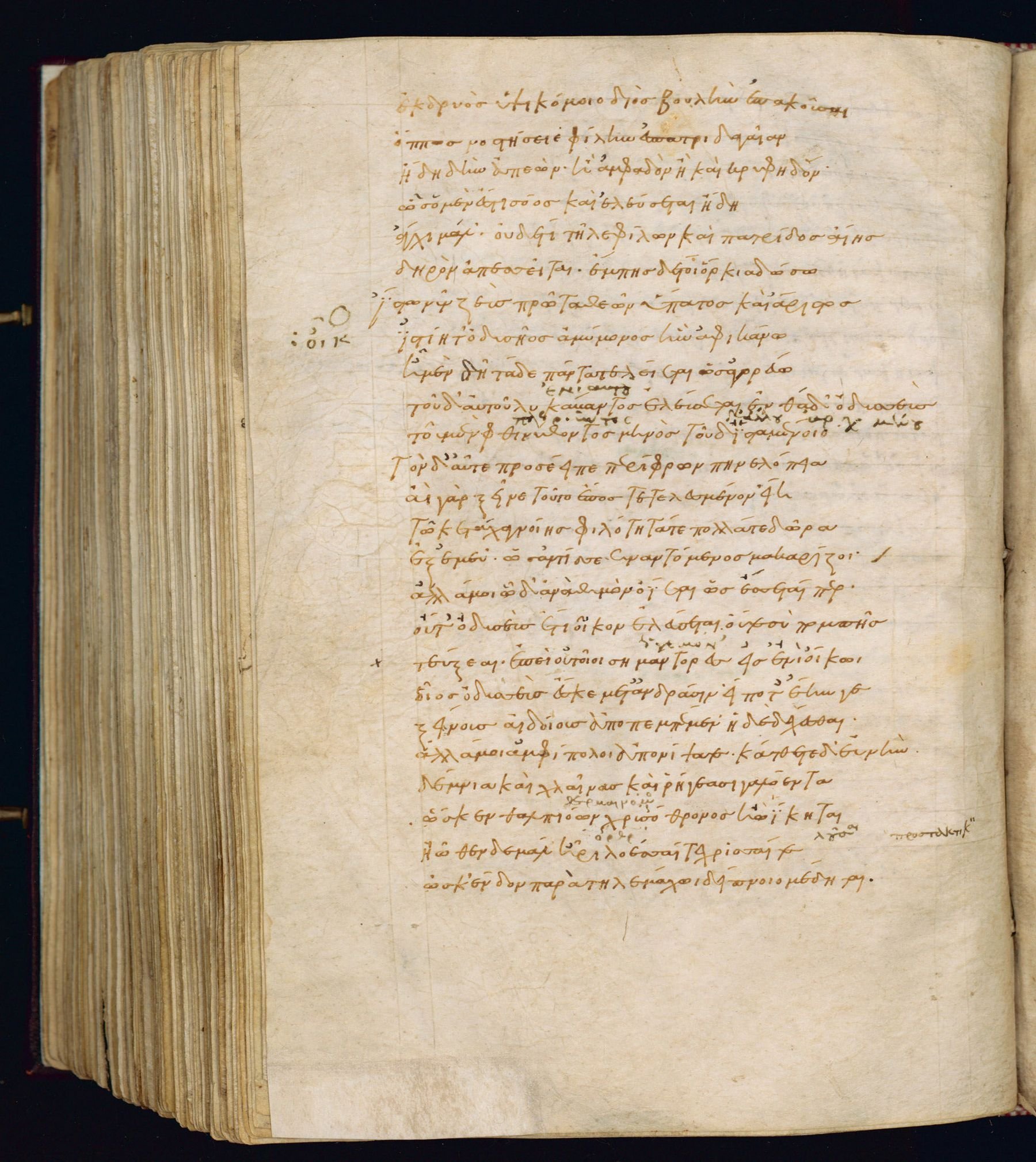
Where on the image
Laur. Plut. 32.24, fol. 191v: Odyssey 19.297-321, begins ‹ἐκ δρυὸς ὑψικόμοιο Διὸς›, ends ‹παρὰ Τηλεμάχῳ δείπνοιο μέδηται›. Checked on the image: first and last lines read and matched to the Greek. Fol. 191r ends with 19.296. Fol. 192r begins with 19.322. English blocks here: 295-299, 300-304, 305-309, 310-314, 315-316, 317-319.
297ἐκ δρυὸς ὑψικόμοιο Διὸς βουλὴν ἐπακούσαι,
298ὅππως νοστήσειε φίλην ἐς πατρίδα γαῖαν
299ἤδη δὴν ἀπεών, ἢ ἀμφαδὸν ἦε κρυφηδόν.
300ὣς ὁ μὲν οὕτως ἐστὶ σόος καὶ ἐλεύσεται ἤδη
301ἄγχι μάλʼ, οὐδʼ ἔτι τῆλε φίλων καὶ πατρίδος αἴης
302δηρὸν ἀπεσσεῖται· ἔμπης δέ τοι ὅρκια δώσω.
303ἴστω νῦν Ζεὺς πρῶτα, θεῶν ὕπατος καὶ ἄριστος,
304ἱστίη τʼ Ὀδυσῆος ἀμύμονος, ἣν ἀφικάνω·
305ἦ μέν τοι τάδε πάντα τελείεται ὡς ἀγορεύω.
306τοῦδʼ αὐτοῦ λυκάβαντος ἐλεύσεται ἐνθάδʼ Ὀδυσσεύς,
307τοῦ μὲν φθίνοντος μηνός, τοῦ δʼ ἱσταμένοιο.
308τὸν δʼ αὖτε προσέειπε περίφρων Πηνελόπεια·
309αἲ γὰρ τοῦτο, ξεῖνε, ἔπος τετελεσμένον εἴη·
310τῷ κε τάχα γνοίης φιλότητά τε πολλά τε δῶρα
311ἐξ ἐμεῦ, ὡς ἄν τίς σε συναντόμενος μακαρίζοι.
312ἀλλά μοι ὧδʼ ἀνὰ θυμὸν ὀΐεται, ὡς ἔσεταί περ·
313οὔτʼ Ὀδυσεὺς ἔτι οἶκον ἐλεύσεται, οὔτε σὺ πομπῆς
314τεύξῃ, ἐπεὶ οὐ τοῖοι σημάντορές εἰσʼ ἐνὶ οἴκῳ
315οἷος Ὀδυσσεὺς ἔσκε μετʼ ἀνδράσιν, εἴ ποτʼ ἔην γε,
316ξείνους αἰδοίους ἀποπεμπέμεν ἠδὲ δέχεσθαι.
317ἀλλά μιν, ἀμφίπολοι, ἀπονίψατε, κάτθετε δʼ εὐνήν,
318δέμνια καὶ χλαίνας καὶ ῥήγεα σιγαλόεντα,
319ὥς κʼ εὖ θαλπιόων χρυσόθρονον Ἠῶ ἵκηται.
320ἠῶθεν δὲ μάλʼ ἦρι λοέσσαι τε χρῖσαί τε,
321ὥς κʼ ἔνδον παρὰ Τηλεμάχῳ δείπνοιο μέδηται
295so great was the wealth that lay stored for him in the halls of the king. But Odysseus, he said, had gone to Dodona to hear the will of Zeus from the high-crested oak of the god, even how he might return to his dear native land after so long an absence, whether openly or in secret. 300“Thus, as I tell thee, he is safe, and will presently come; he is very near, and not long will he now be far from his friends and his native land. Yet will I give thee an oath. Be Zeus my witness first, highest and best of gods, and the hearth of noble Odysseus to which I am come, 305that verily all these things shall be brought to pass even as I tell thee. In the course of this very month shall Odysseus come hither, as the old moon wanes and the new appears.” Then wise Penelope answered him: “Ah, stranger, I would that this word of thine might be fulfilled. 310Then shouldest thou straightway know of kindness and many a gift from me, so that one who met thee would call thee blessed. Yet in my heart I forebode it thus, even as it shall be. Neither shall Odysseus any more come home, nor shalt thou obtain a convoy hence, since there are not now in the house such masters 315as Odysseus was among men—as sure as ever such a man there was—to send reverend strangers on their way, and to welcome them. 317But still, my maidens, wash the stranger's feet and prepare his bed—bedstead and cloaks and bright coverlets—that in warmth and comfort he may come to the golden-throned Dawn.
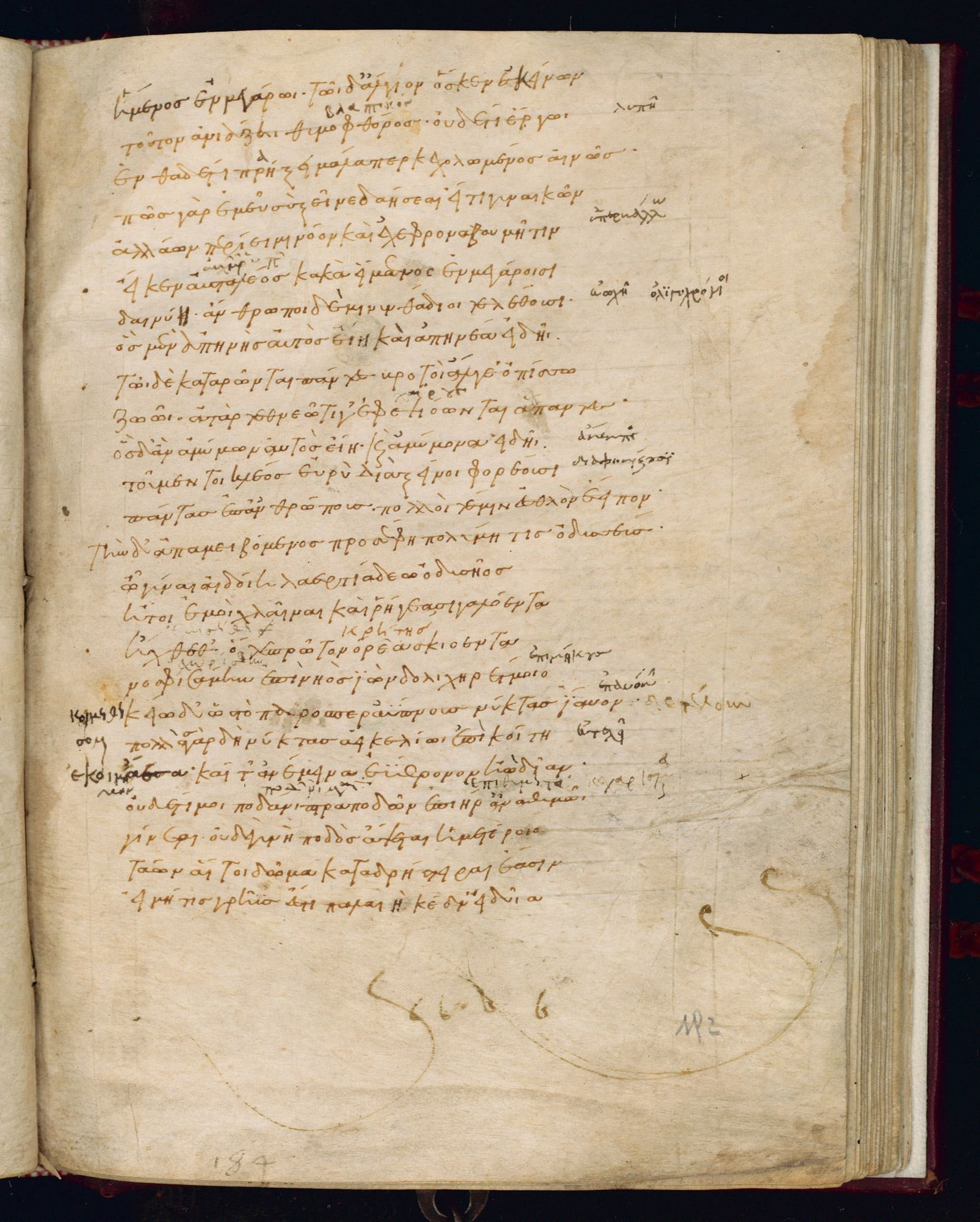
Where on the image
Laur. Plut. 32.24, fol. 192r: Odyssey 19.322-346, begins ‹ἥμενος ἐν μεγάρῳ· τῷ›, ends ‹ἔστι παλαιή, κεδνὰ ἰδυῖα,›. Checked on the image: first and last lines read and matched to the Greek. Fol. 191v ends with 19.321. Fol. 192v begins with 19.347. English blocks here: 320-324, 325-329, 330-334, 335-339, 340-344.
322ἥμενος ἐν μεγάρῳ· τῷ δʼ ἄλγιον ὅς κεν ἐκείνων
323τοῦτον ἀνιάζῃ θυμοφθόρος· οὐδέ τι ἔργον
324ἐνθάδʼ ἔτι πρήξει, μάλα περ κεχολωμένος αἰνῶς.
325πῶς γὰρ ἐμεῦ σύ, ξεῖνε, δαήσεαι εἴ τι γυναικῶν
326ἀλλάων περίειμι νόον καὶ ἐπίφρονα μῆτιν,
327εἴ κεν ἀϋσταλέος, κακὰ εἱμένος ἐν μεγάροισιν
328δαινύῃ; ἄνθρωποι δὲ μινυνθάδιοι τελέθουσιν.
329ὃς μὲν ἀπηνὴς αὐτὸς ἔῃ καὶ ἀπηνέα εἰδῇ,
330τῷ δὲ καταρῶνται πάντες βροτοὶ ἄλγεʼ ὀπίσσω
331ζωῷ, ἀτὰρ τεθνεῶτί γʼ ἐφεψιόωνται ἅπαντες·
332ὃς δʼ ἂν ἀμύμων αὐτὸς ἔῃ καὶ ἀμύμονα εἰδῇ,
333τοῦ μέν τε κλέος εὐρὺ δὶα ξεῖνοι φορέουσι
334πάντας ἐπʼ ἀνθρώπους, πολλοί τέ μιν ἐσθλὸν ἔειπον.
335τὴν δʼ ἀπαμειβόμενος προσέφη πολύμητις Ὀδυσσεύς·
336ὦ γύναι αἰδοίη Λαερτιάδεω Ὀδυσῆος,
337ἦ τοι ἐμοὶ χλαῖναι καὶ ῥήγεα σιγαλόεντα
338ἤχθεθʼ, ὅτε πρῶτον Κρήτης ὄρεα νιφόεντα
339νοσφισάμην ἐπὶ νηὸς ἰὼν δολιχηρέτμοιο,
340κείω δʼ ὡς τὸ πάρος περ ἀΰπνους νύκτας ἴαυον·
341πολλὰς γὰρ δὴ νύκτας ἀεικελίῳ ἐνὶ κοίτῃ
342ἄεσα καί τʼ ἀνέμεινα ἐΰθρονον Ἠῶ δῖαν.
343οὐδέ τί μοι ποδάνιπτρα ποδῶν ἐπιήρανα θυμῷ
344γίγνεται· οὐδὲ γυνὴ ποδὸς ἅψεται ἡμετέροιο
345τάων αἵ τοι δῶμα κάτα δρήστειραι ἔασιν,
346εἰ μή τις γρηῦς ἔστι παλαιή, κεδνὰ ἰδυῖα,
320And right early in the morning bathe him and anoint him, that in our house at the side of Telemachus he may bethink him of food as he sits in the hall. And worse shall it be for any man among them who vexes this man's soul with pain; naught thereafter shall he accomplish here, how fierce soever his wrath. 325For how shalt thou learn of me, stranger, whether I in any wise excel other women in wit and prudent counsel, if all unkempt and clad in poor raiment thou sittest at meat in my halls? Men are but short-lived. If one be himself hard, and have a hard heart, 330on him do all mortal men invoke woes for the time to come, while he still lives, and when he is dead all men mock at him. But if one be blameless and have a blameless heart, his fame do strangers bear far and wide among all men, and many call him a true man.” 335Then Odysseus of many wiles answered her, and said: “Honored wife of Odysseus, son of Laertes, verily cloaks and bright coverlets became hateful in my eyes on the day when first I left behind me the snowy mountains of Crete, as I fared on my long-oared ship. 340Nay, I will lie, as in time past I was wont to rest through sleepless nights; for many a night have I lain upon a foul bed and waited for the bright-throned Dawn. Aye, and baths for the feet give my heart no pleasure, nor shall any woman touch my foot
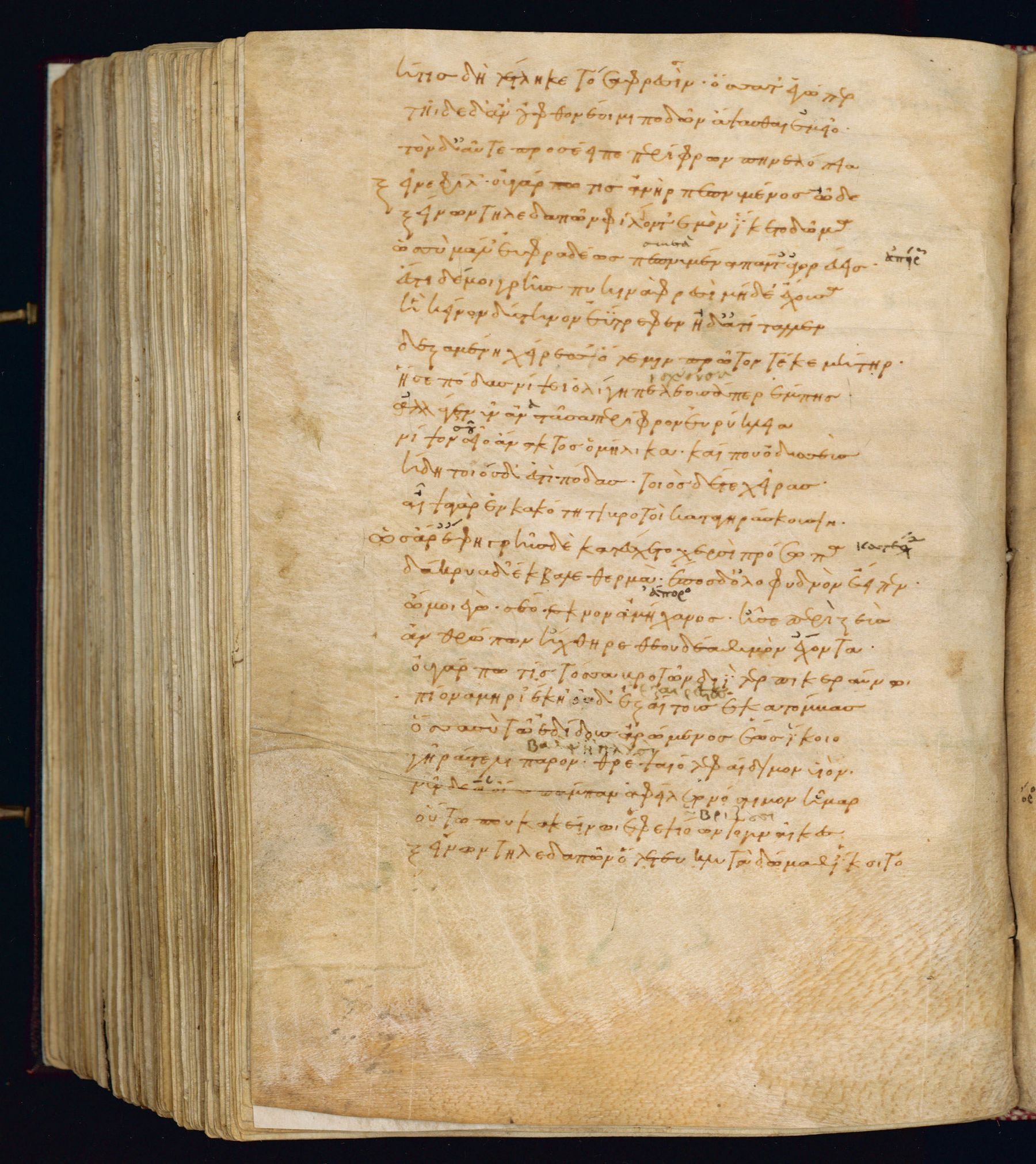
Where on the image
Laur. Plut. 32.24, fol. 192v: Odyssey 19.347-371, begins ‹ἥ τις δὴ τέτληκε›, ends ‹τευ κλυτὰ δώμαθʼ ἵκοιτο,›. Checked on the image: first and last lines read and matched to the Greek. Fol. 192r ends with 19.346. Fol. 193r begins with 19.372. English blocks here: 345-349, 350-354, 355-359, 360-360, 361-364, 365-369.
347ἥ τις δὴ τέτληκε τόσα φρεσὶν ὅσσα τʼ ἐγώ περ·
348τῇ δʼ οὐκ ἂν φθονέοιμι ποδῶν ἅψασθαι ἐμεῖο.
349τὸν δʼ αὖτε προσέειπε περίφρων Πηνελόπεια·
350ξεῖνε φίλʼ· οὐ γάρ πώ τις ἀνὴρ πεπνυμένος ὧδε
351ξείνων τηλεδαπῶν φιλίων ἐμὸν ἵκετο δῶμα,
352ὡς σὺ μάλʼ εὐφραδέως πεπνυμένα πάντʼ ἀγορεύεις·
353ἔστι δέ μοι γρηῢς πυκινὰ φρεσὶ μήδεʼ ἔχουσα
354ἣ κεῖνον δύστηνον ἐῢ τρέφεν ἠδʼ ἀτίταλλε,
355δεξαμένη χείρεσσʼ, ὅτε μιν πρῶτον τέκε μήτηρ,
356ἥ σε πόδας νίψει, ὀλιγηπελέουσά περ ἔμπης.
357ἀλλʼ ἄγε νῦν ἀνστᾶσα, περίφρων Εὐρύκλεια,
358νίψον σοῖο ἄνακτος ὁμήλικα· καί που Ὀδυσσεὺς
359ἤδη τοιόσδʼ ἐστὶ πόδας τοιόσδε τε χεῖρας·
360αἶψα γὰρ ἐν κακότητι βροτοὶ καταγηράσκουσιν.
361ὣς ἄρʼ ἔφη, γρηῢς δὲ κατέσχετο χερσὶ πρόσωπα,
362δάκρυα δʼ ἔκβαλε θερμά, ἔπος δʼ ὀλοφυδνὸν ἔειπεν·
363ὤ μοι ἐγὼ σέο, τέκνον, ἀμήχανος· ἦ σε περὶ Ζεὺς
364ἀνθρώπων ἤχθηρε θεουδέα θυμὸν ἔχοντα.
365οὐ γάρ πώ τις τόσσα βροτῶν Διὶ τερπικεραύνῳ
366πίονα μηρίʼ ἔκηʼ οὐδʼ ἐξαίτους ἑκατόμβας,
367ὅσσα σὺ τῷ ἐδίδους, ἀρώμενος ἧος ἵκοιο
368γῆράς τε λιπαρὸν θρέψαιό τε φαίδιμον υἱόν·
369νῦν δέ τοι οἴῳ πάμπαν ἀφείλετο νόστιμον ἦμαρ.
370οὕτω που καὶ κείνῳ ἐφεψιόωντο γυναῖκες
371ξείνων τηλεδαπῶν, ὅτε τευ κλυτὰ δώμαθʼ ἵκοιτο,
345of all those who are serving-women in thy hall, unless there is some old, true-hearted dame who has suffered in her heart as many woes as I; such an one I would not grudge to touch my feet.” Then wise Penelope answered him again: 350“Dear stranger, never yet has a man discreet as thou, of those who are strangers from afar, come to my house as a more welcome guest, so wise and prudent are all thy words. I have an old dame with a heart of understanding in her breast, who lovingly nursed and cherished my hapless husband, 355and took him in her arms on the day when his mother bore him. She shall wash thy feet, weak with age though she be. Come now, wise Eurycleia, arise and wash the feet of one of like age with thy master. Even such as his are now haply the feet of Odysseus, and such his hands, 360for quickly do men grow old in evil fortune.” 361So she spoke, and the old woman hid her face in her hands and let fall hot tears, uttering words of lamentation: “Ah, woe is me, child, because of thee, for that I can do naught. Surely Zeus hated thee above all men, though thou hadst a god-fearing heart. 365For never yet did any mortal burn to Zeus, who hurls the thunderbolt, so many fat thigh-pieces or so many choice hecatombs as thou gavest him, with prayers that thou mightest reach a sleek old age and rear thy glorious son. But lo, now, from thee alone has he wholly cut off the day of thy returning.
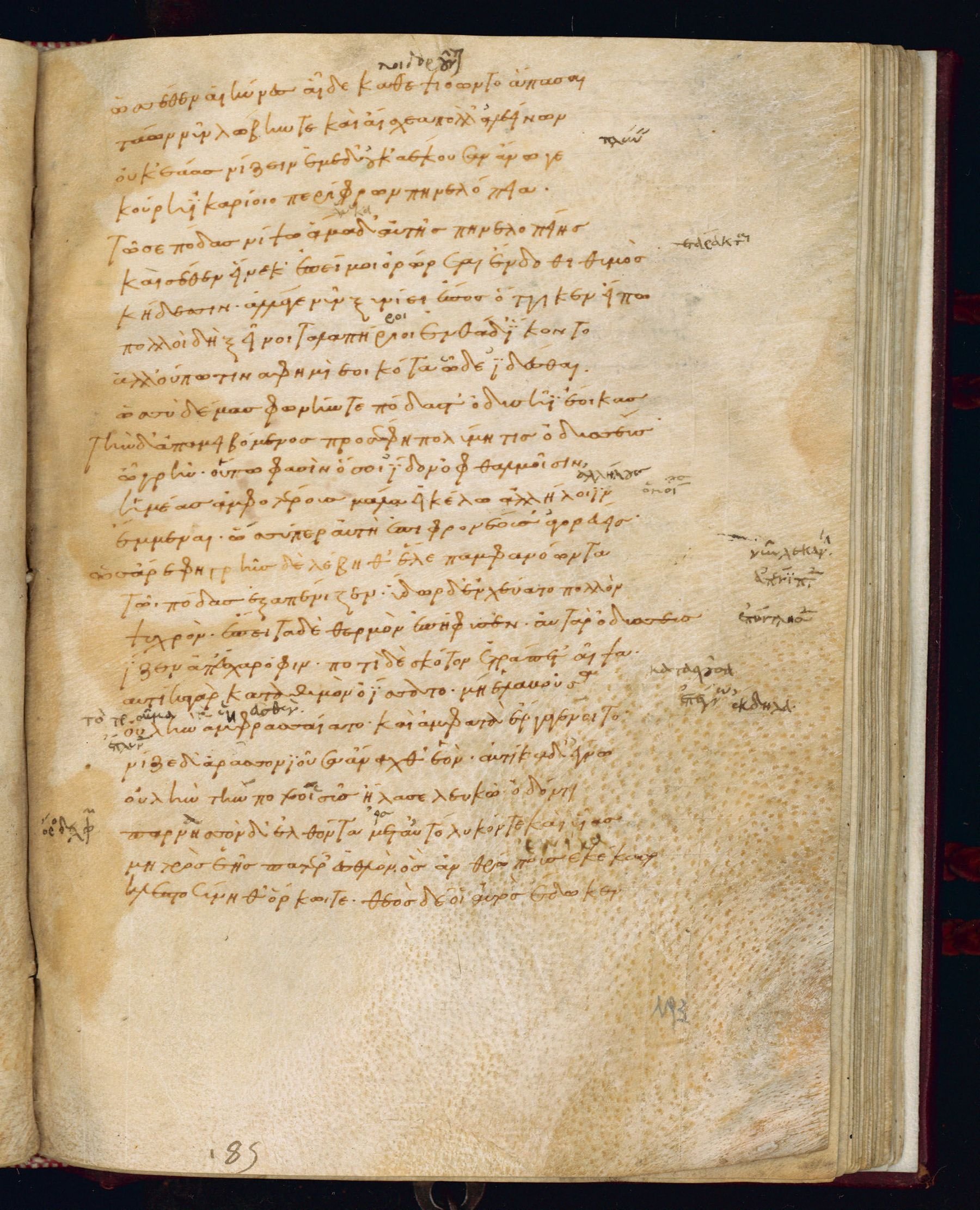
Where on the image
Laur. Plut. 32.24, fol. 193r: Odyssey 19.372-396, begins ‹ὡς σέθεν αἱ κύνες›, ends ‹δέ οἱ αὐτὸς ἔδωκεν›. Checked on the image: first and last lines read and matched to the Greek. Fol. 192v ends with 19.371. Fol. 193v begins with 19.397. English blocks here: 370-374, 375-379, 380-384, 385-389, 390-394.
372ὡς σέθεν αἱ κύνες αἵδε καθεψιόωνται ἅπασαι,
373τάων νῦν λώβην τε καὶ αἴσχεα πόλλʼ ἀλεείνων
374οὐκ ἐάᾳς νίζειν· ἐμὲ δʼ οὐκ ἀέκουσαν ἄνωγε
375κούρη Ἰκαρίοιο, περίφρων Πηνελόπεια.
376τῷ σε πόδας νίψω ἅμα τʼ αὐτῆς Πηνελοπείης
377καὶ σέθεν εἵνεκʼ, ἐπεί μοι ὀρώρεται ἔνδοθι θυμὸς
378κήδεσιν. ἀλλʼ ἄγε νῦν ξυνίει ἔπος, ὅττι κεν εἴπω·
379πολλοὶ δὴ ξεῖνοι ταλαπείριοι ἐνθάδʼ ἵκοντο,
380ἀλλʼ οὔ πώ τινά φημι ἐοικότα ὧδε ἰδέσθαι
381ὡς σὺ δέμας φωνήν τε πόδας τʼ Ὀδυσῆϊ ἔοικας.
382τὴν δʼ ἀπαμειβόμενος προσέφη πολύμητις Ὀδυσσεύς·
383ὦ γρηῦ, οὕτω φασὶν ὅσοι ἴδον ὀφθαλμοῖσιν
384ἡμέας ἀμφοτέρους, μάλα εἰκέλω ἀλλήλοιϊν
385ἔμμεναι, ὡς σύ περ αὐτὴ ἐπιφρονέουσʼ ἀγορεύεις.
386ὣς ἄρʼ ἔφη, γρηῢς δὲ λέβηθʼ ἕλε παμφανόωντα
387τοῦ πόδας ἐξαπένιζεν, ὕδωρ δʼ ἐνεχεύατο πουλὺ
388ψυχρόν, ἔπειτα δὲ θερμὸν ἐπήφυσεν. αὐτὰρ Ὀδυσσεὺς
389ἷζεν ἐπʼ ἐσχαρόφιν, ποτὶ δὲ σκότον ἐτράπετʼ αἶψα·
390αὐτίκα γὰρ κατὰ θυμὸν ὀΐσατο, μή ἑ λαβοῦσα
391οὐλὴν ἀμφράσσαιτο καὶ ἀμφαδὰ ἔργα γένοιτο.
392νίζε δʼ ἄρʼ ἆσσον ἰοῦσα ἄναχθʼ ἑόν· αὐτίκα δʼ ἔγνω
393οὐλήν, τήν ποτέ μιν σῦς ἤλασε λευκῷ ὀδόντι
394Παρνησόνδʼ ἐλθόντα μετʼ Αὐτόλυκόν τε καὶ υἷας,
395μητρὸς ἑῆς πάτερʼ ἐσθλόν, ὃς ἀνθρώπους ἐκέκαστο
396κλεπτοσύνῃ θʼ ὅρκῳ τε· θεὸς δέ οἱ αὐτὸς ἔδωκεν
370Even thus, I ween, did women mock at him too, in a strange and distant land, when he came to some man's glorious house, as these shameless creatures here all mock at thee. It is to shun insult now from them and their many taunts that thou dost not suffer them to wash thy feet, but me, who am nothing loath, has 375the daughter of Icarius, wise Penelope, bidden to wash thee. Therefore will I wash thy feet, both for Penelope's own sake and for thine, for the heart within me is stirred with sorrow. But come now, hearken to the word that I shall speak. Many sore-tried strangers have come hither, 380but I declare that never yet have I seen any man so like another as thou in form, and in voice, and in feet art like Odysseus.” Then Odysseus of many wiles answered her, and said: “Old dame, so say all men whose eyes have beheld us two, that 385we are very like each other, even as thou thyself dost note and say.” So he spoke, and the old dame took the shining cauldron with water wherefrom she was about to wash his feet, and poured in cold water in plenty, and then added thereto the warm. But Odysseus sat him down away from the hearth and straightway turned himself toward the darkness, 390for he at once had a foreboding at heart that, as she touched him, she might note a scar, and the truth be made manifest. So she drew near and began to wash her lord, and straightway knew the scar of the wound which long ago a boar had dealt him with his white tusk, when Odysseus had gone to Parnassus to visit Autolycus and the sons of Autolycus,
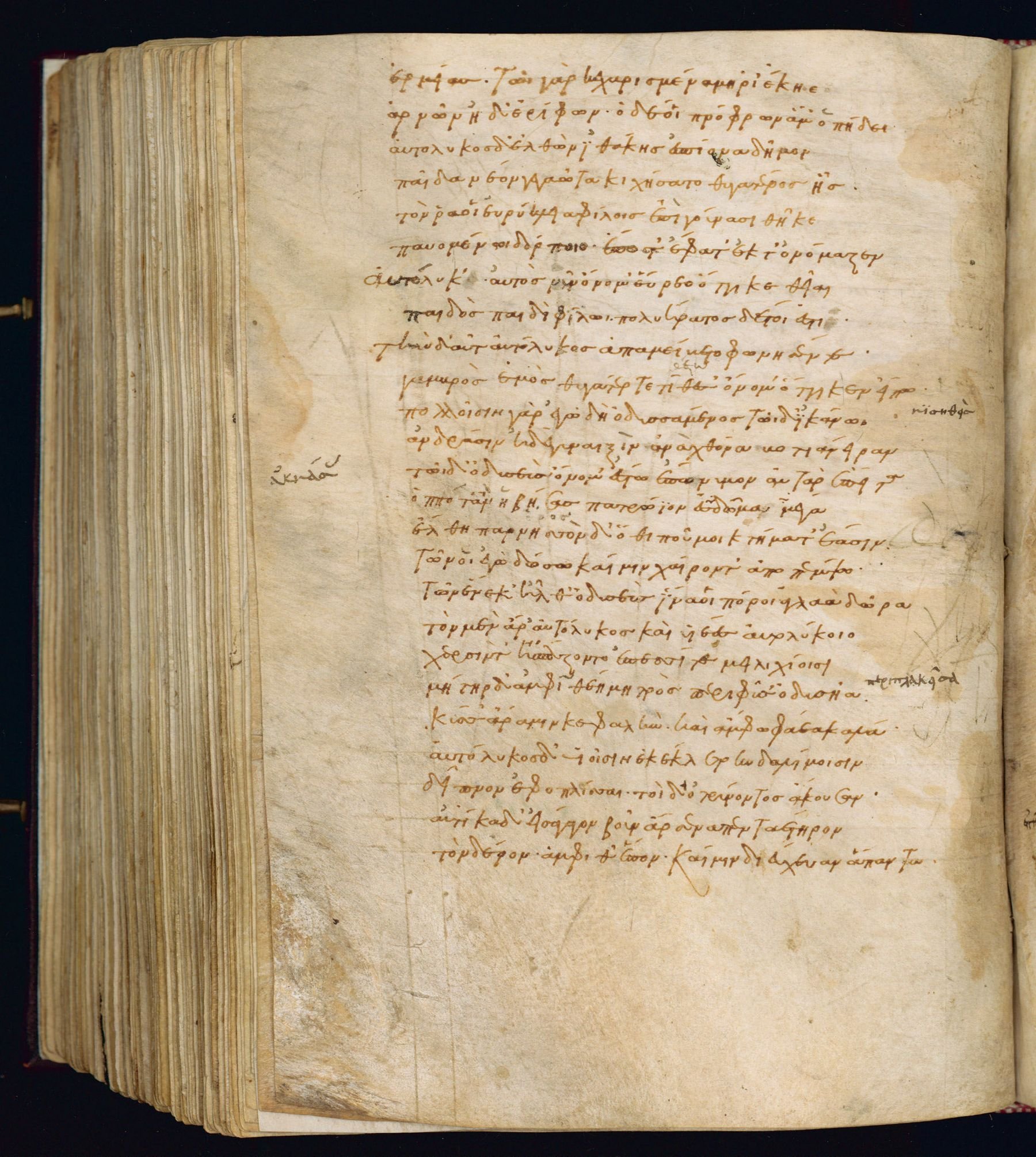
Where on the image
Laur. Plut. 32.24, fol. 193v: Odyssey 19.397-421, begins ‹Ἑρμείας· τῷ γὰρ κεχαρισμένα›, ends ‹καί μιν διέχευαν ἅπαντα,›. Checked on the image: first and last lines read and matched to the Greek. Fol. 193r ends with 19.396. Fol. 194r begins with 19.422. English blocks here: 395-399, 400-404, 405-409, 410-414, 415-419.
397Ἑρμείας· τῷ γὰρ κεχαρισμένα μηρία καῖεν
398ἀρνῶν ἠδʼ ἐρίφων· ὁ δέ οἱ πρόφρων ἅμʼ ὀπήδει.
399Αὐτόλυκος δʼ ἐλθὼν Ἰθάκης ἐς πίονα δῆμον
400παῖδα νέον γεγαῶτα κιχήσατο θυγατέρος ἧς·
401τόν ῥά οἱ Εὐρύκλεια φίλοις ἐπὶ γούνασι θῆκε
402παυομένῳ δόρποιο, ἔπος τʼ ἔφατʼ ἔκ τʼ ὀνόμαζεν·
403Αὐτόλυκʼ, αὐτὸς νῦν ὄνομʼ εὕρεο ὅττι κε θῆαι
404παιδὸς παιδὶ φίλῳ· πολυάρητος δέ τοί ἐστιν.
405τὴν δʼ αὖτʼ Αὐτόλυκος ἀπαμείβετο φώνησέν τε·
406γαμβρὸς ἐμὸς θυγάτηρ τε, τίθεσθʼ ὄνομʼ ὅττι κεν εἴπω·
407πολλοῖσιν γὰρ ἐγώ γε ὀδυσσάμενος τόδʼ ἱκάνω,
408ἀνδράσιν ἠδὲ γυναιξὶν ἀνὰ χθόνα πουλυβότειραν·
409τῷ δʼ Ὀδυσεὺς ὄνομʼ ἔστω ἐπώνυμον· αὐτὰρ ἐγώ γε,
410ὁππότʼ ἂν ἡβήσας μητρώϊον ἐς μέγα δῶμα
411ἔλθῃ Παρνησόνδʼ, ὅθι πού μοι κτήματʼ ἔασι,
412τῶν οἱ ἐγὼ δώσω καί μιν χαίροντʼ ἀποπέμψω.
413τῶν ἕνεκʼ ἦλθʼ Ὀδυσεύς, ἵνα οἱ πόροι ἀγλαὰ δῶρα.
414τὸν μὲν ἄρʼ Αὐτόλυκός τε καὶ υἱέες Αὐτολύκοιο
415χερσίν τʼ ἠσπάζοντο ἔπεσσί τε μειλιχίοισι·
416μήτηρ δʼ Ἀμφιθέη μητρὸς περιφῦσʼ Ὀδυσῆϊ
417κύσσʼ ἄρα μιν κεφαλήν τε καὶ ἄμφω φάεα καλά.
418Αὐτόλυκος δʼ υἱοῖσιν ἐκέκλετο κυδαλίμοισι
419δεῖπνον ἐφοπλίσσαι· τοὶ δʼ ὀτρύνοντος ἄκουσαν,
420αὐτίκα δʼ εἰσάγαγον βοῦν ἄρσενα πενταέτηρον·
421τὸν δέρον ἀμφί θʼ ἕπον, καί μιν διέχευαν ἅπαντα,
395his mother's noble father, who excelled all men in thievery and in oaths. It was a god himself that had given him this skill, even Hermes, for to him he was wont to burn acceptable sacrifices of the thighs of lambs and kids; so Hermes befriended him with a ready heart. Now Autolycus, on coming once to the rich land of Ithaca , 400had found his daughter's son a babe new-born, and when he was finishing his supper, Eurycleia laid the child upon his knees and spoke, and addressed him: “Autolycus, find now thyself a name to give to thy child's own child; be sure he has long been prayed for.” 405Then Autolycus answered her, and said: “My daughter's husband and my daughter, give him whatsoever name I say. Lo, inasmuch as I am come hither as one that has been angered with many, both men and women, over the fruitful earth, therefore let the name by which the child is named be Odysseus. And for my part, 410when he is a man grown and comes to the great house of his mother's kin at Parnassus, where are my possessions, I will give him thereof and send him back rejoicing.” It was for this reason that Odysseus had come, that Autolycus might give him the glorious gifts. And Autolycus and the sons of Autolycus 415clasped his hands in welcome and greeted him with gentle words, and Amphithea, his mother's mother, took Odysseus in her arms and kissed his head and both his beautiful eyes. But Autolycus called to his glorious sons to make ready the meal, and they hearkened to his call.
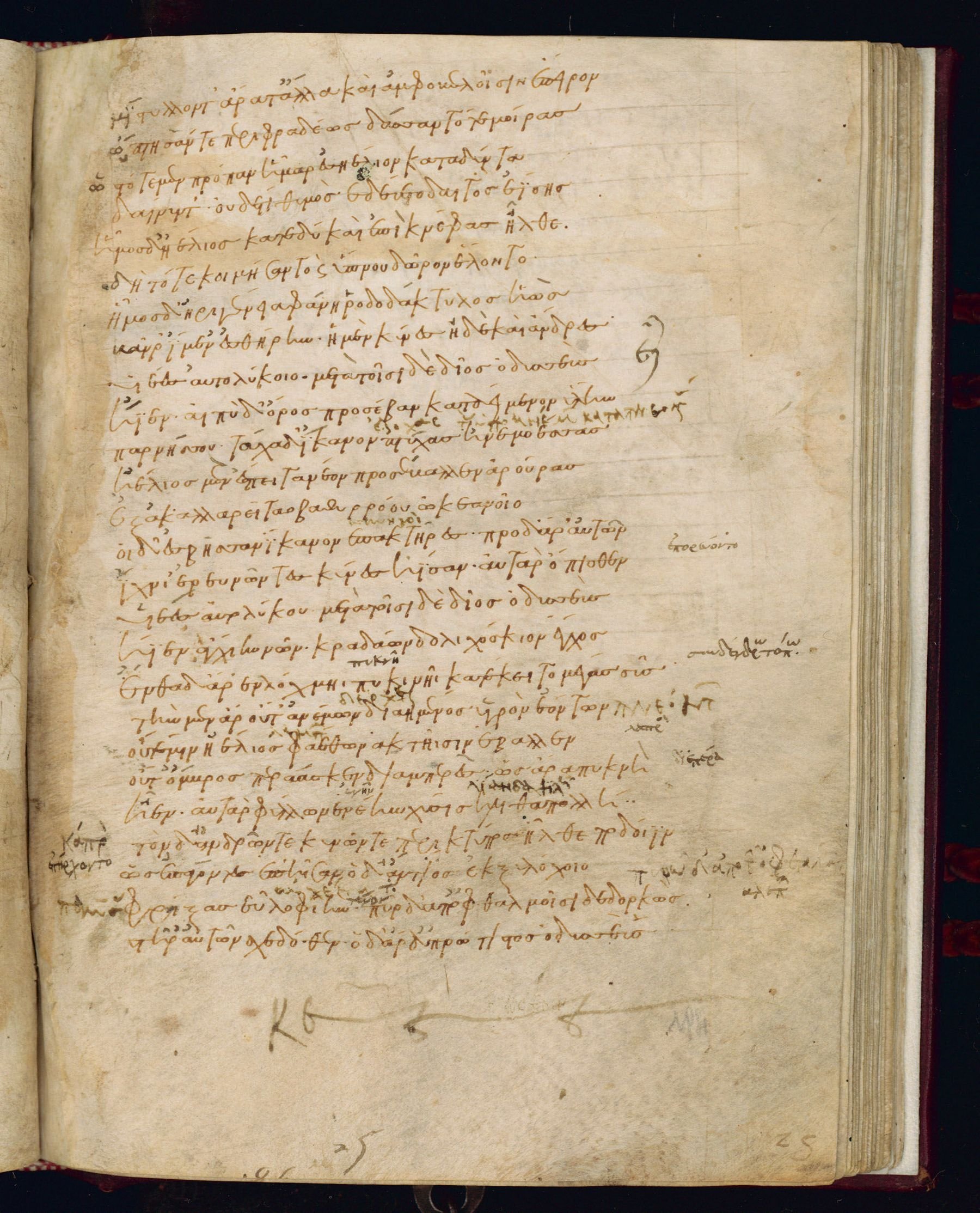
Where on the image
Laur. Plut. 32.24, fol. 194r: Odyssey 19.422-447, begins ‹μίστυλλόν τʼ ἄρʼ ἐπισταμένως›, ends ‹δʼ ἄρα πρώτιστος Ὀδυσσεὺς›. Checked on the image: first and last lines read and matched to the Greek. Fol. 193v ends with 19.421. Fol. 194v begins with 19.448. English blocks here: 420-424, 425-429, 430-434, 435-439, 440-444, 445-449.
422μίστυλλόν τʼ ἄρʼ ἐπισταμένως πεῖράν τʼ ὀβελοῖσιν,
423ὤπτησάν τε περιφραδέως, δάσσαντό τε μοίρας.
424ὣς τότε μὲν πρόπαν ἦμαρ ἐς ἠέλιον καταδύντα
425δαίνυντʼ, οὐδέ τι θυμὸς ἐδεύετο δαιτὸς ἐΐσης·
426ἦμος δʼ ἠέλιος κατέδυ καὶ ἐπὶ κνέφας ἦλθεν,
427δὴ τότε κοιμήσαντο καὶ ὕπνου δῶρον ἕλοντο.
428ἦμος δʼ ἠριγένεια φάνη ῥοδοδάκτυλος Ἠώς,
429βάν ῥʼ ἴμεν ἐς θήρην, ἠμὲν κύνες ἠδὲ καὶ αὐτοὶ
430υἱέες Αὐτολύκου· μετὰ τοῖσι δὲ δῖος Ὀδυσσεὺς
431ἤϊεν· αἰπὺ δʼ ὄρος προσέβαν καταειμένον ὕλῃ
432Παρνησοῦ, τάχα δʼ ἵκανον πτύχας ἠνεμοέσσας.
433Ἠέλιος μὲν ἔπειτα νέον προσέβαλλεν ἀρούρας
434ἐξ ἀκαλαρρείταο βαθυρρόου Ὠκεανοῖο,
435οἱ δʼ ἐς βῆσσαν ἵκανον ἐπακτῆρες· πρὸ δʼ ἄρʼ αὐτῶν
436ἴχνιʼ ἐρευνῶντες κύνες ἤϊσαν, αὐτὰρ ὄπισθεν
437υἱέες Αὐτολύκου· μετὰ τοῖσι δὲ δῖος Ὀδυσσεὺς
438ἤϊεν ἄγχι κυνῶν, κραδάων δολιχόσκιον ἔγχος.
439ἔνθα δʼ ἄρʼ ἐν λόχμῃ πυκινῇ κατέκειτο μέγας σῦς·
440τὴν μὲν ἄρʼ οὔτʼ ἀνέμων διάει μένος ὑγρὸν ἀέντων,
441οὔτε μιν Ἠέλιος φαέθων ἀκτῖσιν ἔβαλλεν,
442οὔτʼ ὄμβρος περάασκε διαμπερές· ὣς ἄρα πυκνὴ
443ἦεν, ἀτὰρ φύλλων ἐνέην χύσις ἤλιθα πολλή.
444τὸν δʼ ἀνδρῶν τε κυνῶν τε περὶ κτύπος ἦλθε ποδοῖϊν,
445ὡς ἐπάγοντες ἐπῇσαν· ὁ δʼ ἀντίος ἐκ ξυλόχοιο
446φρίξας εὖ λοφιήν, πῦρ δʼ ὀφθαλμοῖσι δεδορκώς,
447στῆ ῥʼ αὐτῶν σχεδόθεν· ὁ δʼ ἄρα πρώτιστος Ὀδυσσεὺς
420At once they led in a bull, five years old, which they flayed and dressed, and cut up all the limbs. Then they sliced these cunningly and pierced them with spits, and roasted them skilfully and distributed the portions. So, then, all day long till set of sun 425they feasted, nor did their hearts lack aught of the equal feast. But when the sun set and darkness came on they lay down to rest and took the gift of sleep. But as soon as early Dawn appeared, the rosy-fingered, they went forth to the hunt, the hounds and 430the sons of Autolycus too, and with them went goodly Odysseus. Up the steep mountain Parnassus, clothed with forests, they climbed, and presently reached its windy hollows. The sun was now just striking on the fields, as he rose from softly-gliding, deep-flowing Oceanus, 435when the beaters came to a glade. Before them went the hounds, tracking the scent, and behind them the sons of Autolycus, and among these the goodly Odysseus followed, close upon the hounds, brandishing his long spear. Now thereby a great wild boar was lying in a thick lair, 440through which the strength of the wet winds could never blow nor the rays of the bright sun beat, nor could the rain pierce through it, so thick it was; and fallen leaves were there in plenty. Then about the boar there came the noise of the feet of men and dogs 445as they pressed on in the chase, and forth from his lair he came against them with bristling back and eyes flashing fire, and stood there at bay close before them. Then first of all Odysseus rushed on, holding his long spear on high in his stout hand, eager to smite him; but the boar was too quick for him and struck him
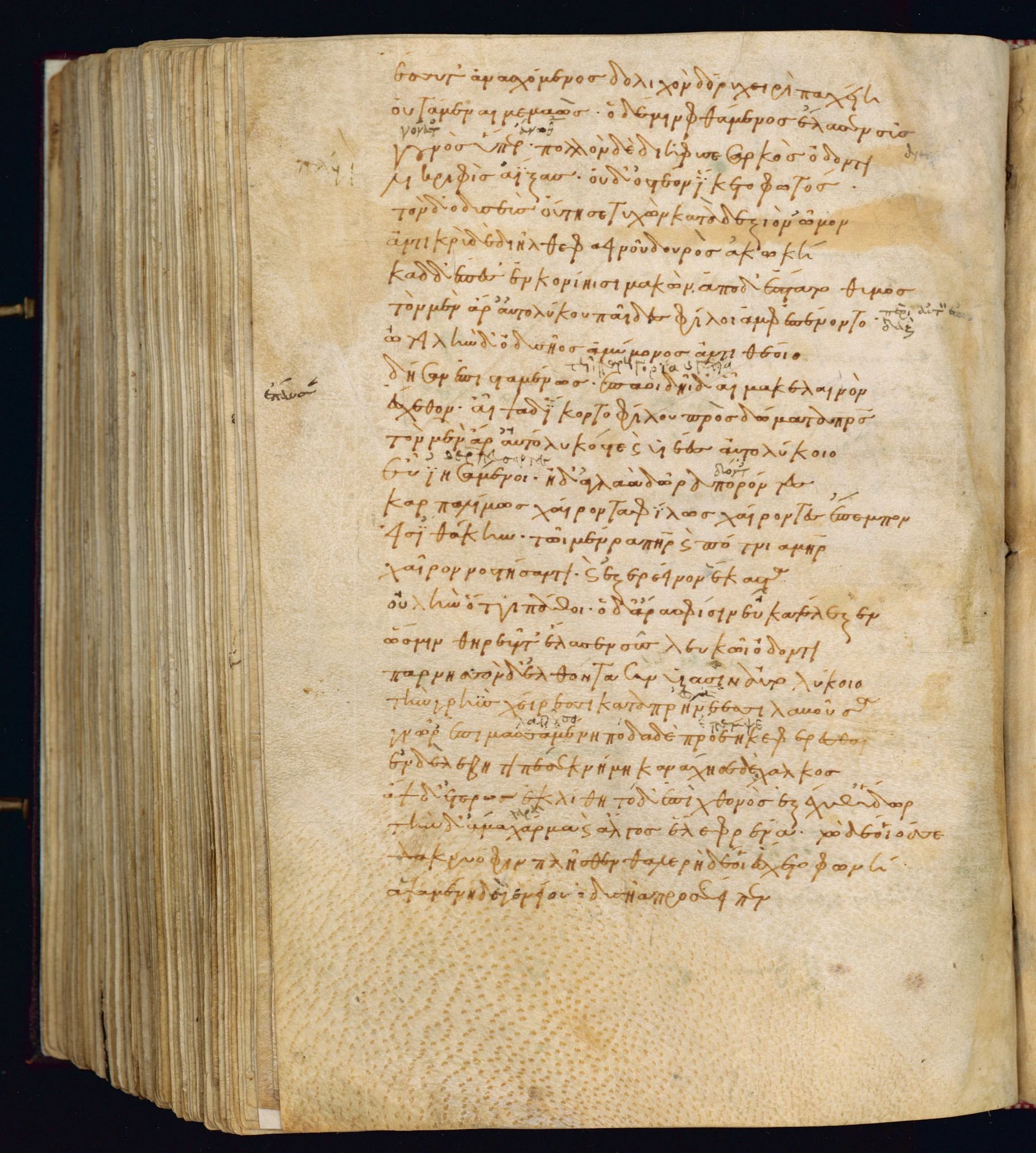
Where on the image
Laur. Plut. 32.24, fol. 194v: Odyssey 19.448-473, begins ‹ἔσσυτʼ ἀνασχόμενος δολιχὸν δόρυ›, ends ‹δὲ γενείου Ὀδυσσῆα προσέειπεν·›. Checked on the image: first and last lines read and matched to the Greek. Fol. 194r ends with 19.447. Fol. 195r begins with 19.474. English blocks here: 450-454, 455-459, 460-464, 465-469, 470-474.
448ἔσσυτʼ ἀνασχόμενος δολιχὸν δόρυ χειρὶ παχείῃ,
449οὐτάμεναι μεμαώς· ὁ δέ μιν φθάμενος ἔλασεν σῦς
450γουνὸς ὕπερ, πολλὸν δὲ διήφυσε σαρκὸς ὀδόντι
451λικριφὶς ἀΐξας, οὐδʼ ὀστέον ἵκετο φωτός.
452τὸν δʼ Ὀδυσεὺς οὔτησε τυχὼν κατὰ δεξιὸν ὦμον,
453ἀντικρὺ δὲ διῆλθε φαεινοῦ δουρὸς ἀκωκή·
454κὰδ δʼ ἔπεσʼ ἐν κονίῃσι μακών, ἀπὸ δʼ ἔπτατο θυμός.
455τὸν μὲν ἄρʼ Αὐτολύκου παῖδες φίλοι ἀμφεπένοντο,
456ὠτειλὴν δʼ Ὀδυσῆος ἀμύμονος ἀντιθέοιο
457δῆσαν ἐπισταμένως, ἐπαοιδῇ δʼ αἷμα κελαινὸν
458ἔσχεθον, αἶψα δʼ ἵκοντο φίλου πρὸς δώματα πατρός.
459τὸν μὲν ἄρʼ Αὐτόλυκός τε καὶ υἱέες Αὐτολύκοιο
460εὖ ἰησάμενοι ἠδʼ ἀγλαὰ δῶρα πορόντες
461καρπαλίμως χαίροντα φίλην ἐς πατρίδʼ ἔπεμπον
462εἰς Ἰθάκην. τῷ μέν ῥα πατὴρ καὶ πότνια μήτηρ
463χαῖρον νοστήσαντι καὶ ἐξερέεινον ἕκαστα,
464οὐλὴν ὅττι πάθοι· ὁ δʼ ἄρα σφίσιν εὖ κατέλεξεν
465ὥς μιν θηρεύοντʼ ἔλασεν σῦς λευκῷ ὀδόντι,
466Παρνησόνδʼ ἐλθόντα σὺν υἱάσιν Αὐτολύκοιο.
467τὴν γρηῢς χείρεσσι καταπρηνέσσι λαβοῦσα
468γνῶ ῥʼ ἐπιμασσαμένη, πόδα δὲ προέηκε φέρεσθαι·
469ἐν δὲ λέβητι πέσε κνήμη, κανάχησε δὲ χαλκός,
470ἂψ δʼ ἑτέρωσʼ ἐκλίθη· τὸ δʼ ἐπὶ χθονὸς ἐξέχυθʼ ὕδωρ.
471τὴν δʼ ἅμα χάρμα καὶ ἄλγος ἕλε φρένα, τὼ δέ οἱ ὄσσε
472δακρυόφι πλῆσθεν, θαλερὴ δέ οἱ ἔσχετο φωνή.
473ἁψαμένη δὲ γενείου Ὀδυσσῆα προσέειπεν·
450above the knee, charging upon him sideways, and with his tusk tore a long gash in the flesh, but did not reach the bone of the man. But Odysseus with sure aim smote him on the right shoulder, and clear through went the point of the bright spear, and the boar fell in the dust with a cry, and his life flew from him. 455Then the dear sons of Autolycus busied themselves with the carcase, and the wound of noble, god-like Odysseus they bound up skilfully, and checked the black blood with a charm, and straightway returned to the house of their dear father. And when Autolycus and the sons of Autolycus 460had fully healed him, and had given him glorious gifts, they quickly sent him back with joy to his native land, to Ithaca. Then his father and his honored mother rejoiced at his return, and asked him all the story, how he got his wound; and he told them all the truth, 465how, while he was hunting, a boar had struck him with his white tusk when he had gone to Parnassus with the sons of Autolycus. This scar the old dame, when she had taken the limb in the flat of her hands, knew by the touch, and she let fall the foot. Into the basin the leg fell, and the brazen vessel rang. 470Over it tilted, and the water was spilled upon the ground. Then upon her soul came joy and grief in one moment, and both her eyes were filled with tears and the flow of her voice was checked. But she touched the chin of Odysseus, and said: “Verily thou art Odysseus, dear child, and I knew thee not,
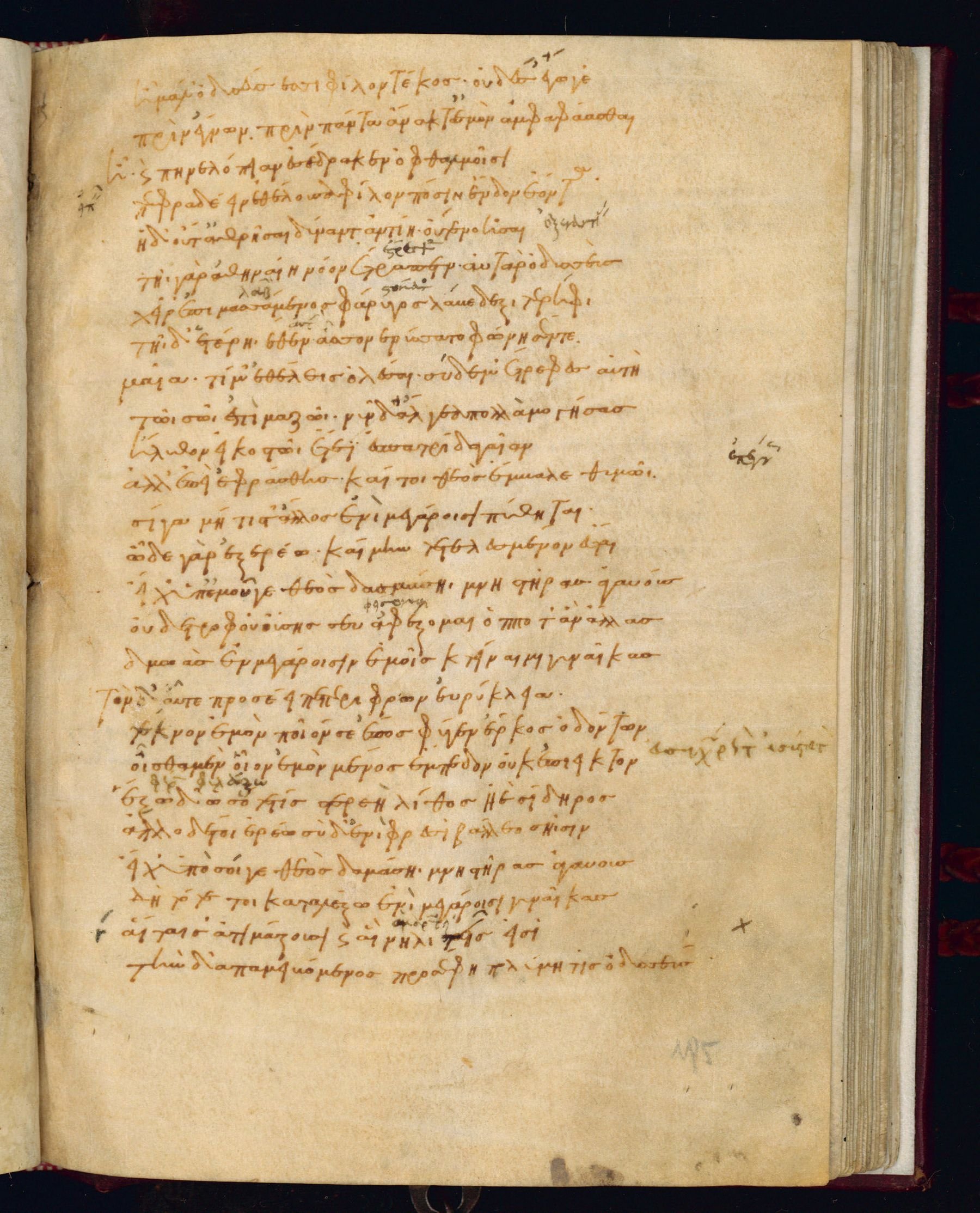
Where on the image
Laur. Plut. 32.24, fol. 195r: Odyssey 19.474-499, begins ‹ἦ μάλʼ Ὀδυσσεύς ἐσσι,›, ends ‹ἀπαμειβόμενος προσέφη πολύμητις Ὀδυσσεύς›. Checked on the image: first and last lines read and matched to the Greek. Fol. 194v ends with 19.473. Fol. 195v begins with 19.500. English blocks here: 475-479, 480-484, 485-489, 490-494, 495-498, 499-499.
474ἦ μάλʼ Ὀδυσσεύς ἐσσι, φίλον τέκος· οὐδέ σʼ ἐγώ γε
475πρὶν ἔγνων, πρὶν πάντα ἄνακτʼ ἐμὸν ἀμφαφάασθαι.
476ἦ καὶ Πηνελόπειαν ἐσέδρακεν ὀφθαλμοῖσι,
477πεφραδέειν ἐθέλουσα φίλον πόσιν ἔνδον ἐόντα.
478ἡ δʼ οὔτʼ ἀθρῆσαι δύνατʼ ἀντίη οὔτε νοῆσαι·
479τῇ γὰρ Ἀθηναίη νόον ἔτραπεν· αὐτὰρ Ὀδυσσεὺς
480χεῖρʼ ἐπιμασσάμενος φάρυγος λάβε δεξιτερῆφι,
481τῇ δʼ ἑτέρῃ ἕθεν ἆσσον ἐρύσσατο φώνησέν τε.
482μαῖα, τίη μʼ ἐθέλεις ὀλέσαι; σὺ δέ μʼ ἔτρεφες αὐτὴ
483τῷ σῷ ἐπὶ μαζῷ· νῦν δʼ ἄλγεα πολλὰ μογήσας
484ἤλυθον εἰκοστῷ ἔτεϊ ἐς πατρίδα γαῖαν.
485ἀλλʼ ἐπεὶ ἐφράσθης καί τοι θεὸς ἔμβαλε θυμῷ,
486σίγα, μή τίς τʼ ἄλλος ἐνὶ μεγάροισι πύθηται.
487ὧδε γὰρ ἐξερέω, καὶ μὴν τετελεσμένον ἔσται·
488εἴ χʼ ὑπʼ ἐμοί γε θεὸς δαμάσῃ μνηστῆρας ἀγαυούς,
489οὐδὲ τροφοῦ οὔσης σεῦ ἀφέξομαι, ὁππότʼ ἂν ἄλλας
490δμῳὰς ἐν μεγάροισιν ἐμοῖς κτείνωμι γυναῖκας.
491τὸν δʼ αὖτε προσέειπε περίφρων Εὐρύκλεια·
492τέκνον ἐμόν, ποῖόν σε ἔπος φύγεν ἕρκος ὀδόντων.
493οἶσθα μὲν οἷον ἐμὸν μένος ἔμπεδον οὐδʼ ἐπιεικτόν,
494ἕξω δʼ ὡς ὅτε τις στερεὴ λίθος ἠὲ σίδηρος.
495ἄλλο δέ τοι ἐρέω, σὺ δʼ ἐνὶ φρεσὶ βάλλεο σῇσιν·
496εἴ χʼ ὑπό σοι γε θεὸς δαμάσῃ μνηστῆρας ἀγαυούς,
497δὴ τότε τοι καταλέξω ἐνὶ μεγάροισι γυναῖκας,
498αἵ τέ σʼ ἀτιμάζουσι καὶ αἳ νηλείτιδές εἰσι.
499τὴν δʼ ἀπαμειβόμενος προσέφη πολύμητις Ὀδυσσεύς
475till I had handled all the body of my lord.” She spoke, and with her eyes looked toward Penelope, fain to show her that her dear husband was at home. But Penelope could not meet her glance nor understand, for Athena had turned her thoughts aside. But Odysseus, 480feeling for the woman's throat, seized it with his right hand, and with the other drew her closer to him, and said: “Mother, why wilt thou destroy me? Thou didst thyself nurse me at this thy breast, and now after many grievous toils I am come in the twentieth year to my native land. 485But since thou hast found me out, and a god has put this in thy heart, be silent lest any other in the halls learn hereof. For thus will I speak out to thee, and verily it shall be brought to pass: if a god shall subdue the lordly wooers unto me, I will not spare thee, my nurse though thou art, when 490I slay the other serving-women in my halls.” Then wise Eurycleia answered him: “My child, what a word has escaped the barrier of thy teeth! Thou knowest how firm my spirit is and unyielding: I shall be as close as hard stone or iron. 495And another thing will I tell thee, and do thou lay it to heart. If a god shall subdue the lordly wooers unto thee, then will I name over to thee the women in thy halls, which ones dishonor thee, and which are guiltless.” 499Then Odysseus of many wiles answered her, and said:
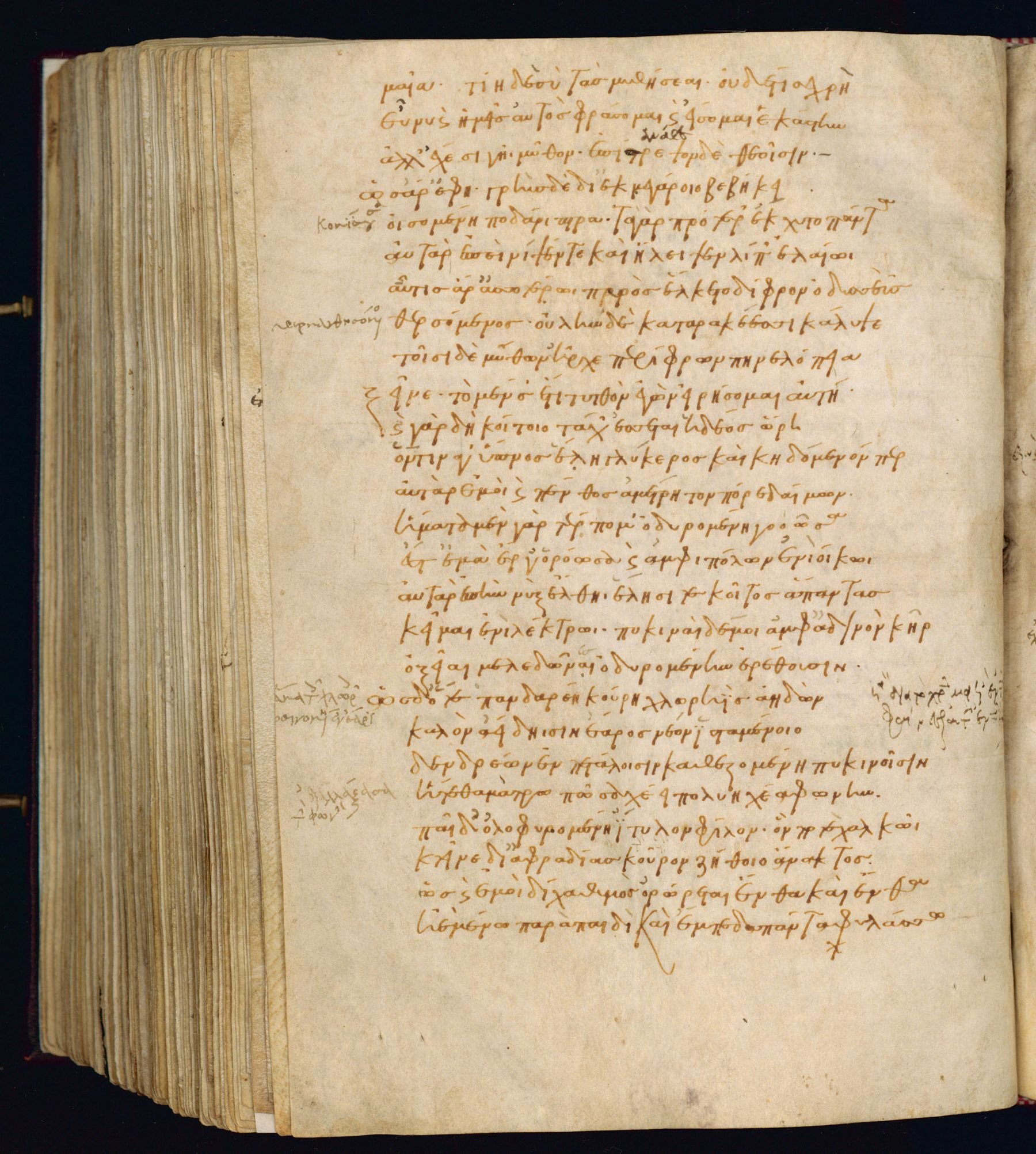
Where on the image
Laur. Plut. 32.24, fol. 195v: Odyssey 19.500-525, begins ‹μαῖα, τίη δὲ σὺ›, ends ‹καὶ ἔμπεδα πάντα φυλάσσω,›. Checked on the image: first and last lines read and matched to the Greek. Fol. 195r ends with 19.499. Fol. 196r begins with 19.526. English blocks here: 500-504, 505-509, 510-514, 515-519, 520-524.
500μαῖα, τίη δὲ σὺ τὰς μυθήσεαι; οὐδέ τί σε χρή.
501εὖ νυ καὶ αὐτὸς ἐγὼ φράσομαι καὶ εἴσομʼ ἑκάστην·
502ἀλλʼ ἔχε σιγῇ μῦθον, ἐπίτρεψον δὲ θεοῖσιν.
503ὣς ἄρʼ ἔφη, γρηῢς δὲ διὲκ μεγάροιο βεβήκει
504οἰσομένη ποδάνιπτρα· τὰ γὰρ πρότερʼ ἔκχυτο πάντα.
505αὐτὰρ ἐπεὶ νίψεν τε καὶ ἤλειψεν λίπʼ ἐλαίῳ,
506αὖτις ἄρʼ ἀσσοτέρω πυρὸς ἕλκετο δίφρον Ὀδυσσεὺς
507θερσόμενος, οὐλὴν δὲ κατὰ ῥακέεσσι κάλυψε.
508τοῖσι δὲ μύθων ἦρχε περίφρων Πηνελόπεια·
509ξεῖνε, τὸ μέν σʼ ἔτι τυτθὸν ἐγὼν εἰρήσομαι αὐτή·
510καὶ γὰρ δὴ κοίτοιο τάχʼ ἔσσεται ἡδέος ὥρη,
511ὅν τινά γʼ ὕπνος ἕλοι γλυκερός, καὶ κηδόμενόν περ.
512αὐτὰρ ἐμοὶ καὶ πένθος ἀμέτρητον πόρε δαίμων·
513ἤματα μὲν γὰρ τέρπομʼ ὀδυρομένη, γοόωσα,
514ἔς τʼ ἐμὰ ἔργʼ ὁρόωσα καὶ ἀμφιπόλων ἐνὶ οἴκῳ·
515αὐτὰρ ἐπὴν νὺξ ἔλθῃ, ἕλῃσί τε κοῖτος ἅπαντας,
516κεῖμαι ἐνὶ λέκτρῳ, πυκιναὶ δέ μοι ἀμφʼ ἀδινὸν κῆρ
517ὀξεῖαι μελεδῶνες ὀδυρομένην ἐρέθουσιν.
518ὡς δʼ ὅτε Πανδαρέου κούρη, χλωρηῒς ἀηδών,
519καλὸν ἀείδῃσιν ἔαρος νέον ἱσταμένοιο,
520δενδρέων ἐν πετάλοισι καθεζομένη πυκινοῖσιν,
521ἥ τε θαμὰ τρωπῶσα χέει πολυηχέα φωνήν,
522παῖδʼ ὀλοφυρομένη Ἴτυλον φίλον, ὅν ποτε χαλκῷ
523κτεῖνε διʼ ἀφραδίας, κοῦρον Ζήθοιο ἄνακτος,
524ὣς καὶ ἐμοὶ δίχα θυμὸς ὀρώρεται ἔνθα καὶ ἔνθα,
525ἠὲ μένω παρὰ παιδὶ καὶ ἔμπεδα πάντα φυλάσσω,
500“Mother, why, pray, wilt thou speak of them? Thou needest not at all. Of myself will I mark them well, and come to know each one. Nay, keep the matter to thyself, and leave the issue to the gods.” So he spoke, and the old woman went forth through the hall to bring water for his feet, for all the first was spilled. 505And when she had washed him, and anointed him richly with oil, Odysseus again drew his chair nearer to the fire to warm himself, and hid the scar with his rags. Then wise Penelope was the first to speak, saying: “Stranger, this little thing further will I ask thee myself, 510for it will soon be the hour for pleasant rest, for him at least on whom sweet sleep may come despite his care. But to me has a god given sorrow that is beyond all measure, for day by day I find my joy in mourning and lamenting, while looking to my household tasks and those of my women in the house, 515but when night comes and sleep lays hold of all, I lie upon my bed, and sharp cares, crowding close about my throbbing heart, disquiet me, as I mourn. Even as when the daughter of Pandareus, the nightingale of the greenwood, sings sweetly, when spring is newly come, 520as she sits perched amid the thick leafage of the trees, and with many trilling notes pours forth her rich voice in wailing for her child, dear Itylus, whom she had one day slain with the sword unwittingly, Itylus, the son of king Zethus; even so my heart sways to and fro in doubt,
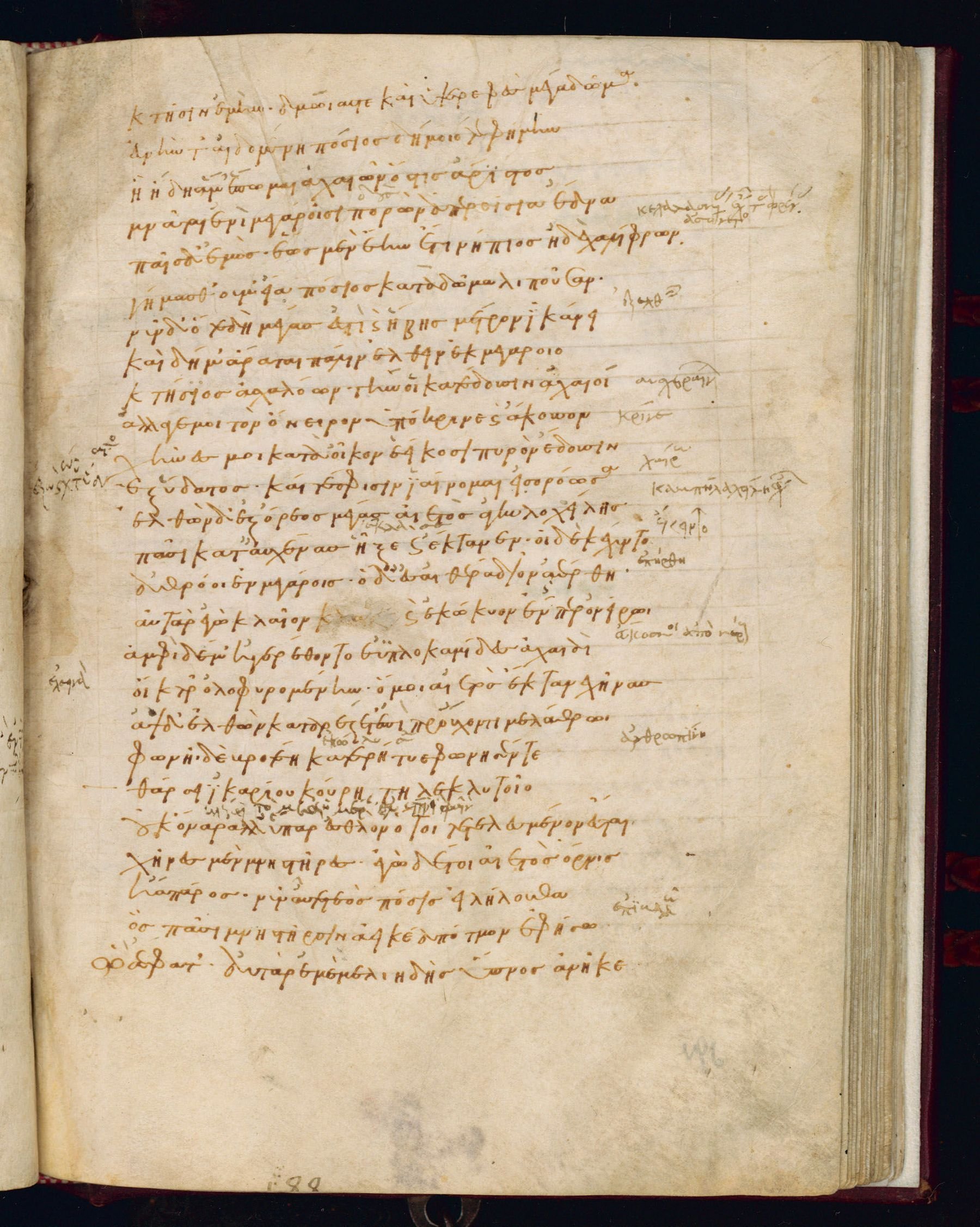
Where on the image
Laur. Plut. 32.24, fol. 196r: Odyssey 19.526-551, begins ‹κτῆσιν ἐμήν, δμῶάς τε›, ends ‹ἐμὲ μελιηδὴς ὕπνος ἀνῆκε·›. Checked on the image: first and last lines read and matched to the Greek. Fol. 195v ends with 19.525. Fol. 196v begins with 19.552. English blocks here: 525-529, 530-534, 535-539, 540-543, 544-544, 545-549.
526κτῆσιν ἐμήν, δμῶάς τε καὶ ὑψερεφὲς μέγα δῶμα,
527εὐνήν τʼ αἰδομένη πόσιος δήμοιό τε φῆμιν,
528ἦ ἤδη ἅμʼ ἕπωμαι Ἀχαιῶν ὅς τις ἄριστος
529μνᾶται ἐνὶ μεγάροισι, πορὼν ἀπερείσια ἕδνα.
530παῖς δʼ ἐμὸς ἧος ἔην ἔτι νήπιος ἠδὲ χαλίφρων,
531γήμασθʼ οὔ μʼ εἴα πόσιος κατὰ δῶμα λιποῦσαν·
532νῦν δʼ ὅτε δὴ μέγας ἐστὶ καὶ ἥβης μέτρον ἱκάνει,
533καὶ δή μʼ ἀρᾶται πάλιν ἐλθέμεν ἐκ μεγάροιο,
534κτήσιος ἀσχαλόων, τήν οἱ κατέδουσιν Ἀχαιοί.
535ἀλλʼ ἄγε μοι τὸν ὄνειρον ὑπόκριναι καὶ ἄκουσον.
536χῆνές μοι κατὰ οἶκον ἐείκοσι πυρὸν ἔδουσιν
537ἐξ ὕδατος, καί τέ σφιν ἰαίνομαι εἰσορόωσα·
538ἐλθὼν δʼ ἐξ ὄρεος μέγας αἰετὸς ἀγκυλοχείλης
539πᾶσι κατʼ αὐχένας ἦξε καὶ ἔκτανεν· οἱ δʼ ἐκέχυντο
540ἀθρόοι ἐν μεγάροις, ὁ δʼ ἐς αἰθέρα δῖαν ἀέρθη.
541αὐτὰρ ἐγὼ κλαῖον καὶ ἐκώκυον ἔν περ ὀνείρῳ,
542ἀμφὶ δʼ ἔμʼ ἠγερέθοντο ἐϋπλοκαμῖδες Ἀχαιαί,
543οἴκτρʼ ὀλοφυρομένην ὅ μοι αἰετὸς ἔκτανε χῆνας.
544ἂψ δʼ ἐλθὼν κατʼ ἄρʼ ἕζετʼ ἐπὶ προὔχοντι μελάθρῳ,
545φωνῇ δὲ βροτέῃ κατερήτυε φώνησέν τε·
546θάρσει, Ἰκαρίου κούρη τηλεκλειτοῖο·
547οὐκ ὄναρ, ἀλλʼ ὕπαρ ἐσθλόν, ὅ τοι τετελεσμένον ἔσται.
548χῆνες μὲν μνηστῆρες, ἐγὼ δέ τοι αἰετὸς ὄρνις
549ἦα πάρος, νῦν αὖτε τεὸς πόσις εἰλήλουθα,
550ὃς πᾶσι μνηστῆρσιν ἀεικέα πότμον ἐφήσω.
551ὣς ἔφατʼ, αὐτὰρ ἐμὲ μελιηδὴς ὕπνος ἀνῆκε·
525whether to abide with my son and keep all things safe, my possessions, my slaves, and my great, high-roofed house, respecting the bed of my husband and the voice of the people, or to go now with him whosoever is best of the Achaeans, who woos me in the halls and offers bride-gifts past counting. 530Furthermore my son, so long as he was a child and slack of wit, would not suffer me to marry and leave the house of my husband; but now that he is grown and has reached the bounds of manhood, lo, he even prays me to go back again from these halls, being vexed for his substance that the Achaeans devour to his cost. 535But come now, hear this dream of mine, and interpret it for me. Twenty geese I have in the house that come forth from the water and eat wheat, and my heart warms with joy as I watch them. But forth from the mountain there came a great eagle with crooked beak and broke all their necks and killed them; and they lay strewn 540in a heap in the halls, while he was borne aloft to the bright sky. Now for my part I wept and wailed, in a dream though it was, and round me thronged the fair-tressed Achaean women, as I grieved piteously because the eagle had slain my geese. 544Then back he came and perched upon a projecting roof-beam, 545and with the voice of a mortal man checked my weeping, and said: “‘Be of good cheer, daughter of far-famed Icarius; this is no dream, but a true vision of good which shall verily find fulfillment. The geese are the wooers, and I, that before was the eagle, am now again come back as thy husband,
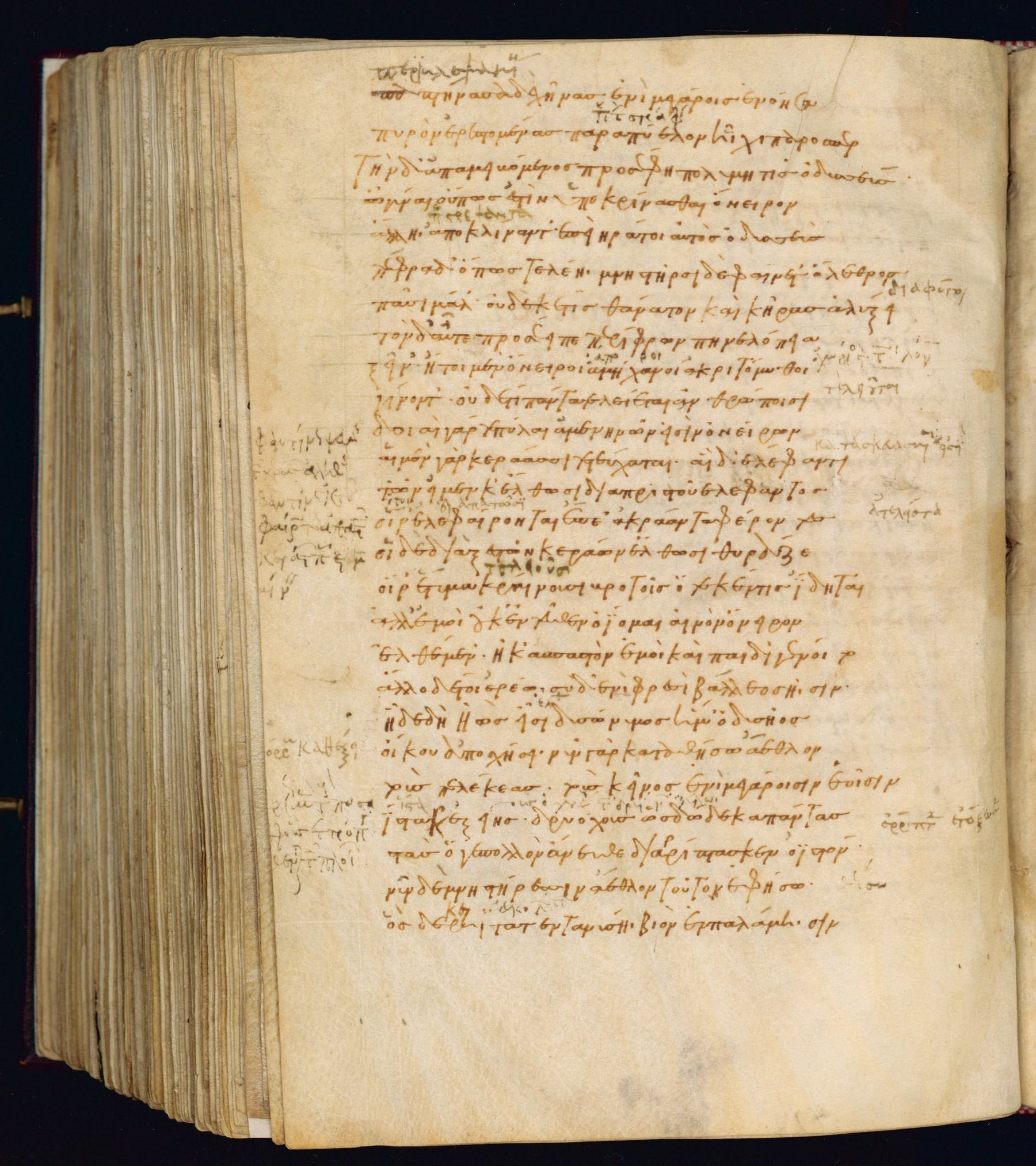
Where on the image
Laur. Plut. 32.24, fol. 196v: Odyssey 19.552-577, begins ‹παπτήνασα δὲ χῆνας ἐνὶ›, ends ‹ἐντανύσῃ βιὸν ἐν παλάμῃσι›. Checked on the image: first and last lines read and matched to the Greek. Fol. 196r ends with 19.551. Fol. 197r begins with 19.578. English blocks here: 550-554, 555-559, 560-564, 565-569, 570-574, 575-575, 576-579.
552παπτήνασα δὲ χῆνας ἐνὶ μεγάροισι νόησα
553πυρὸν ἐρεπτομένους παρὰ πύελον, ἧχι πάρος περ.
554τὴν δʼ ἀπαμειβόμενος προσέφη πολύμητις Ὀδυσσεύς·
555ὦ γύναι, οὔ πως ἔστιν ὑποκρίνασθαι ὄνειρον
556ἄλλῃ ἀποκλίναντʼ, ἐπεὶ ἦ ῥά τοι αὐτὸς Ὀδυσσεὺς
557πέφραδʼ ὅπως τελέει· μνηστῆρσι δὲ φαίνετʼ ὄλεθρος
558πᾶσι μάλʼ, οὐδέ κέ τις θάνατον καὶ κῆρας ἀλύξει.
559τὸν δʼ αὖτε προσέειπε περίφρων Πηνελόπεια·
560ξεῖνʼ, ἦ τοι μὲν ὄνειροι ἀμήχανοι ἀκριτόμυθοι
561γίγνοντʼ, οὐδέ τι πάντα τελείεται ἀνθρώποισι.
562δοιαὶ γάρ τε πύλαι ἀμενηνῶν εἰσὶν ὀνείρων·
563αἱ μὲν γὰρ κεράεσσι τετεύχαται, αἱ δʼ ἐλέφαντι·
564τῶν οἳ μέν κʼ ἔλθωσι διὰ πριστοῦ ἐλέφαντος,
565οἵ ῥʼ ἐλεφαίρονται, ἔπεʼ ἀκράαντα φέροντες·
566οἱ δὲ διὰ ξεστῶν κεράων ἔλθωσι θύραζε,
567οἵ ῥʼ ἔτυμα κραίνουσι, βροτῶν ὅτε κέν τις ἴδηται.
568ἀλλʼ ἐμοὶ οὐκ ἐντεῦθεν ὀΐομαι αἰνὸν ὄνειρον
569ἐλθέμεν· ἦ κʼ ἀσπαστὸν ἐμοὶ καὶ παιδὶ γένοιτο.
570ἄλλο δέ τοι ἐρέω, σὺ δʼ ἐνὶ φρεσὶ βάλλεο σῇσιν·
571ἥδε δὴ ἠὼς εἶσι δυσώνυμος, ἥ μʼ Ὀδυσῆος
572οἴκου ἀποσχήσει· νῦν γὰρ καταθήσω ἄεθλον,
573τοὺς πελέκεας, τοὺς κεῖνος ἐνὶ μεγάροισιν ἑοῖσιν
574ἵστασχʼ ἑξείης, δρυόχους ὥς, δώδεκα πάντας·
575στὰς δʼ ὅ γε πολλὸν ἄνευθε διαρρίπτασκεν ὀϊστόν.
576νῦν δὲ μνηστήρεσσιν ἄεθλον τοῦτον ἐφήσω·
577ὃς δέ κε ῥηΐτατʼ ἐντανύσῃ βιὸν ἐν παλάμῃσι
550who will let loose a cruel doom upon all the wooers.’ “So he spoke, and sweet sleep released me, and looking about I saw the geese in the halls, feeding on wheat beside the trough, where they had before been wont to feed.” Then Odysseus of many wiles answered her and said: 555“Lady, in no wise is it possible to wrest this dream aside and give it another meaning, since verily Odysseus himself has shewn thee how he will bring it to pass. For the wooers' destruction is plain to see, for one and all; not one of them shall escape death and the fates.” Then wise Penelope answered him again: 560“Stranger, dreams verily are baffling and unclear of meaning, and in no wise do they find fulfillment in all things for men. For two are the gates of shadowy dreams, and one is fashioned of horn and one of ivory. Those dreams that pass through the gate of sawn ivory 565deceive men, bringing words that find no fulfillment. But those that come forth through the gate of polished horn bring true issues to pass, when any mortal sees them. But in my case it was not from thence, methinks, that my strange dream came. Ah, truly it would then have been welcome to me and to my son. 570But another thing will I tell thee, and do thou lay it to heart. Even now is coming on this morn of evil name which is to cut me off from the house of Odysseus; for now I shall appoint for a contest those axes which he was wont to set up in line in his halls, like props of a ship that is building, twelve in all, 575and he would stand afar off and shoot an arrow through them. 576Now then I shall set this contest before the wooers: whosoever shall most easily string the bow in his hands, and shoot an arrow through all twelve axes, with him will I go and forsake this house
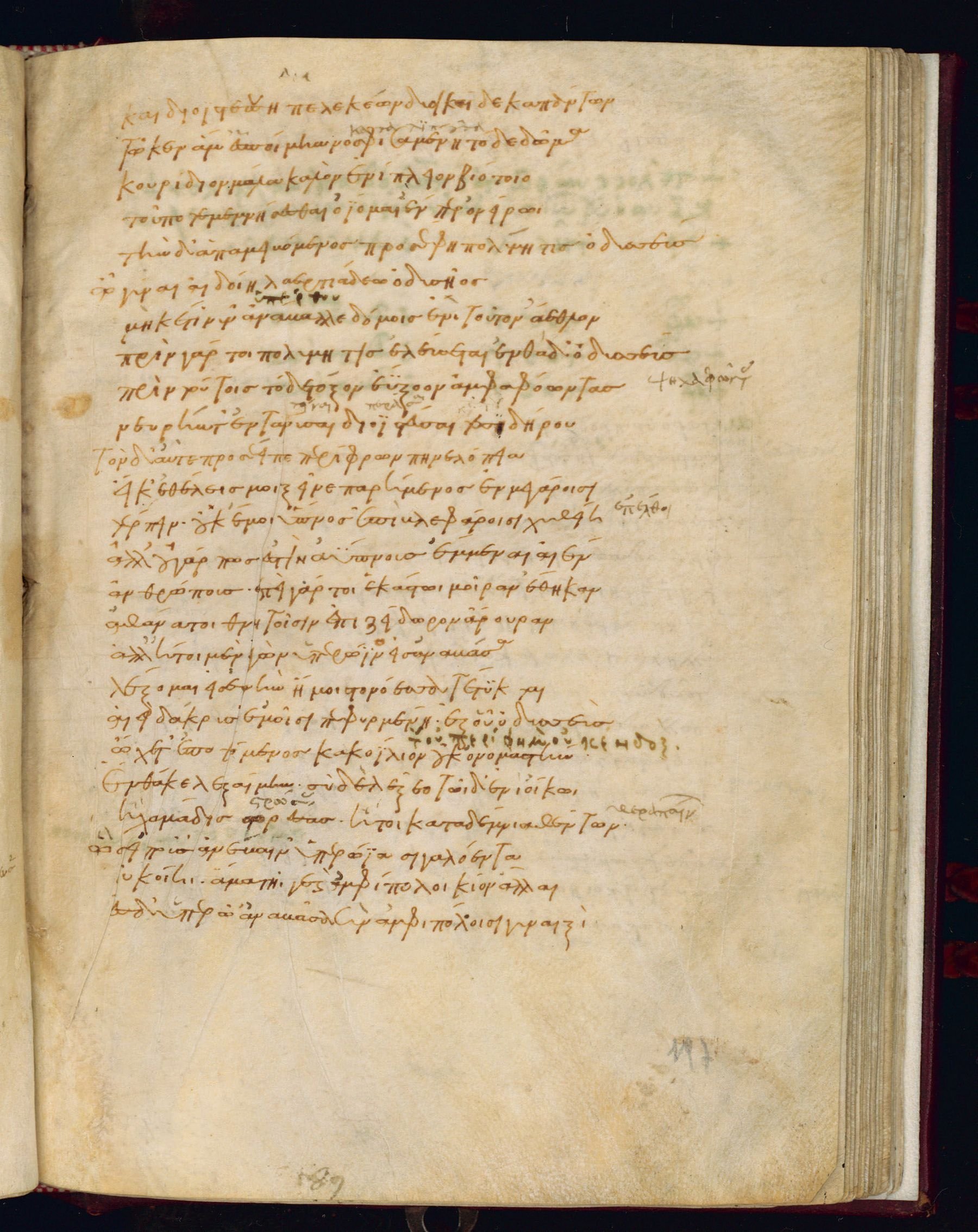
Where on the image
Laur. Plut. 32.24, fol. 197r: Odyssey 19.578-602, begins ‹καὶ διοϊστεύσῃ πελέκεων δυοκαίδεκα›, ends ‹ἀναβᾶσα σὺν ἀμφιπόλοισι γυναιξὶ›. Checked on the image: first and last lines read and matched to the Greek. Fol. 196v ends with 19.577. Fol. 197v begins with 19.603. English blocks here: 580-584, 585-589, 590-594, 595-599, 600-604.
578καὶ διοϊστεύσῃ πελέκεων δυοκαίδεκα πάντων,
579τῷ κεν ἅμʼ ἑσποίμην, νοσφισσαμένη τόδε δῶμα
580κουρίδιον, μάλα καλόν, ἐνίπλειον βιότοιο·
581τοῦ ποτὲ μεμνήσεσθαι ὀΐομαι ἔν περ ὀνείρῳ.
582τὴν δʼ ἀπαμειβόμενος προσέφη πολύμητις Ὀδυσσεύς
583ὦ γύναι αἰδοίη Λαερτιάδεω Ὀδυσῆος,
584μηκέτι νῦν ἀνάβαλλε δόμοις ἔνι τοῦτον ἄεθλον·
585πρὶν γάρ τοι πολύμητις ἐλεύσεται ἐνθάδʼ Ὀδυσσεύς,
586πρὶν τούτους τόδε τόξον ἐΰξοον ἀμφαφόωντας
587νευρήν τʼ ἐντανύσαι διοϊστεῦσαί τε σιδήρου.
588τὸν δʼ αὖτε προσέειπε περίφρων Πηνελόπεια·
589εἴ κʼ ἐθέλοις μοι, ξεῖνε, παρήμενος ἐν μεγάροισι
590τέρπειν, οὔ κέ μοι ὕπνος ἐπὶ βλεφάροισι χυθείη.
591ἀλλʼ οὐ γάρ πως ἔστιν ἀΰπνους ἔμμεναι αἰεὶ
592ἀνθρώπους· ἐπὶ γάρ τοι ἑκάστῳ μοῖραν ἔθηκαν
593ἀθάνατοι θνητοῖσιν ἐπὶ ζείδωρον ἄρουραν.
594ἀλλʼ ἦ τοι μὲν ἐγὼν ὑπερώϊον εἰσαναβᾶσα
595λέξομαι εἰς εὐνήν, ἥ μοι στονόεσσα τέτυκται,
596αἰεὶ δάκρυσʼ ἐμοῖσι πεφυρμένη, ἐξ οὗ Ὀδυσσεὺς
597ᾤχετʼ ἐποψόμενος Κακοΐλιον οὐκ ὀνομαστήν.
598ἔνθα κε λεξαίμην· σὺ δὲ λέξεο τῷδʼ ἐνὶ οἴκῳ,
599ἢ χαμάδις στορέσας ἤ τοι κατὰ δέμνια θέντων.
600ὣς εἰποῦσʼ ἀνέβαινʼ ὑπερώϊα σιγαλόεντα,
601οὐκ οἴη, ἅμα τῇ γε καὶ ἀμφίπολοι κίον ἄλλαι.
602ἐς δʼ ὑπερῷʼ ἀναβᾶσα σὺν ἀμφιπόλοισι γυναιξὶ
580of my wedded life, a house most fair and filled with livelihood, which, methinks, I shall ever remember even in my dreams.” Then Odysseus of many wiles answered her, and said: “Honored wife of Odysseus, son of Laertes, no longer now do thou put off this contest in thy halls; 585for, I tell thee, Odysseus of many wiles will be here, ere these men, handling this polished bow, shall have strung it, and shot an arrow through the iron.” Then wise Penelope answered him: “If thou couldest but wish, stranger, to sit here in my halls 590and give me joy, sleep should never be shed over my eyelids. But it is in no wise possible that men should forever be sleepless, for the immortals have appointed a proper time for each thing upon the earth, the giver of grain. But I verily will go to my upper chamber 595and lay me on my bed, which has become for me a bed of wailings, ever bedewed with my tears, since the day when Odysseus went to see evil Ilios, that should never be named. There will I lay me down, but do thou lie down here in the hall, when thou hast strewn bedding on the floor; or let the maids set a bedstead for thee.” 600So saying, she went up to her bright upper chamber, not alone, for with her went her handmaids as well. And when she had gone up to her upper chamber with her handmaids, she then bewailed Odysseus, her dear husband, until flashing-eyed Athena cast sweet sleep upon her eyelids.
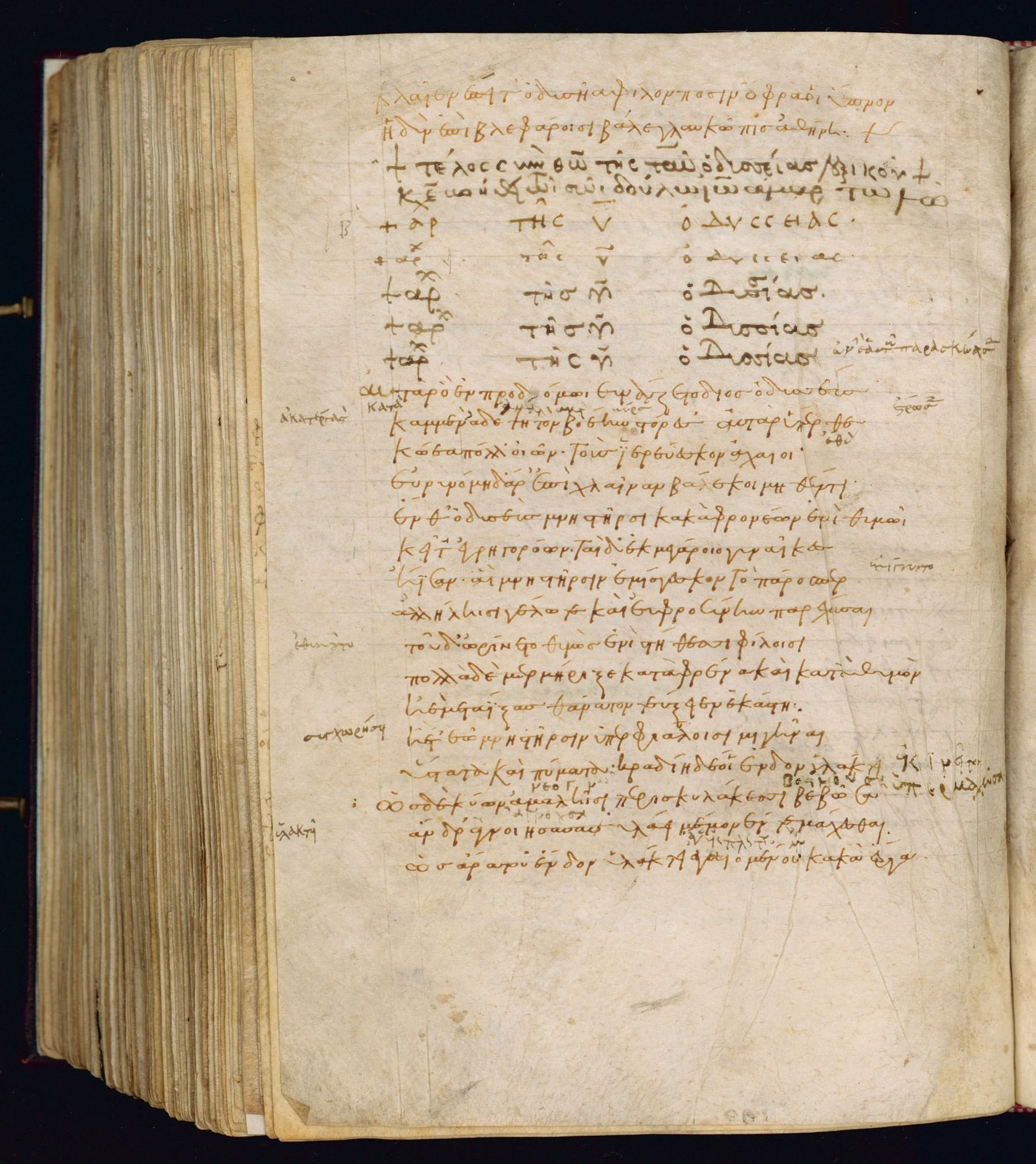
Where on the image
Laur. Plut. 32.24, fol. 197v: Odyssey 19.603-604, begins ‹κλαῖεν ἔπειτʼ Ὀδυσῆα, φίλον›, ends ‹βλεφάροισι βάλε γλαυκῶπις Ἀθήνη.›. Checked on the image: first and last lines read and matched to the Greek. Fol. 197r ends with 19.602. The page holds 19.603-604, 20.1-16. Book 19 ends with 19.604; a subscription (τέλος σὺν θεῷ τῆς ... ὀδυσσείας) and a second line in the same style follow, then five short lines in a later hand repeating the heading for book 20 (ἀρχὴ τῆς υ ὀδυσσείας). Book 20 begins after them.
603κλαῖεν ἔπειτʼ Ὀδυσῆα, φίλον πόσιν, ὄφρα οἱ ὕπνον
604ἡδὺν ἐπὶ βλεφάροισι βάλε γλαυκῶπις Ἀθήνη.
The English for these lines is given with the neighbouring page (Murray's prose is divided every five lines).
Notes
- Greek: A. T. Murray, Homer: The Odyssey (Loeb Classical Library, 1919), via Perseus.
- English: A. T. Murray's translation in the same edition; his footnotes are omitted.
Cite
Sources
- Source: Laur. Plut. 32.24 (BML Teca Digitale IIIF) + Murray Greek (Loeb 1919, Perseus) + Murray English (Loeb 1919, Perseus) (holding institution)
- Critical edition: Murray, Loeb 1919, via Perseus
← previous · → next · v cycle view · l back to library