Homer, Odyssey, Book 5: Calypso and the raft
Introduction
The Odyssey, composed around 700 BCE and attributed to Homer, tells of Odysseus' ten-year journey home from Troy and his return to Ithaca. Book 5 (493 lines): Calypso and the raft.
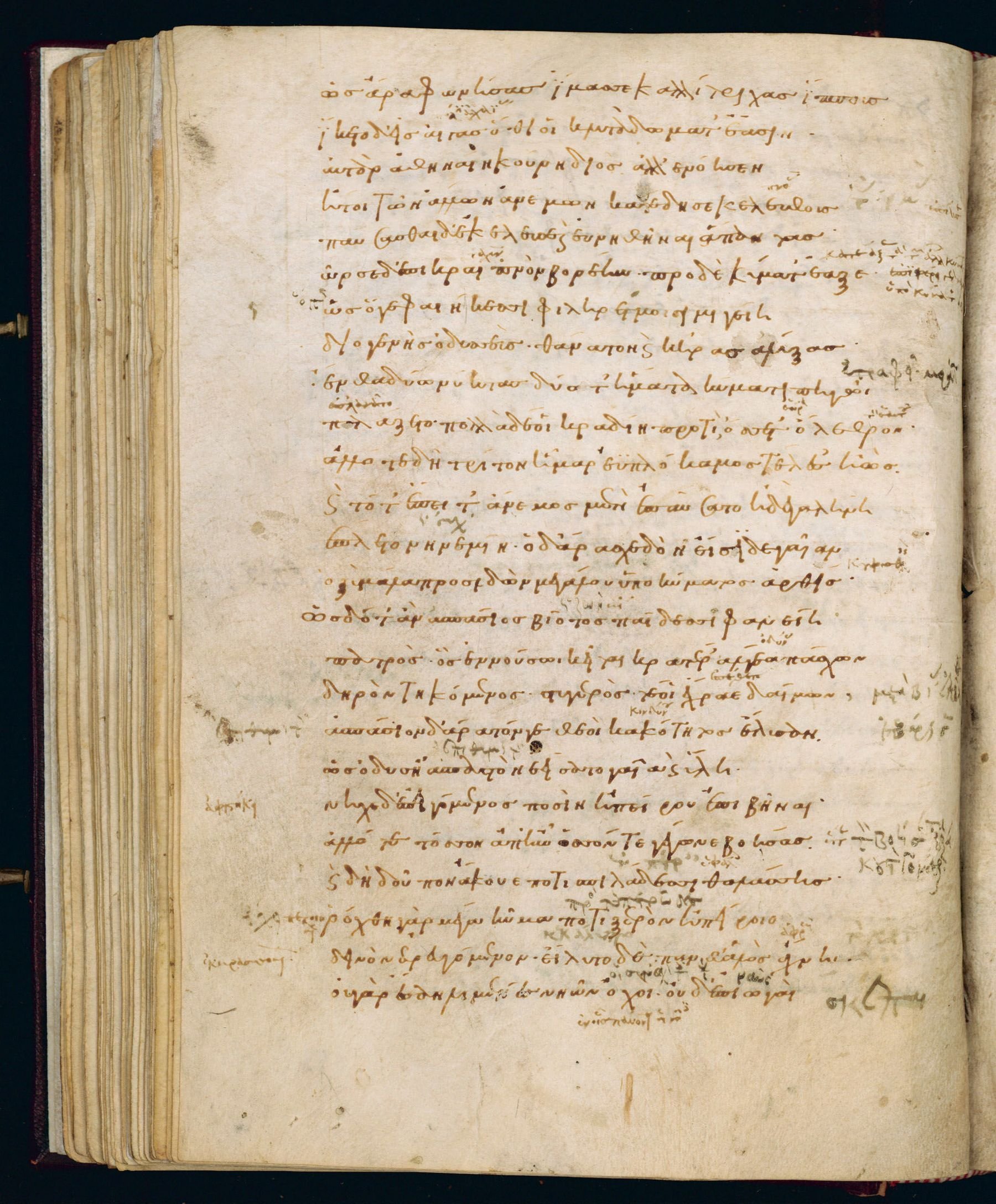
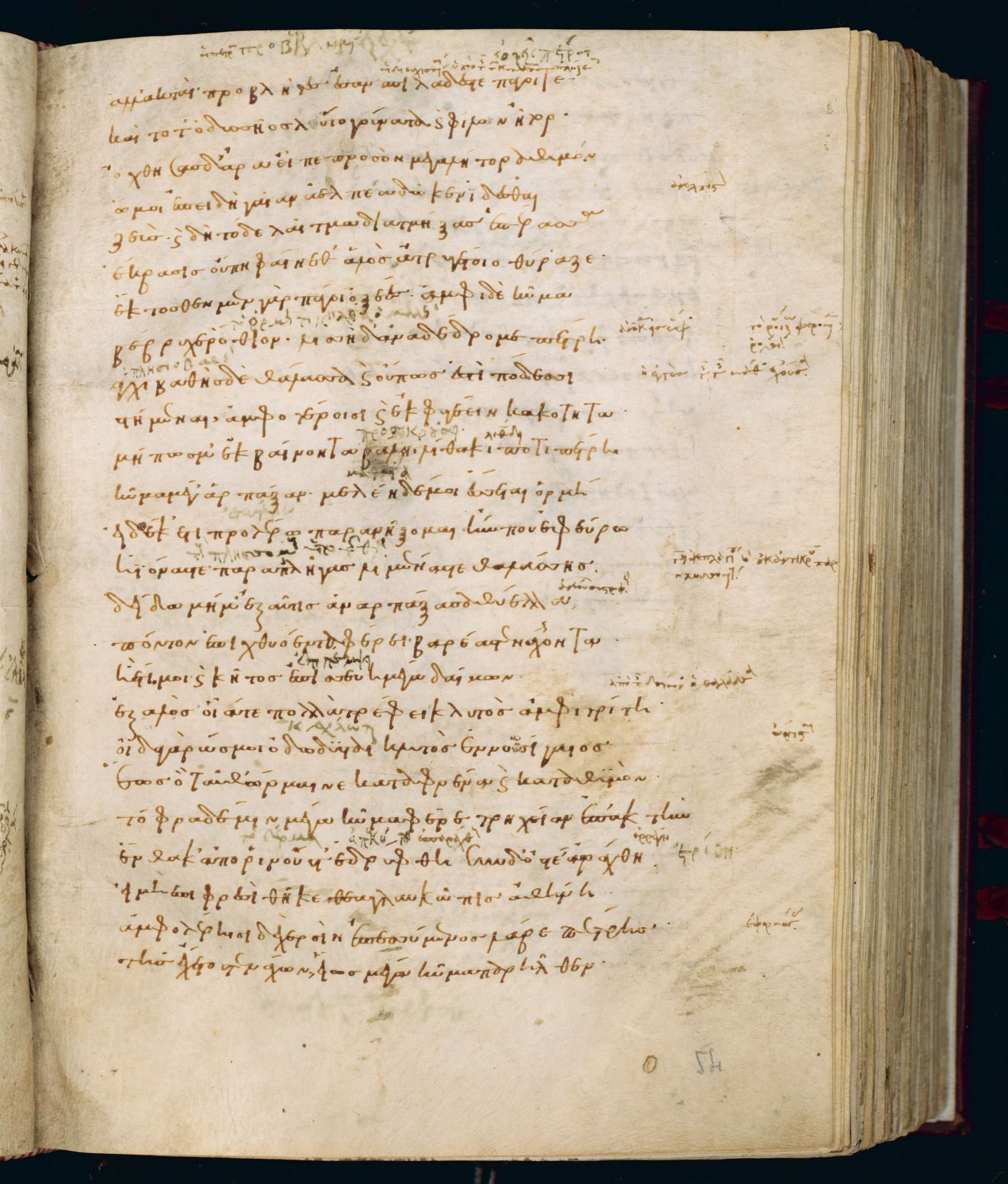
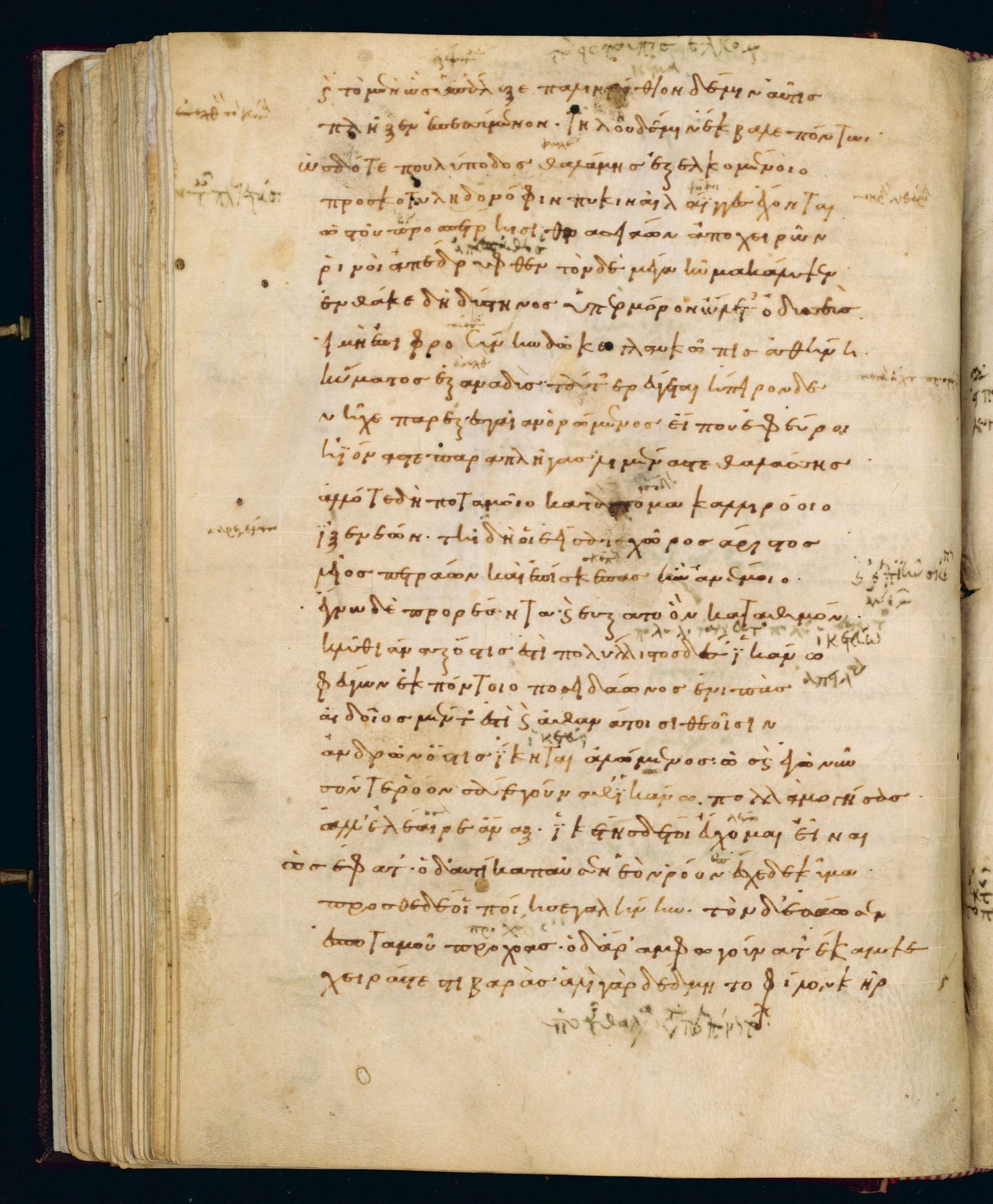
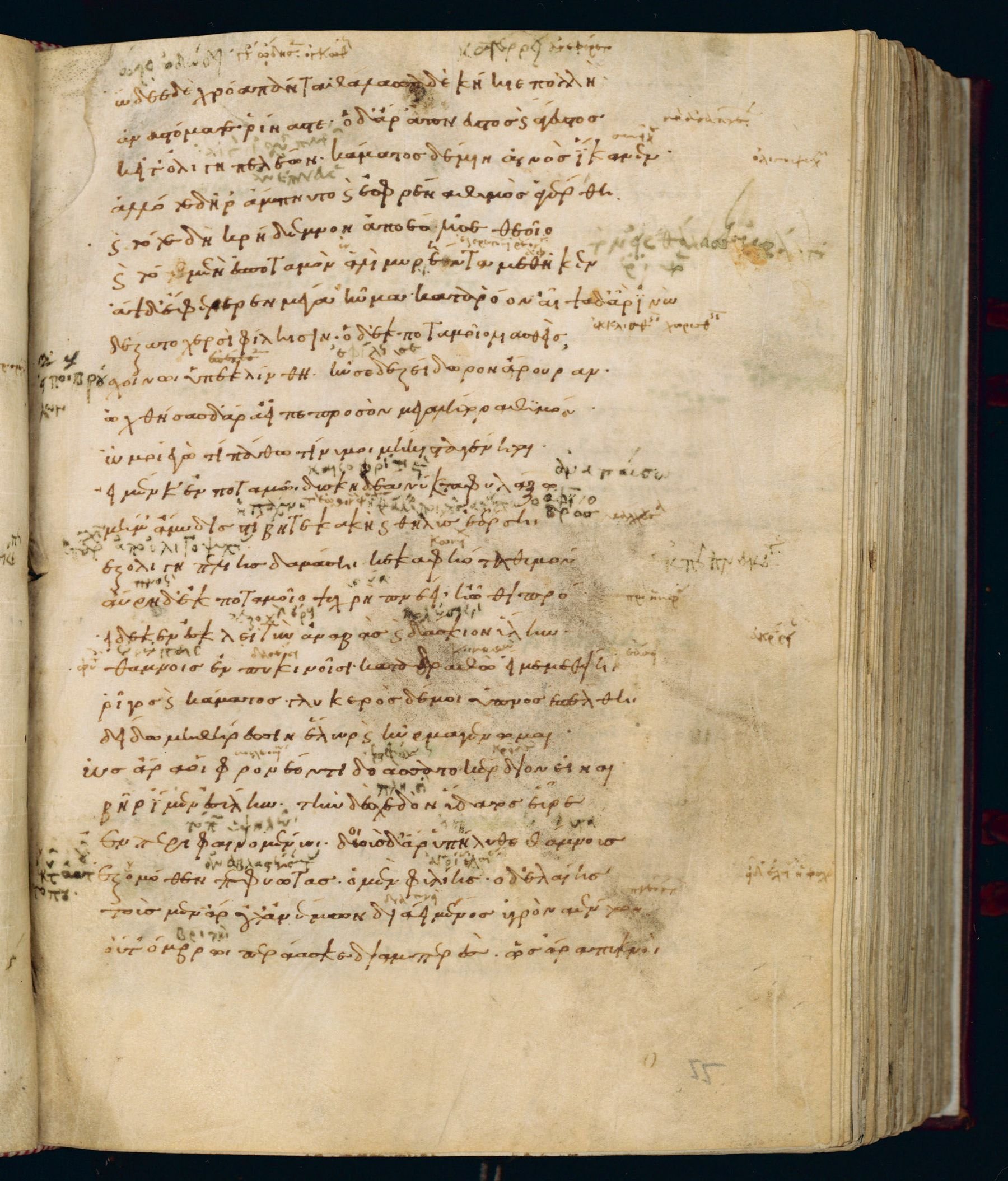
The page photographs are from Florence, Biblioteca Medicea Laurenziana, Plut. 32.24 (parchment, 10th century, 234 folios; the oldest manuscript of the Odyssey with published images), in the Biblioteca Medicea Laurenziana's Teca Digitale. This book is on fol. 45v-55v; each section below is one page, with its first and last line as read on the photograph. Many pages carry interlinear glosses and a few marginal notes in later hands.
The Greek is A. T. Murray's Loeb text (1919) via Perseus, not a transcription of this manuscript, whose wording differs in places. The English is Murray's prose translation (1919), divided every five lines; at a page break a five-line block goes with the page holding most of it, except at the page breaks where a section's note says the English is cut at the end of Murray's sentence. Each section's note gives its English line range.
Where the scribe left out a line, wrote one in the margin, changed the order or added a line not in Murray's text, the section's note on the photograph says so; the Greek and English shown are Murray's full text for the page's range.
How was this verified? (Provenance)
Where on the image
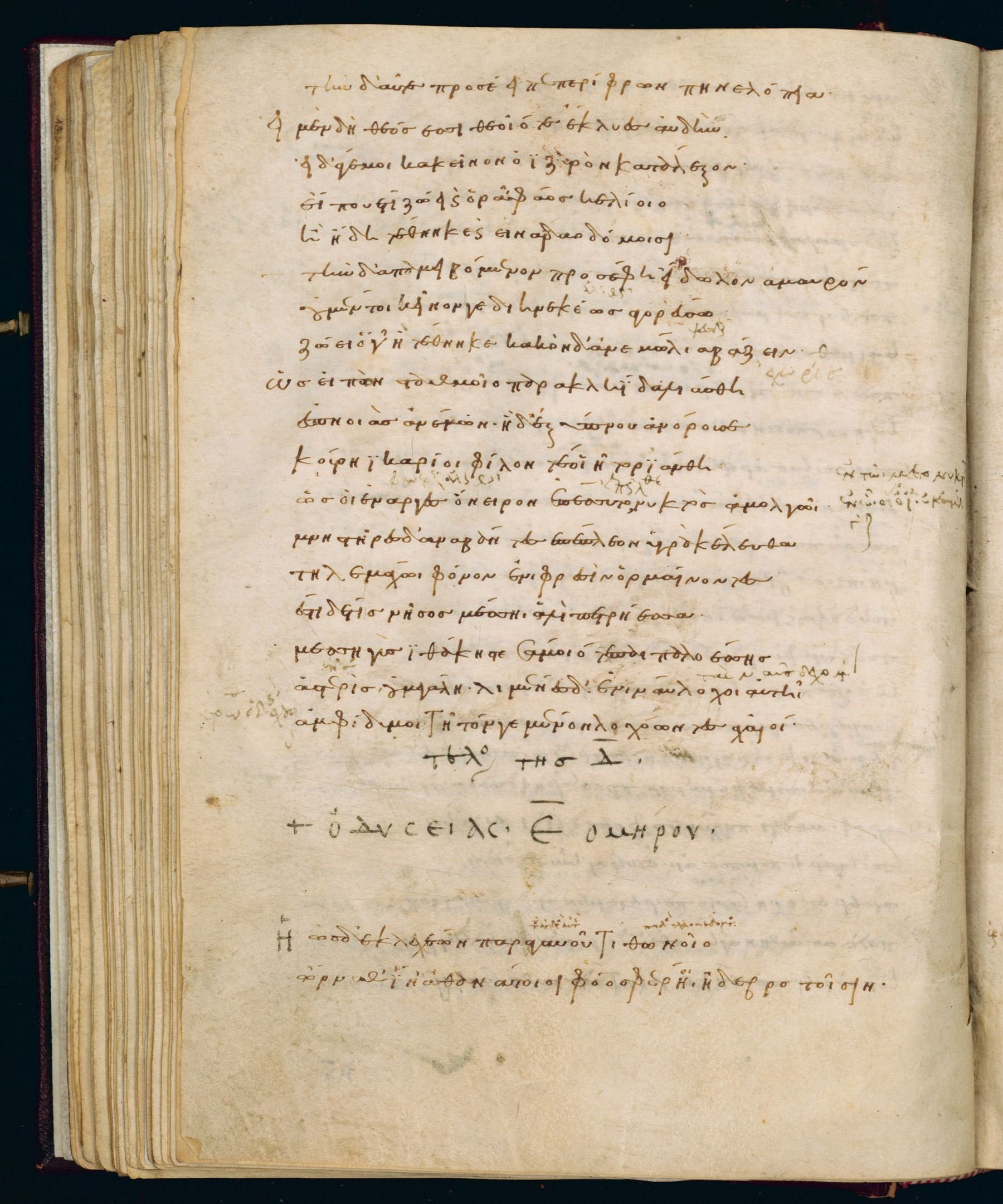
Laur. Plut. 32.24, fol. 45v: Odyssey 5.1-2, begins ‹Ἠὼς δʼ ἐκ λεχέων›, ends ‹φόως φέροι ἠδὲ βροτοῖσιν·›. Checked on the image: first and last lines read and matched to the Greek. Fol. 46r begins with 5.3. The page holds 4.830-847, 5.1-2. Book 4 ends with 4.847, followed by the subscription τέλος τῆς δ; a heading + ὀδυσσείας ε ὁμήρου follows after a space and book 5 begins with an enlarged initial Η. English blocks here: 1-4.
1Ἠὼς δʼ ἐκ λεχέων παρʼ ἀγαυοῦ Τιθωνοῖο
2ὤρνυθʼ, ἵνʼ ἀθανάτοισι φόως φέροι ἠδὲ βροτοῖσιν·
1Now Dawn arose from her couch from beside lordly Tithonus, to bear light to the immortals and to mortal men. And the gods were sitting down to council, and among them Zeus, who thunders on high, whose might is supreme.
Where on the image
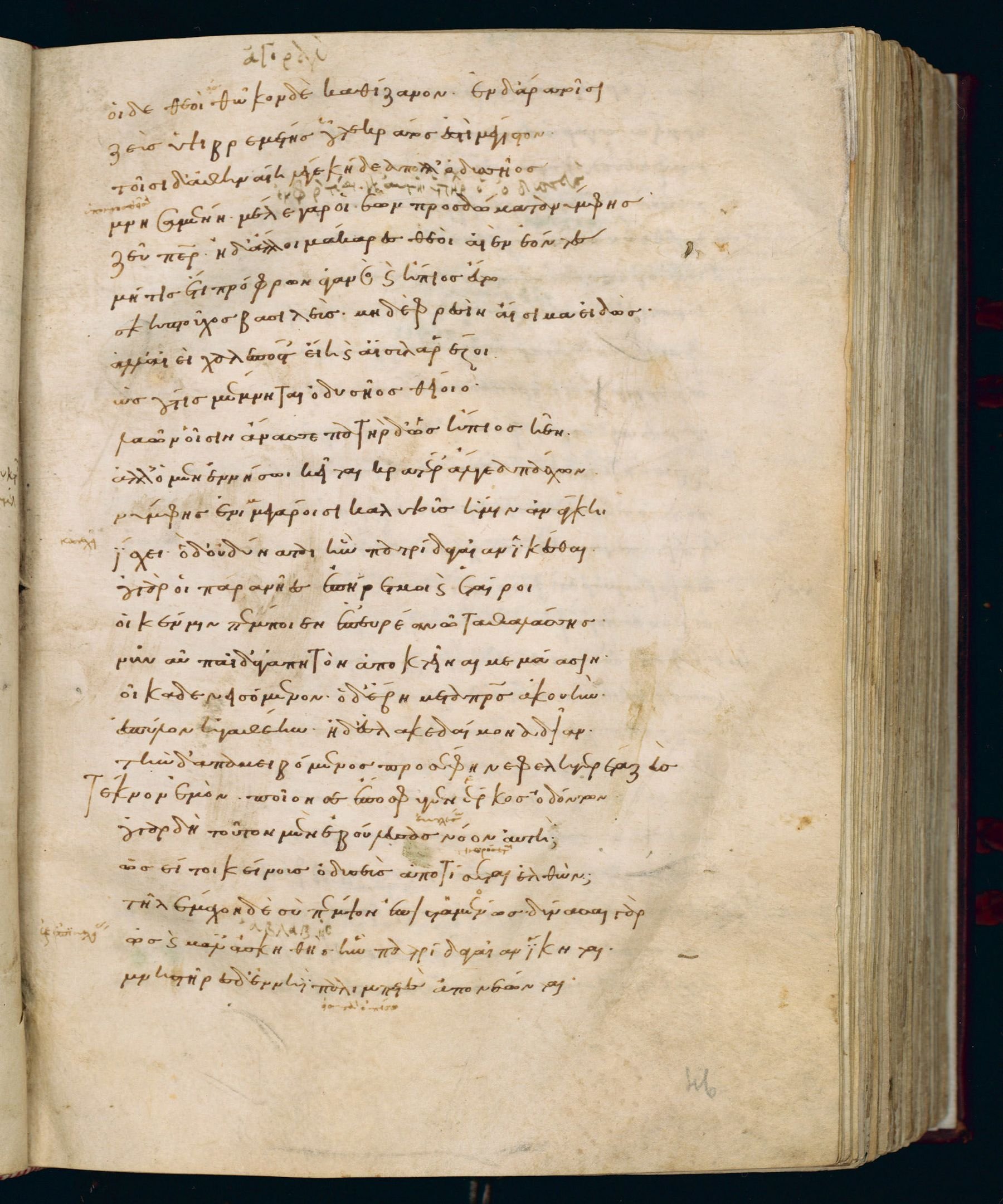
Laur. Plut. 32.24, fol. 46r: Odyssey 5.3-27, begins ‹οἱ δὲ θεοὶ θῶκόνδε›, ends ‹ἐν νηὶ· παλιμπετὲς ἀπονέωνται.›. Checked on the image: first and last lines read and matched to the Greek. Fol. 45v ends with 5.2. Fol. 46v begins with 5.28. English blocks here: 5-9, 10-14, 15-19, 20-24, 25-29.
3οἱ δὲ θεοὶ θῶκόνδε καθίζανον, ἐν δʼ ἄρα τοῖσι
4Ζεὺς ὑψιβρεμέτης, οὗ τε κράτος ἐστὶ μέγιστον.
5τοῖσι δʼ Ἀθηναίη λέγε κήδεα πόλλʼ Ὀδυσῆος
6μνησαμένη· μέλε γάρ οἱ ἐὼν ἐν δώμασι νύμφης·
7Ζεῦ πάτερ ἠδʼ ἄλλοι μάκαρες θεοὶ αἰὲν ἐόντες,
8μή τις ἔτι πρόφρων ἀγανὸς καὶ ἤπιος ἔστω
9σκηπτοῦχος βασιλεύς, μηδὲ φρεσὶν αἴσιμα εἰδώς,
10ἀλλʼ αἰεὶ χαλεπός τʼ εἴη καὶ αἴσυλα ῥέζοι·
11ὡς οὔ τις μέμνηται Ὀδυσσῆος θείοιο
12λαῶν οἷσιν ἄνασσε, πατὴρ δʼ ὣς ἤπιος ἦεν.
13ἀλλʼ ὁ μὲν ἐν νήσῳ κεῖται κρατέρʼ ἄλγεα πάσχων
14νύμφης ἐν μεγάροισι Καλυψοῦς, ἥ μιν ἀνάγκῃ
15ἴσχει· ὁ δʼ οὐ δύναται ἣν πατρίδα γαῖαν ἱκέσθαι·
16οὐ γάρ οἱ πάρα νῆες ἐπήρετμοι καὶ ἑταῖροι,
17οἵ κέν μιν πέμποιεν ἐπʼ εὐρέα νῶτα θαλάσσης.
18νῦν αὖ παῖδʼ ἀγαπητὸν ἀποκτεῖναι μεμάασιν
19οἴκαδε νισόμενον· ὁ δʼ ἔβη μετὰ πατρὸς ἀκουὴν
20ἐς Πύλον ἠγαθέην ἠδʼ ἐς Λακεδαίμονα δῖαν.
21τὴν δʼ ἀπαμειβόμενος προσέφη νεφεληγερέτα Ζεύς·
22τέκνον ἐμόν, ποῖόν σε ἔπος φύγεν ἕρκος ὀδόντων.
23οὐ γὰρ δὴ τοῦτον μὲν ἐβούλευσας νόον αὐτή,
24ὡς ἦ τοι κείνους Ὀδυσεὺς ἀποτίσεται ἐλθών;
25Τηλέμαχον δὲ σὺ πέμψον ἐπισταμένως, δύνασαι γάρ,
26ὥς κε μάλʼ ἀσκηθὴς ἣν πατρίδα γαῖαν ἵκηται,
27μνηστῆρες δʼ ἐν νηὶ· παλιμπετὲς ἀπονέωνται.
5To them Athena was recounting the many woes of Odysseus, as she called them to mind; for it troubled her that he abode in the dwelling of the nymph: “Father Zeus, and ye other blessed gods that are forever, never henceforward let sceptred king with a ready heart be kind and gentle, nor let him heed righteousness in his mind; 10but let him ever be harsh, and work unrighteousness, seeing that no one remembers divine Odysseus of the people whose lord he was; yet gentle was he as a father. He verily abides in an island suffering grievous pains, in the halls of the nymph Calypso, who 15keeps him perforce; and he cannot return to his own land, for he has at hand no ships with oars and no comrades to send him on his way over the broad back of the sea. And now again they are minded to slay his well-loved son on his homeward way; for he went in quest of tidings of his father 20to sacred Pylos and to goodly Lacedaemon.” Then Zeus, the cloud-gatherer, answered her, and said: “My child, what a word has escaped the barrier of thy teeth! Didst thou not thyself devise this plan, that verily Odysseus might take vengeance on these men at his coming? 25But concerning Telemachus, do thou guide him in thy wisdom, for thou canst, that all unscathed he may reach his native land, and the wooers may come back in their ship baffled in their purpose.” He spoke, and said to Hermes, his dear son:“Hermes, do thou now, seeing that thou art at other times our messenger,
Where on the image
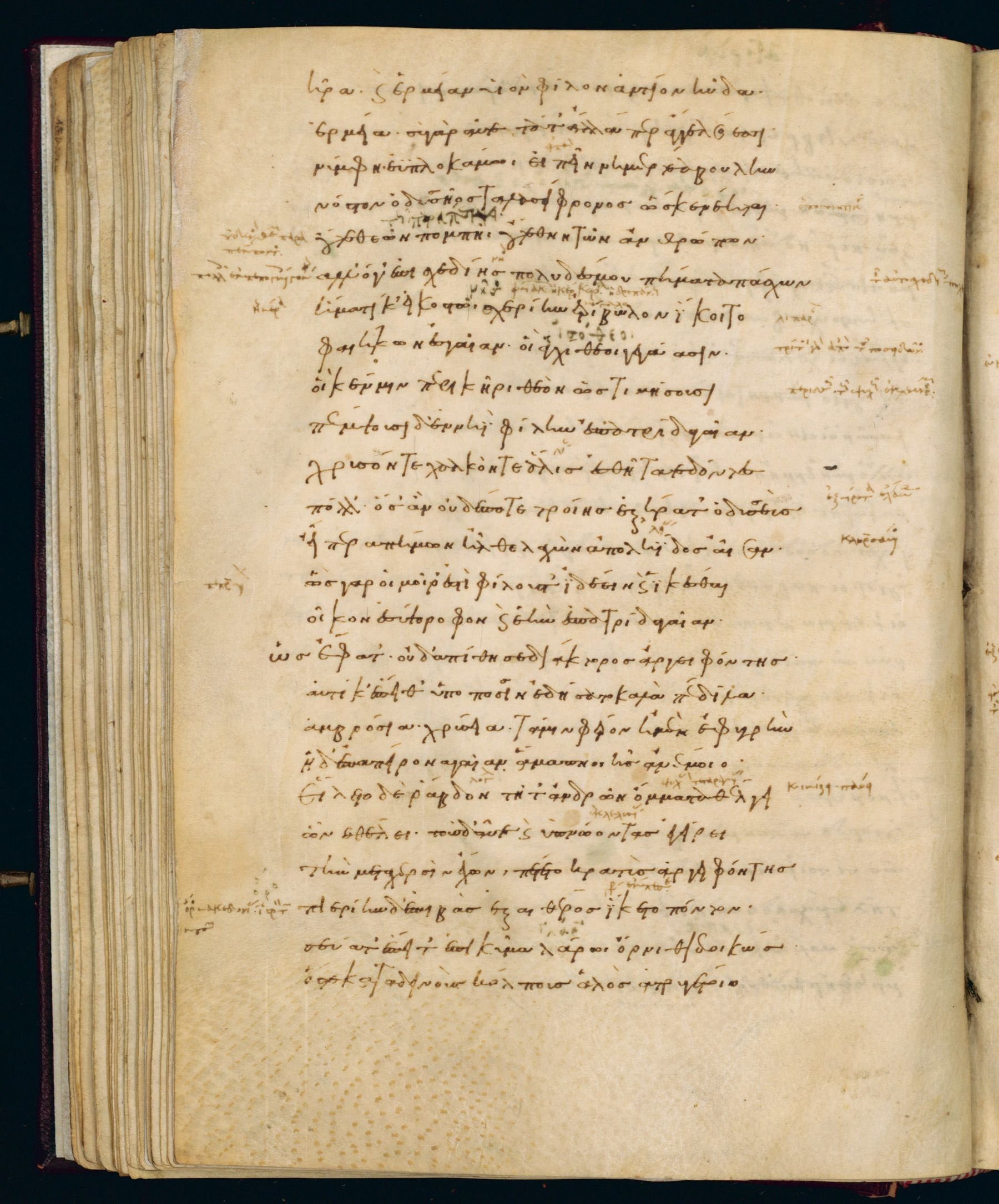
Laur. Plut. 32.24, fol. 46v: Odyssey 5.28-52, begins ‹ἦ ῥα καὶ Ἑρμείαν,›, ends ‹δεινοὺς κόλπους ἁλὸς ἀτρυγέτοιο›. Checked on the image: first and last lines read and matched to the Greek. Fol. 46r ends with 5.27. Fol. 47r begins with 5.53. English blocks here: 30-34, 35-39, 40-44, 45-49, 50-54.
28ἦ ῥα καὶ Ἑρμείαν, υἱὸν φίλον, ἀντίον ηὔδα·
29Ἑρμεία, σὺ γὰρ αὖτε τά τʼ ἄλλα περ ἄγγελός ἐσσι,
30νύμφῃ ἐυπλοκάμῳ εἰπεῖν νημερτέα βουλήν,
31νόστον Ὀδυσσῆος ταλασίφρονος, ὥς κε νέηται
32οὔτε θεῶν πομπῇ οὔτε θνητῶν ἀνθρώπων·
33ἀλλʼ ὅ γʼ ἐπὶ σχεδίης πολυδέσμου πήματα πάσχων
34ἤματί κʼ εἰκοστῷ Σχερίην ἐρίβωλον ἵκοιτο,
35Φαιήκων ἐς γαῖαν, οἳ ἀγχίθεοι γεγάασιν,
36οἵ κέν μιν περὶ κῆρι θεὸν ὣς τιμήσουσιν,
37πέμψουσιν δʼ ἐν νηὶ φίλην ἐς πατρίδα γαῖαν,
38χαλκόν τε χρυσόν τε ἅλις ἐσθῆτά τε δόντες,
39πόλλʼ, ὅσʼ ἂν οὐδέ ποτε Τροίης ἐξήρατʼ Ὀδυσσεύς,
40εἴ περ ἀπήμων ἦλθε, λαχὼν ἀπὸ ληίδος αἶσαν.
41ὣς γάρ οἱ μοῖρʼ ἐστὶ φίλους τʼ ἰδέειν καὶ ἱκέσθαι
42οἶκον ἐς ὑψόροφον καὶ ἑὴν ἐς πατρίδα γαῖαν.
43ὣς ἔφατʼ, οὐδʼ ἀπίθησε διάκτορος ἀργεϊφόντης.
44αὐτίκʼ ἔπειθʼ ὑπὸ ποσσὶν ἐδήσατο καλὰ πέδιλα,
45ἀμβρόσια χρύσεια, τά μιν φέρον ἠμὲν ἐφʼ ὑγρὴν
46ἠδʼ ἐπʼ ἀπείρονα γαῖαν ἅμα πνοιῇς ἀνέμοιο.
47εἵλετο δὲ ῥάβδον, τῇ τʼ ἀνδρῶν ὄμματα θέλγει,
48ὧν ἐθέλει, τοὺς δʼ αὖτε καὶ ὑπνώοντας ἐγείρει.
49τὴν μετὰ χερσὶν ἔχων πέτετο κρατὺς ἀργεϊφόντης.
50Πιερίην δʼ ἐπιβὰς ἐξ αἰθέρος ἔμπεσε πόντῳ·
51σεύατʼ ἔπειτʼ ἐπὶ κῦμα λάρῳ ὄρνιθι ἐοικώς,
52ὅς τε κατὰ δεινοὺς κόλπους ἁλὸς ἀτρυγέτοιο
30declare to the fair-tressed nymph our fixed resolve, even the return of Odysseus of the steadfast heart, that he may return with guidance neither of gods nor of mortal men, but that on a stoutly-bound raft, suffering woes, he may come on the twentieth day to deep-soiled Scheria, 35the land of the Phaeacians, who are near of kin to the gods. These shall heartily shew him all honor, as if he were a god, and shall send him in a ship to his dear native land, after giving him stores of bronze and gold and raiment, more than Odysseus would ever have won for himself from Troy, 40if he had returned unscathed with his due share of the spoil. For in this wise it is his fate to see his friends, and reach his high-roofed house and his native land.” So he spoke, and the messenger, Argeiphontes, failed not to hearken. Straightway he bound beneath his feet his beautiful sandals, 45immortal, golden, which were wont to bear him over the waters of the sea and over the boundless land swift as the blasts of the wind. And he took the wand wherewith he lulls to sleep the eyes of whom he will, while others again he awakens even out of slumber. With this in his hand the strong Argeiphontes flew. 50On to Pieria he stepped from the upper air, and swooped down upon the sea, and then sped over the wave like a bird, the cormorant, which in quest of fish over the dread gulfs of the unresting sea wets its thick plumage in the brine. In such wise did Hermes ride upon the multitudinous waves.
Where on the image
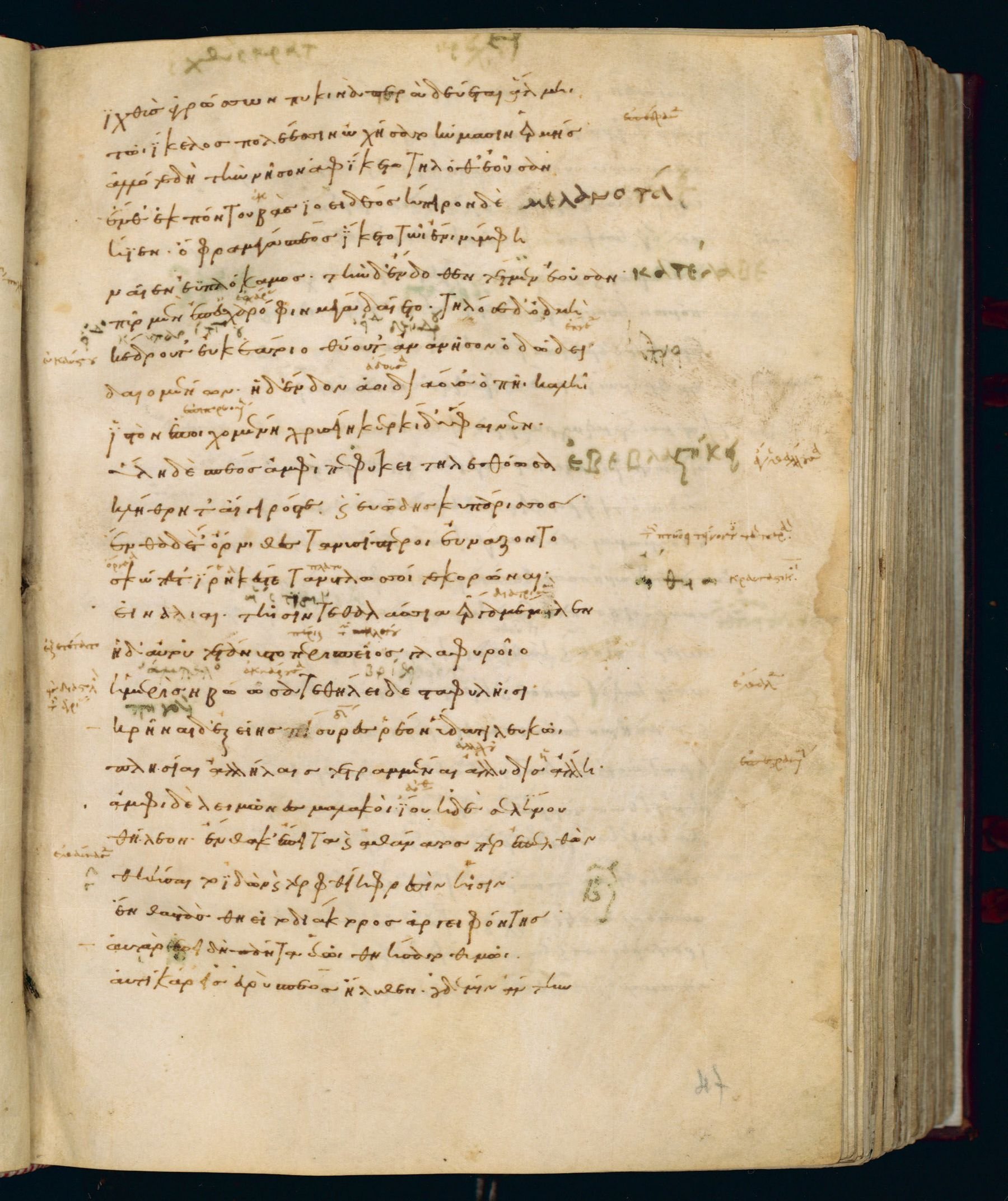
Laur. Plut. 32.24, fol. 47r: Odyssey 5.53-77, begins ‹ἰχθῦς ἀγρώσσων πυκινὰ πτερὰ›, ends ‹ἤλυθεν. οὐδέ μιν ἄντην›. Checked on the image: first and last lines read and matched to the Greek. Fol. 46v ends with 5.52. Fol. 47v begins with 5.78. English blocks here: 55-59, 60-64, 65-69, 70-74, 75-79.
53ἰχθῦς ἀγρώσσων πυκινὰ πτερὰ δεύεται ἅλμῃ·
54τῷ ἴκελος πολέεσσιν ὀχήσατο κύμασιν Ἑρμῆς.
55ἀλλʼ ὅτε δὴ τὴν νῆσον ἀφίκετο τηλόθʼ ἐοῦσαν,
56ἔνθʼ ἐκ πόντου βὰς ἰοειδέος ἤπειρόνδε
57ἤιεν, ὄφρα μέγα σπέος ἵκετο, τῷ ἔνι νύμφη
58ναῖεν ἐυπλόκαμος· τὴν δʼ ἔνδοθι τέτμεν ἐοῦσαν.
59πῦρ μὲν ἐπʼ ἐσχαρόφιν μέγα καίετο, τηλόσε δʼ ὀδμὴ
60κέδρου τʼ εὐκεάτοιο θύου τʼ ἀνὰ νῆσον ὀδώδει
61δαιομένων· ἡ δʼ ἔνδον ἀοιδιάουσʼ ὀπὶ καλῇ
62ἱστὸν ἐποιχομένη χρυσείῃ κερκίδʼ ὕφαινεν.
63ὕλη δὲ σπέος ἀμφὶ πεφύκει τηλεθόωσα,
64κλήθρη τʼ αἴγειρός τε καὶ εὐώδης κυπάρισσος.
65ἔνθα δέ τʼ ὄρνιθες τανυσίπτεροι εὐνάζοντο,
66σκῶπές τʼ ἴρηκές τε τανύγλωσσοί τε κορῶναι
67εἰνάλιαι, τῇσίν τε θαλάσσια ἔργα μέμηλεν.
68ἡ δʼ αὐτοῦ τετάνυστο περὶ σπείους γλαφυροῖο
69ἡμερὶς ἡβώωσα, τεθήλει δὲ σταφυλῇσι.
70κρῆναι δʼ ἑξείης πίσυρες ῥέον ὕδατι λευκῷ,
71πλησίαι ἀλλήλων τετραμμέναι ἄλλυδις ἄλλη.
72ἀμφὶ δὲ λειμῶνες μαλακοὶ ἴου ἠδὲ σελίνου
73θήλεον. ἔνθα κʼ ἔπειτα καὶ ἀθάνατός περ ἐπελθὼν
74θηήσαιτο ἰδὼν καὶ τερφθείη φρεσὶν ᾗσιν.
75ἔνθα στὰς θηεῖτο διάκτορος ἀργεϊφόντης.
76αὐτὰρ ἐπεὶ δὴ πάντα ἑῷ θηήσατο θυμῷ,
77αὐτίκʼ ἄρʼ εἰς εὐρὺ σπέος ἤλυθεν. οὐδέ μιν ἄντην
55But when he had reached the island which lay afar, then forth from the violet sea he came to land, and went his way until he came to a great cave, wherein dwelt the fair-tressed nymph; and he found her within. A great fire was burning on the hearth, and from afar over the isle there was a fragrance 60of cleft cedar and juniper, as they burned; but she within was singing with a sweet voice as she went to and fro before the loom, weaving with a golden shuttle. Round about the cave grew a luxuriant wood, alder and poplar and sweet-smelling cypress, 65wherein birds long of wing were wont to nest, owls and falcons and sea-crows with chattering tongues, who ply their business on the sea. And right there about the hollow cave ran trailing a garden vine, in pride of its prime, richly laden with clusters. 70And fountains four in a row were flowing with bright water hard by one another, turned one this way, one that. And round about soft meadows of violets and parsley were blooming. There even an immortal, who chanced to come, might gaze and marvel, and delight his soul; 75and there the messenger Argeiphontes stood and marvelled. But when he had marvelled in his heart at all things, straightway he went into the wide cave; nor did Calypso, the beautiful goddess, fail to know him, when she saw him face to face; for not unknown are
Where on the image
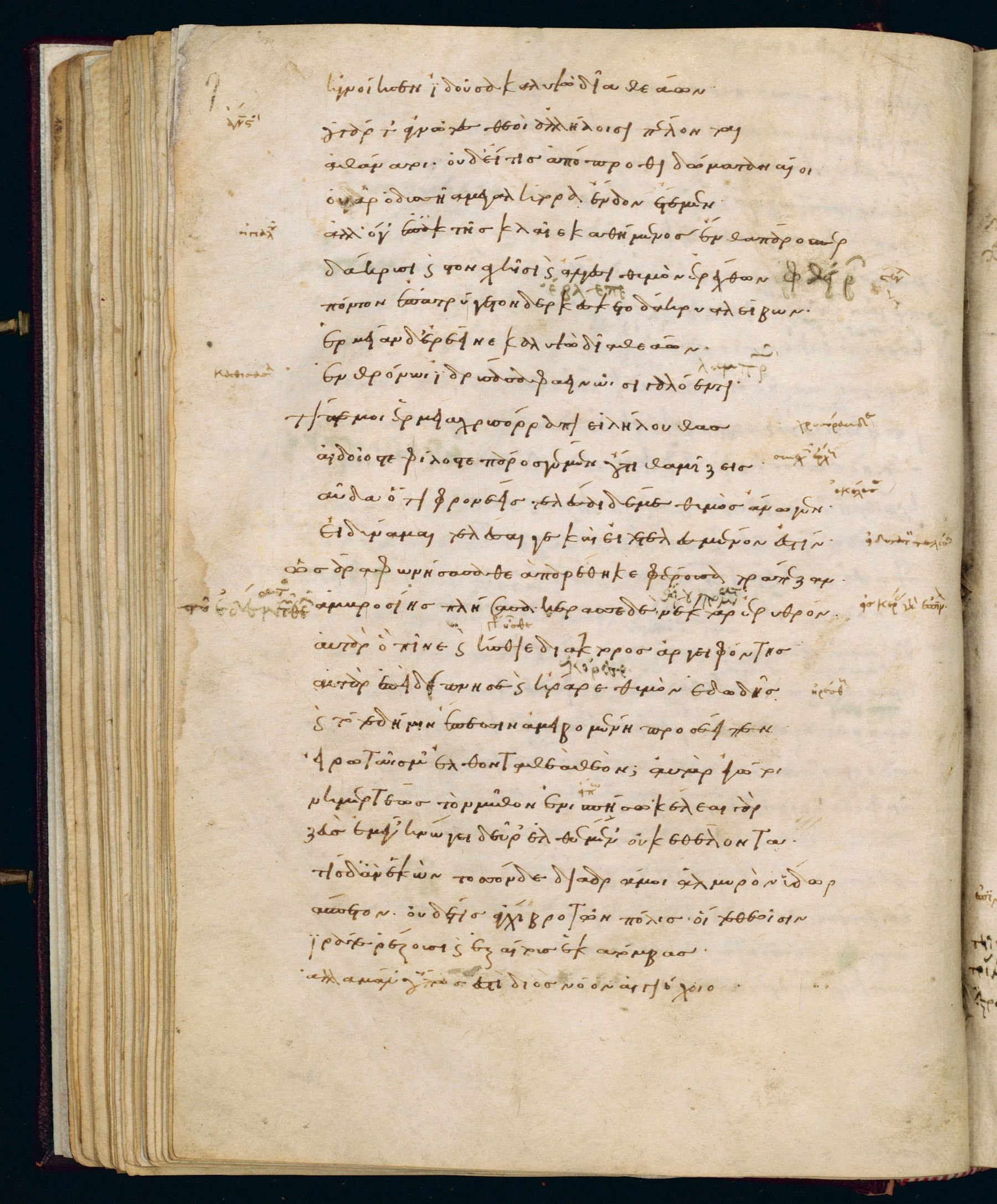
Laur. Plut. 32.24, fol. 47v: Odyssey 5.78-103, begins ‹ἠγνοίησεν ἰδοῦσα Καλυψώ, δῖα›, ends ‹ἔστι Διὸς νόον αἰγιόχοιο›. Checked on the image: first and last lines read and matched to the Greek. Fol. 47r ends with 5.77. Fol. 48r begins with 5.104. 5.91 (ἀλλʼ ἕπεο προτέρω ...) is not on the page: the scribe passes from 5.90 to 5.92 (25 lines). English blocks here: 80-84, 85-89, 90-91, 92-94, 95-99, 100-104.
78ἠγνοίησεν ἰδοῦσα Καλυψώ, δῖα θεάων·
79οὐ γάρ τʼ ἀγνῶτες θεοὶ ἀλλήλοισι πέλονται
80ἀθάνατοι, οὐδʼ εἴ τις ἀπόπροθι δώματα ναίει.
81οὐδʼ ἄρʼ Ὀδυσσῆα μεγαλήτορα ἔνδον ἔτετμεν,
82ἀλλʼ ὅ γʼ ἐπʼ ἀκτῆς κλαῖε καθήμενος, ἔνθα πάρος περ,
83δάκρυσι καὶ στοναχῇσι καὶ ἄλγεσι θυμὸν ἐρέχθων.
84πόντον ἐπʼ ἀτρύγετον δερκέσκετο δάκρυα λείβων.
85Ἑρμείαν δʼ ἐρέεινε Καλυψώ, δῖα θεάων,
86ἐν θρόνῳ ἱδρύσασα φαεινῷ σιγαλόεντι·
87τίπτε μοι, Ἑρμεία χρυσόρραπι, εἰλήλουθας
88αἰδοῖός τε φίλος τε; πάρος γε μὲν οὔ τι θαμίζεις.
89αὔδα ὅ τι φρονέεις· τελέσαι δέ με θυμὸς ἄνωγεν,
90εἰ δύναμαι τελέσαι γε καὶ εἰ τετελεσμένον ἐστίν.
91ἀλλʼ ἕπεο προτέρω, ἵνα τοι πὰρ ξείνια θείω.
92ὥς ἄρα φωνήσασα θεὰ παρέθηκε τράπεζαν
93ἀμβροσίης πλήσασα, κέρασσε δὲ νέκταρ ἐρυθρόν.
94αὐτὰρ ὁ πῖνε καὶ ἦσθε διάκτορος ἀργεϊφόντης.
95αὐτὰρ ἐπεὶ δείπνησε καὶ ἤραρε θυμὸν ἐδωδῇ,
96καὶ τότε δή μιν ἔπεσσιν ἀμειβόμενος προσέειπεν·
97εἰρωτᾷς μʼ ἐλθόντα θεὰ θεόν· αὐτὰρ ἐγώ τοι
98νημερτέως τὸν μῦθον ἐνισπήσω· κέλεαι γάρ.
99Ζεὺς ἐμέ γʼ ἠνώγει δεῦρʼ ἐλθέμεν οὐκ ἐθέλοντα·
100τίς δʼ ἂν ἑκὼν τοσσόνδε διαδράμοι ἁλμυρὸν ὕδωρ
101ἄσπετον; οὐδέ τις ἄγχι βροτῶν πόλις, οἵ τε θεοῖσιν
102ἱερά τε ῥέζουσι καὶ ἐξαίτους ἑκατόμβας.
103ἀλλὰ μάλʼ οὔ πως ἔστι Διὸς νόον αἰγιόχοιο
80the immortal gods to one another, even though one dwells in a home far away. But the great-hearted Odysseus he found not within; for he sat weeping on the shore, as his wont had been, racking his soul with tears and groans and griefs, and he would look over the unresting sea, shedding tears. 85And Calypso, the beautiful goddess, questioned Hermes, when she had made him sit on a bright shining chair: “Why, pray, Hermes of the golden wand, hast thou come, an honorable guest and welcome? heretofore thou hast not been wont to come. Speak what is in thy mind; my heart bids me fulfil it, 90if fulfil it I can, and it is a thing that hath fulfillment. But follow me further, that I may set before thee entertainment.” 92So saying, the goddess set before him a table laden with ambrosia, and mixed the ruddy nectar. So he drank and ate, the messenger Argeiphontes. 95But when he had dined and satisfied his soul with food, then he made answer, and addressed her, saying: “Thou, a goddess, dost question me, a god, upon my coming, and I will speak my word truly, since thou biddest me. It was Zeus who bade me come hither against my will. 100Who of his own will would speed over so great space of salt sea-water, great past telling? Nor is there at hand any city of mortals who offer to the gods sacrifice and choice hecatombs. But it is in no wise possible for any other god to evade or make void the will of Zeus, who bears the aegis.
Where on the image
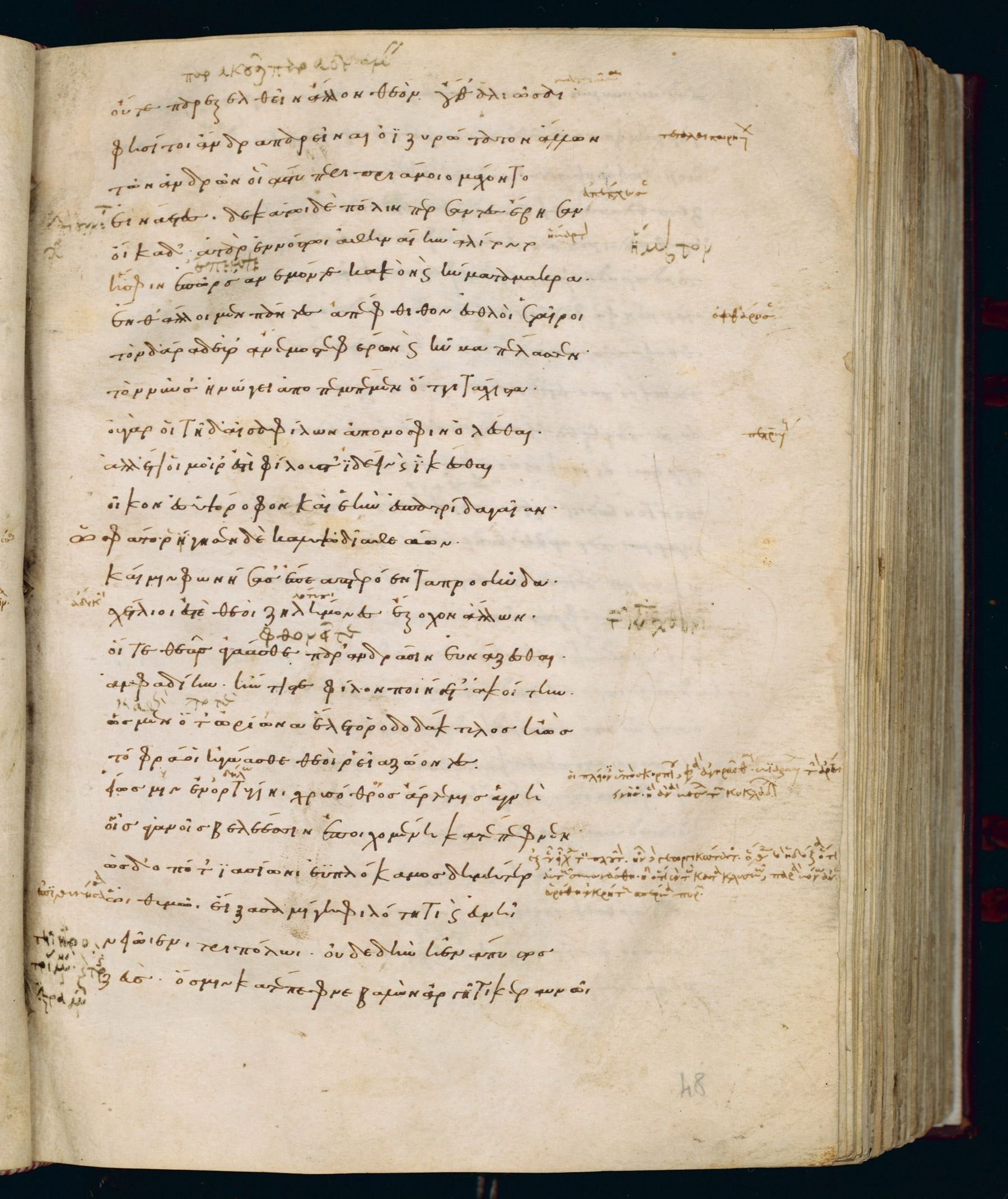
Laur. Plut. 32.24, fol. 48r: Odyssey 5.104-128, begins ‹οὔτε παρεξελθεῖν ἄλλον θεὸν›, ends ‹κατέπεφνε βαλὼν ἀργῆτι κεραυνῷ.›. Checked on the image: first and last lines read and matched to the Greek. Fol. 47v ends with 5.103. Fol. 48v begins with 5.129. English blocks here: 105-109, 110-114, 115-119, 120-124, 125-129.
104οὔτε παρεξελθεῖν ἄλλον θεὸν οὔθʼ ἁλιῶσαι.
105φησί τοι ἄνδρα παρεῖναι ὀιζυρώτατον ἄλλων,
106τῶν ἀνδρῶν, οἳ ἄστυ πέρι Πριάμοιο μάχοντο
107εἰνάετες, δεκάτῳ δὲ πόλιν πέρσαντες ἔβησαν
108οἴκαδʼ· ἀτὰρ ἐν νόστῳ Ἀθηναίην ἀλίτοντο,
109ἥ σφιν ἐπῶρσʼ ἄνεμόν τε κακὸν καὶ κύματα μακρά.
110ἔνθʼ ἄλλοι μὲν πάντες ἀπέφθιθεν ἐσθλοὶ ἑταῖροι,
111τὸν δʼ ἄρα δεῦρʼ ἄνεμός τε φέρων καὶ κῦμα πέλασσε.
112τὸν νῦν σʼ ἠνώγειν ἀποπεμπέμεν ὅττι τάχιστα·
113οὐ γάρ οἱ τῇδʼ αἶσα φίλων ἀπονόσφιν ὀλέσθαι,
114ἀλλʼ ἔτι οἱ μοῖρʼ ἐστὶ φίλους τʼ ἰδέειν καὶ ἱκέσθαι
115οἶκον ἐς ὑψόροφον καὶ ἑὴν ἐς πατρίδα γαῖαν.
116ὣς φάτο, ῥίγησεν δὲ Καλυψώ, δῖα θεάων,
117καί μιν φωνήσασʼ ἔπεα πτερόεντα προσηύδα·
118σχέτλιοί ἐστε, θεοί, ζηλήμονες ἔξοχον ἄλλων,
119οἵ τε θεαῖς ἀγάασθε παρʼ ἀνδράσιν εὐνάζεσθαι
120ἀμφαδίην, ἤν τίς τε φίλον ποιήσετʼ ἀκοίτην.
121ὣς μὲν ὅτʼ Ὠρίωνʼ ἕλετο ῥοδοδάκτυλος Ἠώς,
122τόφρα οἱ ἠγάασθε θεοὶ ῥεῖα ζώοντες,
123ἧος ἐν Ὀρτυγίῃ χρυσόθρονος Ἄρτεμις ἁγνὴ
124οἷς ἀγανοῖς βελέεσσιν ἐποιχομένη κατέπεφνεν.
125ὣς δʼ ὁπότʼ Ἰασίωνι ἐυπλόκαμος Δημήτηρ,
126ᾧ θυμῷ εἴξασα, μίγη φιλότητι καὶ εὐνῇ
127νειῷ ἔνι τριπόλῳ· οὐδὲ δὴν ἦεν ἄπυστος
128Ζεύς, ὅς μιν κατέπεφνε βαλὼν ἀργῆτι κεραυνῷ.
105He says that there is here with thee a man most wretched above all those warriors who around the city of Priam fought for nine years, and in the tenth year sacked the city and departed homeward. But on the way they sinned against Athena, and she sent upon them an evil wind and long waves. 110There all the rest of his goodly comrades perished, but as for him, the wind and the wave, as they bore him, brought him hither. Him now Zeus bids thee to send on his way with all speed, for it is not his fate to perish here far from his friends, but it is still his lot to see his friends and reach 115his high-roofed house and his native land.” So he spoke, and Calypso, the beautiful goddess, shuddered, and she spoke, and addressed him with winged words: “Cruel are ye, O ye gods, and quick to envy above all others, seeing that ye begrudge goddesses that they should mate with men 120openly, if any takes a mortal as her dear bed-fellow. Thus, when rosy-fingered Dawn took to herself Orion, ye gods that live at ease begrudged her, till in Ortygia chaste Artemis of the golden throne assailed him with her gentle shafts and slew him. 125Thus too, when fair-tressed Demeter, yielding to her passion, lay in love with Iasion in the thrice-ploughed fallow land, Zeus was not long without knowledge thereof, but smote him with his bright thunder-bolt and slew him. And even so again do ye now begrudge me, O ye gods, that a mortal man should abide with me.
Where on the image
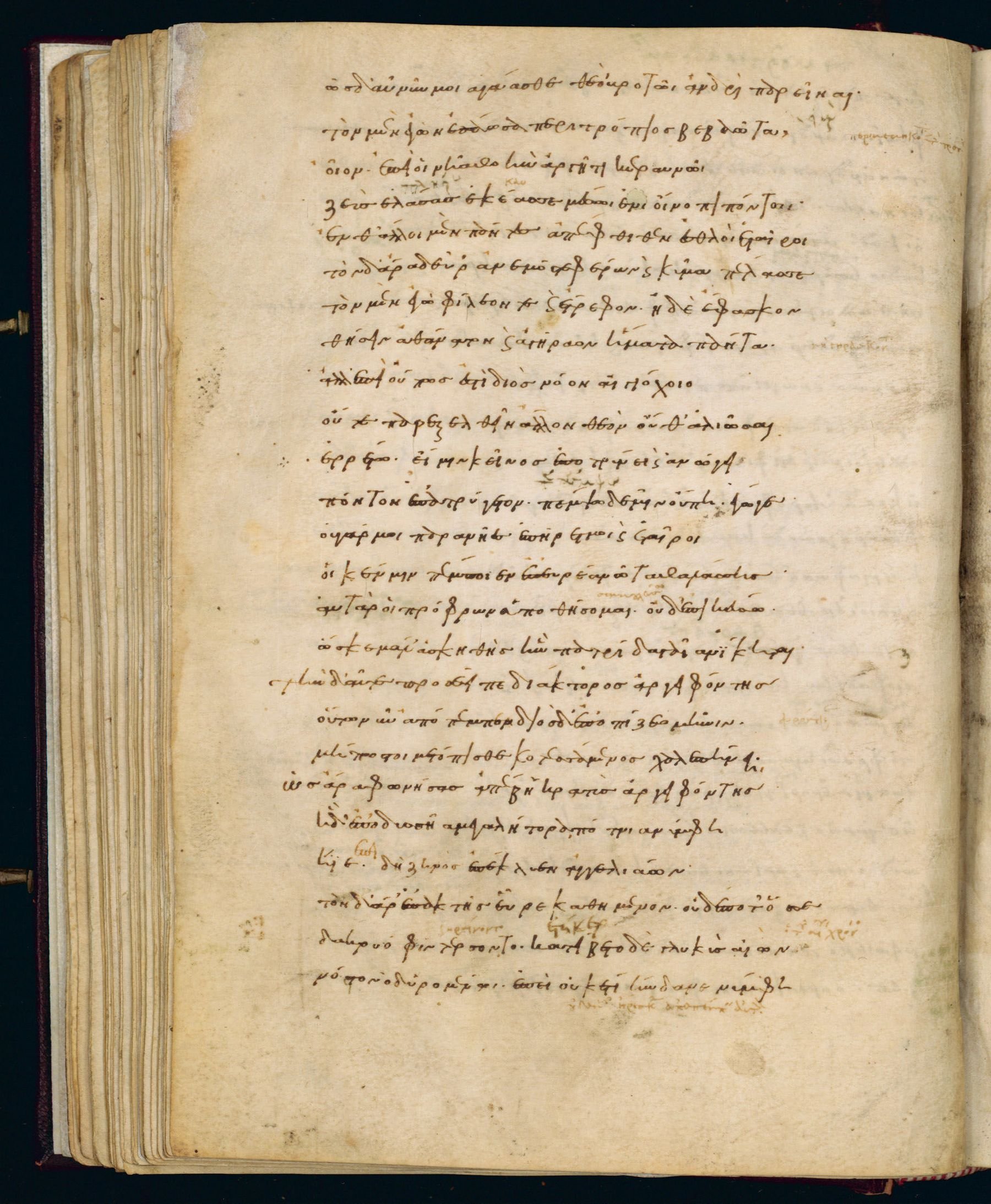
Laur. Plut. 32.24, fol. 48v: Odyssey 5.129-153, begins ‹ὣς δʼ αὖ νῦν›, ends ‹ἐπεὶ οὐκέτι ἥνδανε νύμφη.›. Checked on the image: first and last lines read and matched to the Greek. Fol. 48r ends with 5.128. Fol. 49r begins with 5.154. English blocks here: 130-134, 135-139, 140-144, 145-149, 150-154.
129ὣς δʼ αὖ νῦν μοι ἄγασθε, θεοί, βροτὸν ἄνδρα παρεῖναι.
130τὸν μὲν ἐγὼν ἐσάωσα περὶ τρόπιος βεβαῶτα
131οἶον, ἐπεί οἱ νῆα θοὴν ἀργῆτι κεραυνῷ
132Ζεὺς ἔλσας ἐκέασσε μέσῳ ἐνὶ οἴνοπι πόντῳ.
133ἔνθʼ ἄλλοι μὲν πάντες ἀπέφθιθεν ἐσθλοὶ ἑταῖροι,
134τὸν δʼ ἄρα δεῦρʼ ἄνεμός τε φέρων καὶ κῦμα πέλασσε.
135τὸν μὲν ἐγὼ φίλεόν τε καὶ ἔτρεφον, ἠδὲ ἔφασκον
136θήσειν ἀθάνατον καὶ ἀγήραον ἤματα πάντα.
137ἀλλʼ ἐπεὶ οὔ πως ἔστι Διὸς νόον αἰγιόχοιο
138οὔτε παρεξελθεῖν ἄλλον θεὸν οὔθʼ ἁλιῶσαι,
139ἐρρέτω, εἴ μιν κεῖνος ἐποτρύνει καὶ ἀνώγει,
140πόντον ἐπʼ ἀτρύγετον· πέμψω δέ μιν οὔ πῃ ἐγώ γε·
141οὐ γάρ μοι πάρα νῆες ἐπήρετμοι καὶ ἑταῖροι,
142οἵ κέν μιν πέμποιεν ἐπʼ εὐρέα νῶτα θαλάσσης.
143αὐτάρ οἱ πρόφρων ὑποθήσομαι, οὐδʼ ἐπικεύσω,
144ὥς κε μάλʼ ἀσκηθὴς ἣν πατρίδα γαῖαν ἵκηται.
145τὴν δʼ αὖτε προσέειπε διάκτορος ἀργεϊφόντης·
146οὕτω νῦν ἀπόπεμπε, Διὸς δʼ ἐποπίζεο μῆνιν,
147μή πώς τοι μετόπισθε κοτεσσάμενος χαλεπήνῃ.
148ὣς ἄρα φωνήσας ἀπέβη κρατὺς ἀργεϊφόντης·
149ἡ δʼ ἐπʼ Ὀδυσσῆα μεγαλήτορα πότνια νύμφη
150ἤιʼ, ἐπεὶ δὴ Ζηνὸς ἐπέκλυεν ἀγγελιάων.
151τὸν δʼ ἄρʼ ἐπʼ ἀκτῆς εὗρε καθήμενον· οὐδέ ποτʼ ὄσσε
152δακρυόφιν τέρσοντο, κατείβετο δὲ γλυκὺς αἰὼν
153νόστον ὀδυρομένῳ, ἐπεὶ οὐκέτι ἥνδανε νύμφη.
130Him I saved when he was bestriding the keel and all alone, for Zeus had smitten his swift ship with his bright thunder-bolt, and had shattered it in the midst of the wine-dark sea. There all the rest of his goodly comrades perished, but as for him, the wind and the wave, as they bore him, brought him hither. 135Him I welcomed kindly and gave him food, and said that I would make him immortal and ageless all his days. But since it is in no wise possible for any other god to evade or make void the will of Zeus who bears the aegis, let him go his way, if Zeus thus orders and commands, 140over the unresting sea. But it is not I that shall give him convoy, for I have at hand no ships with oars and no men to send him on his way over the broad back of the sea. But with a ready heart will I give him counsel, and will hide naught, that all unscathed he may return to his native land.” 145Then again the messenger Argeiphontes answered her: “Even so send him forth now, and beware of the wrath of Zeus, lest haply he wax wroth and visit his anger upon thee hereafter.” So saying, the strong Argeiphontes departed, and the queenly nymph went to the great-hearted Odysseus, 150when she had heard the message of Zeus. Him she found sitting on the shore, and his eyes were never dry of tears, and his sweet life was ebbing away, as he longed mournfully for his return, for the nymph was no longer pleasing in his sight. By night indeed he would sleep by her side perforce
Where on the image
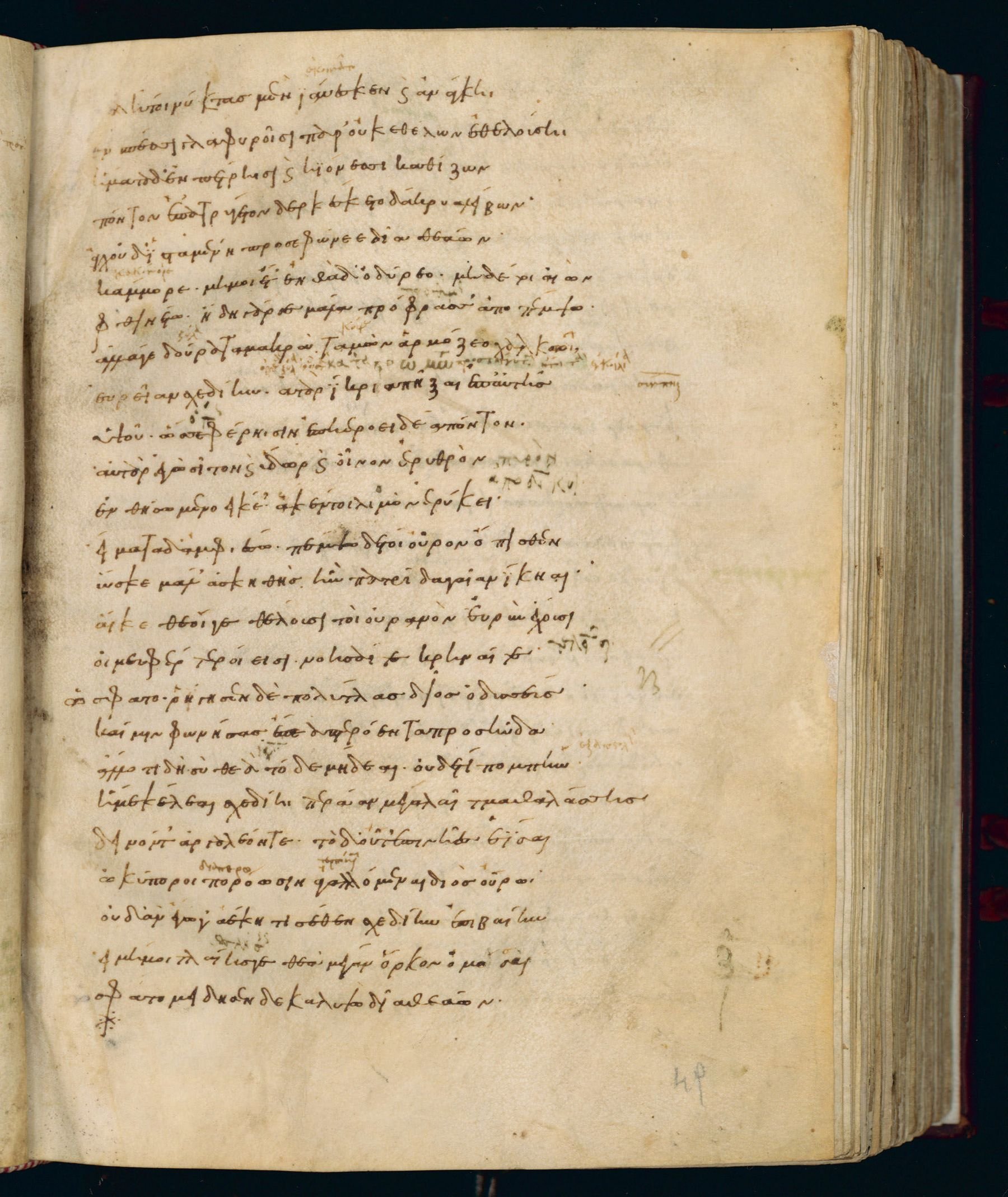
Laur. Plut. 32.24, fol. 49r: Odyssey 5.154-180, begins ‹ἀλλʼ ἦ τοι νύκτας›, ends ‹δὲ Καλυψὼ δῖα θεάων,›. Checked on the image: first and last lines read and matched to the Greek. Fol. 48v ends with 5.153. Fol. 49v begins with 5.181. 5.157 and 5.179 are not on the page: the scribe passes from 5.156 to 5.158 and from 5.178 to 5.180 (25 lines). English blocks here: 155-159, 160-164, 165-169, 170-174, 175-179.
154ἀλλʼ ἦ τοι νύκτας μὲν ἰαύεσκεν καὶ ἀνάγκῃ
155ἐν σπέσσι γλαφυροῖσι παρʼ οὐκ ἐθέλων ἐθελούσῃ·
156ἤματα δʼ ἂμ πέτρῃσι καὶ ἠιόνεσσι καθίζων
157δάκρυσι καὶ στοναχῇσι καὶ ἄλγεσι θυμὸν ἐρέχθων
158πόντον ἐπʼ ἀτρύγετον δερκέσκετο δάκρυα λείβων.
159ἀγχοῦ δʼ ἱσταμένη προσεφώνεε δῖα θεάων·
160κάμμορε, μή μοι ἔτʼ ἐνθάδʼ ὀδύρεο, μηδέ τοι αἰὼν
161φθινέτω· ἤδη γάρ σε μάλα πρόφρασσʼ ἀποπέμψω.
162ἀλλʼ ἄγε δούρατα μακρὰ ταμὼν ἁρμόζεο χαλκῷ
163εὐρεῖαν σχεδίην· ἀτὰρ ἴκρια πῆξαι ἐπʼ αὐτῆς
164ὑψοῦ, ὥς σε φέρῃσιν ἐπʼ ἠεροειδέα πόντον.
165αὐτὰρ ἐγὼ σῖτον καὶ ὕδωρ καὶ οἶνον ἐρυθρὸν
166ἐνθήσω μενοεικέʼ, ἅ κέν τοι λιμὸν ἐρύκοι,
167εἵματά τʼ ἀμφιέσω· πέμψω δέ τοι οὖρον ὄπισθεν,
168ὥς κε μάλʼ ἀσκηθὴς σὴν πατρίδα γαῖαν ἵκηαι,
169αἴ κε θεοί γʼ ἐθέλωσι, τοὶ οὐρανὸν εὐρὺν ἔχουσιν,
170οἵ μευ φέρτεροί εἰσι νοῆσαί τε κρῆναί τε.
171ὣς φάτο, ῥίγησεν δὲ πολύτλας δῖος Ὀδυσσεύς,
172καί μιν φωνήσας ἔπεα πτερόεντα προσηύδα·
173ἄλλο τι δὴ σύ, θεά, τόδε μήδεαι, οὐδέ τι πομπήν,
174ἥ με κέλεαι σχεδίῃ περάαν μέγα λαῖτμα θαλάσσης,
175δεινόν τʼ ἀργαλέον τε· τὸ δʼ οὐδʼ ἐπὶ νῆες ἐῖσαι
176ὠκύποροι περόωσιν, ἀγαλλόμεναι Διὸς οὔρῳ.
177οὐδʼ ἂν ἐγὼν ἀέκητι σέθεν σχεδίης ἐπιβαίην,
178εἰ μή μοι τλαίης γε, θεά, μέγαν ὅρκον ὀμόσσαι
179μή τί μοι αὐτῷ πῆμα κακὸν βουλευσέμεν ἄλλο.
180ὣς φάτο, μείδησεν δὲ Καλυψὼ δῖα θεάων,
155in the hollow caves, unwilling beside the willing nymph, but by day he would sit on the rocks and the sands, racking his soul with tears and groans and griefs, and he would look over the unresting sea, shedding tears. Then coming close to him, the beautiful goddess addressed him: 160“Unhappy man, sorrow no longer here, I pray thee, nor let thy life pine away; for even now with a ready heart will I send thee on thy way. Nay, come, hew with the axe long beams, and make a broad raft, and fasten upon it cross-planks for a deck well above it, that it may bear thee over the misty deep. 165And I will place therein bread and water and red wine to satisfy thy heart, to keep hunger from thee. And I will clothe thee with raiment, and will send a fair wind behind thee, that all unscathed thou mayest return to thy native land, if it be the will of the gods who hold broad heaven; 170for they are mightier than I both to purpose and to fulfil.” So she spoke, and much-enduring goodly Odysseus shuddered, and he spoke, and addressed her with winged words: “Some other thing, goddess, art thou planning in this, and not my sending, seeing that thou biddest me cross on a raft the great gulf of the sea, 175dread and grievous, over which not even the shapely, swift-faring ships pass, rejoicing in the wind of Zeus. But I will not set foot on a raft in thy despite, unless thou, goddess, wilt bring thyself to swear a mighty oath that thou wilt not plot against me any fresh mischief to my hurt.”
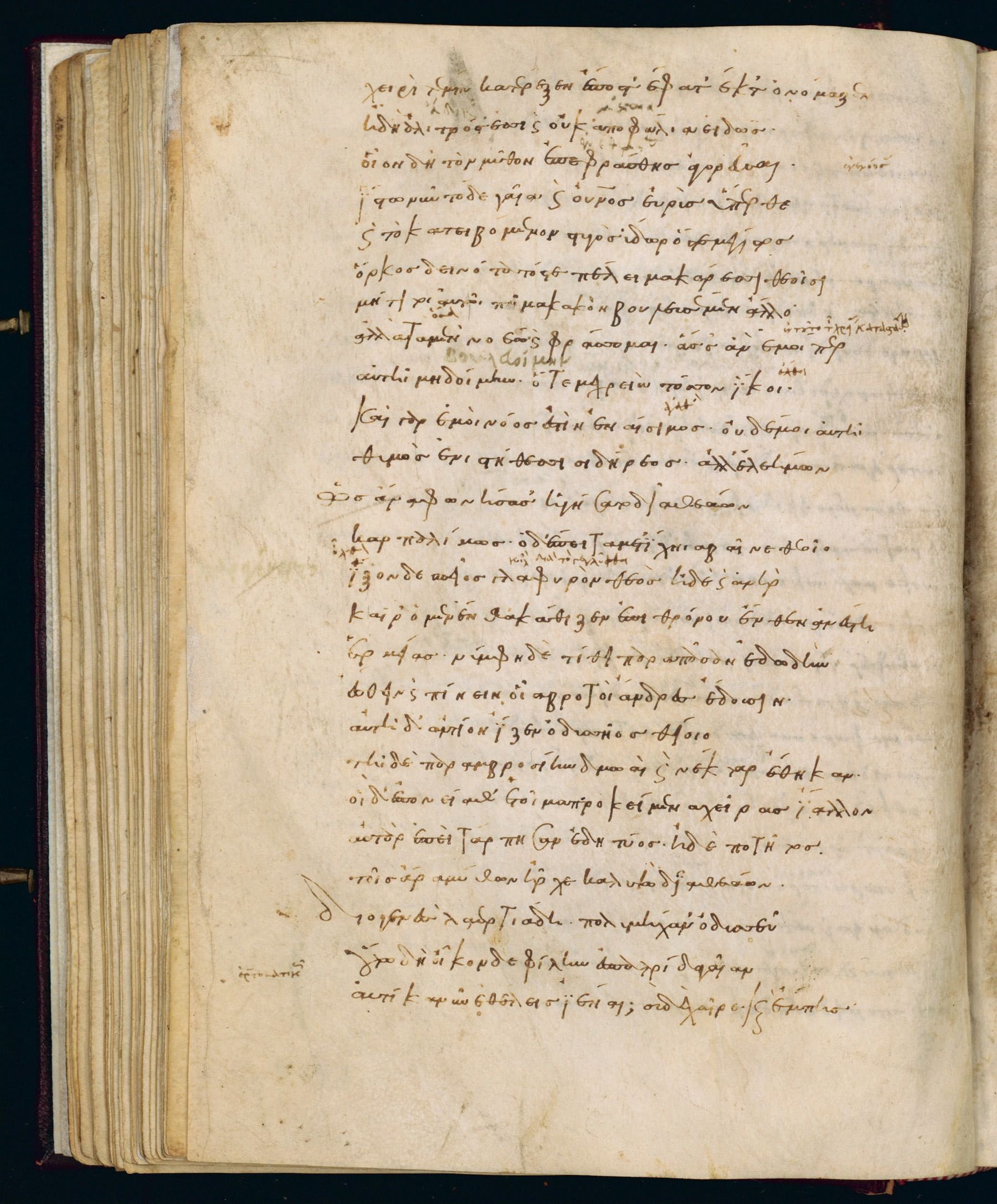
Where on the image
Laur. Plut. 32.24, fol. 49v: Odyssey 5.181-205, begins ‹χειρί τέ μιν κατέρεξεν›, ends ‹δὲ χαῖρε καὶ ἔμπης.›. Checked on the image: first and last lines read and matched to the Greek. Fol. 49r ends with 5.180. Fol. 50r begins with 5.206. English blocks here: 180-184, 185-189, 190-191, 192-194, 195-199, 200-204.
181χειρί τέ μιν κατέρεξεν ἔπος τʼ ἔφατʼ ἔκ τʼ ὀνόμαζεν·
182ἦ δὴ ἀλιτρός γʼ ἐσσὶ καὶ οὐκ ἀποφώλια εἰδώς,
183οἷον δὴ τὸν μῦθον ἐπεφράσθης ἀγορεῦσαι.
184ἴστω νῦν τόδε γαῖα καὶ οὐρανὸς εὐρὺς ὕπερθε
185καὶ τὸ κατειβόμενον Στυγὸς ὕδωρ, ὅς τε μέγιστος
186ὅρκος δεινότατός τε πέλει μακάρεσσι θεοῖσι,
187μή τί τοι αὐτῷ πῆμα κακὸν βουλευσέμεν ἄλλο.
188ἀλλὰ τὰ μὲν νοέω καὶ φράσσομαι, ἅσσʼ ἂν ἐμοί περ
189αὐτῇ μηδοίμην, ὅτε με χρειὼ τόσον ἵκοι·
190καὶ γὰρ ἐμοὶ νόος ἐστὶν ἐναίσιμος, οὐδέ μοι αὐτῇ
191θυμὸς ἐνὶ στήθεσσι σιδήρεος, ἀλλʼ ἐλεήμων.
192ὣς ἄρα φωνήσασʼ ἡγήσατο δῖα θεάων
193καρπαλίμως· ὁ δʼ ἔπειτα μετʼ ἴχνια βαῖνε θεοῖο.
194ἷξον δὲ σπεῖος γλαφυρὸν θεὸς ἠδὲ καὶ ἀνήρ,
195καί ῥʼ ὁ μὲν ἔνθα καθέζετʼ ἐπὶ θρόνου ἔνθεν ἀνέστη
196Ἑρμείας, νύμφη δʼ ἐτίθει πάρα πᾶσαν ἐδωδήν,
197ἔσθειν καὶ πίνειν, οἷα βροτοὶ ἄνδρες ἔδουσιν·
198αὐτὴ δʼ ἀντίον ἷζεν Ὀδυσσῆος θείοιο,
199τῇ δὲ παρʼ ἀμβροσίην δμῳαὶ καὶ νέκταρ ἔθηκαν.
200οἱ δʼ ἐπʼ ὀνείαθʼ ἑτοῖμα προκείμενα χεῖρας ἴαλλον.
201αὐτὰρ ἐπεὶ τάρπησαν ἐδητύος ἠδὲ ποτῆτος,
202τοῖς ἄρα μύθων ἦρχε Καλυψώ, δῖα θεάων·
203διογενὲς Λαερτιάδη, πολυμήχανʼ Ὀδυσσεῦ,
204οὕτω δὴ οἶκόνδε φίλην ἐς πατρίδα γαῖαν
205αὐτίκα νῦν ἐθέλεις ἰέναι; σὺ δὲ χαῖρε καὶ ἔμπης.
180So he spoke, but Calypso, the beautiful goddess, smiled, and stroked him with her hand, and spoke, and addressed him: “Verily thou art a knave, and not stunted in wit, that thou hast bethought thee to utter such a word. Now therefore let earth be witness to this, and the broad heaven above, 185and the down-flowing water of the Styx, which is the greatest and most dread oath for the blessed gods, that I will not plot against thee any fresh mischief to thy hurt. Nay, I have such thoughts in mind, and will give such counsel, as I should devise for mine own self, if such need should come on me. 190For I too have a mind that is righteous, and the heart in this breast of mine is not of iron, but hath compassion.” 192So saying, the beautiful goddess led the way quickly, and he followed in the footsteps of the goddess. And they came to the hollow cave, the goddess and the man, 195and he sat down upon the chair from which Hermes had arisen, and the nymph set before him all manner of food to eat and drink, of such sort as mortal men eat. But she herself sat over against divine Odysseus, and before her the handmaids set ambrosia and nectar. 200So they put forth their hands to the good cheer lying ready before them. But when they had their fill of food and drink, Calypso, the beautiful goddess, was the first to speak, and said: “Son of Laertes, sprung from Zeus, Odysseus of many devices,
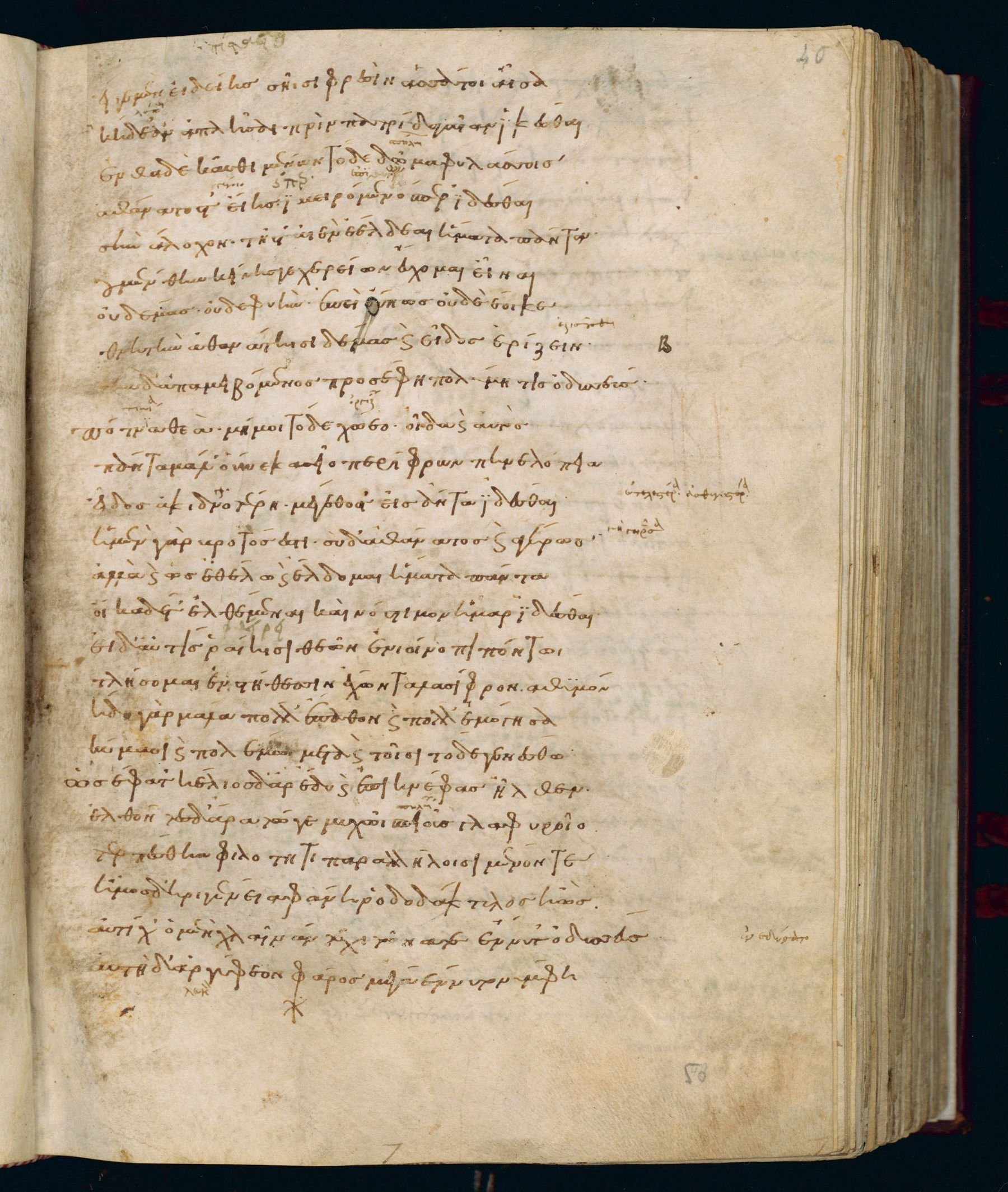
Where on the image
Laur. Plut. 32.24, fol. 50r: Odyssey 5.206-230, begins ‹εἴ γε μὲν εἰδείης›, ends ‹φᾶρος μέγα ἕννυτο νύμφη,›. Checked on the image: first and last lines read and matched to the Greek. Fol. 49v ends with 5.205. Fol. 50v begins with 5.231. English blocks here: 205-209, 210-214, 215-219, 220-224, 225-227, 228-229.
206εἴ γε μὲν εἰδείης σῇσι φρεσὶν ὅσσα τοι αἶσα
207κήδεʼ ἀναπλῆσαι, πρὶν πατρίδα γαῖαν ἱκέσθαι,
208ἐνθάδε κʼ αὖθι μένων σὺν ἐμοὶ τόδε δῶμα φυλάσσοις
209ἀθάνατός τʼ εἴης, ἱμειρόμενός περ ἰδέσθαι
210σὴν ἄλοχον, τῆς τʼ αἰὲν ἐέλδεαι ἤματα πάντα.
211οὐ μέν θην κείνης γε χερείων εὔχομαι εἶναι,
212οὐ δέμας οὐδὲ φυήν, ἐπεὶ οὔ πως οὐδὲ ἔοικεν
213θνητὰς ἀθανάτῃσι δέμας καὶ εἶδος ἐρίζειν.
214τὴν δʼ ἀπαμειβόμενος προσέφη πολύμητις Ὀδυσσεύς·
215πότνα θεά, μή μοι τόδε χώεο· οἶδα καὶ αὐτὸς
216πάντα μάλʼ, οὕνεκα σεῖο περίφρων Πηνελόπεια
217εἶδος ἀκιδνοτέρη μέγεθός τʼ εἰσάντα ἰδέσθαι·
218ἡ μὲν γὰρ βροτός ἐστι, σὺ δʼ ἀθάνατος καὶ ἀγήρως.
219ἀλλὰ καὶ ὣς ἐθέλω καὶ ἐέλδομαι ἤματα πάντα
220οἴκαδέ τʼ ἐλθέμεναι καὶ νόστιμον ἦμαρ ἰδέσθαι.
221εἰ δʼ αὖ τις ῥαίῃσι θεῶν ἐνὶ οἴνοπι πόντῳ,
222τλήσομαι ἐν στήθεσσιν ἔχων ταλαπενθέα θυμόν·
223ἤδη γὰρ μάλα πολλὰ πάθον καὶ πολλὰ μόγησα
224κύμασι καὶ πολέμῳ· μετὰ καὶ τόδε τοῖσι γενέσθω.
225ὣς ἔφατʼ, ἠέλιος δʼ ἄρʼ ἔδυ καὶ ἐπὶ κνέφας ἦλθεν·
226ἐλθόντες δʼ ἄρα τώ γε μυχῷ σπείους γλαφυροῖο
227τερπέσθην φιλότητι, παρʼ ἀλλήλοισι μένοντες.
228ἦμος δʼ ἠριγένεια φάνη ῥοδοδάκτυλος Ἠώς,
229αὐτίχʼ ὁ μὲν χλαῖνάν τε χιτῶνά τε ἕννυτʼ Ὀδυσσεύς,
230αὐτὴ δʼ ἀργύφεον φᾶρος μέγα ἕννυτο νύμφη,
205would'st thou then fare now forthwith home to thy dear native land! Yet, even so fare thee well. Howbeit if in thy heart thou knewest all the measure of woe it is thy fate to fulfil before thou comest to thy native land thou wouldest abide here and keep this house with me, and wouldest be immortal, for all thy desire to see 210thy wife for whom thou longest day by day. Surely not inferior to her do I declare myself to be either in form or stature, for in no wise is it seemly that mortal women should vie with immortals in form or comeliness.” Then Odysseus of many wiles answered her, and said: 215“Mighty goddess, be not wroth with me for this. I know full well of myself that wise Penelope is meaner to look upon than thou in comeliness and in stature, for she is a mortal, while thou art immortal and ageless. But even so I wish and long day by day 220to reach my home, and to see the day of my return. And if again some god shall smite me on the wine-dark sea, I will endure it, having in my breast a heart that endures affliction. For ere this I have suffered much and toiled much amid the waves and in war; let this also be added unto that.” 225So he spoke, and the sun set and darkness came on. And the two went into the innermost recess of the hollow cave, and took their joy of love, abiding each by the other's side. 228As soon as early Dawn appeared, the rosy-fingered, straightway Odysseus put on a cloak and a tunic,
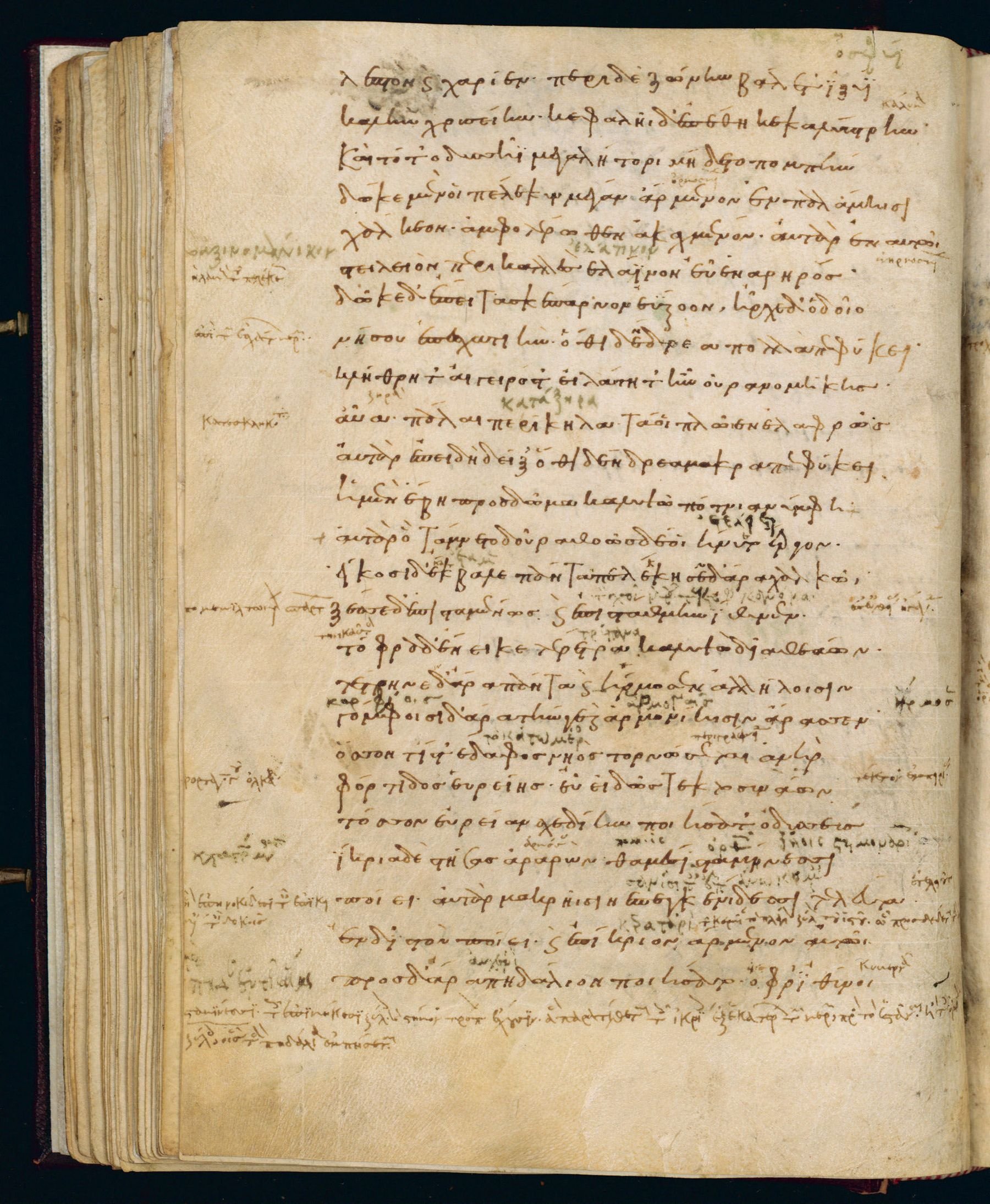
Where on the image
Laur. Plut. 32.24, fol. 50v: Odyssey 5.231-255, begins ‹λεπτὸν καὶ χαρίεν, περὶ›, ends ‹πηδάλιον ποιήσατο, ὄφρʼ ἰθύνοι.›. Checked on the image: first and last lines read and matched to the Greek. Fol. 50r ends with 5.230. Fol. 51r begins with 5.256. Below the last verse there is a long marginal scholium in small script. English blocks here: 230-234, 235-239, 240-244, 245-249, 250-254.
231λεπτὸν καὶ χαρίεν, περὶ δὲ ζώνην βάλετʼ ἰξυῖ
232καλὴν χρυσείην, κεφαλῇ δʼ ἐφύπερθε καλύπτρην.
233καὶ τότʼ Ὀδυσσῆι μεγαλήτορι μήδετο πομπήν·
234δῶκέν οἱ πέλεκυν μέγαν, ἄρμενον ἐν παλάμῃσι,
235χάλκεον, ἀμφοτέρωθεν ἀκαχμένον· αὐτὰρ ἐν αὐτῷ
236στειλειὸν περικαλλὲς ἐλάινον, εὖ ἐναρηρός·
237δῶκε δʼ ἔπειτα σκέπαρνον ἐύξοον· ἦρχε δʼ ὁδοῖο
238νήσου ἐπʼ ἐσχατιῆς, ὅθι δένδρεα μακρὰ πεφύκει,
239κλήθρη τʼ αἴγειρός τʼ, ἐλάτη τʼ ἦν οὐρανομήκης,
240αὖα πάλαι, περίκηλα, τά οἱ πλώοιεν ἐλαφρῶς.
241αὐτὰρ ἐπεὶ δὴ δεῖξʼ, ὅθι δένδρεα μακρὰ πεφύκει,
242ἡ μὲν ἔβη πρὸς δῶμα Καλυψώ, δῖα θεάων,
243αὐτὰρ ὁ τάμνετο δοῦρα· θοῶς δέ οἱ ἤνυτο ἔργον.
244εἴκοσι δʼ ἔκβαλε πάντα, πελέκκησεν δʼ ἄρα χαλκῷ,
245ξέσσε δʼ ἐπισταμένως καὶ ἐπὶ στάθμην ἴθυνεν.
246τόφρα δʼ ἔνεικε τέρετρα Καλυψώ, δῖα θεάων·
247τέτρηνεν δʼ ἄρα πάντα καὶ ἥρμοσεν ἀλλήλοισιν,
248γόμφοισιν δʼ ἄρα τήν γε καὶ ἁρμονίῃσιν ἄρασσεν.
249ὅσσον τίς τʼ ἔδαφος νηὸς τορνώσεται ἀνὴρ
250φορτίδος εὐρείης, ἐὺ εἰδὼς τεκτοσυνάων,
251τόσσον ἔπʼ εὐρεῖαν σχεδίην ποιήσατʼ Ὀδυσσεύς.
252ἴκρια δὲ στήσας, ἀραρὼν θαμέσι σταμίνεσσι,
253ποίει· ἀτὰρ μακρῇσιν ἐπηγκενίδεσσι τελεύτα.
254ἐν δʼ ἱστὸν ποίει καὶ ἐπίκριον ἄρμενον αὐτῷ·
255πρὸς δʼ ἄρα πηδάλιον ποιήσατο, ὄφρʼ ἰθύνοι.
230and the nymph clothed herself in a long white robe, finely woven and beautiful, and about her waist she cast a fair girdle of gold, and on her head a veil above. Then she set herself to plan the sending of the great-hearted Odysseus. She gave him a great axe, well fitted to his hands, 235an axe of bronze, sharpened on both sides; and in it was a beautiful handle of olive wood, securely fastened; and thereafter she gave him a polished adze. Then she led the way to the borders of the island where tall trees were standing, alder and popular and fir, reaching to the skies, 240long dry and well-seasoned, which would float for him lightly. But when she had shewn him where the tall trees grew, Calypso, the beautiful goddess, returned homewards, but he fell to cutting timbers, and his work went forward apace. Twenty trees in all did he fell, and trimmed them with the axe; 245then he cunningly smoothed them all and made them straight to the line. Meanwhile Calypso, the beautiful goddess, brought him augers; and he bored all the pieces and fitted them to one another, and with pegs and morticings did he hammer it together. Wide as a man well-skilled in carpentry marks out the curve of the hull of a freight-ship, 250broad of beam, even so wide did Odysseus make his raft. And he set up the deck-beams, bolting them to the close-set ribs, and laboured on; and he finished the raft with long gunwales. In it he set a mast and a yard-arm, fitted to it,
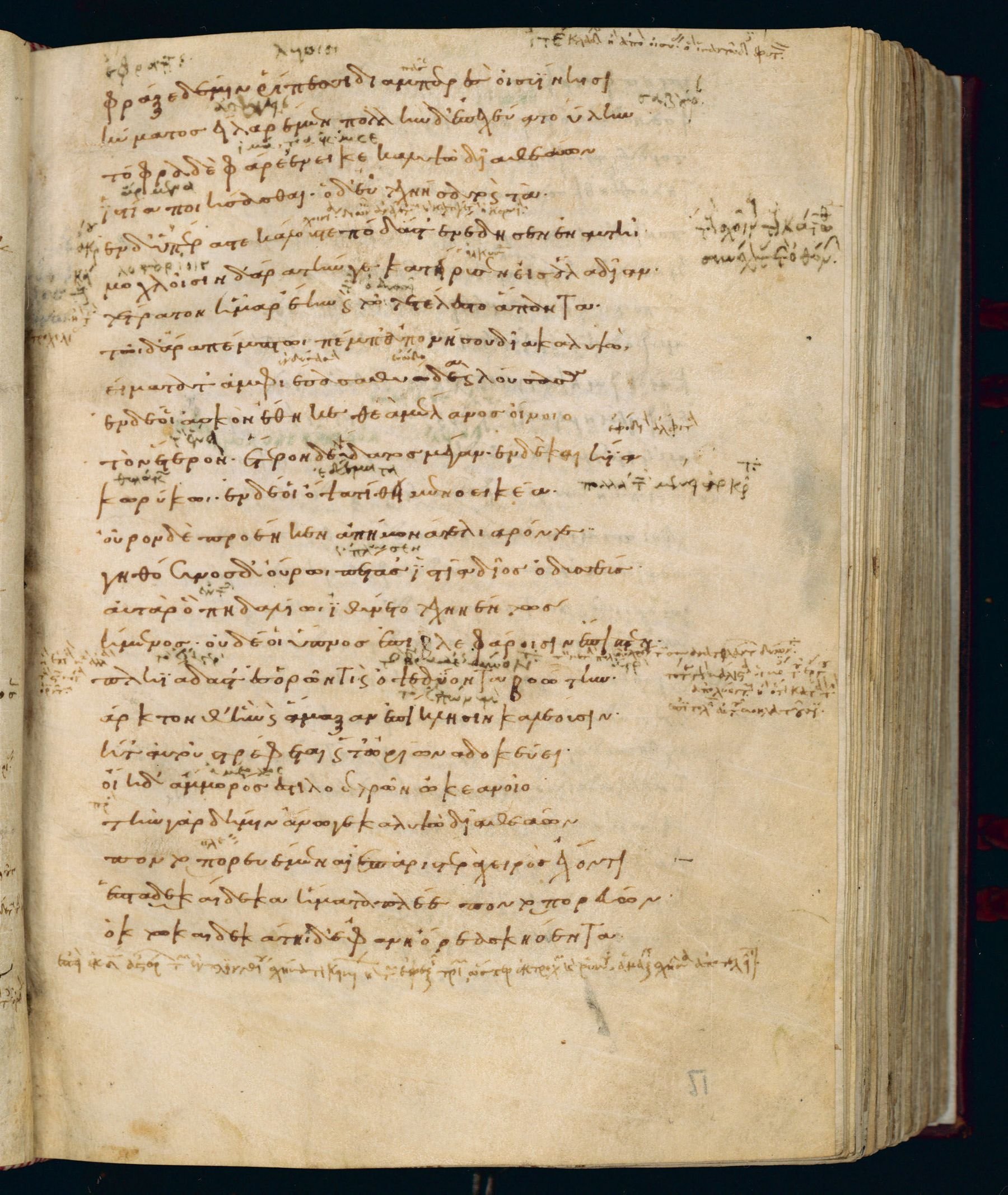
Where on the image
Laur. Plut. 32.24, fol. 51r: Odyssey 5.256-279, begins ‹φράξε δέ μιν ῥίπεσσι›, ends ‹δʼ ἐφάνη ὄρεα σκιόεντα›. Checked on the image: first and last lines read and matched to the Greek. Fol. 50v ends with 5.255. Fol. 51v begins with 5.280. Below the last verse there is a marginal scholium in small script. English blocks here: 255-259, 260-261, 262-264, 265-269, 270-274, 275-279.
256φράξε δέ μιν ῥίπεσσι διαμπερὲς οἰσυΐνῃσι
257κύματος εἶλαρ ἔμεν· πολλὴν δʼ ἐπεχεύατο ὕλην.
258τόφρα δὲ φάρεʼ ἔνεικε Καλυψώ, δῖα θεάων,
259ἱστία ποιήσασθαι· ὁ δʼ εὖ τεχνήσατο καὶ τά.
260ἐν δʼ ὑπέρας τε κάλους τε πόδας τʼ ἐνέδησεν ἐν αὐτῇ,
261μοχλοῖσιν δʼ ἄρα τήν γε κατείρυσεν εἰς ἅλα δῖαν.
262τέτρατον ἦμαρ ἔην, καὶ τῷ τετέλεστο ἅπαντα·
263τῷ δʼ ἄρα πέμπτῳ πέμπʼ ἀπὸ νήσου δῖα Καλυψώ,
264εἵματά τʼ ἀμφιέσασα θυώδεα καὶ λούσασα.
265ἐν δέ οἱ ἀσκὸν ἔθηκε θεὰ μέλανος οἴνοιο
266τὸν ἕτερον, ἕτερον δʼ ὕδατος μέγαν, ἐν δὲ καὶ ᾖα
267κωρύκῳ· ἐν δέ οἱ ὄψα τίθει μενοεικέα πολλά·
268οὖρον δὲ προέηκεν ἀπήμονά τε λιαρόν τε.
269γηθόσυνος δʼ οὔρῳ πέτασʼ ἱστία δῖος Ὀδυσσεύς.
270αὐτὰρ ὁ πηδαλίῳ ἰθύνετο τεχνηέντως
271ἥμενος, οὐδέ οἱ ὕπνος ἐπὶ βλεφάροισιν ἔπιπτεν
272Πληιάδας τʼ ἐσορῶντι καὶ ὀψὲ δύοντα Βοώτην
273Ἄρκτον θʼ, ἣν καὶ ἄμαξαν ἐπίκλησιν καλέουσιν,
274ἥ τʼ αὐτοῦ στρέφεται καί τʼ Ὠρίωνα δοκεύει,
275οἴη δʼ ἄμμορός ἐστι λοετρῶν Ὠκεανοῖο·
276τὴν γὰρ δή μιν ἄνωγε Καλυψώ, δῖα θεάων,
277ποντοπορευέμεναι ἐπʼ ἀριστερὰ χειρὸς ἔχοντα.
278ἑπτὰ δὲ καὶ δέκα μὲν πλέεν ἤματα ποντοπορεύων,
279ὀκτωκαιδεκάτῃ δʼ ἐφάνη ὄρεα σκιόεντα
255and furthermore made him a steering-oar, wherewith to steer. Then he fenced in the whole from stem to stern with willow withes to be a defence against the wave, and strewed much brush thereon. Meanwhile Calypso, the beautiful goddess, brought him cloth to make him a sail, and he fashioned that too with skill. 260And he made fast in the raft braces and halyards and sheets, and then with levers forced it down into the bright sea. 262Now the fourth day came and all his work was done. And on the fifth the beautiful Calypso sent him on his way from the island after she had bathed him and clothed him in fragrant raiment. 265On the raft the goddess put a skin of dark wine, and another, a great one, of water, and provisions, too, in a wallet. Therein she put abundance of dainties to satisfy his heart, and she sent forth a gentle wind and warm. Gladly then did goodly Odysseus spread his sail to the breeze; 270and he sat and guided his raft skilfully with the steering-oar, nor did sleep fall upon his eyelids, as he watched the Pleiads, and late-setting Bootes, and the Bear, which men also call the Wain, which ever circles where it is and watches Orion, 275and alone has no part in the baths of Ocean. For this star Calypso, the beautiful goddess, had bidden him to keep on the left hand as he sailed over the sea. For seventeen days then he sailed over the sea, and on the eighteenth appeared the shadowy mountains
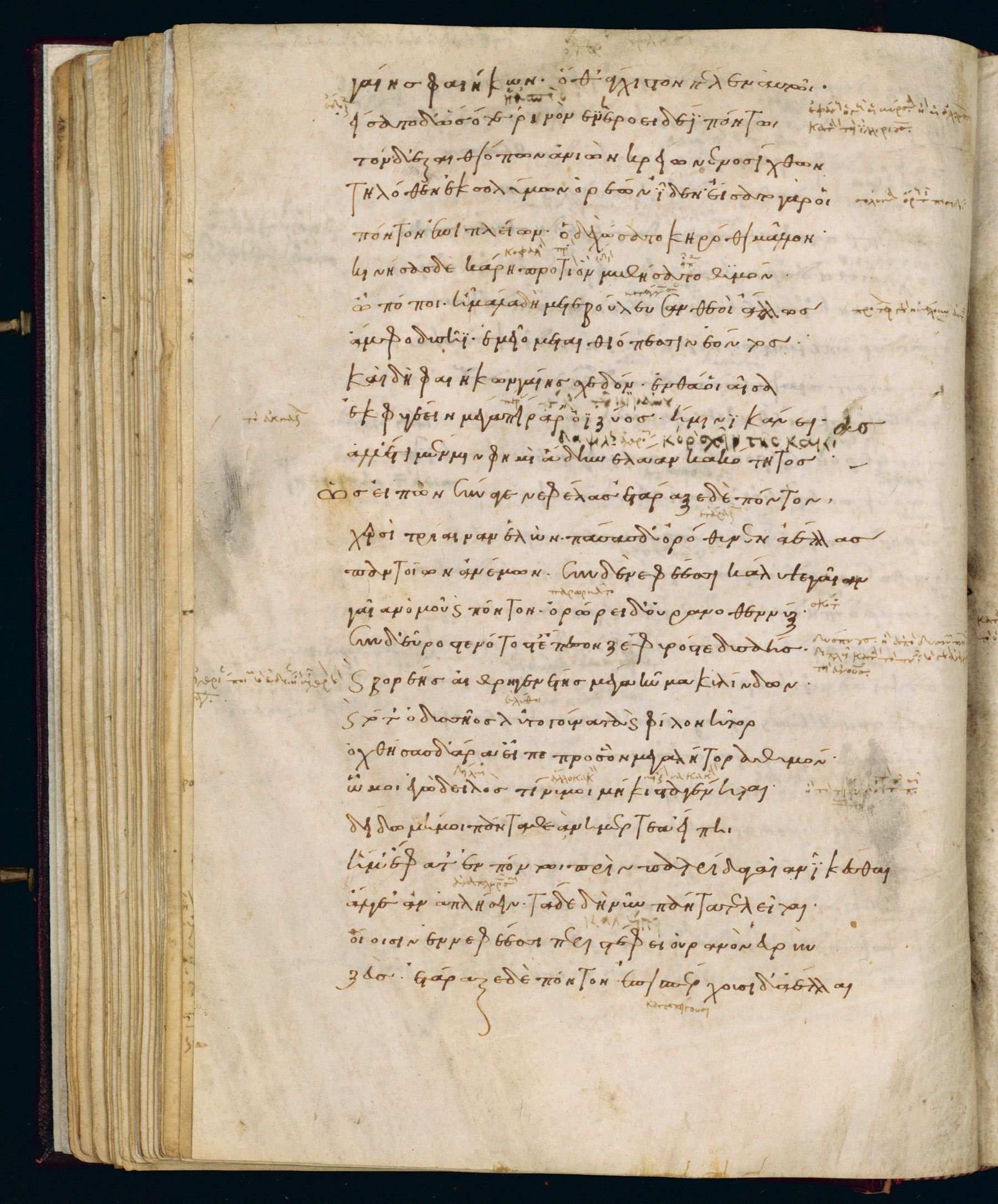
Where on the image
Laur. Plut. 32.24, fol. 51v: Odyssey 5.280-304, begins ‹γαίης Φαιήκων, ὅθι τʼ›, ends ‹πόντον, ἐπισπέρχουσι δʼ ἄελλαι›. Checked on the image: first and last lines read and matched to the Greek. Fol. 51r ends with 5.279. Fol. 52r begins with 5.305. English blocks here: 280-284, 285-289, 290-294, 295-299, 300-304.
280γαίης Φαιήκων, ὅθι τʼ ἄγχιστον πέλεν αὐτῷ·
281εἴσατο δʼ ὡς ὅτε ῥινὸν ἐν ἠεροειδέι πόντῳ.
282τὸν δʼ ἐξ Αἰθιόπων ἀνιὼν κρείων ἐνοσίχθων
283τηλόθεν ἐκ Σολύμων ὀρέων ἴδεν· εἴσατο γάρ οἱ
284πόντον ἐπιπλώων. ὁ δʼ ἐχώσατο κηρόθι μᾶλλον,
285κινήσας δὲ κάρη προτὶ ὃν μυθήσατο θυμόν·
286ὢ πόποι, ἦ μάλα δὴ μετεβούλευσαν θεοὶ ἄλλως
287ἀμφʼ Ὀδυσῆι ἐμεῖο μετʼ Αἰθιόπεσσιν ἐόντος,
288καὶ δὴ Φαιήκων γαίης σχεδόν, ἔνθα οἱ αἶσα
289ἐκφυγέειν μέγα πεῖραρ ὀιζύος, ἥ μιν ἱκάνει.
290ἀλλʼ ἔτι μέν μίν φημι ἅδην ἐλάαν κακότητος.
291ὣς εἰπὼν σύναγεν νεφέλας, ἐτάραξε δὲ πόντον
292χερσὶ τρίαιναν ἑλών· πάσας δʼ ὀρόθυνεν ἀέλλας
293παντοίων ἀνέμων, σὺν δὲ νεφέεσσι κάλυψε
294γαῖαν ὁμοῦ καὶ πόντον· ὀρώρει δʼ οὐρανόθεν νύξ.
295σὺν δʼ Εὖρός τε Νότος τʼ ἔπεσον Ζέφυρός τε δυσαὴς
296καὶ Βορέης αἰθρηγενέτης, μέγα κῦμα κυλίνδων.
297καὶ τότʼ Ὀδυσσῆος λύτο γούνατα καὶ φίλον ἦτορ,
298ὀχθήσας δʼ ἄρα εἶπε πρὸς ὃν μεγαλήτορα θυμόν·
299ὤ μοι ἐγὼ δειλός, τί νύ μοι μήκιστα γένηται;
300δείδω μὴ δὴ πάντα θεὰ νημερτέα εἶπεν,
301ἥ μʼ ἔφατʼ ἐν πόντῳ, πρὶν πατρίδα γαῖαν ἱκέσθαι,
302ἄλγεʼ ἀναπλήσειν· τὰ δὲ δὴ νῦν πάντα τελεῖται.
303οἵοισιν νεφέεσσι περιστέφει οὐρανὸν εὐρὺν
304Ζεύς, ἐτάραξε δὲ πόντον, ἐπισπέρχουσι δʼ ἄελλαι
280of the land of the Phaeacians, where it lay nearest to him; and it shewed like unto a shield in the misty deep. But the glorious Earth-shaker, as he came back from the Ethiopians, beheld him from afar, from the mountains of the Solymi: for Odysseus was seen of him sailing over the sea; and he waxed the more wroth in spirit, 285and shook his head, and thus he spoke to his own heart: “Out on it! Surely the gods have changed their purpose regarding Odysseus, while I was among the Ethiopians. And lo, he is near to the land of the Phaeacians, where it is his fate to escape from the great bonds of the woe which has come upon him. 290Aye, but even yet, methinks, I shall drive him to surfeit of evil.” So saying, he gathered the clouds, and seizing his trident in his hands troubled the sea, and roused all blasts of all manner of winds, and hid with clouds land and sea alike; and night rushed down from heaven. 295Together the East Wind and the South Wind dashed, and the fierce-blowing West Wind and the North Wind, born in the bright heaven, rolling before him a mighty wave. Then were the knees of Odysseus loosened and his heart melted, and deeply moved he spoke to his own mighty spirit: “Ah me, wretched that I am! What is to befall me at the last? 300I fear me that verily all that the goddess said was true, when she declared that on the sea, before ever I came to my native land, I should fill up my measure of woes; and lo, all this now is being brought to pass. In such wise does Zeus overcast the broad heaven with clouds, and has stirred up the sea, and the blasts
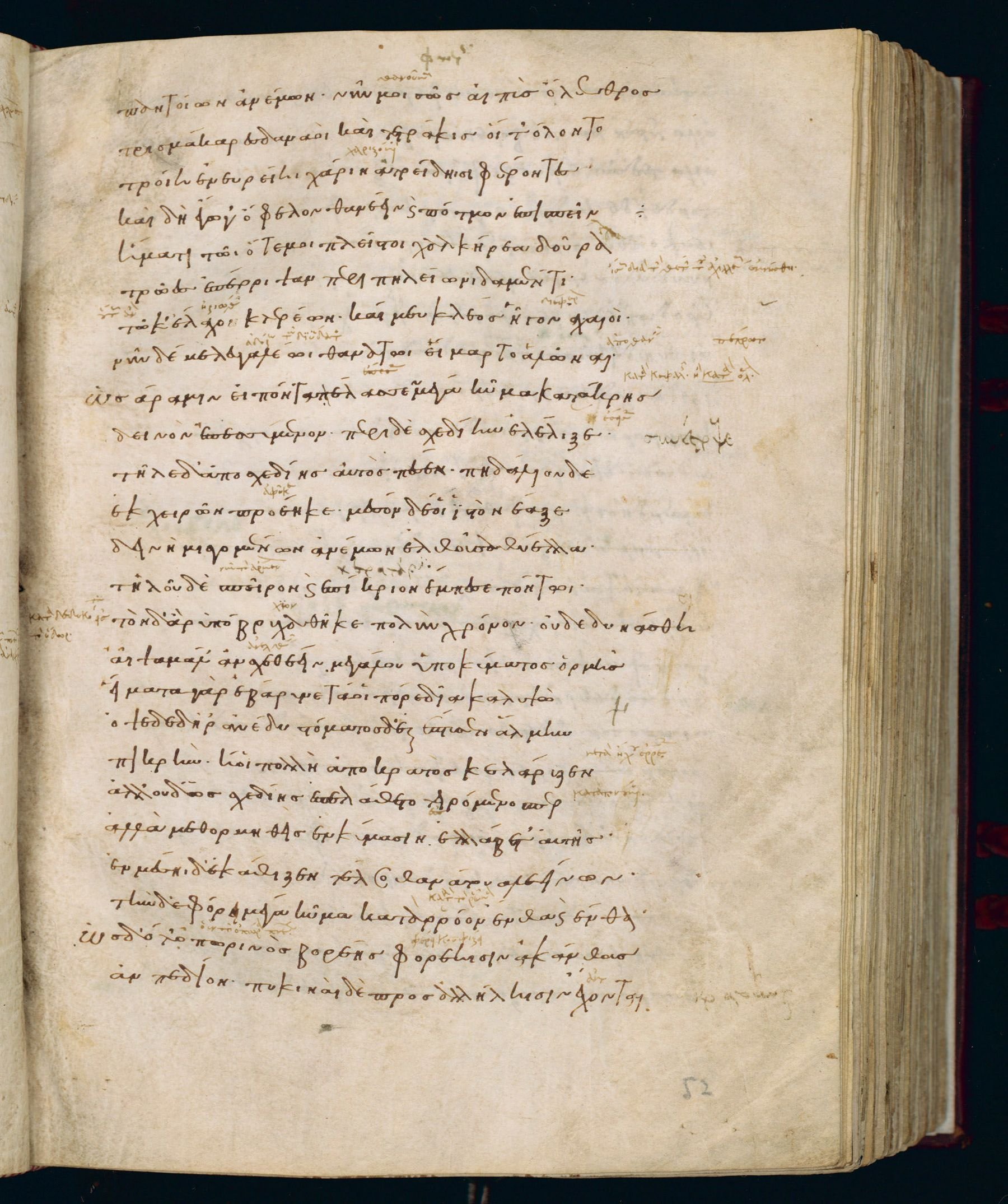
Where on the image
Laur. Plut. 32.24, fol. 52r: Odyssey 5.305-329, begins ‹παντοίων ἀνέμων. νῦν μοι›, ends ‹δὲ πρὸς ἀλλήλῃσιν ἔχονται,›. Checked on the image: first and last lines read and matched to the Greek. Fol. 51v ends with 5.304. Fol. 52v begins with 5.330. English blocks here: 305-309, 310-312, 313-314, 315-319, 320-324, 325-329.
305παντοίων ἀνέμων. νῦν μοι σῶς αἰπὺς ὄλεθρος.
306τρὶς μάκαρες Δαναοὶ καὶ τετράκις, οἳ τότʼ ὄλοντο
307Τροίῃ ἐν εὐρείῃ χάριν Ἀτρεΐδῃσι φέροντες.
308ὡς δὴ ἐγώ γʼ ὄφελον θανέειν καὶ πότμον ἐπισπεῖν
309ἤματι τῷ ὅτε μοι πλεῖστοι χαλκήρεα δοῦρα
310Τρῶες ἐπέρριψαν περὶ Πηλεΐωνι θανόντι.
311τῷ κʼ ἔλαχον κτερέων, καί μευ κλέος ἦγον Ἀχαιοί·
312νῦν δέ με λευγαλέῳ θανάτῳ εἵμαρτο ἁλῶναι.
313ὣς ἄρα μιν εἰπόντʼ ἔλασεν μέγα κῦμα κατʼ ἄκρης
314δεινὸν ἐπεσσύμενον, περὶ δὲ σχεδίην ἐλέλιξε.
315τῆλε δʼ ἀπὸ σχεδίης αὐτὸς πέσε, πηδάλιον δὲ
316ἐκ χειρῶν προέηκε· μέσον δέ οἱ ἱστὸν ἔαξεν
317δεινὴ μισγομένων ἀνέμων ἐλθοῦσα θύελλα,
318τηλοῦ δὲ σπεῖρον καὶ ἐπίκριον ἔμπεσε πόντῳ.
319τὸν δʼ ἄρʼ ὑπόβρυχα θῆκε πολὺν χρόνον, οὐδʼ ἐδυνάσθη
320αἶψα μάλʼ ἀνσχεθέειν μεγάλου ὑπὸ κύματος ὁρμῆς·
321εἵματα γάρ ῥʼ ἐβάρυνε, τά οἱ πόρε δῖα Καλυψώ.
322ὀψὲ δὲ δή ῥʼ ἀνέδυ, στόματος δʼ ἐξέπτυσεν ἅλμην
323πικρήν, ἥ οἱ πολλὴ ἀπὸ κρατὸς κελάρυζεν.
324ἀλλʼ οὐδʼ ὣς σχεδίης ἐπελήθετο, τειρόμενός περ,
325ἀλλὰ μεθορμηθεὶς ἐνὶ κύμασιν ἐλλάβετʼ αὐτῆς,
326ἐν μέσσῃ δὲ καθῖζε τέλος θανάτου ἀλεείνων.
327τὴν δʼ ἐφόρει μέγα κῦμα κατὰ ῥόον ἔνθα καὶ ἔνθα.
328ὡς δʼ ὅτʼ ὀπωρινὸς Βορέης φορέῃσιν ἀκάνθας
329ἂμ πεδίον, πυκιναὶ δὲ πρὸς ἀλλήλῃσιν ἔχονται,
305of all manner of winds sweep upon me; now is my utter destruction sure. Thrice blessed those Danaans, aye, four times blessed, who of old perished in the wide land of Troy, doing the pleasure of the sons of Atreus. Even so would that I had died and met my fate on that day when the throngs 310of the Trojans hurled upon me bronze-tipped spears, fighting around the body of the dead son of Peleus. Then should I have got funeral rites, and the Achaeans would have spread my fame, but now by a miserable death was it appointed me to be cut off.” 313Even as thus he spoke the great wave smote him from on high, rushing upon him with terrible might, and around it whirled his raft. 315Far from the raft he fell, and let fall the steering-oar from his hand; but his mast was broken in the midst by the fierce blast of tumultuous winds that came upon it, and far in the sea sail and yardarm fell. As for him, long time did the wave hold him in the depths, nor could he 320rise at once from beneath the onrush of the mighty wave, for the garments which beautiful Calypso had given him weighed him down. At length, however, he came up, and spat forth from his mouth the bitter brine which flowed in streams from his head. Yet even so he did not forget his raft, in evil case though he was, 325but sprang after it amid the waves, and laid hold of it, and sat down in the midst of it, seeking to escape the doom of death; and a great wave ever bore him this way and that along its course. As when in autumn the North Wind bears the thistle-tufts over the plain, and close they cling to one another,
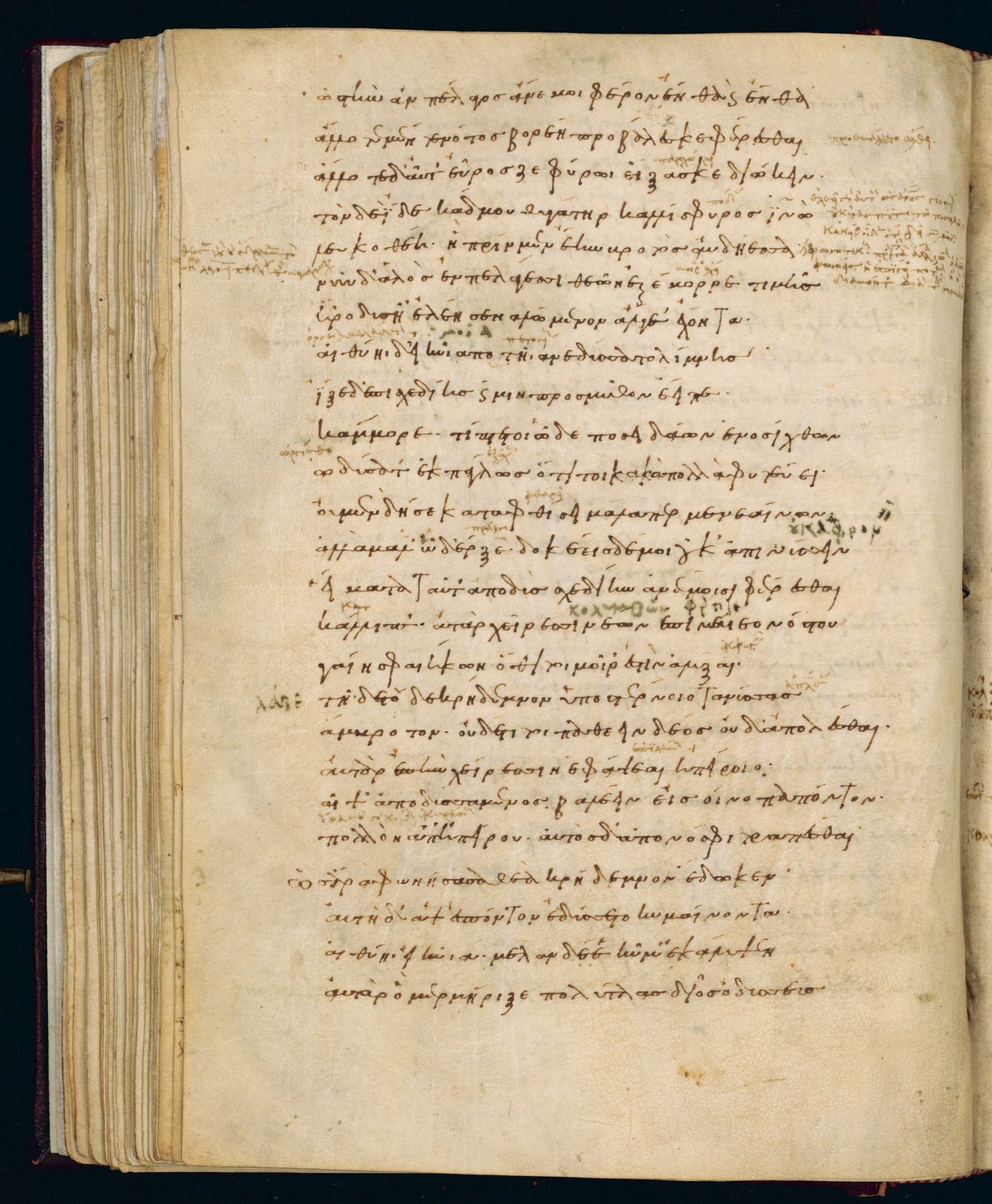
Where on the image
Laur. Plut. 32.24, fol. 52v: Odyssey 5.330-354, begins ‹ὣς τὴν ἂμ πέλαγος›, ends ‹μερμήριξε πολύτλας δῖος Ὀδυσσεύς,›. Checked on the image: first and last lines read and matched to the Greek. Fol. 52r ends with 5.329. Fol. 53r begins with 5.355. English blocks here: 330-334, 335-339, 340-344, 345-349, 350-354.
330ὣς τὴν ἂμ πέλαγος ἄνεμοι φέρον ἔνθα καὶ ἔνθα·
331ἄλλοτε μέν τε Νότος Βορέῃ προβάλεσκε φέρεσθαι,
332ἄλλοτε δʼ αὖτʼ Εὖρος Ζεφύρῳ εἴξασκε διώκειν.
333τὸν δὲ ἴδεν Κάδμου θυγάτηρ, καλλίσφυρος Ἰνώ,
334Λευκοθέη, ἣ πρὶν μὲν ἔην βροτὸς αὐδήεσσα,
335νῦν δʼ ἁλὸς ἐν πελάγεσσι θεῶν ἒξ ἔμμορε τιμῆς.
336ἥ ῥʼ Ὀδυσῆʼ ἐλέησεν ἀλώμενον, ἄλγεʼ ἔχοντα,
337αἰθυίῃ δʼ ἐικυῖα ποτῇ ἀνεδύσετο λίμνης,
338ἷζε δʼ ἐπὶ σχεδίης πολυδέσμου εἶπέ τε μῦθον·
339κάμμορε, τίπτε τοι ὧδε Ποσειδάων ἐνοσίχθων
340ὠδύσατʼ ἐκπάγλως, ὅτι τοι κακὰ πολλὰ φυτεύει;
341οὐ μὲν δή σε καταφθίσει μάλα περ μενεαίνων.
342ἀλλὰ μάλʼ ὧδʼ ἔρξαι, δοκέεις δέ μοι οὐκ ἀπινύσσειν·
343εἵματα ταῦτʼ ἀποδὺς σχεδίην ἀνέμοισι φέρεσθαι
344κάλλιπʼ, ἀτὰρ χείρεσσι νέων ἐπιμαίεο νόστου
345γαίης Φαιήκων, ὅθι τοι μοῖρʼ ἐστὶν ἀλύξαι.
346τῆ δέ, τόδε κρήδεμνον ὑπὸ στέρνοιο τανύσσαι
347ἄμβροτον· οὐδέ τί τοι παθέειν δέος οὐδʼ ἀπολέσθαι.
348αὐτὰρ ἐπὴν χείρεσσιν ἐφάψεαι ἠπείροιο,
349ἂψ ἀπολυσάμενος βαλέειν εἰς οἴνοπα πόντον
350πολλὸν ἀπʼ ἠπείρου, αὐτὸς δʼ ἀπονόσφι τραπέσθαι.
351ὣς ἄρα φωνήσασα θεὰ κρήδεμνον ἔδωκεν,
352αὐτὴ δʼ ἂψ ἐς πόντον ἐδύσετο κυμαίνοντα
353αἰθυίῃ ἐικυῖα· μέλαν δέ ἑ κῦμα κάλυψεν.
354αὐτὰρ ὁ μερμήριξε πολύτλας δῖος Ὀδυσσεύς,
330so did the winds bear the raft this way and that over the sea. Now the South Wind would fling it to the North Wind to be driven on, and now again the East Wind would yield it to the West Wind to drive. But the daughter of Cadmus, Ino of the fair ankles, saw him, even Leucothea, who of old was a mortal of human speech, 335but now in the deeps of the sea has won a share of honor from the gods. She was touched with pity for Odysseus, as he wandered and was in sore travail, and she rose up from the deep like a sea-mew on the wing, and sat on the stoutly-bound raft, and spoke, saying: “Unhappy man, how is it that Poseidon, the earth-shaker, 340has conceived such furious wrath against thee, that he is sowing for thee the seeds of many evils? Yet verily he shall not utterly destroy thee for all his rage. Nay, do thou thus; and methinks thou dost not lack understanding. Strip off these garments, and leave thy raft to be driven by the winds, but do thou swim with thy hands and so strive to reach 345the land of the Phaeacians, where it is thy fate to escape. Come, take this veil, and stretch it beneath thy breast. It is immortal; there is no fear that thou shalt suffer aught or perish. But when with thy hands thou hast laid hold of the land, loose it from thee, and cast it into the wine-dark sea 350far from the land, and thyself turn away.” So saying, the goddess gave him the veil, and herself plunged again into the surging deep, like a sea-mew; and the dark wave hid her. Then the much-enduring, goodly Odysseus pondered,
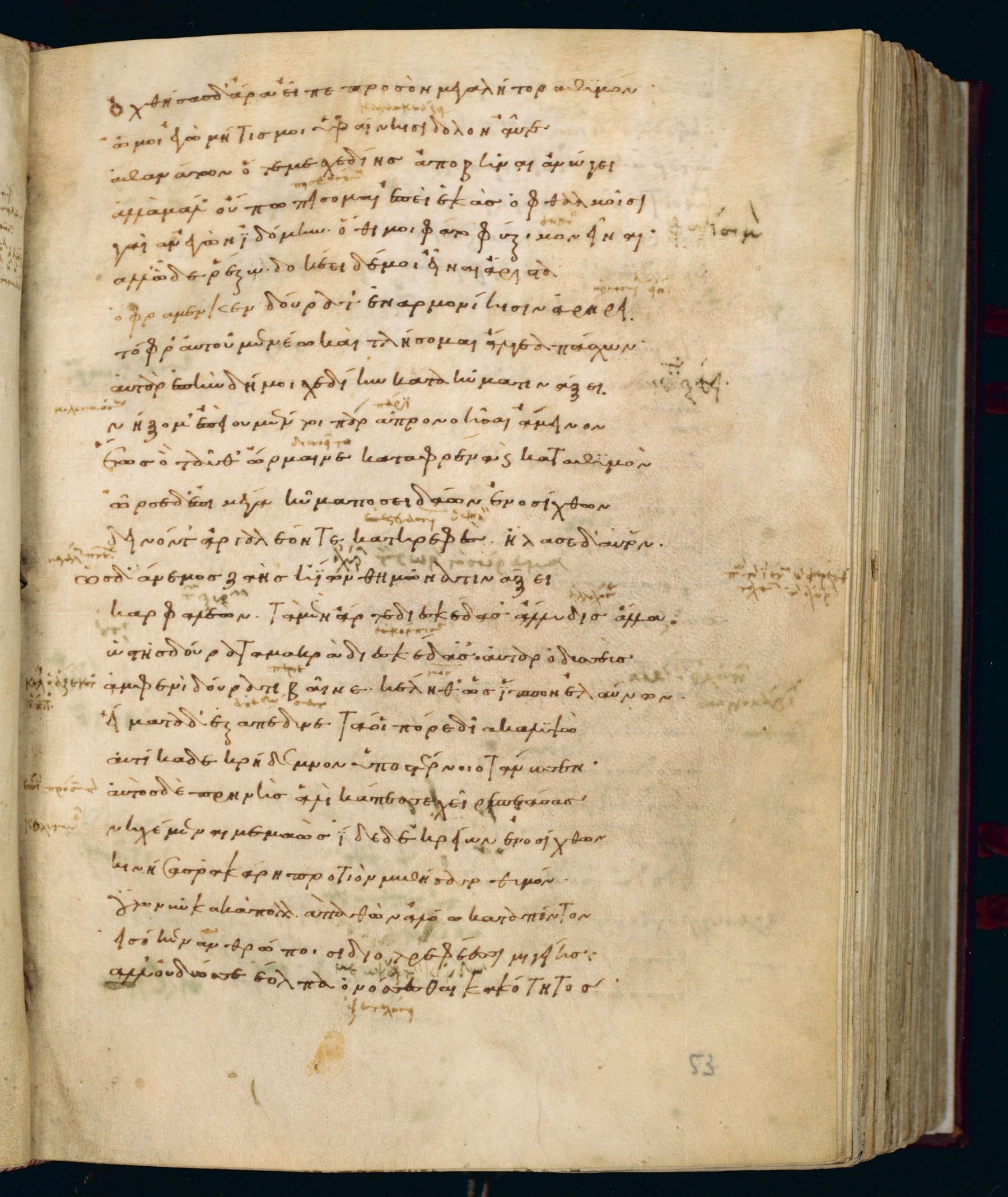
Where on the image
Laur. Plut. 32.24, fol. 53r: Odyssey 5.355-379, begins ‹ὀχθήσας δʼ ἄρα εἶπε›, ends ‹σε ἔολπα ὀνόσσεσθαι κακότητος.›. Checked on the image: first and last lines read and matched to the Greek. Fol. 52v ends with 5.354. Fol. 53v begins with 5.380. English blocks here: 355-359, 360-364, 365-369, 370-374, 375-379.
355ὀχθήσας δʼ ἄρα εἶπε πρὸς ὃν μεγαλήτορα θυμόν·
356ὤ μοι ἐγώ, μή τίς μοι ὑφαίνῃσιν δόλον αὖτε
357ἀθανάτων, ὅ τέ με σχεδίης ἀποβῆναι ἀνώγει.
358ἀλλὰ μάλʼ οὔ πω πείσομʼ, ἐπεὶ ἑκὰς ὀφθαλμοῖσιν
359γαῖαν ἐγὼν ἰδόμην, ὅθι μοι φάτο φύξιμον εἶναι.
360ἀλλὰ μάλʼ ὧδʼ ἔρξω, δοκέει δέ μοι εἶναι ἄριστον·
361ὄφρʼ ἂν μέν κεν δούρατʼ ἐν ἁρμονίῃσιν ἀρήρῃ,
362τόφρʼ αὐτοῦ μενέω καὶ τλήσομαι ἄλγεα πάσχων·
363αὐτὰρ ἐπὴν δή μοι σχεδίην διὰ κῦμα τινάξῃ,
364νήξομʼ, ἐπεὶ οὐ μέν τι πάρα προνοῆσαι ἄμεινον.
365ἧος ὁ ταῦθʼ ὥρμαινε κατὰ φρένα καὶ κατὰ θυμόν,
366ὦρσε δʼ ἐπὶ μέγα κῦμα Ποσειδάων ἐνοσίχθων,
367δεινόν τʼ ἀργαλέον τε, κατηρεφές, ἤλασε δʼ αὐτόν.
368ὡς δʼ ἄνεμος ζαὴς ἠΐων θημῶνα τινάξῃ
369καρφαλέων· τὰ μὲν ἄρ τε διεσκέδασʼ ἄλλυδις ἄλλῃ·
370ὣς τῆς δούρατα μακρὰ διεσκέδασʼ. αὐτὰρ Ὀδυσσεὺς
371ἀμφʼ ἑνὶ δούρατι βαῖνε, κέληθʼ ὡς ἵππον ἐλαύνων,
372εἵματα δʼ ἐξαπέδυνε, τά οἱ πόρε δῖα Καλυψώ.
373αὐτίκα δὲ κρήδεμνον ὑπὸ στέρνοιο τάνυσσεν,
374αὐτὸς δὲ πρηνὴς ἁλὶ κάππεσε, χεῖρε πετάσσας,
375νηχέμεναι μεμαώς. ἴδε δὲ κρείων ἐνοσίχθων,
376κινήσας δὲ κάρη προτὶ ὃν μυθήσατο θυμόν·
377οὕτω νῦν κακὰ πολλὰ παθὼν ἀλόω κατὰ πόντον,
378εἰς ὅ κεν ἀνθρώποισι διοτρεφέεσσι μιγήῃς.
379ἀλλʼ οὐδʼ ὥς σε ἔολπα ὀνόσσεσθαι κακότητος.
355and deeply moved he spoke to his own mighty spirit: “Woe is me! Let it not be that some one of the immortals is again weaving a snare for me, that she bids me leave my raft. Nay, but verily I will not yet obey, for afar off mine eyes beheld the land, where she said I was to escape. 360But this will I do, and meseems that this is best: as long as the timbers hold firm in their fastenings, so long will I remain here and endure to suffer affliction; but when the wave shall have shattered the raft to pieces, I will swim, seeing that there is naught better to devise.” 365While he pondered thus in mind and heart, Poseidon, the earth-shaker, made to rise up a great wave, dread and grievous, arching over from above, and drove it upon him. And as when a strong wind tosses a heap of straw that is dry, and some it scatters here, some there, 370even so the wave scattered the long timbers of the raft. But Odysseus bestrode one plank, as though he were riding a horse, and stripped off the garments which beautiful Calypso had given him. Then straightway he stretched the veil beneath his breast, and flung himself headlong into the sea with hands outstretched, 375ready to swim. And the lord, the earth-shaker, saw him, and he shook his head, and thus he spoke to his own heart: “So now, after thou hast suffered many ills, go wandering over the deep, till thou comest among the folk fostered of Zeus. Yet even so, methinks, thou shalt not make any mock at thy suffering.”
Where on the image
Laur. Plut. 32.24, fol. 53v: Odyssey 5.380-404, begins ‹ὣς ἄρα φωνήσας ἵμασεν›, ends ‹νηῶν ὄχοι, οὐδʼ ἐπιωγαί.›. Checked on the image: first and last lines read and matched to the Greek. Fol. 53r ends with 5.379. Fol. 54r begins with 5.405. English blocks here: 380-384, 385-389, 390-394, 395-399, 400-404.
380ὣς ἄρα φωνήσας ἵμασεν καλλίτριχας ἵππους,
381ἵκετο δʼ εἰς Αἰγάς, ὅθι οἱ κλυτὰ δώματʼ ἔασιν.
382αὐτὰρ Ἀθηναίη κούρη Διὸς ἄλλʼ ἐνόησεν.
383ἦ τοι τῶν ἄλλων ἀνέμων κατέδησε κελεύθους,
384παύσασθαι δʼ ἐκέλευσε καὶ εὐνηθῆναι ἅπαντας·
385ὦρσε δʼ ἐπὶ κραιπνὸν Βορέην, πρὸ δὲ κύματʼ ἔαξεν,
386ἧος ὃ Φαιήκεσσι φιληρέτμοισι μιγείη
387διογενὴς Ὀδυσεὺς θάνατον καὶ κῆρας ἀλύξας.
388ἔνθα δύω νύκτας δύο τʼ ἤματα κύματι πηγῷ
389πλάζετο, πολλὰ δέ οἱ κραδίη προτιόσσετʼ ὄλεθρον.
390ἀλλʼ ὅτε δὴ τρίτον ἦμαρ ἐυπλόκαμος τέλεσʼ Ἠώς,
391καὶ τότʼ ἔπειτʼ ἄνεμος μὲν ἐπαύσατο ἠδὲ γαλήνη
392ἔπλετο νηνεμίη· ὁ δʼ ἄρα σχεδὸν εἴσιδε γαῖαν
393ὀξὺ μάλα προϊδών, μεγάλου ὑπὸ κύματος ἀρθείς.
394ὡς δʼ ὅτʼ ἂν ἀσπάσιος βίοτος παίδεσσι φανήῃ
395πατρός, ὃς ἐν νούσῳ κεῖται κρατέρʼ ἄλγεα πάσχων,
396δηρὸν τηκόμενος, στυγερὸς δέ οἱ ἔχραε δαίμων,
397ἀσπάσιον δʼ ἄρα τόν γε θεοὶ κακότητος ἔλυσαν,
398ὣς Ὀδυσεῖ ἀσπαστὸν ἐείσατο γαῖα καὶ ὕλη,
399νῆχε δʼ ἐπειγόμενος ποσὶν ἠπείρου ἐπιβῆναι.
400ἀλλʼ ὅτε τόσσον ἀπῆν ὅσσον τε γέγωνε βοήσας,
401καὶ δὴ δοῦπον ἄκουσε ποτὶ σπιλάδεσσι θαλάσσης·
402ῥόχθει γὰρ μέγα κῦμα ποτὶ ξερὸν ἠπείροιο
403δεινὸν ἐρευγόμενον, εἴλυτο δὲ πάνθʼ ἁλὸς ἄχνῃ·
404οὐ γὰρ ἔσαν λιμένες νηῶν ὄχοι, οὐδʼ ἐπιωγαί.
380So saying, he lashed his fair-maned horses, and came to Aegae, where is his glorious palace. But Athena, daughter of Zeus, took other counsel. She stayed the paths of the other winds, and bade them all cease and be lulled to rest; 385but she roused the swift North Wind, and broke the waves before him, to the end that Zeus-born Odysseus might come among the Phaeacians, lovers of the oar, escaping from death and the fates. Then for two nights and two days he was driven about over the swollen waves, and full often his heart forboded destruction. 390But when fair-tressed Dawn brought to its birth the third day, then the wind ceased and there was a windless calm, and he caught sight of the shore close at hand, casting a quick glance forward, as he was raised up by a great wave. And even as when most welcome to his children appears the life 395of a father who lies in sickness, bearing grievous pains, long while wasting away, and some cruel god assails him, but then to their joy the gods free him from his woe, so to Odysseus did the land and the wood seem welcome; and he swam on, eager to set foot on the land. 400But when he was as far away as a man's voice carries when he shouts, and heard the boom of the sea upon the reefs—for the great wave thundered against the dry land, belching upon it in terrible fashion, and all things were wrapped in the foam of the sea; for there were neither harbors where ships might ride, nor road-steads,
Where on the image
Laur. Plut. 32.24, fol. 54r: Odyssey 5.405-429, begins ‹ἀλλʼ ἀκταὶ προβλῆτες ἔσαν›, ends ‹ἧος μέγα κῦμα παρῆλθε.›. Checked on the image: first and last lines read and matched to the Greek. Fol. 53v ends with 5.404. Fol. 54v begins with 5.430. English blocks here: 405-407, 408-409, 410-414, 415-419, 420-424, 425-429.
405ἀλλʼ ἀκταὶ προβλῆτες ἔσαν σπιλάδες τε πάγοι τε·
406καὶ τότʼ Ὀδυσσῆος λύτο γούνατα καὶ φίλον ἦτορ,
407ὀχθήσας δʼ ἄρα εἶπε πρὸς ὃν μεγαλήτορα θυμόν·
408ὤ μοι, ἐπεὶ δὴ γαῖαν ἀελπέα δῶκεν ἰδέσθαι
409Ζεύς, καὶ δὴ τόδε λαῖτμα διατμήξας ἐπέρησα,
410ἔκβασις οὔ πῃ φαίνεθʼ ἁλὸς πολιοῖο θύραζε·
411ἔκτοσθεν μὲν γὰρ πάγοι ὀξέες, ἀμφὶ δὲ κῦμα
412βέβρυχεν ῥόθιον, λισσὴ δʼ ἀναδέδρομε πέτρη,
413ἀγχιβαθὴς δὲ θάλασσα, καὶ οὔ πως ἔστι πόδεσσι
414στήμεναι ἀμφοτέροισι καὶ ἐκφυγέειν κακότητα·
415μή πώς μʼ ἐκβαίνοντα βάλῃ λίθακι ποτὶ πέτρῃ
416κῦμα μέγʼ ἁρπάξαν· μελέη δέ μοι ἔσσεται ὁρμή.
417εἰ δέ κʼ ἔτι προτέρω παρανήξομαι, ἤν που ἐφεύρω
418ἠιόνας τε παραπλῆγας λιμένας τε θαλάσσης,
419δείδω μή μʼ ἐξαῦτις ἀναρπάξασα θύελλα
420πόντον ἐπʼ ἰχθυόεντα φέρῃ βαρέα στενάχοντα,
421ἠέ τί μοι καὶ κῆτος ἐπισσεύῃ μέγα δαίμων
422ἐξ ἁλός, οἷά τε πολλὰ τρέφει κλυτὸς Ἀμφιτρίτη·
423οἶδα γάρ, ὥς μοι ὀδώδυσται κλυτὸς ἐννοσίγαιος.
424ἧος ὁ ταῦθʼ ὥρμαινε κατὰ φρένα καὶ κατὰ θυμόν,
425τόφρα δέ μιν μέγα κῦμα φέρε τρηχεῖαν ἐπʼ ἀκτήν.
426ἔνθα κʼ ἀπὸ ῥινοὺς δρύφθη, σὺν δʼ ὀστέʼ ἀράχθη,
427εἰ μὴ ἐπὶ φρεσὶ θῆκε θεά, γλαυκῶπις Ἀθήνη·
428ἀμφοτέρῃσι δὲ χερσὶν ἐπεσσύμενος λάβε πέτρης,
429τῆς ἔχετο στενάχων, ἧος μέγα κῦμα παρῆλθε.
405but projecting headlands, and reefs, and cliffs—then the knees of Odysseus were loosened and his heart melted, and deeply moved he spoke to his own mighty spirit: 408“Ah me, when Zeus has at length granted me to see the land beyond my hopes, and lo, I have prevailed to cleave my way and to cross this gulf, 410nowhere doth there appear a way to come forth from the grey sea. For without are sharp crags, and around them the wave roars foaming, and the rock runs up sheer, and the water is deep close in shore, so that in no wise is it possible to plant both feet firmly and escape ruin. 415Haply were I to seek to land, a great wave may seize me and dash me against the jagged rock, and so shall my striving be in vain. But if I swim on yet further in hope to find shelving beaches and harbors of the sea, I fear me lest the storm-wind may catch me up again, 420and bear me, groaning heavily, over the teeming deep; or lest some god may even send forth upon me some great monster from out the sea—and many such does glorious Amphitrite breed. For I know that the glorious Earth-shaker is filled with wrath against me.” While he pondered thus in mind and heart, 425a great wave bore him against the rugged shore. There would his skin have been stripped off and his bones broken, had not the goddess, flashing-eyed Athena, put a thought in his mind. On he rushed and seized the rock with both hands, and clung to it, groaning, until the great wave went by.
Where on the image
Laur. Plut. 32.24, fol. 54v: Odyssey 5.430-454, begins ‹καὶ τὸ μὲν ὣς›, ends ‹γὰρ δέδμητο φίλον κῆρ.›. Checked on the image: first and last lines read and matched to the Greek. Fol. 54r ends with 5.429. Fol. 55r begins with 5.455. English blocks here: 430-434, 435-439, 440-444, 445-449, 450-450, 451-454.
430καὶ τὸ μὲν ὣς ὑπάλυξε, παλιρρόθιον δέ μιν αὖτις
431πλῆξεν ἐπεσσύμενον, τηλοῦ δέ μιν ἔμβαλε πόντῳ.
432ὡς δʼ ὅτε πουλύποδος θαλάμης ἐξελκομένοιο
433πρὸς κοτυληδονόφιν πυκιναὶ λάιγγες ἔχονται,
434ὣς τοῦ πρὸς πέτρῃσι θρασειάων ἀπὸ χειρῶν
435ῥινοὶ ἀπέδρυφθεν· τὸν δὲ μέγα κῦμα κάλυψεν.
436ἔνθα κε δὴ δύστηνος ὑπὲρ μόρον ὤλετʼ Ὀδυσσεύς,
437εἰ μὴ ἐπιφροσύνην δῶκε γλαυκῶπις Ἀθήνη.
438κύματος ἐξαναδύς, τά τʼ ἐρεύγεται ἤπειρόνδε,
439νῆχε παρέξ, ἐς γαῖαν ὁρώμενος, εἴ που ἐφεύροι
440ἠιόνας τε παραπλῆγας λιμένας τε θαλάσσης.
441ἀλλʼ ὅτε δὴ ποταμοῖο κατὰ στόμα καλλιρόοιο
442ἷξε νέων, τῇ δή οἱ ἐείσατο χῶρος ἄριστος,
443λεῖος πετράων, καὶ ἐπὶ σκέπας ἦν ἀνέμοιο,
444ἔγνω δὲ προρέοντα καὶ εὔξατο ὃν κατὰ θυμόν·
445κλῦθι, ἄναξ, ὅτις ἐσσί· πολύλλιστον δέ σʼ ἱκάνω,
446φεύγων ἐκ πόντοιο Ποσειδάωνος ἐνιπάς.
447αἰδοῖος μέν τʼ ἐστὶ καὶ ἀθανάτοισι θεοῖσιν
448ἀνδρῶν ὅς τις ἵκηται ἀλώμενος, ὡς καὶ ἐγὼ νῦν
449σόν τε ῥόον σά τε γούναθʼ ἱκάνω πολλὰ μογήσας.
450ἀλλʼ ἐλέαιρε, ἄναξ· ἱκέτης δέ τοι εὔχομαι εἶναι.
451ὣς φάθʼ, ὁ δʼ αὐτίκα παῦσεν ἑὸν ῥόον, ἔσχε δὲ κῦμα,
452πρόσθε δέ οἱ ποίησε γαλήνην, τὸν δʼ ἐσάωσεν
453ἐς ποταμοῦ προχοάς. ὁ δʼ ἄρʼ ἄμφω γούνατʼ ἔκαμψε
454χεῖράς τε στιβαράς. ἁλὶ γὰρ δέδμητο φίλον κῆρ.
430Thus then did he escape this wave, but in its backward flow it once more rushed upon him and smote him, and flung him far out in the sea. And just as, when a cuttlefish is dragged from its hole, many pebbles cling to its suckers, even so from his strong hands 435were bits of skin stripped off against the rocks; and the great wave covered him. Then verily would hapless Odysseus have perished beyond his fate, had not flashing-eyed Athena given him prudence. Making his way forth from the surge where it belched upon the shore, he swam outside, looking ever toward the land in hope to find 440shelving beaches and harbors of the sea. But when, as he swam, he came to the mouth of a fair-flowing river, where seemed to him the best place, since it was smooth of stones, and besides there was shelter from the wind, he knew the river as he flowed forth, and prayed to him in his heart: 445“Hear me, O king, whosoever thou art. As to one greatly longed-for do I come to thee, seeking to escape from out the sea from the threats of Poseidon. Reverend even in the eyes of the immortal gods is that man who comes as a wanderer, even as I have now come to thy stream and to thy knees, after many toils. 450Nay, pity me, O king, for I declare that I am thy suppliant.” 451So he spoke, and the god straightway stayed his stream, and checked the waves, and made a calm before him, and brought him safely to the mouth of the river. And he let his two knees bend and his strong hands fall, for his spirit was crushed by the sea.
Where on the image
Laur. Plut. 32.24, fol. 55r: Odyssey 5.455-480, begins ‹ᾤδεε δὲ χρόα πάντα,›, ends ‹διαμπερές· ὣς ἄρα πυκνοὶ›. Checked on the image: first and last lines read and matched to the Greek. Fol. 54v ends with 5.454. Fol. 55v begins with 5.481. 5.479 (οὔτε ποτʼ ἠέλιος ...) is not in the text column: the scribe passes from 5.478 to 5.480 (25 lines). Interlinear glosses above the first line. English blocks here: 455-459, 460-464, 465-469, 470-474, 475-479.
455ᾤδεε δὲ χρόα πάντα, θάλασσα δὲ κήκιε πολλὴ
456ἂν στόμα τε ῥῖνάς θʼ· ὁ δʼ ἄρʼ ἄπνευστος καὶ ἄναυδος
457κεῖτʼ ὀλιγηπελέων, κάματος δέ μιν αἰνὸς ἵκανεν.
458ἀλλʼ ὅτε δή ῥʼ ἄμπνυτο καὶ ἐς φρένα θυμὸς ἀγέρθη,
459καὶ τότε δὴ κρήδεμνον ἀπὸ ἕο λῦσε θεοῖο.
460καὶ τὸ μὲν ἐς ποταμὸν ἁλιμυρήεντα μεθῆκεν,
461ἂψ δʼ ἔφερεν μέγα κῦμα κατὰ ῥόον, αἶψα δʼ ἄρʼ Ἰνὼ
462δέξατο χερσὶ φίλῃσιν· ὁ δʼ ἐκ ποταμοῖο λιασθεὶς
463σχοίνῳ ὑπεκλίνθη, κύσε δὲ ζείδωρον ἄρουραν.
464ὀχθήσας δʼ ἄρα εἶπε πρὸς ὃν μεγαλήτορα θυμόν·
465ὤ μοι ἐγώ, τί πάθω; τί νύ μοι μήκιστα γένηται;
466εἰ μέν κʼ ἐν ποταμῷ δυσκηδέα νύκτα φυλάσσω,
467μή μʼ ἄμυδις στίβη τε κακὴ καὶ θῆλυς ἐέρση
468ἐξ ὀλιγηπελίης δαμάσῃ κεκαφηότα θυμόν·
469αὔρη δʼ ἐκ ποταμοῦ ψυχρὴ πνέει ἠῶθι πρό.
470εἰ δέ κεν ἐς κλιτὺν ἀναβὰς καὶ δάσκιον ὕλην
471θάμνοις ἐν πυκινοῖσι καταδράθω, εἴ με μεθείη
472ῥῖγος καὶ κάματος, γλυκερὸς δέ μοι ὕπνος ἐπέλθῃ,
473δείδω, μὴ θήρεσσιν ἕλωρ καὶ κύρμα γένωμαι.
474ὣς ἄρα οἱ φρονέοντι δοάσσατο κέρδιον εἶναι·
475βῆ ῥʼ ἴμεν εἰς ὕλην· τὴν δὲ σχεδὸν ὕδατος εὗρεν
476ἐν περιφαινομένῳ· δοιοὺς δʼ ἄρʼ ὑπήλυθε θάμνους,
477ἐξ ὁμόθεν πεφυῶτας· ὁ μὲν φυλίης, ὁ δʼ ἐλαίης.
478τοὺς μὲν ἄρʼ οὔτʼ ἀνέμων διάη μένος ὑγρὸν ἀέντων,
479οὔτε ποτʼ ἠέλιος φαέθων ἀκτῖσιν ἔβαλλεν,
480οὔτʼ ὄμβρος περάασκε διαμπερές· ὣς ἄρα πυκνοὶ
455And all his flesh was swollen, and sea water flowed in streams up through his mouth and nostrils. So he lay breathless and speechless, with scarce strength to move; for terrible weariness had come upon him. But when he revived, and his spirit returned again into his breast, then he loosed from him the veil of the goddess and let it fall into the river that murmured seaward; 460and the great wave bore it back down the stream, and straightway Ino received it in her hands. But Odysseus, going back from the river, sank down in the reeds and kissed the earth, the giver of grain; and deeply moved he spoke to his own mighty spirit: 465“Ah, woe is me! what is to befall me? What will happen to me at the last? If here in the river bed I keep watch throughout the weary night, I fear that together the bitter frost and the fresh dew may overcome me, when from feebleness I have breathed forth my spirit; and the breeze from the river blows cold in the early morning. 470But if I climb up the slope to the shady wood and lie down to rest in the thick brushwood, in the hope that the cold and weariness might leave me, and if sweet sleep comes over me, I fear me lest I become a prey and spoil to wild beasts.” Then, as he pondered, this thing seemed to him the better: 475he went his way to the wood and found it near the water in a clear space; and he crept beneath two bushes that grew from the same spot, one of thorn and one of olive. Through these the strength of the wet winds could never blow, nor the rays of the bright sun beat,
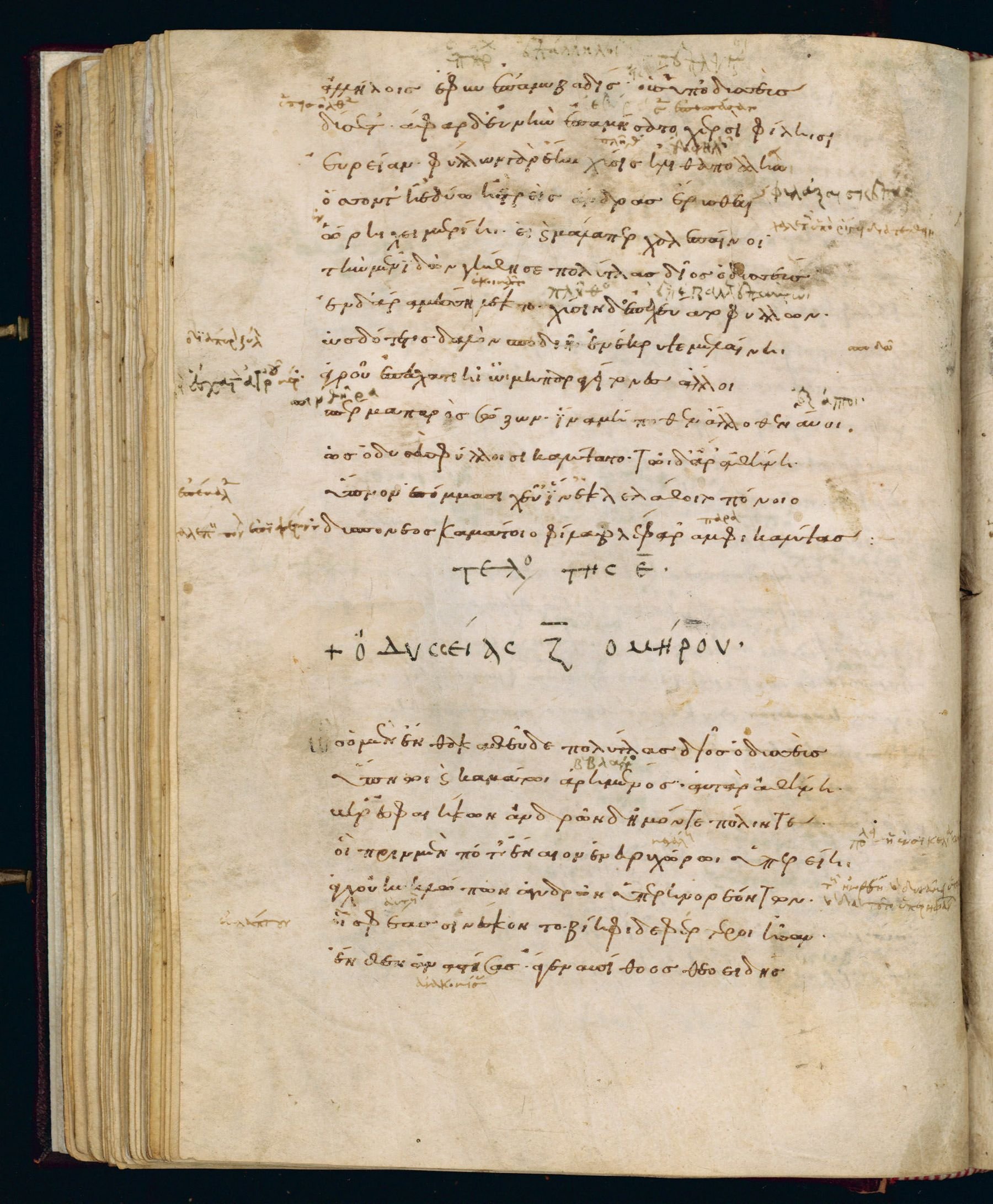
Where on the image
Laur. Plut. 32.24, fol. 55v: Odyssey 5.481-493, begins ‹ἀλλήλοισιν ἔφυν ἐπαμοιβαδίς· οὓς›, ends ‹καμάτοιο φίλα βλέφαρʼ ἀμφικαλύψας.›. Checked on the image: first and last lines read and matched to the Greek. Fol. 55r ends with 5.480. The page holds 5.481-493, 6.1-7. Book 5 ends with 5.493, followed by the subscription τέλος τῆς ε; a heading + ὀδυσσείας ζ ὁμήρου follows and book 6 begins with an enlarged initial. English blocks here: 480-484, 485-489, 490-493.
481ἀλλήλοισιν ἔφυν ἐπαμοιβαδίς· οὓς ὑπʼ Ὀδυσσεὺς
482δύσετʼ. ἄφαρ δʼ εὐνὴν ἐπαμήσατο χερσὶ φίλῃσιν
483εὐρεῖαν· φύλλων γὰρ ἔην χύσις ἤλιθα πολλή,
484ὅσσον τʼ ἠὲ δύω ἠὲ τρεῖς ἄνδρας ἔρυσθαι
485ὥρῃ χειμερίῃ, εἰ καὶ μάλα περ χαλεπαίνοι.
486τὴν μὲν ἰδὼν γήθησε πολύτλας δῖος Ὀδυσσεύς,
487ἐν δʼ ἄρα μέσσῃ λέκτο, χύσιν δʼ ἐπεχεύατο φύλλων.
488ὡς δʼ ὅτε τις δαλὸν σποδιῇ ἐνέκρυψε μελαίνῃ
489ἀγροῦ ἐπʼ ἐσχατιῆς, ᾧ μὴ πάρα γείτονες ἄλλοι,
490σπέρμα πυρὸς σώζων, ἵνα μή ποθεν ἄλλοθεν αὔοι,
491ὣς Ὀδυσεὺς φύλλοισι καλύψατο· τῷ δʼ ἄρʼ Ἀθήνη
492ὕπνον ἐπʼ ὄμμασι χεῦʼ, ἵνα μιν παύσειε τάχιστα
493δυσπονέος καμάτοιο φίλα βλέφαρʼ ἀμφικαλύψας.
480nor could the rain pierce through them, so closely did they grow, intertwining one with the other. Beneath these Odysseus crept and straightway gathered with his hands a broad bed, for fallen leaves were there in plenty, enough to shelter two men or three 485in winter-time, however bitter the weather. And the much-enduring goodly Odysseus saw it, and was glad, and he lay down in the midst, and heaped over him the fallen leaves. And as a man hides a brand beneath the dark embers in an outlying farm, a man who has no neighbors, 490and so saves a seed of fire, that he may not have to kindle it from some other source, so Odysseus covered himself with leaves. And Athena shed sleep upon his eyes, that it might enfold his lids and speedily free him from toilsome weariness.
Notes
- Greek: A. T. Murray, Homer: The Odyssey (Loeb Classical Library, 1919), via Perseus.
- English: A. T. Murray's translation in the same edition; his footnotes are omitted.
Cite
Sources
- Source: Laur. Plut. 32.24 (BML Teca Digitale IIIF) + Murray Greek (Loeb 1919, Perseus) + Murray English (Loeb 1919, Perseus) (holding institution)
- Critical edition: Murray, Loeb 1919, via Perseus
← previous · → next · v cycle view · l back to library