Homer, Odyssey, Book 6: Nausicaa
Introduction
The Odyssey, composed around 700 BCE and attributed to Homer, tells of Odysseus' ten-year journey home from Troy and his return to Ithaca. Book 6 (331 lines): Nausicaa.
The page photographs are from Florence, Biblioteca Medicea Laurenziana, Plut. 32.24 (parchment, 10th century, 234 folios; the oldest manuscript of the Odyssey with published images), in the Biblioteca Medicea Laurenziana's Teca Digitale. This book is on fol. 55v-62r; each section below is one page, with its first and last line as read on the photograph. Many pages carry interlinear glosses and a few marginal notes in later hands.
The Greek is A. T. Murray's Loeb text (1919) via Perseus, not a transcription of this manuscript, whose wording differs in places. The English is Murray's prose translation (1919), divided every five lines; at a page break a five-line block goes with the page holding most of it, except at the page breaks where a section's note says the English is cut at the end of Murray's sentence. Each section's note gives its English line range.
Where the scribe left out a line, wrote one in the margin, changed the order or added a line not in Murray's text, the section's note on the photograph says so; the Greek and English shown are Murray's full text for the page's range.
How was this verified? (Provenance)
Where on the image
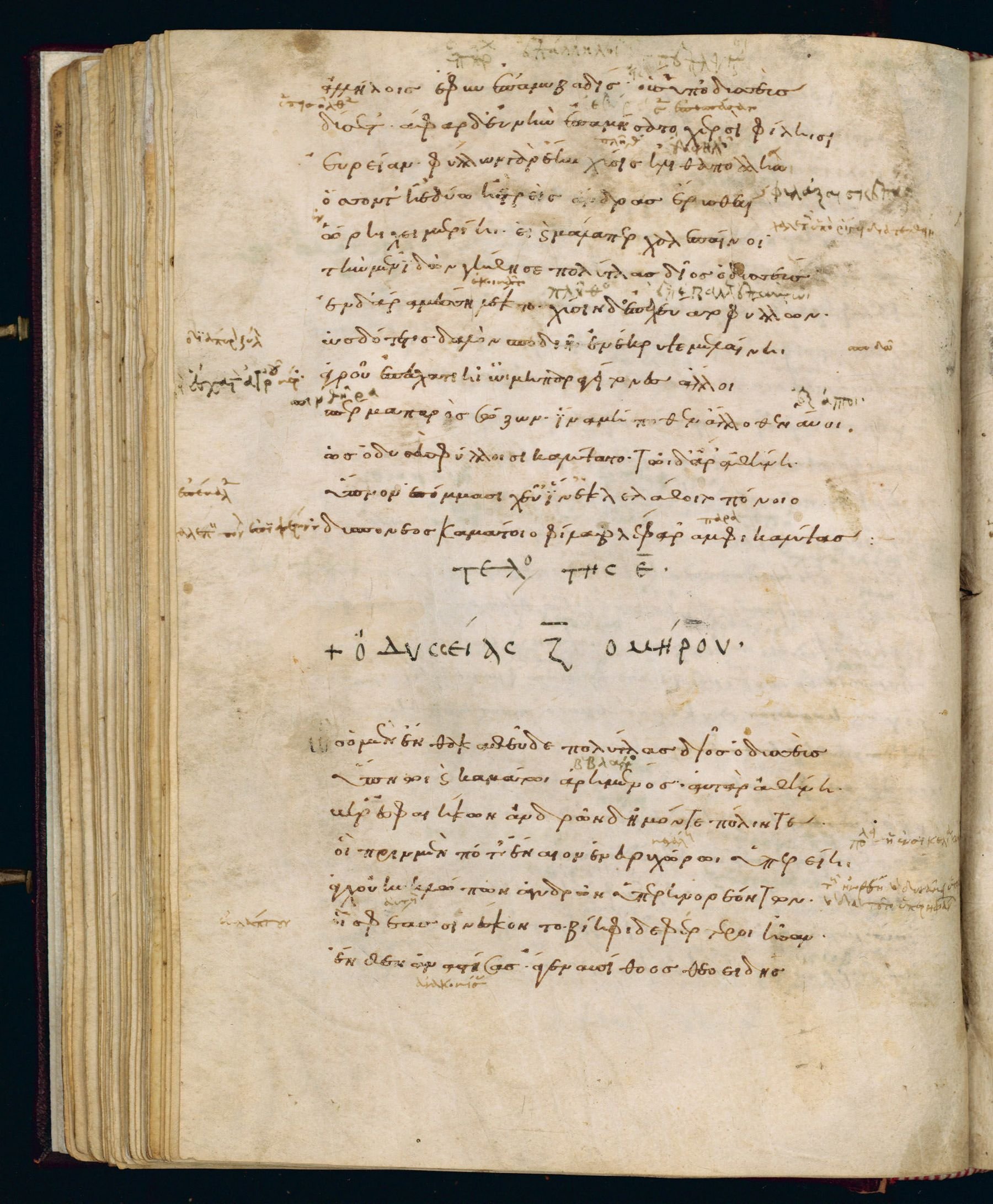
Laur. Plut. 32.24, fol. 55v: Odyssey 6.1-7, begins ‹ὣς ὁ μὲν ἔνθα›, ends ‹ἀναστήσας ἄγε Ναυσίθοος θεοειδής,›. Checked on the image: first and last lines read and matched to the Greek. Fol. 56r begins with 6.8. The page holds 5.481-493, 6.1-7. Book 5 ends with 5.493, followed by the subscription τέλος τῆς ε; a heading + ὀδυσσείας ζ ὁμήρου follows and book 6 begins with an enlarged initial. English blocks here: 1-4, 5-9.
1ὣς ὁ μὲν ἔνθα καθεῦδε πολύτλας δῖος Ὀδυσσεὺς
2ὕπνῳ καὶ καμάτῳ ἀρημένος· αὐτὰρ Ἀθήνη
3βῆ ῥʼ ἐς Φαιήκων ἀνδρῶν δῆμόν τε πόλιν τε,
4οἳ πρὶν μέν ποτʼ ἔναιον ἐν εὐρυχόρῳ Ὑπερείῃ,
5ἀγχοῦ Κυκλώπων ἀνδρῶν ὑπερηνορεόντων,
6οἵ σφεας σινέσκοντο, βίηφι δὲ φέρτεροι ἦσαν.
7ἔνθεν ἀναστήσας ἄγε Ναυσίθοος θεοειδής,
1So he lay there asleep, the much-enduring goodly Odysseus, overcome with sleep and weariness; but Athena went to the land and city of the Phaeacians. These dwelt of old in spacious Hypereia 5hard by the Cyclopes, men overweening in pride who plundered them continually and were mightier than they. From thence Nausithous, the godlike, had removed them, and led and settled them in Scheria far from men that live by toil. About the city he had drawn a wall, he had built houses
Where on the image
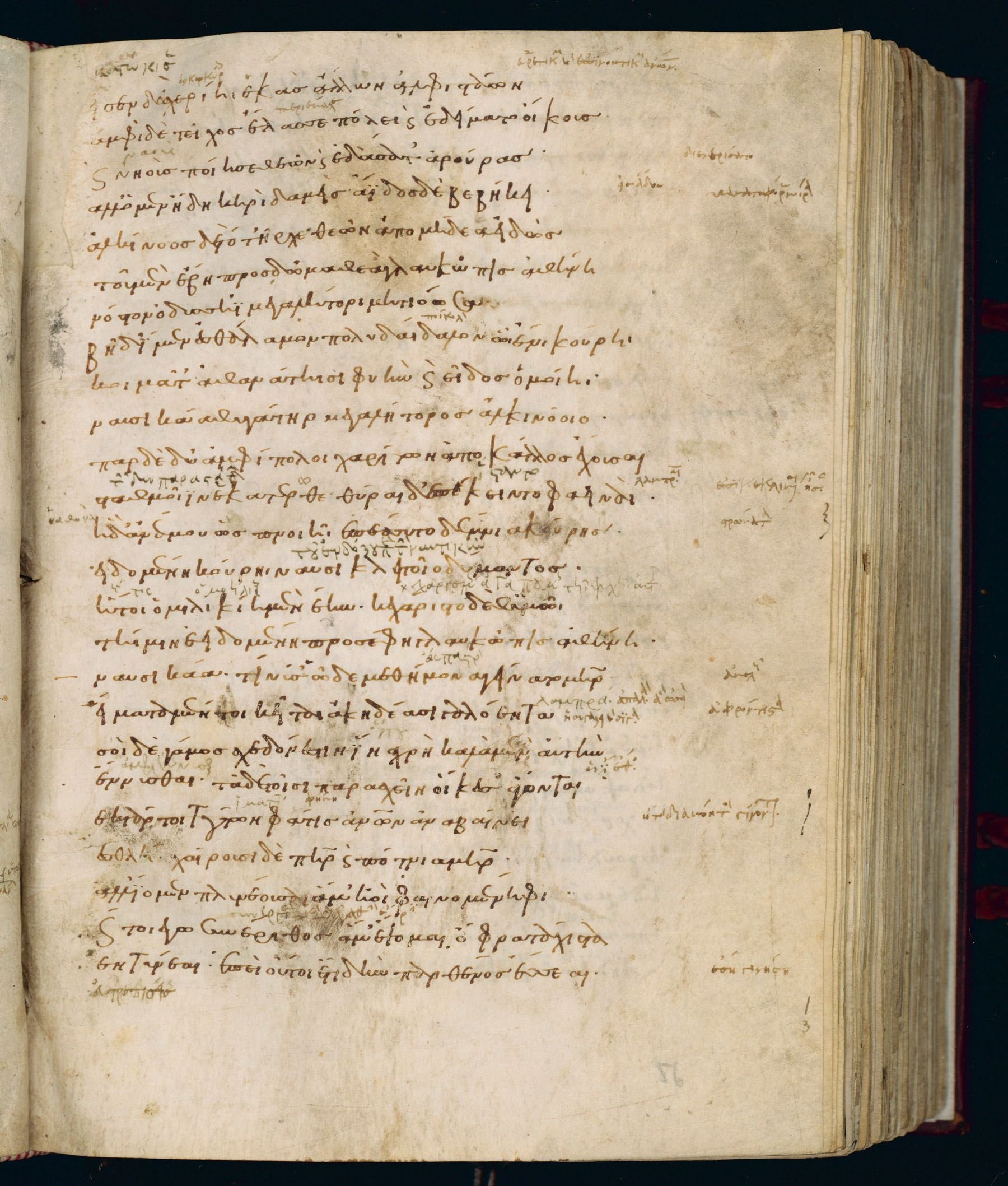
Laur. Plut. 32.24, fol. 56r: Odyssey 6.8-33, begins ‹εἷσεν δὲ Σχερίῃ, ἑκὰς›, ends ‹ἔτι δὴν παρθένος ἔσσεαι·›. Checked on the image: first and last lines read and matched to the Greek. Fol. 55v ends with 6.7. Fol. 56v begins with 6.34. 6.21 (στῆ δʼ ἄρʼ ὑπὲρ κεφαλῆς ...) is not in the text column: the scribe passes from 6.20 to 6.22 (25 lines); the short interlinear note between them is not this verse. English blocks here: 10-14, 15-19, 20-24, 25-29, 30-34.
8εἷσεν δὲ Σχερίῃ, ἑκὰς ἀνδρῶν ἀλφηστάων,
9ἀμφὶ δὲ τεῖχος ἔλασσε πόλει, καὶ ἐδείματο οἴκους,
10καὶ νηοὺς ποίησε θεῶν, καὶ ἐδάσσατʼ ἀρούρας.
11ἀλλʼ ὁ μὲν ἤδη κηρὶ δαμεὶς Ἄϊδόσδε βεβήκει,
12Ἀλκίνοος δὲ τότʼ ἦρχε, θεῶν ἄπο μήδεα εἰδώς.
13τοῦ μὲν ἔβη πρὸς δῶμα θεά, γλαυκῶπις Ἀθήνη,
14νόστον Ὀδυσσῆι μεγαλήτορι μητιόωσα.
15βῆ δʼ ἴμεν ἐς θάλαμον πολυδαίδαλον, ᾧ ἔνι κούρη
16κοιμᾶτʼ ἀθανάτῃσι φυὴν καὶ εἶδος ὁμοίη,
17Ναυσικάα, θυγάτηρ μεγαλήτορος Ἀλκινόοιο,
18πὰρ δὲ δύʼ ἀμφίπολοι, Χαρίτων ἄπο κάλλος ἔχουσαι,
19σταθμοῖιν ἑκάτερθε· θύραι δʼ ἐπέκειντο φαειναί.
20ἡ δʼ ἀνέμου ὡς πνοιὴ ἐπέσσυτο δέμνια κούρης,
21στῆ δʼ ἄρʼ ὑπὲρ κεφαλῆς, καί μιν πρὸς μῦθον ἔειπεν,
22εἰδομένη κούρῃ ναυσικλειτοῖο Δύμαντος,
23ἥ οἱ ὁμηλικίη μὲν ἔην, κεχάριστο δὲ θυμῷ.
24τῇ μιν ἐεισαμένη προσέφη γλαυκῶπις Ἀθήνη·
25Ναυσικάα, τί νύ σʼ ὧδε μεθήμονα γείνατο μήτηρ;
26εἵματα μέν τοι κεῖται ἀκηδέα σιγαλόεντα,
27σοὶ δὲ γάμος σχεδόν ἐστιν, ἵνα χρὴ καλὰ μὲν αὐτὴν
28ἕννυσθαι, τὰ δὲ τοῖσι παρασχεῖν, οἵ κέ σʼ ἄγωνται.
29ἐκ γάρ τοι τούτων φάτις ἀνθρώπους ἀναβαίνει
30ἐσθλή, χαίρουσιν δὲ πατὴρ καὶ πότνια μήτηρ.
31ἀλλʼ ἴομεν πλυνέουσαι ἅμʼ ἠοῖ φαινομένηφι·
32καί τοι ἐγὼ συνέριθος ἅμʼ ἕψομαι, ὄφρα τάχιστα
33ἐντύνεαι, ἐπεὶ οὔ τοι ἔτι δὴν παρθένος ἔσσεαι·
10and made temples for the gods, and divided the ploughlands; but he, ere now, had been stricken by fate and had gone to the house of Hades, and Alcinous was now king, made wise in counsel by the gods. To his house went the goddess, flashing-eyed Athena, to contrive the return of great-hearted Odysseus. 15She went to a chamber, richly wrought, wherein slept a maiden like the immortal goddesses in form and comeliness, Nausicaa, the daughter of great-hearted Alcinous; hard by slept two hand-maidens, gifted with beauty by the Graces, one on either side of the door-posts, and the bright doors were shut. 20But like a breath of air the goddess sped to the couch of the maiden, and stood above her head, and spoke to her, taking the form of the daughter of Dymas, famed for his ships, a girl who was of like age with Nausicaa, and was dear to her heart. Likening herself to her, the flashing-eyed Athena spoke and said: 25“Nausicaa, how comes it that thy mother bore thee so heedless? Thy bright raiment is lying uncared for; yet thy marriage is near at hand, when thou must needs thyself be clad in fair garments, and give other such to those who escort thee. It is from things like these, thou knowest, that good report goeth up among men, 30and the father and honored mother rejoice. Nay, come, let us go to wash them at break of day, for I will follow with thee to aid thee, that thou mayest with speed make thee ready; for thou shalt not long remain a maiden. Even now thou hast suitors in the land, the noblest
Where on the image
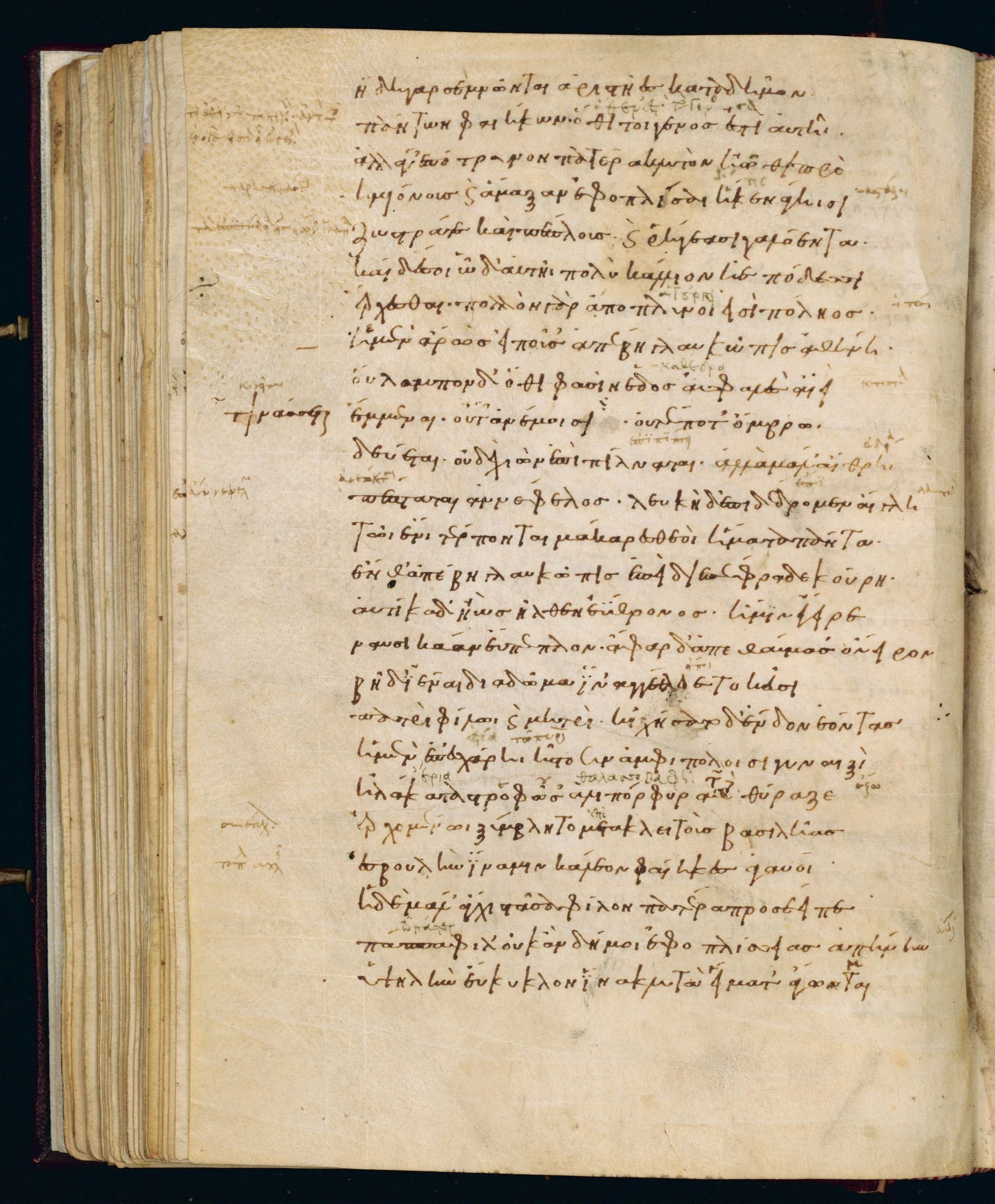
Laur. Plut. 32.24, fol. 56v: Odyssey 6.34-58, begins ‹ἤδη γάρ σε μνῶνται›, ends ‹ἵνα κλυτὰ εἵματʼ ἄγωμαι›. Checked on the image: first and last lines read and matched to the Greek. Fol. 56r ends with 6.33. Fol. 57r begins with 6.59. English blocks here: 35-39, 40-44, 45-47, 48-49, 50-54, 55-59.
34ἤδη γάρ σε μνῶνται ἀριστῆες κατὰ δῆμον
35πάντων Φαιήκων, ὅθι τοι γένος ἐστὶ καὶ αὐτῇ.
36ἀλλʼ ἄγʼ ἐπότρυνον πατέρα κλυτὸν ἠῶθι πρὸ
37ἡμιόνους καὶ ἄμαξαν ἐφοπλίσαι, ἥ κεν ἄγῃσι
38ζῶστρά τε καὶ πέπλους καὶ ῥήγεα σιγαλόεντα.
39καὶ δὲ σοὶ ὧδʼ αὐτῇ πολὺ κάλλιον ἠὲ πόδεσσιν
40ἔρχεσθαι· πολλὸν γὰρ ἀπὸ πλυνοί εἰσι πόληος.
41ἡ μὲν ἄρʼ ὣς εἰποῦσʼ ἀπέβη γλαυκῶπις Ἀθήνη
42Οὔλυμπόνδʼ, ὅθι φασὶ θεῶν ἕδος ἀσφαλὲς αἰεὶ
43ἔμμεναι. οὔτʼ ἀνέμοισι τινάσσεται οὔτε ποτʼ ὄμβρῳ
44δεύεται οὔτε χιὼν ἐπιπίλναται, ἀλλὰ μάλʼ αἴθρη
45πέπταται ἀνέφελος, λευκὴ δʼ ἐπιδέδρομεν αἴγλη·
46τῷ ἔνι τέρπονται μάκαρες θεοὶ ἤματα πάντα.
47ἔνθʼ ἀπέβη γλαυκῶπις, ἐπεὶ διεπέφραδε κούρῃ.
48αὐτίκα δʼ Ἠὼς ἦλθεν ἐύθρονος, ἥ μιν ἔγειρε
49Ναυσικάαν ἐύπεπλον· ἄφαρ δʼ ἀπεθαύμασʼ ὄνειρον,
50βῆ δʼ ἰέναι διὰ δώμαθʼ, ἵνʼ ἀγγείλειε τοκεῦσιν,
51πατρὶ φίλῳ καὶ μητρί· κιχήσατο δʼ ἔνδον ἐόντας·
52ἡ μὲν ἐπʼ ἐσχάρῃ ἧστο σὺν ἀμφιπόλοισι γυναιξὶν
53ἠλάκατα στρωφῶσʼ ἁλιπόρφυρα· τῷ δὲ θύραζε
54ἐρχομένῳ ξύμβλητο μετὰ κλειτοὺς βασιλῆας
55ἐς βουλήν, ἵνα μιν κάλεον Φαίηκες ἀγαυοί.
56ἡ δὲ μάλʼ ἄγχι στᾶσα φίλον πατέρα προσέειπε·
57πάππα φίλʼ, οὐκ ἂν δή μοι ἐφοπλίσσειας ἀπήνην
58ὑψηλὴν ἐύκυκλον, ἵνα κλυτὰ εἵματʼ ἄγωμαι
35of all the Phaeacians, from whom is thine own lineage. Nay, come, bestir thy noble father early this morning that he make ready mules and a wagon for thee, to bear the girdles and robes and bright coverlets. And for thyself, too, it is far more seemly 40to go thus than on foot, for the washing tanks are far from the city.” So saying, the goddess, flashing-eyed Athena, departed to Olympus, where, they say, is the abode of the gods that stands fast forever. Neither is it shaken by winds nor ever wet with rain, nor does snow fall upon it, but the air 45is outspread clear and cloudless, and over it hovers a radiant whiteness. Therein the blessed gods are glad all their days, and thither went the flashing-eyed one, when she had spoken all her word to the maiden. 48At once then came fair-throned Dawn and awakened Nausicaa of the beautiful robes, and straightway she marvelled at her dream, 50and went through the house to tell her parents, her father dear and her mother; and she found them both within. The mother sat at the hearth with her handmaidens, spinning the yarn of purple dye, and her father she met as he was going forth to join the glorious kings 55in the place of council, to which the lordly Phaeacians called him. But she came up close to her dear father, and said: “Papa dear, wilt thou not make ready for me a wagon, high and stout of wheel, that I may take to the river for washing the goodly raiment of mine which is lying here soiled?
Where on the image
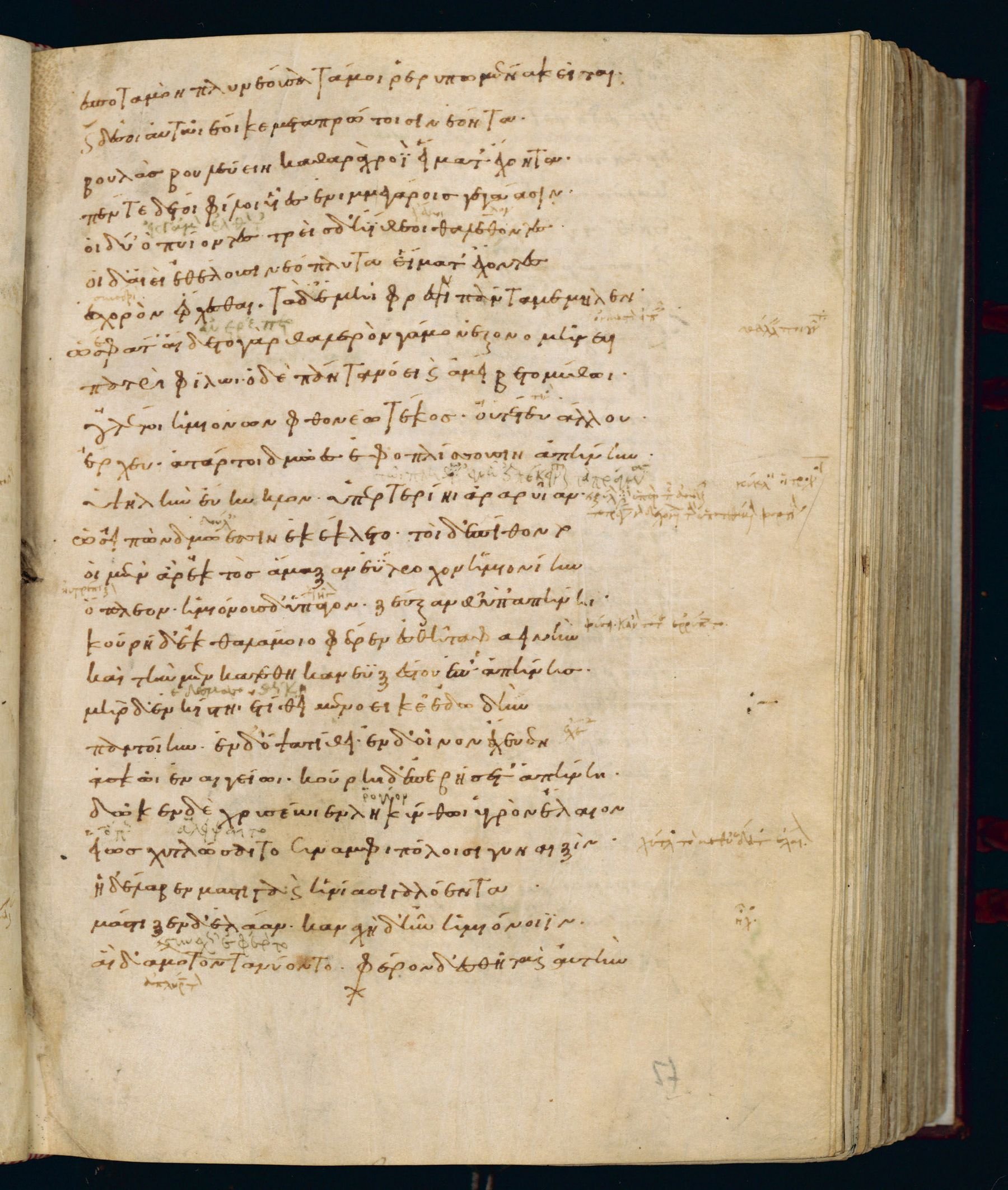
Laur. Plut. 32.24, fol. 57r: Odyssey 6.59-83, begins ‹ἐς ποταμὸν πλυνέουσα, τά›, ends ‹δʼ ἐσθῆτα καὶ αὐτήν,›. Checked on the image: first and last lines read and matched to the Greek. Fol. 56v ends with 6.58. Fol. 57v begins with 6.84. English blocks here: 60-64, 65-69, 70-74, 75-79, 80-84.
59ἐς ποταμὸν πλυνέουσα, τά μοι ῥερυπωμένα κεῖται;
60καὶ δὲ σοὶ αὐτῷ ἔοικε μετὰ πρώτοισιν ἐόντα
61βουλὰς βουλεύειν καθαρὰ χροΐ εἵματʼ ἔχοντα.
62πέντε δέ τοι φίλοι υἷες ἐνὶ μεγάροις γεγάασιν,
63οἱ δύʼ ὀπυίοντες, τρεῖς δʼ ἠίθεοι θαλέθοντες·
64οἱ δʼ αἰεὶ ἐθέλουσι νεόπλυτα εἵματʼ ἔχοντες
65ἐς χορὸν ἔρχεσθαι· τὰ δʼ ἐμῇ φρενὶ πάντα μέμηλεν.
66ὣς ἔφατʼ· αἴδετο γὰρ θαλερὸν γάμον ἐξονομῆναι
67πατρὶ φίλῳ. ὁ δὲ πάντα νόει καὶ ἀμείβετο μύθῳ·
68οὔτε τοι ἡμιόνων φθονέω, τέκος, οὔτε τευ ἄλλου.
69ἔρχευ· ἀτάρ τοι δμῶες ἐφοπλίσσουσιν ἀπήνην
70ὑψηλὴν ἐύκυκλον, ὑπερτερίῃ ἀραρυῖαν.
71ὣς εἰπὼν δμώεσσιν ἐκέκλετο, τοὶ δʼ ἐπίθοντο.
72οἱ μὲν ἄρʼ ἐκτὸς ἄμαξαν ἐύτροχον ἡμιονείην
73ὥπλεον, ἡμιόνους θʼ ὕπαγον ζεῦξάν θʼ ὑπʼ ἀπήνῃ·
74κούρη δʼ ἐκ θαλάμοιο φέρεν ἐσθῆτα φαεινήν.
75καὶ τὴν μὲν κατέθηκεν ἐυξέστῳ ἐπʼ ἀπήνῃ,
76μήτηρ δʼ ἐν κίστῃ ἐτίθει μενοεικέʼ ἐδωδὴν
77παντοίην, ἐν δʼ ὄψα τίθει, ἐν δʼ οἶνον ἔχευεν
78ἀσκῷ ἐν αἰγείῳ· κούρη δʼ ἐπεβήσετʼ ἀπήνης.
79δῶκεν δὲ χρυσέῃ ἐν ληκύθῳ ὑγρὸν ἔλαιον,
80ἧος χυτλώσαιτο σὺν ἀμφιπόλοισι γυναιξίν.
81ἡ δʼ ἔλαβεν μάστιγα καὶ ἡνία σιγαλόεντα,
82μάστιξεν δʼ ἐλάαν· καναχὴ δʼ ἦν ἡμιόνοιιν.
83αἱ δʼ ἄμοτον τανύοντο, φέρον δʼ ἐσθῆτα καὶ αὐτήν,
60Moreover for thyself it is seemly that when thou art at council with the princes thou shouldst have clean raiment upon thee; and thou hast five sons living in thy halls—two are wedded, but three are sturdy bachelors—and these ever wish to put on them freshly-washed raiment, 65when they go to the dance. Of all this must I take thought.” So she spoke, for she was ashamed to name gladsome marriage to her father; but he understood all, and answered, saying: “Neither the mules do I begrudge thee, my child, nor aught beside. Go thy way; the slaves shall make ready for thee the wagon, 70high and stout of wheel and fitted with a box above.” With this he called to the slaves, and they hearkened. Outside the palace they made ready the light-running mule wagon, and led up the mules and yoked them to it; and the maiden brought from her chamber the bright raiment, 75and placed it upon the polished car, while her mother put in a chest food of all sorts to satisfy the heart. Therein she put dainties, and poured wine in a goat-skin flask; and the maiden mounted upon the wagon. Her mother gave her also soft olive oil in a flask of gold, 80that she and her maidens might have it for the bath. Then Nausicaa took the whip and the bright reins, and smote the mules to start them; and there was a clatter of the mules as they sped on a main, bearing the raiment and the maiden; neither went she alone, for with her went her handmaids as well.
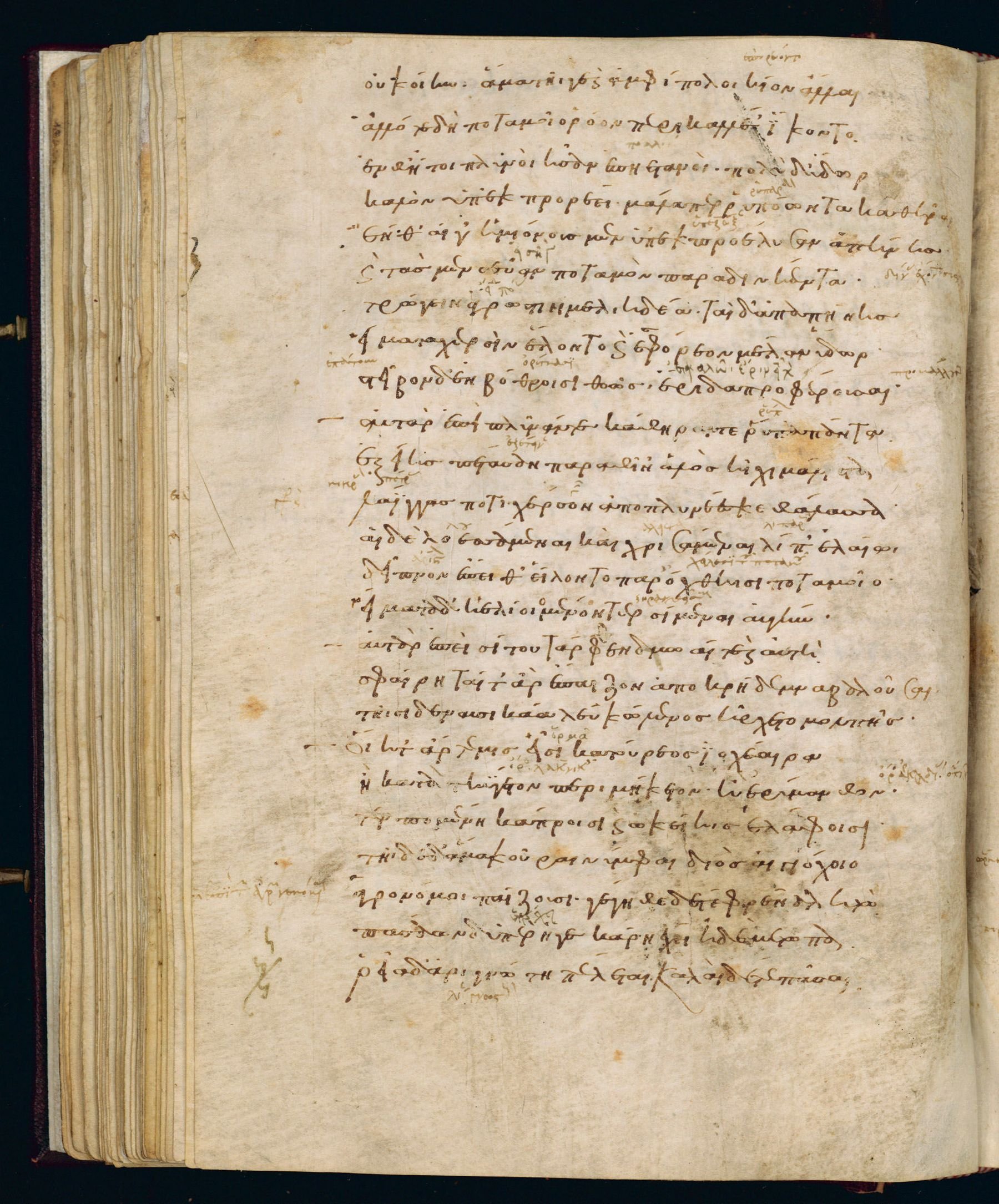
Where on the image
Laur. Plut. 32.24, fol. 57v: Odyssey 6.84-108, begins ‹οὐκ οἴην, ἅμα τῇ›, ends ‹καλαὶ δέ τε πᾶσαι·›. Checked on the image: first and last lines read and matched to the Greek. Fol. 57r ends with 6.83. Fol. 58r begins with 6.109. English blocks here: 85-89, 90-94, 95-99, 100-104, 105-109.
84οὐκ οἴην, ἅμα τῇ γε καὶ ἀμφίπολοι κίον ἄλλαι.
85αἱ δʼ ὅτε δὴ ποταμοῖο ῥόον περικαλλέʼ ἵκοντο,
86ἔνθʼ ἦ τοι πλυνοὶ ἦσαν ἐπηετανοί, πολὺ δʼ ὕδωρ
87καλὸν ὑπεκπρόρεεν μάλα περ ῥυπόωντα καθῆραι,
88ἔνθʼ αἵ γʼ ἡμιόνους μὲν ὑπεκπροέλυσαν ἀπήνης.
89καὶ τὰς μὲν σεῦαν ποταμὸν πάρα δινήεντα
90τρώγειν ἄγρωστιν μελιηδέα· ταὶ δʼ ἀπʼ ἀπήνης
91εἵματα χερσὶν ἕλοντο καὶ ἐσφόρεον μέλαν ὕδωρ,
92στεῖβον δʼ ἐν βόθροισι θοῶς ἔριδα προφέρουσαι.
93αὐτὰρ ἐπεὶ πλῦνάν τε κάθηράν τε ῥύπα πάντα,
94ἑξείης πέτασαν παρὰ θῖνʼ ἁλός, ἧχι μάλιστα
95λάιγγας ποτὶ χέρσον ἀποπλύνεσκε θάλασσα.
96αἱ δὲ λοεσσάμεναι καὶ χρισάμεναι λίπʼ ἐλαίῳ
97δεῖπνον ἔπειθʼ εἵλοντο παρʼ ὄχθῃσιν ποταμοῖο,
98εἵματα δʼ ἠελίοιο μένον τερσήμεναι αὐγῇ.
99αὐτὰρ ἐπεὶ σίτου τάρφθεν δμῳαί τε καὶ αὐτή,
100σφαίρῃ ταὶ δʼ ἄρʼ ἔπαιζον, ἀπὸ κρήδεμνα βαλοῦσαι·
101τῇσι δὲ Ναυσικάα λευκώλενος ἤρχετο μολπῆς.
102οἵη δʼ Ἄρτεμις εἶσι κατʼ οὔρεα ἰοχέαιρα,
103ἢ κατὰ Τηΰγετον περιμήκετον ἢ Ἐρύμανθον,
104τερπομένη κάπροισι καὶ ὠκείῃς ἐλάφοισι·
105τῇ δέ θʼ ἅμα νύμφαι, κοῦραι Διὸς αἰγιόχοιο,
106ἀγρονόμοι παίζουσι, γέγηθε δέ τε φρένα Λητώ·
107πασάων δʼ ὑπὲρ ἥ γε κάρη ἔχει ἠδὲ μέτωπα,
108ῥεῖά τʼ ἀριγνώτη πέλεται, καλαὶ δέ τε πᾶσαι·
85Now when they came to the beautiful streams of the river, where were the washing tanks that never failed—for abundant clear water welled up from beneath and flowed over, to cleanse garments however soiled—there they loosed the mules from under the wagon and drove them along the eddying river 90to graze on the honey-sweet water-grass, and themselves took in their arms the raiment from the wagon, and bore it into the dark water, and trampled it in the trenches, busily vying each with each. Now when they had washed the garments, and had cleansed them of all the stains, they spread them out in rows on the shore of the sea where 95the waves dashing against the land washed the pebbles cleanest; and they, after they had bathed and anointed themselves richly with oil, took their meal on the river's banks, and waited for the clothing to dry in the bright sunshine. Then when they had had their joy of food, she and her handmaids, 100they threw off their head-gear and fell to playing at ball, and white-armed Nausicaa was leader in the song. And even as Artemis, the archer, roves over the mountains, along the ridges of lofty Taygetus or Erymanthus, joying in the pursuit of boars and swift deer, 105and with her sport the wood-nymphs, the daughters of Zeus who bears the aegis, and Leto is glad at heart—high above them all Artemis holds her head and brows, and easily may she be known, though all are fair—so amid her handmaidens shone the maid unwed.
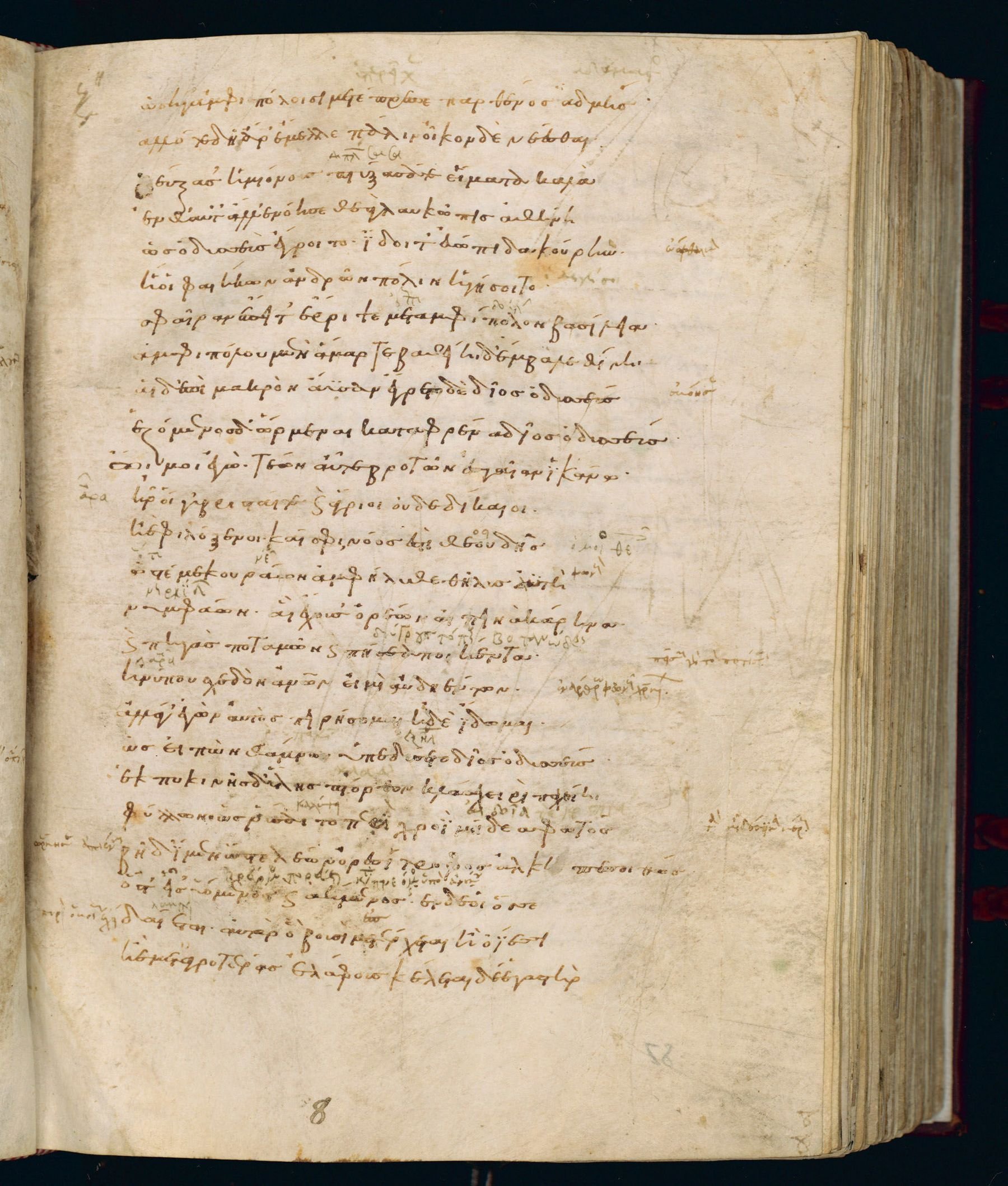
Where on the image
Laur. Plut. 32.24, fol. 58r: Odyssey 6.109-133, begins ‹ὣς ἥ γʼ ἀμφιπόλοισι›, ends ‹κέλεται δέ ἑ γαστὴρ›. Checked on the image: first and last lines read and matched to the Greek. Fol. 57v ends with 6.108. Fol. 58v begins with 6.134. English blocks here: 110-114, 115-119, 120-124, 125-126, 127-129, 130-134.
109ὣς ἥ γʼ ἀμφιπόλοισι μετέπρεπε παρθένος ἀδμής.
110ἀλλʼ ὅτε δὴ ἄρʼ ἔμελλε πάλιν οἶκόνδε νέεσθαι
111ζεύξασʼ ἡμιόνους πτύξασά τε εἵματα καλά,
112ἔνθʼ αὖτʼ ἄλλʼ ἐνόησε θεά, γλαυκῶπις Ἀθήνη,
113ὡς Ὀδυσεὺς ἔγροιτο, ἴδοι τʼ ἐυώπιδα κούρην,
114ἥ οἱ Φαιήκων ἀνδρῶν πόλιν ἡγήσαιτο.
115σφαῖραν ἔπειτʼ ἔρριψε μετʼ ἀμφίπολον βασίλεια·
116ἀμφιπόλου μὲν ἅμαρτε, βαθείῃ δʼ ἔμβαλε δίνῃ·
117αἱ δʼ ἐπὶ μακρὸν ἄυσαν· ὁ δʼ ἔγρετο δῖος Ὀδυσσεύς,
118ἑζόμενος δʼ ὥρμαινε κατὰ φρένα καὶ κατὰ θυμόν·
119ὤ μοι ἐγώ, τέων αὖτε βροτῶν ἐς γαῖαν ἱκάνω;
120ἦ ῥʼ οἵ γʼ ὑβρισταί τε καὶ ἄγριοι οὐδὲ δίκαιοι,
121ἦε φιλόξεινοι καί σφιν νόος ἐστὶ θεουδής;
122ὥς τέ με κουράων ἀμφήλυθε θῆλυς ἀυτή·
123νυμφάων, αἳ ἔχουσʼ ὀρέων αἰπεινὰ κάρηνα
124καὶ πηγὰς ποταμῶν καὶ πίσεα ποιήεντα.
125ἦ νύ που ἀνθρώπων εἰμὶ σχεδὸν αὐδηέντων;
126ἀλλʼ ἄγʼ ἐγὼν αὐτὸς πειρήσομαι ἠδὲ ἴδωμαι.
127ὣς εἰπὼν θάμνων ὑπεδύσετο δῖος Ὀδυσσεύς,
128ἐκ πυκινῆς δʼ ὕλης πτόρθον κλάσε χειρὶ παχείῃ
129φύλλων, ὡς ῥύσαιτο περὶ χροῒ μήδεα φωτός.
130βῆ δʼ ἴμεν ὥς τε λέων ὀρεσίτροφος ἀλκὶ πεποιθώς,
131ὅς τʼ εἶσʼ ὑόμενος καὶ ἀήμενος, ἐν δέ οἱ ὄσσε
132δαίεται· αὐτὰρ ὁ βουσὶ μετέρχεται ἢ ὀίεσσιν
133ἠὲ μετʼ ἀγροτέρας ἐλάφους· κέλεται δέ ἑ γαστὴρ
110But when she was about to yoke the mules, and fold the fair raiment, in order to return homeward, then the goddess, flashing-eyed Athena, took other counsel, that Odysseus might awake and see the fair-faced maid, who should lead him to the city of the Phaeacians. 115So then the princess tossed the ball to one of her maidens; the maiden indeed she missed, but cast it into a deep eddy, and thereat they cried aloud, and goodly Odysseus awoke, and sat up, and thus he pondered in mind and heart: “Woe is me! to the land of what mortals am I now come? 120Are they cruel, and wild, and unjust? or do they love strangers and fear the gods in their thoughts? There rang in my ears a cry as of maidens, of nymphs who haunt the towering peaks of the mountains, the springs that feed the rivers, and the grassy meadows! 125Can it be that I am somewhere near men of human speech? Nay, I will myself make trial and see.” 127So saying the goodly Odysseus came forth from beneath the bushes, and with his stout hand he broke from the thick wood a leafy branch, that he might hold it about him and hide therewith his nakedness. 130Forth he came like a mountain-nurtured lion trusting in his might, who goes forth, beaten with rain and wind, but his two eyes are ablaze: into the midst of the kine he goes, or of the sheep, or on the track of the wild deer, and his belly bids him go even into the close-built fold, to make an attack upon the flocks.
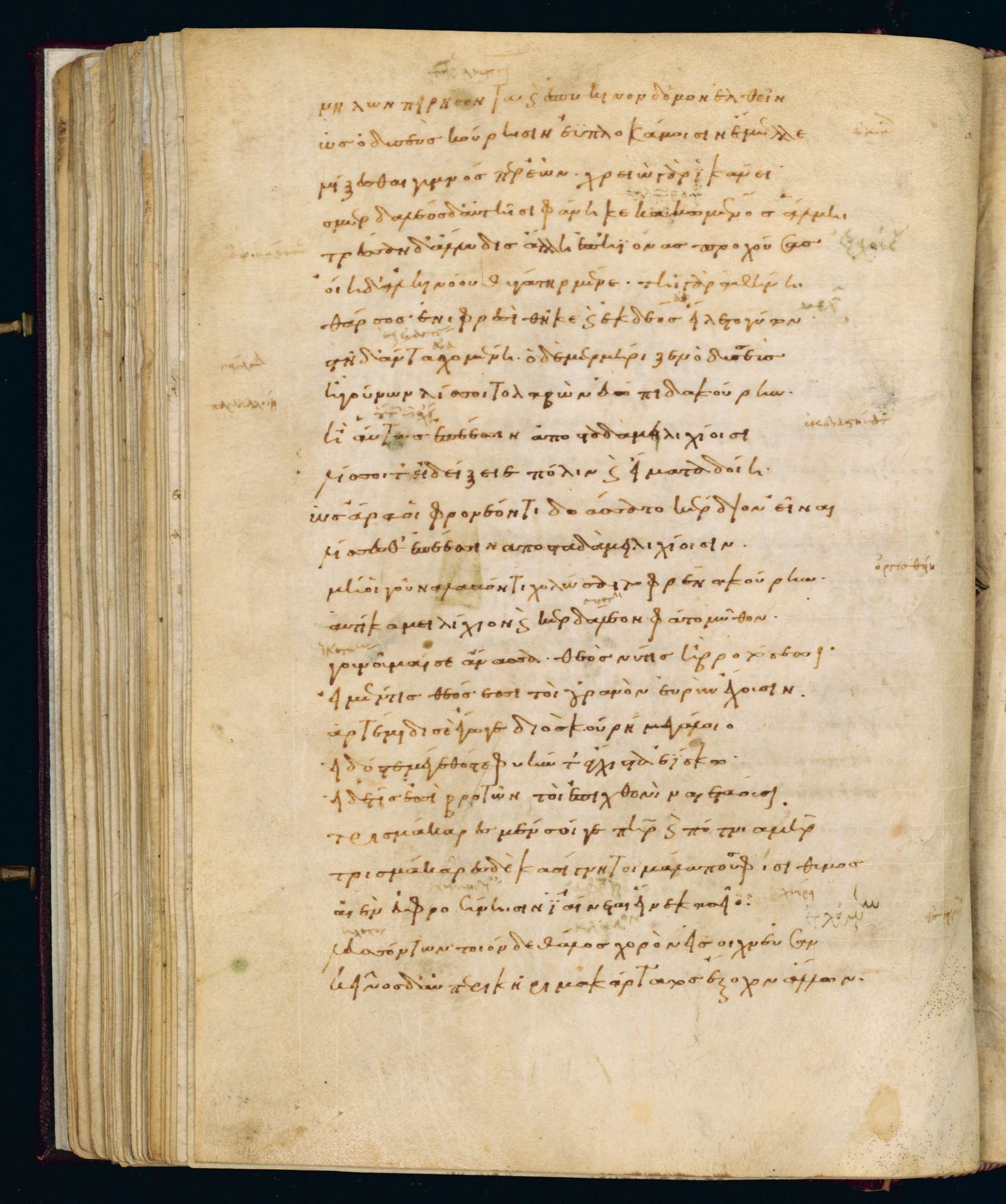
Where on the image
Laur. Plut. 32.24, fol. 58v: Odyssey 6.134-158, begins ‹μήλων πειρήσοντα καὶ ἐς›, ends ‹κῆρι μακάρτατος ἔξοχον ἄλλων,›. Checked on the image: first and last lines read and matched to the Greek. Fol. 58r ends with 6.133. Fol. 59r begins with 6.159. English blocks here: 135-139, 140-144, 145-149, 150-154, 155-159.
134μήλων πειρήσοντα καὶ ἐς πυκινὸν δόμον ἐλθεῖν·
135ὣς Ὀδυσεὺς κούρῃσιν ἐυπλοκάμοισιν ἔμελλε
136μίξεσθαι, γυμνός περ ἐών· χρειὼ γὰρ ἵκανε.
137σμερδαλέος δʼ αὐτῇσι φάνη κεκακωμένος ἅλμῃ,
138τρέσσαν δʼ ἄλλυδις ἄλλη ἐπʼ ἠιόνας προὐχούσας·
139οἴη δʼ Ἀλκινόου θυγάτηρ μένε· τῇ γὰρ Ἀθήνη
140θάρσος ἐνὶ φρεσὶ θῆκε καὶ ἐκ δέος εἵλετο γυίων.
141στῆ δʼ ἄντα σχομένη· ὁ δὲ μερμήριξεν Ὀδυσσεύς,
142ἢ γούνων λίσσοιτο λαβὼν ἐυώπιδα κούρην,
143ἦ αὔτως ἐπέεσσιν ἀποσταδὰ μειλιχίοισι
144λίσσοιτʼ, εἰ δείξειε πόλιν καὶ εἵματα δοίη.
145ὣς ἄρα οἱ φρονέοντι δοάσσατο κέρδιον εἶναι,
146λίσσεσθαι ἐπέεσσιν ἀποσταδὰ μειλιχίοισι,
147μή οἱ γοῦνα λαβόντι χολώσαιτο φρένα κούρη.
148αὐτίκα μειλίχιον καὶ κερδαλέον φάτο μῦθον.
149γουνοῦμαί σε, ἄνασσα· θεός νύ τις, ἦ βροτός ἐσσι;
150εἰ μέν τις θεός ἐσσι, τοὶ οὐρανὸν εὐρὺν ἔχουσιν,
151Ἀρτέμιδί σε ἐγώ γε, Διὸς κούρῃ μεγάλοιο,
152εἶδός τε μέγεθός τε φυήν τʼ ἄγχιστα ἐίσκω·
153εἰ δέ τίς ἐσσι βροτῶν, τοὶ ἐπὶ χθονὶ ναιετάουσιν,
154τρὶς μάκαρες μὲν σοί γε πατὴρ καὶ πότνια μήτηρ,
155τρὶς μάκαρες δὲ κασίγνητοι· μάλα πού σφισι θυμὸς
156αἰὲν ἐυφροσύνῃσιν ἰαίνεται εἵνεκα σεῖο,
157λευσσόντων τοιόνδε θάλος χορὸν εἰσοιχνεῦσαν.
158κεῖνος δʼ αὖ περὶ κῆρι μακάρτατος ἔξοχον ἄλλων,
135Even so Odysseus was about to enter the company of the fair-tressed maidens, naked though he was, for need had come upon him. But terrible did he seem to them, all befouled with brine, and they shrank in fear, one here, one there, along the jutting sand-spits. Alone the daughter of Alcinous kept her place, for 140in her heart Athena put courage, and took fear from her limbs. She fled not, but stood and faced him; and Odysseus pondered whether he should clasp the knees of the fair-faced maid, and make his prayer, or whether, standing apart as he was, he should beseech her with gentle words, in hope that she might show him the city and give him raiment. 145And, as he pondered, it seemed to him better to stand apart and beseech her with gentle words, lest the maiden's heart should be wroth with him if he clasped her knees; so straightway he spoke a gentle word and crafty: “I beseech thee, O queen,—a goddess art thou, or art thou mortal? 150If thou art a goddess, one of those who hold broad heaven, to Artemis, the daughter of great Zeus, do I liken thee most nearly in comeliness and in stature and in form. But if thou art one of mortals who dwell upon the earth, thrice-blessed then are thy father and thy honored mother, 155and thrice-blessed thy brethren. Full well, I ween, are their hearts ever warmed with joy because of thee, as they see thee entering the dance, a plant so fair. But he again is blessed in heart above all others, who shall prevail with his gifts of wooing and lead thee to his home.
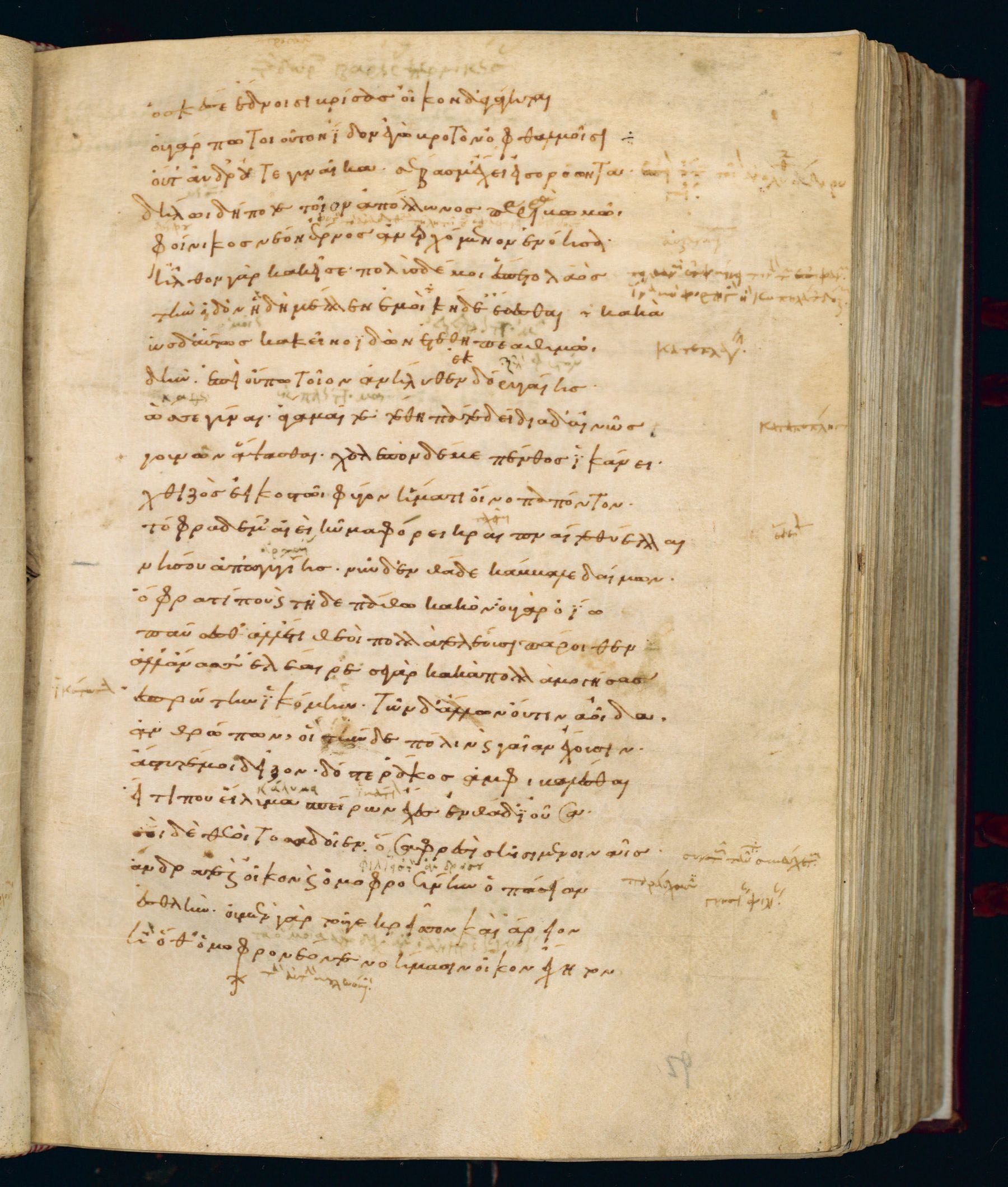
Where on the image
Laur. Plut. 32.24, fol. 59r: Odyssey 6.159-183, begins ‹ὅς κέ σʼ ἐέδνοισι›, ends ‹ὁμοφρονέοντε νοήμασιν οἶκον ἔχητον›. Checked on the image: first and last lines read and matched to the Greek. Fol. 58v ends with 6.158. Fol. 59v begins with 6.184. English blocks here: 160-161, 162-164, 165-169, 170-174, 175-179, 180-184.
159ὅς κέ σʼ ἐέδνοισι βρίσας οἶκόνδʼ ἀγάγηται.
160οὐ γάρ πω τοιοῦτον ἴδον βροτὸν ὀφθαλμοῖσιν,
161οὔτʼ ἄνδρʼ οὔτε γυναῖκα· σέβας μʼ ἔχει εἰσορόωντα.
162Δήλῳ δή ποτε τοῖον Ἀπόλλωνος παρὰ βωμῷ
163φοίνικος νέον ἔρνος ἀνερχόμενον ἐνόησα·
164ἦλθον γὰρ καὶ κεῖσε, πολὺς δέ μοι ἕσπετο λαός,
165τὴν ὁδὸν ᾗ δὴ μέλλεν ἐμοὶ κακὰ κήδεʼ ἔσεσθαι.
166ὣς δʼ αὔτως καὶ κεῖνο ἰδὼν ἐτεθήπεα θυμῷ
167δήν, ἐπεὶ οὔ πω τοῖον ἀνήλυθεν ἐκ δόρυ γαίης,
168ὡς σέ, γύναι, ἄγαμαί τε τέθηπά τε, δείδια δʼ αἰνῶς
169γούνων ἅψασθαι· χαλεπὸν δέ με πένθος ἱκάνει.
170χθιζὸς ἐεικοστῷ φύγον ἤματι οἴνοπα πόντον·
171τόφρα δέ μʼ αἰεὶ κῦμʼ ἐφόρει κραιπναί τε θύελλαι
172νήσου ἀπʼ Ὠγυγίης. νῦν δʼ ἐνθάδε κάββαλε δαίμων,
173ὄφρʼ ἔτι που καὶ τῇδε πάθω κακόν· οὐ γὰρ ὀίω
174παύσεσθʼ, ἀλλʼ ἔτι πολλὰ θεοὶ τελέουσι πάροιθεν.
175ἀλλά, ἄνασσʼ, ἐλέαιρε· σὲ γὰρ κακὰ πολλὰ μογήσας
176ἐς πρώτην ἱκόμην, τῶν δʼ ἄλλων οὔ τινα οἶδα
177ἀνθρώπων, οἳ τήνδε πόλιν καὶ γαῖαν ἔχουσιν.
178ἄστυ δέ μοι δεῖξον, δὸς δὲ ῥάκος ἀμφιβαλέσθαι,
179εἴ τί που εἴλυμα σπείρων ἔχες ἐνθάδʼ ἰοῦσα.
180σοὶ δὲ θεοὶ τόσα δοῖεν ὅσα φρεσὶ σῇσι μενοινᾷς,
181ἄνδρα τε καὶ οἶκον, καὶ ὁμοφροσύνην ὀπάσειαν
182ἐσθλήν· οὐ μὲν γὰρ τοῦ γε κρεῖσσον καὶ ἄρειον,
183ἢ ὅθʼ ὁμοφρονέοντε νοήμασιν οἶκον ἔχητον
160For never yet have mine eyes looked upon a mortal such as thou, whether man or woman; amazement holds me as I look on thee. 162Of a truth in Delos once I saw such a thing, a young shoot of a palm springing up beside the altar of Apollo—for thither, too, I went, and much people followed with me, 165on that journey on which evil woes were to be my portion;—even so, when I saw that, I marvelled long at heart, for never yet did such a tree spring up from the earth. And in like manner, lady, do I marvel at thee, and am amazed, and fear greatly to touch thy knees; but sore grief has come upon me. 170Yesterday, on the twentieth day, I escaped from the wine-dark sea, but ever until then the wave and the swift winds bore me from the island of Ogygia; and now fate has cast me ashore here, that here too, haply, I may suffer some ill. For not yet, methinks, will my troubles cease, but the gods ere that will bring many to pass. 175Nay, O queen, have pity; for it is to thee first that I am come after many grievous toils, and of the others who possess this city and land I know not one. Shew me the city, and give me some rag to throw about me, if thou hadst any wrapping for the clothes when thou camest hither. 180And for thyself, may the gods grant thee all that thy heart desires; a husband and a home may they grant thee, and oneness of heart—a goodly gift. For nothing is greater or better than this, when man and wife dwell in a home in one accord, a great grief to their foes
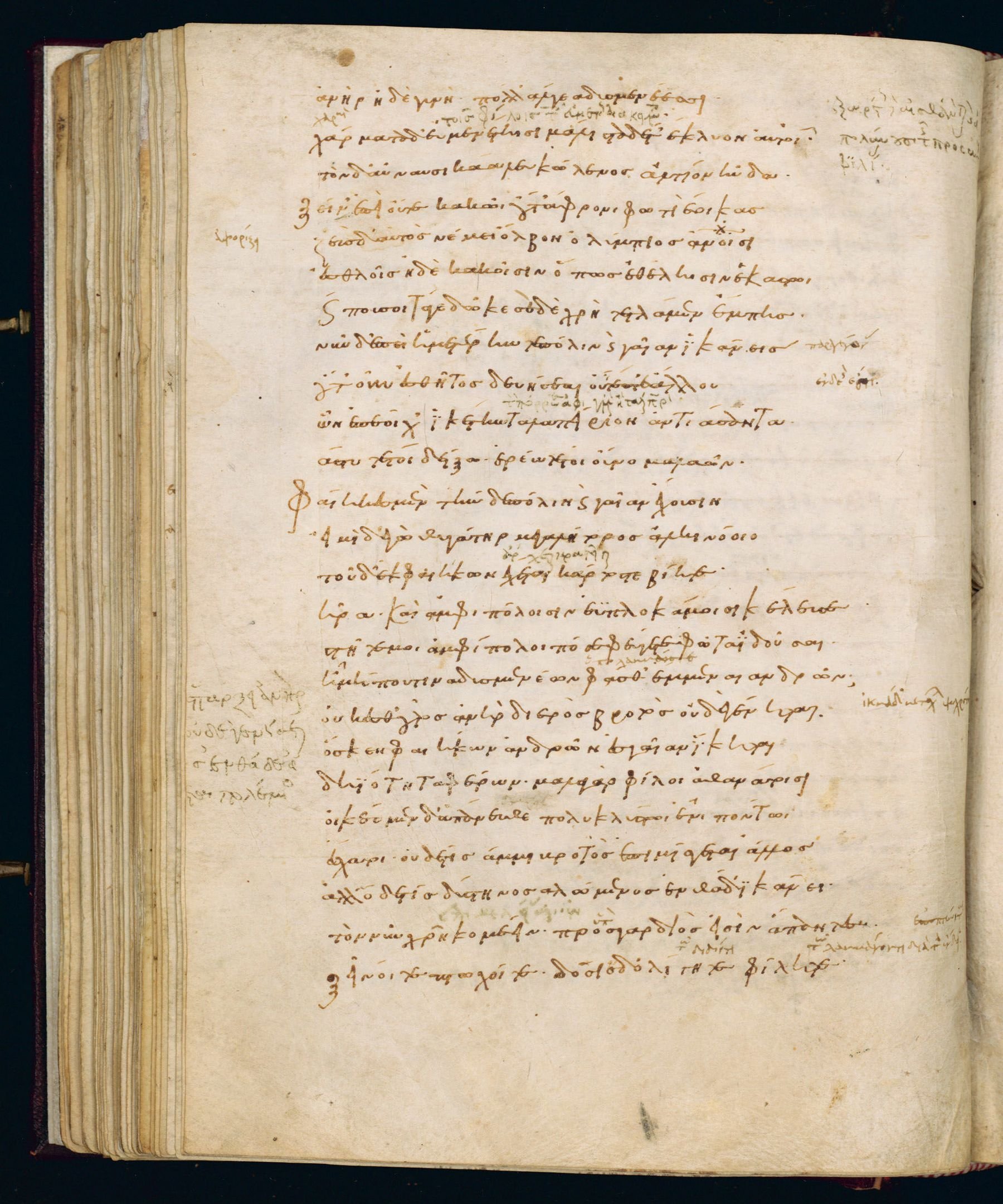
Where on the image
Laur. Plut. 32.24, fol. 59v: Odyssey 6.184-208, begins ‹ἀνὴρ ἠδὲ γυνή· πόλλʼ›, ends ‹ὀλίγη τε φίλη τε.›. Checked on the image: first and last lines read and matched to the Greek. Fol. 59r ends with 6.183. Fol. 60r begins with 6.209. English blocks here: 185-189, 190-194, 195-199, 200-204, 205-209.
184ἀνὴρ ἠδὲ γυνή· πόλλʼ ἄλγεα δυσμενέεσσι,
185χάρματα δʼ εὐμενέτῃσι, μάλιστα δέ τʼ ἔκλυον αὐτοί.
186τὸν δʼ αὖ Ναυσικάα λευκώλενος ἀντίον ηὔδα·
187ξεῖνʼ, ἐπεὶ οὔτε κακῷ οὔτʼ ἄφρονι φωτὶ ἔοικας·
188Ζεὺς δʼ αὐτὸς νέμει ὄλβον Ὀλύμπιος ἀνθρώποισιν,
189ἐσθλοῖς ἠδὲ κακοῖσιν, ὅπως ἐθέλῃσιν, ἑκάστῳ·
190καί που σοὶ τάδʼ ἔδωκε, σὲ δὲ χρὴ τετλάμεν ἔμπης.
191νῦν δʼ, ἐπεὶ ἡμετέρην τε πόλιν καὶ γαῖαν ἱκάνεις,
192οὔτʼ οὖν ἐσθῆτος δευήσεαι οὔτε τευ ἄλλου,
193ὧν ἐπέοιχʼ ἱκέτην ταλαπείριον ἀντιάσαντα.
194ἄστυ δέ τοι δείξω, ἐρέω δέ τοι οὔνομα λαῶν.
195Φαίηκες μὲν τήνδε πόλιν καὶ γαῖαν ἔχουσιν,
196εἰμὶ δʼ ἐγὼ θυγάτηρ μεγαλήτορος Ἀλκινόοιο,
197τοῦ δʼ ἐκ Φαιήκων ἔχεται κάρτος τε βίη τε.
198ἦ ῥα καὶ ἀμφιπόλοισιν ἐυπλοκάμοισι κέλευσε·
199στῆτέ μοι, ἀμφίπολοι· πόσε φεύγετε φῶτα ἰδοῦσαι;
200ἦ μή πού τινα δυσμενέων φάσθʼ ἔμμεναι ἀνδρῶν;
201οὐκ ἔσθʼ οὗτος ἀνὴρ διερὸς βροτὸς οὐδὲ γένηται,
202ὅς κεν Φαιήκων ἀνδρῶν ἐς γαῖαν ἵκηται
203δηιοτῆτα φέρων· μάλα γὰρ φίλοι ἀθανάτοισιν.
204οἰκέομεν δʼ ἀπάνευθε πολυκλύστῳ ἐνὶ πόντῳ,
205ἔσχατοι, οὐδέ τις ἄμμι βροτῶν ἐπιμίσγεται ἄλλος.
206ἀλλʼ ὅδε τις δύστηνος ἀλώμενος ἐνθάδʼ ἱκάνει,
207τὸν νῦν χρὴ κομέειν· πρὸς γὰρ Διός εἰσιν ἅπαντες
208ξεῖνοί τε πτωχοί τε, δόσις δʼ ὀλίγη τε φίλη τε.
185and a joy to their friends; but they know it best themselves.” Then white-armed Nausicaa answered him:“Stranger, since thou seemest to be neither an evil man nor a witless, and it is Zeus himself, the Olympian, that gives happy fortune to men, both to the good and the evil, to each man as he will; 190so to thee, I ween, he has given this lot, and thou must in any case endure it. But now, since thou hast come to our city and land, thou shalt not lack clothing or aught else of those things which befit a sore-tried suppliant when he cometh in the way. The city will I shew thee, and will tell thee the name of the people. 195The Phaeacians possess this city and land, and I am the daughter of great-hearted Alcinous, upon whom depend the might and power of the Phaeacians.” She spoke, and called to her fair-tressed handmaids:“Stand, my maidens. Whither do ye flee at the sight of a man? 200Ye do not think, surely, that he is an enemy? That mortal man lives not, or exists nor shall ever be born who shall come to the land of the Phaeacians as a foeman, for we are very dear to the immortals. Far off we dwell in the surging sea, 205the furthermost of men, and no other mortals have dealings with us. Nay, this is some hapless wanderer that has come hither. Him must we now tend; for from Zeus are all strangers and beggars, and a gift, though small, is welcome. Come, then, my maidens, give to the stranger food and drink,
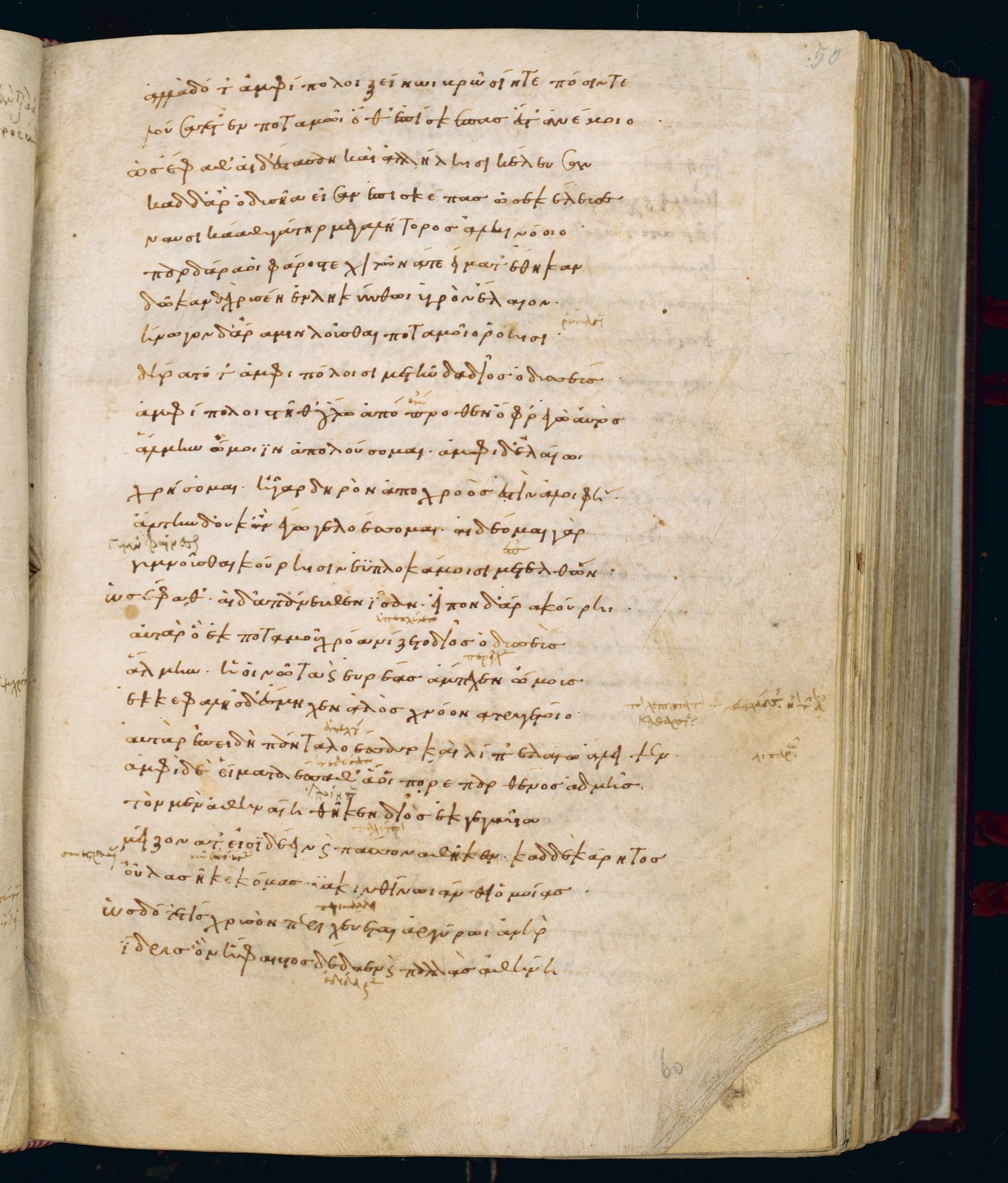
Where on the image
Laur. Plut. 32.24, fol. 60r: Odyssey 6.209-233, begins ‹ἀλλὰ δότʼ, ἀμφίπολοι, ξείνῳ›, ends ‹δέδαεν καὶ Παλλὰς Ἀθήνη›. Checked on the image: first and last lines read and matched to the Greek. Fol. 59v ends with 6.208. Fol. 60v begins with 6.234. English blocks here: 210-210, 211-214, 215-219, 220-224, 225-229, 230-234.
209ἀλλὰ δότʼ, ἀμφίπολοι, ξείνῳ βρῶσίν τε πόσιν τε,
210λούσατέ τʼ ἐν ποταμῷ, ὅθʼ ἐπὶ σκέπας ἔστʼ ἀνέμοιο.
211ὣς ἔφαθʼ, αἱ δʼ ἔσταν τε καὶ ἀλλήλῃσι κέλευσαν,
212κὰδ δʼ ἄρʼ Ὀδυσσῆʼ εἷσαν ἐπὶ σκέπας, ὡς ἐκέλευσεν
213Ναυσικάα θυγάτηρ μεγαλήτορος Ἀλκινόοιο·
214πὰρ δʼ ἄρα οἱ φᾶρός τε χιτῶνά τε εἵματʼ ἔθηκαν,
215δῶκαν δὲ χρυσέῃ ἐν ληκύθῳ ὑγρὸν ἔλαιον,
216ἤνωγον δʼ ἄρα μιν λοῦσθαι ποταμοῖο ῥοῇσιν.
217δή ῥα τότʼ ἀμφιπόλοισι μετηύδα δῖος Ὀδυσσεύς·
218ἀμφίπολοι, στῆθʼ οὕτω ἀπόπροθεν, ὄφρʼ ἐγὼ αὐτὸς
219ἅλμην ὤμοιιν ἀπολούσομαι, ἀμφὶ δʼ ἐλαίῳ
220χρίσομαι· ἦ γὰρ δηρὸν ἀπὸ χροός ἐστιν ἀλοιφή.
221ἄντην δʼ οὐκ ἂν ἐγώ γε λοέσσομαι· αἰδέομαι γὰρ
222γυμνοῦσθαι κούρῃσιν ἐυπλοκάμοισι μετελθών.
223ὣς ἔφαθʼ, αἱ δʼ ἀπάνευθεν ἴσαν, εἶπον δʼ ἄρα κούρῃ.
224αὐτὰρ ὁ ἐκ ποταμοῦ χρόα νίζετο δῖος Ὀδυσσεὺς
225ἅλμην, ἥ οἱ νῶτα καὶ εὐρέας ἄμπεχεν ὤμους,
226ἐκ κεφαλῆς δʼ ἔσμηχεν ἁλὸς χνόον ἀτρυγέτοιο.
227αὐτὰρ ἐπεὶ δὴ πάντα λοέσσατο καὶ λίπʼ ἄλειψεν,
228ἀμφὶ δὲ εἵματα ἕσσαθʼ ἅ οἱ πόρε παρθένος ἀδμής,
229τὸν μὲν Ἀθηναίη θῆκεν Διὸς ἐκγεγαυῖα
230μείζονά τʼ εἰσιδέειν καὶ πάσσονα, κὰδ δὲ κάρητος
231οὔλας ἧκε κόμας, ὑακινθίνῳ ἄνθει ὁμοίας.
232ὡς δʼ ὅτε τις χρυσὸν περιχεύεται ἀργύρῳ ἀνὴρ
233ἴδρις, ὃν Ἥφαιστος δέδαεν καὶ Παλλὰς Ἀθήνη
210and bathe him in the river in a spot where there is shelter from the wind.” 211So she spoke, and they halted and called to each other. Then they set Odysseus in a sheltered place, as Nausicaa, the daughter of great-hearted Alcinous, bade, and beside him they put a cloak and a tunic for raiment, 215and gave him soft olive oil in the flask of gold, and bade him bathe in the streams of the river. Then among the maidens spoke goodly Odysseus: “Maidens, stand yonder apart, that by myself I may wash the brine from my shoulders, and 220anoint myself with olive oil; for of a truth it is long since oil came near my skin. But in your presence will I not bathe, for I am ashamed to make me naked in the midst of fair-tressed maidens.” So he said, and they went apart and told the princess. But with water from the river goodly Odysseus washed from his skin 225the brine which clothed his back and broad shoulders, and from his head he wiped the scurf of the unresting sea. But when he had washed his whole body and anointed himself with oil, and had put on him the raiment which the unwedded maid had given him, then Athena, the daughter of Zeus, made him 230taller to look upon and mightier, and from his head she made the locks to flow in curls like unto the hyacinth flower. And as when a man overlays silver with gold, a cunning workman whom Hephaestus and Pallas Athena have taught all manner of craft, and full of grace is the work he produces,
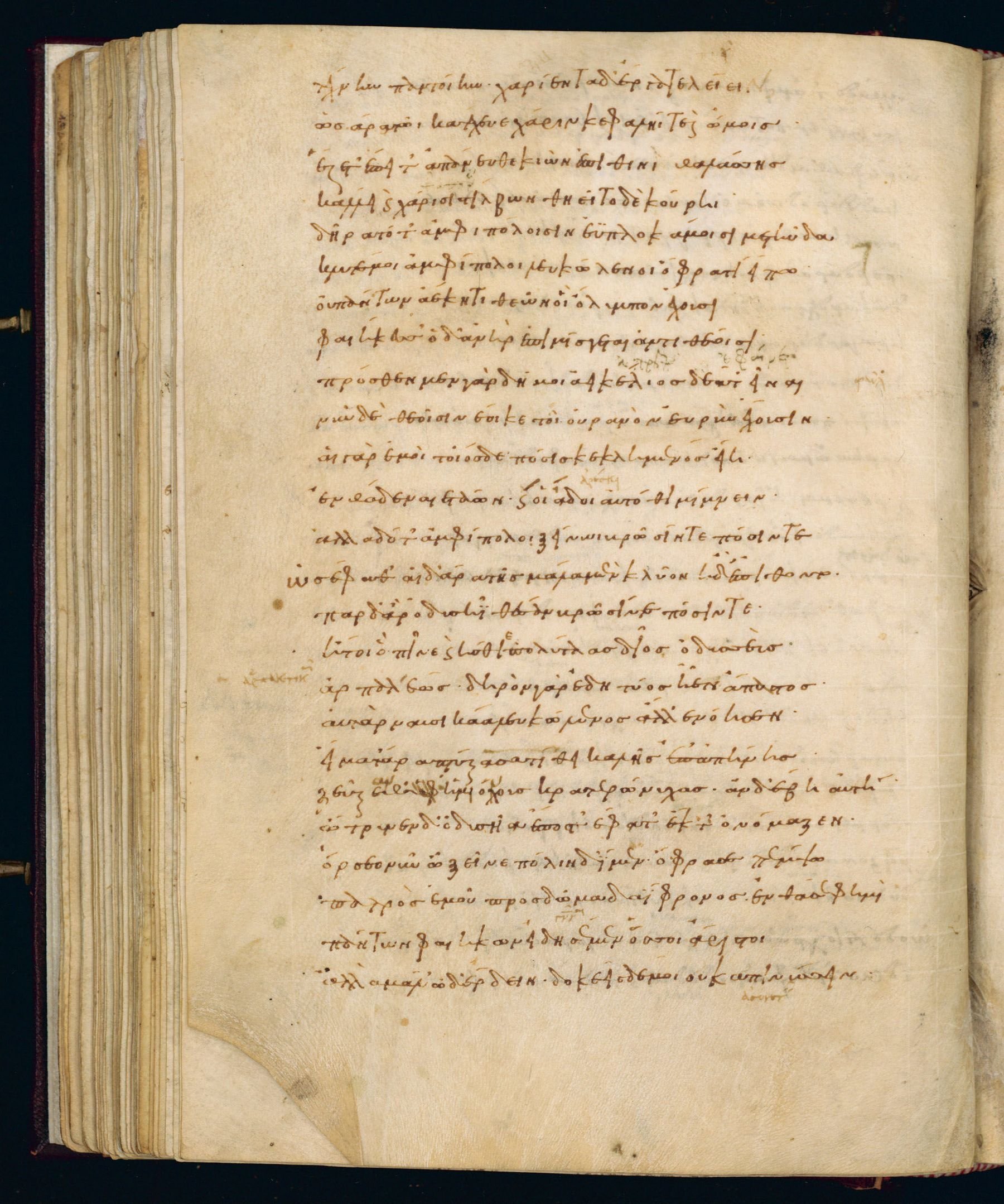
Where on the image
Laur. Plut. 32.24, fol. 60v: Odyssey 6.234-258, begins ‹τέχνην παντοίην, χαρίεντα δὲ›, ends ‹δέ μοι οὐκ ἀπινύσσειν·›. Checked on the image: first and last lines read and matched to the Greek. Fol. 60r ends with 6.233. Fol. 61r begins with 6.259. English blocks here: 235-239, 240-244, 245-249, 250-250, 251-254, 255-259.
234τέχνην παντοίην, χαρίεντα δὲ ἔργα τελείει,
235ὣς ἄρα τῷ κατέχευε χάριν κεφαλῇ τε καὶ ὤμοις.
236ἕζετʼ ἔπειτʼ ἀπάνευθε κιὼν ἐπὶ θῖνα θαλάσσης,
237κάλλεϊ καὶ χάρισι στίλβων· θηεῖτο δὲ κούρη.
238δή ῥα τότʼ ἀμφιπόλοισιν ἐυπλοκάμοισι μετηύδα·
239κλῦτέ μευ, ἀμφίπολοι λευκώλενοι, ὄφρα τι εἴπω.
240οὐ πάντων ἀέκητι θεῶν, οἳ Ὄλυμπον ἔχουσιν,
241Φαιήκεσσʼ ὅδʼ ἀνὴρ ἐπιμίσγεται ἀντιθέοισι·
242πρόσθεν μὲν γὰρ δή μοι ἀεικέλιος δέατʼ εἶναι,
243νῦν δὲ θεοῖσιν ἔοικε, τοὶ οὐρανὸν εὐρὺν ἔχουσιν.
244αἲ γὰρ ἐμοὶ τοιόσδε πόσις κεκλημένος εἴη
245ἐνθάδε ναιετάων, καί οἱ ἅδοι αὐτόθι μίμνειν.
246ἀλλὰ δότʼ, ἀμφίπολοι, ξείνῳ βρῶσίν τε πόσιν τε.
247ὣς ἔφαθʼ, αἱ δʼ ἄρα τῆς μάλα μὲν κλύον ἠδʼ ἐπίθοντο,
248πὰρ δʼ ἄρʼ Ὀδυσσῆι ἔθεσαν βρῶσίν τε πόσιν τε.
249ἦ τοι ὁ πῖνε καὶ ἦσθε πολύτλας δῖος Ὀδυσσεὺς
250ἁρπαλέως· δηρὸν γὰρ ἐδητύος ἦεν ἄπαστος.
251αὐτὰρ Ναυσικάα λευκώλενος ἄλλʼ ἐνόησεν·
252εἵματʼ ἄρα πτύξασα τίθει καλῆς ἐπʼ ἀπήνης,
253ζεῦξεν δʼ ἡμιόνους κρατερώνυχας, ἂν δʼ ἔβη αὐτή,
254ὤτρυνεν δʼ Ὀδυσῆα, ἔπος τʼ ἔφατʼ ἔκ τʼ ὀνόμαζεν·
255ὄρσεο δὴ νῦν, ξεῖνε, πόλινδʼ ἴμεν ὄφρα σε πέμψω
256πατρὸς ἐμοῦ πρὸς δῶμα δαΐφρονος, ἔνθα σέ φημι
257πάντων Φαιήκων εἰδησέμεν ὅσσοι ἄριστοι.
258ἀλλὰ μάλʼ ὧδʼ ἔρδειν, δοκέεις δέ μοι οὐκ ἀπινύσσειν·
235even so the goddess shed grace upon his head and shoulders. Then he went apart and sat down on the shore of the sea, gleaming with beauty and grace; and the damsel marvelled at him, and spoke to her fair-tressed handmaids, saying: “Listen, white-armed maidens, that I may say somewhat. 240Not without the will of all the gods who hold Olympus does this man come among the godlike Phaeacians. Before he seemed to me uncouth, but now he is like the gods, who hold broad heaven. Would that a man such as he might be called my husband, 245dwelling here, and that it might please him here to remain. But come, my maidens; give to the stranger food and drink.” So she spoke, and they readily hearkened and obeyed, and set before Odysseus food and drink. Then verily did the much-enduring goodly Odysseus drink and eat, 250ravenously; for long had he been without taste of food. 251But the white-armed Nausicaa took other counsel. She folded the raiment and put it in the fair wagon, and yoked the stout-hoofed mules, and mounted the car herself. Then she hailed Odysseus, and spoke and addressed him: 255“Rouse thee now, stranger, to go to the city, that I may escort thee to the house of my wise father, where, I tell thee, thou shalt come to know all the noblest of the Phaeacians. Only do thou thus, and, methinks, thou dost not lack understanding: so long as we are passing through the country and the tilled fields of men go thou quickly
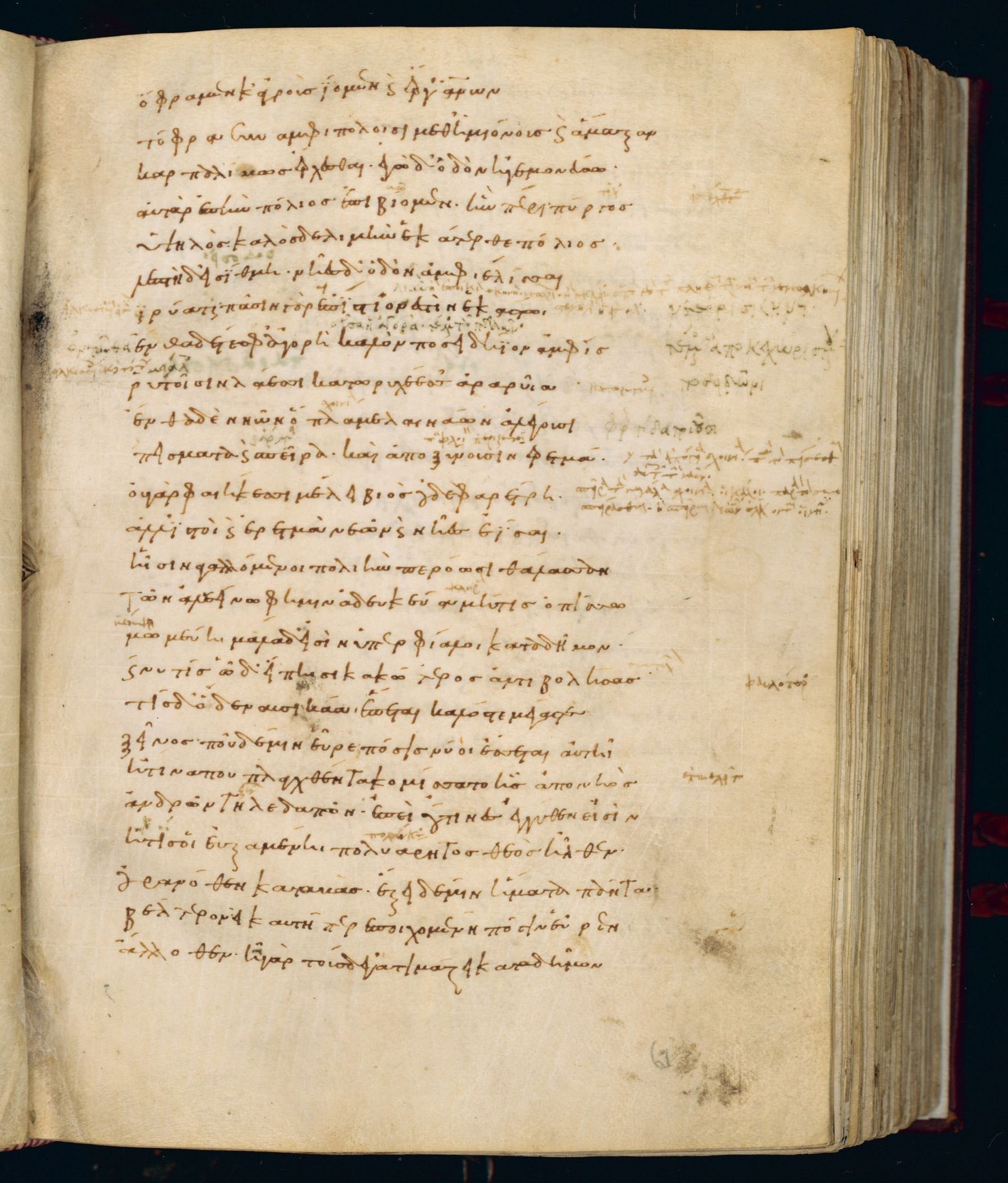
Where on the image
Laur. Plut. 32.24, fol. 61r: Odyssey 6.259-283, begins ‹ὄφρʼ ἂν μέν κʼ›, ends ‹γʼ ἀτιμάζει κατὰ δῆμον›. Checked on the image: first and last lines read and matched to the Greek. Fol. 60v ends with 6.258. Fol. 61v begins with 6.284. English blocks here: 260-264, 265-269, 270-274, 275-279, 280-284.
259ὄφρʼ ἂν μέν κʼ ἀγροὺς ἴομεν καὶ ἔργʼ ἀνθρώπων,
260τόφρα σὺν ἀμφιπόλοισι μεθʼ ἡμιόνους καὶ ἄμαξαν
261καρπαλίμως ἔρχεσθαι· ἐγὼ δʼ ὁδὸν ἡγεμονεύσω.
262αὐτὰρ ἐπὴν πόλιος ἐπιβήομεν, ἣν πέρι πύργος
263ὑψηλός, καλὸς δὲ λιμὴν ἑκάτερθε πόληος,
264λεπτὴ δʼ εἰσίθμη· νῆες δʼ ὁδὸν ἀμφιέλισσαι
265εἰρύαται· πᾶσιν γὰρ ἐπίστιόν ἐστιν ἑκάστῳ.
266ἔνθα δέ τέ σφʼ ἀγορὴ καλὸν Ποσιδήιον ἀμφίς,
267ῥυτοῖσιν λάεσσι κατωρυχέεσσʼ ἀραρυῖα.
268ἔνθα δὲ νηῶν ὅπλα μελαινάων ἀλέγουσι,
269πείσματα καὶ σπεῖρα, καὶ ἀποξύνουσιν ἐρετμά.
270οὐ γὰρ Φαιήκεσσι μέλει βιὸς οὐδὲ φαρέτρη,
271ἀλλʼ ἱστοὶ καὶ ἐρετμὰ νεῶν καὶ νῆες ἐῖσαι,
272ᾗσιν ἀγαλλόμενοι πολιὴν περόωσι θάλασσαν.
273τῶν ἀλεείνω φῆμιν ἀδευκέα, μή τις ὀπίσσω
274μωμεύῃ· μάλα δʼ εἰσὶν ὑπερφίαλοι κατὰ δῆμον·
275καί νύ τις ὧδʼ εἴπῃσι κακώτερος ἀντιβολήσας·
276τίς δʼ ὅδε Ναυσικάᾳ ἕπεται καλός τε μέγας τε
277ξεῖνος; ποῦ δέ μιν εὗρε; πόσις νύ οἱ ἔσσεται αὐτῇ.
278ἦ τινά που πλαγχθέντα κομίσσατο ἧς ἀπὸ νηὸς
279ἀνδρῶν τηλεδαπῶν, ἐπεὶ οὔ τινες ἐγγύθεν εἰσίν·
280ἤ τίς οἱ εὐξαμένῃ πολυάρητος θεὸς ἦλθεν
281οὐρανόθεν καταβάς, ἕξει δέ μιν ἤματα πάντα.
282βέλτερον, εἰ καὐτή περ ἐποιχομένη πόσιν εὗρεν
283ἄλλοθεν· ἦ γὰρ τούσδε γʼ ἀτιμάζει κατὰ δῆμον
260with the handmaids behind the mules and the wagon, and I will lead the way. But when we are about to enter the city, around which runs a lofty wall,—a fair harbor lies on either side of the city and the entrance is narrow, and curved ships 265are drawn up along the road, for they all have stations for their ships, each man one for himself. There, too, is their place of assembly about the fair temple of Poseidon, fitted with huge stones set deep in the earth. Here the men are busied with the tackle of their black ships, with cables and sails, and here they shape the thin oar-blades. 270For the Phaeacians care not for bow or quiver, but for masts and oars of ships, and for the shapely ships, rejoicing in which they cross over the grey sea. It is their ungentle speech that I shun, lest hereafter some man should taunt me, for indeed there are insolent folk in the land, 275and thus might some baser fellow say, shall he meet us: ‘Who is this that follows Nausicaa, a comely man and tall, a stranger? Where did she find him? He will doubtless be a husband for her. Haply she has brought from his ship some wanderer of a folk that dwell afar—for none are near us— 280or some god, long prayed-for, has come down from heaven in answer to her prayers, and she will have him as her husband all her days. Better so, even if she has herself gone forth and found a husband from another people; for of a truth she scorns the Phaeacians here in the land, where she has wooers many and noble!’
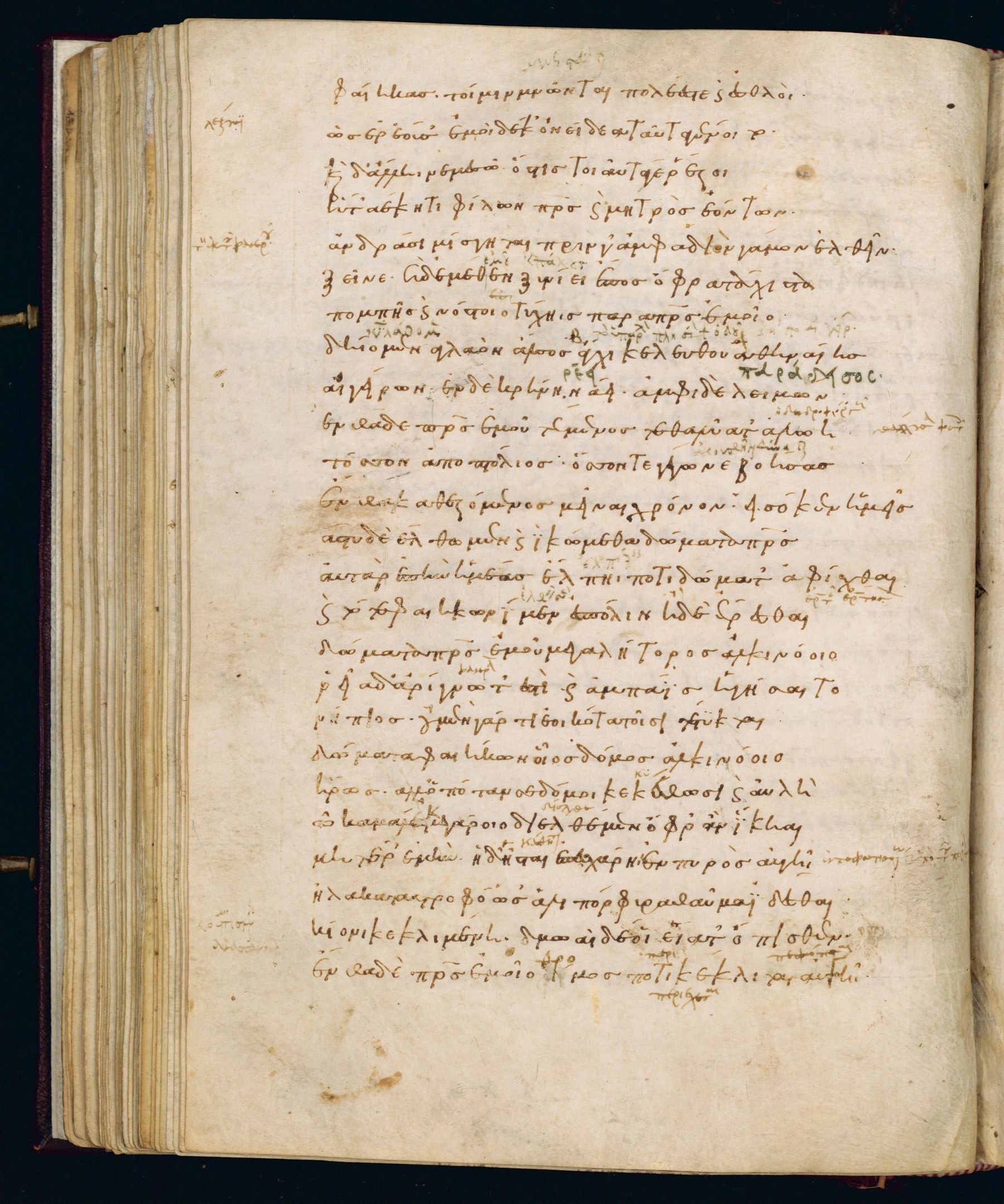
Where on the image
Laur. Plut. 32.24, fol. 61v: Odyssey 6.284-308, begins ‹Φαίηκας, τοί μιν μνῶνται›, ends ‹ἐμοῖο θρόνος ποτικέκλιται αὐτῇ,›. Checked on the image: first and last lines read and matched to the Greek. Fol. 61r ends with 6.283. Fol. 62r begins with 6.309. English blocks here: 285-287, 288-289, 290-294, 295-299, 300-304, 305-309.
284Φαίηκας, τοί μιν μνῶνται πολέες τε καὶ ἐσθλοί.
285ὣς ἐρέουσιν, ἐμοὶ δέ κʼ ὀνείδεα ταῦτα γένοιτο.
286καὶ δʼ ἄλλῃ νεμεσῶ, ἥ τις τοιαῦτά γε ῥέζοι,
287ἥ τʼ ἀέκητι φίλων πατρὸς καὶ μητρὸς ἐόντων,
288ἀνδράσι μίσγηται, πρίν γʼ ἀμφάδιον γάμον ἐλθεῖν.
289ξεῖνε, σὺ δʼ ὦκʼ ἐμέθεν ξυνίει ἔπος, ὄφρα τάχιστα
290πομπῆς καὶ νόστοιο τύχῃς παρὰ πατρὸς ἐμοῖο.
291δήεις ἀγλαὸν ἄλσος Ἀθήνης ἄγχι κελεύθου
292αἰγείρων· ἐν δὲ κρήνη νάει, ἀμφὶ δὲ λειμών·
293ἔνθα δὲ πατρὸς ἐμοῦ τέμενος τεθαλυῖά τʼ ἀλωή,
294τόσσον ἀπὸ πτόλιος, ὅσσον τε γέγωνε βοήσας.
295ἔνθα καθεζόμενος μεῖναι χρόνον, εἰς ὅ κεν ἡμεῖς
296ἄστυδε ἔλθωμεν καὶ ἱκώμεθα δώματα πατρός.
297αὐτὰρ ἐπὴν ἡμέας ἔλπῃ ποτὶ δώματʼ ἀφῖχθαι,
298καὶ τότε Φαιήκων ἴμεν ἐς πόλιν ἠδʼ ἐρέεσθαι
299δώματα πατρὸς ἐμοῦ μεγαλήτορος Ἀλκινόοιο.
300ῥεῖα δʼ ἀρίγνωτʼ ἐστί, καὶ ἂν πάϊς ἡγήσαιτο
301νήπιος· οὐ μὲν γάρ τι ἐοικότα τοῖσι τέτυκται
302δώματα Φαιήκων, οἷος δόμος Ἀλκινόοιο
303ἥρωος. ἀλλʼ ὁπότʼ ἄν σε δόμοι κεκύθωσι καὶ αὐλή,
304ὦκα μάλα μεγάροιο διελθέμεν, ὄφρʼ ἂν ἵκηαι
305μητέρʼ ἐμήν· ἡ δʼ ἧσται ἐπʼ ἐσχάρῃ ἐν πυρὸς αὐγῇ,
306ἠλάκατα στρωφῶσʼ ἁλιπόρφυρα, θαῦμα ἰδέσθαι,
307κίονι κεκλιμένη· δμωαὶ δέ οἱ εἵατʼ ὄπισθεν.
308ἔνθα δὲ πατρὸς ἐμοῖο θρόνος ποτικέκλιται αὐτῇ,
285So will they say, and this would become a reproach to me. Yea, I would myself blame another maiden who should do such thing, and in despite of her dear father and mother, while yet they live, should consort with men before the day of open marriage. 288Nay, stranger, do thou quickly hearken to my words, that with all speed 290thou mayest win from my father an escort and a return to thy land. Thou wilt find a goodly grove of Athena hard by the road, a grove of poplar trees. In it a spring wells up, and round about is a meadow. There is my father's park and fruitful vineyard, as far from the city as a man's voice carries when he shouts. 295Sit thou down there, and wait for a time, until we come to the city and reach the house of my father. But when thou thinkest that we have reached the house, then do thou go to the city of the Phaeacians and ask for the house of my father, great-hearted Alcinous. 300Easily may it be known, and a child could guide thee, a mere babe; for the houses of the Phaeacians are no wise built of such sort as is the palace of the lord Alcinous. But when the house and the court enclose thee, pass quickly through the great hall, till thou comest 305to my mother, who sits at the hearth in the light of the fire, spinning the purple yarn, a wonder to behold, leaning against a pillar, and her handmaids sit behind her. There, too, leaning against the selfsame pillar, is set the throne of my father, whereon he sits and quaffs his wine, like unto an immortal.
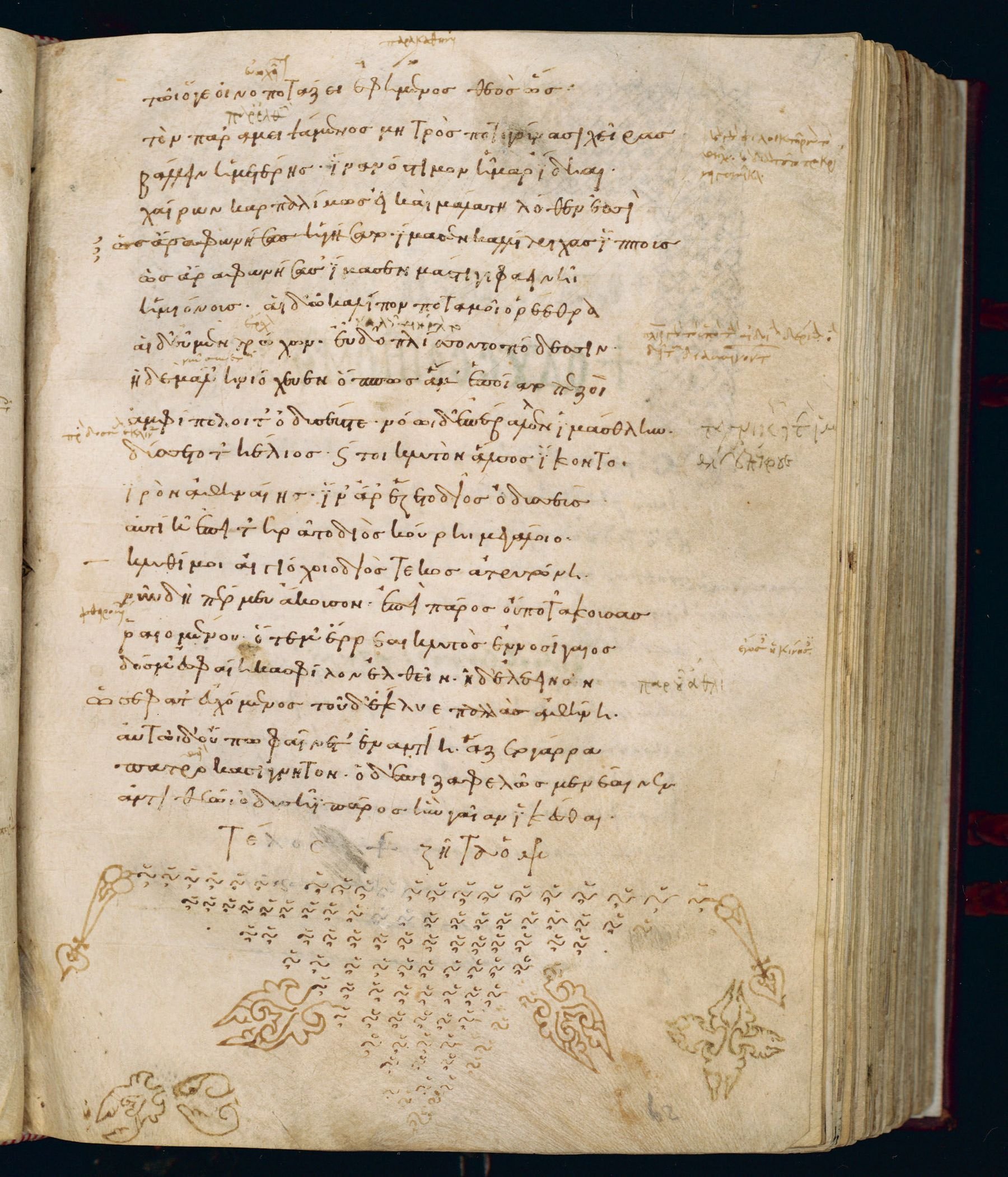
Where on the image
Laur. Plut. 32.24, fol. 62r: Odyssey 6.309-331, begins ‹τῷ ὅ γε οἰνοποτάζει›, ends ‹πάρος ἣν γαῖαν ἱκέσθαι.›. Checked on the image: first and last lines read and matched to the Greek. Fol. 61v ends with 6.308. 6.313-315 are not on the page. In their place, before 6.316, there is a line beginning ὣς ἄρα φωνήσασ(α), marked with a sign in the left margin (21 verse lines). Book 6 ends here with the subscription τέλος τῆς ζ and a large ornament filling the lower part of the page. English blocks here: 310-314, 315-319, 320-329, 330-331.
309τῷ ὅ γε οἰνοποτάζει ἐφήμενος ἀθάνατος ὥς.
310τὸν παραμειψάμενος μητρὸς περὶ γούνασι χεῖρας
311βάλλειν ἡμετέρης, ἵνα νόστιμον ἦμαρ ἴδηαι
312χαίρων καρπαλίμως, εἰ καὶ μάλα τηλόθεν ἐσσί.
313εἴ κέν τοι κείνη γε φίλα φρονέῃσʼ ἐνὶ θυμῷ,
314ἐλπωρή τοι ἔπειτα φίλους τʼ ἰδέειν καὶ ἱκέσθαι
315οἶκον ἐυκτίμενον καὶ σὴν ἐς πατρίδα γαῖαν.
316ὣς ἄρα φωνήσασʼ ἵμασεν μάστιγι φαεινῇ
317ἡμιόνους· αἱ δʼ ὦκα λίπον ποταμοῖο ῥέεθρα.
318αἱ δʼ ἐὺ μὲν τρώχων, ἐὺ δὲ πλίσσοντο πόδεσσιν·
319ἡ δὲ μάλʼ ἡνιόχευεν, ὅπως ἅμʼ ἑποίατο πεζοὶ
320ἀμφίπολοί τʼ Ὀδυσεύς τε, νόῳ δʼ ἐπέβαλλεν ἱμάσθλην.
321δύσετό τʼ ἠέλιος καὶ τοὶ κλυτὸν ἄλσος ἵκοντο
322ἱρὸν Ἀθηναίης, ἵνʼ ἄρʼ ἕζετο δῖος Ὀδυσσεύς.
323αὐτίκʼ ἔπειτʼ ἠρᾶτο Διὸς κούρῃ μεγάλοιο·
324κλῦθί μευ, αἰγιόχοιο Διὸς τέκος, Ἀτρυτώνη·
325νῦν δή πέρ μευ ἄκουσον, ἐπεὶ πάρος οὔ ποτʼ ἄκουσας
326ῥαιομένου, ὅτε μʼ ἔρραιε κλυτὸς ἐννοσίγαιος.
327δός μʼ ἐς Φαίηκας φίλον ἐλθεῖν ἠδʼ ἐλεεινόν.
328ὣς ἔφατʼ εὐχόμενος, τοῦ δʼ ἔκλυε Παλλὰς Ἀθήνη.
329αὐτῷ δʼ οὔ πω φαίνετʼ ἐναντίη· αἴδετο γάρ ῥα
330πατροκασίγνητον· ὁ δʼ ἐπιζαφελῶς μενέαινεν
331ἀντιθέῳ Ὀδυσῆι πάρος ἣν γαῖαν ἱκέσθαι.
310Him pass thou by, and cast thy hands about my mother's knees, that thou mayest quickly see with rejoicing the day of thy return, though thou art come from never so far. If in her sight thou dost win favour, then there is hope that thou wilt see thy friends, and return 315to thy well-built house and unto thy native land.” So saying, she smote the mules with the shining whip, and they quickly left the streams of the river. Well did they trot, well did they ply their ambling feet, and she drove with care that 320the maidens and Odysseus might follow on foot, and with judgment did she ply the lash. Then the sun set, and they came to the glorious grove, sacred to Athena. There Odysseus sat him down, and straightway prayed to the daughter of great Zeus: “Hear me, child of aegis-bearing Zeus, unwearied one. Hearken now to my prayer, since aforetime thou didst not hearken when I was smitten, what time the glorious Earth-shaker smote me. Grant that I may come to the Phaeacians as one to be welcomed and to be pitied.” So he spoke in prayer, and Pallas Athena heard him; but she did not yet appear to him face to face, for she feared 330her father's brother; but he furiously raged against godlike Odysseus, until at length he reached his own land.
Notes
- Greek: A. T. Murray, Homer: The Odyssey (Loeb Classical Library, 1919), via Perseus.
- English: A. T. Murray's translation in the same edition; his footnotes are omitted.
Cite
Sources
- Source: Laur. Plut. 32.24 (BML Teca Digitale IIIF) + Murray Greek (Loeb 1919, Perseus) + Murray English (Loeb 1919, Perseus) (holding institution)
- Critical edition: Murray, Loeb 1919, via Perseus
← previous · → next · v cycle view · l back to library