P46 (Chester Beatty II): 1 Corinthians 15:6-50 (fols. 57v-59r)
Introduction
P46 is a papyrus codex of the letters of Paul copied in Egypt around 200, the oldest surviving collection of Paul's letters. 86 of its 104 leaves survive: 56 in the Chester Beatty Library, Dublin (Biblical Papyrus II, published by Frederic Kenyon in 1934-1937) and 30 in the University of Michigan Library, Ann Arbor (P.Mich. inv. 6238, published by Henry Sanders in 1935). The letters run in the order Romans, Hebrews, 1 and 2 Corinthians, Ephesians, Galatians, Philippians, Colossians and 1 Thessalonians; the first seven leaves (Romans 1:1-5:17) and the end of the book are lost. Hebrews standing after Romans, and the doxology of Romans (16:25-27) standing after 15:33, are among its best-known features.
Each section below is one page side: the holding library's photograph, the NTVMR diplomatic transcription line by line, and the King James Version of every verse that has text on the page. The lower lines of many leaves are lost; the transcribers' restorations are in square brackets.
This entry covers fols. 57v-59r (1 Corinthians 15:6-50).
How was this verified? (Provenance)
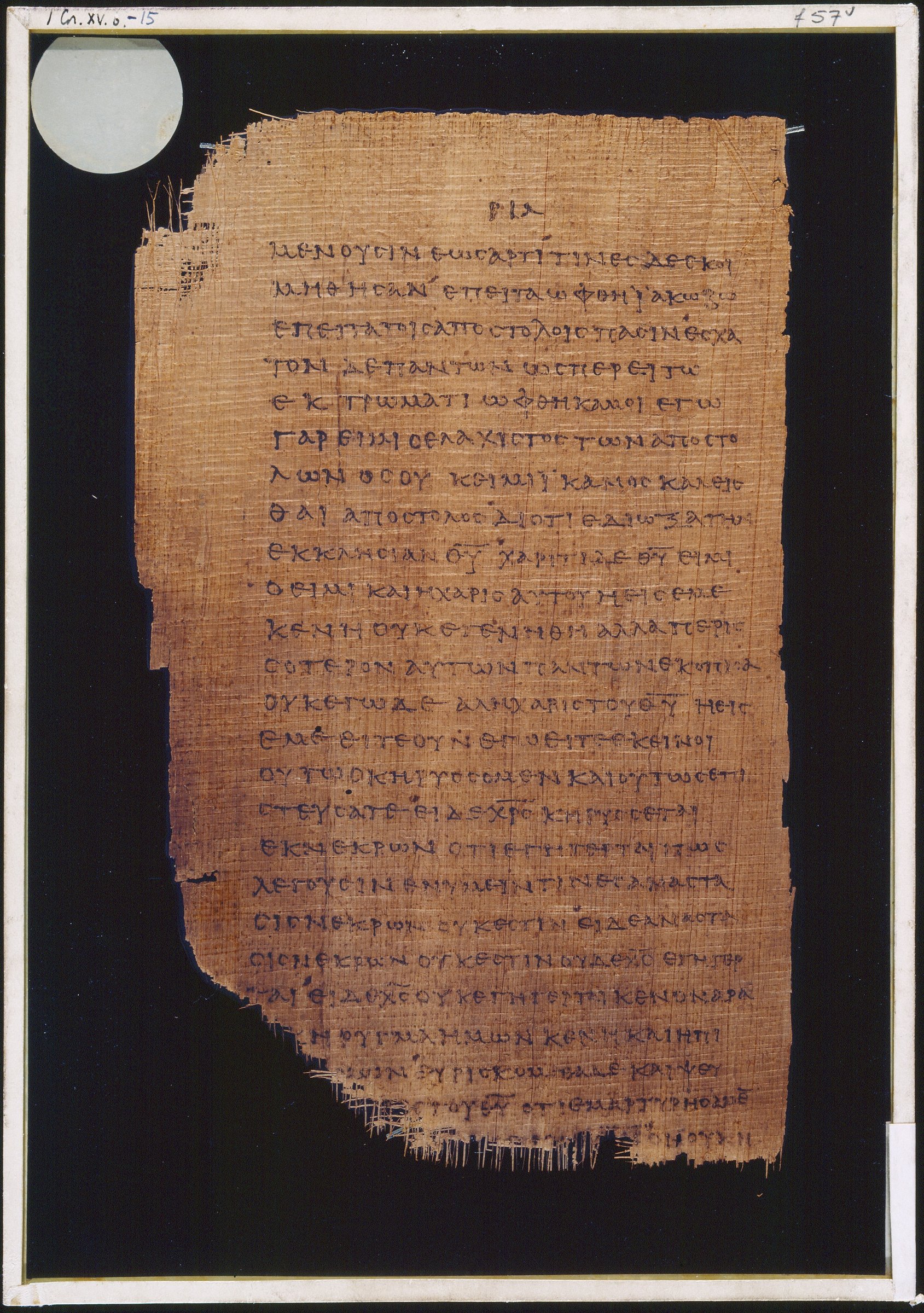
Where on the image
Chester Beatty Library photograph T0005569.jpg (https://ntmss.info/images/webfriendly/10046/T0005569.jpg), linked to NTVMR page 960 (folio 57v) in NTVMR's page index. 15:6 begins on the previous page; 15:15 continues on the next page. Checked on the image: the scribe's page number ρια (111) at the head of the page, continuing the sequence of the neighbouring pages.
15:6 μενουσιν εως αρτι τινες δε εκοι
μηθησαν 7 επειτα ωφθη ιακωβω
επειτα τοις αποστολοις πασιν 8 εσχα
τον δε παντων ωσπερει τω
εκτρωματι ωφθη καμοι 9 εγω
γαρ ειμι ο ελαχιστος των αποστο
λων ος ουκ ειμι ικανος καλεισ
θαι αποστολος διοτι εδιωξα την
εκκλησιαν θ̅υ̅ 10 χαριτι δε θ̅υ̅ ειμι
ο ειμι και η χαρις αυτου η εις εμε
κενη ουκ εγενηθη αλλα περισ
σοτερον αυτων παντων εκοπισ̣α
ουκ εγω δε αλ η χαρις του θ̅υ̅ η εις
εμε 11 ειτε ουν εγω̣ ειτε εκεινοι
ουτως κηρυσσομεν και ουτως επι
στευσατε 12 ει δε χ̅ρ̅ς̅ κηρυσσεται
εκ νεκρων οτι εγηγερται πως
λεγουσιν εν υμειν τινες αναστα
σις νεκρων ουκ εστιν 13 ει δε αναστα
σις νεκρων ουκ εστιν ουδε χ̅ς̅ εγηγερ
ται 14 ει δε χ̅ς̅ ουκ εγηγερται κενον αρα
[το] κ̣ηρυγμα ημων κενη και η πι
[στις υ]μ̣ων 15 ε̣υρισκομεθα δε και ψευ
[δομαρτυ]ρ̣ε̣ς του θ̅υ̅ οτι εμαρτυρησαμεν
[κατα του θ̅υ̅ οτι ηγ]ε̣ι̣ρ̣ε̣[ν χ̅]ν̅ ον ουκ η
[γειρεν]
15:6After that, he was seen of above five hundred brethren at once; of whom the greater part remain unto this present, but some are fallen asleep. 7After that, he was seen of James; then of all the apostles. 8And last of all he was seen of me also, as of one born out of due time. 9For I am the least of the apostles, that am not meet to be called an apostle, because I persecuted the church of God. 10But by the grace of God I am what I am: and his grace which was bestowed upon me was not in vain; but I laboured more abundantly than they all: yet not I, but the grace of God which was with me. 11Therefore whether it were I or they, so we preach, and so ye believed. 12Now if Christ be preached that he rose from the dead, how say some among you that there is no resurrection of the dead? 13But if there be no resurrection of the dead, then is Christ not risen: 14And if Christ be not risen, then is our preaching vain, and your faith is also vain. 15Yea, and we are found false witnesses of God; because we have testified of God that he raised up Christ: whom he raised not up, if so be that the dead rise not.
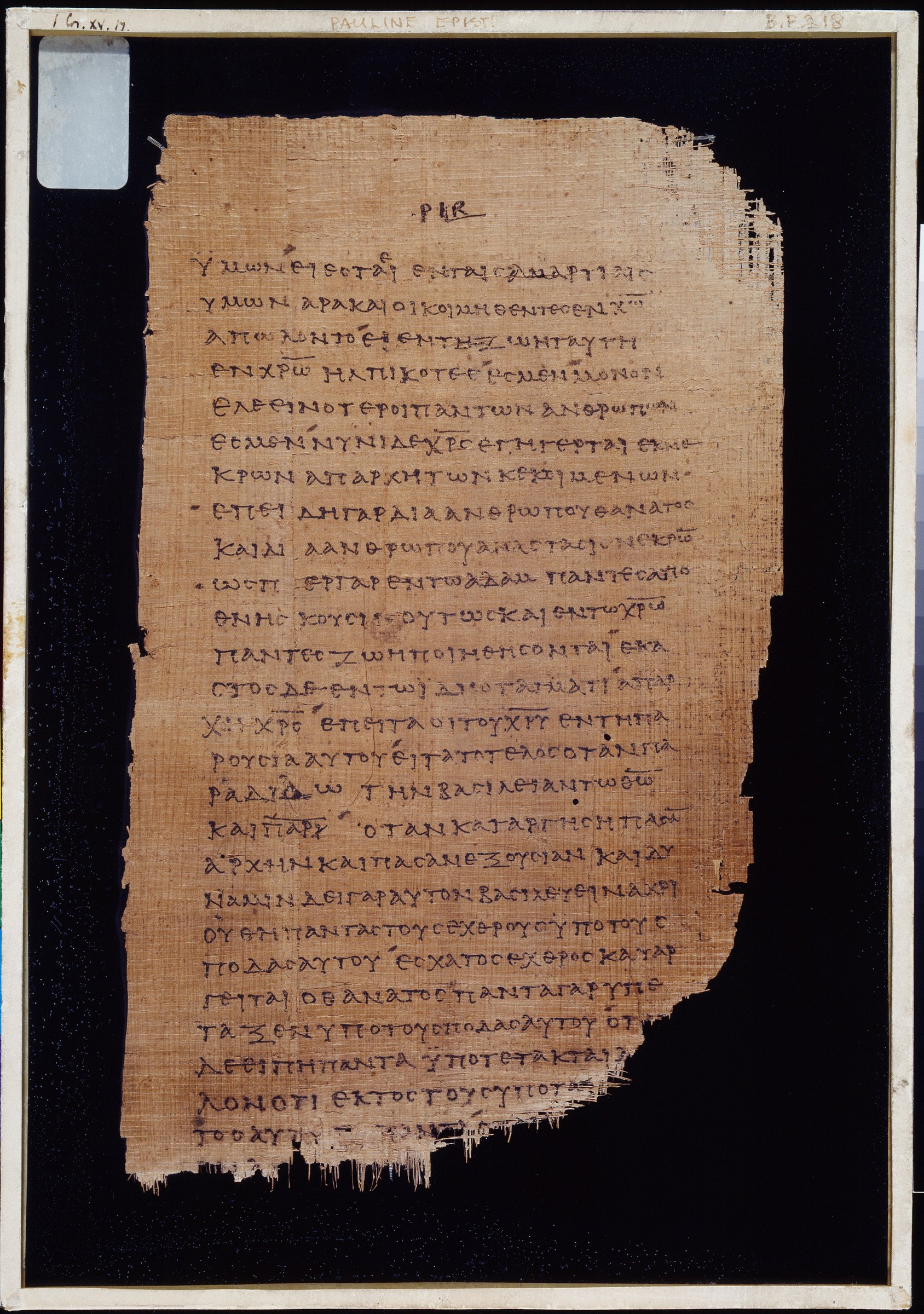
Where on the image
Chester Beatty Library photograph T0005253.jpg (https://ntmss.info/images/webfriendly/10046/T0005253.jpg), linked to NTVMR page 970 (folio 58r) in NTVMR's page index. 15:17 begins on the previous page; 15:28 continues on the next page. Checked on the image: the scribe's page number ριβ (112) at the head of the page, continuing the sequence of the neighbouring pages.
15:17 υμων ει εσται εν ταις αμαρτιαις
υμων 18 αρα και οι κοιμηθεντες εν χ̅ω̅
απωλοντο 19 ει εν τη ζωη ταυτη
εν χ̅ρ̅ω̅ ηλπικοτες εσμεν μονον
ελεεινοτεροι παντων ανθρωπων
εσμεν 20 νυνι δε χ̅ρ̅ς̅ εγηγερται εκ̣ ν̣ε
κρων απαρχη των κεκοιμενων
21 επειδη γαρ δια ανθρωπου θανατος
και δια ανθρωπου αναστασις νεκρων
22 ωσπερ γαρ εν τω αδαμ παντες απο
θνησκουσιν ουτως και εν τω χ̅ρ̅ω̅
παντες ζωηποιηθησονται 23 εκα
στος δε εν τω ιδιω ταγματι απαρ
χη̣ χ̅ρ̅ς̅ επειτα οι του χ̅ρ̅υ̅ εν τη πα
ρουσια αυτου 24 ειτα το τελος οταν πα
ραδισ̣ω την βασιλειαν τω θ̅ω̅
και π̅α̅ρ̅ι̅ οταν καταργηση πασαν
αρχην και πασαν εξουσιαν και δυ
ναμιν 25 δει γαρ αυτον βασιλευειν αχρι
ου θη παντας τους εχθρους υπο τους
ποδας αυτου 26 εσχατος εχθρος καταρ
γειται ο θανατος 27 παντα γαρ υπε
ταξεν υπο τους ποδας αυτου οτα̣[ν]
δε ειπη παντα υποτετακται δ̣[η]
λον οτι εκτος τους υποταξ̣[αν]
τος αυτ̣ω̣ τ̣[α] παντ̣α̣ 28 ο̣τ̣α̣ν̣ [δε υποτα]
γ̣η̣ α̣υ̣[τω τα παντα τοτε και αυτος]
15:17And if Christ be not raised, your faith is vain; ye are yet in your sins. 18Then they also which are fallen asleep in Christ are perished. 19If in this life only we have hope in Christ, we are of all men most miserable. 20But now is Christ risen from the dead, and become the firstfruits of them that slept. 21For since by man came death, by man came also the resurrection of the dead. 22For as in Adam all die, even so in Christ shall all be made alive. 23But every man in his own order: Christ the firstfruits; afterward they that are Christ’s at his coming. 24Then cometh the end, when he shall have delivered up the kingdom to God, even the Father; when he shall have put down all rule and all authority and power. 25For he must reign, till he hath put all enemies under his feet. 26The last enemy that shall be destroyed is death. 27For he hath put all things under his feet. But when he saith all things are put under him, it is manifest that he is excepted, which did put all things under him. 28And when all things shall be subdued unto him, then shall the Son also himself be subject unto him that put all things under him, that God may be all in all.
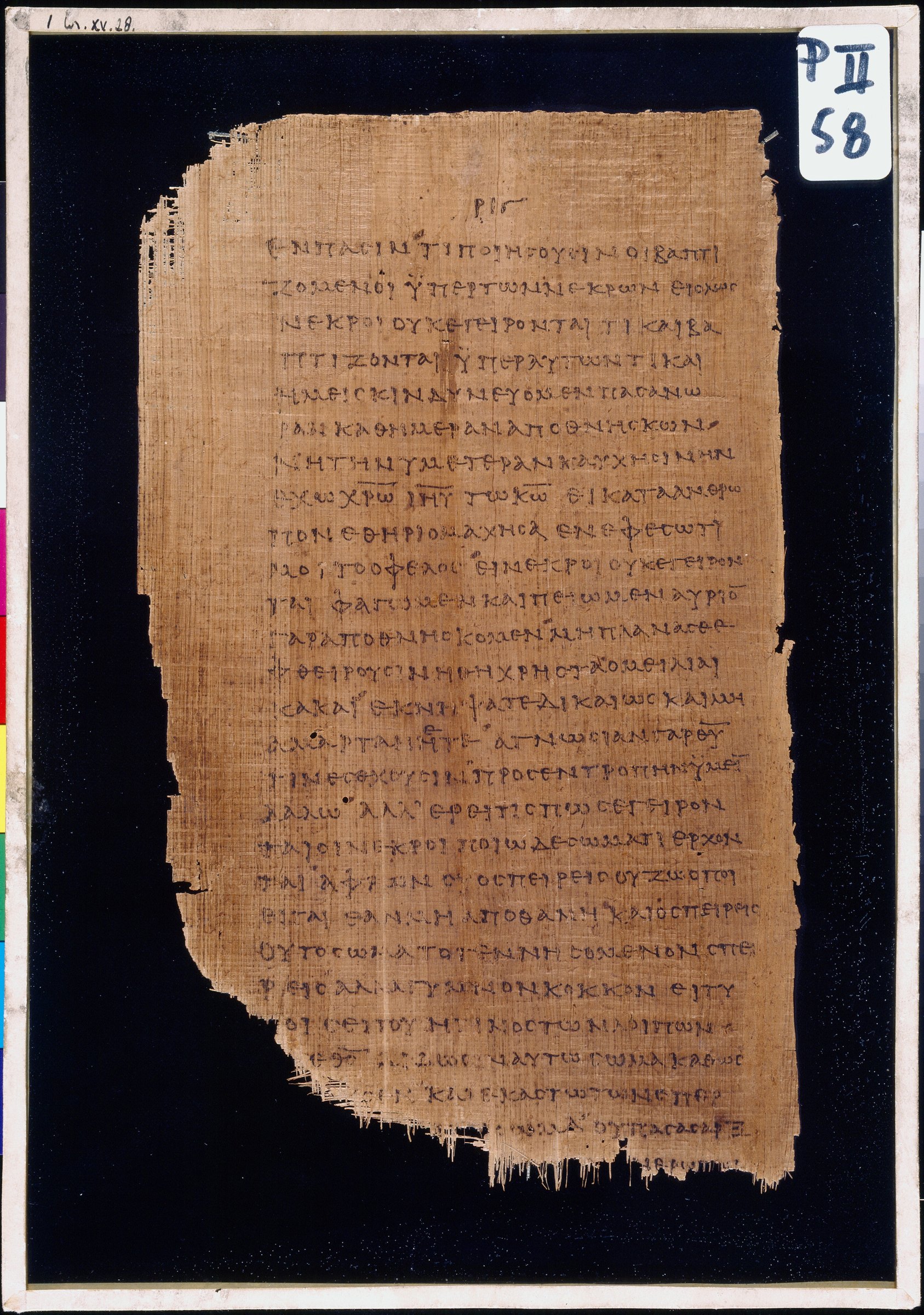
Where on the image
Chester Beatty Library photograph T0005251.jpg (https://ntmss.info/images/webfriendly/10046/T0005251.jpg), linked to NTVMR page 980 (folio 58v) in NTVMR's page index. 15:28 begins on the previous page; 15:39 continues on the next page. Checked on the image: the scribe's page number ριγ (113) at the head of the page, continuing the sequence of the neighbouring pages; the label on the frame reads ‹P II 58›.
15:28 εν πασιν 29 τι ποιησουσιν οι βαπτι
ζομενοι υπερ των νεκρων ει ολως
νεκροι ουκ εγειρονται τι και βα
πτιζονται υπερ αυτων 30 τι και
ημεις κινδυνευομεν πασαν ω
ραν 31 καθ ημεραν αποθνησκων
νη την υμετεραν καυχησιν ην
εχω χ̅ρ̅ω̅ ι̅η̅υ̅ τω κ̅ω̅ 32 ει κατα ανθρω
πον εθηριομαχησα εν εφεσω τι
μοι το οφελος ει νεκροι ουκ εγειρον
ται φαγωμεν και πειωμεν αυριον
γαρ αποθνησκομεν 33 μη πλανασθε
φθειρουσιν ηθη χρηστα ομειλιαι
κακαι 34 εκνηψατε δικαιως και μη
αμαρτανητε αγνωσιαν γαρ θ̅υ̅
τινες εχουσιν προς εντροπην υμειν
λαλω 35 αλλ ερει τις πως εγειρον
ται οι νεκροι ποιω δε σωματι ερχον
ται 36 αφρων συ̣ ο σπειρεις ου ζωοποι
ειτ̣αι εαν μη αποθανη 37 και ο σπειρεις
ου το σωμα το γεννησομενον σπει
ρεις αλλα γυμνον κοκκον ει τυ
[χ]οι σειτου η τινος των λοιπων
38 [ο δ]ε θ̅ς̅ διδωσι̣ν αυτω σωμα καθως
[ηθε]λ̣η̣σεν και εκαστω των σπερ
[ματων ι]δ̣ι̣[ο]ν̣ σωμα 39 ου πασα σαρξ
[η αυτη σαρξ αλλα αλλη μεν α]ν̣θ̣ρωπ̣ω̣ν̣
15:28And when all things shall be subdued unto him, then shall the Son also himself be subject unto him that put all things under him, that God may be all in all. 29Else what shall they do which are baptized for the dead, if the dead rise not at all? why are they then baptized for the dead? 30And why stand we in jeopardy every hour? 31I protest by your rejoicing which I have in Christ Jesus our Lord, I die daily. 32If after the manner of men I have fought with beasts at Ephesus, what advantageth it me, if the dead rise not? let us eat and drink; for to morrow we die. 33Be not deceived: evil communications corrupt good manners. 34Awake to righteousness, and sin not; for some have not the knowledge of God: I speak this to your shame. 35But some man will say, How are the dead raised up? and with what body do they come? 36Thou fool, that which thou sowest is not quickened, except it die: 37And that which thou sowest, thou sowest not that body that shall be, but bare grain, it may chance of wheat, or of some other grain: 38But God giveth it a body as it hath pleased him, and to every seed his own body. 39All flesh is not the same flesh: but there is one kind of flesh of men, another flesh of beasts, another of fishes, and another of birds.
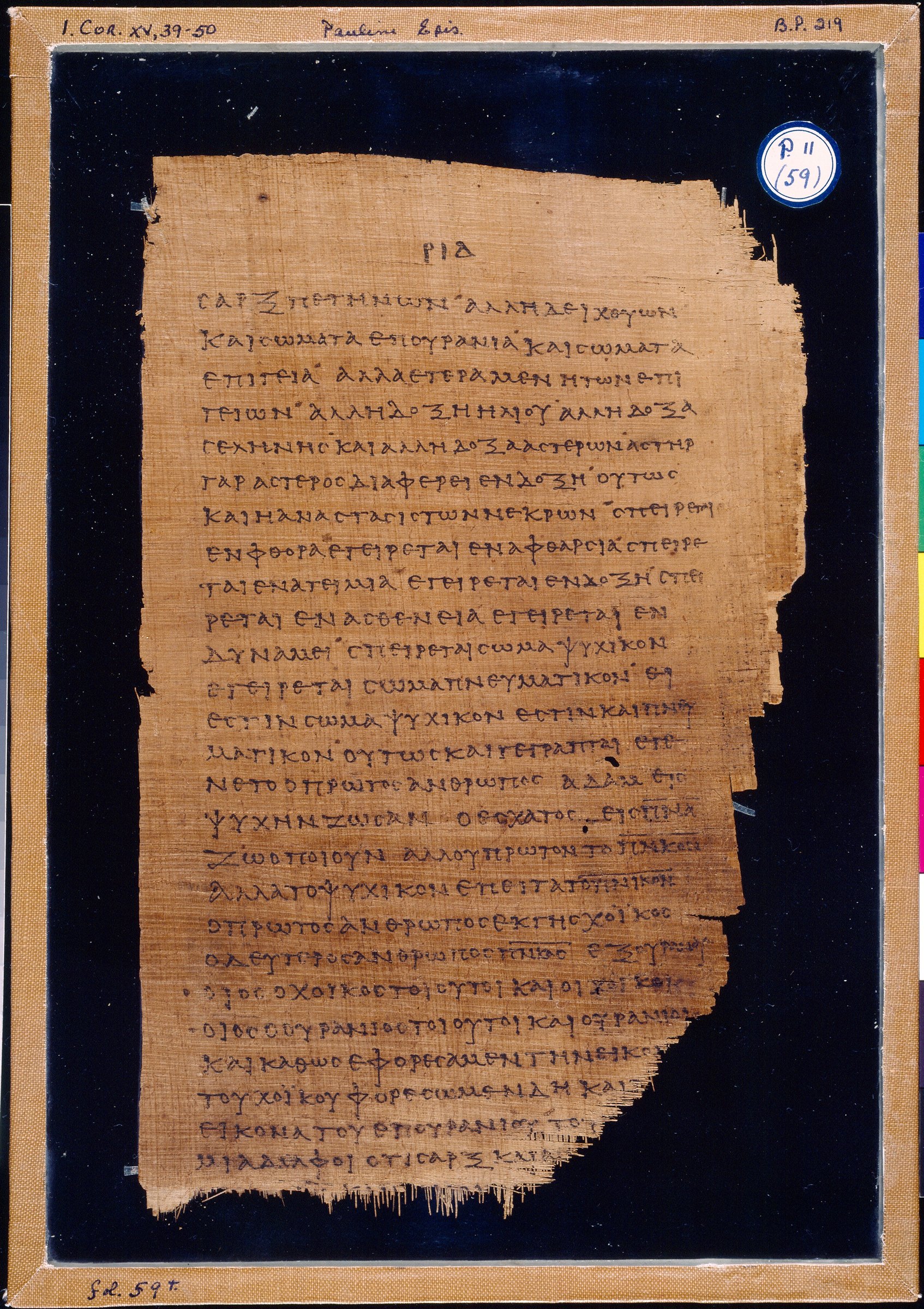
Where on the image
Chester Beatty Library photograph T0005254.jpg (https://ntmss.info/images/webfriendly/10046/T0005254.jpg), linked to NTVMR page 990 (folio 59r) in NTVMR's page index. 15:39 begins on the previous page; 15:50 continues on the next page. Checked on the image: the disc on the frame reads ‹P II (59)›.
15:39 σαρξ πετηνων αλλη δε ιχθυων
40 και σωματα επουρανια και σωματα
επιγεια αλλα ετερα μεν η των επι
γειων 41 αλλη δοξη ηλιου αλλη δοξα
σεληνης και αλλη δοξα αστερων αστηρ
γαρ αστερος διαφερει εν δοξη 42 ουτως
και η αναστασις των νεκρων σπειρεται
εν φθορα εγειρεται εν αφθαρσια 43 σπειρε
ται εν ατειμια εγειρεται εν δοξη σπει
ρεται εν ασθενεια εγειρεται εν
δυναμει 44 σπειρεται σωμα ψυχικον
εγειρεται σωμα πνευματικον ει
εστιν σωμα ψυχικον εστιν και πνευ
ματικον 45 ουτως και γεγραπται εγε
νετο ο πρωτος ανθρωπος αδαμ εις
ψυχην ζωσαν ο εσχατος εις π̅ν̅α̅
ζωοποιουν 46 αλλ ου πρωτον το π̅ν̅κ̅ο̅ν̅
αλλα το ψυχικον επειτα το π̅ν̅ι̅κ̅ο̅ν̅
47 ο πρωτος ανθρωπος εκ γης χοικος
ο δευτερος ανθρωπος π̅ν̅κ̅ο̅ς̅ εξ ουρανου
48 οιος ο χοικος τοιουτοι και οι χοικοι
οιος ο ουρανιος τοιουτοι και ουρανιοι̣
49 και καθως εφορεσαμεν την εικον̣[α]
του χοικου φορεσωμεν δη και τ̣[ην]
εικονα του επουρανιου 50 του̣[το δε φη]
μι αδελφοι οτι σαρξ και α̣ι̣[μα βασι]
λ̣[ει]α̣[ν] θ̣̣̅υ̣̣̅ κ̣λ̣η̣[ρο]ν̣ο̣μ̣[ησαι ου δυναται]
15:39All flesh is not the same flesh: but there is one kind of flesh of men, another flesh of beasts, another of fishes, and another of birds. 40There are also celestial bodies, and bodies terrestrial: but the glory of the celestial is one, and the glory of the terrestrial is another. 41There is one glory of the sun, and another glory of the moon, and another glory of the stars: for one star differeth from another star in glory. 42So also is the resurrection of the dead. It is sown in corruption; it is raised in incorruption: 43It is sown in dishonour; it is raised in glory: it is sown in weakness; it is raised in power: 44It is sown a natural body; it is raised a spiritual body. There is a natural body, and there is a spiritual body. 45And so it is written, The first man Adam was made a living soul; the last Adam was made a quickening spirit. 46Howbeit that was not first which is spiritual, but that which is natural; and afterward that which is spiritual. 47The first man is of the earth, earthy: the second man is the Lord from heaven. 48As is the earthy, such are they also that are earthy: and as is the heavenly, such are they also that are heavenly. 49And as we have borne the image of the earthy, we shall also bear the image of the heavenly. 50Now this I say, brethren, that flesh and blood cannot inherit the kingdom of God; neither doth corruption inherit incorruption.
Notes
- Greek: the NTVMR diplomatic transcription, line by line as on the papyrus. Square brackets enclose letters that are lost or illegible and were supplied by the transcribers; a dot under a letter marks it as uncertain; [...] marks a gap. Nomina sacra and numerals keep the scribe's overline. Spelling is the scribe's (no accents or breathings). Words broken at a line end stay broken as on the papyrus. Corrections are not shown: the text is the first hand.
- English: the King James Version (1611), whole verses, for every verse that has text on the page. A verse that begins on one page and ends on the next is given in full on both. The KJV translates a later form of the Greek text, so its wording does not always match the papyrus; material differences (such as verses the papyrus does not have) are noted in the section.
Cite
Sources
- Source: P46 (Chester Beatty Biblical Papyrus II, Chester Beatty Library, Dublin): photographs as published in the INTF New Testament Virtual Manuscript Room; Greek from the INTF NTVMR transcription of P46; English from the King James Version (holding institution)
- Critical edition: INTF NTVMR diplomatic transcription (CC BY 4.0)
← previous · → next · v cycle view · l back to library