P46 (Chester Beatty II): 1 Corinthians 16:2-22 (fols. 60r-60v)
Introduction
P46 is a papyrus codex of the letters of Paul copied in Egypt around 200, the oldest surviving collection of Paul's letters. 86 of its 104 leaves survive: 56 in the Chester Beatty Library, Dublin (Biblical Papyrus II, published by Frederic Kenyon in 1934-1937) and 30 in the University of Michigan Library, Ann Arbor (P.Mich. inv. 6238, published by Henry Sanders in 1935). The letters run in the order Romans, Hebrews, 1 and 2 Corinthians, Ephesians, Galatians, Philippians, Colossians and 1 Thessalonians; the first seven leaves (Romans 1:1-5:17) and the end of the book are lost. Hebrews standing after Romans, and the doxology of Romans (16:25-27) standing after 15:33, are among its best-known features.
Each section below is one page side: the holding library's photograph, the NTVMR diplomatic transcription line by line, and the King James Version of every verse that has text on the page. The lower lines of many leaves are lost; the transcribers' restorations are in square brackets.
This entry covers fols. 60r-60v (1 Corinthians 16:2-22).
How was this verified? (Provenance)
Where on the image
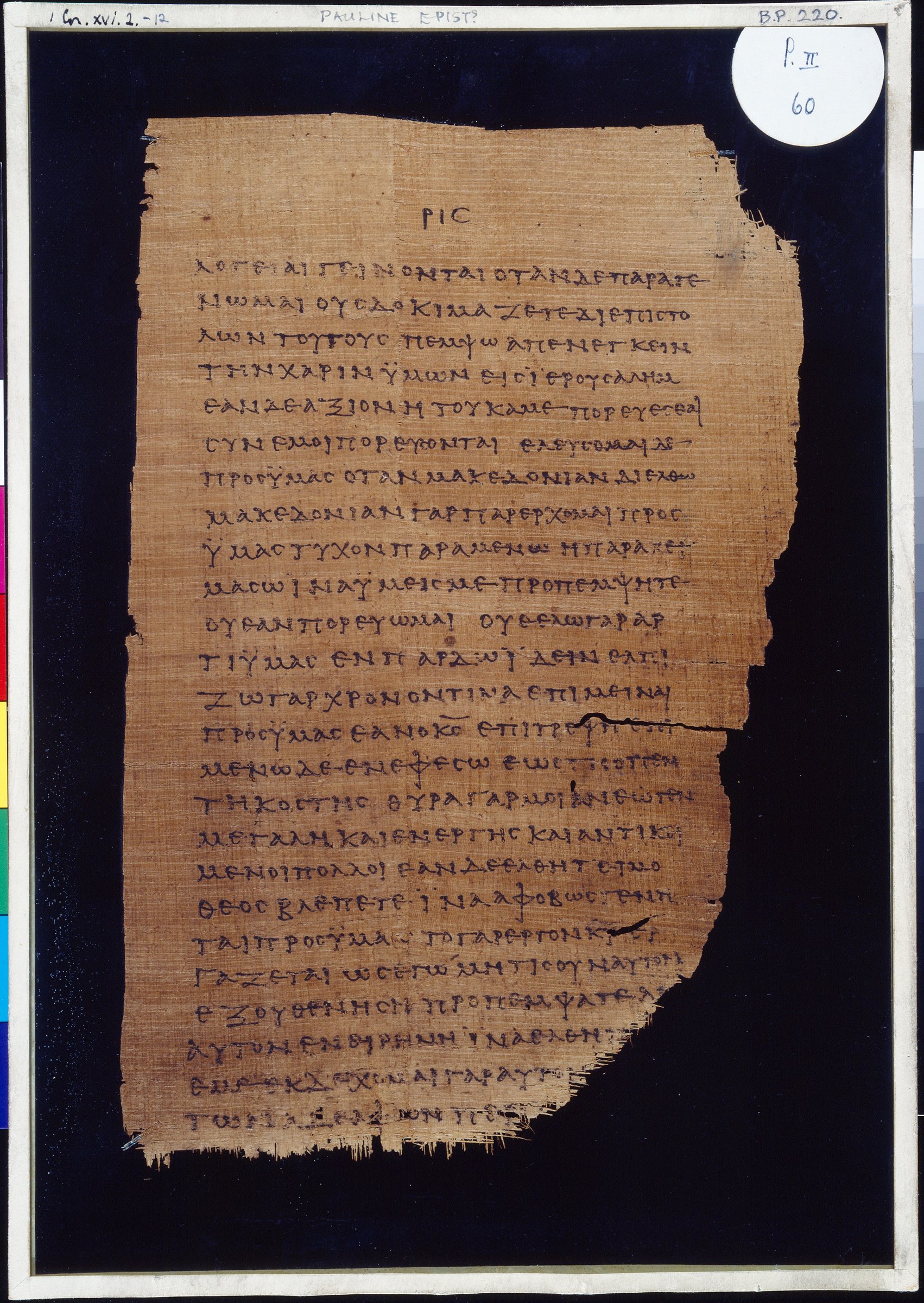
Chester Beatty Library photograph T0005256.jpg (https://ntmss.info/images/webfriendly/10046/T0005256.jpg), linked to NTVMR page 1010 (folio 60r) in NTVMR's page index. 16:2 begins on the previous page; 16:12 continues on the next page. Checked on the image: the scribe's page number ρις (116) at the head of the page, continuing the sequence of the neighbouring pages; the disc on the frame reads ‹P. II 60›.
16:2 λογειαι γεινονται 3 οταν δε παραγε
νωμαι ους δοκιμαζετε δι επιστο
λων τουτους πεμψω απενεγκειν
την χαριν υμων εις ιερουσαλημ
4 εαν δε αξιον η του καμε πορευεσθαι
συν εμοι πορευονται 5 ελευσομαι δε
προς υμας οταν μακεδονιαν διελθω
μακεδονιαν γαρ παρερχομαι 6 προς
υμας τυχον παραμενω η παραχ̣ει
μασω ινα υμεις με προπεμψητε
ου εαν πορευωμαι 7 ου θελω γαρ αρ
τι υμας εν παρδω ιδειν ελπι
ζω γαρ χρονον τινα επιμειναι
προς υμας εαν ο κ̅ς̅ επιτρεψη 8 ε̣πι
μενω δε εν εφεσω εως της πεν
τηκοστης 9 θυρα γαρ μοι ανεωγεν
μεγαλη και ενεργης και αντικει
μενοι πολλοι 10 εαν δε ελθη τειμο
θεος βλεπετε ινα αφοβως γενη
ται προς υμας το γαρ εργον κ̅υ̣̣̅ ε̣ρ
γαζεται ως εγω 11 μη τις ουν αυτον
εξουθενηση προπεμψατε δε̣
αυτον εν ειρηνη ινα ελθη π̣[ρος]
εμε εκδεχομαι γαρ αυτο̣ν̣ [μετα]
των αδελφων 12 περ̣ι̣ δ̣[ε απολλω]
16:2Upon the first day of the week let every one of you lay by him in store, as God hath prospered him, that there be no gatherings when I come. 3And when I come, whomsoever ye shall approve by your letters, them will I send to bring your liberality unto Jerusalem. 4And if it be meet that I go also, they shall go with me. 5Now I will come unto you, when I shall pass through Macedonia: for I do pass through Macedonia. 6And it may be that I will abide, yea, and winter with you, that ye may bring me on my journey whithersoever I go. 7For I will not see you now by the way; but I trust to tarry a while with you, if the Lord permit. 8But I will tarry at Ephesus until Pentecost. 9For a great door and effectual is opened unto me, and there are many adversaries. 10Now if Timotheus come, see that he may be with you without fear: for he worketh the work of the Lord, as I also do. 11Let no man therefore despise him: but conduct him forth in peace, that he may come unto me: for I look for him with the brethren. 12As touching our brother Apollos, I greatly desired him to come unto you with the brethren: but his will was not at all to come at this time; but he will come when he shall have convenient time.
Where on the image
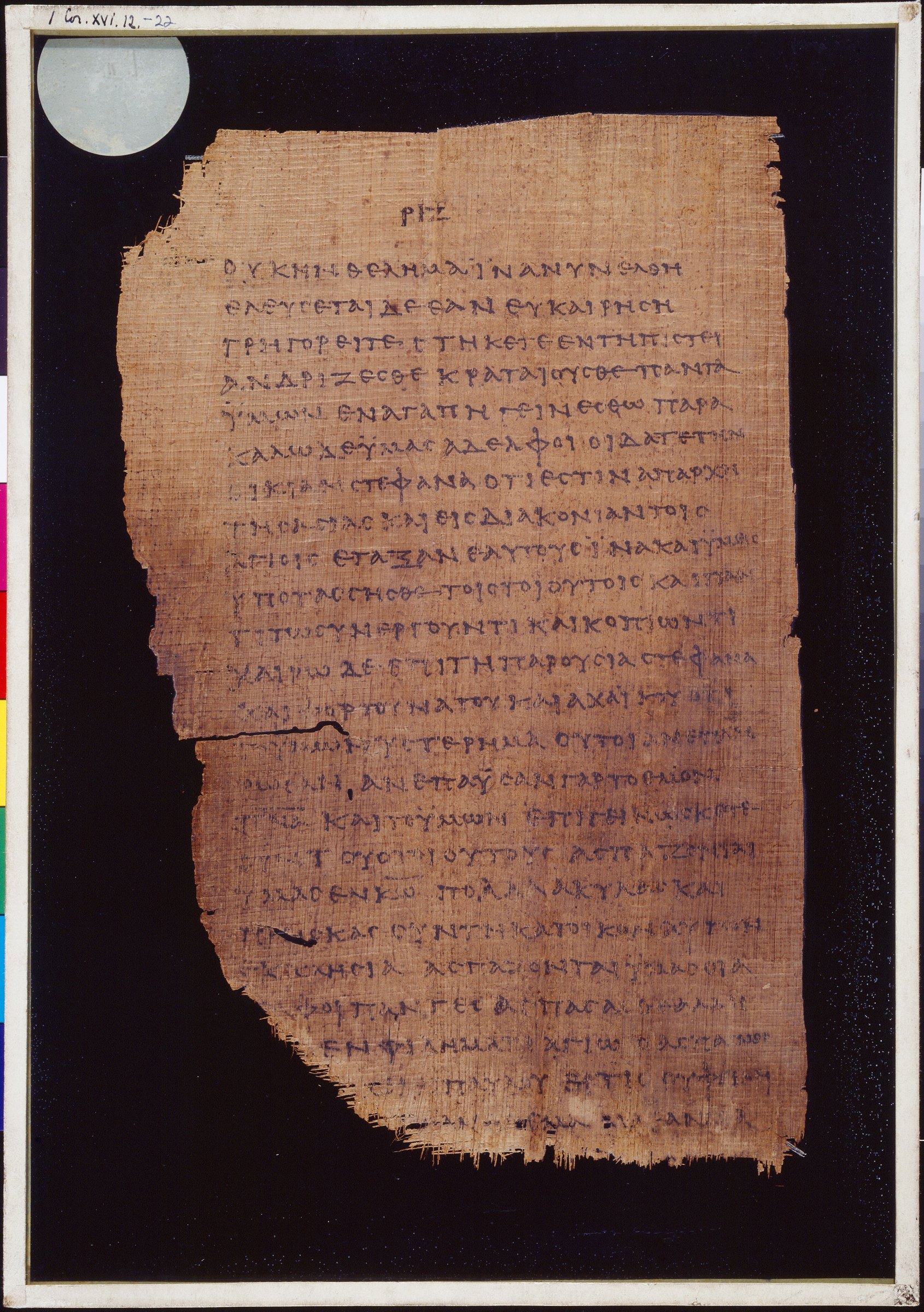
Chester Beatty Library photograph T0005257.jpg (https://ntmss.info/images/webfriendly/10046/T0005257.jpg), linked to NTVMR page 1020 (folio 60v) in NTVMR's page index. 16:12 begins on the previous page. Checked on the image: the scribe's page number ριζ (117) at the head of the page, continuing the sequence of the neighbouring pages.
16:12 ουκ ην θελημα ινα νυν ελθη
ελευσεται δε εαν ευκαιρηση
13 γρηγορειτε στηκετε εν τη πιστει
ανδριζεσθε κραταιουσθε 14 παντα
υμων εν αγαπη γεινεσθω 15 παρα
καλω δε υμας αδελφοι οιδατε την
ο̣ικιαν στεφανα οτι εστιν απαρχη
της ασιας και εις διακονιαν τοις
α̣γιοις εταξαν εαυτους 16 ινα και υμεις
υποτασσησθε τοις τοιουτοις και παν
τι τω συνεργουντι και κοπιωντι
17 χαιρω δε επι τη παρουσια στεφανα
και φ̣ορτουνατου και αχαικου οτι
το̣ υμων υστερημα ουτοι ανεπλη
ρ̣ωσα̣ν 18 ανεπαυσαν γαρ το εμον
π̅ν̅α̅ και το υμων επιγεινωσκετε
ουν τους τοιουτους 19 ασπαζονται
υμας εν κ̅ω̅ πολλα̣ ακυλας και
πρε̣ισκας συν τη κατ οικον αυτων
εκκλησια 20 ασπαζονται υμας οι α
[δ]ε̣λ̣φοι παντες ασπασασθε αλλη
[λους] εν φιληματι αγιω 21 ο ασπασ̣μος
[τη εμη] χ̣ειρ̣ι̣ παυλου 22 ει τις ου φε̣ιλ̣ε̣ι
[τον κ̅ν̅ ητ]ω̣ α̣ν[α]θ̣εμα μ̣α̣ρανα̣ θ̣α
16:12As touching our brother Apollos, I greatly desired him to come unto you with the brethren: but his will was not at all to come at this time; but he will come when he shall have convenient time. 13Watch ye, stand fast in the faith, quit you like men, be strong. 14Let all your things be done with charity. 15I beseech you, brethren, (ye know the house of Stephanas, that it is the firstfruits of Achaia, and that they have addicted themselves to the ministry of the saints,) 16That ye submit yourselves unto such, and to every one that helpeth with us, and laboureth. 17I am glad of the coming of Stephanas and Fortunatus and Achaicus: for that which was lacking on your part they have supplied. 18For they have refreshed my spirit and yours: therefore acknowledge ye them that are such. 19The churches of Asia salute you. Aquila and Priscilla salute you much in the Lord, with the church that is in their house. 20All the brethren greet you. Greet ye one another with an holy kiss. 21The salutation of me Paul with mine own hand. 22If any man love not the Lord Jesus Christ, let him be Anathema Maranatha.
Notes
- Greek: the NTVMR diplomatic transcription, line by line as on the papyrus. Square brackets enclose letters that are lost or illegible and were supplied by the transcribers; a dot under a letter marks it as uncertain; [...] marks a gap. Nomina sacra and numerals keep the scribe's overline. Spelling is the scribe's (no accents or breathings). Words broken at a line end stay broken as on the papyrus. Corrections are not shown: the text is the first hand.
- English: the King James Version (1611), whole verses, for every verse that has text on the page. A verse that begins on one page and ends on the next is given in full on both. The KJV translates a later form of the Greek text, so its wording does not always match the papyrus; material differences (such as verses the papyrus does not have) are noted in the section.
Cite
Sources
- Source: P46 (Chester Beatty Biblical Papyrus II, Chester Beatty Library, Dublin): photographs as published in the INTF New Testament Virtual Manuscript Room; Greek from the INTF NTVMR transcription of P46; English from the King James Version (holding institution)
- Critical edition: INTF NTVMR diplomatic transcription (CC BY 4.0)
← previous · → next · v cycle view · l back to library