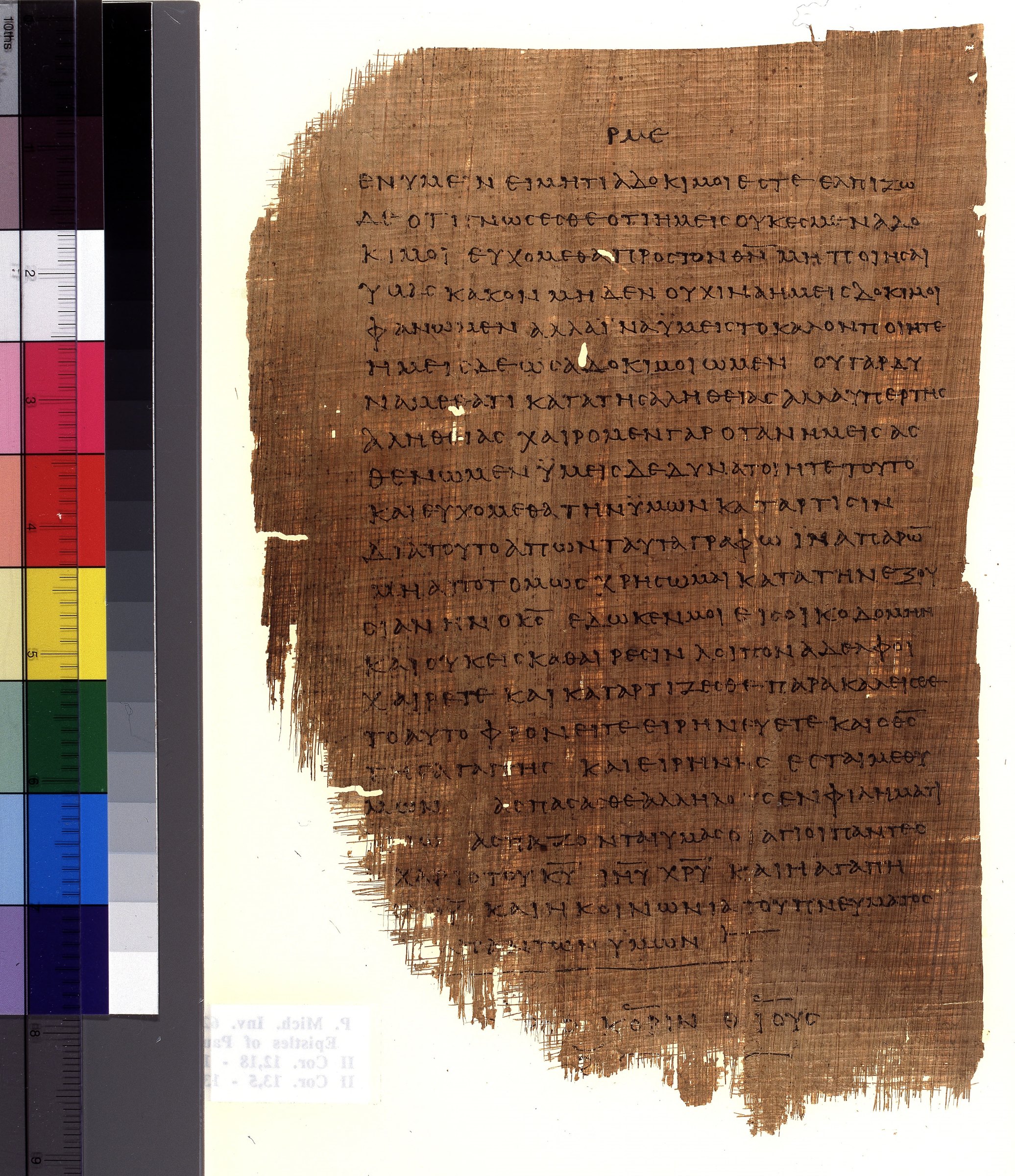
P46 (P.Mich. inv. 6238): 2 Corinthians 13:5-13 (fol. 74v)
Introduction
P46 is a papyrus codex of the letters of Paul copied in Egypt around 200, the oldest surviving collection of Paul's letters. 86 of its 104 leaves survive: 56 in the Chester Beatty Library, Dublin (Biblical Papyrus II, published by Frederic Kenyon in 1934-1937) and 30 in the University of Michigan Library, Ann Arbor (P.Mich. inv. 6238, published by Henry Sanders in 1935). The letters run in the order Romans, Hebrews, 1 and 2 Corinthians, Ephesians, Galatians, Philippians, Colossians and 1 Thessalonians; the first seven leaves (Romans 1:1-5:17) and the end of the book are lost. Hebrews standing after Romans, and the doxology of Romans (16:25-27) standing after 15:33, are among its best-known features.
Each section below is one page side: the holding library's photograph, the NTVMR diplomatic transcription line by line, and the King James Version of every verse that has text on the page. The lower lines of many leaves are lost; the transcribers' restorations are in square brackets.
This entry covers fol. 74v (2 Corinthians 13:5-13).
How was this verified? (Provenance)
Where on the image
University of Michigan Library photograph 10046x6238_145JP2_UMich.jpg (https://ntmss.info/images/webfriendly/10046/10046x6238_145JP2_UMich.jpg), linked to NTVMR page 1300 (folio 74v) in NTVMR's page index. 13:5 begins on the previous page. The page also carries a book title, shown in italics in the Greek ([π]ρ̣ος κορινθιους β̅); the KJV has no English for it. Checked on the image: the scribe's page number ρμε (145) at the head of the page, continuing the sequence of the neighbouring pages; the first line reads ‹εν υμειν ει μητι αδοκιμοι εστε ελπιζω›, as in the transcription.
13:5 εν υμειν ει μητι αδοκιμοι εστε 6 ελπιζω
δε οτι γνωσεσθε οτι ημεις ουκ εσμεν αδο
κιμοι 7 ευχομεθα προς τον θ̅ν̅ μη ποιησαι
υμας κακον μηδεν ουχ ινα ημεις δοκιμοι
φανωμεν αλλα ινα υμεις το καλον ποιητε
ημεις δε ως αδοκιμοι ωμεν 8 ου γαρ δυ
ναμεθα τι κατα της αληθειας αλλα υπερ της
αληθειας 9 χαιρομεν γαρ οταν ημεις ασ
θενωμεν υμεις δε δυνατοι ητε τουτο
και ευχομεθα την υμων καταρτισιν
10 δια τουτο απων ταυτα γραφω ινα παρων
μη αποτομως χρησωμαι κατα την εξου
σιαν ην ο κ̅ς̅ εδωκεν μοι εις οικοδομην
και ουκ εις καθαιρεσιν 11 λοιπον αδελφοι
χαιρετε και καταρτιζεσθε παρακαλεισθε
το αυτο φρονειτε ειρηνευετε και ο θ̅ς̅
της αγαπης και ειρηνης εσται μεθ υ
μων 12 ασπασασθε αλληλους εν φιληματι
α̣γ̣ιω ασπαζονται υμας οι αγιοι παντες
13 η̣ χαρις του κ̅υ̅ ι̅η̅υ̅ χ̅ρ̅υ̅ και η αγαπη
[τ]ο̣υ̣ θ̅υ̅ και η κοινωνια του πνευματος
[μετ]α̣ παντων υμων
[π]ρ̣ος κορινθιους
β̅
13:5Examine yourselves, whether ye be in the faith; prove your own selves. Know ye not your own selves, how that Jesus Christ is in you, except ye be reprobates? 6But I trust that ye shall know that we are not reprobates. 7Now I pray to God that ye do no evil; not that we should appear approved, but that ye should do that which is honest, though we be as reprobates. 8For we can do nothing against the truth, but for the truth. 9For we are glad, when we are weak, and ye are strong: and this also we wish, even your perfection. 10Therefore I write these things being absent, lest being present I should use sharpness, according to the power which the Lord hath given me to edification, and not to destruction. 11Finally, brethren, farewell. Be perfect, be of good comfort, be of one mind, live in peace; and the God of love and peace shall be with you. 12Greet one another with an holy kiss. 13All the saints salute you.
Notes
- Greek: the NTVMR diplomatic transcription, line by line as on the papyrus. Square brackets enclose letters that are lost or illegible and were supplied by the transcribers; a dot under a letter marks it as uncertain; [...] marks a gap. Nomina sacra and numerals keep the scribe's overline. Spelling is the scribe's (no accents or breathings). Words broken at a line end stay broken as on the papyrus. Corrections are not shown: the text is the first hand.
- English: the King James Version (1611), whole verses, for every verse that has text on the page. A verse that begins on one page and ends on the next is given in full on both. The KJV translates a later form of the Greek text, so its wording does not always match the papyrus; material differences (such as verses the papyrus does not have) are noted in the section.
Cite
Sources
- Source: P46 (P.Mich. inv. 6238, University of Michigan Library): photographs as published in the INTF New Testament Virtual Manuscript Room; Greek from the INTF NTVMR transcription of P46; English from the King James Version (holding institution)
- Critical edition: INTF NTVMR diplomatic transcription (CC BY 4.0)
← previous · → next · v cycle view · l back to library