P46 (P.Mich. inv. 6238): 2 Corinthians 12:10-13:5 (fols. 73v-74r)
Introduction
P46 is a papyrus codex of the letters of Paul copied in Egypt around 200, the oldest surviving collection of Paul's letters. 86 of its 104 leaves survive: 56 in the Chester Beatty Library, Dublin (Biblical Papyrus II, published by Frederic Kenyon in 1934-1937) and 30 in the University of Michigan Library, Ann Arbor (P.Mich. inv. 6238, published by Henry Sanders in 1935). The letters run in the order Romans, Hebrews, 1 and 2 Corinthians, Ephesians, Galatians, Philippians, Colossians and 1 Thessalonians; the first seven leaves (Romans 1:1-5:17) and the end of the book are lost. Hebrews standing after Romans, and the doxology of Romans (16:25-27) standing after 15:33, are among its best-known features.
Each section below is one page side: the holding library's photograph, the NTVMR diplomatic transcription line by line, and the King James Version of every verse that has text on the page. The lower lines of many leaves are lost; the transcribers' restorations are in square brackets.
This entry covers fols. 73v-74r (2 Corinthians 12:10-13:5).
How was this verified? (Provenance)
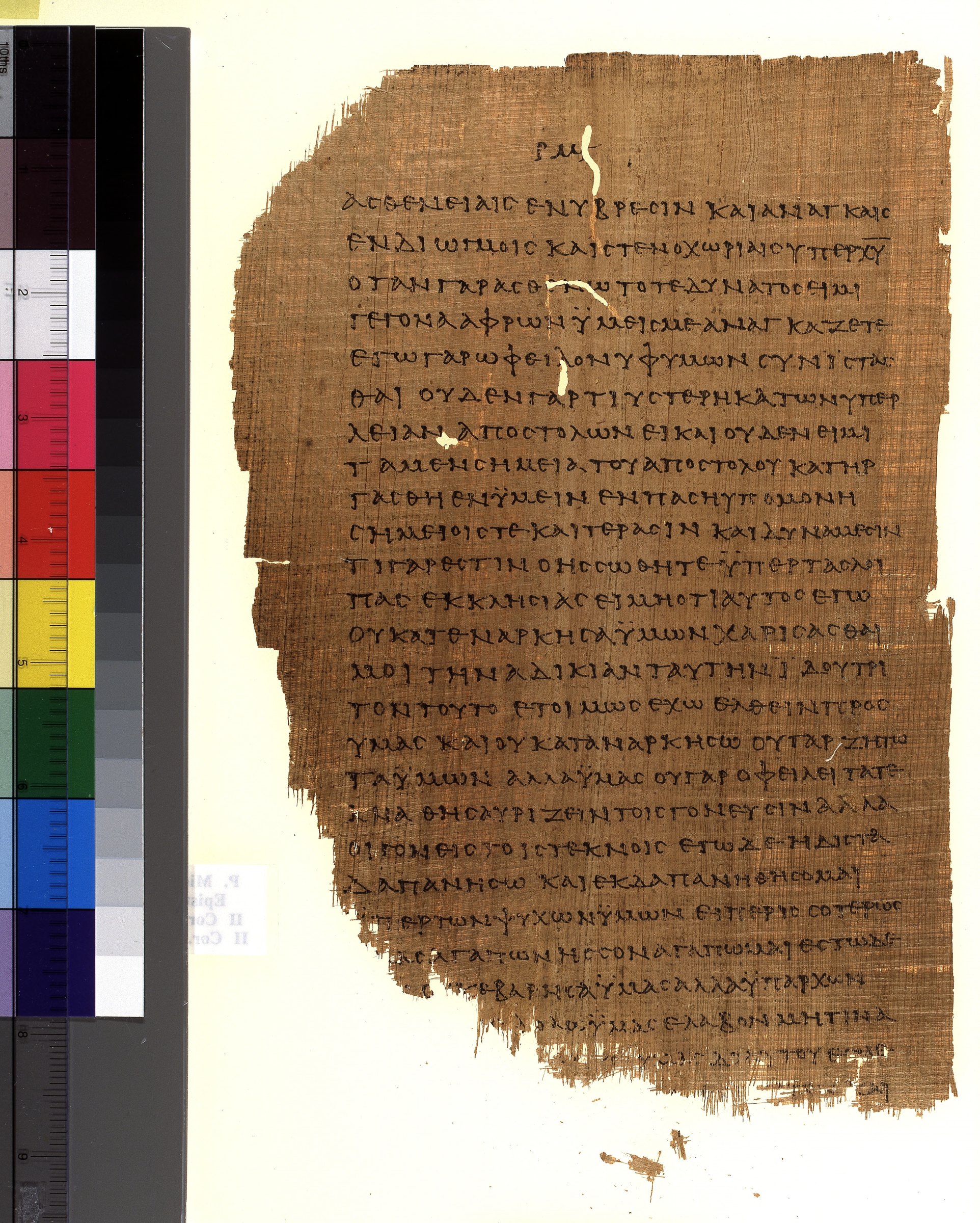
Where on the image
University of Michigan Library photograph 10046x6238_143JP2_UMich.jpg (https://ntmss.info/images/webfriendly/10046/10046x6238_143JP2_UMich.jpg), linked to NTVMR page 1280 (folio 73v) in NTVMR's page index. 12:10 begins on the previous page; 12:18 continues on the next page. Checked on the image: the scribe's page number ρμγ (143) at the head of the page, continuing the sequence of the neighbouring pages.
12:10 ασθενειαις εν υβρεσιν και αναγκαις
εν διωγμοις και στενοχωριαις υπερ χ̅υ̅
οταν γαρ ασθε̣νω τοτε δυνατος ειμι
11 γεγονα αφρων υμεις με αναγκαζετε
εγω γαρ ωφειλον υφ υμων συνιστασ
θαι ουδεν γαρ τι υστερηκα των υπερ
λειαν αποστολων ει και ουδεν ειμι
12 τα μεν σημεια του αποστολου κατηρ
γασθη εν υμειν εν παση υπομονη
σημειοις τε και τερασιν και δυναμεσιν
13 τι γαρ εστιν ο ησσωθητε υπερ τας λοι
πας εκκλησιας ει μη οτι αυτος εγω
ου κατεναρκησα υμων χαρισασθαι
μοι την αδικιαν ταυτην 14 ιδου τρι
τον τουτο ετοιμως εχω ελθειν προς
υμας και ου καταναρκησω ου γαρ ζητω
τα υμων αλλα υμας ου γαρ οφειλει τα τε
κνα θησαυριζειν τοις γονευσιν αλλα
οι γονεις τοις τεκνοις 15 εγω δε ηδιστα
δαπανησω και εκδαπανηθησομαι
υ̣περ των ψυχων υμων ει περισσοτερως
[υ]μ̣ας αγαπων ησσον αγαπωμαι 16 εστω δε
[εγ]ω̣ ου̣κ εβαρησα υμας αλλα υπαρχων
[πανουργο]ς̣ δολω υμας ελαβον 17 μη τινα
[ων απεστα]λ̣κ̣α̣ π̣ρος υμας δι αυτου επ̣λε
[ονεκτησα υμας] 18 [παρεκ]α̣[λ]εσα̣ τ̣ιτον και
12:10Therefore I take pleasure in infirmities, in reproaches, in necessities, in persecutions, in distresses for Christ’s sake: for when I am weak, then am I strong. 11I am become a fool in glorying; ye have compelled me: for I ought to have been commended of you: for in nothing am I behind the very chiefest apostles, though I be nothing. 12Truly the signs of an apostle were wrought among you in all patience, in signs, and wonders, and mighty deeds. 13For what is it wherein ye were inferior to other churches, except it be that I myself was not burdensome to you? forgive me this wrong. 14Behold, the third time I am ready to come to you; and I will not be burdensome to you: for I seek not yours, but you: for the children ought not to lay up for the parents, but the parents for the children. 15And I will very gladly spend and be spent for you; though the more abundantly I love you, the less I be loved. 16But be it so, I did not burden you: nevertheless, being crafty, I caught you with guile. 17Did I make a gain of you by any of them whom I sent unto you? 18I desired Titus, and with him I sent a brother. Did Titus make a gain of you? walked we not in the same spirit? walked we not in the same steps?
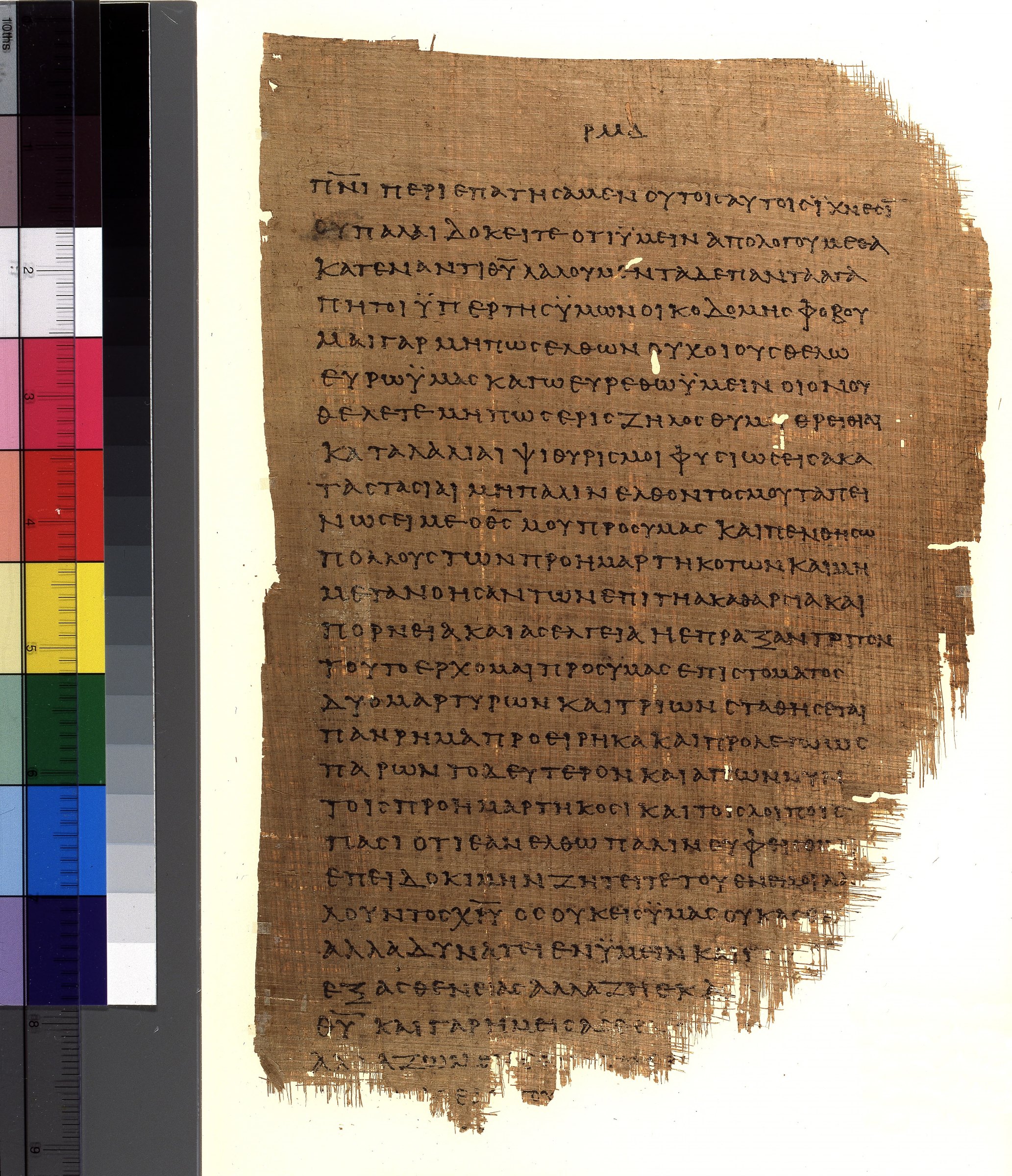
Where on the image
University of Michigan Library photograph 10046x6238_144JP2_UMich.jpg (https://ntmss.info/images/webfriendly/10046/10046x6238_144JP2_UMich.jpg), linked to NTVMR page 1290 (folio 74r) in NTVMR's page index. 12:18 begins on the previous page; 13:5 continues on the next page. Checked on the image: the scribe's page number ρμδ (144) at the head of the page, continuing the sequence of the neighbouring pages; the first line reads ‹π̅ν̅ι̅ περιεπατησαμεν ου τοις αυτοις ...›, as in the transcription.
12:18 π̅ν̅ι̅ περιεπατησαμεν ου τοις αυτοις ιχνεσιν
19 ου παλαι δοκειτε οτι υμειν απολογουμεθα
κατεναντι θ̅υ̅ λαλουμεν τα δε παντα αγα
πητοι υπερ της υμων οικοδομης 20 φοβου
μαι γαρ μη πως ελθων ουχ οιους θελω
ευρω υμας καγω ευρεθω υμειν οιον ου
θελετε μη πως ερις ζηλος θυμο̣ι ερειθιαι
καταλαλιαι ψιθυρισμοι φυσιωσεις ακα
ταστασιαι 21 μη παλιν ελθοντος μου ταπει
νωσει με ο θ̅ς̅ μου προς υμας και πενθησω
πολλους των προημαρτηκοτων και μη
μετανοησαντων επι τη ακαθαρσια και
πορνεια και ασελγεια η επραξαν 13:1 τριτον
τουτο ερχομαι προς υμας επι στοματος
δυο μαρτυρων και τριων σταθησεται
παν ρημα 2 προειρηκα και προλεγω ως
παρων το δευτερον και απων νυν
τοις προημαρτηκοσι και τοις λοιποις
πασι οτι εαν ελθω παλιν ου φεισομαι̣
3 επει δοκιμην ζητειτε του εν εμοι λα
λουντος χ̅ρ̅υ̅ ος ουκ εις υμας ουκ ασθε[νει]
αλλα δυνατει εν υμειν 4 και γα̣ρ̣ [ε̅σ̅τ̅ρ̅η̅]
εξ ασθενειας αλλα ζη εκ δ[υ]ν̣[αμεως]
θ̅υ̅ και γαρ ημεις ασθεν̣ο̣[υμεν εν αυτω]
αλλ̣α ζωμεν̣ ε̣ν̣ [αυ]τ̣ω̣ ε̣κ̣ [δυναμεως θ̅υ̅]
[εις] υ̣[μ]α̣ς̣ 5 εα̣υ̣τ̣ου[ς πειραζετε ει εστε]
12:18I desired Titus, and with him I sent a brother. Did Titus make a gain of you? walked we not in the same spirit? walked we not in the same steps? 19Again, think ye that we excuse ourselves unto you? we speak before God in Christ: but we do all things, dearly beloved, for your edifying. 20For I fear, lest, when I come, I shall not find you such as I would, and that I shall be found unto you such as ye would not: lest there be debates, envyings, wraths, strifes, backbitings, whisperings, swellings, tumults: 21And lest, when I come again, my God will humble me among you, and that I shall bewail many which have sinned already, and have not repented of the uncleanness and fornication and lasciviousness which they have committed. 13:1This is the third time I am coming to you. In the mouth of two or three witnesses shall every word be established. 2I told you before, and foretell you, as if I were present, the second time; and being absent now I write to them which heretofore have sinned, and to all other, that, if I come again, I will not spare: 3Since ye seek a proof of Christ speaking in me, which to you-ward is not weak, but is mighty in you. 4For though he was crucified through weakness, yet he liveth by the power of God. For we also are weak in him, but we shall live with him by the power of God toward you. 5Examine yourselves, whether ye be in the faith; prove your own selves. Know ye not your own selves, how that Jesus Christ is in you, except ye be reprobates?
Notes
- Greek: the NTVMR diplomatic transcription, line by line as on the papyrus. Square brackets enclose letters that are lost or illegible and were supplied by the transcribers; a dot under a letter marks it as uncertain; [...] marks a gap. Nomina sacra and numerals keep the scribe's overline. Spelling is the scribe's (no accents or breathings). Words broken at a line end stay broken as on the papyrus. Corrections are not shown: the text is the first hand.
- English: the King James Version (1611), whole verses, for every verse that has text on the page. A verse that begins on one page and ends on the next is given in full on both. The KJV translates a later form of the Greek text, so its wording does not always match the papyrus; material differences (such as verses the papyrus does not have) are noted in the section.
Cite
Sources
- Source: P46 (P.Mich. inv. 6238, University of Michigan Library): photographs as published in the INTF New Testament Virtual Manuscript Room; Greek from the INTF NTVMR transcription of P46; English from the King James Version (holding institution)
- Critical edition: INTF NTVMR diplomatic transcription (CC BY 4.0)
← previous · → next · v cycle view · l back to library